“They call her the Goddess of Gymnastics.”
If you grew up in the United States watching gymnastics in the 1980s and 90s, lines like these are seared into your brain. NBC routinely bestowed nicknames on gymnasts. The Belarusian Swan. The Painted Bird of Odessa. The Goddess of Gymnastics. But have you ever wondered if those monikers actually existed in the athletes’ home countries or if they were fabrications of NBC commentators or the playful inventions by Soviet officials amusing themselves at American credulity?
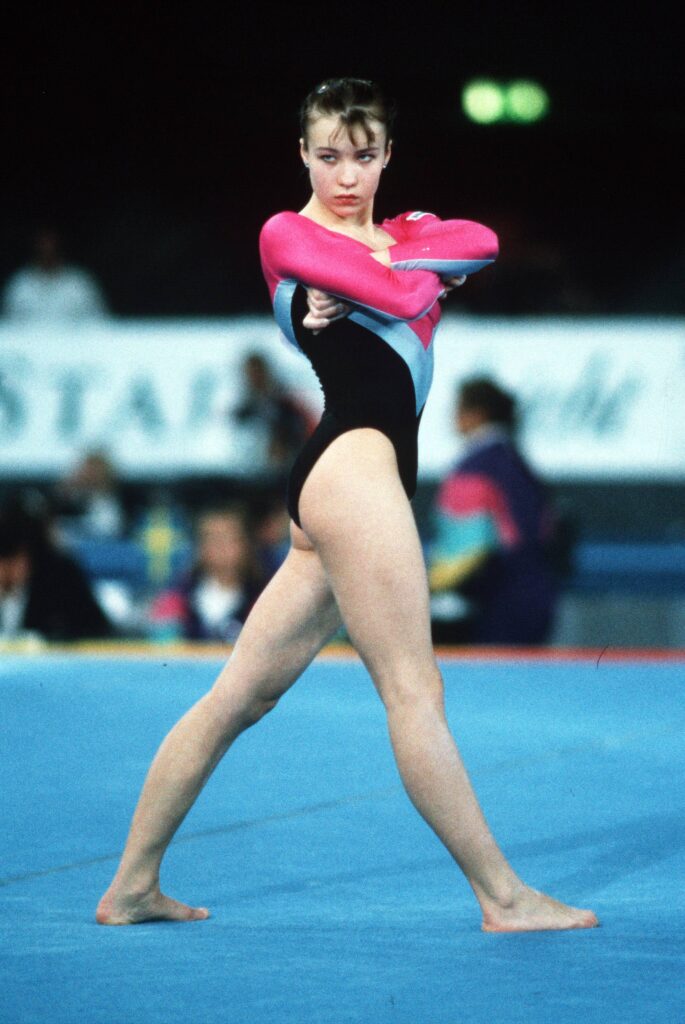
One of these nicknames, at least, was genuine. Svetlana Boginskaya really was called “The Goddess” by her teammates and coaches in the Soviet press—sometimes “Sveta the Goddess,” sometimes “The Goddess of Gymnastics.” The nickname was a play on her surname: Богиня (Boginya) means “goddess” in Russian, while her last name is Богинская (Boginskaya). What seemed to Western audiences like pure tribute was also clever wordplay that any Russian speaker would have caught immediately.
But as these contemporaneous Soviet articles reveal, the nickname had complicated connotations. It was one part admiration for her elegance and dominance, and one part wariness about a gymnast who refused to smile on command, who demanded favorable treatment, who “loved to take charge,” and who had a “complex character.” She was incomparable—and she knew it. That combination made her both indispensable and unsettling.
What follows are three articles that give context to one of her nicknames: the “Goddess of Gymnastics.”
March 1989
A Time of Revelations
You understand, of course, that the girls call her the Goddess. That’s exactly what they say: “Sveta-the-Goddess.” And she accepts this calmly and has gotten used to it—that’s what her ninth-grade girlfriends call her, too.
Svetlana Boginskaya acts as though her victories tire her out, as though journalists’ questions wear her down. And even a magnificent prize, established by the “Russian Gems” association and valued at several thousand rubles, didn’t particularly cheer her up: “It’s heavy, I still don’t understand what it means.” In a bored tone of voice, she answered questions from Hans-Jürgen Zeume, a correspondent from Berlin’s Deutsches Sportecho: “Yes, of course, this season I plan to compete at both the European Championships and the World Championships. Yes, I’ve increased the difficulty of my routines on all events after the Olympics. Yes, I have a good rapport with my young coach Lyudmila Leonidovna Popkovich. Yes, I won’t refuse the role of team leader.”
Don’t think that this Minsk schoolgirl, Sveta, is tired of the attention and gymnastics. That’s just her character—complex, as we say. As Lyubov Miromanova, a coach who recently passed away, told me, “her Svetochka-Goddess is a natural-born leader, loves to be in charge, to take responsibility, and her brave heart is akin to the fearlessness and courage of Olga Korbut.”
Spectators who came to the “Olympic” sports complex were able to see performances by three Olympic champions at once, plus junior European champion Yulia Kut from Lviv. And this little Kut, by the way, Boginskaya’s best friend, came in second only to Svetlana. To which the new senior coach of the women’s team, Alexander Alexandrov, remarked: “This was to be expected.” Alexander Sergeyevich began his duties on January 3rd, when training camp started at the “Lake Krugloe” base. That’s where Yulia Kut, who turned 15 on February 4th, first appeared with the senior team.
17-year-old Muscovite Elena Shevchenko once again captivated the audience with her “Pink Panther” composition. She’s been performing this genuine masterpiece of world gymnastics for several years, and we wished for her this season to win the world championship on floor exercise with precisely this routine.
During competitions, it’s interesting to follow not only the events on the mat but also around it. Tiny girls with programs in hand walk in crowds after those they know only from stories (surely admiring ones) from their coaches—after Lyudmila Turishcheva, Nelli Kim, Natalia Kuchinskaya, Elena Davydova, Maria Filatova. It’s a shame they don’t approach the head judge, Viktor Ivanovich Kalognomos. He’s a whole era in gymnastics; he’s 82 years old, strong as a gnarled oak, still pedantic as ever, and under his strict eye, the tournament proceeds without a hitch. It’s a shame the girls don’t recognize Alexander Semyonovich Mishakov by sight. After all, this is the legendary coach who trained Boris Shakhlin and Larisa Latynina. They could also approach Mikhail Voronin and congratulate him on his birthday.
V. GOLUBEV
TECHNICAL RESULTS 16th International Sports Gymnastics Tournament for the prizes of the newspaper “Moscow News.” “Olympic” Sports Complex. March 25. Women. Optional program. 1. S. Boginskaya—39.675; 2. Yu. Kut—39.275; 3. E. Shevchenko (all—USSR)—39.25; 4. G. Gheorghe (Romania)—38.85; 5. N. Lashchenova (USSR)—37.8; 6. S. Woolsey (USA)—37.7.
Sovetsky Sport, March 26, 1989
December 1989
The Goddess from Minsk
Svetlana Boginskaya is a gymnast from the capital of Belarus, an Olympic champion in Seoul in the team event and on vault. At the beginning of the season, she was predicted to become the leader of the national team, and she fully lived up to even the boldest expectations. First, Svetlana won the European championship title in a dramatic battle in Brussels, and very recently, in the West German city of Stuttgart, she also captured the crown of world champion.
Her teammates call Sveta “the Goddess.” This nickname was given to the future queen of gymnastics by her beloved coach, Lyubov Miromanova. Tragically, Lyubov Maksimovna died, which became a great personal loss for the young athlete.
The past season became the pinnacle of Boginskaya’s sporting career. In the spring, she brilliantly won the international tournament for the Moskovskie Novosti (Moscow News) newspaper, followed by victory at the European Championships in the Belgian capital. There, she left behind one of her main rivals, the Romanian Daniela Silivaș. And then came another triumph — this time in the Schleyer-Halle. Once again, her main rival was three-time Olympic champion D. Silivaș. After the first apparatus — the uneven bars — Sveta was only in fourth place. But then came the passion and risk without which there is no gymnastics. She brilliantly performs the most complex routine on beam, looks excellent on floor and vault… And once again becomes first!
As the legendary Soviet gymnast Larisa Latynina once noted, the complexity and virtuosity of modern gymnastics have increased unimaginably. All members of the national team possess these qualities to one degree or another. But in Svetlana Boginskaya, world gymnastics gained an athlete of a new formation — one in whom difficulty is combined with true beauty, something many champions of recent years had lacked. Svetlana is slender, elegant, she has fairly tall height, and it’s not so easy to control. By the way, Boginskaya grew 4-5 centimeters after Seoul. She has long legs, smooth arm movements, a pleasant smile, and large, charming eyes. She knows how to look like a queen on the mat. Senior team coach Alexander Alexandrov even remarked with a sigh: “Well, at last a real gymnast has appeared!”
“The Goddess” became the absolute leader of the USSR team, displacing Elena Shushunova from the throne. However, getting her to talk is not so easy. She answers questions sparingly.
— Why do you never smile during competitions, unlike other gymnasts?
— During competition, I don’t want to relax; I try to stay focused. I can smile afterward.
— Your program has changed a lot since Seoul!
— Of course. Standing still means stagnation. Gymnastics is constantly progressing, and to stay on the podium, you must constantly improve — and not forget the beauty of gymnastics, as Latynina, Astakhova, and Čáslavská once did.
— Do you have any free time outside of gymnastics?
— Very little. To achieve success and recognition, you have to work a lot. But when I do have free time, I like to dance, listen to modern music, and go to the movies.
— Your next goal?
— To meet Daniela Silivaș again on the competition floor.
E. Krymov
Gudok, December 12, 1989
April 1992
Note: This was printed after the 1992 World Championships, where the Soviet women’s team won only three medals: Boginskaya’s silver on vault, Chusovitina’s bronze on vault, and Lysenko’s bronze on floor. In Paris, they competed as athletes from the Commonwealth of Independent States (CIS).
Only the Beloved Can Be Like This…
Whatever you say, gymnastics is still fascinating to watch. There is something intriguing about this sport. I suppose what draws spectators most is the courage of the boys and the charming spontaneity of the girls. And as for the older ones — say, Sveta Boginskaya or the American Betty Okino — you can truly admire them. Artistry is combined with femininity, and we drift a little, floating in rosy, airy erotic clouds…
ASIAN CARDS! PLACE YOUR BETS!
The twenty-year reign on the throne of the head coach of the men’s team, Leonid Arkayev, has led to the point where our boys could practically sweep all the gold medals at every old and new championship without breaking a sweat. All great coaches are similar in something: Viktor Tikhonov, Igor Turchin, Gennady Sapunov, Ivan Yarygin, Vyacheslav Platonov — all of them are considered “tyrants” and “despots.” At least, that’s what their colleagues call them.
In their harsh training methods, in their rigid approach, there is a principle of the “firm hand.” In everyday life, they can be sentimental, kind, madly devoted to their children — but at work, no mercy remains when they are molding true champions with their own hands. Sadly, many talented athletes were lost in this brutal race, but that is Darwinism: the strongest survive.
One famous gymnast once told me about Arkayev: “I love him, and I hate him.” Meaning that Leonid Yakovlevich made him a star, but their personal relationship never worked out because of constant confrontation.
Our guys shone at the “Bercy” competition, in the ultramodern Palace of Sports, where the International Gymnastics Federation organized the first World Championships in individual apparatus. Objectively speaking, the technical level and difficulty of routines performed by Igor Korobchinsky, Grigory Misutin, Valery Belenky, and Alexei Voropaev were superb. This advantage was also evident at the “regular” 1991 World Championships in Indianapolis.
But something inside tells me that very soon — very soon — we will face serious competition. And it will come from Chinese, Korean, and Japanese gymnasts. After all, competitions are more interesting when there’s a sharp edge, a real bite to them. And since Arkayev has announced that after Barcelona, he will go to work abroad (according to unconfirmed reports, to Japan), there is no doubt he will raise a new Mitsuo Tsukahara or Shigeru Kasamatsu.
And I am also convinced that the German team will regain its strength — there are already young, ambitious athletes there who cannot sleep peacefully because of the glory of Eberhard Gienger.
THIS DIVINE, CAPRICIOUS GIRL
On television appeared the great Larisa Latynina, deeply upset that our gymnasts did not win a single gold medal. A tragedy? It depends on how you look at it. The judges continue to “squeeze” us — that’s absolutely certain. It’s a pity that President Yuri Titov’s promises to disqualify “short-sighted” judges are not being kept.
On the other hand, the girls themselves faltered and made mistakes. Perhaps they are affected by the confidence of the world all-around champion Kim Zmeskal? The American performs with dignity — cheerfully, boldly, with fire.
But I think it’s Svetlana Boginskaya who really gets on the girls’ nerves. She is given the most favorable treatment on the team because the leadership desperately wants to preserve her talent until the Olympics. Sveta is, of course, an extraordinary athlete — not just a gymnast, but a true competitor: fierce, strong, hungry for victory. But her character — oh dear! Everything is tangled up in her life. She survived the death of her beloved coach, Lyubov Miromanova. She moved from one coach to another. She even refused to train under the senior coach, Aleksandr Alexandrov. Her frequent whims are forgiven. And the other girls see all of this.
Did her refusal to step onto the podium after the vault final not affect the team’s mood? They had to beg her to accept the silver medal.
Perhaps I am wrong. Perhaps the gymnasts’ mistakes have other causes — new routines, the search for Olympic polish. Still, I have expressed my point of view. And I am convinced that the incomparable Goddess of gymnastics, Boginskaya, must be preserved at all costs! She can become the Olympic all-around queen!
MOSCOW TELETYPE: NO MURDERS — YET
There will be no crime report. There will be Moscow gymnastics news.
In Paris, a student of Dynamo coach Dmitry Derzhavin, the elegant Alexei Voropaev, became world champion on the parallel bars. And in Indianapolis, he was part of the gold-medal team. A real virtuoso has grown up!
At the Dynamo school, the coaches continue to work tirelessly. Two-time Olympic champion Sergei Kharkov is also preparing for Barcelona there. His coach, Vitaly Lomtev, says, “Everything will be decided at the CIS Championship at the end of May. You have to make the top five.”
And the CSKA gym still hums like a beehive. There are not yet girls like Olga Karaseva or Olga Bicherova in sight, but the talented coaching duo of Irina and Viktor Razumovsky is preparing a surprise for us. Who knows — maybe two of their pupils will cause a sensation by the end of May?
RUMORS OF DEATH ARE GREATLY EXAGGERATED
President of the FIG Yuri Titov’s fears that Soviet gymnastics is dying seem to me somewhat panicked. Watching years of championships and Cups, one doesn’t need to be a great expert to marvel at the diversity of schools and approaches. We have excellent Ukrainian, Belarusian, and Russian gymnastics. Kazakhstan, Uzbekistan, Georgia, and Armenia can all appear as separate teams at world championships.
The world will see many new stars who have never made it onto the USSR team. And therefore, gymnastics will not die. The bouquet will simply become more colorful and fragrant.
Am I an optimist? You wouldn’t say so from my salary…
V. Golubev,
Sovetsky Sport, April 22, 1992
More on Soviet Gymnastics