After the 1981 World Championships, the IOC was forced to confront an uncomfortable reality in women’s gymnastics: many elite competitors looked far younger than their official ages suggested. Olga Bicherova, who looked particularly young, had won the all-around, provoking widespread alarm across the sporting world and pushing concerns about women’s gymnastics all the way to the IOC’s highest levels.
To much of the Western gymnastics community, the explanation was straightforward. Birthdates were being falsified to satisfy age-eligibility rules. The International Olympic Committee (IOC), however, did not initially see the matter as an administrative deception. Its medical commission framed the issue as a health concern, questioning whether “dieting control” or pharmaceutical manipulation were being used to delay puberty and keep gymnasts artificially small. They wanted the FIG to establish a medical commission to conduct further investigation.
In this sense, the IOC was operating in the same conceptual space Western officials had occupied just a few years earlier. In 1978, accusations of doping in Eastern Bloc women’s gymnastics were widespread. By 1981, that narrative had begun to shift. Although state-run doping programs did exist in parts of the Eastern Bloc (and the gymnastics community still suspected it), many Western observers focused their efforts on underscoring the manipulation of birth records, not biology. It was a more provable allegation; they could point to paper records and show that the dates did not match.
The documents that follow illustrate this moment of interpretive overlap. The first is a brief report on an IOC Executive Committee meeting held in late 1981; the second is a lengthy interview with Prince Alexander de Mérode, then head of the IOC Medical Commission. Together, they show how age, doping, and women’s health were discussed not as separate issues, but as facets of the same unresolved problem.
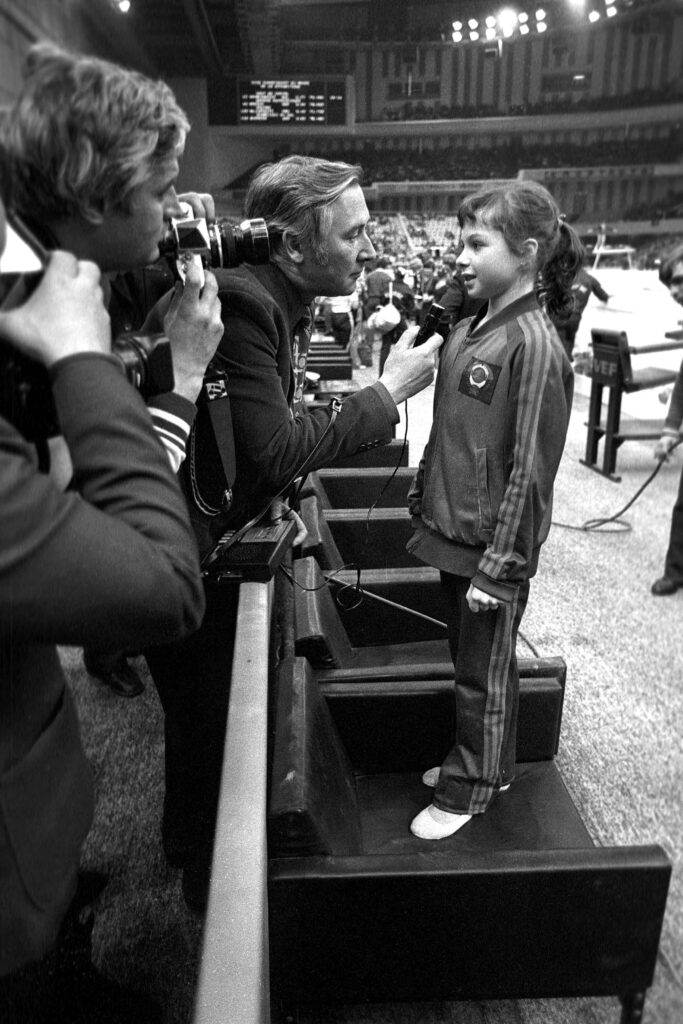
To be clear, Bicherova did not do anything wrong; she did not ask for her passport to be altered. This photo simply illustrates what everyone was seeing and questioning in 1981.
Olympism: Tougher Controls in Athletics and Gymnastics
The Medical Commission of the International Olympic Committee (IOC) intends to strengthen its ties with the International Amateur Athletics Federation (IAAF) in its fight against doping. “We would like testing to be carried out year-round, not only during competitions but also in training,” said the commission’s president, Prince Alexandre de Mérode (Belgium), on the occasion of the IOC Executive Commission meeting in Sarajevo.
Among Girls
The commission also wants the International Gymnastics Federation (FIG) to increase medical monitoring of young girls who, according to Prince de Mérode, are putting their health at risk. “The frequently raised debate about the use of products to delay puberty in girls has not produced any conclusive results,” he said. “Some doctors speak of drugs, others of dietary control, and still others of selection carried out mainly among small-statured girls,” he added, before concluding that, in any case, the issue warrants closer examination.Mr. Juan Antonio Samaranch, president of the International Olympic Committee, sought to dispel fears arising from a possible boycott of the 1988 Olympic Games in Seoul (South Korea) by North Korea. During his visit to Sarajevo (Bosnia-Herzegovina), the site of the 1984 Winter Olympic Games, Mr. Samaranch explained: “I do not like the word boycott, and I am convinced that all nations recognized by the IOC will take part in the Seoul Games. But no one is obliged to accept an invitation,” he added.
Furthermore, the IOC president mentioned his recent trip to five South American countries. “The city of Buenos Aires has shown great interest in possibly hosting the Games. Sports officials in the Argentine capital, enthused by the success of the 1978 Football World Cup, are going to undertake a serious study of the matter.”
L’Impartial (Switzerland), December 7, 1981
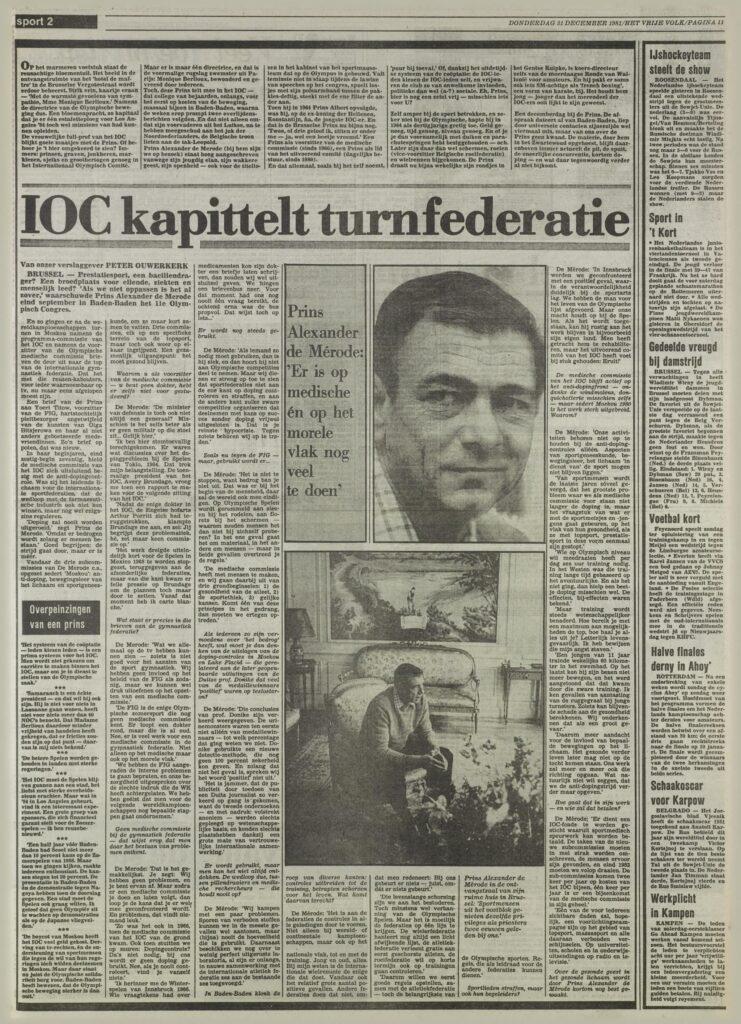
IOC Reprimands Gymnastics Federation
By our correspondent PETER OUWERKERK
Het Vrije Volk, December 31, 1981
BRUSSELS — Elite sport, a breeding ground for germs? A breeding place for misery, disease, and human suffering? “If we do not take care, that is already the case,” warned Prince Alexander de Mérode at the end of September in Baden-Baden at the 11th Olympic Congress.
And so, after the World Championships in artistic gymnastics in Moscow, letters were sent out in the name of the IOC’s programme commission and in the name of the chairman of the Olympic Medical Commission, urging the leadership of the International Gymnastics Federation to bring an end to these “rough-and-tumble” practices that every television viewer and observer by now had to have noticed.
One such letter, addressed from the Prince to Yuri Titov, president of the FIG, earnestly pleaded for understanding of the “artistry” of Olga Bicherova and her already not-so-recently born fellow competitors. A letter full of platitudes—nothing new there.
In its early years, in the late 1960s and early 1970s, the IOC’s medical commission dealt almost exclusively with anti-doping control. It was the leading body for the international sports federations, which could not defeat the pharmaceutical industry, but could at least regulate it to some extent.
“Doping will never be eradicated,” says Prince de Mérode. “Because as long as people exist, there will be cheating. A fair fight: the struggle goes on, but there is more to it.”
Hence, the three subcommittees set up by De Mérode and his colleagues since ‘Moscow’: anti-doping, movement science of the body, and sports medicine, to summarize them briefly. Three committees, each operating in a specific domain of elite sport, yet also overlapping and intervening in one another. One shared point of departure: it must remain healthy.
Why, as chairman of the medical commission, are you not a doctor—does that not bother you?
De Mérode: The minister of defense is not always a general either! Perhaps it is even better if no soldier is sitting in that chair. The same applies here.
I ended up here more or less by chance. There were some discussions about the doping problems at the Tokyo Games in 1964. That caught my interest. The then-president of the IOC, Avery Brundage, asked me to prepare a report for the next IOC session.
After the only doctor in the IOC, the Englishman Arthur Porritt, had withdrawn, Brundage approached me and said: ‘You understand these problems—go ahead and set up a commission.’
The work ultimately threatened to be halted shortly before the Games in Mexico in 1968, to be handed back to the individual federations, but from that side, there was strong pressure on Brundage to push the plans through after all. From that moment on, I had a free hand.
What exactly is written in those letters to the gymnastics federation?
De Mérode: What we have all been able to see on television—things like that are not good for the image of the sport of gymnastics. We have no influence over FIG policy as such, but we can exert pressure on the establishment of a medical commission.
The FIG is the only Olympic summer sport that still does not have a medical commission. There is a doctor walking around, but that is outdated. No, there is a great deal of work to be done for a medical commission within the gymnastics federation—not only on the medical level, but also on the moral level.
We have advised the FIG to begin discussing its internal problems and have expressed our concern about the poor impression left by the World Championships. We have demanded that steps be taken before the next World Championships.
No medical commission within the gymnastics federation—that does point to a denial of the existence of problems.
De Mérode: That is the easy part. You say: we have no problems, and you are done with it. But as soon as you establish a medical commission and allow it to operate, you run the risk of actually being confronted with problems. A problem—that is not pleasant.
That was also the case in 1966, when the IOC’s medical commission was founded. At that time, too, we ran into walls: doping control? That is not necessary—there is no doping used here. No, if you never check, you will never find anything.
I remember the Winter Games in Innsbruck in 1964. Anyone who raised questions about medications could have their doctor write a short note, and then we would grant an exemption. We put up a mailbox. Until that moment, we had not received a single question; the next morning, the box was full. That does point to something…
It is still being used.
De Mérode: If someone needs to use something to that extent, then he is ill and therefore does not belong in Olympic competitions. But we insist strongly that sports federations must not, on the one hand, control and punish doping, while on the other hand, organize such demanding competitions that participation with a chance of success is virtually impossible without doping. That is pure hypocrisy. We must take action against such practices.
As now against the FIG — but it is being used…
De Mérode: It cannot be stopped, because you cannot eliminate cheating. It existed at the beginning of humanity and will end together with the world. At the Olympic Games, there is cheating in sailing, in luge, in rowing, in fencing—so why would people not try it on themselves? In one case, it concerns equipment, in the other people, but in both cases, the rules are being broken.
The medical commission deals with people, and we proceed from three basic principles: 1) the health of the athlete, 2) sports ethics, and 3) equal opportunities. If any one of these principles is threatened, then we must intervene.
If everyone has such suspicions about “cheating,” what should one then think of the results of the doping controls in Moscow and Lake Placid—those related to the later public statements of the German Professor Donike that many of the medal winners were “positive” for testosterone?
De Mérode: Professor Donike’s conclusions have been incorrectly reported. The urine samples were, first of all, not only from medal winners—we did not know what percentage they represented. Donike used a new detection method that could not yet provide 100 percent certainty. And as long as that is the case, we do not use the word ‘positive.’
[See notes below to understand the context of this conversation.]
It is regrettable that the public debate, through the actions of a German journalist, got so badly off track, because the second investigation—and I emphasize: completely anonymous—was carried out purely on a scientific basis and could only take place thanks to a high degree of confidential international cooperation.
It is being used, but it cannot always be detected. So the race between pill swallowers and medical researchers—does it never end?
De Mérode: We are struggling with a few problems. In most cases, we can demonstrate traces of banned substances, but (almost) never the quantity that has been used. In addition, we still have too few perfectly equipped laboratories, although recently—working closely with the International Athletics Federation—six have been added to the existing ones.
In Baden-Baden, the call was heard from various sides: to extend controls to training, to suspend offenders for life. What will actually come of that?
De Mérode: It is up to the federations to carry out controls on all occasions. Not only at world or continental championships, but also at the national level, including during training. Young and old—everyone. To my knowledge, the International Cycling Federation is the only one that does this. Hence, the relatively large number of positive cases. Other federations do not do this, because they reason: with us nothing happens—precisely because nothing happens.
We are studying lifetime suspensions. At the very least, exclusion from the Olympic Games. But it is difficult to get the federations to fall into line. The cycling federation still uses a slightly different list; the athletics federation grants amnesty to athletes who were first suspended; the rowing federation wants to start controlling training sessions in the short term.
That is why we first want to draw up good rules together with the athletics federation—after all, the most important of the Olympic sports. Rules that can serve as guidelines for the other federations.
Athletes from the Eastern Bloc enjoyed the same privileges as priests did with us two centuries ago.
Punish athletes—but also their handlers?
De Mérode: In Innsbruck, we were confronted with a positive case in which responsibility clearly lay with the sports doctor. We removed the man for life from the Olympic list. But our authority ends with the Games. If it is allowed, he can simply continue working, for example, in his own country. There was an attempt to rehabilitate him, but the IOC’s Executive Committee put its foot down: ‘Out!’
The IOC’s Medical Commission remains active on the anti-doping front—despite the windmills, perhaps even Don Quixote–like—but since Moscow 1980, the work has been greatly expanded. Why?
De Mérode: Our activities should not be confined to anti-doping controls alone. Aspects of sports medicine, movement science, and the human body ‘in the service’ of sport must not be neglected.
In recent years, so much has been demanded of athletes that the greatest problem we, as a medical commission, now face is no longer doping, but the question of what will happen to young female and male athletes, in terms of their health, once they stop elite, high-performance sport in this form.
Anyone who wants to compete at Olympic level needs six hours of training a day. In the West, training for a long time was based on the adventurous. And if things did not work out, perhaps a bit of doping helped. The effects and side effects were known.
But training is increasingly being approached in a scientific way. How do you reach the top while pushing human capacities to the maximum? How do you get everything out of someone? Literally life-threatening. I have evidence that supports my fears.
An 11-year-old boy trained 60 kilometers a week in the swimming pool. In the end, he could no longer move his legs, and it was shown that this was caused by the heavy training. I know cases of damage to the spine in young gymnasts. Such things can cause lasting damage to health. We consider that a major danger.
That is why more attention must be paid to the impact of certain movements on the body. A healthy life afterwards must not be jeopardized. Our work will increasingly move in that direction as well. Which of course does not mean that we are giving up the fight against doping.
How will that work in practice—and who will pay for it?
De Mérode: An IOC fund should be established from which sports-medical investigative work can be financed. The tasks of the new subcommittees must be clearly defined, the right people found, and by the end of 1982, we must be fully operational. The subcommittees will meet twice a year at the IOC’s expense, and once a year, there will be a full meeting of the medical commission.
One of the actions that will, hopefully, be visible to everyone will be an information campaign in the field of elite sport, mass sport, and all related phenomena—at universities, schools, and through educational broadcasts on radio and television.
On the healthy mind in the healthy body, Prince Alexander de Mérode will, in short, continue to keep a close watch.
Note on the FIG’s Medical Commission
At the 1980 General Assembly on July 16 and 17, 1980, West Germany proposed that the FIG create a medical commission. It was approved.
From the minutes:
Federal Republic of Germany
a) Creation of a Medical Commission
We suggest the creation of a medical commission and are prepared to collaborate therein.
Decision: This proposal was accepted by 40 votes in favor and 3 abstentions.
Mr. F. Fernandez (Executive Committee): approved this proposal and asked the FRG to send the FIG any publications dealing with the matter. A representative of the FRG should participate in the undertaking.
FIG Bulletin, September 1980
⁂ ⁂ ⁂
Note on 1981
Reminder: In addition to age falsification being front and center in 1981, one East German gymnast tested positive for a banned substance. At the 1978 World Championships, the FIG reportedly did not test the competitors despite having the testing supplies at its disposal.
⁂ ⁂ ⁂
Note on Professor Donike
Not a single competitor failed a doping test at the 1980 Moscow Olympics. Prince Alexander de Mérode hailed the event as the “purest” Games in history. Then the narrative shifted. Manfred Donike, a West German physician serving on the IOC’s Medical Commission, conducted his own investigation. Having developed a new method for detecting abnormal testosterone levels in urine, Donike applied it retrospectively to Olympic samples. His informal analysis suggested that long-standing rumors of widespread doping in Moscow were well-founded. By his estimate, roughly 20 percent of the specimens he examined would have triggered disciplinary proceedings under his testing criteria.
A 1989 study by the Australian government went so far as to claim, “There is hardly a medal winner at the Moscow Games, certainly not a gold medal winner… who is not on one sort of drug or another: usually several kinds. The Moscow Games might as well have been called the Chemists’ Games.”
For more, see Thomas M. Hunt’s Drug Games.
Appendix: Yuri Titov’s Response to Issues of Age Falsification
In its April 1982 issue, International Gymnast published an interview with Yuri Titov, the president of the FIG at the time. Here’s what he had to say about age falsification at the 1981 World Championships.
SUNDBY: Many members of the press and delegation made allegations that certain female gymnasts were not the age of 15 for the 1981 World Championships and should not be allowed to compete. Several of the gymnasts mentioned were Agache and Szabo of Romania and Bicherova of the Soviet Union. How does the FIG plan to police this problem in the future to guarantee that the rules of the FIG are followed concerning minimum age?
TITOV: About ages, it seems to me that it is more gossipy than a real situation. I can give you proof about Bicherova, for the Soviet team, it was not a problem, I know as I stayed between the coaches many times and I was a witness how they chose Bicherova to the team. It was really the last day that she was included. As to her size, there are many gymnasts the same, but because she is a very little one she looks like a kid, so many people think she is younger than her age. We make the control with the passport, what else can we do? The official passport, we did it for Championship of the Juniors, and I don’t know how to arrange this question for additional control in the future. We will continue to accept this official document. We also know in gymnastics it is impossible to come up suddenly because they go through the youth competition in the now established European competition so we will know much earlier when a gymnast girl or boy comes into the adult level of competition. We will know them from before. I don’t think this is a problem, maybe only the influence of height of a little girl. I don’t know how to say it, take the Japanese for example, I’m not very tall but during my competition the tallest Japanese gymnast was not much above my shoulder but nobody asked the age of them. But really my friend, my very good friend from Japan, Ahara, competed in my time, but now he looks like 27 or 28, but he is my age. We have in Russia a proverb about little dogs, little dogs look like a puppy until near dying. So I think the control of the official passport and intent to compare results of the youth competition will give us assurance that it will be good. And, of course, we must be polite and honor the nation and trust them, it is a moral obligation of any other federation and it is a moral that must belong to the bodies of federation of the National Federations.
International Gymnast, April 1982
More on Age