On October 30, 1983, the Budapest Sports Palace erupted as a Bulgarian gymnast in a red leotard stuck her first vault with textbook control. She shuffled back on her second vault, but her score was good enough. For the first time at a women’s World Championships, the Bulgarian anthem—Mila Rodino—played in the arena. Boriana Stoyanova had become the first Bulgarian woman ever to win a world championship gold medal in artistic gymnastics.
Back home, the press called it a zlatna nedelya, a golden Sunday. Bulgaria’s “golden account,” as one paper put it, had finally been opened.
The moment would be replayed, narrated, and commemorated for decades. What took longer to register was that Stoyanova was not 15 when she won gold.

June 1983: “Only Fifteen”
Four months earlier, at Bulgaria’s national championships, Naroden Sport described Stoyanova’s ascent with a mix of admiration and caution. In the optional program, the paper noted, she held an advantage on vault—specifically naming a full-twisting Tsukahara and a Cuervo among the elements that separated her from the field. But the article noted that there was room for improvement: “The tired and sometimes nervous road to top mastery is not always simultaneously brilliant—so here, too, in Stoyanova’s performances, an attentive eye can find things to scrutinize, but her refinement is still continuing.”
Then came a line that would read differently in retrospect. Even with what she presented, the paper wrote, she—“only 15 years old”—had become the new national champion.
There was no birthdate. No day or month. Just the age.
At the time, it functioned as praise. Later, it would look like something else: a way of signaling youth without anchoring it too tightly to the calendar.
Vault Final, Budapest
By the time the apparatus finals began in Budapest, the vault competition had already compressed into a narrow margin. After compulsory and optional rounds, Maxi Gnauck led with 9.925. Just behind her, at 9.900, were Boriana Stoyanova, the Soviet Union’s Natalia Yurchenko, and Romania’s Lavinia Agache and Ecaterina Szabó.
As Stoyanova sprinted down the runway for her first attempt, Bulgarian correspondents described a moment of collective anticipation. “Now, now, now,” the crowd chanted to the rhythm of Stoyanova’s sprint. She rose into a full-twisting Tsukahara, body stretched, rotation exact, and landed to an audible command from the stands—“Stick!”—which she obeyed without flinching. The report called it “a marvelous attempt,” the kind that leaves no doubt about control.
Her second vault was a tucked Cuervo, which she attacked decisively and rotated with confidence. The landing required a small backward shuffle. Together, the two vaults earned 9.925, enough to lift her to the top of the podium—“the summit,” as one paper wrote, “dreamed of by so many generations of gymnasts.”
In Her Own Words
Stoyanova’s interviews after Budapest were unremarkable in the way elite gymnastics interviews often are—direct, procedural, and tightly focused on execution.
Asked how it felt to be a world champion, she answered without embellishment.
— How does the not-so-well-known Boriana Stoyanova feel among the stars?
— Not like a star. I performed my program and placed well.
— Did you expect this success?
— The plans were one thing, the results another. I’m happy with the success.
— What did you think when you realized you had won the vault?
— That I still had to perform my floor routine the way I had prepared it.
— What brings you the greatest joy at this moment?
— I’m proud that Bulgarian gymnastics is now recognized. I’m happy about the fourth place of the Bulgarian team and, of course, about my gold medal.
There was nothing striking in her language. It was the voice of a gymnast trained to suppress emotion—to reduce triumph to process, to move from apparatus to apparatus without pause.
What was striking was the birthdate attached to the press conference: “Born on July 3, 1968, in Sofia. Her first coaches were D. Sirakova, later D. Dobrev, and she acquired her highest level of mastery under M. Krastev.”
She was no longer “only fifteen.” She now had an official date of birth in the press, albeit one that would later prove to be a fiction.
The Biography Crystallizes
The return flight from Budapest to Sofia became part of the legend. On board the Tu-154, a stewardess announced that passengers had the privilege of flying with the world champion. Over Bulgarian territory, Stoyanova was invited into the pilots’ cabin. The aircraft commander joked that she could “land” the plane—not with a double somersault, but the way she landed in vault competition.
“The passengers felt,” Naroden Sport reported, “that this was the most pleasant landing at Sofia Airport, and also the most emotional welcome.”
Two days later, in the November 7, 1983 edition of Naroden Sport, Stoyanova was named “Athlete of October.” Her “official” date of birth was repeated: Born on 3 July 1968 in Sofia.
Three days later, in case anyone in Bulgaria missed the details, another profile repeated the date—3 July 1968 in Sofia—while detailing her progression through the sport: training at SSU “Chavdar,” competing for CSKA “Septemvriysko Zname,” discovered by Rositsa Zheleva, early coaching under Dora Sirakova and Dobri Dobrev, refinement since 1980 under Margarit Krastev.
While her initial press interviews were restrained, by the time she spoke to Naroden Sport for the November 10, 1983 edition, the victory had fully sunk in, and she could no longer contain her joy.
— The congratulations and wishes from Comrade Zhivkov are precious to me, as they are to every Bulgarian athlete. I simply can’t find my place for joy!
— Will you continue to delight us in the future with new major achievements, as wished in the telegram?
— I will give everything I can; I won’t spare myself… and once again: this greeting is so dear to me—I am so very happy!
— Clearly, you can’t hide your joy, but how does excitement sometimes turn into fear before competition?
— At the Worlds in Budapest, I told myself: stay calm—it’s like a friendly meet, only with more countries.
— It was said that your mother would come to Budapest?
— …She didn’t come; my father didn’t want to be left alone here—how would he endure watching me on television?
— But now he has “endured” the congratulations for his daughter’s success, hasn’t he?
— Both he and my mother—she works at the NPK “Malchika” [a state factory]—and there, the other day, it was as if she had been the world champion.
— I see your hand is delicate and childlike, yet your palms are covered in calluses?!
— Well, that’s gymnastics! Does anyone think you become a world champion with a manicure?
— When you began, did you think you would become a champion?
— No. Not at all. At first, I just wanted to bounce on the trampoline; later, this sport drew me in. I realized I’m attracted to its difficulty. Today it’s different—real hard work is required…
— But that doesn’t frighten you?
— My background is such that I’m not afraid of hard work, and that’s why I believe I’ll continue to succeed. All the more so since my coach, Comrade Krastev, is beside me—he is like a second father to me!
July 3, 1968, appeared again and again, woven into triumphal narratives and repeated until it became inseparable from the achievement itself.
November 1969
Where age falsification was common, even straightforward reporting absorbed a measure of fiction. When Boriana Stoyanova won the all-around title at the Bulgarian Championships in June 1983, Naroden Sport noted that she was “only 15.” But a July 3, 1968, birthdate—the one that would soon harden into official biography—would not have made her fifteen at the time; she would have still been fourteen.
Unraveling that fiction proved difficult. In October 2002, nearly twenty years after Budapest, International Gymnast published a retrospective profile that still failed to resolve the most basic biographical fact about Stoyanova. The article described her as born on December 3, 1968, repeating the familiar birth year that had accompanied her rise while adding a new distortion of its own: the wrong birth month.
Only later did a different date surface. “I was born in Sofia in November 1969,” Stoyanova said in an interview for the book Bulgarian Gymnasts in Conversation. There was no explanation. No reconciliation of the record. Just a statement.
November 3, 1969, is now the birthdate used in the Bulgarian press. Which means that Bulgarian sports officials had not only altered Stoyanova’s year of birth (1969 vs. 1968); they had altered the month (November vs. July), as well. Imagine being Stoyanova and having to remember both a falsified birth year and a falsified birth month.
The discrepancy between her competitive birth year and her actual one amounts to seventeen months, and it changes the lens through which we view 1983. A July 1968 birth makes Stoyanova fifteen in Budapest: young, but eligible. A November 3, 1969, birth makes her thirteen, turning fourteen just days after her vault victory, and below the senior minimum.
Two Archives
Today, the sports world cannot quite agree on which version of Stoyanova’s birthdate to store in its archives, even though one is true.
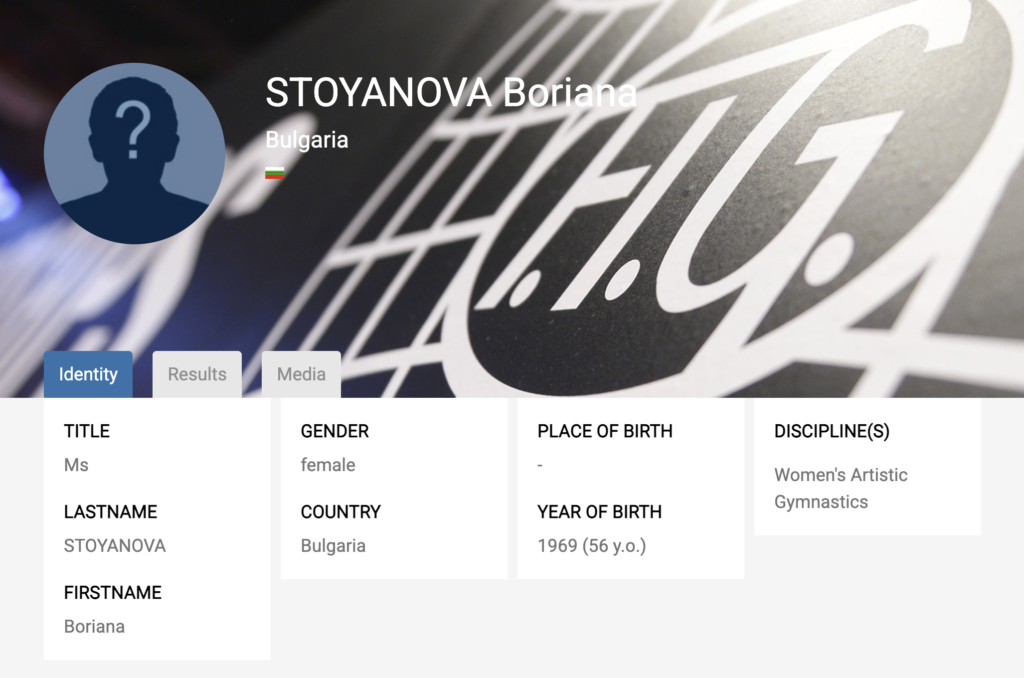
The International Gymnastics Federation’s athlete database now lists her birth year as 1969, the year she was actually born, a correction that surfaced long after her competitive career had ended.
The International Olympic Committee’s public athlete profile still lists her birth year as 1968—the year that the Bulgarian federation used throughout her senior gymnastics career, including at the 1988 Olympics.
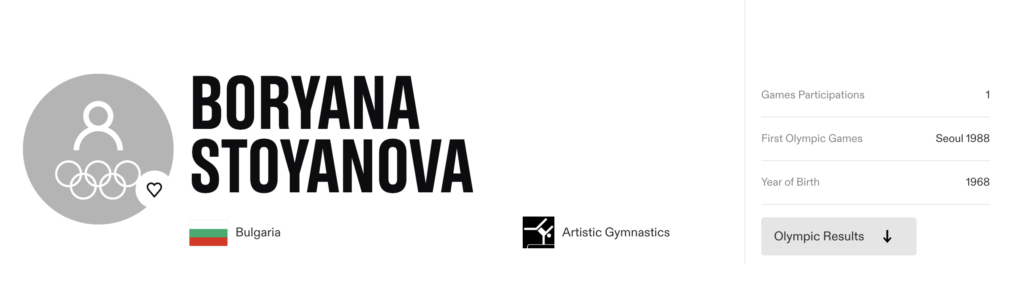
Two official records. Two official birth years. One gymnast.
The contradiction matters. It shows how age falsification does not immediately collapse the moment the facts emerge. Instead, it survives in parallel records: one archive was quietly updated with her legal birth year while another preserved the administrative fiction that made it possible for a thirteen-year-old to become a world champion.
References
Naroden Sport (Bulgaria):
• Issue No. 5287, June 28, 1982. “Three Medals for Bulgaria: Boriana Stoyanova—Second in the All-Around.”
• Issue No. 5289, July 3, 1982. “Three Medals—and Missed Opportunities.” Interview with Dimitar Palatov.
• Issue No. 5442, June 27, 1983. “The Important Part is Over—Now Comes the Twice-as-Important Part.”
• Issue No. 5496, October 31, 1983. “A Golden Sunday for Bulgaria as Well!” By Emanuel Kotev.
• Issue No. 5498, November 5, 1983. “Bulgarian Women—Great Among the Great.” By Tsvetan Georgiev and Emanuel Kotev.
• Issue No. 5499, November 7, 1983. “Athlete of October: Boriana Stoyanova.”
• Issue No. 5500, November 10, 1983. Biographical profile and interview. By Tsvetan Georgiev.
• Issue No. 5507, November 26, 1983. “The Three Peaks of a Great Success.”
Sovetsky Sport (Soviet Union):
• Issue No. 250, November 1, 1983. “Inspiration of Strength—and the Strength of Inspiration.” By I. Dekartova.
• Issue No. 254, November 5, 1983. “World Gymnastics—At New Frontiers.” Interview with Yuri Titov, Koji Gushiken, and Lidia Ivanova.
Other Sources:
• Stoyanova, Boriana. Interview translated by Hrabrína Hrabróvá Spencer. In Bulgarian Gymnasts in Conversation, by Karen Louise Hollis.
• International Gymnastics Federation (FIG). Official athlete biography.
• International Olympic Committee (IOC). Official athlete biography.
• Otechestven Front. (No. 11736). November 1, 1983. “A Starry Moment.”
• International Gymnast. October 2002. “Catching up with Bulgaria.”
Appendix: 1983 and the Podiums of Falsifications
It is worth noting that Stoyanova’s closest rivals on the vault podium in Budapest were themselves gymnasts whose official birth records would later be revisited. Romania’s Ecaterina Szabó, who finished second, publicly acknowledged in 1990 that her age had been falsified earlier in her career; her competitive documents listed a 1967 birth year, despite her actual birth in 1968.
Another Romanian finalist, Lavinia Agache, likewise competed internationally under an altered birth year, two years older than her true 1968 date. In both cases, however, the manipulation did not affect eligibility: based on their actual birth years, both gymnasts met the senior age requirement in 1983.
The same cannot be said of all medal contenders that week. The floor exercise podium in Budapest included three gymnasts whose published birth years were inaccurate: Szabó, who remained age-eligible in 1983 based on her true year of birth; Olga Mostepanova, who was thirteen or fourteen depending on the source; and Stoyanova herself, who was just days short of her fourteenth birthday.
More on Age