On August 27, 1984, in the Winter Stadium in Olomouc, Czechoslovakia, Olga Mostepanova achieved what no elite gymnast had ever done before or has done since: four perfect scores of 10.0 in a single all-around competition. Vault: 10.0. Uneven bars: 10.0. Balance beam: 10.0. Floor exercise: 10.0. Sovetsky Sport called it “a record—an absolute one.” Thousands of spectators rose in thunderous applause for, as a subsequent profile described her, “the fifteen-year-old winner.”
Except according to official Soviet records, Olga Mostepanova was sixteen years old in August 1984.
Or was she?
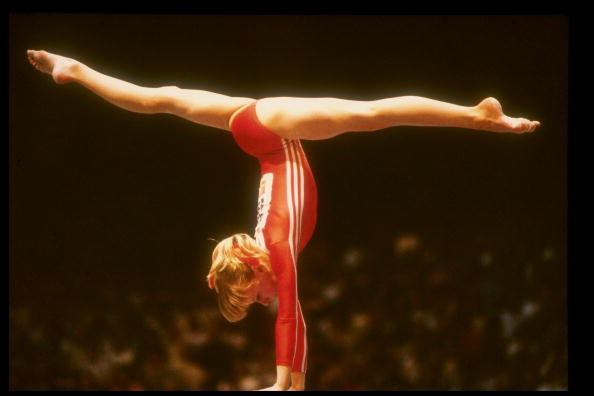
1983: Olga Mostepanova does her routine on the balance beam. Mandatory Credit: Tony Duffy /Allsport
Tatiana Frolova had what Soviet journalists called “soft” gymnastics—a quality that made her stand out even among the technical virtuosos of the early 1980s. Blessed with “beautiful physical qualities,” her movements flowed with a natural grace that allowed her to combine power with lyrical expression. When she performed her floor exercise to Chopin’s “Impromptu,” she embodied a style reminiscent of an earlier generation—Kuchinskaya, Petrik, Karaseva—though with far greater difficulty.
She came from a working-class background in Bryansk, where her mother worked as a shop cashier and her father as a fitter at the city’s machine-building plant. Her coach, Vladimir Shishkin, was himself a former miner from Kemerovo who had moved west, married fellow coach Lyudmila Borisova, and formed a partnership that would produce one of the Soviet Union’s top gymnasts. Shishkin encouraged independent thinking in his pupil. Frolova, journalists noted, “liked to think things through herself” and engaged in deep analytical discussions with her coach.
When she burst onto the senior scene in April 1981 at the USSR Cup in Leningrad, her performance seemed to come from nowhere. She had placed eleventh at the 1980 junior championships; now she won silver behind Alla Mysnik and claimed vault gold. Josef Göhler, writing in International Gymnast, called it a “quantum leap.”
He noted that she had been born in 1967. Little did he know that Frolova wouldn’t just leap spots in the rankings; she would leap years, as well.
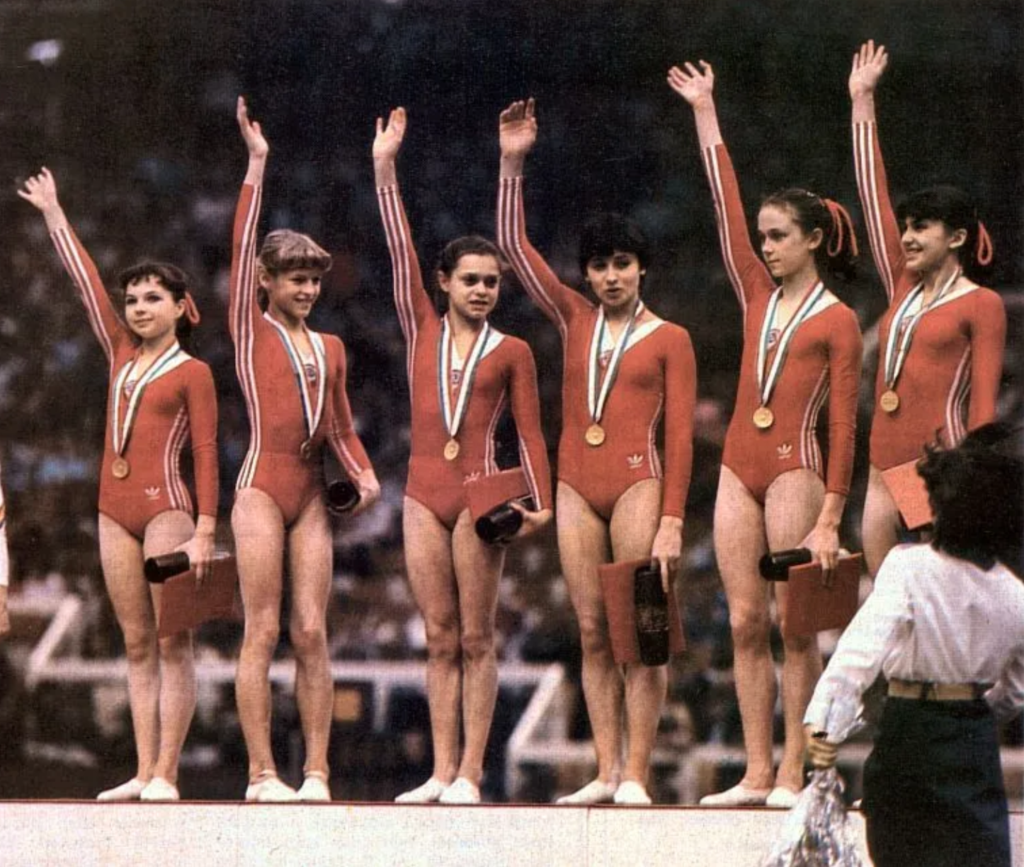
The Soviet team at the 1983 World Championships. From left to right: Bichukina, Mostepanova, Frolova, Shishova, Ilienko, Yurchenko
On October 30, 1983, the Budapest Sports Palace erupted as a Bulgarian gymnast in a red leotard stuck her first vault with textbook control. She shuffled back on her second vault, but her score was good enough. For the first time at a women’s World Championships, the Bulgarian anthem—Mila Rodino—played in the arena. Boriana Stoyanova had become the first Bulgarian woman ever to win a world championship gold medal in artistic gymnastics.
Back home, the press called it a zlatna nedelya, a golden Sunday. Bulgaria’s “golden account,” as one paper put it, had finally been opened.
The moment would be replayed, narrated, and commemorated for decades. What took longer to register was that Stoyanova was not 15 when she won gold.
Stoyanova on the front page of the October 31, 1983 edition of Naroden Sport, Bulgaria’s main sports newspaper.