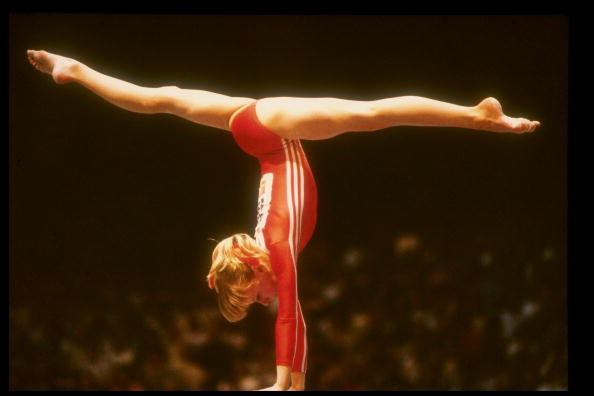
On August 27, 1984, in the Winter Stadium in Olomouc, Czechoslovakia, Olga Mostepanova achieved what no elite gymnast had ever done before or has done since: four perfect scores of 10.0 in a single all-around competition. Vault: 10.0. Uneven bars: 10.0. Balance beam: 10.0. Floor exercise: 10.0. Sovetsky Sport called it “a record—an absolute one.” Thousands of spectators rose in thunderous applause for, as a subsequent profile described her, “the fifteen-year-old winner.”
Except according to official Soviet records, Olga Mostepanova was sixteen years old in August 1984.
Or was she?
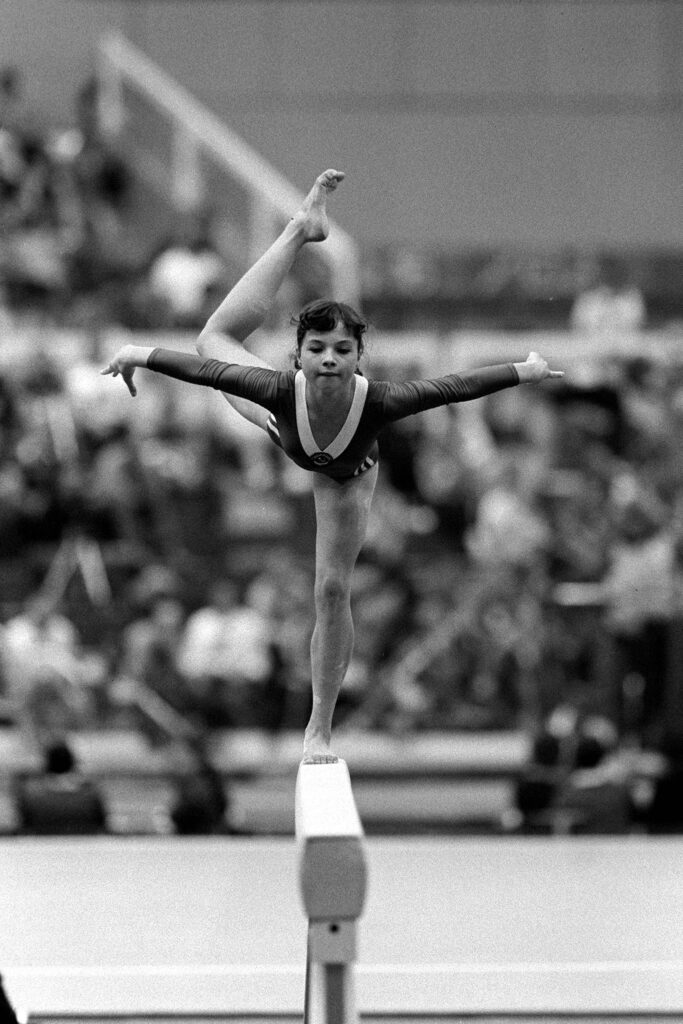
1983: Olga Mostepanova does her routine on the balance beam. Mandatory Credit: Tony Duffy /Allsport
In the summer of 1983, Soviet sports journalist Vladimir Golubev watched Irina Baraksanova compete at the Spartakiad and reached for the kind of language writers reserve for truly special talents. She was, he wrote, “a pure diamond” — a girl of “exceptional talent and natural gifts” whose sixth-place finish at the national championships was quite “an achievement” for a seventh-grader. After the Friendship-84 tournament the following autumn, another article celebrated her as embodying “the freshness of young shoots,” declaring that she and her fellow newcomers had brought gymnastics “new shades and freshness.”
The Soviet sports press had found a narrative they loved: the late bloomer from Tashkent who had started gymnastics only in second grade, yet possessed such refined technique that “there seems to be no element in modern gymnastics beyond her reach.” Her “exceptional spring and flight” produced vaults that were “both the highest and the longest.” Her floor routines were “daring and free,” her movements “harmonious and lyrical.” Month after month, Sovetsky Sport charted her ascent — gold in the all-around at the 1984 European Junior Championships, bronze in the all-around at the 1984 USSR Championships in Donetsk, gold on floor exercise at the 1984 USSR Championships in Individual Events in Moscow.
Eventually, Montréal happened.
At the 1985 World Championships, Baraksanova finished fourth in the team final, ahead of both Oksana Omelianchik and Elena Shushunova. Yet when the individual all-around final arrived, it was Omelianchik and Shushunova who competed, while Baraksanova and Mostepanova watched from the sidelines. The official explanation was injuries, but neither Irina nor Olga was injured.
The moment crystallized something about Baraksanova’s career: extraordinary talent never quite converted into championship results, promise never fully realized, potential always just out of reach. Twenty-five years later, the gymnast once hailed as a “pure diamond” reflected on what she achieved, what she lost, and the peace she had made with her gymnastics destiny.
How did people in the USSR feel about Olga Bicherova’s age falsification at the time?Did everyone simply accept that it was for the greater good of the Soviet Union?
In a 1987 essay published in Ogonyok under the provocative title “Don’t Lose the Person,” Tokarev returned to this episode not to litigate eligibility rules, but to imagine the human cost of the lie. He opened the article with the age-falsification case, identifying the gymnast only as “B” to spare her further harm. At the tournament’s final press conference, officials calmly insisted that the champion’s age complied with the rules. When a reporter produced not one but two start lists showing that she had not yet turned fourteen, officials dismissed them as “mistakes.” Only later did a federation insider admit to Tokarev that the documents had been deliberately swapped.
What haunted Tokarev was the position in which this placed the girl herself. Friends, relatives, classmates—everyone knew the truth. She was told that lying was necessary, that falsifying her age served “higher interests,” the honor and glory of the state. The burden of the deception, Tokarev suggested, fell not on officials or coaches, but on a child expected to live inside a public fiction.
(Tokarev would return to this case in 1989, writing again in Ogonyok and naming the gymnast explicitly as Olga Bicherova.)
The heart of Tokarev’s outrage, however, centers on the 1985 World Championships in Montreal. There, coach Vladimir Aksenov watched his protégé Olga Mostepanova—sitting in second place after two days of competition—be abruptly removed from the individual finals along with Irina Baraksanova. In their places, head coach Andrei Rodionenko inserted Oksana Omelianchik and Elena Shushunova, who would go on to share the gold medal. When Tokarev recounts this episode, he anticipates the response he knew so well: the medals were still Soviet medals, so what difference did it make whose names were attached to them?
Aksenov explained the reasoning to Tokarev in stark terms. Rodionenko, he said, was taking revenge. After Sovetskaya Rossiya (Soviet Russia) reported that people’s control inspectors at the Lake Krugloye training base had caught Rodionenko hoarding scarce food supplies meant for athletes, coaches were pressured to sign a letter denying the incident. Aksenov was the only one who refused. His punishment was swift: he was barred from accompanying his own athlete to Montreal, and Mostepanova was sacrificed in the finals as retribution. “Olga and Yurchenko hugged each other and burst into tears,” Aksenov recalled. “You could say that all the way back to Moscow, Olga’s eyes never dried.”
Tokarev recognizes that these individual injustices—the falsified documents, the stolen food, the vindictive substitutions—are symptoms of a deeper corruption. He challenges the notion that such deceptions serve “higher interests” or the “honor and glory of the state.” Through pointed examples, from the pentathlete Boris Onishchenko’s rigged épée at the 1976 Olympics to weightlifters caught trafficking anabolic steroids abroad, Tokarev argues that secrecy and complicity had rotted Soviet sport from within. The system demanded that witnesses sign false statements, that coaches look the other way, that everyone prioritize medals over human dignity. His closing plea is both moral and practical: sport cannot be reformed unless it embraces the same transparency and accountability reshaping Soviet society. “No medals,” he writes, “can replace for us what is most valuable—the person.”
What follows is a translation of Tokarev’s seminal essay.