In the summer of 1983, Soviet sports journalist Vladimir Golubev watched Irina Baraksanova compete at the Spartakiad and reached for the kind of language writers reserve for truly special talents. She was, he wrote, “a pure diamond” — a girl of “exceptional talent and natural gifts” whose sixth-place finish at the national championships was quite “an achievement” for a seventh-grader. After the Friendship-84 tournament the following autumn, another article celebrated her as embodying “the freshness of young shoots,” declaring that she and her fellow newcomers had brought gymnastics “new shades and freshness.”
The Soviet sports press had found a narrative they loved: the late bloomer from Tashkent who had started gymnastics only in second grade, yet possessed such refined technique that “there seems to be no element in modern gymnastics beyond her reach.” Her “exceptional spring and flight” produced vaults that were “both the highest and the longest.” Her floor routines were “daring and free,” her movements “harmonious and lyrical.” Month after month, Sovetsky Sport charted her ascent — gold in the all-around at the 1984 European Junior Championships, bronze in the all-around at the 1984 USSR Championships in Donetsk, gold on floor exercise at the 1984 USSR Championships in Individual Events in Moscow.
Eventually, Montréal happened.
At the 1985 World Championships, Baraksanova finished fourth in the team final, ahead of both Oksana Omelianchik and Elena Shushunova. Yet when the individual all-around final arrived, it was Omelianchik and Shushunova who competed, while Baraksanova and Mostepanova watched from the sidelines. The official explanation was injuries, but neither Irina nor Olga was injured.
The moment crystallized something about Baraksanova’s career: extraordinary talent never quite converted into championship results, promise never fully realized, potential always just out of reach. Twenty-five years later, the gymnast once hailed as a “pure diamond” reflected on what she achieved, what she lost, and the peace she had made with her gymnastics destiny.
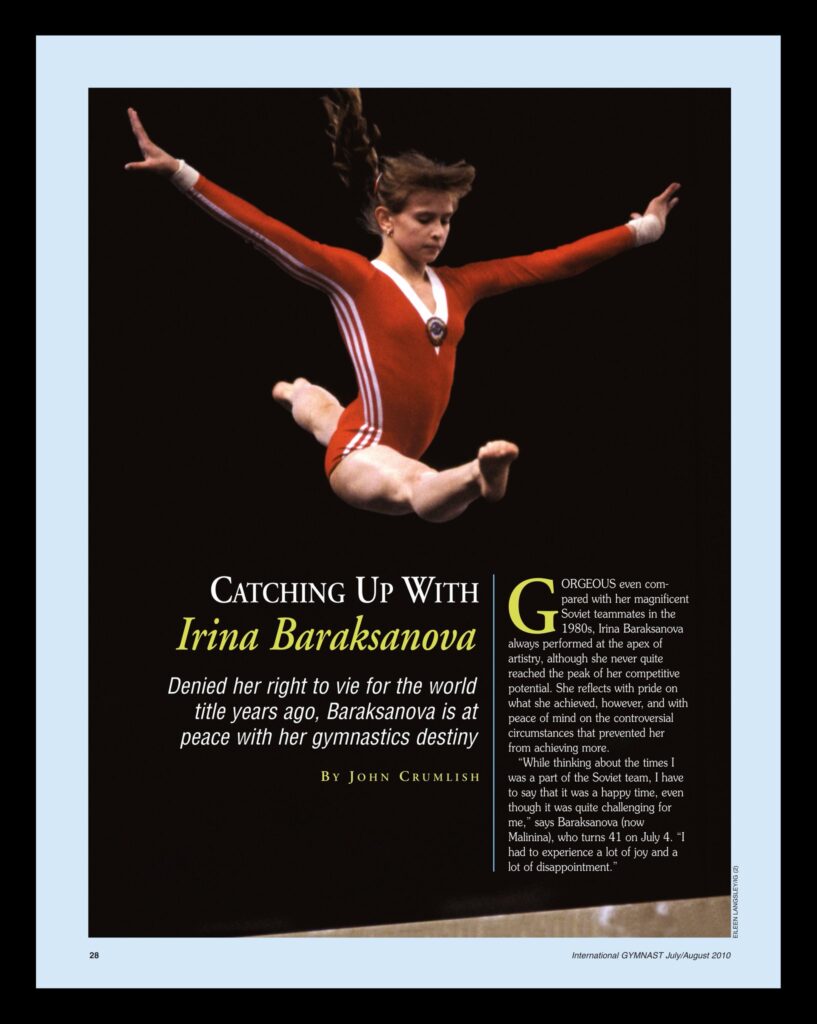
Catching Up With Irina Baraksanova
Denied her right to vie for the world title years ago, Baraksanova is at peace with her gymnastics destiny
Gorgeous even compared with her magnificent Soviet teammates in the 1980s, Irina Baraksanova always performed at the apex of artistry, although she never quite reached the peak of her competitive potential. She reflects with pride on what she achieved, however, and with peace of mind on the controversial circumstances that prevented her from achieving more.
“While thinking about the times I was a part of the Soviet team, I have to say that it was a happy time, even though it was quite challenging for me,” says Baraksanova (now Malinina), who turns 41 on July 4. “I had to experience a lot of joy and a lot of disappointment.”
⸻
Experts respected the majesty of Baraksanova’s performances, which, combined with her prodigious talent, earned her a precious spot in the Soviet team in the mid-1980s. Born in Tashkent, Uzbekistan, Baraksanova tied for the all-around title at the 1984 European Junior Championships and helped her senior team win gold at the 1984 “Alternate Games” in Olomouc, which mainly included teams that had boycotted the Los Angeles Olympics. Baraksanova’s top skills included a full-in dismount on beam. On floor in various meets, she tumbled a piked full-in as a first pass and tucked full-in as a last pass; double layout as a first pass; and 1½ twist through to double tuck as a middle pass.
Baraksanova moved with an aesthetic purity that few gymnasts then or since could replicate. Her 1984-85 floor routine, sumptuously choreographed to composer Yevgeny Doga’s haunting waltz from a 1978 Soviet film, is one of gymnastics history’s most beautiful compositions. The nimble Baraksanova Malinina credits genetics for providing the rudiments of her poetless style.
“Nature gave me a very good physique: good proportions, lightness, and strength,” she says. “Besides, I was a very hard-working child. I loved gymnastics and trained a lot.”
No amount of discipline and determination, however, could intercede when Baraksanova lost her chance to contend for the all-around title at the 1985 World Championships in Montreal. She and her teammates easily won the team competition, in which Baraksanova finished fourth in the individual standings, behind Romania’s Ecaterina Szabo and Soviet teammates Natalia Yurchenko (the defending world champion) and Olga Mostepanova. Only three gymnasts per country could advance to the all-around final, and with qualification totals halved and then carried over into the final, Baraksanova would be able to enter the final just 0.125 out of first place.
That was as close as Baraksanova got to victory, though. Soviet officials told the press in Montreal that Baraksanova and Mostepanova were suffering from lingering injuries, and therefore were being replaced in the final by teammates Oksana Omelianchik and Yelena Shushunova. “I wasn’t injured,” Baraksanova Malinina says. “I was simply exchanged, even though I was prepared to perform and was healthy.”
Omelianchik and Shushunova, who made costly mistakes on uneven bars in the team competition, were equally splendid in the all-around final and tied for the gold medal.
“That was the decision of the team management,” Baraksanova Malinina says. “My teammates understood that my participation in the finals could make me win, but we didn’t become enemies, nevertheless.”
While outside forces put Baraksanova’s potential-for glorious moment in Montreal out of reach, she refuses to torment herself by asking what she could have made of it.
“I don’t like to think What if…?” Baraksanova Malinina says. “It doesn’t make any sense. It is important to overcome the challenges that come your way. And I was able to do that, which makes me very proud of myself. I wish that all the people who encounter challenges in their lives could do the same.”
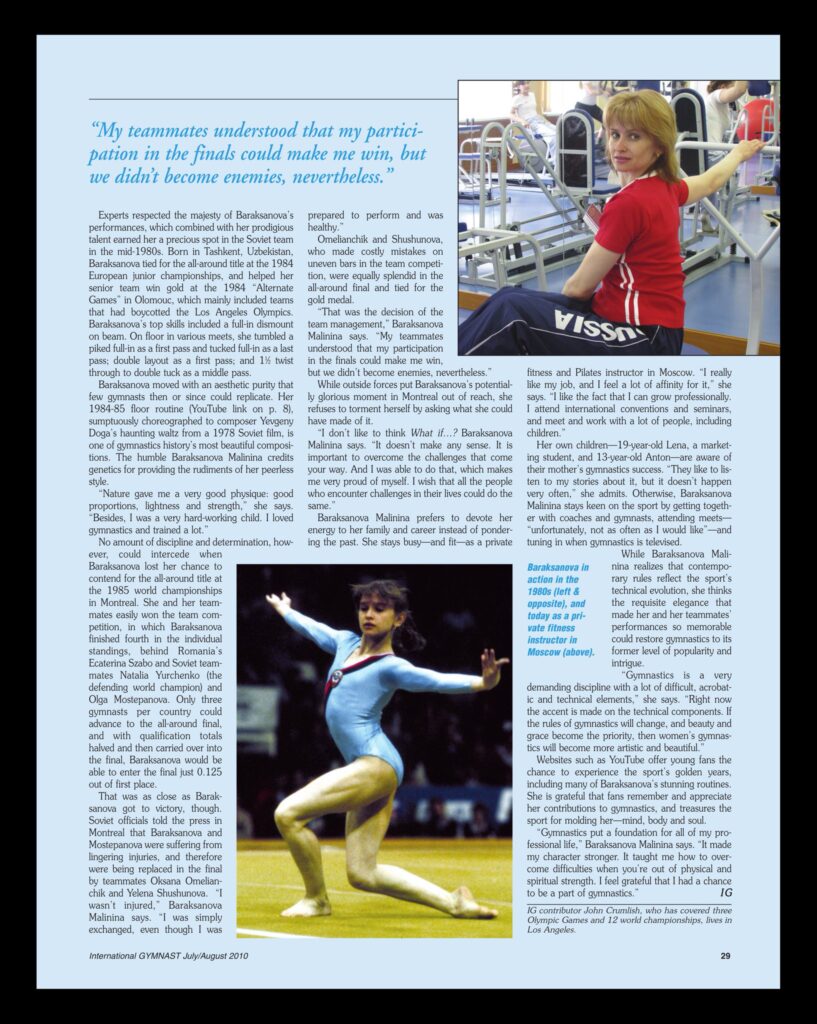
Baraksanova Malinina prefers to devote her energy to her family and career instead of pondering the past. She stays busy—and fit—as a private fitness and Pilates instructor in Moscow. “I really like my job, and I feel a lot of affinity for it,” she says. “I like the fact that I can grow professionally. I attend international conventions and seminars, and meet and work with a lot of people, including children.”
Her own children—19-year-old Lena, a marketing student, and 13-year-old Anton—are aware of their mother’s gymnastics success. “They like to listen to my stories about it, but it doesn’t happen very often,” she admits. Otherwise, Baraksanova Malinina stays keen on the sport by getting together with coaches and gymnasts, attending meets—”unfortunately, not as often as I would like”—and tuning in when gymnastics is televised.
While Baraksanova Malinina realizes that contemporary rules reflect the sport’s technical evolution, she thinks the requisite elegance that made her and her teammates’ performances so memorable could restore gymnastics to its former level of popularity and intrigue.
“Gymnastics is a very demanding discipline with a lot of difficult, acrobatic and technical elements,” she says. “Right now, the accent is made on the technical components. If the rules of gymnastics will change, and beauty and grace become the priority, then women’s gymnastics will become more artistic and beautiful.”
Websites such as YouTube offer young fans the chance to experience the sport’s golden years, including many of Baraksanova’s stunning routines. She is grateful that fans remember and appreciate her contributions to gymnastics, and treasures the sport for molding her—mind, body and soul.
“Gymnastics put a foundation for all of my professional life,” Baraksanova Malinina says. “It made my character stronger. It taught me how to overcome difficulties when you’re out of physical and spiritual strength. I feel grateful that I had a chance to be a part of gymnastics.” IG
John Crumlish, International Gymnast, July/August 2010
1984: A Profile of Baraksanova, Balabanov, and Tumilovich
The Freshness of Young Shoots
I would like to speak first about three debutants of the national gymnastics team who, together with their teams, won gold medals at the Friendship-84 tournament in the Czechoslovak city of Olomouc. I mean Irina Baraksanova, Yuri Balabanov, and Alexander Tumilovich.
I chose these three masters because, with their arrival on the national team, gymnastics — in my view — gained new shades and freshness. Their routines possess the freshness of young shoots and a refined compositional completeness. Of course, the routines of Dmitry Bilozerchev, Vladimir Artemov, Natalia Yurchenko, and Olga Mostepanova remain the standard of world gymnastics, but I believe that Irina, Yuri, and Alexander will soon be able to surpass their teammates in both difficulty and harmony.
Irina Baraksanova from Tashkent turned fifteen on July 4. I have seen her perform full senior programs many times: last season at the USSR Spartakiad (sixth place), this year at the Moskovskie Novosti [Moscow News] tournament (shared second place with Elena Shushunova), at the European Junior Championships in Italy (shared first place with Elena Zabrodina), at the USSR Championships in Donetsk (bronze in the all-around), and at the USSR Cup in Moscow (gold in floor exercise). Each time I noted her finely sculpted figure and the sharp, energetic tempo of her execution. What impressed me most was the completeness of her lines and movements — a true sign of class and talent.
Irina’s gymnastics are daring and free. She performs many elements in which even the slightest inaccuracy could ruin everything. She knows this, and perhaps that is why she can sometimes be cautious — although “cautious” is hardly the right word for her bold, expansive style. But when she stops thinking about the delicate threads connecting her complex elements — threads that sometimes break, leading to mistakes — we will see Baraksanova in her full brilliance. I am confident that with her character, Irina will achieve great things.
Do you know how she came to gymnastics? Her coach, Valentina Yevgenyevna Yakovleva, once told me that she was walking past a schoolyard when she suddenly froze in horror: a little girl was hanging upside down from the metal frame of a basketball hoop, swinging back and forth. “My heart nearly stopped,” Yakovleva recalled. “But when the girl saw me, she jumped down and ran off. I chased her, caught up, scolded her — and then persuaded her to take up gymnastics.”
At the Friendship-84 tournament, Baraksanova did not win an individual medal. But I would like to quote the head coach of the women’s national team, Andrei Radionenko, who gave an accurate assessment of this young gymnast:
“Irina fully deserved the highest praise. In Olomouc, she made her first appearance as a member of the national team. She did not let the team down, even though she had the difficult role of opening the competition. Her routines captivated the audience, and her technique was virtuoso.”
Now let me introduce Yuri Balabanov, a 20-year-old Dynamo athlete from Minsk, bronze medalist at Friendship-84 in the all-around. His performances are unmistakable — just as distinctive as figure skater Igor Bobrin’s. His extraordinary flexibility allows him to perform elements that even world-class gymnasts find difficult. His combinations on floor, parallel bars, and horizontal bar deserve to bear his name.
Balabanov is originally from Vitebsk, from a large family. His first coach was Valery Karyakin — a composed man who nonetheless sometimes lost patience during endless debates with his pupil. His current coach, Anatoly Ovsyak, a well-known Belarusian trainer who once coached Olympic medalist Vladimir Shchukin, emphasizes how difficult Balabanov can be to work with. Yuri is cheerful and sociable, but so deeply in love with gymnastics that he often forgets about “tact” in training, turning sessions into long discussions. At 20, he understands technique very deeply and does not tolerate vague criticism — it instantly puts him on edge. But his impulsiveness also helps him explode on the apparatus, producing breathtaking amplitude.
Balabanov won the national junior championship and, at last year’s Spartakiad, captured gold on rings. At the USSR Cup in Luzhniki, he again won top honors — on rings and parallel bars. Television viewers could fully appreciate his artistry at Friendship-84: whenever he performed on floor, parallel bars, rings, or high bar, the applause erupted — his “signature touches” captivated the crowd.
Finally, Alexander Tumilovich, a 22-year-old Dynamo athlete from Vitebsk. He made his senior debut three years ago at the USSR Championships in Minsk, finishing ninth in the all-around and winning gold on pommel horse. He impressed everyone — modest, reserved, elegant, and technically refined. His coach, Nikolai Aiskovich, then 42, had begun his career in the small town of Kobrin before moving to Vitebsk and later joining the famous school of Vikenty Dmitriev.
“Alexander always struck me with his maturity,” Aiskovich recalled. “Everything was orderly with him — especially his diet and training. When we went fishing with the team, I’d try to give Sasha extra soup because he was too strict with himself about weight. His shyness slowed his rise somewhat, but judges remembered his clean lines and beautiful compositions from the junior competitions.”
Third place at the 1984 USSR Cup earned Tumilovich a place on the national team. In Olomouc, he did not let the team down, although he was very nervous and nearly spoiled his high bar routine. Still, he held on and finished cleanly. His team medal was well deserved.
Vladimir Golubev, Sovetsky Sport, September 1, 1984
⸻
Note: In a separate article, Golubev noted that Baraksanova started gymnastics in second grade: “The true revelation of the day was Irina Baraksanova, an eighth-grader from Tashkent. She only began gymnastics in second grade (which by modern standards is very late!), yet her talent is extraordinary. Her technique is so refined that she is able to perform some of the most difficult routines in the world. There seems to be no element in modern gymnastics beyond her reach. Her routines are rich, harmonious, and confident on every apparatus.” (Sovetsky Sport, April 19, 1984)
More Interviews and Profiles