Olga Mostepanova’s name may not have been as familiar to American gymnastics fans as that of some of her Soviet contemporaries, such as Natalia Yurchenko, but her story ranks among the most poignant of the Cold War era. A world champion on balance beam in 1983 at just fourteen years old, Mostepanova appeared destined for Olympic glory—until the Soviet boycott of the 1984 Los Angeles Games intervened. An even more devastating blow followed at the 1985 World Championships in Montreal, where her elite career effectively ended at its peak: despite qualifying, she was withdrawn from the all-around final.
By 2008, she had returned to the sport that once broke her heart, working as a preschool coach at Dynamo Moscow, the gym where she once trained under the legendary “Aksyonov Brigade.”
In this interview, Mostepanova made a striking admission—one she insisted she had never made before: that Dynamo Moscow had added a year to her age to make her eligible for senior competition. Her categorical statement—”I can respond to anyone who says that my age was changed. It was. But I never discussed that in any interview, official or unofficial”—called into question the authenticity of previous reports, including a 1998 interview in Sovetsky Sport, where such admissions appeared. Mostepanova also reflected on the political forces that shaped Soviet gymnastics, her coaching philosophy, and her hopes for the future of Russian gymnastics.
Enjoy this interview with the only elite gymnast to score a perfect 40 in the all-around at a major international competition.
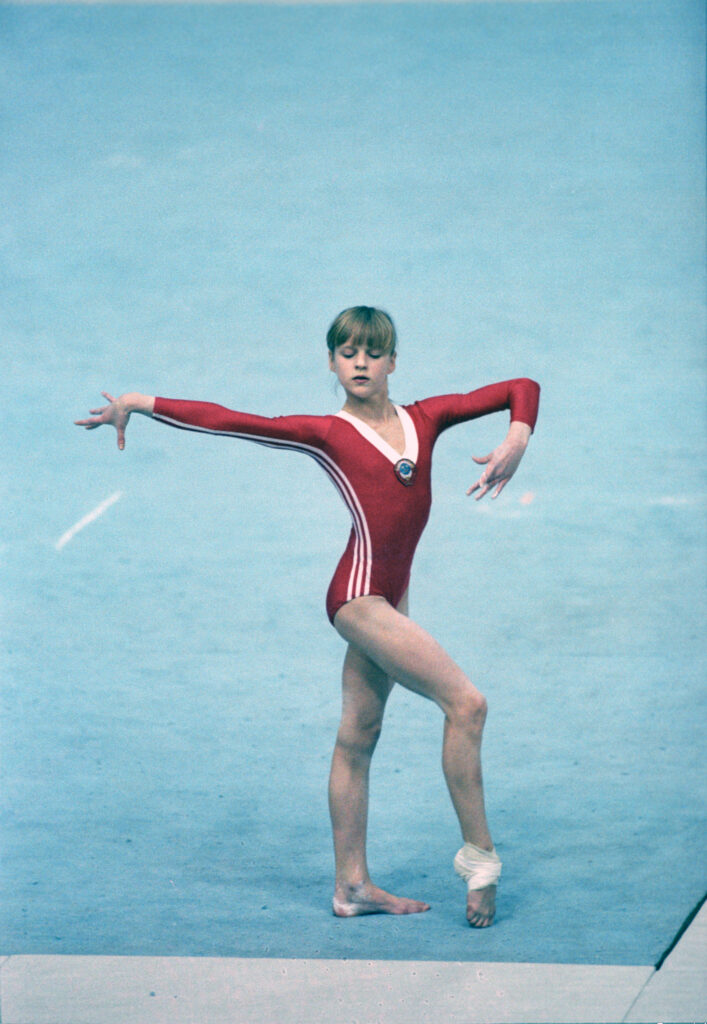
Dream Realized
Olga Mostepanova’s competitive career ended much too quickly. She burst onto the senior ranks in 1983, but the Soviet-led boycott of the 1984 Los Angeles Games robbed her of a chance at Olympic glory. The following year, Mostepanova suffered such a devastating disappointment that she quit at the height of her career. Fourteen years later, she returned to gymnastics, and today, she has a newfound love for the sport.
Olga was born Jan. 3, 1969, in Moscow. Her mother, Galina, wanted her oldest daughter to be a gymnast and took her to Dynamo Moscow. Olga was 5.
By age 7, having been identified as a gymnast with some promise, Olga joined the “Aksyonov Brigade.” Composed of a troika of coaches—Vladimir Aksyonov, Yelena Kapitonova, and Vladimir Kondratenko—this group would turn her into a world champion.
Aksyonov was Olga’s main coach. A perfectionist who was always looking for clean lines in his athletes, he had extensive experience working with high-caliber gymnasts, such as two-time Olympic champion Elvira Saadi.
Choreographer Yelena Kapitonova, who occasionally worked with the Soviet national team, was responsible for all of Olga’s floor routines. To this day, Mostepanova is grateful for Kapitonova’s influence and guidance. “I consider her a gift from God,” she says. “She was the best choreographer ever!”
Olga also singled out Kondratenko for praise. “He was an amazing coach for spotting releases on bars and especially for difficult tumbling,” she recalls.
“His hands were always in the right place and at the right time during a spot. Kondratenko was a very intelligent, respectful, and educated coach during all his hard work with me.”
The Aksyonov Brigade created the unique elements in Mostepanova’s routines. “The full-twisting dive roll was very popular,” Olga explains. “I first did it as a dive roll, and later on, I just put my hands on the floor and [performed] it as a full-twisting front handspring.”
The Arabian handspring on beam (called an Onodi in the Code of Points) was another such invention, which evolved from a series of drills in the 1972 Soviet publication “Programmed Learning of Difficult Gymnastics Exercises on Balance Beam.” It took Olga nearly a year to master this element.
The Dynamo sports organization had won many world and Olympic medals in gymnastics.
The Dynamo Moscow club, however, had not produced a high-level gymnast in some time and was rather desperate to have a world champion in its ranks once again. When it became apparent that Mostepanova had medal potential, one year was added to Olga’s age so she would be able to compete in senior competitions.
Incidentally, Olga said she has never spoken about this with the press and flatly states, “I can respond to anyone who says that my age was changed. It was. But I never discussed that in any interview, official or unofficial. …Honestly, I never thought about the importance of age changing. Little kids didn’t play this adult game.”
After her success in Budapest, where she won four medals, including the world beam title, Mostepanova had high hopes to win at least one gold medal at the Olympic Games in Los Angeles. But a boycott derailed her dream.
“It’s really difficult for me to think that somebody decided [to boycott] without any thoughts about the gymnasts and coaches who spent the best years of their lives preparing to be on the Olympic podium,” she says. “It would have been great to participate in the Olympic Games. I think that in 1984, when I was in my best shape and condition ever, it would have been possible for me to be the all-around champion and get one or two medals. But it wouldn’t have been easy. The other competitors were strong, and of course, there was the political situation. It’s not so easy to compete when the spectators consider you as a kind of adversary.”
Instead, countries that boycotted Los Angeles held their own “mini Olympics” in the Czech city of Olomouc, where Mostepanova dominated the field. She scored a 40.0 in the all-around final, and also won golds with her team, and on vault, beam, and floor.
In spite of the pressure she felt as a member of the national team—“You can’t make a mistake!”—Mostepanova was proud to be a part of the Soviet gymnastics machine and looked forward to proving herself at the 1985 World Championships.
Things started well for her in Montreal, but they didn’t end that way. She received a 10.0 for her compulsory beam routine, and with a 78.575 after the team competition, she was inthird place, behind Romanian Ecaterina Szabó and teammate Natalia Yurchenko.
“I made the all-around final and was very happy that I would represent the USSR,” Olga says. “But the day of the all-around final, our bosses made an announcement at the morning line-up that [Irina] Baraksanova and I would not compete that afternoon. It was really hard for me to hear it, even though I was injured and was expecting that my foot would bother me [during the competition].”
Mostepanov was crushed by the news. “After Andrei Rodionenko’s announcement, I cried all day long,” she says. “It was so difficult to believe that I wouldn’t be competing in this event. I earned the right to compete, and I deserved to compete.”
It was this incident that prematurely ended Mostepanova’s career. “After this, I decided to quit gymnastics and not come back,” she says. “But it was thanks to some good people in Moscow who helped me a lot to not feel bad about gymnastics and to not to feel bad about some particular people. I decided that I will leave [my decision to quit gymnastics] on the conscience of the people who were responsible.”
Olga got married, had five children, and was away from the sport for many years. Now divorced, Olga returned to her old gym four years ago. Dynamo offered her a convenient work schedule. More importantly, Olga’s salary allowed her to support her children without financial help from her parents. Today, she works as a preschool coach for children ages 3 to 7. She works only in the morning, so she can be at home in the afternoon when her own kids return from school.
Andrei Zoudin, president of Dynamo Moscow Gymnastics Club, has nothing but praise for Mostepanova. “If I had more coaches with the same attitude to gymnastics and to the kids as Olga, my life would be much easier,” he says. “Olga loves gymnastics and her job. She’s always in the right place at the right time, with the right suggestions. She works for the kids.”
Mostepanova has an easygoing coaching style and tries to convey the positive side of gymnastics to her students. “I’m not ready to force a gymnast [to perform a skill], because in my gymnastics life, I was forced a lot,” she says. “I am not ready to do this, probably because I haven’t recovered from [my own experience] yet. …The highlight of my current gymnastics career is working with small kids and helping them to understand what a nice sport gymnastics is.”
What does Olga think about herself as a trainer? “I hope I do my job well,” she begins. “Maybe I can achieve good results as a gymnastics coach.”
Olga’s opinions about the current state of gymnastics are more confident, especially when it concerns a minimum age requirement in the sport. “I strongly consider an age limit to be very unfair to the little hard-working gymnasts who have spent more than 10 years [training] in order to compete in the Olympic Games,” she says. “It’s not fair if they are denied the opportunity to be a champion while they are the best.”
She believes that a gymnast should be awarded for the difficult elements in a routine, and agrees that a routine’s start value should be based on the level of difficulty. Olga also thinks that, in general, today’s routines display too much difficulty and not enough artistry. “But, I can give the best example of a good combination of difficulty and artistry: Nastia Liukin,” she says. “She has the best technical skills, done with a very high level of artistry. She is a marvelous, delightful, and fantastic gymnast.… She is one of the best that I’ve seen in my life.”
Olga also spoke passionately about the Russian team. “I think that Russia has always had good gymnasts and great coaches,” she says. “They must work hard every day, and of course, my Russia will come back to the line-up of the world winners.”
While she’s not sure what needs to be done to make the Russian women’s team successful once again, Mostepanova feels that a changing of the guard is necessary to get her country back in the medals. “We are working according to the former traditions,” she explains. “Of course, it’s good to follow traditions, but something has to be changed. Has the current leadership brought some innovation to the structure of preparations, or to gymnastics technique? I really don’t know what to do, but maybe someone knows how to put the Russian team on the right path.”
Olga’s path in gymnastics was, unfortunately for her, a short one. “My own career as a high-level gymnast was so fast,” she reflects. “I had my best achievements when I was 15 or 16 years old.”
She credits her children—Mohammed (17), Liza (15), Hassan (13), Mariam (11), and Sofia (9)—for bringing joy to her life. “It was only my own kids who taught me how to smile at life, how to have fun, and how to be happy.”
Perhaps no one deserves it more than Olga Mostepanova.
—
Debbie Poe, International Gymnast, November 2008
More Interviews and Profiles