In December 1990, as Romania struggled to redefine itself after the fall of communism, Celestina Popa said something that should have forced a reckoning in international gymnastics. Speaking to Dutch journalist Hans van Wissen for De Volkskrant, she acknowledged openly that the Romanian federation had falsified her age.
“Sometimes people on the street asked me how old I was,” Popa said. “I didn’t know what to tell them: my real age or the age the federation gave me. Officially, I was one year too young to compete at the 1985 World Championships.”
It was not a vague admission or a rumor repeated secondhand. Popa, herself, was correcting the historical record. Her confession came on the heels of Ecaterina Szabó’s own admission and Aurelia Dobre’s divulgence of Daniela Silivaș’s age falsification, as well.
Together, their statements represented a breach in the Eastern Bloc’s code of silence: athletes speaking openly, shortly after their careers were over, about a system built on falsification and obedience.
Yet nothing changed.
Becoming Eligible for Montréal
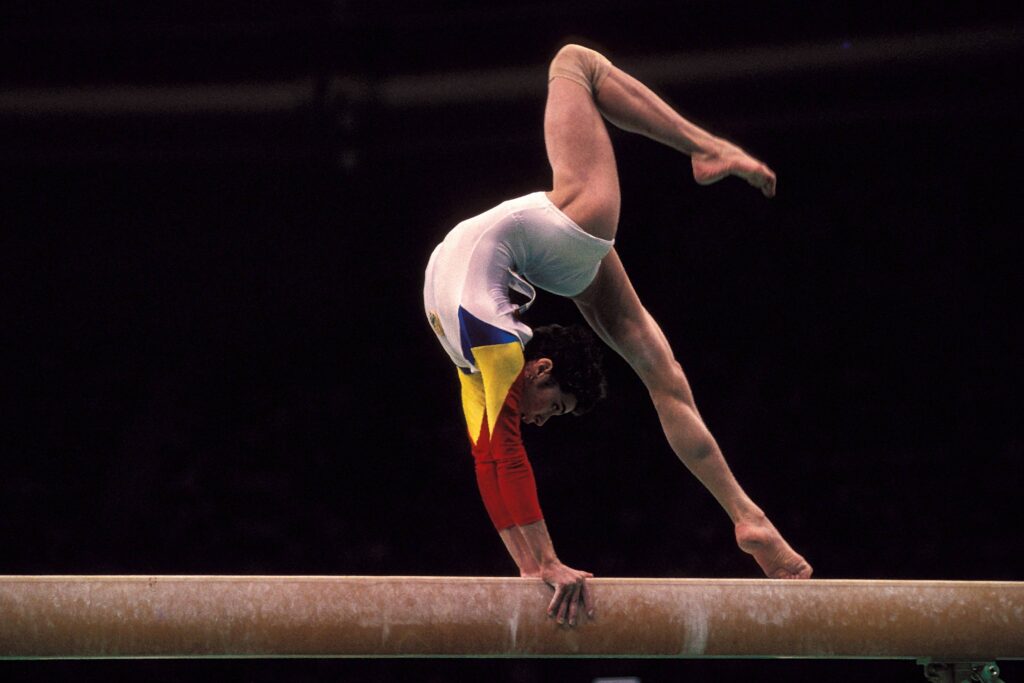
Celestina Popa was born in 1971. Throughout her senior career, however, she competed under a fabricated birth year of 1970. The discrepancy sounds small. But a year is a year, and rules are rules. And in 1985, the minimum age for the World Championships was fifteen. Popa was fourteen. Under her real birthdate, Popa was ineligible, but by adjusting her paperwork, the federation made her eligible to help the Romanian team win the silver medal in Montréal.
Though she was not the star of the team, Popa made quite the impression in Montréal. In the Romanian press, she was quickly framed as one of the revelations of the championships: “the little sprite Celestina Popa from Petrolul Ploieștim.” Like many of her teammates, she was a gymnast competing for the first time on a stage that tested not only skill but nerve: “These are gymnasts with ribbons in their hair, taking part for the first time in competitions as demanding—especially from a psychological standpoint—as the world championships.”
The praise only intensified after Montréal. When Popa won the all-around title at the Chunichi Cup in Japan—tied with the more experienced Hana Říčná and followed by gold medals on vault and balance beam—commentator Horia Alexandrescu declared her “a genuine star for me,” presenting her success as confirmation of a prediction made before the World Championships, when he called her, “the great talent who will soon astonish the world of international gymnastics.”
By the end of 1985, Popa was no longer discussed merely as a promising young gymnast. She was publicly named among the athletes expected to carry Romanian women’s gymnastics into the next Olympic cycle. “In women’s gymnastics,” Maria Login, General Secretary of the Romanian Gymnastics Federation, noted, “Daniela Silivaș and Celestina Popa may reach, in 1988, the optimal level of technical and physical maturity.”
By then, she would be 17 but 18 on paper. The falsified year would no longer matter for her eligibility.
Popa’s Legacy
That falsified birthdate, though, followed her everywhere. When she won silver at the 1985 World Championships. When she won gold at the 1985 Chunichi Cup. When she earned team gold at the 1987 World Championships. When she stood on the Olympic podium in Seoul with a team silver medal. At every stage, official documentation listed her birth year as 1970, making her one year older. It had to; there couldn’t be any discrepancies in the FIG’s competition records.
Then, in 1990, she told the truth.
The interview was translated and published in International Gymnast, making her admission accessible to an international audience. It should have marked the end of the fiction. Instead, the correction stalled at the level of testimony.
Even when her confession resurfaced in 2002 during Romania’s age reckoning, it did nothing to correct the public record.
Decades later, the false birth year still circulates. Wikipedia repeats it. Sports databases repeat it. The International Gymnastics Federation has never amended its records.
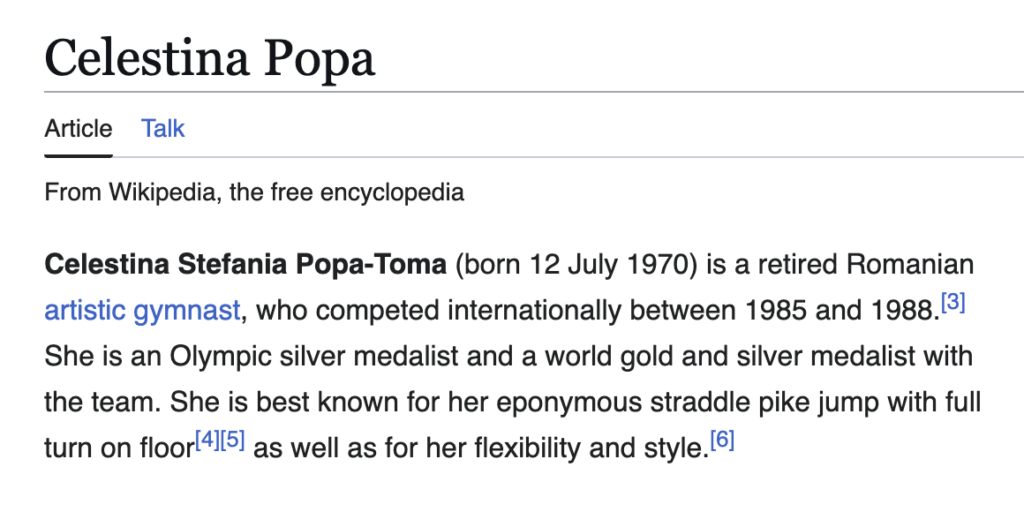
Meanwhile, Popa’s name has never disappeared from the sport. It appears every day in gyms around the world, attached to a single element: the straddle jump with a full turn, known simply as “the Popa.”
Young gymnasts learn it without knowing anything about Montréal, age limits, or falsified passports. They know only the element that carries her name in the Code of Points.
And for Popa, that is her legacy. “One of my biggest accomplishments is creating the ‘Popa jump’ on floor. This skill is still popular today after 30 years!”
References
Primary Sources
Flamura (Brașov), November 5, 1985. “Montreal at the Hour of Gymnastics.”
Flacăra (Bucharest), May 3, 1985. “Success Across the Board.”
Informatia Bucureştiului, April 24, 1985. “Important Test of Preparation Ahead of the European Championships.”
Scînteia (Bucharest), January 24, 1985. “Gymnastics: Romania’s Women’s Gymnastics Team.”
Scînteia Tineretului (Bucharest), August 20, 1984. “The First Appearance of Our Olympic Champions after Los Angeles.”
Sportul (Bucharest), November 11, 1980. “At ‘Petrolul,’ the successors of Elena Ceampelea and Mariana Constantin are being prepared.”
Sportul, March 27, 1982. “A Talented Element Can Appear at Any Time.”
Sportul, December 4, 1982. “Beautiful and Applauded Performances on the Opening Day.”
Sportul, December 6, 1982. “Cristina Grigoraș Successfully Returns to Competition.”
Sportul, January 14, 1983. “The Top 10 Athletes of the Dinamo Clubs” [includes Petrolul Ploiești rankings].
Sportul, November 19, 1983. “The First Winners in the Junior Gymnasts’ Competitions.”
Sportul, November 21, 1983. “Simona Păuca—Winner in the Masters Category.”
Sportul, May 26, 1984. “Three Gymnasts Leave for the National Team.”
Sportul, May 26, 1984. “From Where Three Champions Took Flight.”
Sportul, June 14, 1984. “A Carpet of Flowers and a Beautiful Cauldron… In Memory.”
Sportul, December 3, 1984. “Laura Cutina, Eugenia Golea, and Marius Gherman—Winners of the ‘Romanian Cup.'”
Sportul, January 21, 1985. “Our Women’s Gymnastics Team Must Confirm.”
Sportul, March 8, 1985. “Gymnast Aurelia Dobre — Remarkable Performance in Avignon.”
Sportul, April 26, 1985. “Gymnasts from 22 Countries at the International Championships of Romania.”
Sportul, April 26, 1985. “Victory for Our Gymnasts, In View of the Upcoming European Championships.”
Sportul, October 28, 1985. “Romania’s Women’s Gymnastics Team Departs for Montreal.”
Scînteia, October 28, 1985. “Safe Travels to Our Girls and Complete Success at the World Championships!”
Sportul, November 7, 1985. “Romania’s Team in Second Place After the Compulsory Exercises.”
Scînteia Tineretului, November 27, 1985. “Celestina Popa, a Star for Me.”
Scînteia, November 9, 1985. “Romania’s Team — World Silver Medalist.”
Sportul, December 24, 1985. “Let Us Prepare, in Good Time, Competently, and Responsibly.”
Wissen, Hans van. “De verloren jeugd van Aurelia Dobre.” De Volkskrant, December 8, 1990.
Secondary Sources
Almanahul Sportul, 1986. “Łódź, August 9–11” and “Montreal, November 3–10.”
Hollis, Karen Louise. Romanian Gymnasts in Conversation. Self-published, 2020.
“The Lost Youth of Aurelia Dobre.” International Gymnast, April 1991. English adaptation of Wissen (1990).
Appendix A: The Dobre Article
The Lost Youth of Aurelia Dobre
AURELIA Dobre ended her career as a gymnast. Now, the sweet-looking Dobre has changed into a bitter 18-year-old who blames everybody for everything. Even her so-called best friend Daniela Silivaș can do no good in the eyes of Aurelia. According to Dobre, it was unfair that Silivaș was seen as the best Romanian gymnast. Perhaps, in all the bitterness, she forgot that Silivaș won the most gold medals of them all. It makes one wonder why she continued gymnastics if she hated it so much…
Sometimes the hunger in the training center of Deva was so awful that the gymnasts stole food. It wasn’t starvation caused by the lack of food. No, on the contrary, other Romanians would have been jealous of the conditions in Deva, but maintaining a weight of only 40 kilos made “normal eating” a sin. In the everlasting duel with the Soviet Union, somersaults and twists had to be perfect. Dobre, Popa, Voinea, no matter how young they were, were slapped if they “helped” themselves to some extras or if they were caught with chocolate. They were punished immediately.
What could they do? Protest? Run away? Leave everything behind for which they had trained eight hours a day? No, the thoughts disappeared as fast as they came. It was a very hard life, but the only advantage was that they could visit foreign countries, and of course, there were the major competitions. They offered everything they had to reach the competitions. Nobody could understand that, not even the parents, but what child who started at the age of 6 would not want to compete at a world championships 9 years later? That was more important than the opinion of the parents.
If you look back, everything seems different. Very different. If Aurelia has to tell us what her most painful experience is, she doesn’t name the severity of the coaches, nor the beating, nor the hunger. She tells us about her experience after she decided to end her career. She had to stop; her knee couldn’t cope with the hard work any longer. “I didn’t want to be the last one to stop,” she says. “I always wanted to stop at the peak of my career.”
“My worst experience is that I fell in love,” she says after a long thought. “I’m 18 years old right now, and I don’t know anything. I would rather have had a teacher of love than a good gymnastics coach. They stole my youth. My youth has just started.”
“We couldn’t say a word, not allowed to ask questions. Contact with foreigners was forbidden. The coaches were our spokesmen. We were soldiers in duty for the country. We had to keep our own ideas to ourselves. That’s why we still find it so hard to speak freely. You get used to dealing with your own problems, not to discuss anything. You locked your feelings up inside of you.”
“My world title … was a big surprise for me … but I would have loved to trade it for more freedom at that time. As soon as I got off the awards stand, I was a slave again.”
“If I came home after a meet in Paris or Rome, people asked me what it was like in those cities, if I had seen the Champs-Élysées or the Coliseum [sic]. I had not even heard of [those places] and felt really ashamed. Others were jealous that I could see so much of the world. I think I’ve been in Paris five times, but I didn’t see more than the airport. You only left the hotel for the competition. There were always the people of the Securitate around. Even shopping was impossible.
“The management told everybody that we had had such a great school education, but in real life, it was nothing. The lessons we got were political instructions. In fact, we didn’t go to school at all in Deva. No wonder Nadia had so much trouble in America. She knew about nothing. What could she do? She followed everybody who seemed nice. I would never want to swap with Nadia. I don’t envy her.
“I haven’t been taught anything other than gymnastics. I get nervous if people ask me questions. I hardly know the answer to the most common question. I have often been jealous of other girls. I can’t think of anything positive to say about all those years. My world title? No, that was a big surprise for me too, but I would have loved to trade it for more freedom at that time. As soon as I got off the awards stand, I was a slave again. I’m happier now than I was then.
“If I have to say something positive, then only one word comes to mind: ambition. In 1988 I had to try to fight back after my second operation. It’s strange, but do you know that nobody has asked me before what gymnastics has taught me? My first answer would be that other girls my age are far more mature, less childish. That is what I’ve learned.”
Aurelia Dobre started as a 6-year-old with two hours of daily training, with a lot of fun and playing. Nadia Comaneci was her big example, but seriousness followed soon.
At age 9, she started training six hours a day, with three hours of school. Often, she was completely worn out. At age 12 she was talented enough to go to the national center in Deva, which meant eight hours of training a day, sleeping, and dieting. The most important interruptions were the medical tests and periodic psychological tests. Then they were asked “questions of life” and buttons had to be pressed to measure the speed of reaction.
Soon came the competitions. Dobre did well at the 1986 Junior Europeans (3rd AA, 1st V, UB) and realized she had a chance to beat the Soviets—if she obeyed instructions.
It was forbidden to watch the Soviets during a meet; that would make them uncertain. They had to look in front of them, strict and severe. But that wasn’t hard, because life was strict and severe anyway. It was far more difficult to keep your eye off the scoreboard at the end of a meet. That, too, was the judgment of the psychologists who worked for the Romanian Federation.The Soviets always started with an advantage. The International Gymnastics Federation (FIG) was dominated by Soviets, and their influence on the judges was in keeping. But more disturbing was discovering the corruption within their own federation. Dobre thinks Daniela Silivas was favored. She doesn’t know why Silivas was protected all the time. Silivas would always go up last during team competition. Popa and Voinea agree immediately and excitedly discuss that they, too, never got equal chances. Why, they don’t know. Perhaps because Silivas was Romania’s best gymnast in foreign countries. “She had the connections,” says Dobre.
“Only her work was judged. Our work was neglected.”
And then follows the rumor that has been going around for some time, that [the] passports of young Romanian gymnasts were falsified. “Silivas was two years too young to compete at the 1985 World Championships,” says Dobre.
Aurelia’s age was never falsified, but Celestina Popa can describe the feelings she had to face because of these ‘tricks.’ “Sometimes people on the street asked me how old I was,” says Popa. “I didn’t know what to tell them: my real age or the age the federation gave me. Officially, I was one year too young to compete at the 1985 World Championships.”
According to the three gymnasts, ages were manipulated for a number of years; the medals should be declared invalid. Dobre knew about the age fraud, but what could she do? Accuse the federation, as a child, in a game that was much too complicated for her? She would have certainly destroyed her career by doing that. “It wasn’t our fault, but the fault of the coaches and the federation.
“Concerning that matter, nothing has changed since the revolution. In fact, it’s gotten worse. Everybody wants to ‘save’ their jobs or positions. That is done over our heads, like in the old days when the coaches and federation made a profit off of us, mainly financially.”
Voinea agrees. “At the 1986 World Cup, we [Voinea, Silivas and Szabó] won $10,000. We returned to the airport, and it was taken away from us. It was considered ‘dangerous’ for young kids to have a lot of money.”
Dobre has similar stories. “At the Grand Prix in Rome, an envelope with $1,500 was taken away from me. Maria Cosma and Mrs. Login (federation member) refused to give it back to me. Those two always took everything. I had to be satisfied with an ice cream. Potorac won a motorcycle in Italy, but it was taken in by Romanian customs. She wasn’t allowed to declare it. So after all these years, we are left with nothing.”
Maybe Dobre can become a coach in Italy, where she went in January. She could understand why coaches such as Cosma and Karolyi defected, but she also felt betrayed. The gymnastics that she started as a child was losing a lot. Now the situation in Romania is hopeless. Only a job outside Romania seems the solution.
The smart and older athletes were able to pull some strings to help themselves, but Dobre couldn’t exploit her success. Her father remained a taxi driver, and her mother still goes to the chocolate factory every day. Their house has three rooms, an average home for a Romanian family. Dobre is glad to spend a few months somewhere else. She smokes out of boredom. ‘The days used to pass quickly,’ she recalls. “There was never enough time. Now there’s plenty of time. In the Romania of today, there is nothing to do.”
Three years after winning the Rotterdam World Championships, Dobre returned to Holland with some of her teammates. They wanted to buy a lot of things, but they lacked the money. In Romania, it’s worse than ever, no matter how much they approve of the revolution. There’s a shortage of everything. The economy is bad, and the corruption continues.
It’s an awkward moment when Dobre says she wished she was never born in Romania. Silence… Popa and Voinea look reproachful; you don’t betray your own country, however horrible it may be there. The dark look on Aurelia’s face disappears. “All right, I’ll put it a different way. I’m sorry, I was born 1,500 miles from here.”
Originally: Hans Van Wissen of De Volkskrant in 1990
Adapted for: International Gymnast, April 1991
Appendix B: How the Dobre Article Was Covered in Romania in 2002
In an interview given to a Dutch journalist, former world champion Aurelia Dobre made explosive revelations.
The Federation Falsified the Gymnasts’ Ages!
The recent scandal shaking Romanian gymnastics has revealed the ugly face of this sport. Before they ever reach the grace shown in competition, gymnasts must pass through a true ordeal: thousands of hours of grueling training combined with a near-carceral regimen during preparation. The negative aspects of life inside the Romanian national team are spoken about by athletes only in intimate settings, and very rarely in the media. Aurelia Dobre was the first to reveal to the press the hardships of her years on the national team in the late ’80s: deprivation, hunger, beatings. Below are passages from the interview she gave in 1991 to a Dutch journalist, later published in the prestigious magazine International Gymnast.
“I started gymnastics at age six, and by nine I was already training six hours a day. At twelve I was selected to the national team and moved to Deva. The program there was strictly set: eight hours of training, sleep, and diet food. At Deva, the worst thing was the hunger. It wasn’t that food was unavailable—ordinary Romanians could have been jealous of our conditions. But keeping our weight at only 40 kilograms made ‘normal eating’ feel like a sin. No matter how small we were, the coaches slapped us if they caught us with any ‘supplements.’ Federation officials told everyone we had an excellent education, but in reality that was a lie—our lessons were mostly political,” said the gymnast. Two former teammates, Celestina Popa and Camelia Voinea (now a coach in Constanța), also took part in the discussion.
“My world title” (editor’s note: won in 1987 in Rotterdam) “was a huge surprise to me. I would have gladly traded it for more freedom and a different life. Outside of gymnastics, I know nothing else,” Aurelia admitted, adding: “They stole my childhood! We were nothing but soldiers serving the country. Slaves. You were free only when you won the big trophy. As soon as you stepped off the podium, you were a slave again.”
“They took our money and left us enough for ice cream.”
Camelia Voinea and Celestina Popa confirmed that the money earned at international competitions was confiscated by the coaches and federation officials.
“At the 1986 World Cup, the team—Camelia Voinea, Aurelia Dobre, and Ecaterina Szabo—won $10,000. When we got home, all the money was taken away on the grounds that it was dangerous for children like us to have such large sums. At another meet, in Rome, I received an envelope with $1,500. Coaches Maria Cosma and Maria Login” (editor’s note: then general secretary of the Romanian Gymnastics Federation) “refused to give it to me. They kept everything; we were given enough only for an ice cream.”
Aurelia Dobre also discovered that the federation falsified the gymnasts’ ages, one such case being that of double Olympic champion Daniela Silivaș, now a gymnastics coach in the United States.
“To allow her to compete at the 1985 World Championships, Silivaș’s age was altered. They “aged” her by two years, turning 14 into 16.”
Celestina Popa admitted that she, too, had been “aged”: “Sometimes, when I was asked how old I was, I didn’t know what to answer—my real age or the one in my passport, which the federation had made a year older?”
“This was done everywhere in the communist world.”
Nicolae Vieru, who led the Romanian Gymnastics Federation for more than two decades, partially confirmed the issues raised by Aurelia Dobre.
“In the period she condemns, 1983–87, I wasn’t in the federation—I had been replaced by Maria Login. A true communist! At Deva, the girls really do go to school. Not the best school, but you can’t do both things equally well—high-level sport and a lot of education. The girls learn only the basic subjects: math, Romanian, history, geography, and one foreign language. That’s how it is; performance demands sacrifices,” said the federation president.
Vieru denied that coaches or officials took the athletes’ money. “Login was a devout communist, trained in Moscow. But I don’t think she would take money from the girls. The coaches, even less so.”
He also dismissed the accusations about passport falsification:
“I don’t believe that’s true. It’s true that there were some attempts. Even I once tried such an ‘arrangement,’ but some ministers refused! This was done everywhere in the communist world. The Chinese are masters of this. Only one case has ever been proven, a North Korean girl,” Nicolae Vieru told us yesterday.LAURENȚIU CIORNEI
Evenimentul Zilei, March 28, 2002
More on Age