Not every Soviet gymnast whose age was falsified went on to become a World or Olympic medalist. Valentina Shkoda was one of them.
In Shkoda’s case, the evidence of age falsification was not hidden in sealed files or whispered recollections. It appeared plainly in the public record.
In November 1981, Sovetsky Sport published a warm profile of the young gymnast under the headline “Ten Points for Valentina.” The article introduced Shkoda as one of the standouts of the 12th USSR Youth Championships, held at Moscow’s Olympic Sports Complex, and lingered on her personality as much as her gymnastics. She was described as mischievous, funny, endlessly energetic—“a little spinning top of joy,” in the words of her coach, Lyudmila Komarova. She loved books and read everywhere: on the metro, walking down the street, at home. Asked what she was reading just moments before competing, Shkoda replied that her favorite book was The Two Captains.
The profile also placed her firmly in childhood. Shkoda was identified as a sixth-grade student at Sports Boarding School No. 9 in Moscow’s Pervomaysky District. She was praised as an excellent student, with only two grades of “good” (B’s) that term. The article traced her discovery back to age six, when Komarova spotted her walking with her grandmother on 16th Parkovaya Street and invited her to try gymnastics. Seven months after beginning formal training, she won her sports school championship.
Most importantly, the profile, written by Vladimir Golubev, included a formal biographical box:
Valentina Shkoda
Moscow, Burevestnik
Born June 23, 1969
Sixth-grade student
Silver medalist of the USSR Youth Championships (CMS program)
Balance beam champion
Coach — L. Komarova
That birthdate mattered. With a June 1969 birthdate, Shkoda would turn fourteen during the summer of 1983. She would not be age-eligible for the 1983 World Championships in Budapest.
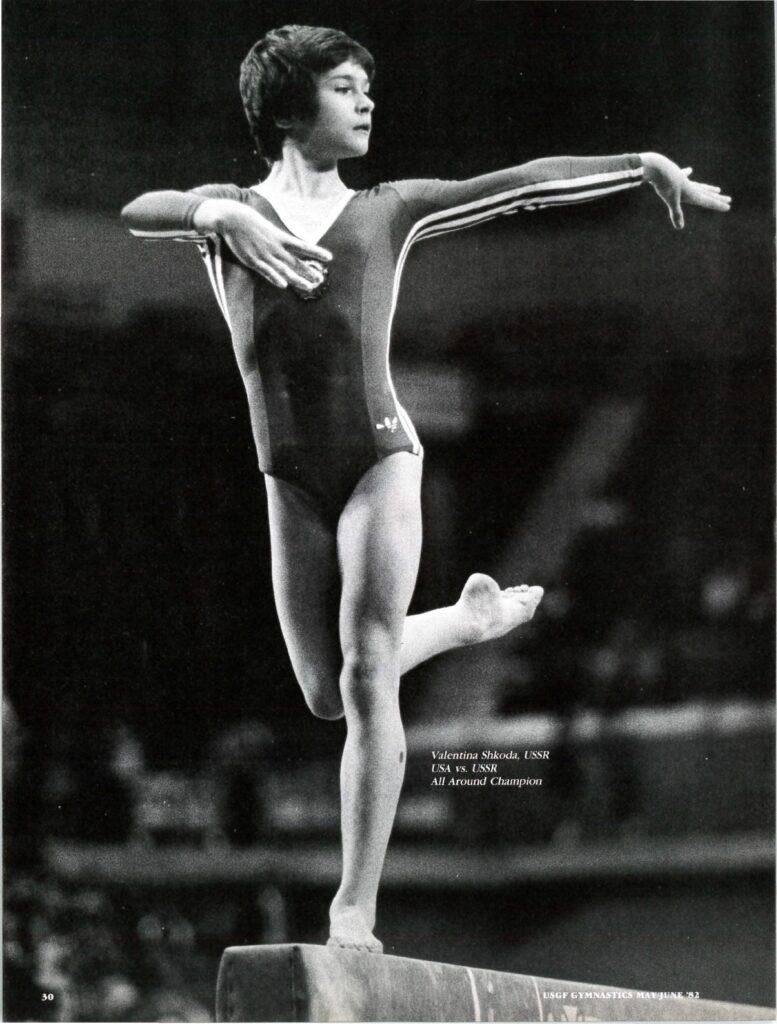
Yet by April 1982, when the Soviet Union traveled to the United States for a dual meet against the Americans at the University of Florida, something no longer added up. USGF News reported that Shkoda was fourteen, which was impossible. Born in 1969, she could not yet be fourteen in 1982; she was still thirteen.
With a new birth year on paper, Shkoda won the all-around with 39.25 (9.80, 9.75, 9.85, 9.85), finishing ahead of Kathy Johnson’s 38.95 and Michelle Goodwin’s 38.85.
A few weeks later, Shkoda competed at the 1982 USSR Cup. Although the FIG’s minimum age for senior international competition was fifteen, the Soviet Union allowed fourteen-year-old female gymnasts to compete at the senior national level. (On the men’s side, gymnasts had to be sixteen—the same age as the FIG’s requirement.) After the meet, Vladimir Golubev published an essay titled “Protect Talent” in Sovetsky Sport, reflecting on the toll placed on the youngest competitors. Turning his attention to gymnasts like Shkoda and Olga Mostepanova, he posed a pointed question:
“Are we not rushing things by admitting such extremely young girls as Tanya Kim, Valya Shkoda, and Olya Mostepanova to the grueling adult marathon (and a team one at that, where the responsibility is especially great)? Yes, Olya held up, but the others did not—they dropped out of the competition. Care, and care again, is what our talents need. Haste will lead to nothing good and will only cause harm.”
— Sovetsky Sport, May 28, 1982
Golubev could not openly state the obvious—that these gymnasts’ ages had been falsified. But he did not need to. By asking why they were being rushed, he invited readers to draw their own conclusions. A careful reader of Sovetsky Sport could do the arithmetic. Born June 23, 1969, Valentina Shkoda was not eligible to compete with the seniors at the USSR Cup; she had not yet turned fourteen. The proof had been published in the same newspaper only months earlier, under Golubev’s own byline.
Further confirmation of the age alteration came the following year. In 1983, just before the World Championships in Budapest, Sovetsky Sport printed a list of national team members and reserves. Shkoda’s entry read:
Valentina Shkoda.
Moscow, Burevestnik.
Born June 23, 1968.
International Master of Sport.
Fifth place at the USSR Cup, 1983.
Eighth-grade student.
Coach — L. Komarova.
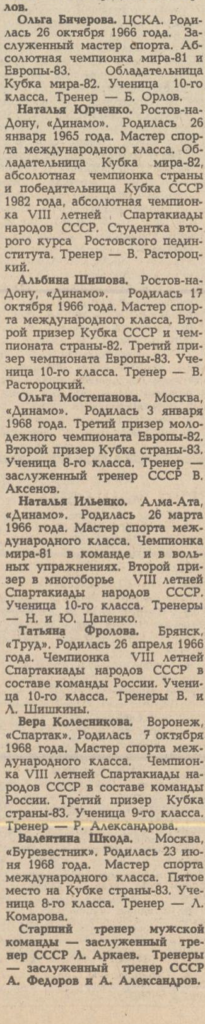
Her birthdate was no longer June 23, 1969, as it had been printed in 1981. It was now June 23, 1968—one year earlier. On paper, the change made her fifteen and thus eligible for the 1983 World Championships. Ultimately, she was not selected for the team. Her fellow Muscovite Olga Mostepanova was chosen, and like Shkoda, her birth year had been quietly shifted from 1969 to 1968.
While confusion surrounded Mostepanova’s age for decades, there was no such ambiguity in Valentina Shkoda’s case. Her real birthdate had already been published, clearly and unequivocally, in the national sports press. The subsequent change did not correct a mistake. It overwrote a truth that had become inconvenient.
Since little has been written about Shkoda over the years, here is a translation of her 1981 profile.
Ten Points for Valentina
The 12th USSR Youth Championships in Artistic Gymnastics concluded at the capital’s Olympic Sports Complex. On the final day, medals were contested in the individual apparatus events of the all-around.
One of the most notable gymnasts on the competition floor was Moscuvite Valentina Shkoda.
Athlete Profile
Valentina Shkoda
Moscow, Burevestnik
Born June 23, 1969
Sixth-grade student at Sports Boarding School No. 9, Pervomaysky District
Silver medalist of the USSR Youth Championships in the Candidate for Master of Sport program
Champion on balance beam
Coach: L. Komarova
“You can’t imagine what a mischievous and funny girl she is,” Lyudmila Komarova said, keeping an eye on Valya, who was due to go out onto the apparatus in just two or three minutes. “Life at our sports school would be duller without her. When Shkoda is in the gym, everyone’s mood lifts. She’s like a little spinning top of joy! And she never parts with books—she reads on the metro, while walking down the street, at home… Go ahead, ask her what she’s reading right now.”
“But she’s about to compete…”
“She’s not nervous at all—see, she’s chatting away about something with Tanya Kim.”
“Valya, what’s your favorite book?”
‘The Two Captains,’ Shkoda replied after a moment’s thought.
[The Two Captains, written by Vladimir Kaverin and published in 1944, follows Aleksandr Grigoryev, an orphan who grows up during the upheavals of early-20th-century Russia and devotes his life to uncovering the truth behind a doomed pre-revolutionary Arctic expedition. ]
Her eyes are bright and playful. Her little face is impish. I already know that Valya is an excellent student; she had only two grades of “good” this term.
A minute later, Valya was already fluttering across the balance beam. The hall fell silent. Shkoda showed outstanding class, elegantly performing such difficult connections as two back handsprings to layout salto, round-off to salto, and a double salto dismount. Her routine included seven elements of the highest difficulty group, which, under the rules, brings substantial bonuses.
The scoreboard lit up: 10 points!
…Six years ago, Valya was walking somewhere along 16th Parkovaya Street with her grandmother. Coming toward them was coach Komarova. She noticed the girl, and intuition prompted her: What if this is the one I’ve been looking for?
“How old are you?”
“Six.”
“Come to the sports school and try gymnastics.”The next day, Vladimir Mikhailovich and Tamara Grigoryevna brought their daughter to Komarova.
“Will she manage? The girls in your group have already been training for a whole year.”
Seven months later, Valya Shkoda won the sports school championship under the special program.
She loves her training partners and wishes them success even more than she wishes it for herself. When Lena Shushunova completed her vault, Valya—who was competing next—clapped louder than anyone else.
Valya’s leg has been bothering her, but she stubbornly says, “I’ll do floor anyway!” And she does—and how! The choreography is excellent, lively, and fiery.
“Our choreographer is strong—Galina Milyakina,” Komarova explains.
…During the Olympic tournament, Bogdan Makuts waved to her from the podium—specifically to Valya Shkoda, his friend, a girl dreaming of great victories.
By: V. Golubev, Master of Sport
Published: Sovetsky Sport, November 7, 1981
At the competition, Shkoda won beam:
- Vault and Floor Exercise: E. Shushunova (Armed Forces) — 19.2 and 19.2
- Uneven Bars: E. Belkina (Armed Forces) — 18.825
- Beam: V. Shkoda (“Burevestnik”) — 19.575
And she took silver in the all-around:
- T. Kim (“Moldova”) — 74.70
- V. Shkoda (“Burevestnik”) — 74.65
- E. Shushunova (Armed Forces) — 74.60
Note: This Kim is not related to Nellie Kim.
Note #2: I always wonder how much fiction is woven into these Soviet profiles. Valentina, if you ever read this, please let us know if The Two Captains really was your favorite book.
More on Age