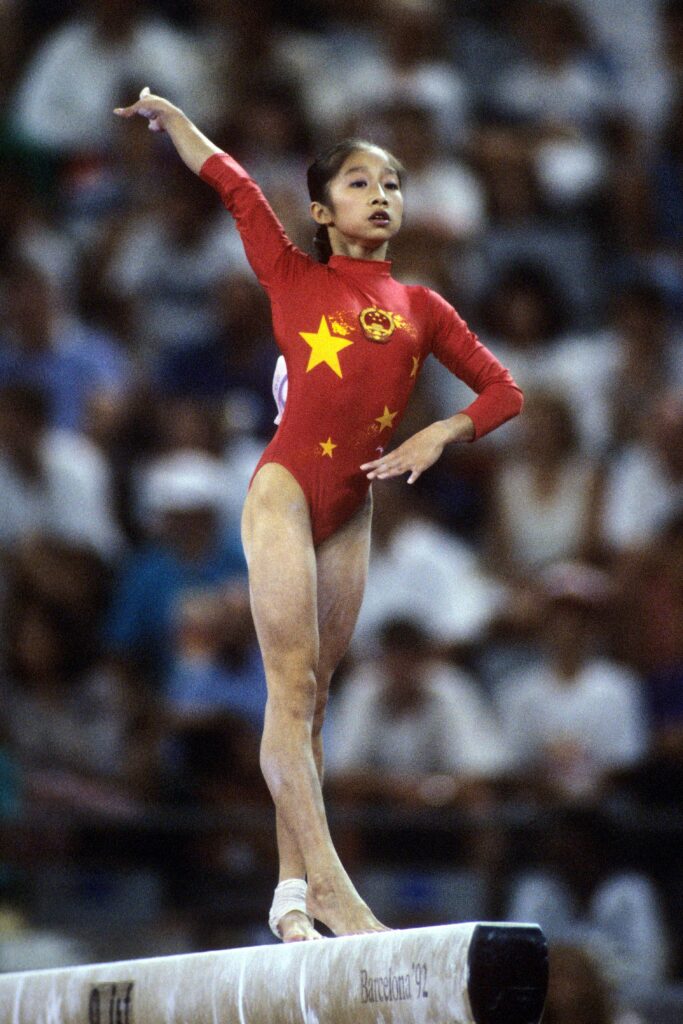
Lu Li was fifteen years old — or so the record showed — when she mounted the uneven bars at the 1992 Barcelona Olympics and earned a perfect 10.0, becoming the first gymnast from Hunan province to win an Olympic gold medal and the second Chinese female gymnast to do so, following in the footsteps of Ma Yanhong.
The interview below, published in August 2006 by the Hunan Daily and translated here from Chinese, finds Lu Li fourteen years later — living in Gilroy, California, coaching alongside her husband, and reflecting on her career and her relationship to the sport: driven by curiosity rather than obligation, and by a stubbornness she wears as a point of pride. She crossed half of Changsha alone at age six to sneak into a gymnasium. She arrived at Peking University having never attended regular school and insisted on being treated like any other student. The interview is, among other things, a portrait of that temperament — and of what became of a champion after the spotlight moved on.
One detail is worth noting before reading. The article lists her birth year as 1977. With a late-August birthday, she would have still been fourteen at the time of the Olympics, turning fifteen weeks later. Her official competition record, however, lists a birth year of 1976, making her fifteen in Barcelona, turning sixteen weeks later. Why her birth year was altered is unclear, particularly since her real birth year of 1977 would have made her age-eligible for the 1992 Olympics. (It is my understanding that she uses a 1977 birth year in the United States.)
At any rate, enjoy the interview below!
Success Comes from Interest
An interview with Lu Li, the first Olympic gold medalist in Hunan’s history
August 29, 2006
Source: Hunan Daily
When the cheerful laughter of Lu Li came through the other end of the overseas phone call, time seemed to rewind fourteen years.
On August 2, 1992, at the Barcelona Olympic Games, Lu Li floated lightly between the uneven bars. After completing the innovative, high-difficulty element named after her—the “Lu Li” salto—she landed softly on the mat like a small swallow gliding to earth.
When the six judges simultaneously displayed the perfect score of “10.0,” the arena, after a brief moment of breath-holding silence, erupted in thunderous applause. At that same moment, enthusiasm in her hometown also burst into flame, because Lu Li had just made history as the first Olympic gold medalist from Hunan.
Fourteen years have passed in the blink of an eye, and Lu Li has gradually faded from public view. How is she doing now? With that question in mind, the reporter conducted a phone interview with her in late August.
Interest and Determination Conquer Everything
Born in 1977, Lu Li is a stubborn native of Changsha. From the age of five, she spent her days in the gymnasium pushing her body to its limits. By the time she entered the national team in 1991, she was always striving to do more than others.
What she did not realize was that she had contracted liver disease at a young age. As her health deteriorated, training loads that might be normal for others became double—or more—for her body.
Yet when she spoke about that period during the phone call, she did so lightly: “I love gymnastics. Whenever I encounter the challenge of a new skill, a sense of curiosity always drives me to conquer it.”
This interest and curiosity were so strong that at the age of six she would cross half the city of Changsha alone, sneaking off to the gym to train. By twelve, she had essentially mastered the “Lu Li” salto, an innovative combination incorporating difficult elements from the men’s horizontal bar.
Even at the Olympic Games, when she stood on the podium wearing a gleaming gold medal, there were no tears of emotion in her eyes—only curiosity and excitement greater than anyone else’s.
After the Barcelona Olympics, Lu Li retired at age seventeen due to health reasons, and the following year she entered the School of International Relations at Peking University.
Since she had never attended regular school as a child, did she feel worried or uncertain?
She gave the same answer: “I was full of curiosity about studying. I knew it would be difficult, but athletes are people who face difficulties head-on.”
Although the university offered her many preferential policies, the stubborn Lu Li insisted that the school treat her exactly the same as other students.
“Only that way can I truly learn something. I don’t require myself to get excellent grades, but I must at least pass.”
When asked why she went to the United States after graduation, she laughed.
“Actually, my motivation for coming to the U.S. was very simple—I wanted to learn English well.”
Lu Li enjoys communicating with people, and languages became her greatest academic interest during university. Besides English, she even put considerable effort into learning Cantonese.
Because she had never studied English systematically like her classmates, no matter how hard she worked she could not reach the level she wanted. After graduating in 1999, driven by her fascination with English, curiosity about the outside world, and her unwillingness to give up, she set off for the United States and began a new chapter in life.
A Love for Gymnastics That Cannot Be Let Go
After arriving in the United States, Lu Li first worked as a coach at a gymnastics club while continuing to study English. She successfully trained a group of young athletes.
Even happier was that she met her current husband there: Kim Gussenhoven. Kim is also a gymnastics coach and had been U.S. national vault champion three times. He is helpful by nature, and he and Lu Li share many similar ideas about coaching.
The two soon became close. They married in 2003, and the following year welcomed a lovely baby boy. By then, Lu Li’s health had also recovered.
Lu Li and Kim established their own gymnastics club at the end of 2000, naming it AAC, meaning All-Around Champion Club. In September 2005, the family moved to Gilroy, California, where AAC gained a permanent training facility and improved equipment.
Chinese gymnastics traditionally emphasizes upper-body strength, which is why Lu Li excelled on the uneven bars. American gymnastics, by contrast, focuses more on lower-body power, and Kim specializes in vault.
Together, they provide recreational and beginner gymnastics training for local children. Their expertise complements each other perfectly.
Concern for Chinese Gymnastics
What Lu Li cannot forget most, however, is the development of gymnastics in China and in Hunan.
When speaking about the Chinese team’s disappointing performance at the 2004 Athens Olympics and the rise of the U.S. gymnastics team, she offered several thoughts.
She believes that the American team carefully studied its athletes’ weaknesses in upper-body training and strengthened that area, reducing China’s traditional advantage. At the same time, the U.S. team continued innovating within its own strengths—for example in lower-body power training and music choreography for floor exercise—which further narrowed the gap between the two countries.
In addition, the American system selects athletes through two channels:
- Competition results, and
- Coaches’ recommendations based on training
China has done somewhat less in the first area. As a result, it may select athletes who perform well in training, but not necessarily those who perform best in competition—in other words, gymnasts whose psychological resilience in competition may not be strong enough.
Finally, Lu Li expressed her hope that Chinese athletes preparing for the 2008 Olympic Games would achieve excellent results, and she very much hopes to go to Beijing to cheer them on.
She also expressed deep gratitude to all the coaches and teammates who had helped her.
In her personal life, she hopes that her father can obtain a U.S. visa as soon as possible to reunite with her, so that after her mother’s passing she can fulfill more of her filial duty toward him.
—
Note: Lu Li currently lives in Washington state.
成功源自兴趣——访湖南奥运史上首金获得者陆莉
2006年08月29日
来源:红网-湖南日报
本报记者 李宁 当越洋电话的另一端传来陆莉爽朗的笑声,时间似乎又回到了14年前。1992年8月2日的巴塞罗那奥运会赛场上,陆莉轻盈地在高低杠之间翻飞,完成以她名字命名的高难度创新动作“陆莉”空翻后,像小燕子一样轻巧地飞落在地上。 当6名裁判同时亮出满分“10分”时,全场观众在屏气凝神的短暂寂静之后迸发出了雷鸣般的掌声,家乡人民的热情也在这一刻燃烧了起来,因为这意味着陆莉作为湖南奥运史上首金的获得者被载入史册。 转眼就是匆匆十四载,陆莉也逐渐淡出了大家的视线。她现在还好吗?记者带着这样的疑问于8月下旬对她进行了电话采访。 兴趣和倔强战胜一切 1977年出生的陆莉是一个倔强的长沙人。她从5岁开始就整天泡在体育馆里挑战自己的身体极限,直到1991年进入国家队,她总是努力比别人做得更多。但是她并不清楚自己很小就被感染了肝病,健康状况的恶化使得正常人一倍的训练对她的身体负荷而言是两倍或者更多。 她在电话里说起这段往事时,却轻松地说:“我喜欢体操,每当我遇到一个新动作的挑战时,总有一股好奇心驱使我去征服它。”这种兴趣和好奇心是如此之强,使得她6岁就独自一人横跨半个长沙市,偷偷跑去体育馆训练,12岁就已经基本掌握了“陆莉”空翻的技巧,这是一套融合了当时男子单杠高难度动作的创新。就是在奥运赛场上,当她挂着金灿灿的金牌时,眼里没有激动的泪水,却比别人多了一份好奇和兴奋。 巴塞罗那奥运会之后,17岁的陆莉因为健康原因不得不退役,翌年去北京大学国际关系学院读书。陆莉从小就没有正式上学,当时有没有担心和疑虑?她还是那句话:“我对读书充满了好奇,虽然知道会很难,但是我们运动员都是知难而上的人。”她进入北大时有许多的优惠政策,但是倔强的她却要求学校像对待其他同学一样地对待自己。陆莉说:“只有这样我才能真正学到东西。我不要求自己的成绩很好,但一定要合格。” 当记者问她为什么会在毕业之后去美国时,她咯咯地笑了起来,“其实我来美国的动机很简单,就是为了要学好英语。”原来陆莉喜欢与人交流,语言成了她在大学期间最感兴趣的学习方向,不仅是英语,甚至连粤语也成了她花心思的攻克对象。由于她不像其他同学那样按部就班地学习过英语,无论她怎么努力也不能达到理想的水平。1999年毕业后,她因为对英语的着迷,对外面世界的好奇和不服输的倔强,踏上了前往美国的旅途,开始了一段新的人生。 无法割舍的体操情 陆莉赴美国后最开始在一家体操俱乐部担任体操教练、学习英语,并成功地带出了一批小运动员。更加幸福的是,她在那里遇到了她现在的丈夫肯姆•加森霍温。肯姆也是一名体操教练,曾3次获得美国跳马全国冠军。他乐于助人,而且与陆莉在一些训练理念上有很多不谋而合的地方,两人很快就走到了一起,并于2003年结婚,次年有了一个可爱的小男孩,陆莉的身体也恢复了健康。 陆莉与肯姆于2000年底建立起了自己的体操俱乐部,取名叫AAC,意思是全能冠军俱乐部。2005年9月他们一家搬到了加利福尼亚州的吉尔洛市,AAC有了固定的场所,设施也得以完善。 中国体操历来注重上肢力量的训练,因此陆莉在高低杠上成绩突出。美国体操则偏重下肢力量的训练,而肯姆正是跳马健将。两人在一起为当地小孩提供娱乐性和初级体操培训,可谓是互补所短,相得益彰。 但是陆莉最念念不忘的还是中国和湖南的体操发展。提起中国体操队在2004年雅典奥运会上的失利,和美国体操队的崛起,她谈了一些自己的看法。 她认为,由于美国队认真研究了队员在上肢训练上的弱点,并且加强了这方面的训练,使得中国队原有优势不再明显;另一方面,美国队在自己传统优势上不断创新,例如在下肢力量训练、自由体操中的音乐编排等方面,使得美国队进一步缩小了与中国队的差距。 另外,美国队选苗子从两方面入手,一是通过各种比赛来看成绩,另外是通过训练来看教练的推荐。而中国体操前者做得相对不足一些,这样容易选出来一些训练型选手,而不是比赛型选手。也就是说,选手训练成绩可能很好,而比赛时心理素质不过硬。 最后,陆莉希望正在备战2008年奥运会的中国运动员能够在赛场上取得好成绩,并非常希望能届时到北京为他们加油。她非常感谢曾经帮助过她的所有教练和伙伴。生活上,她则希望自己的父亲能尽快得到美国签证与自己团聚,这样她就能在母亲过世后多为父亲尽一份孝心。
Archived here.
Appendix A: Lu Li’s 1992 Victory
A Golden Swallow on the Bars—A Brief Account of Lu Li’s Uneven Bars Victory
People’s Daily, August 3, 1992, Page 4
By reporter Guo Weicheng
Little Lu Li, wearing a blue leotard with a dazzling national emblem on her chest, calmly walked onto the uneven bars platform. She ran up, jumped, and flew onto the bars like a little swallow. Before the audience’s eyes had even settled, Lu Li had already executed a beautiful forward giant circle, followed by a 360-degree turn. Then, in a reverse grip position, she performed an inverted hang circle, followed by a front flip to catch. At this moment, the crowded audience erupted in cheers. Continuing, little Lu Li executed an arc turn of 180 degrees, followed by three consecutive high-difficulty moves: flight circle, straddle circle, handstand—both beautiful and thrilling, dazzling to watch. Finally, she performed a straight double back somersault, nailed to the ground. Immediately, thunderous applause filled the venue.
Lu Li happily raised her hands to acknowledge the audience and bounced and skipped off the platform. At that moment, the huge electronic scoreboard lit up brilliantly: “Lu Li, 10.000.” The judging panel, composed of six gymnastics experts from Bulgaria, Portugal, Hungary, Israel, Germany, and Italy, unanimously awarded Lu Li a perfect score. The Sant Jordi Gymnastics Hall cheered for Lu Li once again. In this competition that gathered contemporary women’s gymnastics superstars including Boginskaya and Zmeskal, Chinese girl Lu Li became the first champion to earn a perfect score with her flawless performance.
This set of high-difficulty moves was first created by Lu Li and her coach. In April of this year at the World Cup individual gymnastics competition in Paris, the routine was officially named after “Lu Li.” Unfortunately, that time Lu Li didn’t land steadily when dismounting and only received a score of 9.875, placing fourth. After returning home, Lu Li regretted it for quite a while. After all, that was Lu Li’s first international gymnastics competition. In recent days, good news kept coming from the Chinese delegation, and Lu Li had several dreams—not of wearing gold or silver medals, but of coming down from the uneven bars with both feet nailing the landing.
Little Lu Li’s dream was finally perfectly realized.
(From Barcelona, August 1)
杠上衔金纤纤燕
——陆莉高低杠夺冠小记
本报记者郭伟成
小陆莉身穿蓝色的体操服,胸前缀着耀眼的国徽,从容地走上高低杠赛台。助跑、起跳,像小燕子似地飞上了高低杠。观众眼神甫定,陆莉已经做了个漂亮的向前大回环,再来个转体360度;然后,成扭臂握杠姿势,接反吊回环,再接前空翻抓杠。这时,万头攒动的观众席上发出一片喝采声。再看小陆莉,已经接着来了个弧形转体180度,又连续3个高难动作:腾身回环,分腿回环,手倒立,既漂亮又惊险,令人目不暇接。最后她来了个直体后空翻2周,稳稳当当地钉在地上。顿时,全场响起雷鸣般的掌声。
陆莉高兴地举手向观众致意,蹦蹦跳跳地跑下台去。这时,硕大的电子记分牌上发出了耀眼的光亮:“陆莉,10.000”。由保加利亚、葡萄牙、匈牙利、以色列、德国、意大利的6位体操专家组成的裁判团,一致给陆莉打了满分。圣豪尔迪体操馆里又一次为陆莉欢呼起来。在荟萃了包括博金斯卡娅、兹梅斯卡尔等一批当代女子体操巨星的本次大赛上,中国小姑娘陆莉成为第一个以其完美动作而赢得满分的冠军。
陆莉的这一套高难动作,是她和她的教练首创的。今年4月在巴黎举行的世界杯单项体操比赛中,该套动作被正式以“陆莉”的名字命名。可惜,那一次陆莉在下杠时没有站稳,只得了9.875分,名列第四。回国后,陆莉懊悔了好一阵。那毕竟是陆莉第一次出征国际体操大赛。近几天来,中国代表团捷报频传,陆莉做了好几回梦,不过,不是梦见胸前挂上了金银奖牌,而是梦见自己从高低杠上下来时,双脚都站得稳稳当当的。
小陆莉的梦终于完美地实现了。
(本报巴塞罗那8月1日电)
Appendix B: How Her Liver Problem Was Reported at the Time
The Ailing Swallow Dreams of Flight—Little Lu Li
People’s Daily, August 12, 1994, Page 11
By Miao Saiwang
Two years have passed since the Barcelona Olympics, and uneven bars gold medalist Lu Li seems to have been forgotten. Recently, she appeared at the Changsha Political Institute’s “Ling Gong” training class, wearing appropriate athletic clothing and with her familiar, lively face.
[Note: Ling Gong is a type of therapeutic physical conditioning that combines breathing, controlled movement, and mental focus to cultivate internal energy (qi), improve health, and enhance physical and mental discipline.]
It turned out that during a physical examination at the beginning of the year, a shadow was discovered on her liver. Combined with a torn ligament in her left foot from training last May that had not healed, she was forced to suspend training and return to her home province of Hunan for treatment.
In daily life, Lu Li gives the impression of being optimistic, cheerful, talkative, easy-going, and enterprising.
During her recuperation, while receiving treatment and maintaining physical exercise, she seized every opportunity to study at the Yingda Foreign Language School English class.
She said: “Leaving the training ground and looking at society, I truly recognized the lack of my own knowledge and became aware of the importance of studying and learning.”
Lu Li said with some regret: “For gymnastics, I left school and the classroom too early, incurring too much educational debt that I shouldn’t have. I envy others who can study on such elegant, quiet campuses. Going to university is also my greatest wish. Now that I’m on medical leave at home with time, I want to use it as reasonably as possible, striving to learn more and enrich myself. The golden age of a gymnast is extremely brief. When I retire in the future, I definitely want to return to campus. Championships are yesterday’s glory, past history. I cannot and do not wish to spend my whole life resting on my laurels, unable to do anything besides gymnastics. I’m only 17 years old, and the road ahead is still very long. In a certain sense, life’s journey has only just begun.”
Always dressed in athletic wear, Lu Li explained her choice of clothing: “I love athletic clothing just as soldiers love wearing uniforms, for the same reason, the same feeling. Half is due to professional preference, half is from the established and fixed affection for the clothing itself. Wearing athletic clothes constantly reminds me that I am an athlete and cannot forget physical training and moral cultivation for even a moment.
“I’m participating in ‘Ling Gong’ training so that my body can recover as soon as possible and I can win several more gold medals for the country with my limited athletic life. Watching the Hiroshima Asian Games approach while my body is still in this condition, I feel a sense of urgency, and it’s particularly strong.”
病燕思飞小陆莉
缪腮旺
巴塞罗那奥运会已经过去两年,高低杠金牌得主陆莉似乎已被人淡忘。不久前,她身着得体的运动衣,和着她那张熟悉而生动的脸庞出现在长沙政治学院“灵功”训练班上。
原来,她年初在体检时肝部发现阴影,加之去年5月在训练中左脚韧带撕裂,一直没有痊愈,不得不中止训练,暂回湖南老家治疗。
生活中的陆莉,给人的印象是乐观开朗、健谈随和而富于进取。
休养期间,她一边接受治疗,坚持锻炼身体,一边见缝插针地参加英达外国语学校英语班学习。
她说:“离开了训练场,到社会上看一看,才真正认识到自己知识的贫乏,意识到读书、学习的重要性。”
陆莉带着些许遗憾说:“为了体操,我过早离开了学校,离开了课堂,欠下了太多不该欠下的学业上的债务。我很羡慕别人能在这么幽雅、宁静的校园里学习。上大学,也是我最大的愿望。现在病休在家,有了时间,我要尽可能合理地利用起来,争取多学点东西,充实自己。体操运动员的黄金时代是极其短暂的,将来退下来以后,我一定要争取重返校园。冠军是昨天的辉煌,过去的历史,我不可能,也不愿意躺在功劳簿上过一辈子,不能除了体操便无其他作为。我才17岁,以后的路还很长很长,从某种意义上说,人生的旅程刚刚举步迈出。”
总是一袭运动着装的陆莉对自己的服饰解释说:“我爱运动服装就如同军人爱穿军装,出于一样的道理,同种感受,一半是因为职业上的偏爱,一半是对服装本身形成和固定的感情。穿着运动服,便会时刻提醒自己是运动员,须臾不能忘记体能锻炼、道德修养。
“参加‘灵功’训练,就是为了身体早日康复,用有限的运动生命为国家多拿几枚金牌。眼看着广岛亚运会开赛在即,身体还是这个样子,我心中有紧迫感,而且特别强烈。”
Appendix C: Another Profile of Lu Li
This article lists her birth year as 1976, but the text states that she was 5½ in 1983. If she had been born in 1976, she would have been 6 or 7 at that time; a 1977 birth year is therefore more consistent with the account.
Lu Li: Swallow on the Bars
By Hua Yu New Xiang Review, Issue 7, 2008
Athlete Profile
Lu Li, born in Changsha, Hunan, in 1976. Began formal gymnastics training in 1983; entered the national team in December 1991. At the 1991 National Gymnastics Championships: uneven bars champion, all-around 4th place, women’s team champion. At the 1992 World Gymnastics Championships: uneven bars 4th place. At the 25th Olympic Games in 1992: uneven bars gold medal, balance beam silver medal, women’s team 4th place.
Lu Li is a legend — but one sustained, it seems, only by the memories of a dwindling few. Many people today do not even know who Lu Li is; after all, China’s gymnastics team has produced so many talents, so many iconic moments. Yet in all of gymnastics history, Lu Li is the first — and so far the only — athlete to have all six judges simultaneously award a perfect 10. Before her, only the celebrated Romanian “Queen of Gymnastics” Nadia Comaneci had won an Olympic gymnastics title with a perfect score, and even then only four judges were officiating.
Those who witnessed the uneven bars final at the Barcelona Olympics will not forget how Lu Li conquered everyone with her singular, high-difficulty “three-D combination” (later named the “Lu Li element”) — light and soaring on the bars, unmistakably a swallow in flight.
Lu Li, as the first Olympic gold medalist in Hunan’s history, has been written into the record books. Sixteen years on, her world-stunning performance at Barcelona still lingers in the mind. In early April 2008, to mark the 50th anniversary of the Hunan gymnastics team’s founding, Lu Li — who had spent years making her way in America — returned to her hometown as the owner of the AAC Gymnastics Club, and opened up her long-sealed memories to this writer.
A Gymnastics Prodigy Who Nearly Slipped Away
Lu Li was restless and fearless from childhood. At her father’s workplace stood a very tall tool cabinet; at barely three years old she would climb to the top and jump down without hesitation, not caring whether anyone was there to catch her. Her father had been an outstanding athlete at the Changsha Hydraulic Machinery Factory. Seeing that Lu Li had excellent jumping ability and all-round physical gifts, he quietly began to guide her, often taking her to play on swings and walk along concrete ledges.
But slight as she was, Lu Li was physically frail. To build up their daughter’s strength, her parents enrolled five-and-a-half-year-old Lu Li in the Changsha Amateur Sports School for gymnastics in 1983. Her first coach, Zhou Xiaolin, took one look at the bouncing, leaping child and was immediately convinced she was natural gymnastics material. Zhou lifted her onto a vaulting horse 1.3 meters high to test her nerve. The result: she stood on top, launched herself off without a moment’s hesitation, and flew toward Coach Zhou like a swallow.
Coach Zhou was famously demanding in training, and little Lu Li always practiced with exceptional seriousness, never once complaining of hardship. Then a small incident nearly buried this gymnastics prodigy entirely. Because Lu Li’s home was far from the gymnasium, the years of commuting wore her parents out, and they had no choice but to tell her to stop training. But Lu Li could not bear to leave the gymnastics team. She recalls: “Two days later I couldn’t hold back any longer. That evening it happened to be pouring rain. I grabbed a few coins, took the bus on my own to the Hunan Provincial Gymnastics Training Center, and found my first coach, Zhou Xiaolin. She was bewildered and asked why I had come so late. I told her: I have to do gymnastics.”
When Coach Zhou learned of the family’s situation, she appealed to Lu Li’s parents to allow her to continue training, and arranged for Lu Li to live together with her own daughter to solve the problem of the daily commute. Coach Zhou’s genuine warmth moved Lu Li’s parents, and Lu Li was finally able to go on training.
Six Perfect 10s Dazzle Barcelona
In 1985, with her exceptional physical gifts and solid foundation, Lu Li smoothly entered the Changsha Sports School. In 1988, she officially joined the Hunan Provincial Gymnastics Team, where she encountered her second coach, Yan Ninan. At the 1989 National Youth Games, Lu Li’s uneven bars performance caused a sensation. In 1991, at the National Gymnastics Championships, she burst into prominence, winning the uneven bars title and finishing 4th in the all-around. Shortly afterward, she was formally transferred to the national gymnastics team.
In April 1992, Lu Li competed at the inaugural World Gymnastics Individual Event Championships held in Paris — her first major international competition. Due to limited experience, she took a step on landing, and that one step dropped her to 4th place. But her unique, high-difficulty uneven bars routine sent shockwaves through the international gymnastics world, and the FIG named her “three-D combination” the “Lu Li element.”
Preparations then began for the approaching Olympics. Because Lu Li had won titles only at the national championships and lacked a more prominent international record, she was listed only as a reserve for the Olympic team. Then came an unforeseen development: Olympic team member Li Li suffered an accidental injury and was unable to compete. Lu Li stepped in to replace her and caught the last train to the Games.
At 2:50 a.m. Beijing time on August 2, 1992, the women’s uneven bars final at the Palau Municipal dels Esports in Barcelona was fiercely contested. As Lu Li was still relatively inexperienced, most expected the Ningbo native Yang Bo to prevail — but Yang Bo faltered in competition. At that point, little Lu Li stepped forward: 1.36 meters tall, 37 kilograms. Before she took the floor, the American gymnast had scored a high 9.987; for Lu Li to win gold, she needed a perfect 10 — something virtually everyone in the arena considered almost impossible.
Once on the apparatus, Lu Li flew between the bars like a swallow, executing a forward giant swing into a 360-degree twisting straddle, connecting into an inbar hip circle and inbar front salto, then a curved release over the low bar into a counter-kip and an uprise straddle over the high bar, finishing with a high-difficulty double back salto dismount — soaring off the bars, drifting down like a swallow, and landing solidly. After a brief, breathless silence, the tens of thousands in the arena erupted in thunderous applause. All six judges simultaneously showed “10” — she had topped every rival with a perfect score and taken the gold medal, creating a miracle in Olympic gymnastics history. Ten minutes later, in the balance beam final that immediately followed, Lu Li earned a silver medal with a score of 9.912. The media immediately dubbed Lu Li the Chinese gymnastics team’s “secret weapon.”
An Unbreakable Bond with Gymnastics
After Barcelona, the 17-year-old Lu Li was compelled to retire due to health reasons, and the following year enrolled at Peking University’s School of International Studies. When she first entered university, many people recognized her and came forward to greet her; each time she responded with a quiet, friendly smile, without any trace of self-importance. She felt that even though she had achieved success in gymnastics — success she could treat as a new starting point — it was not everything, and in every other respect she was beginning from zero. Having trained in gymnastics since the age of five, with every day consumed by exhausting practice, she had barely had time to study. The academic pressure at Peking University was immense; after all, the students around her had earned their places through national examination competition. But Lu Li threw herself into her work, methodically conquering each academic obstacle, and she graduated successfully in 1999.
After graduation, Lu Li chose to cross the ocean and make her way in the United States. She began working as a gymnastics coach in California, later coaching at a prominent sports club. Her salary was not high, but her coaching results were excellent — several of her students won titles at major club competitions across California.
After years of effort, Lu Li now owns her own gymnastics club. But the low-profile Lu Li chose not to name it after herself; she called it “AAC,” meaning “All-Around Champions Club.” She explains with a laugh: “The name AAC was actually given by the USA Gymnastics association, because the students I’ve trained consistently win all-around and team titles in domestic American competitions.”
On why she chose to go to America after retiring, the ever self-reliant Lu Li said: “I felt that life in America would really challenge me. If I had stayed, I would have gone on being looked after by those around me. I had so many friends, so many people helping me, that I was losing my sense of self. In America I could prove my own abilities — everything depends on yourself alone. I think that’s a good thing.”
That is Lu Li. Perhaps our memory of her is gradually fading, but we will always remember that summer of 1992 in Barcelona — always remember that slender, beautiful girl, always remember the moment she danced like a little swallow on the uneven bars, always remember the magnificent instant she conquered the whole world, always remember the miraculous story of six judges raising “10” all at once……
陆莉 杠上飞燕
华玉
新湘评论
人物档案
陆莉,1976年出生于湖南长沙。1983年正式投入体操训练,1991年12月进入国家队。1991年在全国体操锦标赛中,获得高低杠冠军和全能第4名,女子团体冠军;1992年在世界体操单项锦标赛上,获高低杠第4名;1992年在第25届奥运会体操比赛中,获高低杠金牌、平衡木银牌和女子团体第4名。
陆莉是一部传奇。但这部传奇似乎只靠一部分人的回忆去维持。如今有许多人甚至不知道陆莉是谁,毕竟中国体操队有太多的人才,太多的经典瞬间。但是,世界体操历史上能让6名裁判不约而同地打出满分10分的,陆莉是第一人,也是目前唯一一个。以满分的佳绩夺得奥运会体操冠军,在陆莉之前,只有赫赫有名的罗马尼亚”体操皇后”科马内奇享有过此项殊荣,而当时只有4名裁判执赛。
见证过巴塞罗那奥运会高低杠决赛的人不会忘记,陆莉凭借那套独特的、拥有高难度”三D相连”(后被命名为”陆莉动作”)的动作征服了所有人,她在高低杠上轻盈翻腾,那分明是一只飞舞的燕子。
陆莉,作为湖南奥运史上首金的获得者已被载入了史册。16年过去了,她在巴塞罗那奥运会上令世界惊艳的表现依旧让人回味。2008年4月初,为庆祝湖南体操队成立50周年,在美国闯荡多年的陆莉以”AAC体操俱乐部”老板的身份回到家乡,向笔者打开了尘封已久的回忆。
差点埋没的体操天才
陆莉从小就好动,胆子也大,在她父亲工作的地方有一个很高的工具柜,3岁多的她爬上去毫不犹豫地就往下跳,有没有人接也不在乎。陆莉的父亲曾是长沙市水工机械厂的运动尖子,他见陆莉弹跳力好,各方面的条件都不错,于是他就潜移默化地引导着她,经常带她去玩秋千,走走水泥台子。
但长得小巧的陆莉身体却很单薄,为了强壮女儿的身体,1983年,父母将5岁半的小陆莉送进了长沙市业余体校练体操。陆莉的启蒙教练周晓琳当时一看陆莉蹦蹦跳跳的,就觉得这个小孩子肯定是块搞体操的好料。于是周晓琳就把她抱到1.3米的高马上,想试试她的胆量。结果她站在高马上蹦地一跳,像燕子一样向周晓琳飞了过来。
周晓琳教练平时训练要求非常严格,小陆莉每次都练得格外认真,从不叫一声苦。后来一件小小的事情,差点将这位体操天才埋没了。由于陆莉家与体操房距离较远,时间久了,往返接送的父母都累倒了。迫不得已,父母只好叫陆莉停练。而这时的陆莉却不愿离开体操队了,她回忆说:”两天后,我实在憋不住了,那天晚上正好下着大雨,我拿了几毛钱,自己坐车跑到湖南省体操训练中心去,找到我的启蒙教练周晓琳,她很奇怪,问我为什么这么晚还跑过来。我对她说,我一定要练体操。”
当知道陆莉家庭情况后,周教练恳求陆莉的父母同意让陆莉继续训练,并让陆莉与她的女儿住在一起,以解决接送问题。周教练真诚的关怀,打动了陆莉父母,陆莉终于得以继续练起了体操。
6个”10分”惊艳巴塞罗那
1985年,陆莉以其独特的身体条件和扎实的基础,顺利地进入了长沙市体育学校。1988年,她正式进入湖南省体操队。在这里,遇到了她的第二任老师燕呢喃。1989年,全国青少年运动会,陆莉在高低杠上的动作一鸣惊人。1991年,在全国体操锦标赛中,陆莉一举成名,夺得了高低杠冠军和全能第4名。不久,陆莉被正式调入国家体操队。
1992年4月,陆莉参加了在巴黎举办的首届世界体操单项锦标赛,这是她第一次参加大型国际比赛。由于经验不足,她落地时挪了一步,就这一步把她挪到了第4名的位置。但她那套独特、高难的高低杠动作引起了国际体操界的轰动,国际体操联合会因此将她的”三D相连”动作命名为”陆莉动作”。
紧接着就是备战即将到来的奥运会。但因为此前陆莉只在全国锦标赛上拿过冠军,没有太突出的成绩,所以她还只是作为候补备战奥运。偏偏这时奥运选手李莉意外受伤,无法参加比赛。于是陆莉就顶替李莉,搭上了奥运会的末班车。
北京时间1992年8月2日凌晨2时50分,巴塞罗那市立体育馆内女子高低杠决赛异常激烈。由于那时陆莉毕竟还是经验少,所以大家更看好来自宁波的女孩杨波,但是杨波在比赛中却发挥失常。这时身高只有1.36米,体重37公斤的小陆莉出场了。在陆莉出场以前,美国运动员获得了9.987分的高分,陆莉要想夺冠,就只有获得满分10分——在所有人的眼中,这样的情况几乎不可能出现。
陆莉上场后,如飞燕般在杠间翻飞,她以向前大回环接转体360度成扭臂,接反吊回环和反吊前空翻,然后一个弧形转体飞越低杠接反掏和腾身回环分腿越过高杠,最后以一个高难度的后空翻两周下从杠间凌空飞出,像一只燕子,飘然而下,稳稳落地。全场上万名观众在屏气凝神的短暂寂静之后迸发出了雷鸣般的掌声——6名裁判同时亮出了”10分”,她以满分10分超过所有对手夺得金牌,创造了体操奥运史上的一个奇迹。10分钟后,紧接着的平衡木比赛中,陆莉以9.912的高分获得了一枚银牌。一时间,媒体都称陆莉是中国体操队的”秘密武器”。
无法割舍的体操情
巴塞罗那奥运会之后,17岁的陆莉因为健康原因不得不退役,翌年去北京大学国际关系学院读书。刚进入大学,许多人认出她,纷纷跟她打招呼,每次她都友好地微微一笑,没有一点张扬。她觉得,虽然在体操上取得了成功,可以把成功当作自己的下一个起点,但这不是全部,一切都还要从零开始。由于从5岁开始练习体操,每天都要辛苦地训练,因此陆莉一直没怎么读书,进入北大学习压力非常大,毕竟身边的同学都是全国考进来的尖子。不过,陆莉非常用功,努力攻克学业上的一个个难点,1999年她顺利地毕业了。
毕业后,陆莉选择远渡重洋赴美国发展。开始她一直在加州担任体操教练,后来在一家明星体育俱乐部当教练。她的工资不是很高,但她教的成绩很好,她带的几个学生在加州一些大型俱乐部比赛中获得了冠军。
经过多年的奋斗,如今陆莉已经拥有了自己的体操俱乐部。但低调的陆莉没有用自己的名字命名俱乐部,取的名字是”AAC”,意即”全能冠军俱乐部”。对此,陆莉笑着解释:”这个名字(AAC)其实是美国体操协会送的,因为我带出的学生在美国国内比赛中总是能夺得全能和团体冠军。”
对于退役后之所以要去美国,一直都自立自强的陆莉说:”我觉得在美国的日子对我挑战蛮大的。如果我不出去,就会一直生活在别人的爱护中。因为我身边的朋友特别多,帮我的人多了,我就没有了自我。而在美国可以体现我自己的能力,一切只能靠自己,我觉得这样挺好。”
这就是陆莉。也许我们对于陆莉的记忆正渐渐模糊,但是我们永远都会记得1992年巴塞罗那的那个夏天,永远记得那位美丽俏瘦的女孩,永远记得她在高低杠上像小燕子飞舞的瞬间,永远记得她征服全世界的那一美妙时刻,永远记得6位裁判同时亮出10分的神奇故事……
More on Age