For gymnasts whose ages have been falsified, a single birthdate is never enough. Their careers must be read against two calendars: the date on which they were actually born, and the date under which they were permitted to compete. Only by holding those two timelines together can we understand not just that an age was altered, but why.
Take Eugenia Golea. She was born in 1971, yet her first senior World Championship medals came in 1985. To be fifteen at those championships, she would have needed a 1970 birth year. But that was not the date under which she competed. Instead, Golea was officially registered as having been born in 1969, making her eligible for the Los Angeles Games. However, for Golea, things never quite came together in 1984.
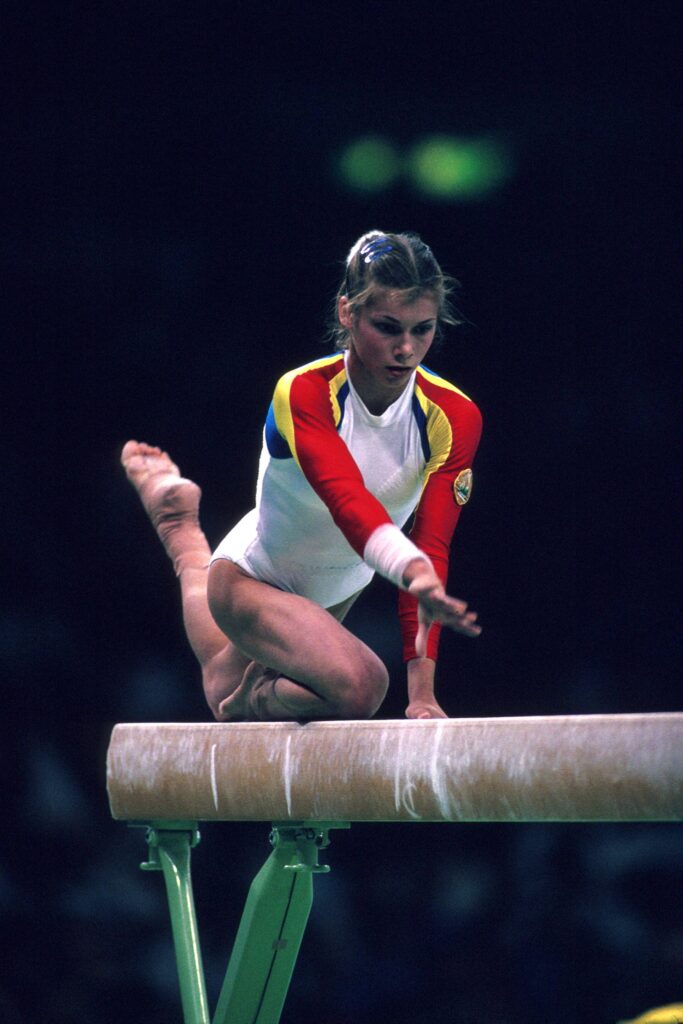
Photo credit: Norbert Schmidt
1984: The Year of Almost Making It
By 1983, Eugenia Golea was no longer merely a promising junior; she was already being fast-tracked through Romania’s internal competitive hierarchy. In April, at age 12, she finished second in Category III at the national School Sports Clubs Championships in Buzău, scoring 37.60 for C.S.S. No. 2 Bucharest—just a tenth behind the winner—and emerging as part of a new cohort described as “knocking on the door of recognition.”
The door opened quickly. By November, at the National Junior Championships in Baia Mare, Golea jumped categories and was competing in Category I—the system’s highest classification for school sports clubs—and winning decisively. She took the all-around with 39.20 and swept three apparatus titles: vault, uneven bars, and balance beam. Still officially a junior, she had become one of Romania’s most complete young gymnasts, nationally dominant and competitive across all events.
That dominance earned her a spot among the seniors. When the national team resumed training in Deva in January 1984, Sportul reported that “the ‘newcomers’ to the group are Simona Păucă and Eugenia Golea, young gymnasts of clear promise,” noting that their talent and ambition made them realistic candidates for future first-team selection.
Golea—still a junior by age—had been drawn into the senior national team conversation. But her performance had outpaced her paperwork. Under FIG regulations, senior international competition required a gymnast to reach fifteen during the calendar year of competition, and Golea had been born in 1971. She was just thirteen.
The solution was administrative. Romanian officials changed her birth year to 1969, transforming a gymnast who turned thirteen in 1984 into one who could be presented as fifteen.
The American Cup, scheduled for March, became her first senior international assignment. This was a big opportunity for Golea. Romanian coaches told Sportul that they were placing special emphasis on the competition, noting that the gymnasts needed to “reach competitive form as quickly as possible because at the end of February, we are scheduled to take part in the American Cup, and we want our debut in the new international season to be crowned with success.”
At thirteen—though fifteen on paper—Golea placed fourth in the all-around in New York, finishing behind Mary Lou Retton (USA), Laura Cutina (Romania), and Julianne McNamara (USA).
After Golea’s successful debut in the United States, coach Maria Cosma included Golea among gymnasts “in good training and competitive form,” alongside Ecaterina Szabó, Lavinia Agache, and Daniela Silivaș. Weeks later, it looked like she might compete at the European Junior Championships in Rimini. In April, Sportul listed her among four candidates for the competition, but in the end, Silivaș, Raluca Bugner, and Aurelia Dobre competed instead. She was still knocking on the door, waiting for her turn to be let in.
Later that year, Golea competed at the Balkan Championships, finishing third in the all-around behind Szabó and Camelia Voinea and ahead of Lavinia Agache. At the Cup of the Capitals in Sofia, she placed second in the all-around and won uneven bars.
Strong results. But not enough for Los Angeles.
The 1969 birth year turned out to be unnecessary for Los Angeles. But the Rubicon had been crossed. Romanian officials had shifted her age by two years and the paper trail could not be undone. From that point forward, Eugenia Golea was fixed in the records as a 1969 birth, and that’s the age that she would compete under for the rest of her senior elite career, including at the 1985 World Championships, where she won a team silver while being underage.
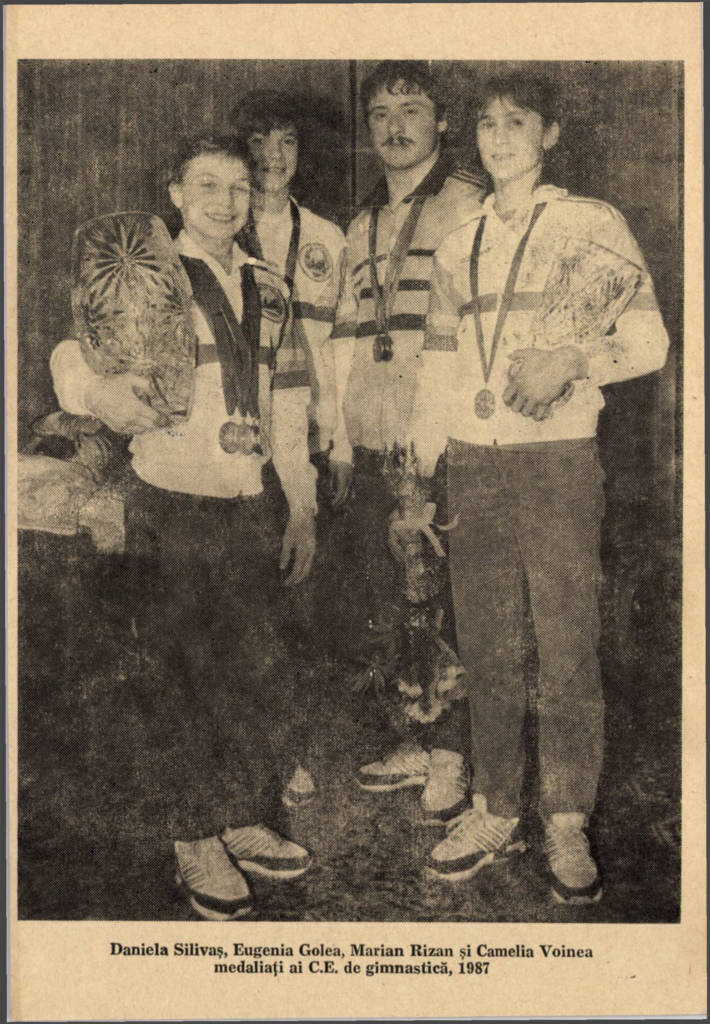
1987: A Year of Individual Success
By 1987, when all the pieces finally came together for her individually, Golea had spent three years competing under a falsified birthdate. At the May 1987 European Championships in Moscow, Golea placed fifth in the all-around. Sportul noted her “remarkable high-level performance,” with 9.800 on vault and beam, 9.775 on uneven bars, and 9.750 on floor. In the apparatus finals, she won silver on beam and bronze on vault.
The Romanian press framed her success largely in relation to Daniela Silivaș’s dominance. Flacăra magazine observed that Golea and Camelia Voinea “were prevented from winning more than silver and bronze, and silver respectively, only by Daniela’s presence in the competition. This was particularly the case in the balance beam and floor finals, where Eugenia and Camelia would have secured gold medals had Daniela not also competed.”
But Flacăra saw something larger at work than mere medal counts. In language that bordered on the mystical, the magazine elevated the Romanian team’s performance to a statement of national identity and even global harmony:
“When a child rises onto the podium of victory, time allows itself an extra heartbeat. A true children’s crusade, in the name of a faith simply called life and beauty, gymnastics has long since become more than a sport—it has become a symbol, a kind of emblem of talent and tenacity, of tradition and youth, of a particular way of being Romanian.”
The passage continued, naming Golea explicitly as part of this almost spiritual mission: “Much has already been said about the seasons, the mornings and afternoons of these children (beside Daniela stand, in all truth, Eugenia Golea, Camelia Voinea, and Marian Rizan—the latter perhaps the beginning of a competitive ascent in men’s gymnastics as well). Documentaries have been made, photo reports assembled, and books written. Yet nowhere in these testimonies do we find the mystery of the victorious smile.”
And then, the grand claim: “Daniela Silivaș is today the youngest lesson in life for each of us. With her—with these four children who returned laden with ten precious medals—we know better than ever how to value the Romanian tradition in gymnastics, but also the all-healing power of sporting competition. If, among the ancient Greeks, the time of the Olympics had the power to suspend all tensions, hostilities, and wars, we must believe that even today, in the name of the unwritten law of universal harmony, sporting victory protects us by bringing us together.”
It was rhetoric that transformed children into symbols, competition into crusade, and gymnastics into something approaching theology.
At the October 1987 World Championships in Rotterdam, Golea stood on the podium again, winning gold with her team and silver on vault. Előre reported that “our gymnasts earned no fewer than eleven perfect 10s,” with Golea receiving one of them. The article noted that “four Romanian gymnasts—Silivaș, Dobre, Golea, and Szabó—rightfully won medals” in apparatus finals.
For Golea, this was literally a dream come true. “Vaulting was my passion,” she later reflected. “I dreamed about how to get better and better every day and not forgetting my coach at the time, Mr. Adrian Goreac – I wouldn’t have done it without his hard work and persistence.”
But she also sensed that her results were, in some ways, beyond her control. “As for the judging, there is no control—just remember it was, and still has to do with, politics. I was not Shushunova. I did have the hardest vault in the finals.”
Moving Back Her Clock
By the time Eugenia Golea reached the summit of her career in 1987, the fiction that had been imposed on her in 1984 no longer mattered. With her actual 1971 birthdate, she was sixteen years old—age-eligible—when she won those European and World Championship medals and helped Romania reclaim the world title from the Soviet Union.
“1987 was the best year of my life,” she later said—proud not only of her silver medal on vault, but of helping Romania take back the world title after years of pursuit. “Coming back from the World Championships, we were treated like queens, and it was a great experience to be part of that celebration.”
Then came the Olympic year. It began like a continuation of Rotterdam. At the Romanian International in Constanța, she looked every bit a star: decisive in finals, brilliant on floor, and dominant on vault and beam. She was making her case to be on the Olympic team that had eluded her in 1984.
And then, that dream was called into question. “Training all your life to achieve that dream,” she remembered, “and it was almost gone in a matter of minutes when the tendon of the bottom of my left foot snapped. I thought it was over.”
She made the team anyway—“Luckily, I made the Olympic team, and the rest is history”—but it was not the history she wanted. She won silver with the team, but her time at the Olympics was described as a moment of underperformance and uncertainty. Romanian accounts said it in the careful language of official disappointment: she and Camelia Voinea “did not perform at the level anticipated by the coaches for the Olympic Games. Their performances were sometimes marked by inconsistency and were often scored below expectations (the former, it must be said, was not at full strength.)”
After Seoul, she was removed from the senior national team and assigned to prepare for the World University Games—an administrative demotion that functioned as a verdict.
In reality, she was eighteen; on paper, she was already twenty.
Either way, a younger cohort was already knocking at the door of opportunity, and yet, Golea did not give up. She continued to compete in 1989 at meets like the Semenic Trophy, but in the press, it was obvious that the federation was trying to close the door on her career. After a dual meet with Czechoslovakia, Sportul printed a paragraph about Golea: “Positive remarks must also be made about Eugenia Golea, who, through remarkable willpower and determination, succeeded in reaching a level of form that once again secured her a place on the national team, serving as a fine example for the younger gymnasts on the national team.” She was no longer a contender; she was an example of good character traits for young gymnasts.
Decades later, Golea does her own time traveling. Whereas the adults around her pushed her clock forward on paper, she sometimes moves her clock back in time. “Even though I did not get into the finals on vault, due to my injury, I still dream that I won the Olympics on vault.”
And she adds, with a note of wistfulness: “I would have loved to challenge Simone Biles and McKayla Maroney on vault.”
References
Karen Louise Hollis, Romanian Gymnasts in Conversation (2020).
Sportul, June 24, 1980 (Anul 36, nr. 9508). “200 Gymnasts at the Finals of the School Sports Clubs Championships.”
Sportul, April 11, 1981 (Anul 37, nr. 9753). “S.C. Bacău and Petrolul Ploiești Teams Win the Championship of the Youngest Gymnasts.”
Sportul, October 7, 1981 (Anul 37, nr. 9904). “Republican School Clubs Gymnastics Competition.”
Sportul, June 30, 1982 (Anul 38, nr. 10128). “Obor — A Living Hub of Bucharest Sport.”
Sportul, June 30, 1982 (Anul 38, nr. 10128). “Competitions of the Young Gymnasts.”
Sportul, November 8, 1982 (Anul 38, nr. 10238). “Junior Gymnasts Championships.”
Sportul, November 10, 1982 (Anul 38, nr. 10240). “‘Romania Cup’ in Gymnastics.”
Sportul, April 20, 1983 (Anul 39, nr. 10376). “New Gymnasts Knocking on the Door of Recognition.”
Sportul, November 21, 1983 (Anul 39, nr. 10557). “Simona Păucă — Winner of the Masters Category.”
Sportul, January 13, 1984 (Anul 40, nr. 10601). “The First Rounds of Intense Training for Romania’s Leading Gymnasts.”
Sportul, March 20, 1984 (Anul 40, nr. 10658). “Laura Cutina — Second Place in the ‘American Cup’ Gymnastics Competition.”
Sportul, March 31, 1984 (Anul 40, nr. 10668). “Between New York and Los Angeles — New Objectives for Our Gymnasts.”
Sportul, April 27, 1984 (Anul 40, nr. 10691). “European Gymnastics Championships for Juniors.”
Sportul, May 15, 1984 (Anul 40, nr. 10704). “Gymnastics Hopes on the ‘Slope’ Toward Full International Recognition.”
Sportul, January 21, 1985 (Anul 41, nr. 10917). “Our Women’s Gymnastics Team Must…”
Sportul, April 20, 1985 (Anul 41, nr. 10994). “The International Championships of Romania, at the ‘Victoria’ Hall in Ploiești.”
Sportul, April 30, 1985 (Anul 41, nr. 11002). “Victory for Our Gymnasts, in the Run-Up to the European Championships.”
Sportul, September 26, 1985 (Anul 41, nr. 11127). “Balkan Gymnastics Championships.”
Sportul, September 30, 1985 (Anul 41, nr. 11130). “Romania’s National Teams — Balkan Gymnastics Champions.”
Sportul, October 8, 1985 (Anul 41, nr. 11137). “At Reșița: A Useful Check Ahead of the Gymnastics World Championships.”
Sportul, October 28, 1985 (Anul 41, nr. 11154). “Romania’s Women’s Gymnastics Team Departs for Montreal.”
Sportul, November 7, 1985 (Anul 41, nr. 11163). “Romania’s Team in Second Place After the Compulsory Exercises.”
Sportul, November 9, 1985 (Anul 41, nr. 11165). “Romania’s Women’s Team Wins the Silver Medal at the World Championships.”
Sportul, November 9, 1985 (Anul 41, nr. 11165). “The Successes Achieved in Montreal — A Premise for New Affirmations of Romanian Gymnastics.”
Flamura, November 5, 1985 (Anul 37, nr. 3547). “Montreal at the Hour of Gymnastics.”
Sportul, May 21, 1987 (Anul 43, nr. 11635). “Gymnastics at the Hour of the ‘Europeans.'”
Sportul, May 22, 1987 (Anul 43, nr. 11636). “The Absolute Champion of Europe 1987 Is Daniela Silivaș.”
Sportul, May 25, 1987 (Anul 43, nr. 11638). “Brilliant Balance Sheet at the European Championships.”
Sportul, May 26, 1987 (Anul 43, nr. 11639). “The Great Satisfaction of Duty Fulfilled, Bold Thoughts for the Future.”
Sportul, May 29, 1987 (Anul 43, nr. 11642). “The Meaning of Perfect Scores.”
Flacăra, May 29, 1987. “Daniela Silivaș carries forward the wonderful story of grace, beauty, and mastery.”
Sportul, October 15, 1987 (Anul 43, nr. 11761). “The World Gymnastics Championships on the Eve of the Start.”
Sportul, October 22, 1987 (Anul 43, nr. 11767). “A Fierce Battle for First Place in the Women’s Competition!”
Sportul, October 24, 1987 (Anul 43, nr. 11769). “Romania’s Women’s Gymnastics Team Wins the World Championship Title.”
Sportul, October 25, 1987 (Anul 43, nr. 11769). “Saturday and Sunday: The Supreme All-Around Title, Three Gold Medals in the Apparatus Finals.”
Előre, October 27, 1987. “Another Brilliant, Unprecedented Triumph for Our Women Gymnasts in Rotterdam.”
Sportul, May 3, 1988 (Anul 44, nr. 11930). “Romania’s International Gymnastics Championships—A Competition of High Caliber.”
Sportul, May 3, 1988 (Anul 44, nr. 11930). “The Relay.”
Sportul, August 16, 1988 (Anul 44, nr. 12020). “A Festival of High Mastery and Spectacle.”
Sportul, October 7, 1988 (Anul 44, nr. 12064). “A Turning Point for Our Gymnasts.”
Flacăra, May 26, 1989 (Anul 38, nr. 21). “The Medal Pyramid.”
Sportul, August 8, 1989 (Anul 45, nr. 12323). “The Semenic Trophy in Gymnastics.”
Sportul, August 15, 1989 (Anul 45, nr. 12329). “Another Verification Test Successfully Passed by Our Leading Gymnasts.”
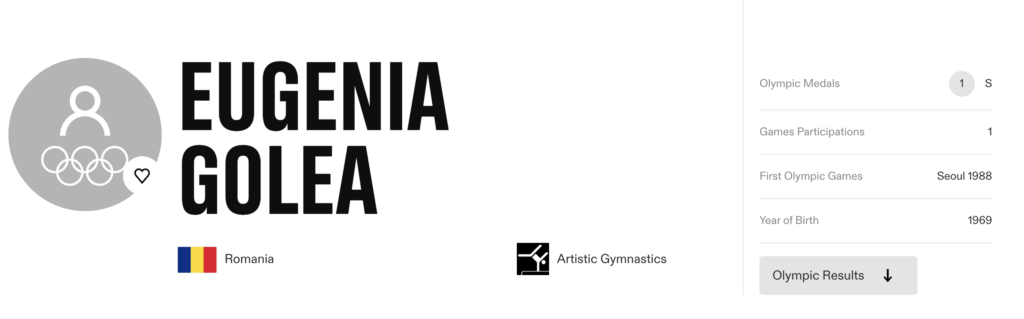
Her IOC biography lists 1969 as her birth year.
More on Age