In September 2014, the International Gymnastics Federation issued a disciplinary notice withdrawing the license of a North Korean gymnast, fining her federation, and annulling her results.
The gymnast was Cha Yeong Hwa (차영화), and once again, the charge was age falsification.
What made the case significant was not the accusation itself—by then, age manipulation was a familiar problem—but how quickly it was detected and how comprehensively it was punished. Compared with earlier North Korean cases, Cha’s discrepancy was smaller. The response was not.

Uemura Miki of Japan would eventually take Cha’s third-place spot.
From Passports to “Gymnastics Passports”
For decades, the FIG relied on national federations and state-issued passports to determine age eligibility. Birthdates were checked at competitions, passports were inspected, and contradictions—if they surfaced at all—often took years to register.
Birthdates were rarely cross-checked across competitions. As a result, a gymnast like Kim Gwang Suk could appear at three successive major meets under three different birthdates. In other cases, gymnasts competed as juniors under one birthdate, only to acquire a different one upon entering the senior ranks—a pattern particularly visible at the Druzhba competitions among Eastern Bloc countries.
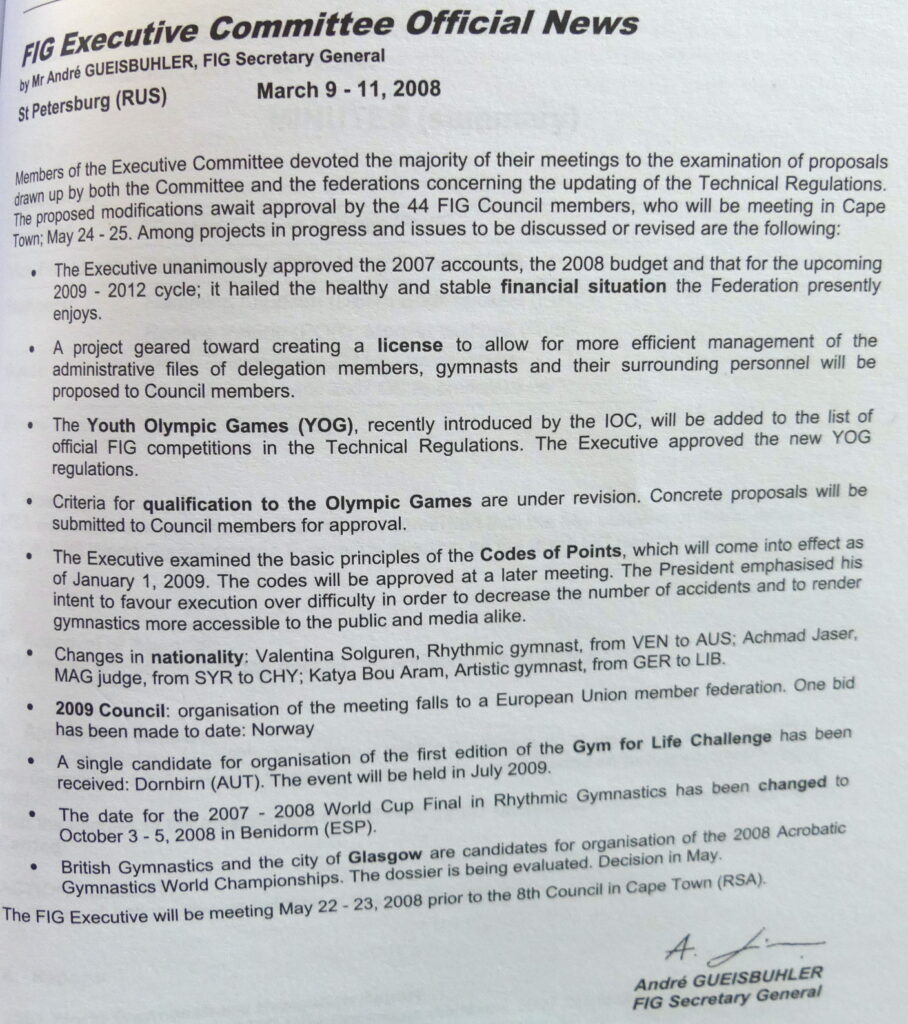
Eventually, the FIG constructed something new: a centralized identity system designed to follow gymnasts across competitions and seasons. When the federation announced the project in March of 2008, it did not invoke age falsification. Instead, the executive committee framed it as “a project geared toward creating a license to allow for more efficient management of the administrative files of delegation members, gymnasts, and their surrounding personnel.”
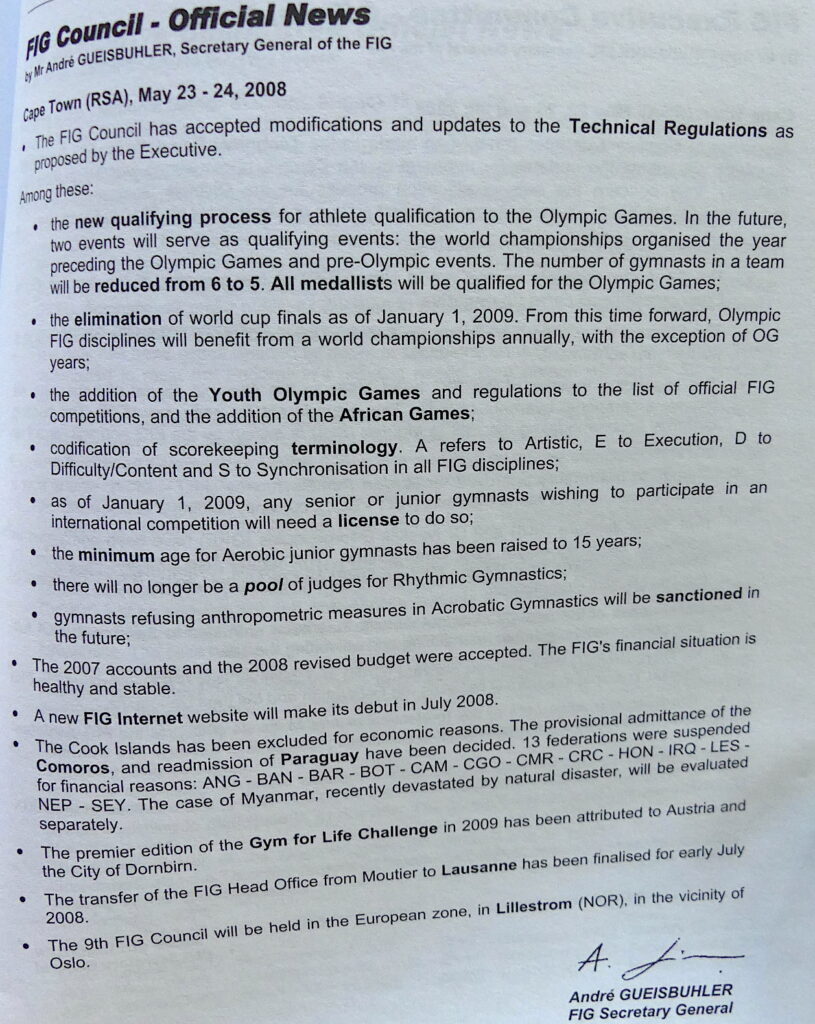
By May of that year, the FIG announced that, as of January 1, 2009, any senior or junior gymnast wishing to compete internationally would be required to hold such a license. The license fixed an athlete’s name, nationality, discipline, and—crucially—date of birth in a central database. Without it, an athlete could not compete.
Licenses—often called “gymnastics passports”—were time-limited and subject to renewal. Each renewal required federations to resubmit documentation consistent with what the FIG already had on file. Any discrepancy—especially in a gymnast’s date of birth—could now be flagged.
How Cha’s Discrepancy Surfaced
And that’s exactly how Cha’s case began—with a license renewal.
At the 2006 Asian Games in Doha, Cha had been registered as a 16-year-old with a 1990 birthdate. That date had passed into the FIG’s records without incident, as thousands of others had before it. She went on to compete at several major competitions, including at the 2008 Beijing Olympics, where she appeared in qualifications. A fall on her Def kept her out of the uneven bar finals.
Years later, in 2014, when Cha’s FIG license came up for renewal, the documents submitted by the North Korean federation listed her birth year as 1991.
The change was small—just one year—but the license system existed to catch exactly that. The FIG now held two incompatible identities for the same gymnast, both submitted by the same federation.
FIG officials determined that the discrepancy did not stem from a clerical error but from a falsified passport, and the matter quickly escalated from administrative review to disciplinary action.
Fewer contradictions, harsher consequences
Measured numerically, Cha’s case looked less egregious than earlier scandals involving North Korea.
Kim Gwang Suk had been registered with three different birthdates across the 1989 World Championships, the 1991 Worlds, and the 1992 Olympics—an absurdity that made denial impossible. When the FIG finally acted, it barred North Korea’s women’s team from the 1993 World Championships, then moved on.
In 2010, Hong Su Jeong was found to have competed under three different birth years over seven seasons. The FIG responded more aggressively, imposing an emergency suspension days before the World Championships, later converting it into a two-year ban and a fine.
Yet by 2014, even a single verified inconsistency—detected within the FIG’s own licensing system—was enough. As in earlier cases, the federation emphasized that responsibility lay with the national federation, not the gymnast herself. Passports were prepared by officials; licenses were submitted by administrators; athletes competed under the identities they were given. Nevertheless, the FIG withdrew Cha’s athlete license under Article 43.2 of its statutes and suspended her from all international competition through the end of 2015.
Medals and prize money were ordered returned within sixty days; the federation was fined 25,000 Swiss francs and required to cover the costs of the proceedings.
What distinguished the case was not the suspension itself, but its retroactive scope. Unlike earlier sanctions against North Korea, which imposed forward-looking constraints—bans from future competitions intended to prevent further violations—the FIG reached backward, annulling all of Cha’s individual results dating to August 2006 and all team results from competitions in which she had participated. Cha’s name remains on start lists but disappears from the official results, surviving only in medal photographs and on websites that have not been updated since 2014.
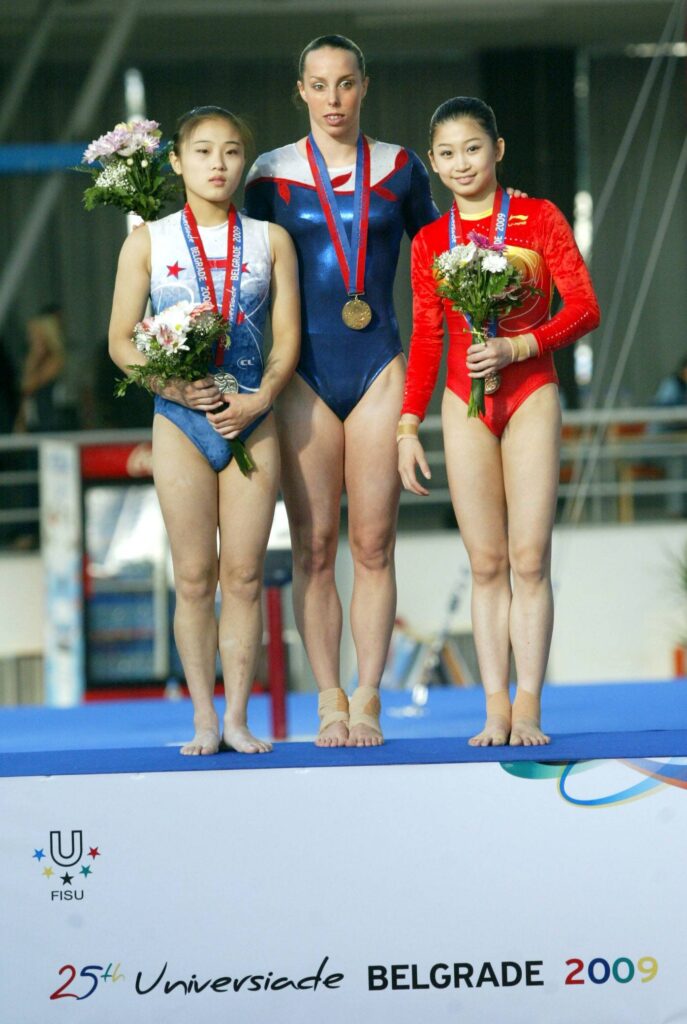
Hong Eun Jong was originally in 4th place.
Passport Limits
Between Kim’s sanction in 1993 and Cha’s in 2014, the FIG transformed age enforcement from reactive scandal management into routine administrative control. The introduction of the “gymnastics passport” was a step forward. Renewal forced comparison. Comparison exposed contradictions. Contradictions triggered discipline.
In an earlier era, Cha’s one-year discrepancy might have produced confusion, debate, or jokes. In 2014, it produced action.
The gymnastics passport system is not perfect. It saves the FIG from the public embarrassment of having a gymnast compete with three different birthdates (e.g., Kim Gwang Suk and Hong Su Jeong). It prevents federations from last-minute birthdate changes (e.g., Olga Bicherova). But it does not prevent a program with early talent selection and a modicum of foresight from altering a gymnast’s birthdate even before she reaches the junior ranks. It is plausible that, say, the Romanian federation could have navigated the passport system on Daniela Silivaș’s behalf without incident. She was identified as an extraordinarily talented gymnast early on and was fast-tracked through the Romanian age-group categories. It’s likely that shifting her birth year before her first junior competitions would have been an easy step to take.
In that sense, the gymnastics passport does not guarantee truth; it guarantees that contradictions, once visible, no longer continue.
Appendix A: The Official Disciplinary Statement from the FIG
Disciplinary decisions – The FIG takes action
17/09/2014
Following the disciplinary procedures concerning the birth year of North Korean gymnast Cha Yong Hwa and the non-certified mats produced by equipment manufacturer American Athletic Inc. (AAI), the FIG Disciplinary Commission has released the following decisions.
Concerning the North Korean gymnast, the FIG Disciplinary Commission has made the decision to withdraw Cha Yong Hwa‘s license, pursuant to Article 43.2 of the FIG Statutes. Cha Yong Hwa is suspended from participating in any and all FIG and other international events until 31 December 2015. All results obtained by Cha Yong Hwa and the Democratic People’s Republic of Korea Gymnastics Federation‘s (DPRKGF) Women’s Artistic Gymnastic team in all events at which Cha Yong Hwa participated as a team member from August 2006 onwards are cancelled and all medals and/or prize money received by Cha Yong Hwa and/or the DPRKGF Women’s Artistic Gymnastics team during this period are to be returned to the FIG within 60 days of the date of this decision.
DPRKGF is ordered to pay a fine of CHF 25,000 to the FIG. The DPRKGF is blamed for submitting a fake passport for Cha Yong Hwa and is not to repeat this conduct in the future. The DPRKGF is ordered to pay the costs of these disciplinary proceedings.
Pursuant to the FIG Statutes in force, the gymnast and the DPRKGF may lodge an appeal within 21 days following notification.
Manufacturer sanctioned
The FIG Disciplinary Commission has found that the American Apparatus Manufacturer American Athletic Inc. (AAI) has sold and delivered 20cm landing mats since 15th March 2012 that are different from the mats tested and approved by the FIG Testing Institute. AAI has voluntarily agreed to a number of remedial actions, including an appropriate fine, and the matter has been resolved.
Pursuant to the FIG Statutes in force, AAI may lodge an appeal within 21 days following notification.
Note: The passport system was in place when Hong Su Jeong was sanctioned in 2010. However, the FIG’s press release did not mention license renewal. Instead, it mentioned that the federation found the discrepancy upon reviewing the nominative roster for the 2010 World Championships.
Appendix B: Past License Documents
2009
2010
2016
2023
More on Age