In November 2001, at China’s Ninth National Games, a small gymnast from Beijing captured the country’s attention. Newspapers called her “Kang Douzi”—“Little Bean Kang”—and, almost without exception, they described her the same way: just thirteen years old. She cried after a costly fall on uneven bars that may have cost her team the gold. Days later, she rebounded to win the all-around title, throwing herself into her coach’s arms, still unmistakably a child on one of the biggest stages in Chinese sport.
And yet, within a year, that same gymnast had changed. By 2002, Kang Xin was no longer thirteen. According to her official profile, she was sixteen—old enough to compete internationally, old enough to stand alongside China’s senior team at the Asian Games.
How does a gymnast age three years in the span of one?
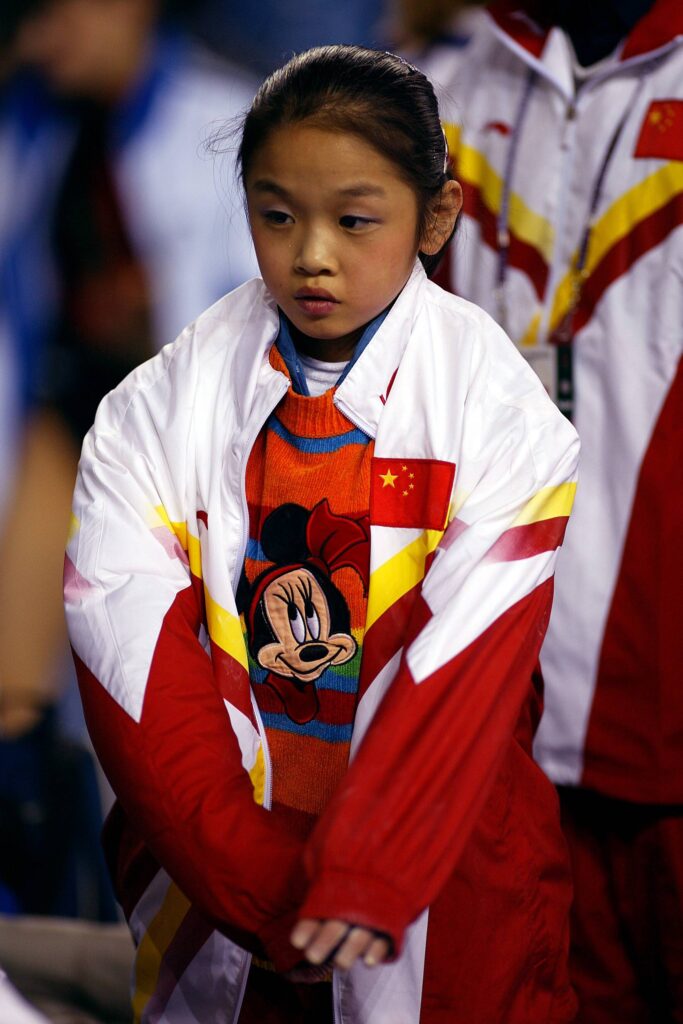
13 at the 2001 National Games
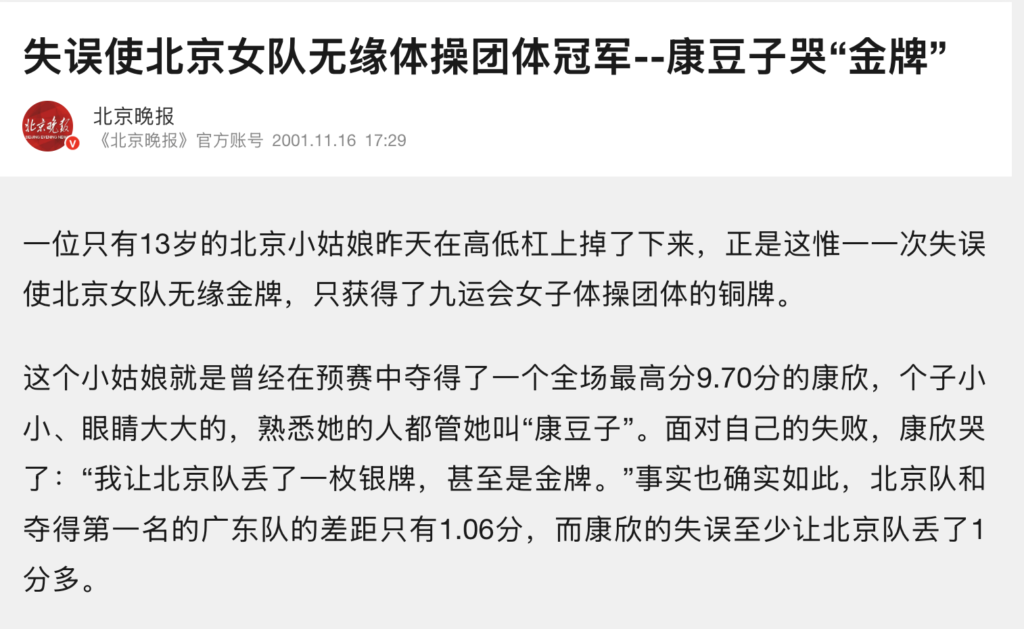
Kang Xin was one of the main stories of the 2001 National Games, and overwhelmingly, the newspapers thought that she was 13 years old. For example, on November 16, 2001, the Beijing Evening News (北京晚报 ) wrote about Kang Xin’s fall from the uneven bars during the team competition:
A 13-year-old girl from Beijing fell off the uneven bars yesterday. That single mistake cost the Beijing women’s team the gold medal, leaving them with only the bronze in the women’s team competition at the Ninth National Games.
The girl was Kang Xin, who had previously earned the highest score of the entire preliminaries with a 9.70. Small in stature with big eyes, those who know her affectionately call her “Kang Douzi” (“Little Bean Kang”). Faced with her mistake, Kang Xin burst into tears: “I cost the Beijing team a silver medal—or even a gold.” And that was indeed the case. The gap between Beijing and the first-place Guangdong team was only 1.06 points, and Kang Xin’s fall alone cost the team more than one point.
一位只有13岁的北京小姑娘昨天在高低杠上掉了下来,正是这惟一一次失误使北京女队无缘金牌,只获得了九运会女子体操团体的铜牌。
这个小姑娘就是曾经在预赛中夺得了一个全场最高分9.70分的康欣,个子小小、眼睛大大的,熟悉她的人都管她叫“康豆子”。面对自己的失败,康欣哭了:“我让北京队丢了一枚银牌,甚至是金牌。”事实也确实如此,北京队和夺得第一名的广东队的差距只有1.06分,而康欣的失误至少让北京队丢了1分多。
Despite the fall during the team competition, Kang Xin rebounded to win the all-around title — at just 13 years old. Here’s how the Shenzhen Evening News (深圳晚报) described her victory on November 21, 2001:
Although the 13-year-old Beijing gymnast Kang Xin won the women’s all-around title, she too came off the uneven bars at one point.
[…]
On the 17th, 13-year-old Beijing gymnast Kang Xin won the women’s all-around title. After completing her final routine, she threw herself into her coach’s arms. On the 15th, after winning the women’s double sculls title in rowing, Liaoning athletes Zhao Guifeng and Liu Chunmei shed tears of excitement in front of their coach.
只有13岁的北京姑娘康欣虽然获得了女子全能冠军,但在高低杠上也曾经脱杠。
[…]
17日,北京队13岁小将康欣获得女子体操全能冠军。做完最后一个动作后,她扑向教练的怀中。15日,获得赛艇女子双人单桨冠军的辽宁队员赵桂凤和刘春梅在教练面前流下了激动的泪水。
Archived here
The Life Times (生活时报) noted that a pair of 13-year-olds ruled the competition:
In gymnastics, unlike the men’s events where veterans still dominate, the women’s events were ruled by young newcomers, with the Beijing team emerging as the biggest winner. Among them were two 13-year-olds—Kang Xin and Yang Yahong—who each won gold medals for Beijing.
What is particularly interesting is that neither girl was considered a top domestic contender before the Games. Kang Xin had only been in the national team for six months and was ranked third within the Beijing team, behind Bai Chunyue and Zhang Nan. As for Yang Yahong, she was originally just a substitute, stepping in for injured star Kui Yuanyuan, and had not yet even entered the national team.
November 22, 2001
在体操项目上,与男子单项老将称雄的局面不同,女子单项则由小鬼当家,而北京队无疑是这场较量的最大赢家。这里要介绍的就是为北京队夺得两枚金牌、同为13岁的小姑娘康欣和杨亚红。
最有意思的是第一次参加全运会的两位小姑娘赛前都不是国内拔尖选手,康欣进入国家队也就半年时间,在北京队,她是排在白春月、张楠后面的第3号人物;杨亚红呢,其实是个替补选手,临时顶替做手术的北京名将奎媛媛来参赛,到目前还没进过国家队大门。
In general, China’s domestic media believed that Kang Xin was 13 in 2001.
16 at the 2002 Asian Games
Although Kang Xin was reported as 13 in 2001—suggesting a 1988 birth year—her official birthdate later shifted to 1986, making her 16 in 2002 and eligible to compete alongside Zhang Nan at the Asian Games, where the team won gold.
Here is a short profile from New Sports:
Kang Xin
Date of birth: April 23, 1986
Place of origin: Beijing
Height: 1.37 m [Approximately 4’6″]
Weight: 31.5 kgTechnical characteristics: Excellent flexibility in toes and knees
Strongest events: Balance beam, all-around
Major results:
- 2000 National Gymnastics Championships: balance beam 5th place
- 2001 National Gymnastics Championships and 9th National Games gymnastics qualifying competition: balance beam 4th place
- 2001 9th National Games: women’s gymnastics all-around champion, team 3rd, balance beam 5th
- 2002 National Gymnastics Championships: all-around champion, balance beam champion, floor exercise 6th, uneven bars 5th
First steps into the gymnasium:
On the third day of the Lunar New Year, when she was 5 years old, she went with her father to visit her aunt’s family for the holiday. She was jumping and bouncing around in the subway, where she was spotted by Coach Chen Fei from the Beijing Dongcheng District Sports School — and from that moment her gymnastics career began.
First time on the balance beam / doing a somersault:
Can’t remember.
Personality Traits:
In everyday life Kang Xin is like a little child. Her classmate from the Shichahai Sports School, Zhang Nan, reported: “She’s always acting spoiled with us.” Kang Xin shot back in her broad Beijing accent: “Oh, get out of here.” In the gymnasium, however, she is dead serious — stone-faced, never cracking a smile whether training is going well or badly, whether the coach is praising or scolding her. She trains hard and does as she’s told; whatever the coach says, that’s how she trains — no quibbling or haggling.
She’s quite childlike. Even at 10 she still couldn’t handle money on her own and needed her mother to take her out on the street. A bit of a simpleton, but endearingly so.
What she enjoys most about gymnastics: Winning gold medals. What she finds most painful: Getting injured. Hobbies: Reading, practicing calligraphy.
Person she respects most: Her parents.
Personality: A little introverted.
New Sports, September 1, 2002, 运动队里的小萝卜头, “”The Little Turnip Head of the Sports Team”
康欣
主要成绩: 2000年全国体操锦标赛平衡木第五名 2001年全国体操锦标赛暨九运会体操预选赛平衡木第四名 2001年第九届全运会女子体操全能冠军,团体第三,平衡木第五 2002年全国体操锦标赛全能冠军、平衡木冠军、自由操第六、高低杠第五
步入体操房之初:
5岁时的大年初三,跟爸爸去姑姑家过年,在地铁里蹦蹦跳跳的,被北京东城区体校的陈斐教练看中,从此开始体操生涯。
第一次上平衡木/翻跟头:不记得了
性情特点:
康欣生活中像个小孩子,和她在什刹海体校便同学的张楠揭发:”她老跟我们撒娇。”康欣一口嗲嗲的北京腔出来了:”哎呦去你的吧。”她在体操房里却可严肃了,面无表情,不管是练得好还是坏,教练是夸还是骂,她都一律不苟言笑。训练刻苦听话,教练怎么说怎么练,不挑三拣四”讲价还钱”的。
比较小孩儿气,都10岁了自己还不会花钱,上街还得妈妈领着。有点傻傻的,但是傻得可爱。
练体操最快乐的:可以拿金牌 最痛苦的:受伤。 爱好:看书、练字 最尊敬的人:父母 性格:有点内向
This abrupt change was never publicly explained, nor was it treated as unusual. Instead, the new birthdate was accepted without comment, seamlessly aligning her with the eligibility requirements for senior international competition.
If she was in fact fifteen in 2001, why did so many publications report otherwise? And why has the Chinese media ecosystem not faced similar difficulties in reporting the ages and birthdates of male gymnasts?
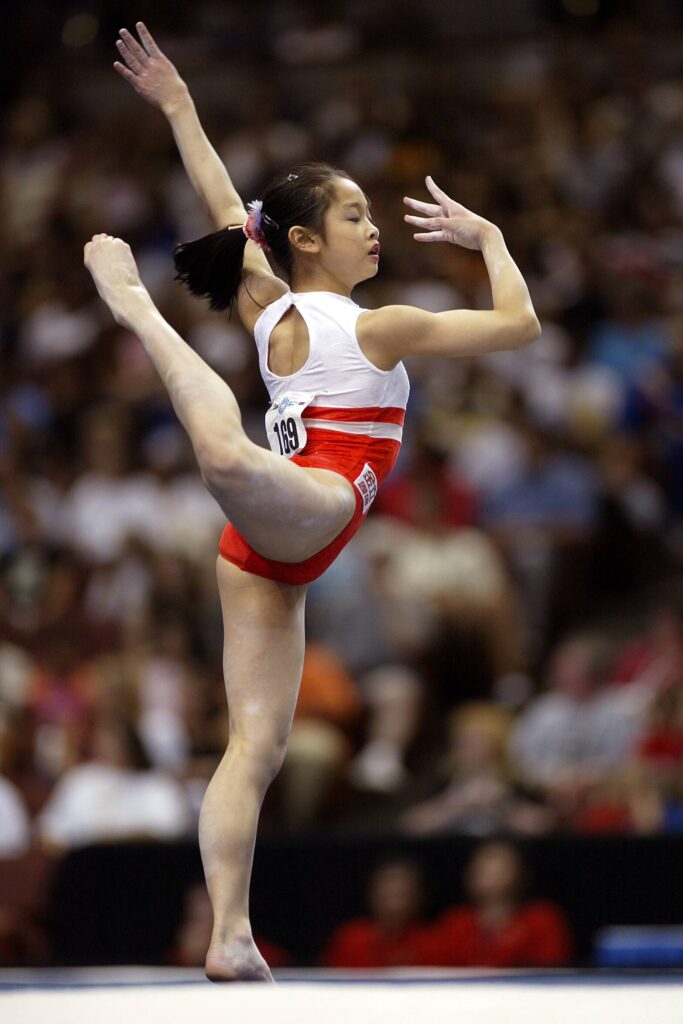
According to her competitive birthdate, she was 17 in this photo. According to her age in 2001, she was 15 in this photo.
Appendix: The Full Translations of the 2001 Articles
A Mistake Costs Beijing Women’s Team the Gymnastics Title — “Kang Douzi” Cries Over Lost Gold
Beijing Evening News
Official account of Beijing Evening News — November 16, 2001
A 13-year-old girl from Beijing fell on the uneven bars yesterday. That single mistake cost the Beijing women’s team the gold medal, leaving them with only the bronze in the women’s team competition at the Ninth National Games.
The girl was Kang Xin, who had previously earned the highest score of the entire preliminaries with a 9.70. Small in stature with big eyes, those who know her affectionately call her “Kang Douzi” (“Little Bean Kang”). Faced with her mistake, Kang Xin burst into tears: “I cost the Beijing team a silver medal—or even a gold.” And that was indeed the case. The gap between Beijing and the first-place Guangdong team was only 1.06 points, and Kang Xin’s fall alone cost the team more than one point.
After the third rotation, Beijing’s situation suddenly became severe. Not only were they out of contention for gold, but they had dropped to fifth place, and even winning a medal was uncertain. The final event was Beijing’s strength: balance beam. All three young athletes were standouts—Bai Chunyue was a Universiade silver medalist, Zhang Nan was the national champion earlier that year, and Kang Xin had posted the top preliminary score of 9.70. As long as they avoided mistakes, a bronze medal was still within reach.
Kang Xin said that after experiencing that failure, she would absolutely not allow herself to make another mistake. She performed her routine beautifully, landing solidly and scoring 9.65, doing her part to secure the bronze medal for Beijing.
“Next, we still have the all-around and apparatus finals. The Beijing women’s team will definitely fight for a gold medal,” team leader Zhang said after the competition, encouraging the athletes. Kang Xin felt the same way: “In the preliminaries, I ranked third in the all-around, Bai Chunyue was fifth. In the apparatus events, I’m ranked first on beam, and Yang Yahong is first on vault—we will definitely win a gold medal.”
Reporter: Li Li
“Beijing’s Little ‘Doudou’ Kang Xin: ‘I Made My Parents Proud’” (with photos)
November 17, 2001, 23:37
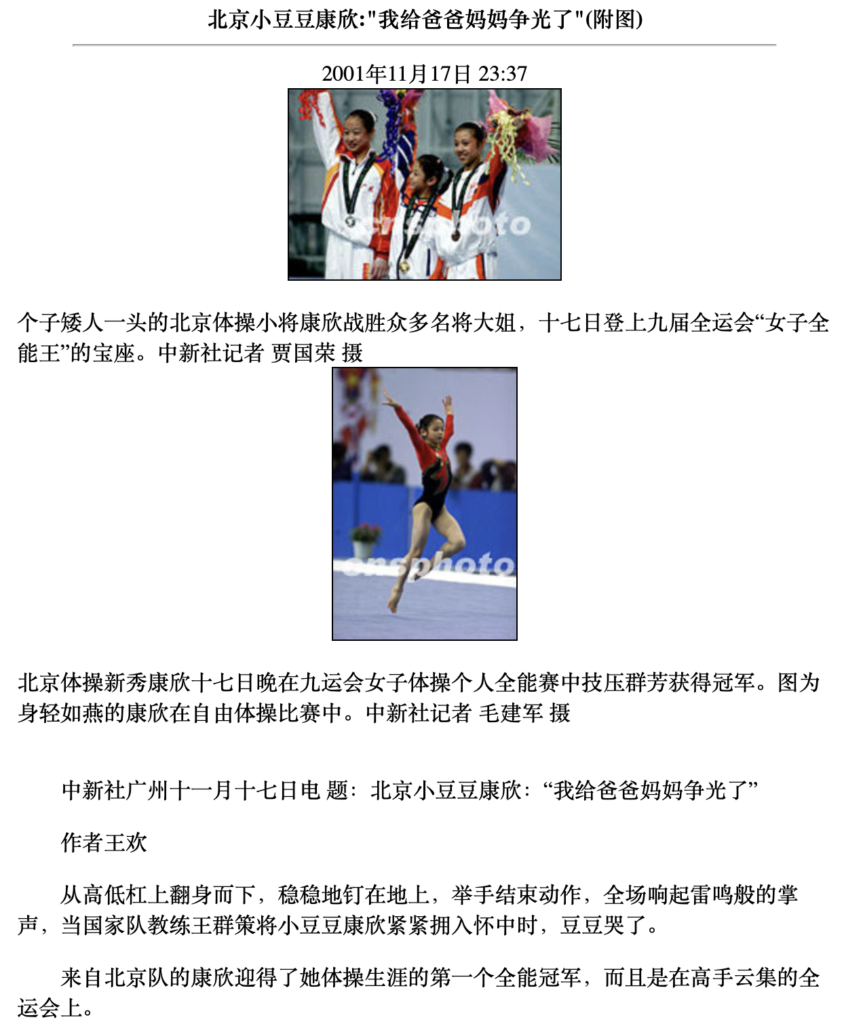
The petite Beijing gymnast Kang Xin, smaller than her competitors, defeated a field of top, more experienced athletes to claim the title of women’s all-around champion at the Ninth National Games on the 17th. (Photo by Jia Guorong, China News Service)
Rising Beijing gymnastics star Kang Xin won the women’s individual all-around title at the Ninth National Games on the evening of the 17th. The photo shows her light, graceful performance on floor exercise. (Photo by Mao Jianjun, China News Service)
China News Service, Guangzhou, November 17
Title: Beijing’s Little “Doudou” Kang Xin: “I Made My Parents Proud”
By Wang Huan
Flipping down from the uneven bars, landing firmly, and raising her arms to finish—thunderous applause erupted across the arena. When national team coach Wang Qunce pulled “Little Doudou” Kang Xin tightly into his arms, she burst into tears.
Representing the Beijing team, Kang Xin had just captured the first all-around title of her gymnastics career—and at a National Games packed with elite competitors.
Kang Xin is called “Doudou” (“Little Bean”) because she is small—young in age and petite in stature. Even standing atop the highest podium, she was only about as tall as the runner-up, Qi Linzi of Guangdong, and the third-place finisher, Dong Fangxiao of Hebei.
Coach Wang commented on her performance:
“Today she was extremely steady and composed. Her natural advantages aren’t as strong as those of veteran athletes like Sun Xiaojiao and Qi Linzi, but she wins with youth, drive, and even exceeded her usual level. We’ll be counting on her for the 2004 Olympics.”
Indeed, Kang Xin posted the highest score of the day—9.787—on her strongest event, balance beam.
Her personal coach, Bao Xianqin, was full of praise:
“She performed very well today. The quality of her execution was excellent. Even though her start values weren’t especially high, she was very consistent.”
When asked what head coach Huang Yubin had said to her before the competition, Kang Xin replied: “He just told me to relax and compete freely.” With the national team’s head coach cheering her on, it’s no wonder she performed so well.
Reflecting on her victory, Doudou blinked her big eyes and said simply: “I made my mom and dad proud.”
This year, Doudou is just thirteen years old. She began gymnastics at age four. From the Dongcheng sports school to Shichahai sports school and then to the Beijing team, she has progressed step by step, improving year by year. At the Australian Junior Championships this January, she won gold on both balance beam and uneven bars.
She told reporters that she attends classes on Tuesdays and Thursdays, while spending the rest of her time training. In her spare time, she enjoys reading and watching TV—especially sports programs. Somewhat introverted, Doudou most admires her senior teammate Ling Jie, and it seems she has already quietly set her sights on becoming a world champion.
Little Doudou is still just a child, her face full of innocence. Yet in her eyes is a maturity and confidence beyond her years. Now a rising star of the national gymnastics team, she is steadily ascending—beginning to shine with dazzling brilliance.
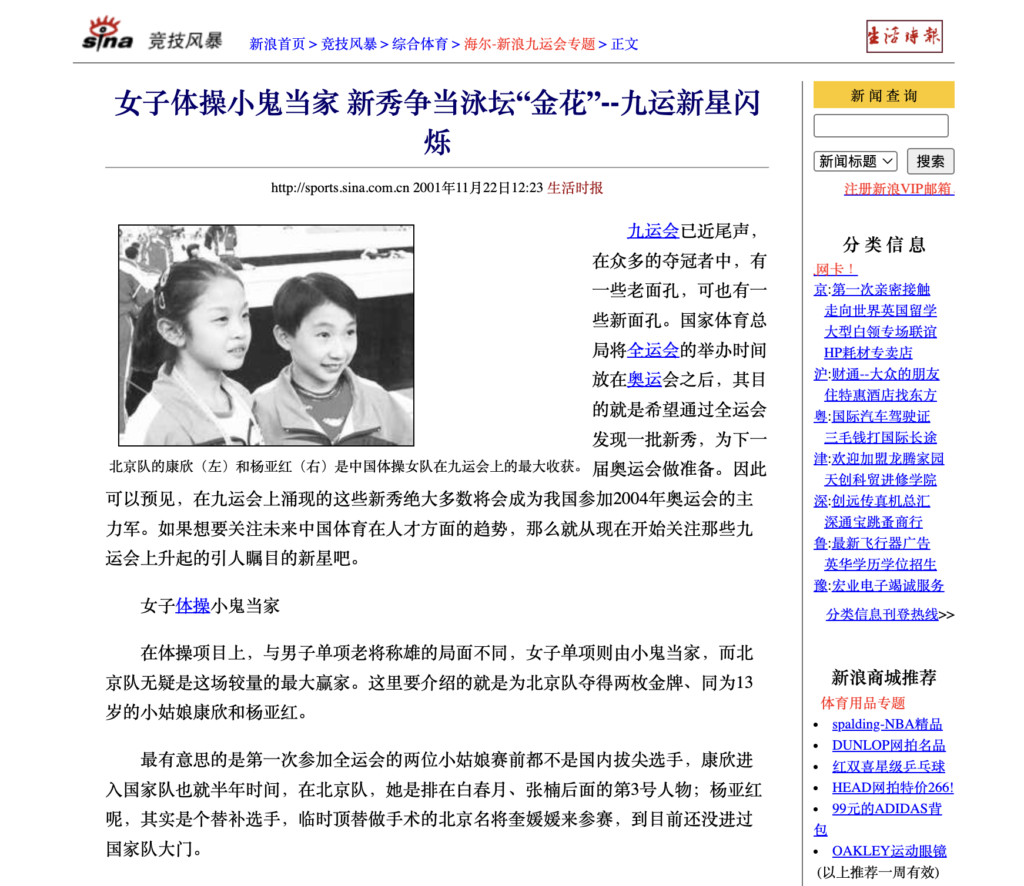
Young Athletes Take Charge in Women’s Gymnastics; Rising Stars Emerge Across Events — New Talents Shine at the 9th National Games
Sina Sports — November 22, 2001 (Life Times)
Beijing team athletes Kang Xin (left) and Yang Yahong (right) were the biggest discoveries for China’s women’s gymnastics team at the National Games.
As the 9th National Games draw to a close, among the many champions are both familiar veterans and fresh new faces. The General Administration of Sport scheduled the National Games after the Olympics specifically to identify emerging talent and prepare for the next Olympic cycle. It is foreseeable that most of the standout newcomers from these Games will become the backbone of China’s team at the 2004 Olympics. To understand the future direction of Chinese sports talent, one needs only look at the rising stars of this competition.
Women’s Gymnastics: Youth Takes the Lead
In gymnastics, unlike the men’s events where veterans still dominate, the women’s events were ruled by young newcomers, with the Beijing team emerging as the biggest winner. Among them were two 13-year-olds—Kang Xin and Yang Yahong—who each won gold medals for Beijing.
What is particularly interesting is that neither girl was considered a top domestic contender before the Games. Kang Xin had only been in the national team for six months and was ranked third within the Beijing team, behind Bai Chunyue and Zhang Nan. As for Yang Yahong, she was originally just a substitute, stepping in for injured star Kui Yuanyuan, and had not yet even entered the national team.
In the women’s all-around final, most attention was focused on star athletes Qi Linzi of the host team and Sun Xiaojiao of Zhejiang. It was only in the final rotation, when national team head coach Huang Yubin approached Kang Xin to offer last-minute advice, that spectators began to realize that this consistently steady Beijing youngster might pull off an upset. In the end, Kang Xin won gold by a margin of 0.057 points over Qi Linzi.
After the competition, national women’s team head coach Lu Shanzhen spoke highly of Kang Xin’s future: “Her stability and explosive power are excellent. She will undoubtedly be a pillar of China’s women’s gymnastics team at the 2004 Olympics.” In Huang Yubin’s view, she had the potential to become the leading figure of Chinese women’s gymnastics.
In the women’s vault final, the diminutive Yang Yahong created a sensation, delivering a near-perfect performance to win her first-ever gold medal. Previously, her only standout moment had come in the team preliminaries, where she scored a top mark of 9.675 on vault and qualified first into the apparatus final.
According to her coach, Yang Yahong’s strong leg power made vault her specialty, and her success was due to the high level of difficulty and start value of her routines. Although she had not yet entered the national team, her outstanding performance at the National Games suggested that her promotion would come soon.
Mistakes Were Made, but the Effort Was There — A Tribute to Those Disappointed at the Ninth National Games
Sina Sports, November 21, 2001, 4:01 p.m.
Shenzhen Evening News
Mistakes were made, but the effort was there
The gymnastics competition at the Ninth National Games concluded yesterday. In the battle for 14 gold medals, there was the joy of champions, but naturally also the loneliness of those who fell short. When we cheer for the successful completion of a new skill, we should also applaud the brave athletes who dared to challenge the limits.
In the men’s all-around final, Hubei athlete Zhao [character missing in the text] made a mistake on pommel horse and missed out on a medal.
In the women’s balance beam competition at the Ninth National Games, Guizhou’s Li Xin lost her balance.
In the men’s individual all-around final, Hubei athlete Zheng Lihui, who had been on the verge of winning bronze, made an unexpected mistake on the horizontal bar in the final rotation and lost the medal. Hunan’s Xia Hong also fell unexpectedly from the balance beam.
Although the 13-year-old Beijing gymnast Kang Xin won the women’s all-around title, she too came off the uneven bars at one point.
In the women’s team qualification round, Wu Qian of the PLA team made an error and fell from the balance beam.
Coach, thank you
On the 17th, 13-year-old Beijing gymnast Kang Xin won the women’s all-around title. After completing her final routine, she threw herself into her coach’s arms. On the 15th, after winning the women’s double sculls title in rowing, Liaoning athletes Zhao Guifeng and Liu Chunmei shed tears of excitement in front of their coach.
On the 14th, at the Ninth National Games archery competition, Jilin athlete Qu Yongchao fought hard to eliminate his opponent in the repechage round. After stepping away from the target, Qu bowed deeply to his Korean coach, Lim In-taek. On the 15th, members of the Bayi team, winners of the men’s basketball title at the Ninth National Games, tossed their remarkable coach, Wang Fei, into the air to celebrate their victory.
2002: An Interview with Kang Xin
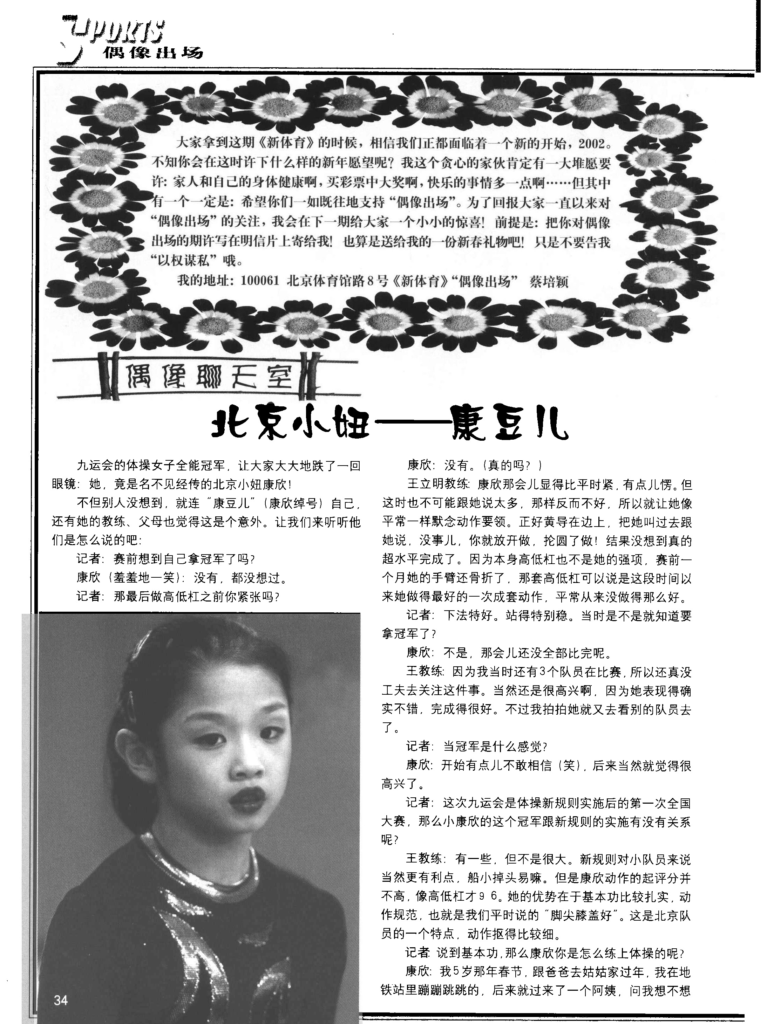
Idol Chat Room: Beijing Girl — Kang Dou’er
The women’s all-around champion at the Ninth National Games gave everyone a big shock: she turned out to be the little-known Beijing girl Kang Xin!
Not only did no one else expect it. Even “Kang Dou’er” (Kang Xin’s nickname) herself, along with her coach and her parents, felt it was a surprise. Let’s hear what they had to say:
Reporter: Did you think before the competition that you might win the championship?
Kang Xin (smiling shyly): No, I never even thought about it.
Reporter: Were you nervous before your uneven bars routine at the end?
Kang Xin: No. (Really?)
Coach Wang Liming: Kang Xin seemed more tense than usual at that point, a bit dazed. But there wasn’t much you could say to her then — saying too much would only make it worse — so I just had her silently go over the key points of her routine as normal. Director Huang happened to be nearby and called her over and told her: don’t worry, just go out there and perform freely, give it everything you’ve got! As it turned out, she exceeded expectations. Uneven bars isn’t even her strong event, and on top of that, she had broken her arm a month before the competition. That bars routine was the best she had performed in all that time — she had never done it that well in practice.
Reporter: Her dismount was excellent. She landed very steadily. Did you know at that moment that you were going to win?
Kang Xin: No, the competition wasn’t finished yet.
Coach Wang: I still had three other athletes competing at the time, so I really didn’t have the chance to focus on that. Of course, I was happy — she really performed well and finished beautifully. But I gave her a pat on the back and went off to watch the other athletes.
Reporter: What did it feel like to be a champion?
Kang Xin: At first, I could hardly believe it (laughs), but then of course I was very happy.
Reporter: The Ninth National Games were the first national competition held under the new gymnastics rules. Did the new rules have anything to do with Kang Xin’s championship?
Coach Wang: To some extent, but not greatly. The new rules are naturally more favorable for younger athletes — a smaller boat turns more easily. But Kang Xin’s start values weren’t high; her uneven bars routine was only 9.6. Her advantage lies in her solid fundamentals and clean execution — what we usually call “good pointed toes and straight knees.” That’s a characteristic of Beijing athletes; the technique is very precise.
Reporter: Speaking of fundamentals — Kang Xin, how did you get into gymnastics?
Kang Xin: When I was five, during the Spring Festival, I went with my dad to visit my aunt. I was jumping around at the subway station, and a woman came over and asked me if I wanted to learn gymnastics. I said yes, and she told my dad to come find her after the holiday. That was my first coach, Chen Fei. After the New Year, on the third day of the new year, my dad took me to Dongcheng Sports School. When I walked in, I thought it was so much fun — mainly because of the big trampoline — so I kept clamoring to do gymnastics.
Kang Xin’s father: When Kang Xin was training as a child, to use the coach’s words, in the beginning, it wasn’t so much training the child as training the parents. It was really heartbreaking to watch. Many times, Doudou would come home in tears, telling me, “Dad, I don’t want to train anymore.” A few times, I picked her up from kindergarten at noon, and when it was time to take her back to training in the afternoon, she would start crying. When she cried, my heart would soften, and I’d say, “All right, we won’t go this afternoon, Dad is giving you the day off.” She would be so happy she’d jump up and down on the bed, having the time of her life.
But Doudou had a wonderfully dedicated and responsible teacher, Coach Chen Fei. The moment she noticed the child hadn’t shown up on time, she’d call to check if she was home, then hail a minivan, come straight over, scoop Doudou up, and leave. (Reporter: Didn’t Doudou cry?) Strangely enough, Doudou was always very well-behaved in front of Coach Chen — never cried or made a fuss.
When Doudou first started gymnastics, she was still a tiny child who couldn’t do anything. To put it bluntly, she still needed someone to wipe her bottom after using the toilet. Coach Chen Fei treated Doudou just like her own child. Coach Chen’s mother had also been a gymnastics coach at Shike Hai Sports School back in the day, and she was also very fond of Doudou, often having her come stay at their home. Doudou called Coach Chen “Chen Fei Mama” and called her own mother “姥姥” (maternal grandmother).
Reporter: Is gymnastics training hard?
Kang Xin: It’s all right. At first, I really loved it because it seemed so fun. Later… well, it was still okay.
Reporter: Coach Wang, when did you start coaching Doudou?
Coach Wang: Around 1998. But I had already noticed her before that. Because of the nickname “Kang Dou’er” — as the name suggests, she was like a little bean, bouncing around all day, full of energy. This child is young at heart, just like a little kid. I like that kind of personality — carefree and easygoing, nothing really gets to her, she cries it out, and she’s done.
Reporter: Does Doudou cry a lot?
Coach Wang: She loves to cry! And it’s not just when she’s sad — she cries when she’s scolded, and sometimes even when she’s praised. I’m very strict during training (as you can tell). The girls are all a bit afraid of me; sometimes they cry after just a word or two. Crying is crying, but training still has to happen. What’s good about Kang Xin is that once she’s done crying, she’s done — she just carries on as before.
Reporter: Doudou, what would you say your strengths are?
Kang Xin: Hmm… pointed toes and straight knees (meaning clean technique — knees don’t bend, toes don’t flex during skills), I suppose.
Reporter: And your weaknesses?
Kang Xin: Not focused enough, I like to slack off.
Reporter: Now that you’re older, do you still slack off?
Kang Xin: Hmm… sometimes, a little, when the coach isn’t around. (So honest!)
Reporter: Now that you’ve won the National Games championship, what are your plans for the future?
Kang Xin: Train hard.
Coach Wang: Kang Xin is good in that regard — since coming back, she hasn’t been acting any differently, still the same as before. Of course, the coaches and parents are also keeping an eye on that; she still needs to be kept in check. She’s not a world champion yet.
Reporter: Kang Xin still has some distance to go before reaching the top level internationally. What are your plans in that regard?
Coach Wang: Kang Xin’s strength is her precision and high standards. But this past year, because of the new rules and preparations for the National Games, some areas have slipped compared to before. This group, including Kang Xin, was always being prepared for the 2004 Olympics. This winter training cycle, we plan to really polish some of her skills, and we may also design some higher-difficulty elements specifically for her. (Ha — sounds like Doudou won’t be getting much rest this winter.)
Reporter: Has anyone written to you since you came back from the National Games?
Kang Xin: Yes, one letter.
Reporter: Will you write back?
Kang Xin: If I have time, definitely.
Reporter: Who is your favourite female gymnast?
Kang Xin: Sister Xuan (Liu Xuan).
Reporter: What about internationally?
Kang Xin: Răducan. Reporter: Why?
Kang Xin (grinning): I don’t know, I just like her.
That’s our Kang Dou!
Idol File
Kang Xin
▶ Birthday: April 23, 1986
▶ Star sign: Taurus
▶ Blood type: O
▶ Height: 1.34 m
▶ Weight: 30 kg
▶ Favorite cartoon character: Crayon Shin-chan
Note: Crayon Shin-chan (蜡笔小新) is a Japanese manga and anime character created by Yoshito Usui in 1990. He’s a mischievous five-year-old boy known for being cheeky, irreverent, and frequently embarrassing his parents.
Also, including blood type is not unusual in gymnast biographies. Yang Yun’s New Sports profile from 2001, for example, also noted that her blood type was O.