Gina Gogean’s birth certificate said 1978. The passport said 1977. And no one could explain where the truth went.
In April 2002, Romanian sports fans woke each morning wondering what ProSport would publish next. For the first set of articles, the sports daily had sent reporters to a small commune in the Eastern Carpathians, to village clinics and town halls, searching for birth certificates. What they found—tucked into green folders bound with string, recorded in yellowing registries—contradicted a decade of official documents for Gina Gogean.
The newspaper published its findings as the story developed, revelation by revelation. What follows is a distillation of the newspaper’s day-by-day reporting, the details of which did not circulate widely outside Romania. Revisiting them now offers a clearer sense of what the episode revealed and what it ultimately obscured.

Note: This is the first installment in a series on Romanian age falsification. Future pieces will examine other gymnasts’ cases, the relevant Romanian laws, and the FIG’s statutes and regulations.
Wednesday, April 10, 2002
Ten kilometers past Focșani, on the national road toward Suceava, a sign appears: Panciu. Tourists turn left there, toward the hills that rise like guardians of the Eastern Carpathians, toward the Oituz Pass.
Four kilometers past Mărăști lies the commune of Cîmpuri—an elongated settlement that seems never to end, stretching like a giant snake caught between two threatening hills.
“It’s the longest commune in Romania,” Mayor Dumitru Vlădescu says with pride. “Ten kilometers from one end to the other. Besides Gina Gogean, we’re also proud of Moș Ion Roată, adviser to Alexandru Ioan Cuza. He was born here, too.”
Without realizing it, he offers an important clue in uncovering an unflattering truth about the commune’s most celebrated figure.
The mayor hesitates at first. He disappears into the secretary’s office, then returns smiling, holding a green folder labeled “Birth Records ’77–’78.”
The registry is not large. Inside the covers—bound with two strings—are the birth certificates. He flips through them and stops, satisfied.
“This is it. You can photograph it.”
September 9, 1978.
Exactly one year later than the date used on the documents with which Gina Gogean competed. The Romanian Gymnastics Federation, according to ProSport reporters, had falsified her age so she could enter senior competitions a year early.
In 1992, the minimum age for international competition was fifteen. A gymnast had to turn that age within the calendar year. Gogean would have been fourteen, one year under the limit, yet she competed in senior events thanks to a “trick” by federation officials, who “aged her up.”
The balance sheet of that debut year was impressive. In April 1992, she went to the World Apparatus Championships in Paris, then to the European Championships in Nantes in May, where she won her first medals: gold on floor and two silvers, one in the all-around and the other on vault.
But the falsification almost certainly served a single purpose: getting her to Barcelona that July. Gogean placed fifth on vault and sixth in the all-around, and contributed to Romania’s silver medal in the team event at the XXV Olympiad.
For Gina Gogean, 1992 was a spectacular debut year, even though she would not be age-eligible until 1993. But few people knew that. Her birth certificate remained hidden between the covers of a green folder in a small village, thousands of kilometers from the bustling cities where she competed and won medals.
When ProSport reached Octavian Belu, the head coach of the Romanian team, his response was dismissive.
“Now, after ten years, what am I supposed to remember? And even if it was like that, what’s the problem? It’s not my job as a coach to deal with the girls’ IDs and passports! The federation takes care of that, not me!” His voice rose. “I don’t ask the gymnasts how old they are. I have no idea when they were born. What’s the point of digging up the dead?”
Gogean was not dead; she was very much alive, but the choice of metaphor made Belu’s message unmistakably clear: the past should remain in the past. In this framing, any inquiry into Gogean’s age became an act of desecration, a morbid curiosity, a prying open of a coffin. Even so, the phrasing held its own quiet admission: something had been buried, and Belu’s irritation suggested he believed it should stay that way.
Anica Gogean, Gina’s mother, pushed back. She had her own birth certificate, she said, and made it seem absurd to question a mother’s memory of her child’s birth.
“I don’t know, but who gave you this information? I’m very sorry, I don’t know what this is, but I also have her birth certificate. So… I don’t know what you’re talking about. I have a certificate from 1977. Do you mean I don’t know when I gave birth to my own child?”
Nicolae Vieru, president of the Romanian Gymnastics Federation, had been working in the federation for thirty-five years. He insisted that Romania had never falsified a gymnast’s age.
There was only one case he knew of, he said. A Korean girl, caught at the World Championships in Stuttgart in 1989. After that, North Korea was suspended from all international competitions for a year.
Vieru was referring to Kim Gwang Suk, the tiny uneven bars specialist who had won gold at the 1991 World Championships in Indianapolis with a perfect 10.00. North Korea had entered her into competitions with three different birth dates over three years—October 5, 1974, then February 15, 1975, then February 15, 1976—before the FIG finally banned the team from the 1993 World Championships for what it called “most unsportsmanlike behavior and unfair to all other participating nations and gymnasts.”
On the question of falsified ages in Romania, Vieru’s initial response was denial. “Ah, no, sir! I don’t know anything like that.”
When told that ProSport had obtained Gina Gogean’s birth certificate—and that it clearly said she was born on September 9, 1978, not 1977—he became agitated.
“I don’t know. I haven’t seen anything like that.”
Wasn’t it irregular, the reporter pressed, if the certificate said one thing and the passport another?
“How should I put it…” Vieru paused. “An uncaught thief is… I don’t know, she knows best. Her passport isn’t kept at the federation.”
Wasn’t he worried that if this falsification were proven, sanctions would be taken against the federation?
He laughed. “What sanctions could they take? I’m a vice president of the FIG, responsible for regulations and the statutes. There’s nothing in the rules about this.”
It was a remarkable claim, particularly coming from the man who had just cited North Korea’s suspension as proof that age falsification was taken seriously. Vieru had walked himself into a corner: he’d begun the interview by pointing to sanctions imposed in the past, then ended it by insisting there were no rules that would allow for sanctions at all.
When ProSport reached Gina herself, her battery was dying.
The progression of the interview was careful. She was fourteen going on fifteen in 1992, she explained. “It was the year when you could compete at fourteen if you turned fifteen that same year. I turned fifteen in September, and the Olympics were in August.”
Her birth year was 1977, she insisted. “September 9, 1977. That’s my date. You’ve been writing about me for so many years, and you still don’t know how old I am, what day I was born?”
When told that ProSport had a birth certificate showing 1978, she remained cooperative, even confident. “I can show you my birth certificate, and all my documents say 1977. I’ll bring my ID card and my passport too.”
Then came the specificity that changed everything: “We have the certificate from Cîmpuri.”
Not just a birth certificate—the certificate from her hometown registry. They hadn’t relied on secondary documents or federation files. They’d gone to Cîmpuri itself. Her tone shifted immediately.
“Mine is from Cîmpuri too. I don’t know where you went or what you did to get it wrong! I can show you all my documents—what more can I say?”
When they pressed the competitive implication—that a 1978 birthdate would have made her ineligible in 1992—she became irritated.
“Sir, I don’t understand what your interest is! I’m sorry, I can’t talk now. I just walked into a store. We’ll talk another time.”
The line went dead.
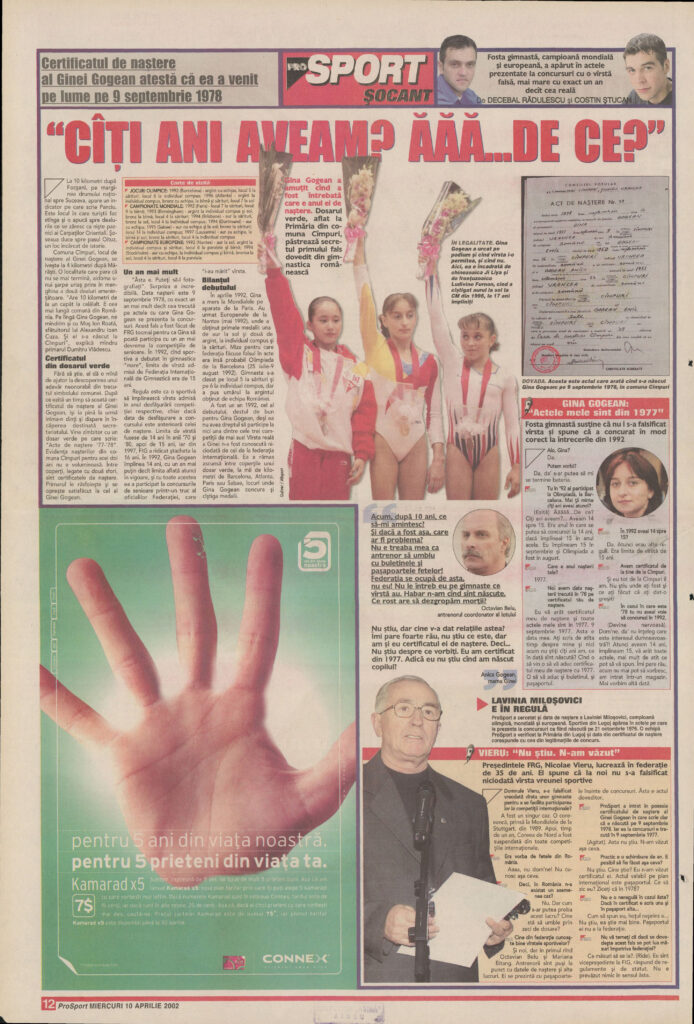
Thursday, April 11, 2002
The day after ProSport reported that Gina’s age had been falsified, the newspaper began asking a simple question: Where were her documents?
Neither the Romanian Gymnastics Federation, nor the Romanian Olympic Committee, nor the Ministry of Youth and Sports could provide any document that confirmed Gina Gogean’s year of birth.
Each institution passed the responsibility to the next. From the Olympic Committee to the federation. From the ministry to the federation. From the federation to clubs and county sports directorates.
No one knew.
At the Romanian Olympic Committee headquarters on Oțetari Street, secretary general Dan Popper had an explanation ready.
The Committee had been operating inside the Ministry building on Vasile Conta Street back in 1992. “The archive, which was located in the basement, was flooded, and only half of the documents could be recovered.” Among those lost—according to the information he had received, since he was not working at the Committee then—were the materials related to the Barcelona Olympics.
The Olympic Committee worked only with athletes’ passports, he explained, which were provided by the relevant national federations. “I am more than convinced that Gina Gogean’s identity documents listed 1977 as her birth year.”
At the Ministry of Youth and Sport, state secretary Nicolae Mărășescu was even more direct: they kept no records of athletes. Not even those on Olympic or national teams.
“We do not have any statistics regarding athletes’ personal data. The only data banks are the annual reports, which tally domestic and international results, as well as the number of athletes registered in each sport.” Specialized federations, he said, must hold the documents regarding athletes’ identifying information.
But the Romanian Gymnastics Federation did not hold the documents. Secretary General Adrian Stoica told ProSport, “There is no database of athletes’ identity documents at the Romanian Gymnastics Federation. We work only with the gymnasts’ passports, and when they retire from sport, we don’t even keep those.”
He would like to comment on Gina Gogean’s real age, he said, but he didn’t know what to say. “Personally, this issue is beyond me. Even if I wanted to look into it now, I wouldn’t know where to start or where to go.”
The secretary general explained that a gymnast who does not yet have a passport must obtain a sports ID card, which was not the federation’s responsibility. “Today—just as it was before 1989—the entities that issue ID cards are the clubs or the county sports directorates.”
A perfect circle of plausible deniability. The archive was flooded. The ministry didn’t keep records. The federation didn’t maintain a database. The clubs issued the ID cards. Everyone pointed somewhere else.
No one knew where Gina Gogean’s documents were.
Back in Cîmpuri, in the village clinic in the Eastern Carpathians, Dr. Țuțu Dinu asked his nurse to check the birth and vaccination register.
“Please look for the name Gina Gogean.”
After half an hour of searching, the nurse still couldn’t find the gymnast listed in either 1977 or 1978.
“Check the old register in the cupboard—it should be there.”
“It isn’t, doctor. I think she was registered in Focșani, not here.”
“Keep looking,” Dr. Dinu insisted.
Finally: “Aaaa, look, I found her!”
In the yellowed document, next to the gymnast’s name, the birth year 1978 appeared. Month nine, day nine.
“Yes, she was born in ’78, and she received all her vaccinations,” the doctor announced proudly. “It doesn’t get more accurate than our records.”
Outside, the people of Cîmpuri lived with Gina’s legend in their memory.
“She’s our pride,” boasted a woman sitting on a bench in front of Gina’s grandparents’ house. “She was born in the evening, around 10 p.m., and it had just started raining outside. It was September 9, 1978.”
She remembered that Anica, Gina’s mother, didn’t struggle much during the birth. It was afterward that she struggled because Gina wouldn’t sit still for a moment. But it was her grandmother, Ecaterina Gogean, who raised her during the early part of her life. When Gina was six months old, her mother had trouble with the Militia, and from then on, Ecaterina took care of her.
The woman’s voice suddenly fell silent. A man driving a horse cart approached and whispered something in her ear.
When she spoke again, her tone had changed. “Why are you making me talk, dear? I’m an old woman. Don’t put me on television.”
In the gentle eyes of the grandmotherly woman on the bench, the truth about Gina was still there. She no longer needed documents or papers. Her memory was enough.
The Art of Not Knowing
The Gogean case was not the first example of age falsification in gymnastics—not even the first involving Romania. In 1990, Ecaterina Szabó had told the German magazine Olympisches Turnen Aktuell: “I was born on January 22, 1968, and not, as has always been claimed, in 1967.” The Romanian federation could have been investigated, and the FIG could have levied sanctions. But nothing happened, and the admission faded from memory.
Eight years later, in 1998, former Soviet star Olga Mostepanova revealed in an interview that she, too, had competed under a falsified age. Her coach had simply “made a new birth certificate” to add a year so she could enter senior events early. Unlike Szabó’s case, where the responsible federation was still a member of the FIG, the Soviet Union had ceased to exist by 1998. The federation responsible for the falsification had dissolved, effectively insulating the admission from consequence. There was no entity left to sanction.
What made Gogean’s case different was the evidence: not a retrospective confession, but a birth certificate retrieved from a town hall, photographable and indisputable.
And that’s the strange thing about this: no one could dispute it. When ProSport asked where the documents were that could confirm or deny the falsification, every institution gave the same answer: nowhere.
The archive was flooded. The ministry didn’t keep records. The federation didn’t maintain a database. The passport wasn’t kept at the federation.
When ProSport pressed the federation’s own president for answers, Nicolae Vieru compared the falsification to an uncaught thief before stopping himself mid-sentence. Asked whether he feared sanctions, the FIG vice president responsible for the sport’s regulations simply laughed. “There’s nothing in the rules about this.”
Meanwhile, in Cîmpuri, the truth sat waiting in a green folder bound with two simple strings: September 9, 1978.
One year too late for Barcelona. But Gina Gogean had gone anyway.
References
“1978 Și În Registrul de Nașteri” Pro Sport, 11 Apr. 2002.
“Cîți Ani Aveam? Aaa … De Ce?” Pro Sport, 10 Apr. 2002.
“Gina Înfierează Pentru Viitor.” Pro Sport, 25 Feb. 2003.
“În Război Faci și Lucruri de Care Altfel Te Ferești.” Pro Sport, 11 Apr. 2002.
“Internat in Deva aufgelöst.” Olympisches Turnen Aktuell, April 1990
“Kim Gwang Suk: How Old Is She Really?” USA Gymnastics Magazine, 22.2 (1993).
“Nicu Vlad három érem birtokosa.” Romániai Magyar Szó 1 Aug. 1990.
“Nimeni Nu Știe Unde Sînt Actele Ginei Gogean.” Pro Sport 11 Apr. 2002.
“Pionieri în întrecerile ‘Daciade.'”Cutezătorii 27 Apr. 1989.
“Suspendată pentru vîrstă falsă,” Pro Sport 17 Apr. 2002.
Appendix A: When Did the Year Change?
When, exactly, did Gina Gogean’s birth year shift from 1978 to 1977? ProSport never pursued that timeline in its published reporting. But, over the years, the sports press had left clues—small details that, read carefully, mark the boundaries of the change.
In April 1989, Cutezătorii (The Bold Ones), a weekly magazine for children and adolescents, published a glowing profile of Focșani’s junior gymnasts. The article celebrated Gina Gogean’s national titles and her January 1989 promotion to the junior national team. Gogean, it noted matter-of-factly, was 10 years old: “Gina Gogean, în vîrstă de 10 ani, şi Graţiela Lazăr, in vîrstă de 11 ani – au fost promovate, in luna ianuarie a acestui an, in lotul naţional de junioare.”
If she had been 10 in April 1989, she would have turned 11 in September 1989, making her birth year 1978. The arithmetic was simple.
But by August 1990, the numbers no longer added up. According to the birth certificate ProSport would later cite, and to domestic coverage from 1989, Gogean should have turned 12 that year. Yet at the Goodwill Games in Seattle—where she finished ninth in the all-around and took bronze on vault—she competed under a different age. Româniai Magyar Szó, Adevărul Harghitei, Tineretul Liber, and even Sovetsky Sport reported that she was “only 13.”
Somewhere, between April 1989 and August 1990, Gina Gogean had aged remarkably quickly on paper.
And once that extra year was added to her age, it never came off.
By 2002, when ProSport arrived in Cîmpuri in search of her birth certificate, that presumably* fabricated year had survived more than a decade—long enough to feel like truth. Long enough, perhaps, that those who had invented it no longer felt compelled to explain it at all.
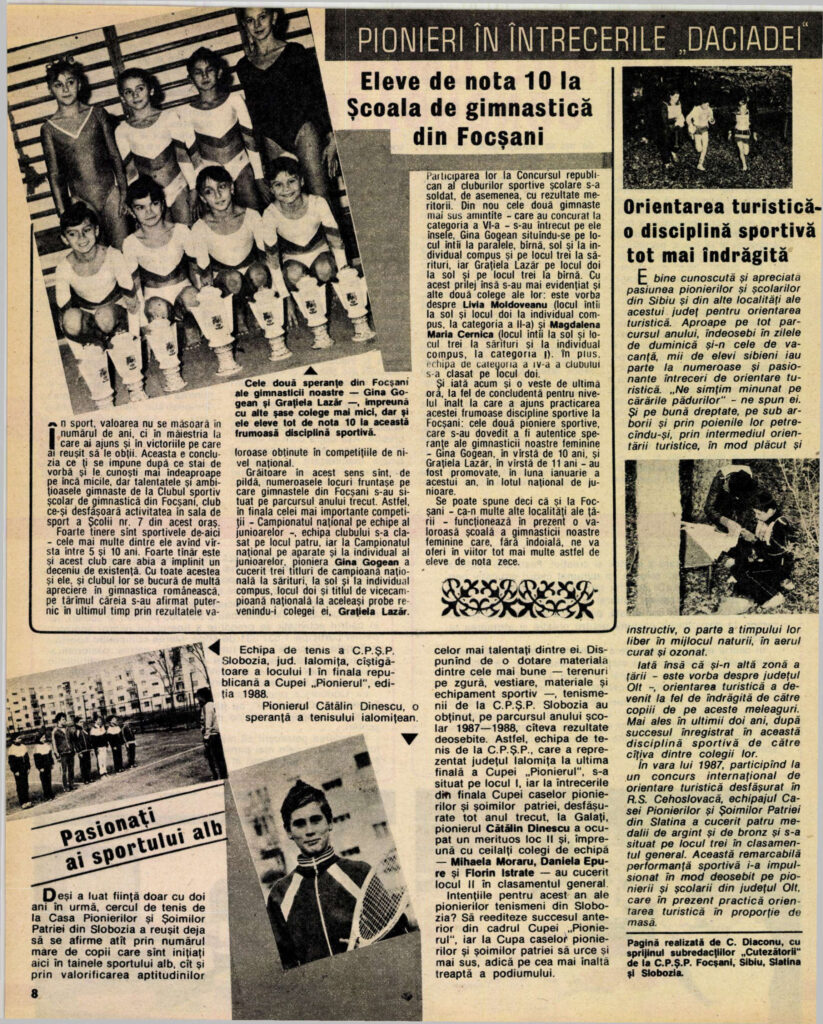
*To be clear, Gina Gogean has never acknowledged that her age was altered, despite an abundance of evidence to the contrary. Curiously, Romanian media continued to use her federation age. Even ProSport, the newspaper that had tracked down her birth certificate, referred to her as a 26-year-old in an April 2004 profile: “În momentul de față, Gina Gogean(26 de ani)este antrenoare la Sînnicolaul Mare, ocupîndu-se totodată de organizarea competițiilor pentru copii. “M-a prins destul de bine această meserie. Îmi place foarte mult să lucrez cu cei mici”, a spus Gina, care urmează și cursurile unui Master în știința sportului, la Arad.” (ProSport, April 29, 2004). That would have made her birthdate September 9, 1977—not 1978 as her birth certificate in Cîmpuri said.
Appendix B: The Full Text of the Gogean Interview
GINA GOGEAN: “My documents say 1977.”
The former gymnast insists her age was never falsified and says she competed legitimately in 1992.
ProSport: Hello, Gina?
Gogean: Yes.
ProSport: Can we talk?
Gogean: Yes, but my battery might die.
ProSport: In ’92 you competed at the Barcelona Olympics. Do you remember how old you were then?
Gogean: (Hesitates) Uhhh… Why? How old was I?… I was 14 going on 15. It was the year when you could compete at 14 if you turned 15 that same year. I turned 15 in September, and the Olympics were in August.
ProSport: What’s your birth year?
Gogean: 1977.
ProSport: We have your birth certificate, and it lists 1978.
Gogean: I can show you my birth certificate, and all my documents say 1977. September 9, 1977. That’s my date. You’ve been writing about me for so many years and you still don’t know how old I am, what day I was born? When I come by, I’ll bring you my birth certificate with 1977. I’ll bring my ID card and my passport too.
ProSport: So in 1992 you were 14 going on 15?
Gogean: Yes. The rules were different then. The age limit was 15.
ProSport: We have the certificate from Cîmpuri.
Gogean: Mine is from Cîmpuri too. I don’t know where you went or what you did to get it wrong!
ProSport: If it’s 1978, then you weren’t allowed to compete in 1992.
Gogean: (Becomes irritated.) Sir, I don’t understand what your interest is! At that time I was 14, turning 15. I can show you all my documents—what more can I say? I’m sorry, I can’t talk now, I just walked into a store. We’ll talk another time.
ProSport, April 10, 2002
Appendix C: The Full Text of the Vieru Interview
VIERU: “I don’t know. I haven’t seen it.”
Nicolae Vieru, president of the Romanian Gymnastics Federation (FRG), has been working in the federation for 35 years. He insists that Romania has never falsified a gymnast’s age.
ProSport: Mr. Vieru, has the age of any gymnast ever been falsified to make it easier for her to compete internationally?
Vieru: There was only one case. A Korean girl, caught at the World Championships in Stuttgart in 1989. After that, North Korea was suspended from all international competitions for a year.
ProSport: We’re referring to Romanian girls.
Vieru: Ah, no, sir! I don’t know anything like that.
ProSport: So in Romania, such a case has never existed?
Vieru: No. But how could anyone prove such a thing? Who’s going to dig through dozens of files?
ProSport: Who in the federation knows the gymnasts’ ages best?
Vieru: We do, but primarily Octavian Belu and Mariana Bitang. The coaches are kept up to date with birthdates and other details. They present the passports before competitions. That’s the official document.
ProSport: ProSport has obtained Gina Gogean’s birth certificate, and it clearly says she was born on September 9, 1978. Yet at competitions she is listed as September 9, 1977.
Vieru: (Agitated.) I don’t know. I haven’t seen anything like that.
ProSport: It’s essentially a change of year. Is it possible something like that was done?
Vieru: I don’t know. Who knows? I’ve never seen her certificate. The document valid internationally is the passport. What can I say? You’re telling me 1978?
ProSport: Isn’t this irregular? If the certificate says one thing and the passport another…
Vieru: How should I put it… an uncaught thief is… I don’t know, she knows best. Her passport isn’t kept at the federation.
ProSport: Aren’t you worried that if this falsification is proven, sanctions might be taken against the federation?
Vieru: What sanctions could they take? (Laughs.) I’m a vice president of the FIG, responsible for regulations and the statutes. There’s nothing in the rules about this.
ProSport, April 10, 2002
One reply on ““The Uncaught Thief”: Unraveling Gina Gogean’s Age”
This is the first I’ve heard of Gina’s age being falsified! Thanks for publishing everything you have uncovered. It is fascinating to know what really happened back in the day.