Tatiana Frolova had what Soviet journalists called “soft” gymnastics—a quality that made her stand out even among the technical virtuosos of the early 1980s. Blessed with “beautiful physical qualities,” her movements flowed with a natural grace that allowed her to combine power with lyrical expression. When she performed her floor exercise to Chopin’s “Impromptu,” she embodied a style reminiscent of an earlier generation—Kuchinskaya, Petrik, Karaseva—though with far greater difficulty.
She came from a working-class background in Bryansk, where her mother worked as a shop cashier and her father as a fitter at the city’s machine-building plant. Her coach, Vladimir Shishkin, was himself a former miner from Kemerovo who had moved west, married fellow coach Lyudmila Borisova, and formed a partnership that would produce one of the Soviet Union’s top gymnasts. Shishkin encouraged independent thinking in his pupil. Frolova, journalists noted, “liked to think things through herself” and engaged in deep analytical discussions with her coach.
When she burst onto the senior scene in April 1981 at the USSR Cup in Leningrad, her performance seemed to come from nowhere. She had placed eleventh at the 1980 junior championships; now she won silver behind Alla Mysnik and claimed vault gold. Josef Göhler, writing in International Gymnast, called it a “quantum leap.”
He noted that she had been born in 1967. Little did he know that Frolova wouldn’t just leap spots in the rankings; she would leap years, as well.
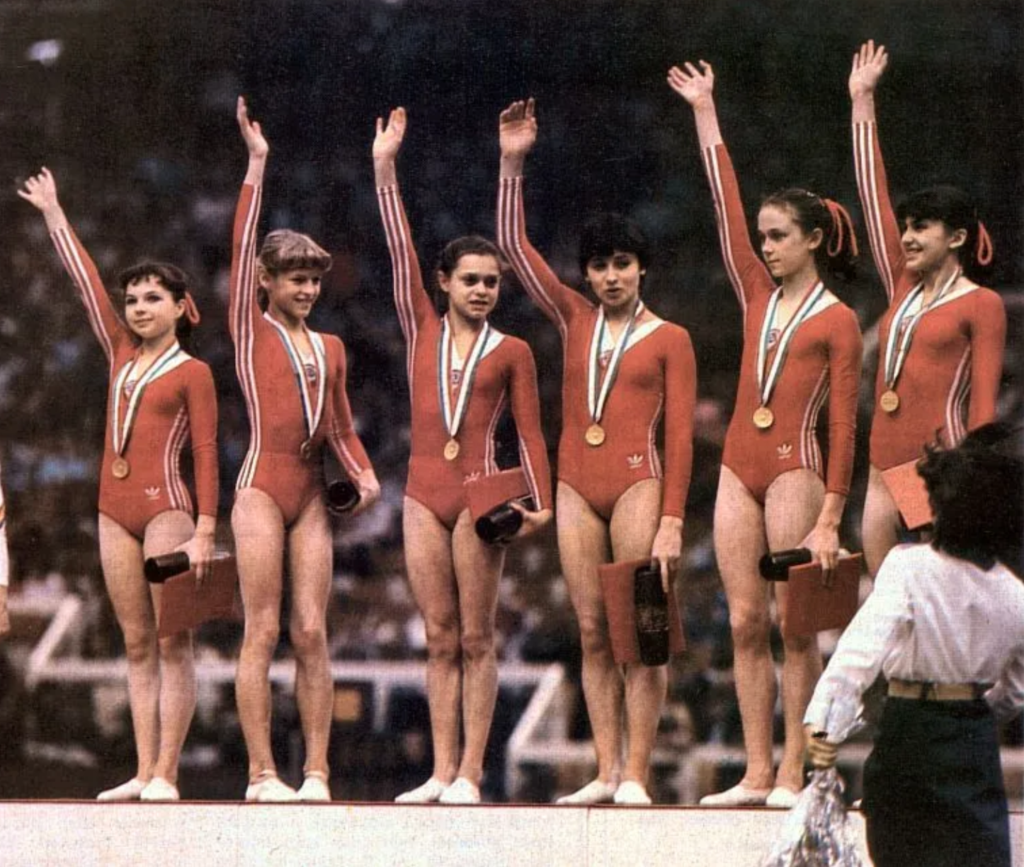
Sovetsky Sport captured the public’s fascination with the two youngest competitors at the 1981 USSR Cup: “In the women’s program, Alla Mysnik, Tanya Frolova, Elena Naimushina, Natasha Yurchenko, Elena Polevaya, and Aida Babasyan stood out. But the crowd favorites were still Alla and Tanya, the youngest of all. They are not yet even fourteen, but that does not mean, as some might say, ‘another kindergartener on the podium.’ Yes, these two seventh-graders are tiny, but judges do not evaluate height, nor do they award high scores for pretty faces (though the girls really do have lovely ones), but for very original routines, for astonishing precision and novelty.”
Not yet fourteen. Seventh-graders. That still tracked with a birth year of 1967.
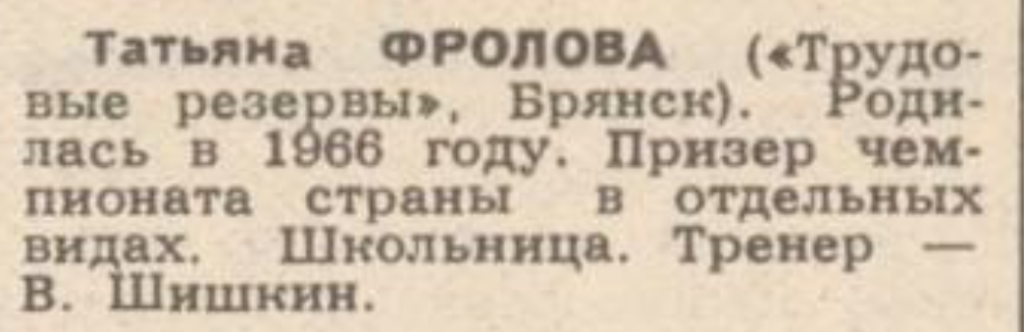
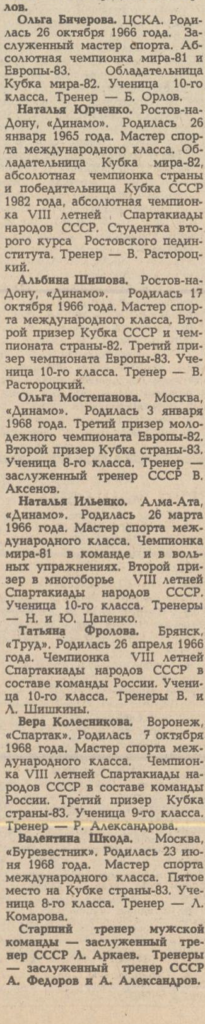
Seven months later, when the Soviet roster for the 1981 World Championships was published, Frolova’s bio recorded a 1966 birth year—making her fifteen, the minimum age for senior international competition. The mathematics are simple and damning: a girl who was still thirteen in April could not possibly be fifteen by November of the same year.
Frolova became an alternate for those 1981 Worlds, watching from the sidelines as teammates like Elena Davydova and Stella Zakharova competed in Moscow. But her time came, and she earned a place on the Soviet team for the 1983 World Championships in Budapest.
By then, Frolova was genuinely age-eligible even under her true birth year (1967): she had turned sixteen that April. Her documents, however, still listed 1966, making her seventeen on paper. She competed alongside Olga Bicherova and Natalia Ilienko, whose records had also been altered, shifting their birth years from 1967 to 1966. Like Frolova, both were now old enough according to their actual birthdates; the falsification no longer conferred any competitive advantage. It persisted instead to avoid creating discrepancies in the FIG’s records—an administrative fiction maintained for the sake of continuity rather than necessity.
In Budapest, Frolova won gold with the Soviet team and finished fifth in the all-around. She found herself in fifth again during the beam final after falling on her full-twisting double back dismount, and she barely missed the bars podium, taking fourth only 0.025 behind Romania’s Lavinia Agache and Ecaterina Szabó, who tied for second.
What made Frolova remarkable wasn’t just her gymnastics—though her routines were, as one Soviet report noted, “excellent and rich in expressive means”—but her resilience. Before the 1984 USSR Cup, she sustained an ankle injury serious enough that many questioned whether she could compete. Soviet journalists said she “showed courage,” pushing through to finish second and earn her spot on the team for Friendship-84 in Czechoslovakia, where the Soviet women’s team claimed gold.
In Budapest and Olomouc, the falsification served no competitive purpose. Frolova was age-eligible. But the fabricated birth year remained in official records, a ghost of an institutional practice that treated young gymnasts’ identities as administrative conveniences rather than biographical facts.
Somewhere in the bureaucratic machinery of Soviet gymnastics, a year of Tatiana Frolova’s childhood simply disappeared.
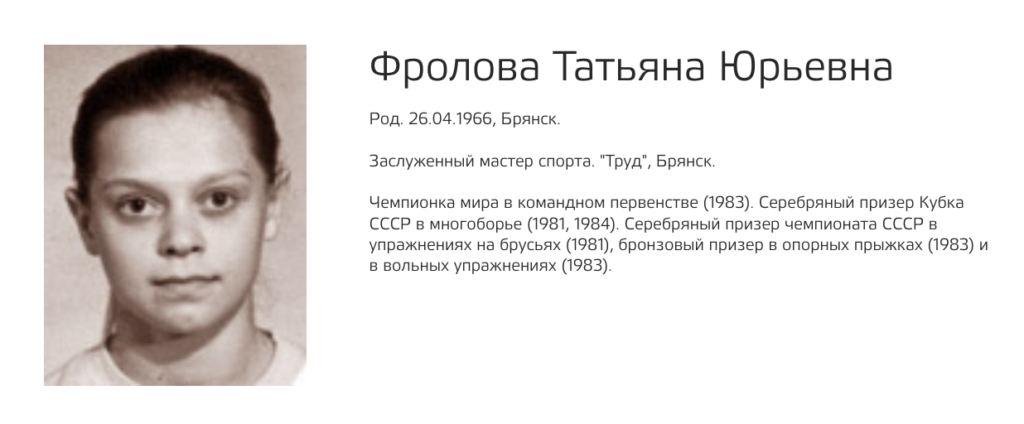
The Russian Gymnastics Federation still has not found that missing year. Frolova’s biography on the site still lists her birthdate as April 26, 1966—one year older than the archival record suggests.
Catching up with Frolova
In 2002, International Gymnast caught up with Frolova, who was coaching in Canada.
Frolova Flips for Canada
Fifth all-around at the 1983 World Championships, Tatiana Frolova is now thriving in Canada, where she has been coaching at the Winstonettes gymnastics club in Oshawa, Ontario, since the fall of 2001.
A native of Bryansk, Russia, Frolova was a member of the Soviet Union’s gold medal-winning teams at the ’83 World Championships, ’84 Alternate Games and ’85 World University Games.
“Without a doubt, Canada is a wonderful country,” says Frolova, who resides in Oshawa with husband Dmitry and son Alexander. “Everyone greeted us so hospitably. The parents of the children who train at the club eagerly helped with everything. This is my wonderful new life.”
Far removed from the now-defunct Soviet system that produced many champions like herself, Frolova says she aims to help her Canadian students appreciate how athletics can enhance their perspectives. “Taking up a sport provides a very good ‘school’ for life,” she says. “It is the chance to realize what you think about. It is the chance to make a lot of new friends, to see the world, to know a lot. It is the chance to live beautifully—to be happy in life, in the name of sports.”
John Crumlish, International Gymnast, October 2002
References
Göhler, Josef. “USSR Cup.” International Gymnast, August 1981.
“First Steps Are Easy for Them.” Sovetsky Sport, April 19, 1981, No. 92.
“USSR National Team Roster.” Sovetsky Sport, November 22, 1981, No. 270.
“Minsk, September 26.” Sovetsky Sport, September 27, 1981, No. 224.
“Gymnastics Aimed at the Future.” Komsomolskoye Znamya, April 3, 1983, No. 64.
“Flights Not in a Dream, But in Real Life.” Sovetsky Sport, August 6, 1983, No. 180.
“Schoolgirls in ‘School.'” Sovetsky Sport, October 27, 1983, No. 246.
“Inspiration of Strength and the Strength of Inspiration.” Sovetsky Sport, November 1, 1983, No. 250.
“A Level-Headed Contest.” Sovetsky Sport, April 6, 1984, No. 80.
“Boldness Is Encouraged.” Sovetsky Sport, April 19, 1984, No. 91.
“These Different Faces.” Sovetsky Sport, June 30, 1984, No. 149.
“Conquering Heights.” Sovetsky Sport, August 25, 1984, No. 196.
More on Age