Most age-falsification cases involve making gymnasts older so they can enter senior competition earlier. But what if the goal were the opposite—to make a gymnast younger, allowing her to compete in both junior and senior events?
That appears to be what happened with Bulgarian gymnast Hrabrina Hrabrova, who competed at both the 1988 Olympic Games and the 1988 Junior European Championships under a falsified age.
Hrabrina Hrabrova grew up in a gymnastics family. Born in Varna, Bulgaria, she was the daughter of two decorated national team gymnasts—her father, Bozhidar Hrabrov, who became a prominent coach, and her mother, Vanya Hrabrova. “I began going to the gym since the age of two or three,” she later recalled. “Not sure exactly when my father decided I’m okay to take along to work.” At age seven, her father formally invited her to join his competitive team.
When Hrabrova was eleven, the family moved to Sofia, where her father had been offered a high-ranking coaching position at one of Bulgaria’s two largest sports clubs. By age fourteen, she had earned a coveted spot on the Bulgarian National Senior Team—one of the top five teams in the world during the 1980s.
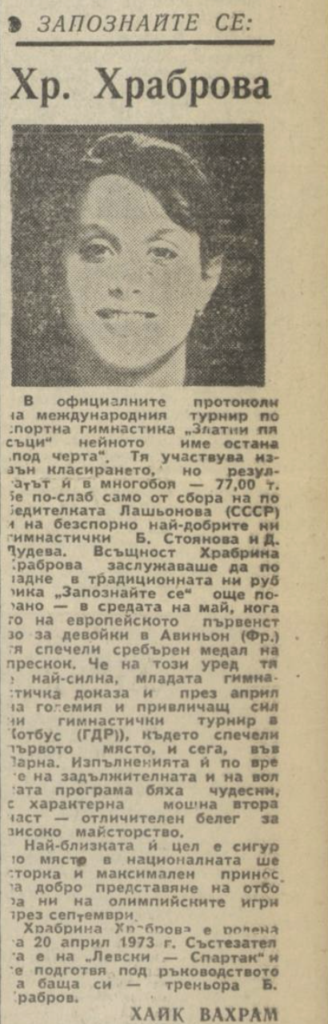
In 1988, Hrabrina Hrabrova competed under the official birthdate of April 20, 1973. That date was printed across Bulgarian state media, including a June 2, 1988, profile in Otechestven Front, which stated plainly: “Hrabrina Hrabrova was born on April 20, 1973.” The article appeared shortly after her silver medal on vault at the Junior European Championships in Avignon, France—a breakthrough performance that confirmed her emergence as one of Bulgaria’s rising gymnasts.
But decades later, the truth would come out. Her gym’s official biography confirms: “Hrabrina was born on April 20th, 1972.” (Her Instagram username also has 72 in it.)
For Hrabrova, the falsification ran in the opposite direction: instead of making her older to gain early senior eligibility, officials seem to have made her younger to preserve access to junior competitions, which typically restricted eligibility to athletes who were 15 years old and under. Born in 1972, she would have turned sixteen in April 1988, making her too old for junior competition. With a falsified 1973 birthdate, she remained fifteen and eligible.
This allowed her to compete at both the Junior European Championships in May 1988 and the Olympic Games in Seoul that September—a rare opportunity to shine on both the junior and senior stages in the same year. (Note: I contacted Hrabrova regarding the discrepancy, but she did not know when or why her birthdate had been altered. As in many such cases, the decision was administrative and not the athlete’s own.)
At the Junior Europeans in Avignon, she won silver on vault. “I loved getting that medal on vault at Europeans, although I didn’t do a single vault for a week prior (I was lost and was missing my hands every time),” she remembered. More memorable still was her floor routine: “It was in Avignon, France, where the entire audience got up on their feet in applause for my floor routine (although I wasn’t the floor winner)—that sight was mesmerizing for me.”
Then came the Olympics. The experience would mark both the pinnacle and the beginning of the end of her career. One week before departing for Seoul, Hrabrova suffered a devastating injury. The national team coordinator—whom Hrabrina would later describe only as “the monster” in the book Bulgarian Gymnasts in Conversation—held her in the training gym long after everyone else had left, demanding she complete a floor routine with full difficulty and no mistakes. “My body was exhausted, and the achievement of that was not possible,” Hrabrova recalled. “That is when the damage on my Achilles was done.”
A strong cortisone injection allowed her to walk and compete. She helped Bulgaria place fifth with the team. But the damage had been done. “No good memories from the competition part of the Olympics,” she later said. “I was held by the ‘monster’ for more than one hour longer at practice than the rest of my teammates on the day before optionals. Exhaustion led up to all the mistakes on competition day.”
The following year, 1989, she fractured both arms, forcing her to miss the World Championships. Then her Achilles—masked by cortisone in Seoul—ruptured. An unsuccessful surgery followed. At just seventeen years old (or sixteen, according to her official documents), her competitive career was over.
She remained involved with gymnastics, working as a clinician and choreographer with her club and the Bulgarian National Team while attending the National Sports Academy. Then, in 1991, her father defected while in Indianapolis for the World Championships. In 1992, Hrabrova withdrew from university and joined him in the United States, eventually settling in West Virginia. Together they founded Bozhi’s Gym Nest in 1996, where her father—with Hrabrova’s assistance—coached Kayla Williams to the 2009 vault World Championship title.
Looking back, Hrabrova has no illusions about the system she competed under. She describes in detail the abusive training environment, the “monster” coordinator who destroyed gymnasts “physically and exercised mental and emotional—and in some cases physical—abuse to the highest extent on generations of girls.” But she takes pride in her achievements: “It was amazing to represent my country at the [junior] European championships and the Olympics.”
For more on Hrabrova’s career, see Bulgarian Gymnasts in Conversation by Karen Louise Hollis. You can also read her profile on her gym’s website.
Appendix: The 1988 Profile
Meet: Hr. Hrabrova
In the official protocols of the international artistic gymnastics tournament “Golden Sands,” her name appeared “below the line.” She competed outside the standings, yet her all-around score—77.00 points—was surpassed only by the total of the winner Lashyonova (USSR) and by those of our unquestionably best gymnasts, B. Stoyanova and D. Dudeva.
In fact, Hrabrina Hrabrova deserved to appear in our traditional “Meet the Athlete” column earlier—back in mid-May—when she won the silver medal on vault at the European Junior Championships in Avignon (France). That vault is her strongest apparatus was proven again by the young gymnast in April at the major, star-studded tournament in Cottbus (GDR), where she took first place, and now once more in Varna.
Her performances in both the compulsory and optional programs were excellent, marked by a powerful second half—a distinctive sign of high mastery. Her nearest goal is surely a secure place on the national team and a maximum contribution to a strong team showing at the Olympic Games in September.
Hrabrina Hrabrova was born on April 20, 1973. She competes for Levski–Spartak and is coached by her father, coach B. Hrabrov.
Hayk Vahram
Отечествен фронт, June 2, 1988
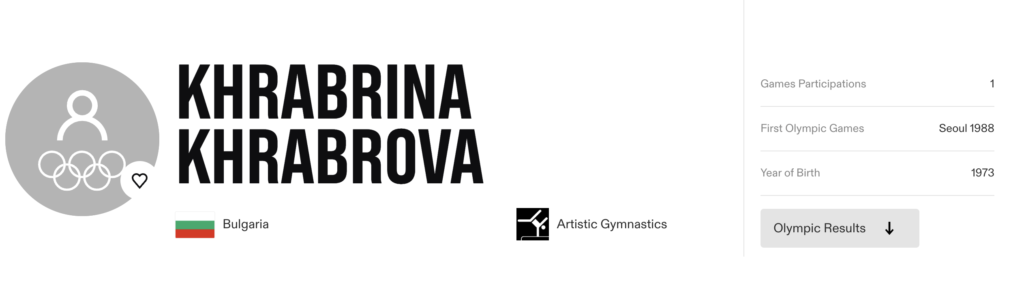
Note: Her IOC profile also lists her birth year as 1973.
More on Age