“A Person Must Have Some Spirit” appeared in the People’s Daily on January 2, 1982. It was attributed to Tong Fei, one of China’s pioneering male gymnasts in the early reform era. The essay recounts his performance at the 1981 Grand Prix in Paris, where—competing just days after suffering a concussion in a car accident—he won three gold medals and an all-around silver.
Tong’s account offers a window into Chinese gymnastics culture at a crucial moment: China had only recently rejoined the international gymnastics community after decades of isolation, and athletes like Tong were among the first generation to compete regularly against Western and Soviet opponents. Published in the Communist Party’s official newspaper, the piece follows the conventions of socialist-realist athlete narratives, emphasizing collective duty, national honor, and ideological commitment over individual achievement. Yet beneath the formulaic rhetoric lies a genuine athletic feat and a glimpse of the mentality that would soon propel Chinese gymnastics to world dominance.
The essay also references Li Yuejiu, another pioneering Chinese gymnast who had competed through injury at the 1980 Alternative Games in Hartford, Connecticut. He established a template of athletic sacrifice that Tong explicitly invokes as precedent.
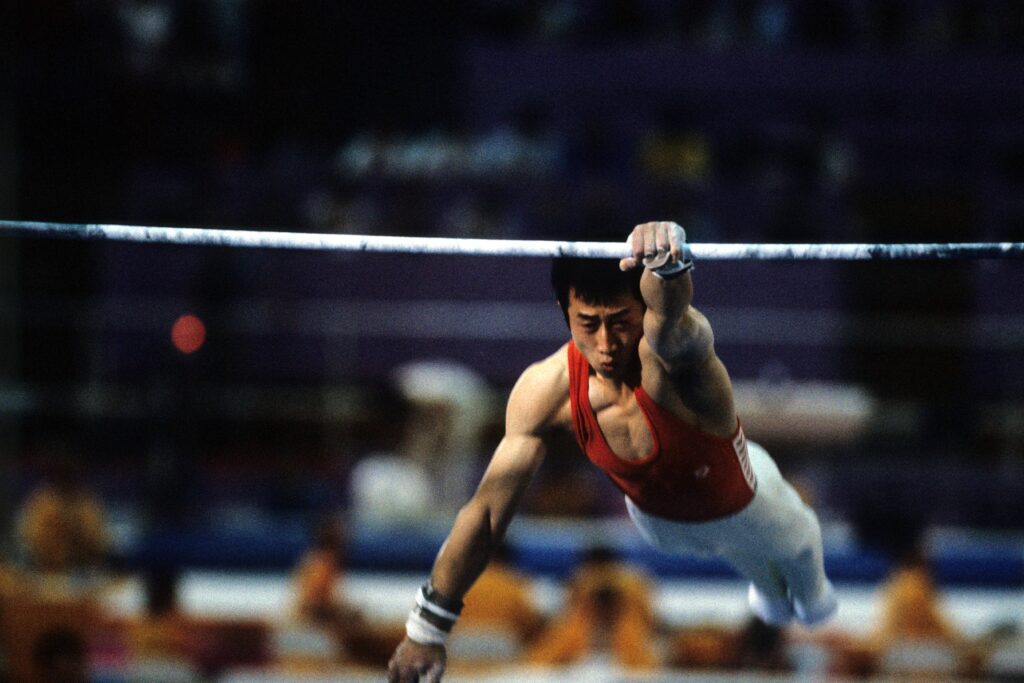
A Person Must Have Some Spirit
By Tong Fei
As 1982 arrives, I have many things I could say. But the one sentence I most want to say is this: a person must have some spirit. On this point, I had direct personal experience in 1981.
Last August, I went to France to compete in a World Gymnastics Grand Prix event. Unfortunately, before the competition, I was injured in a car accident and suffered a head injury. The doctor diagnosed a concussion. At the time, I felt groggy and could hardly sleep; whenever I lowered my head, the pain was severe. Well-informed reporters, after learning of my condition, all assumed I would be unable to compete.
After discussing it with my coach, I thought: the Chinese team had come with only one athlete—if I didn’t compete, wouldn’t the trip to Paris have been for nothing? Hadn’t Li Yuejiu knocked out a front tooth and split his lip at a competition in Hartford in the United States, yet still insisted on competing? I made up my mind to take part—and not just to compete, but to compete well.
With my coach’s help, I prepared. On the first day, I entered the competition, bearing a scar on my right cheek, and won second place in the all-around. Some comrades might say that achieving such a result while injured was already quite good. But as an athlete, my goal is the championship; I am never satisfied with what I have already achieved.
On the second day, in the apparatus finals, I won three gold medals—in floor exercise, still rings, and parallel bars. I feel that in this competition, what I gained was not merely three gold medals and one silver trophy. Through this experience, I achieved a spiritual victory and strengthened my willpower, taking a significant step forward on the path of overcoming difficulties.
Why was I able, under extremely difficult circumstances, to create what French newspapers called a “miracle”? I believe it was the power of spirit that supported and inspired me. That spiritual force comes from the expectations of the Party and the people of the whole country, from the honor of our socialist motherland, and from the dignity of the Chinese nation.
In 1981, we achieved some successes, yet the Party and the people bestowed upon us far greater honors. As the new year arrives, I will strive to achieve new accomplishments.
More Interviews and Profiles