In October 1978, gymnasts gathered in Strasbourg, France, for the XIX World Artistic Gymnastics Championships. Among the Bulgarian women was Krassimira Toneva, who, like many gymnasts in the sport’s history, was technically too young to be there. She was born in 1965.
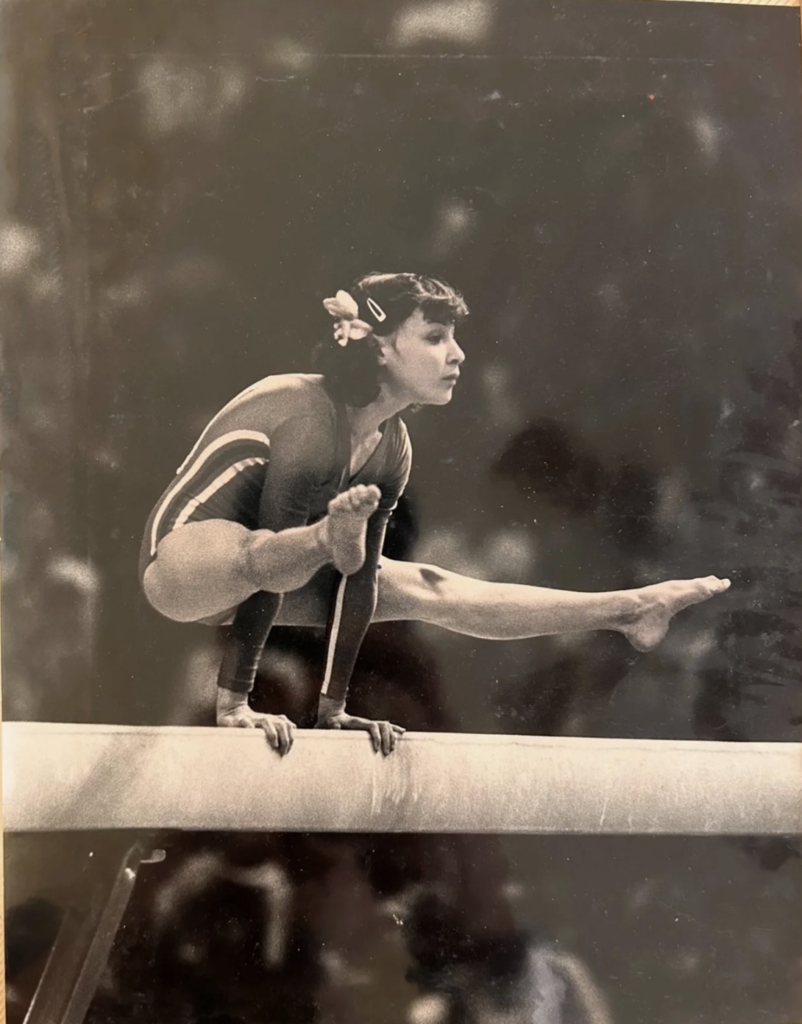
From Under-13 to the World Championships
As late as December 1977, Toneva took part in competitions for gymnasts under the age of thirteen. At the Third International “Sofia Cup,” for example, she won the girls’ under-13 all-around, as well as the vault and beam titles. (Olga Bicherova won the floor title.)
At most, she could have been twelve in 1977, which meant that there was no plausible way for her to be fourteen in 1978. Yet by the spring of that year, she had begun competing in senior domestic competitions and was named to the expanded national team. By October, she appeared on the final roster for Strasbourg:
D. Gluhcheva (Levski-Spartak)—all-around champion for 1978; S. Topalova (Slavia)—perhaps the strongest at the moment; Ir. Gyoreva (CSKA); Kr. Varbanova (Lokomotiv, Gorna Oryahovitsa); A. Rahneva (Lokomotiv, Gorna Oryahovitsa); G. Marinova (Cherno More); reserve: Kr. Toneva (CSKA). The average age of the team is 14 years.
Otechestven Front, Oct. 20, 1978
Though she was initially named as the reserve, Toneva ultimately took the floor in place of Galina Marinova (who is better known today as one of McKayla Maroney’s coaches). According to Naroden Sport, she finished 63rd in the all-around and tenth with the team.
The Contradiction
The FIG’s eligibility requirement was straightforward: female gymnasts had to turn 14 during the calendar year of competition. For the 1978 World Championships, that meant that gymnasts born in 1964 were eligible, while gymnasts born in 1965 were not.
By the 1980 Moscow Olympics, Toneva’s birth year was consistently recorded as June 23, 1965. That date appears in Olympic profiles, news reports, and later biographical summaries. Under a 1965 birth year, she would have been 12 in 1977 and 13 during the 1978 World Championships—a full year below the age minimum.
There are two possibilities: Toneva competed at Strasbourg with a 1965 birth year, and the rule went unenforced. Or, she competed under a conveniently falsified 1964 birth year that was later corrected during her elite career. Either way, she was underage in Strasbourg.
Further Confirmation
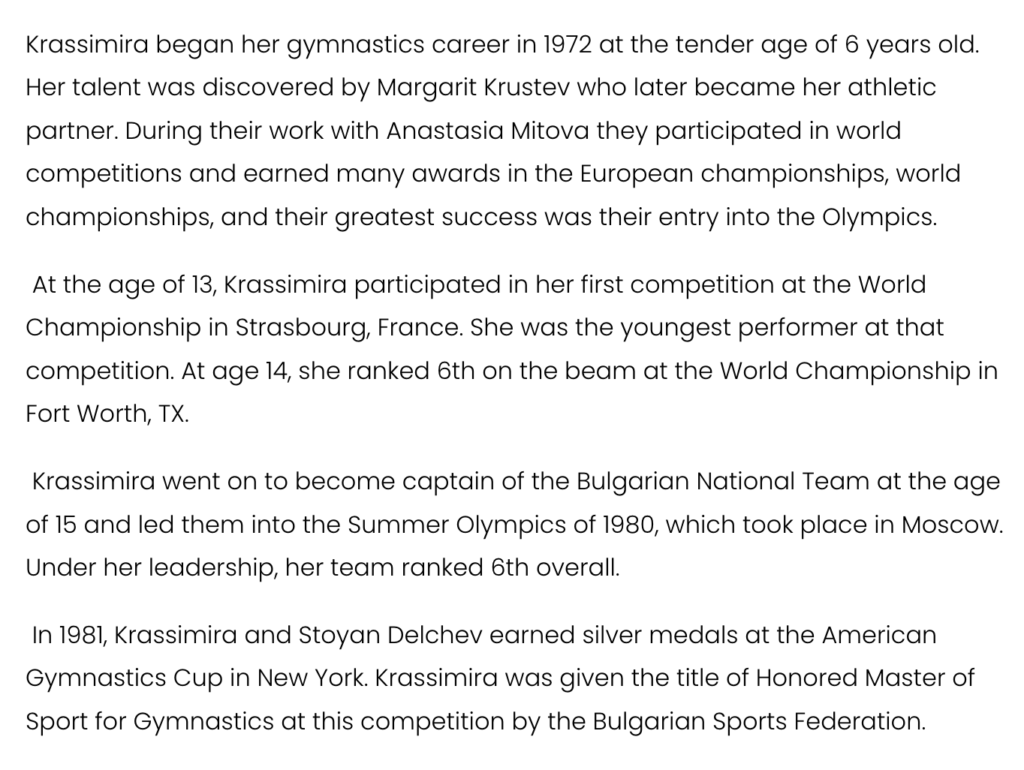
Decades later, a short biography published by Toneva’s U.S. club confirmed that she was underage. It states that she competed at the 1978 World Championships at the age of 13, describing her as the youngest participant in Strasbourg. (Whether she was actually the youngest in an era of age falsification is another question entirely.)
What the biography frames as brilliance would, at the time, have constituted ineligibility. It offers no explanation for how a thirteen-year-old could have satisfied the FIG’s age requirement. Her age is simply stated—treated as both an uncontested fact and something to celebrate.
To place Toneva’s achievement back in its original context, I have translated two articles from the Bulgarian press. Unlike their Soviet or Romanian counterparts from the 1970s, Bulgarian gymnasts have received comparatively little attention on the gymternet, leaving much of the country’s gymnastics history untranslated and unexamined. So, here’s a bit of Bulgarian gymnastics history for you.
May 1980
The Truth Is in Great Success
Master of Sport Krassimira Toneva was born on June 23, 1965, in Pernik. She began practicing artistic gymnastics in 1973 in her hometown. Two years later, she joined the ranks of CSKA “Septemvriysko Zname,” where she continues to train to this day.
[Note: Her bio on her U.S. club indicates that she started gymnastics in 1972.]
The successes she has achieved are many, but the most significant among them are three republican titles: in 1976 as a pioneer (youth), in 1977 among juniors (senior age group), and in 1979 as the champion among Masters of Sport. In that same year, she also achieved her highest results on the international stage. At the European Championships in Copenhagen, she placed 11th in the all-around, which was the best result ever achieved by a Bulgarian gymnast up to that point. At the World Championships in Fort Worth (USA), she managed to qualify for the balance beam final and took an honorable seventh place.
Krassimira Toneva is a student at the “Chavdar” Secondary Sports School. Her coaches are M. Krăstev and An. Mitova.
She captivates the audience the moment she steps onto the gymnastics podium. From her slender figure and the elegance of her walk emanate confidence and calm. A moment before she grips the apparatus, her face becomes serious, focused. Then everything follows its logical course. The spectators, holding their breath in the stands, follow her every movement—as if they, too, are performing with her. The difficult and spectacular routines, executed in the most perfect manner, are usually accompanied by that drawn-out “ahhh” through which the audience spontaneously expresses its admiration. Then there is a brief pause, before it erupts again in thunderous applause at the magnificent finale.
Krassimira Toneva truly is a major challenge on the gymnastics stage. But how did it come to the moment when this enthusiastic feeling among spectators and specialists alike defined her as one of the best gymnasts we have ever had?
Little Krassi, still a first-grade pupil, preferred to spend her free time in the gymnastics hall with her older sister. There she saw so many interesting exercises that stirred her desire to master them. And almost imperceptibly, she began to sculpt wonderfully beautiful gymnastic figures with her flexible little body. It was not long before her talent was noticed by the coach Siyka Nachkova, who showed her the basics of high-level sports, taught her precision, and instilled a sense of beauty. Thus, Krassimira discovered her calling—she devoted herself to sport with all her heart and soul.
Great diligence and persistence in training soon opened the path to success—a dizzying ascent from one rank to the next higher one, where defeat was not tolerated. In just six years (1973–1979), she passed through the four ranking barriers and conquered the master standard as well. During this time, Krassi was already at CSKA, where the experienced coaches M. Krăstev and An. Mitova completed the shaping of a great gymnast.
The last two years have brought the greatest joy to her and her coaches. She finished all domestic competitions with victories. She also performed excellently on the international stage, where she achieved the highest accomplishments ever for Bulgarian women’s gymnastics. Just one month ago, Krassimira once again caused joyful excitement with her wonderful performance at the Tournament of Champions held in London, where she placed fourth, behind the representatives of the USSR, Romania, and the GDR.
This success intrigued me and prompted me to pose a few questions to Krassimira Toneva, before she steps onto the Olympic podium:
— There is an old aphorism: “In dispute, truth is born.” And in sport, in your opinion, what is born?
— I think sport, too, has its own truth. Because every athlete, if they devote themselves entirely to their chosen discipline, reaches the same truth: great success.
— And for that, a great deal of will and ambition is needed. What is yours for “Olympics ’80”?
— To perform my routines without major mistakes. Then I can hope for a good ranking during my first Olympic Games.
— For now, on which apparatus do you feel the most secure, the most stable?
— I think I perform well on all apparatus, but it seems that I execute the balance beam and vault with the greatest ease.
— Who are the most serious candidates for the championship title at the XXII Olympic Games—and therefore your main rivals?
— All the Soviet and Romanian gymnasts, Maxi Gnauck (GDR), and Věra Černá (Czechoslovakia). These are competitors with great finesse and expressive elegance in their performance. I strive to be like them, even to show something more original by which I might be remembered. I will be satisfied if I defeat some of them and contribute to the success of our entire team.
Veneta Ignatova
Narodna Armiya, May 23, 1980
May 1981
Among the Top Six
In recent years, we have usually associated the successes of Bulgarian artistic gymnastics primarily with the name of its undisputed favorite, Stoyan Delchev. But at the Olympic Games in Moscow, we already achieved our first team success as well—both our men’s and women’s teams found places among the top six.
The first major competition after the Olympics was the XIII European Women’s Championships, which concluded in Madrid in recent days. There, once again, our progress in gymnastics was confirmed. For the first time since 1965—when Maria Karashka placed fifth in the all-around at a European Championship and won a bronze medal on the uneven bars—a Bulgarian gymnast once again ranked among the six strongest on the continent.
Now, in Madrid’s “Palacio de Deportes,” the 16-year-old Krassimira Toneva (a CSKA “Septemvriysko Zname” gymnast, coached by Margarita Krăsteva) finished sixth in the all-around with a total score of 38.25—just one point less than the winner, Maxi Gnauck (GDR).
Toneva’s progress becomes even more evident when her performance at “Olympics ’80” is compared with her showing now in Madrid. In Moscow, she placed 16th in the all-around, 2.525 points behind the champion Elena Davydova (USSR).
The other two Bulgarian competitors also performed very well: Galya Marinova finished 15th and Silvia Topalova 16th in the all-around. Toneva and Marinova also secured places among the top six in the apparatus championships. In fact, only gymnasts from five of the 18 participating countries reached this final phase of the European Championships: the GDR, Romania, the USSR, Bulgaria, and Czechoslovakia.
Undoubtedly, the success of the GDR gymnasts was due above all to the excellent performance of the new European champion, Maxi Gnauck. She was born on October 10, 1964, in Berlin and began practicing gymnastics at the age of nine. But it was at the 1979 World Championships in the USA that her star truly rose in elite gymnastics. She finished second in the all-around and, for the first time, performed a stretched salto with a triple twist. At the Moscow Olympic Games, Gnauck shared second place in the all-around with Comăneci (Romania) and won the gold medal on the uneven bars in the apparatus finals.
Incidentally, she was the only member of the “big three” from Moscow ’80 to compete in Madrid—Elena Davydova (USSR) and Comăneci were absent.
The European Championships are now over, and even bigger events are on the agenda: the world championships for men and women in Moscow in November, and the World Cup in France. Before those, at the annual international tournament “Golden Sands” in Varna in June, we will most likely see some of Europe’s strongest gymnasts, both women and men.
Anteni, May 6, 1981
More on Age