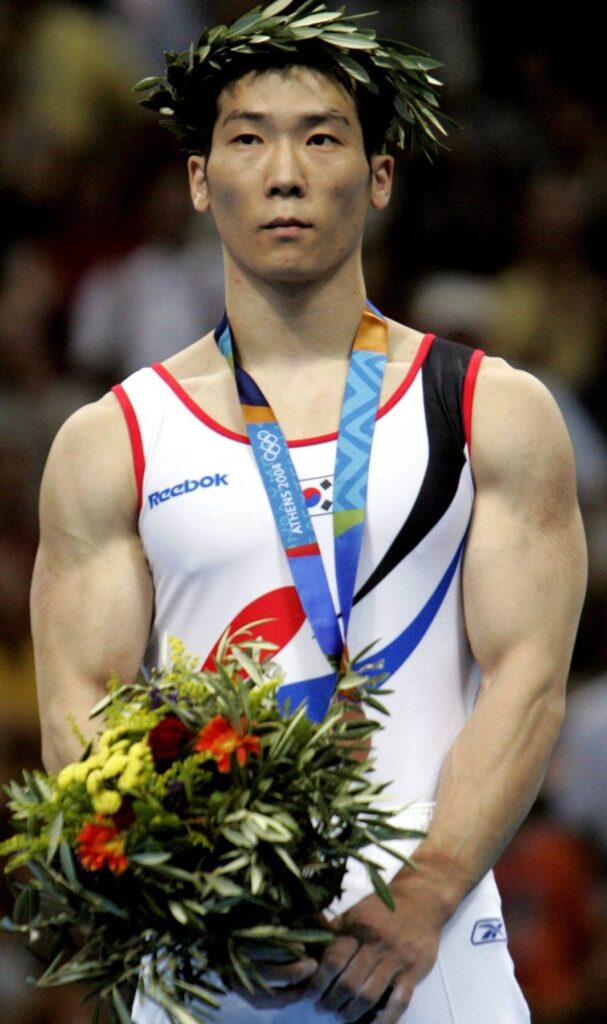
On September 22, 2004 — more than three weeks after the Athens Olympics closed — Yang Tae-young received a gold medal for the Olympic all-around.
The ceremony took place at the Lotte Hotel in Seoul, before officials of the Korean Olympic Committee (KOC) and the Korea Gymnastics Association, with the press in attendance. The KOC president, Lee Yeon-taek, placed a medal made from ten don of pure gold — 37.5 grams — around Yang’s neck. Engraved on its face were the words “28th Athens Olympics, Men’s Gymnastics Individual All-Around” (제28회 아테네올림픽 남자 체조 개인종합). Yang also received a $20,000 USD certificate, the bonus reserved for an individual Olympic champion.
“Although Yang Tae-young displayed the finest competitive performance at the Olympics, he suffered a genuinely unjust wrong,” Lee declared. “As one can see from the letter of FIG president Bruno Grandi, the true champion is, beyond any need for further discussion, Yang Tae-young” (양태영이 올림픽에서 가장 뛰어난 경기력을 발휘했음에도 참으로 억울한 일을 당했다. 국제체조연맹(FIG) 브루노 그란디 회장의 서한에서도 알 수 있듯이 진정한 우승자는 재론의 여지없이 양태영이다).
The Olympic record, however, says Yang won bronze.
That contradiction lies at the heart of the Yang Tae-young affair (양태영 사건). In South Korea, the controversy became known as the story of a “stolen gold medal” (도둑맞은 금메달) and has been remembered as “one of the most unjust incidents in Korean sports history” (한국 스포츠 역사상 가장 억울했던 사건 가운데 하나).
But the story was not always so clear-cut. In the days after the final, Korean newspapers offered competing explanations for what had happened. Some accepted Hamm’s victory; others blamed Korean officials, condemned the international federation, or accused the judges of stealing the gold. Over time, these competing accounts gave way to a more enduring story of a Korean athlete wronged by international sport. How that story took shape is as revealing as the judging error itself.
I. The Night of August 18
Yang Tae-young had been working toward Athens since he began gymnastics at Changcheon Elementary School in 1991. He went on to Seoul Physical Education High School and Korea National Sport University. During his training, he idolized the great Soviet and Belarusian champion Vitaly Scherbo. “I push myself hard every day to become a perfect gymnast like Scherbo,” he said (세르보처럼 완벽한 선수가 되기 위해 매일 나 자신을 채찍질한다). His first World Championships, in 2003, had ended in disappointment: third in qualification, he fell to twelfth in the all-around final. Days later, he won four gold medals at the Daegu Universiade, a feat KBS described as a first for South Korea at an international multi-sport games. He had voiced an ambition no Korean gymnast had yet fulfilled: “If Korea’s first gymnastics gold medal comes in Athens, I hope I’m the one who wins it” (아테네에서 한국의 체조 첫 금메달이 나온다면 그 주인공이 나였으면 좋겠다).
He had reason to believe he could. In Olympic qualification on August 14, Yang scored 57.924 across six apparatus, second only to reigning world champion Paul Hamm’s 58.061. The Dong-A Ilbo reported the result in a single sentence of an Olympic roundup, between archery and badminton.
Four nights later, at the Olympic Indoor Hall, Hamm led the all-around final through three rotations before a disastrous vault sent him staggering sideways, off two mats and nearly onto the judges’ podium. His 9.137 dropped him to twelfth place.¹ Coach Miles Avery told him that two 9.8 scores might still salvage bronze. “I thought that the gold at that point was impossible,” Avery recalled.
Then the leaders began to falter. Yang Wei of China lost his grip on a high bar pirouette. Romania’s Ioan Suciu botched a parallel bars handstand. In the fifth rotation, Yang Tae-young moved into first place with a parallel bars routine featuring piked and tucked Belles, a Healy to front 1¼, and a stuck double-pike dismount. It was the routine that would change everything, although neither Yang nor the spectators knew it yet.
The parallel bars A-panel had made a mistake. Benjamin Bango of Spain and Oscar Buitrago Reyes of Colombia, overseen by apparatus jury chair George Beckstead of the United States, had credited one of Yang’s Belles, an E-level element worth 0.2 in bonus, as a Morisue, a D-level element worth 0.1. His start value appeared as 9.9 instead of 10.0. The same three officials had awarded the routine a 10.0 start value in qualification and the team final but somehow failed to do so during the all-around final.²
The competition continued, and during the final rotation, on high bar, Yang finished a pirouette in the wrong grip, which reduced his start value and resulted in a 9.475. Hamm, performing last and believing he was fighting for bronze, delivered a superb routine for 9.837.
The scoreboard made Hamm the first American man to win the Olympic all-around: 57.823 to Kim Dae-eun’s 57.811 and Yang’s 57.774. Gold and bronze were separated by 0.049 points. The missing tenth in Yang’s parallel bars start value was twice that margin.
At first, Yang blamed himself. “What’s done is done,” he said. “I got this result because of my own mistake, so I should not complain.” Kim Dae-eun, who had buried his face in his hands when Hamm’s score appeared, was similarly resigned: “I’m a bit dissatisfied, but that’s what the judges are for. They made this decision, and I can’t contest it.” The loudest complaints came instead from the Romanians. “The only thing I can say is that the USA got something more than it deserved,” said Suciu, who finished fourth. Marian Drăgulescu, eighth, agreed that the Americans had received “a little bit more” than everyone else.
Apart from a grumble on SBS’s live broadcast about “questionable judging” (석연치 않은 심판의 판정), the Korean media initially treated the result as a breakthrough, not an injustice. The Dong-A Ilbo celebrated the country’s first Olympic all-around medals, men’s or women’s. A KBS profile published the following morning described Yang as having “agonizingly let the gold slip away before his eyes” (이번에 아쉽게 금메달을 눈앞에서 놓쳤다). Neither suggested that the judges had taken it from him.
But behind the scenes, the error had already been noticed.
According to the Korean delegation’s chronology, Kim Dong-min, a Korean judge serving on the parallel bars execution panel, spotted the incorrect start value as soon as the score came up and objected, but the technical judges brushed his concern aside (기술심들은 이를 일축함). The CAS award records only “a dialogue between Judge Kim and Buitrago at the conclusion of the parallel bar rotation.” Whatever Kim’s “inner state of mind,” the arbitrators found, “he gave no indication of continued dissatisfaction to Buitrago,” and he “did not suggest to us that he asked Buitrago to take the matter further.” At the same time, he could not have protested himself because, as the CAS panel held, “to make a protest would be inconsistent with his judicial functions.”
What the Korean coaches knew, and when, became a dispute of its own. Coach Lee Joo-hyung initially claimed that they had spotted the error but delayed protesting for fear that Yang would be penalized on high bar. Several days later, at a press conference in Athens, he said they had never checked the start value. Delegation chief Shin Park-je maintained that Lee had protested before the medal ceremony. The October issue of International Gymnast offered yet another account, saying the coaches had noticed the 9.9 on their way to high bar. The arbitrators ultimately accepted that Lee had not known of the error until Kim told him; television cameramen, Lee said, had blocked his view of the scoreboard.³
According to South Korea’s chronology, Kim found Lee around 11 p.m., with the final rotation over, and explained what had happened. Lee and his fellow coaches confronted the technical judges. Buitrago Reyes acknowledged the mistake, apologized, and directed them to Adrian Stoica, president of the FIG’s Men’s Technical Committee. The coaches searched for Stoica while the medal ceremony proceeded.⁴ When Lee finally reached him, he was told to submit a written protest.
At 2:30 the following morning, by the same chronology, Shin Park-je faxed Stoica an “Official Request for Correction of Start Value.”
The New York Times would later report that the Koreans had “waited two days” to complain. They had not. A Korean judge questioned the score when it appeared, the coaches raised the error that night, and the written request followed before dawn. But the formal protest still came after the competition had ended.
That distinction — hours rather than days, but after the final score nonetheless — would determine much of what followed.
II. “We Are Very Sorry”: The Admission
At noon on August 19, less than ten hours after the overnight fax, Shin faxed FIG president Bruno Grandi. Grandi’s reply, signed with secretary-general Norbert Bueche, answered both faxes and came within a day. It confirmed the scoring discrepancy and apologized, but offered Yang no remedy.
“Our technical delegate has confirmed that the Parallel Bar routine of your Korean gymnast Yang Tae-Young was given a start value of 10 at the Qualifying Competition (I) and at the Team Final (competition IV). At the All Around Final (Competition II) the judges gave a start value of 9.9. Our rules do not allow a protest against judges’ marks. The judges’ marks have to be accepted as a final decision and cannot be changed. […]
We are very sorry that such an occurrence took place and regret not being able to give you a more favourable answer.”
The Dong-A Ilbo reported on the letter under a headline that captured its absurdity: “Yang Tae-young’s Bronze Was a Judging Error… But It Cannot Be Overturned” (체조 양태영 銅은 오심… 번복은 안돼). The paper had Grandi confirming that Yang’s start value should have been 10.0 and calling the 9.9 a misjudgment (심판진이 9.9점을 준 것은 오심), a word the letter preserved in the award does not use. Yet the result would stand.
The federation was not finished with the case. On August 20, Grandi called an extraordinary meeting of his Executive Committee, which decided unanimously to analyze the all-around final. The next day, the FIG announced the result under the headline “Judging Mistake Confirmed. Three Technical Officials Suspended.” The error, the statement said, “is confirmed by the FIG.” To “protect the integrity of the FIG” and “maintain and ensure the highest possible judging standard,” the Executive Committee suspended the three officials concerned, pending an inquiry: George Beckstead, Benjamin Bango, and Oscar Buitrago Reyes.⁵ In the same statement, the federation repeated that judges’ marks “cannot be changed.”
The suspensions made the contradiction official. The FIG had punished the officials for the error while leaving its consequence in place. The Chosun Ilbo summed up the situation in a subhead: “No reversal, three judges suspended” (판정번복없이 심판 3명 자격정지). For the Korean delegation, that was not enough. The sanctions, Shin Park-je said two days later, were “not sufficient for us to accept” (우리가 받아들이기에 충분하지 못하다).
The suspensions also brought renewed scrutiny to the mistake itself. The two skills at the center of the dispute ended the same way, but began differently. A Morisue is a double back to the upper arms; a Belle is the same double back, entered from a giant swing. Kim Dong-min, the Korean judge who had challenged the start value during the competition, told the Korea Times that he could not understand how the head judge and both technical assistants had misread skills with such different entries. There was, he said, ample reason for suspicion (시작이 다른 기술인데 주심과 2명의 TA가 모두 잘못봤다는 것이 이해가 안간다… 충분히 의심할 만한 부분이 있다). The same article reported that questions were already being raised about whether the error had been deliberate (고의적 오판 의심까지 제기되고 있다).
III. The Fifteen-Minute Rule That Did Not Exist
By August 22, the controversy had acquired a more provocative name. The Chosun Ilbo declared: “‘Yang Tae-young Is Not 3rd but 1st’ — The Stolen Gold Medal” (“양태영은 3위아닌 1위” 도둑맞은 금메달). The headline rested on simple arithmetic. Restore the missing tenth, the paper calculated, and Yang’s 57.774 became 57.874, enough to pass Hamm’s 57.823.
The article itself was more hopeful than angry. Its subheads reported that “even the American press” wanted the gold returned and that the USOC was considering a joint award. It reminded readers that CAS had just stripped Germany of two equestrian gold medals after a disputed ruling, a precedent that, the paper said, opened the possibility of Yang recovering his.
Further down, the same article carried the FIG’s explanation of why the result would stand. “Judges can make mistakes,” spokesman Philippe Silacci told the paper, “but as in football, the result of a competition once finished cannot be changed” (심판은 실수할 수 있지만 축구처럼 일단 끝난 경기의 결과는 바뀔 수 없다). The federation added that the delegation had failed to submit a written protest within fifteen minutes of the competition, as the regulations supposedly required.
Coach Lee Joo-hyung did not dispute it. “I did not know of the FIG’s 15-minute written protest regulation,” he told the paper (FIG의 15분 이내 서면 항의규정은 몰랐다).⁶
But therein lies the problem: the regulation did not exist.
A fifteen-minute deadline had once existed. Under the FIG’s 1982 Technical Regulations, complaints written in French or German had to reach the jury president within fifteen minutes of the incident, and a Jury of Appeal could change the gymnast’s marks. By Athens, however, that provision had disappeared. Neither the 1997 Technical Regulations nor the 2002 edition, then in force, specified how a coach or federation should protest a score.⁷ There was no explicit written-form requirement, no deadline, and no fifteen-minute rule.
That did not mean the judges were powerless to correct mistakes. The Technical Regulations authorized the Superior Jury, chaired by the president of the Men’s Technical Committee, to “take such action as they consider necessary” in cases of “a grave error of judgement.” The Code of Points was more explicit: under Article 10.1(f), the apparatus jury chair could, with the approval of the Chair of the Competition Jury, change “an extremely incorrect score.” Though the authority to intervene existed, the rules failed to explain how coaches could invoke it, what form their objections should take, or how quickly they had to act.
IV. Two Golds
For several days, a compromise seemed possible. At the 2002 Salt Lake City Olympics, the IOC had awarded Canada’s Jamie Salé and David Pelletier a second pairs figure skating gold after evidence emerged that a French judge had been pressured. Athens, some believed, might end the same way.
American officials were initially receptive. The Los Angeles Times reported that the USOC was considering a shared gold, and an unnamed senior official explained the reasoning: “You can’t replay what happened. But you can say an honest mistake was made, and let’s try to do something fair for both athletes.”
On August 22, at the Koreans’ request, USOC leaders Jim Scherr and Peter Ueberroth met with Korean Olympic officials; USA Gymnastics president Bob Colarossi had described a second all-around gold as the meeting’s principal subject. The two committees then went to the IOC together and proposed awarding two gold medals. IOC president Jacques Rogge said the IOC would not issue them, though it would respect a request from the FIG to correct the scoring error and reallocate the medals. But on the night of August 23, Grandi told the Associated Press that the FIG had no power to change the result: “I don’t have the possibility to change it. Our rules don’t allow it.”
For Korean readers, the door closed on August 24, when Rogge told delegation chief Shin Park-je: “Two gold medals are not a possibility” (2개의 금메달은 있을 수 없다). Only days earlier, the Dong-A Ilbo had told readers the IOC might consider a joint gold. Now it drew the opposite conclusion: the controversy could end only with a single gold medal, for Hamm or for Yang.
While the officials negotiated, the competition went on, and on the night of August 23, it produced more judging controversies. In the high bar final, for example, spectators booed Alexei Nemov’s score for nearly ten minutes. Midway through, two judges raised their marks, but the protest did not stop until Nemov himself appealed for quiet. According to International Gymnast, the change came at the direction of Adrian Stoica, the same Men’s Technical Committee president who, five nights earlier, had told the Korean coaches to put their protest in writing.⁸
Yang himself competed in the final, on his weakest apparatus. He caught his feet on the bar, stumbled on his dismount, and finished last with 8.675. He left without speaking to reporters. “He wasn’t in the mood to say anything,” his coach said (어떤 말도 할 기분이 아니었다).
V. “Dear Paul”
Hamm had made his position plain. After the first night of event finals on August 22, he argued that the FIG’s review of the competition video was itself improper: “If you start reviewing tapes of gymnastics, do you review every one? Who’s to say there weren’t other mistakes?” Yet he also said he would accept an official decision. “If they tell me to return the medal, I will,” he said the following night. “If they tell me to share the medal, I will.”
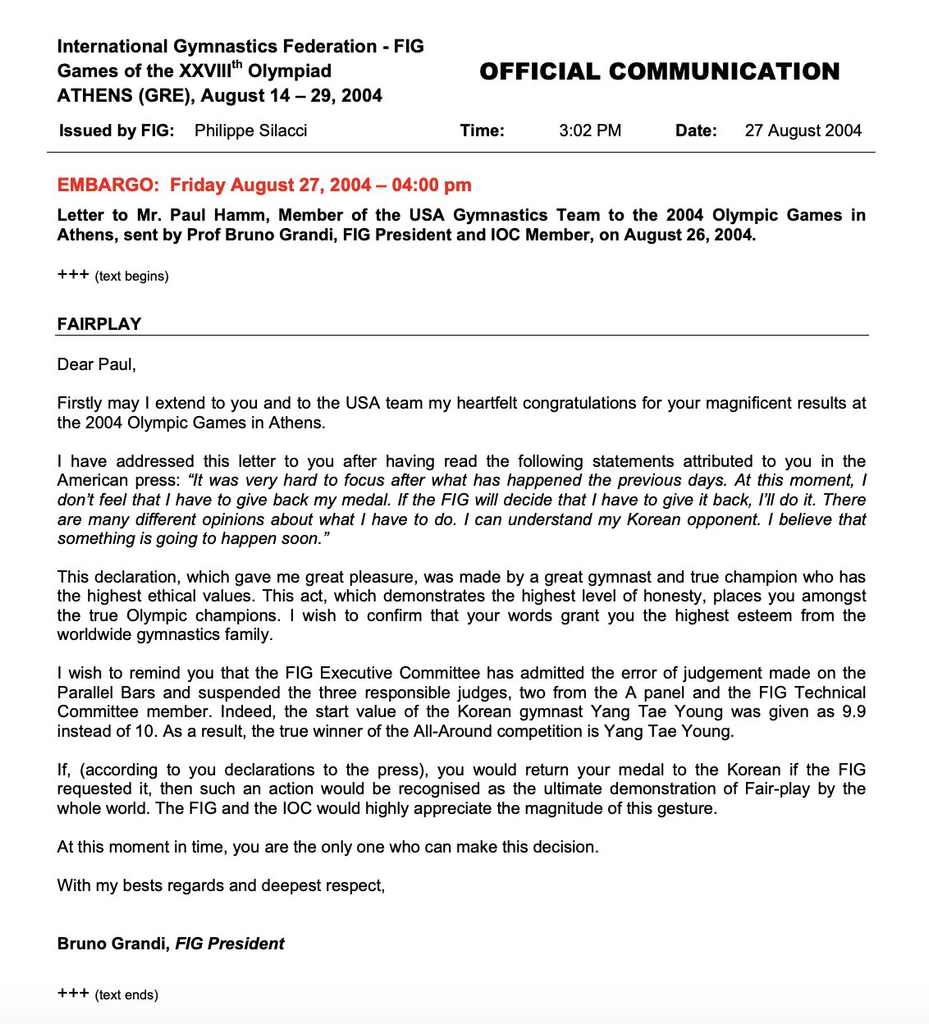
On August 26, FIG president Bruno Grandi took him at his word. His letter, headed “FAIRPLAY,” began with congratulations, then quoted Hamm’s statement back to him as the American press had reported it: “At this moment, I don’t feel that I have to give back my medal. If the FIG will decide that I have to give it back, I’ll do it.” Grandi praised the statement as the mark of “a great gymnast and true champion who has the highest ethical values.” Then came the request:
“I wish to remind you that the FIG Executive Committee has admitted the error of judgement made on the Parallel Bars and suspended the three responsible judges, two from the A panel and the FIG Technical Committee member. Indeed, the start value of the Korean gymnast Yang Tae Young was given as 9.9 instead of 10. As a result, the true winner of the All-Around competition is Yang Tae Young.
If, (according to you declarations to the press), you would return your medal to the Korean if the FIG requested it, then such an action would be recognised as the ultimate demonstration of Fair-play by the whole world. The FIG and the IOC would highly appreciate the magnitude of this gesture.
At this moment in time, you are the only one who can make this decision.”
The contradiction was extraordinary. The FIG had declared in writing that Yang was the true winner, yet insisted that its own rules prevented it from correcting the result. Instead, it asked Hamm, a twenty-one-year-old athlete, to make the decision the federation would not.
The letter did not stay private for long. The FIG asked the USOC to deliver it; the USOC made it public instead, and the FIG issued it as an official communication on August 27.
The American response was furious. The USOC refused to pass the letter along and called the request “improper, outrageous and… beyond the bounds of what is acceptable.” Chief executive Jim Scherr called it “a thinly veiled suggestion to our athlete that he should solve the problems of the F.I.G. through his own actions.” Chairman Peter Ueberroth, the Dong-A Ilbo reported, declared the matter closed. Only days earlier, he noted, the Americans had been receptive to Korea’s proposal for a shared gold; if the FIG was going to handle the situation this way, there was no reason to cooperate (FIG가 이런 식으로 일 처리를 한다면 협조할 필요를 느끼지 못한다).
The FIG responded with a statement saying the letter was not its first approach. The federation had already asked Hamm, through the president of USA Gymnastics, to consider a gesture of fair play toward Yang, and had received a negative answer from USA Gymnastics. It had written directly only after reading Hamm’s willingness to surrender the medal if the FIG requested it. The statement also disclosed that the suspended judges had acknowledged their error in writing. Its final sentence appeared to concede to the American position: “Paul Hamm cannot be responsible for a judging error.”
By the end of August, the possibility of an informal settlement had collapsed. Korean officials also lacked an influential intermediary they might once have turned to. IOC vice-president Kim Un-yong, long a powerful figure in international sport, had been convicted of corruption and suspended from the IOC. Without him to broker a private settlement, the Los Angeles Times reported, the delegation had turned to arbitration instead. Yonhap relayed the report to Korean readers.
On August 28, just before the closing ceremony, the Koreans filed an application with the Court of Arbitration for Sport. The ad hoc panel was ready to hear the case the next day, but the FIG and Hamm’s lawyers asked for more time, and the case was transferred to ordinary arbitration in Lausanne.
As a result, the Games ended without a resolution. The dispute would continue for nearly two more months.
VI. The Editorial Battlefield
While officials argued over whether Yang could still be given a gold medal, Korean newspapers were having a different argument: who was to blame for his not winning it in the first place? The answer had changed considerably since the night of the final.
The “stolen gold medal” was not the South Korean press’s first interpretation of Athens, nor was it the only one. Even the Chosun Ilbo, which gave the accusation its most memorable headline, had arrived there by a circuitous route. On August 20, the newspaper presented Hamm’s victory as a remarkable comeback, quoting Korean coach Lee Joo-hyung’s acknowledgment that, since all six judges had scored Hamm’s flawless high bar highly, “the judging cannot be called into question” (판정을 문제 삼을 수는 없다). The next day, after the FIG admitted the scoring error, the paper criticized the Korean delegation for waiting until the following day to protest. By August 22, it was calling the gold medal stolen.
The reversal drew ridicule from a contributor to Media Today, a media-criticism weekly and longtime critic of the Chosun. If changing positions were an Olympic event, the piece joked, the newspaper would win gold.
Other publications continued to direct their anger at Korea’s own officials. On August 25, Dong-A Ilbo correspondent Jang Hwan-su blamed “an absurdly slow response” for throwing away the gold medal (어처구니없는 늑장대응이 금메달을 날려버린 것이다). Had officials tried to conceal the error, he wondered, because they feared being blamed for their ignorance of the rules? “How do we console him, whose four-year dream of Olympic gold was thrown away through his officials’ mistakes?” he asked (임원들의 실수로 4년간 키워온 올림픽 금메달의 꿈을 날려버린 그를 어떻게 위로해야 할까).
The Seoul Shinmun divided the responsibility. In an August 30 editorial, it condemned the FIG’s letter to Hamm as “a ploy to evade responsibility” (책임모면의 술수) and demanded that the federation correct its own mistake. But it also faulted the Korean delegation for failing to understand the protest rules and responding too slowly.
By the end of August, three explanations were competing in the Korean press: the gold had been stolen, the FIG had refused to correct an acknowledged error, or Korean officials had squandered their chance to challenge it. These accounts were not mutually exclusive, but they assigned responsibility differently.⁹ As the dispute over who was to blame continued, another question emerged: what, if anything, could South Korea do for Yang Tae-young?
VII. A Gold Medal of Their Own
On September 10, the Dong-A Ilbo published an appeal from Kang Jeong-ho, a physical-education professor at Kyungsung University, urging Korea to give Yang Tae-young “gold medal-level treatment” (양태영에 금메달급 대우를). Kang pointed to Brazil’s Vanderlei de Lima, who had been leading the Olympic marathon when a spectator attacked him. Back home, Kang wrote, Brazilians had greeted de Lima with chants of “Lima gold medal” and rewarded him at gold-medal rates. Korea, by contrast, seemed to have moved on. “Since the Olympics, the press and the public seem to have forgotten the ‘stolen gold medal,'” he complained (올림픽 이후 언론과 국민은 ‘도둑맞은 금메달’을 잊은 듯한 모습이다). He called for Yang to receive the pension and prize money of an Olympic champion, regardless of the pending CAS decision.
The Korean Olympic Committee did part of what Kang had asked. Before the ceremony, it announced that, since an appeal was pending and the FIG had declared Yang the true winner in its letter to Hamm, it would honor him as a gold medalist “regardless of how CAS ultimately rules” (CAS의 최종 판단과 관계없이 양태영을 금메달리스트로 예우하기로 했다). On September 22, at Seoul’s Lotte Hotel, KOC president Lee Yeon-taek presented Yang with a gold medal of the committee’s own making, ten don of pure gold, and a certificate for $20,000, the bonus for an individual Olympic gold. The pension was another matter.
Yang was grateful, but he still wanted the Olympic medal. “I am grateful to the KOC for treating me with the honors of a gold medalist,” he said. “I will attend the hearing of my appeal at the Court of Arbitration for Sport and come back having recovered the gold medal without fail” (KOC의 금메달리스트 예우에 감사드린다. 스포츠중재재판소(CAS) 소청 심리에 참석해 금메달을 반드시 찾아서 돌아오겠다).
His father, Yang Kwan-cheol, was more concerned with what the controversy had already cost the family. “Seeing my son with a gold medal around his neck makes me happy,” he said. “It has been truly hard on the family too. I hope the case is resolved quickly in court.” (아들이 금메달을 목에 거는 모습을 보니 기쁘다. 가족들도 참 힘들었다. 법정에서 빨리 사건이 해결되기를 바란다).
VIII. Lausanne
The Korean delegation prepared its case in secrecy. Kim & Chang, the country’s largest law firm, worked with two British sports-law specialists who flew to Seoul in late September. A Korean Olympic Committee official put their estimate of success at fifty percent. The strategy rested on two arguments: FIG president Bruno Grandi had written to Paul Hamm declaring Yang Tae-young the true winner, and the federation’s regulations contained no express requirement that a scoring protest be lodged before the competition ended.
Outside observers were less optimistic. Around the Rings, a publication covering Olympic politics, predicted that Yang would lose because he had failed to protest during the competition, citing an FIG regulation that did not explicitly exist. The arbitrators would ultimately reach the same conclusion, but by interpreting the rules rather than enforcing a stated deadline.
The hearing began at 9:30 a.m. on September 27 at Lausanne’s Beau-Rivage Palace, before a three-member panel of Michael Beloff of Britain, Dirk-Reiner Martens of Germany, and Sharad Rao of Kenya. It lasted until nine that evening, interrupted only by a half-hour lunch of sandwiches. Hamm and Yang attended with their lawyers and delegations. Both were offered the opportunity to speak; neither did.
Asked by International Gymnast after the hearing how he would have reacted in Yang’s position, Hamm said he would have been upset with himself for failing to check the start value and with his coach for failing to protest. Would he have pursued the case as Yang had? “No, I don’t think I would have.”
On October 21, sixty-four days after the all-around final, CAS dismissed the Korean appeal.
The first ground was procedural. The FIG’s rules empowered its juries to correct “an extremely incorrect score” or intervene in cases of “a grave error of judgement,” but they did not specify when that authority expired. The arbitrators found the answer in the surrounding language: the Code of Points described the apparatus chair’s “functions during competition,” while the Technical Regulations assigned the juries responsibilities “at official competitions.” Together, these phrases “sufficiently identif[y] that any appeal must be dealt with during, not after a competition.” Once the competition ended, the juries’ authority ended with it. Any protest therefore “had to be made before the end of the competition,” whereas Korea’s “first effective protest was made after the competition ended.” This was not the fifteen-minute deadline the FIG had invoked in August. That requirement had appeared in the 1982 regulations, but the federation’s representatives “were not able to enlighten us as to why the [Technical Regulations] had been changed — or even when.”
The panel defended its interpretation as a necessary compromise between fairness and finality. “At the close of a competition in any sport, gymnastics included, the identity of the winner should be known,” it wrote, acknowledging that this “may represent a trade-off between the ideal and the realistic, and between justice and certainty.” Kim Dong-min, the Korean judge who had spotted the error, had questioned the start value during the competition, but his position as a judge limited what he could do. The responsibility to protest lay with the coaches. Lee Joo-hyung had not seen the score because television cameramen blocked his view, though he admitted he could have moved. Had he noticed the discrepancy, the panel observed, “events might — we stress might — have taken a different turn.”
The second ground was broader. Even an admitted judging error did not necessarily justify overturning a completed result. “An error identified with the benefit of hindsight, whether admitted or not, cannot be a ground for reversing a result of a competition,” the arbitrators wrote. “Finality is in this area all important: rough justice may be all that sport can tolerate.”
Nor did they accept the FIG’s assertion that Yang was the rightful champion. Because one rotation remained after his parallel bars routine, there was no way to know how he or the other competitors might have performed had the correct start value appeared. “While the error may have cost Yang a gold medal,” the panel concluded, “it did not necessarily do so.”
The arbitrators also took up the FIG’s own conduct, and, in doing so, took apart the statements on which the Korean appeal had rested, above all Grandi’s letter naming Yang the “true winner.” The federation, they wrote, had acted out of “an understandable anxiety to maintain public confidence in the judging of Olympic competitions,” but it had made three mistakes, “we are certain in entire good faith.” First, it had admitted the error without qualification, although under its own rules an error found only after a competition was “immaterial to the result.” Second, it had declared that Yang would otherwise have won, a claim “in [the] realm of speculation, not of certainty.” Third, it had urged Hamm to surrender his gold medal “when there was no reason for him to do so.” For declining, the panel added, Hamm was “not to be criticized.”
The award ended by acknowledging the human cost of a dispute the law could not resolve to everyone’s satisfaction. “There are two victims of this unusual sequence of events, Hamm and Yang,” the arbitrators wrote. “Nonetheless, the Court of Arbitration is not Solomon: nor can it mediate a solution acceptable to both gymnasts or their respective NOCs [i.e., National Olympic Committees].”
Yang accepted the decision. “Although I could not recover the gold medal, I respect the opinion of CAS,” he said, promising to return from the 2008 Beijing Olympics with gold (비록 금메달을 되찾지 못했지만 CAS의 의견을 존중한다. 그동안 보내주신 국민의 성원에 감사드린다. 이 자리에서 좌절하지 않고 최선을 다해 2008년 베이징올림픽에서는 반드시 금메달을 목에 걸고 오겠다.). The Korean Olympic Committee expressed regret but accepted the ruling, and the Korea Gymnastics Association acknowledged its own shortcomings: “We feel responsible for having failed to respond thoroughly” (철저히 대처하지 못한 데 대해 책임을 느낀다).
IX. Before and After Athens
The consequences of Athens extended well beyond the arbitration. For the FIG, the controversy had exposed problems not only with individual judges but with the rules and procedures governing the sport.
The first response was disciplinary. In February 2005, after reviewing footage from the Athens competitions, the federation imposed further sanctions on the three officials responsible for Yang Tae-young’s incorrect start value. George Beckstead and Benjamin Bango were suspended through the end of 2005. Oscar Buitrago Reyes received a one-year suspension dating from August 2004 and was barred from serving on the A-jury at that year’s World Championships in Melbourne. Nor were they the only officials punished. Four more officials were suspended over the men’s vault final, while three judges received warnings for their work in the team competition. The judging failures of Athens, the federation’s investigation suggested, were not confined to Yang’s parallel bars routine.
The next response was to change the rules. At the time of the Athens final, there had been no clearly defined procedure for protesting a start value. The FIG had initially invoked a fifteen-minute deadline that no longer appeared in its regulations; CAS had subsequently upheld the result by inferring that a protest had to be lodged before the competition ended. Neither told a coach how to challenge an error while the competition was still under way.
In April 2005, an advisory FIG symposium recommended a formal procedure for objections to the start value, to be raised “as soon as the mark is posted.” Later that year, the FIG Council, meeting in Helsinki, adopted such a rule, allowing start values to be challenged through video review. The Dong-A Ilbo described the change as an effort “to prevent a second Yang Tae-young incident” (제2의 양태영 사건 방지). Korea Gymnastics Association technical chairman Kim Dae-won explained the difference: “Until now there was no clear rule, so when a protest came in, the chief judge would conduct a video review at his own discretion” (지금까지는 명확한 규정이 없어 심판위원장이 항의가 들어오면 재량에 따라 비디오 판독을 하곤 했다). What had been left to officials’ discretion would now be governed by an explicit procedure.
But the FIG’s concerns went beyond preventing another scoring dispute. Athens had shaken confidence in the sport itself. In June 2005, the federation’s multilingual bulletin, World of Gymnastics, published a retrospective under the headline “After the shock, the electroshock!”¹⁰ Its account recalled judges leaving the arena amid boos from 17,000 spectators, Yang struggling with his disappointment, and 4,800 angry messages flooding the FIG’s website.
The bulletin sided emphatically with the spectators. It praised the Greek crowd as “an adult and coherent public that refused to be had!” and declared that on August 18, “the Greek public simply said, ‘No!'” It even repeated a journalist’s sarcastic observation: “One thing is for sure, in the Hall there were 3 judges who were right and 17,000 imbeciles!” Ten months after the Olympics, the federation’s own publication was reproducing some of the harshest criticism directed at its judges.
A more serious anxiety hid beneath the rhetoric. The IOC was preparing to vote, in July 2005, on which sports would remain on the Olympic program for 2012, and the FIG, at least, did not treat its place as secure. “For those who know how to read,” the bulletin warned, “this means that mistakes such as were made in Athens are no longer allowed if we wish to remain included in the 28 Olympic sports.” The controversy had become, in the FIG’s own telling, a threat not merely to the credibility of its judges but to the sport’s Olympic future. “Indeed,” the retrospective concluded, “from now on, there is a before and an after Athens 2004.”
The federation was already working on a more fundamental overhaul. Among the “immediate measures” taken by Grandi and the Executive Committee after Athens, the bulletin listed a new Code of Points built around “open difficulty” and “video control.” Introduced in 2006, the new system abandoned the traditional maximum combined score of 10.0, allowing difficulty to be rewarded without a fixed ceiling while retaining a ten-point scale for execution. The reform addressed problems much broader than Yang’s incorrect start value, but in Korea, the connection was remembered more directly. Looking back in 2010, KBS reported that the federation had abandoned the perfect 10 “so as not to produce another victim like Yang Tae-young” (양태영과 같은 희생양을 낳지 않기 위해).
The federation could revise its rules, but it could do nothing to change what Athens had meant for the two gymnasts at the center of the dispute. Hamm never returned to the Games.
For Yang, the distinction between official and unofficial recognition became tangible within weeks of the ruling. The Korean Olympic Committee had presented him with its own gold medal and $20,000, but the government pension remained tied to the Olympic bronze. In November, the Korea Gymnastics Association awarded him the same 30 million won bonus as silver medalist Kim Dae-eun, citing the judging error that had left Yang third. He thus had a gold medal and the equivalent bonus from the KOC, a silver medalist’s bonus from his federation, and a bronze medalist’s pension.
The gap persisted. By 2016, according to Reuters, an Olympic gold medalist received a monthly pension of 1 million won (about $840 at the time), compared with 750,000 won for silver and 525,000 won for bronze. The difference between bronze and gold was 475,000 won a month (roughly $400), nearly half the gold medalist’s pension. “Everyone thought I would receive the gold medal pension, if not the medal itself,” Yang told Reuters. “I did too. But it didn’t work out that way.”
By then, Yang’s competitive career was long over. In December 2004, Yang returned to competition at the national team trials in Taereung. On parallel bars, he performed a routine with a 10.0 start value, and he finished first overall, a tenth of a point ahead of Kim Dae-eun.
Watching from the stands was Lee Joo-hyung, the coach whose failure to challenge the score in time had become central to the case, now studying English in Canada. “I learned a great deal going through that incident,” he said. “To keep the same thing from happening again, coaches and athletes will have to know the rules precisely and respond accordingly” (그 사건을 겪으면서 많은 걸 배웠다. 앞으로 같은 일이 또 일어나지 않기 위해 지도자와 선수들이 정확하게 룰을 알고 대응해야 할 것).
Yang kept competing, determined to win the gold he had missed, but the rest of his career was marked by injuries and disappointments. An injury in training kept him out of the 2005 World Championships. At the 2006 Asian Games in Doha, a fall from the parallel bars forced him to withdraw. He finished eighth in the all-around at the 2007 World Championships and eighth again at the 2008 Beijing Olympics, where he competed despite a back injury.
In March 2010, Yang retired and joined the national team coaching staff. His ambition had not changed, only the role he hoped to play in fulfilling it. “I want to achieve, through my juniors, the dream of Olympic gold I could not realize as an athlete,” he said (선수 때 이루지 못한 올림픽 금메달을 향한 꿈을 후배들을 통해 이루고 싶다).
X. How a Gold Medal Became Stolen
Athens remained a painful reference point in South Korean gymnastics long after Yang Tae-young retired, resurfacing in retirement profiles, retrospectives, and accounts of other Korean gymnasts who had lost close decisions.
In August 2018, Kim Han-sol lost the Asian Games vault title in Jakarta by 0.062 points after a Russian judge imposed a 0.3 deduction for allegedly failing to salute the panel. The Korea Gymnastics Association insisted that Kim had saluted and that the judge “insisted he hadn’t seen it” (러시아 심판 1명이 이를 못 봤다고 우겼다). Sports Chosun called the incident “Another Stolen Gold” (또 금메달 도둑), describing the deduction as “retaliatory” (보복성) and accusing the judge of punishing Kim for 괘씸죄, the supposed offense of showing insufficient deference to authority. It was, the newspaper said, the second time Korean gymnastics had been robbed of gold at a multi-sport games. The first was Yang’s, and the paper gave it only a few sentences. By then, the reference was enough: another Korean gymnast, another disputed decision, another gold medal lost to foreign judges.
The larger symbolism of Athens emerged in a 2021 episode of Byeolbyeol Sports, a program on SBS’s Sports Mug channel, titled “‘Hard-Luck Gymnastics Star’ Yang Tae-young’s Stolen Gold Medal” (‘비운의 체조스타’ 양태영의 도둑맞은 금메달).
The episode replayed the original television commentary from the 2004 all-around final. Korea’s gymnasts had fought really well, the announcer said, “but because of questionable judging they’ve missed out on the gold once again” (석연치 않은 심판의 판정으로 인해서 또다시 금메달을 놓치게 됐습니다). The commentator, Park Jong-hoon, added: “We have to work really hard so that our younger athletes never have to suffer this kind of injustice again” (다시는 우리 후배들이 이러한 설움을 받지 않도록 정말 노력 많이 해야 되겠습니다).
In hindsight, the language is striking because the parallel bars error had not yet come to light. Even on the night of the final, the commentators understood the result as part of a longer history of Korean athletes suffering at the hands of judges. The announcer’s “once again” looked backward; the commentator’s “never again” looked forward. Their sense of injustice preceded the evidence that would later appear to vindicate it.
Back in the studio, SBS reporter Kwon Jong-oh, who had covered Athens, described the dispute in terms that went beyond the missing tenth. The American press, he recalled, had defended Hamm and disparaged Yang. “What I felt on the ground was that our ideas of common sense and justice didn’t work there,” Kwon said. “In the end, it’s the logic of power” (우리가 생각하는 상식, 정의 이런 게 안 통하더라고요. 결국 힘의 논리). The United States, he argued, enjoyed enormous influence in international sport, including through its media. Korea might have had the stronger case, but it lacked the power to prevail.
Kwon acknowledged that the Korean delegation had not understood the rules: “I didn’t know, and the Korean Sport & Olympic Committee didn’t really know either” (저도 몰랐고요, 대한체육회도 잘 몰랐어요). But he saw a deeper problem. In a judged sport, challenging the international federation could invite retaliation in future competitions. Korean gymnasts risked being “marked” (찍혔다).¹¹ “Because of that, for decades Korea has never really been able to stand up to the international federation” (그런 것 때문에 우리나라가 이때까지 수십 년 동안 보면요, 세계 연맹하고 세게 싸우질 못했어요). What began as a dispute over one gymnast’s score had become, in Kwon’s mind, a story about Korea’s place in international sport: a smaller nation that was afraid to make an enemy of the people who judged it.
There was, however, one thing Korea could do. At the Lotte Hotel in September 2004, KOC president Lee Yeon-taek placed ten don of pure gold around Yang’s neck and declared him the true champion “beyond any need for further discussion.” It was a declaration Korea could make on its own authority. The Olympic record, however, still said bronze.
Korea could give Yang a gold medal of its own, but it could not make him an Olympic gold medalist.
In the next post, we’ll look at how the United States told the same story.
Notes
- During the all-around final, the vault jury was chaired by Xiao Guanglai (FIG), with Robert Paquin (FIG) and Kim Dae-won (Korea) on the A-panel and, on the B-panel, Borys Shakhlin (Ukraine), Siegfried Funk (Germany), Bjoern Magnus Tomasson (Iceland), José Antonio Mendes (Portugal), Javier Colón (Puerto Rico) and Butch Zunich (United States).
The parallel bars jury was chaired by George Beckstead (FIG), with Benjamin Bango (FIG) and Oscar Buitrago Reyes (Colombia) on the A-panel and, on the B-panel, Kim Dong-min (Korea), Teruaki Takeuchi (Japan), Diego Lazzarich (Italy), Anzor Gongadze (Georgia), Harry Bjerke (United States) and Yuliy Kuksenkov (Ukraine).
The official results give these marks, B1 to B6 in that order. Hamm, vault: start value 9.90; 9.00, 9.10, 9.05, 9.30, 9.20, 9.20; final 9.137.
Hamm, parallel bars: start value 10.00; 9.85, 9.80, 9.85, 9.80, 9.85, 9.85; final 9.837.
Yang, vault: start value 9.90; 9.70, 9.70, 9.70, 9.70, 9.70, 9.65; final 9.700.
Yang, parallel bars: start value 9.90; 9.75, 9.70, 9.70, 9.75, 9.70, 9.65; final 9.712.
The highest and lowest marks were dropped, and the middle four averaged.
On Hamm’s vault, the middle four (9.10, 9.05, 9.20, 9.20) reflect deductions of 0.70 to 0.85 from his 9.90 start value, a spread of 0.15. The Code of Points allowed a spread of up to 0.30 among the middle deductions in that range (0.55 to 1.00), so the marks were within the permitted range and required no adjustment by the jury chair. That said, the rule governed how closely the judges had to agree, not whether their deductions were large enough. - The CAS award also recorded an argument absent from the Korean coverage examined here. Yang’s lawyers contended that Bango had lowered his head at the start of the routine, missed a second of the opening sequence, and consulted Buitrago, and that Beckstead had no reason to doubt what looked like a joint view. The panel called Bango’s unsightedness “unproven” as a cause of the error and found that Buitrago and Beckstead each “properly had his own view.”
- The accounts, in order. (1) Lee Joo-hyung to the Chosun Ilbo, published August 22 (Korea time): “I understood that if we protested after the parallel bars, we would be penalized on the next apparatus, the high bar — so we protested after the whole competition was over.” (평행봉을 마친 뒤 항의를 하면 다음 연기인 철봉을 할 때 벌점을 받는 것으로 알고 있어서 경기가 다 끝난 뒤 항의했다.) (2) Lee at a press conference at Team Korea House, Athens, August 25: “On the 19th, the day of the competition, Yang Tae-young was the last competitor on parallel bars, and in the rush to move to the next venue for the high bar, we only looked at the overall score — we did not check the start value.” (경기가 열린 19일 양태영이 평행봉 마지막 주자여서 경기 후 급하게 다음 종목인 철봉 경기장으로 이동하느라 전체 점수만 봤지 스타트밸류는 확인하지 못했다.) Jang Hwan-su noted in the Dong-A Ilbo that this was “directly contrary” (정면으로 배치되는 것) to the coach’s earlier account. (3) Shin Park-je at the same press conference: “Although the competition had ended, coach Lee met the parallel bars head judge as he was walking out into the corridor before the medal ceremony began and lodged a protest, so the timing of the protest was appropriate.” (경기가 모두 끝났지만 이 코치가 시상식이 시작되기 전 복도로 걸어 나가던 평행봉 주심을 만나 항의를 했기 때문에 항의 시기는 적절했다.) The KBS chronology has the coaches confronting the two technical judges, not the head judge; the CAS award says they “raised the matter with the ‘A’ Judges and Stoica,” left the conflict of evidence unresolved, and found only that the protest was “made too late to affect the medal ceremony.” (4) Lee to International Gymnast, October 2004: “As we moved to high bar, we noticed that the Start Value was 9.9 and we were very shocked. We knew that it was not correct and that there must have been some mistake.” That account has Kim Dong-min going to Beckstead, who “replied that the 9.9 was correct and ended the conversation with Kim,” and assigns the lobby search to the delegation’s spokeswoman, Yoo Jae-soon, whom neither the KBS chronology nor the award mentions. The CAS award accepted the second account: Lee’s view of the screen had been “blocked by TV cameramen,” and he did not know of the start value until Kim told him.
- The CAS award puts the start of the medal ceremony at 10:48 p.m. and the presentation of the medals at about 11:20, so KBS’s “around 11:00” for Kim’s approach is approximate at best. On the award’s clock, the coaches were hunting for the technical president with the ceremony already underway.
- This was not the first problem with the parallel bars panel in Athens. The 2001 men’s Code of Points limited how far apart the four counting deductions could be, from 0.20 for the smallest deductions to 0.50 for the largest, and required the apparatus chair to act when they were not: “The Chair of the Apparatus Jury will resolve excessive differences by making adjustments according to the allowable differences.” George Beckstead of the United States was the Chair of the Apparatus Jury for qualifications, team finals, and the all-around final before he was suspended.
On August 14, in qualification, Matteo Morandi of Italy performed a parallel bars routine with a 9.60 start value. With the high and low marks dropped, the counting marks were 8.10, 8.40, 8.40, and 8.60, with deductions of 1.00 to 1.50. A spread of 0.50 between the middle four scores exceeded the allowable limit according to 3.8.4 in the Code of Points. Morandi’s final mark, 8.375, was the plain average of the four, so Beckstead made no adjustment, even though the rules should have compelled him to intervene.
Additionally, it should be noted that the suspension did not keep Beckstead out of the competition. According to an Athens official, Adrian Stoica told the judges’ meeting before the event finals that Beckstead would sit with him on the Superior Jury for every apparatus. The FIG’s statement did not specify what the suspension covered. As a member of the Men’s Technical Committee, Beckstead was eligible for the Superior Jury, which consisted of the technical president and two experts appointed by the committee (see note 7). - Lee’s confession needs one qualification. The CAS award records that earlier in the same Games, during the team competition, these coaches had protested to Stoica about a parallel bars score given to their teammate Cho Seong-min. That protest failed, but it shows they knew there was someone to protest to, and that it could be done while a competition was running.
- The 1997 Technical Regulations, signed by president Yuri Titov and secretary-general Norbert Bueche, contained no procedure by which a coach, gymnast, or federation could protest a score. Their Superior Jury (Regn. 8.8.1) could “take such action as they consider necessary” where there was “a grave error of judgement,” and their Jury of Appeal (Regn. 8.8.3), despite its name, heard only “appeals made by judges who have been warned or excluded by the Superior Jury,” not appeals against scores. The 2002 edition in force at Athens, quoted in the CAS award, kept the same structure. Under Reg. 7.8.1, the Superior Jury, made up of the technical president and two experts appointed by the Technical Committee, had four functions: to supervise the competition and deal with “any breaches of discipline or any extraordinary circumstances”; “where there is a grave error of judgement on the part of one, or several, judges to take such action as they consider necessary”; to review the judges’ marks “continually” and warn any judge whose work was “unsatisfactory or showing partiality”; and, if a warning failed, to “remove and replace any judging personnel.” None of these said in so many words that the Superior Jury could change a mark; most of them concerned controlling the judges. The clearer power lay in the Code of Points, under which the chair of an apparatus jury, “with the approval of the Chair of the Competition Jury,” could act “to change an extremely incorrect score” (Article 10.1(f)). The arbitrators read the Superior Jury’s mandate as “large enough to embrace reversing marks as well as disciplining judges” and concluded that “there is no doubt that a mechanism exists for reversing judging errors.” But they also found that “there did not appear to be universal familiarity with it even among those responsible for its operation,” including on “whether special forms had to be used for the purposes of protest.”
- Nemov’s circumstances differed from Yang’s: his score was changed while the competition was still under way. But the procedure raised questions of its own. The Technical Regulations gave the Superior Jury broad authority to “take such action as they consider necessary” in cases of “a grave error of judgment,” giving Stoica, as Chair of the Competition Jury, grounds to intervene. The 2001 Code of Points, however, described a different procedure. Under Article 10.1(f), the apparatus jury chair could change “an extremely incorrect score,” with the approval of the Chair of the Competition Jury, “to assure that the gymnast is given the correct score for his performance.” On high bar, the apparent sequence was reversed. According to reports, the apparatus jury chair, Kato Sawao, did not initiate the change; Stoica did. A separate article will look at the men’s high bar final.
- The Korean-language press in the United States went further in both directions. The U.S. edition of the Korea Times warned in an August 24 editorial that the affair “risks stoking anti-American sentiment within Korea and damaging Korea–U.S. relations” (이번 사건은 한국내 반미정서를 부추켜 한미관계에 악영향을 끼칠 우려마저 있다), and passed along, as if settled, the claim that the judge who gave Yang “the most unfavorable score lived in the same region as the American athlete and had personal ties with him.” A week later its San Francisco columnist, Ahn Byung-sun, built a conspiracy case on the Belle–Morisue pattern and on the report that a technical judge had “lived for years and coached in Ohio, the home state of Paul Hamm” (기술심 중의 한 사람이 금메달을 가져간 미국 선수 폴 햄의 고향 오하이오주에서 수년간 살면서 코치생활을 했다고 한다). That detail began with an International Gymnast report on August 22 that Buitrago had lived and worked in Ohio, carried worldwide by Reuters. Hamm trained in Ohio but is from Wisconsin, and no report linked Buitrago’s American past to the misread Belle. Ahn also blamed the Korean delegation for failing “to object in time.” At the other extreme, the columnist Lee Jung-hoon asked on August 26 whether “it is not closer to the Olympic spirit to endure the injustice” (억울하지만 억울함을 참는 것이 올림픽 정신에 맞지 않을까). These pieces were written for Korean Americans and are evidence of diaspora opinion, not of opinion in South Korea.
- Yonhap’s Jang Jae-eun summarized the retrospective for Korean readers on July 7, 2005, under the headline “International Gymnastics Federation Revisits the ‘Yang Tae-young Affair'” (국제체조연맹, ‘양태영 사태’ 재조명).
- Korea was not alone in that calculation. The Canadian gymnast Kyle Shewfelt finished fourth in the Athens vault final, behind Romania’s Marian Drăgulescu, whose score came from a panel the FIG later sanctioned; four of its officials were suspended in 2005. In his 2021 memoir, Make It Happen, Shewfelt wrote that the decision not to take his case to CAS was his own. Cost was one reason. Another was that he did not want to face Stoica and “have an ‘X’ on my back” if he returned to competition.
Sources
A note on sources. This essay draws on the Seoul dailies (Dong-A Ilbo, Chosun Ilbo and Sports Chosun, JoongAng Ilbo), KBS and SBS, the U.S. edition of the Korea Times, the FIG’s own documents, the CAS award, and International Gymnast, among others listed below. The Korea Times (U.S.) is published for Korean Americans; its editorials and columns are evidence of diaspora opinion, not of opinion inside South Korea. Where the essay says “examined here,” it means these sources; other Korean publications may well have said things these did not.
Arbitration and regulations. CAS 2004/A/704, Yang Tae Young & Korean Olympic Committee v. International Gymnastics Federation, award of 21 October 2004 (Beloff, Martens, Rao). FIG Technical Regulations, 1997 edition (incl. the 1982 TR Article 27 provisions as quoted in the CAS award; 2002 TR provisions as quoted in the award). FIG Official Communication, “Letter to Mr. Paul Hamm… sent by Prof Bruno Grandi,” issued by Philippe Silacci, 27 August 2004. FIG press releases, Athens, 16 August (“Maras Appeal Rejected”), 19, 20 and 21 August, and 27 August 2004 (statement on the letter to Hamm), via web.archive.org captures of fig-gymnastics.com (27 August statement; 19–21 August releases; Maras release). FIG Official Communication, “Judges Suspended in Athens,” Moutier, 11 March 2005.
International Gymnast. Dwight Normile, “Unbelievable!”, October 2004; “An All-Around Fiasco: The Korean delegation’s search for answers,” with sidebar quotations from Hamm and Yang, October 2004; Paul Ziert, “Ziert Alert: The Best of Times, the Worst of Times,” October 2004, p. 6; “10 Questions: Paul Hamm,” November 2004; “Paul Hamm Keeps the Gold,” December 2004; Dwight Normile, “Athens Afterthoughts”; readers’ letters, October–December 2004.
Dong-A Ilbo. Athens coverage of 16–31 August 2004: qualification and team final reports; medal report of 20 August KST; Jang Hwan-su, “Yang Tae-young’s Bronze Was a Judging Error… But It Cannot Be Overturned,” 21 August KST; “Even in America: ‘Gymnastics Gold Should Be Shared with Korea,'” 23 August KST; “IOC: ‘Joint Gold Could Be Considered'” and Hamm press-conference sidebar, 24 August KST; Jang Hwan-su, “A Gold Medal Squandered by a Tardy Protest,” 25 August KST; high bar final and Yang sidebar, 25 August KST; Jang Hwan-su, “Yang Tae-young’s Parallel Bars Score Was Not Checked on the Spot,” 26 August KST; Jang Hwan-su, “Wrestling: Timely Protest Leads to Overturned Ruling,” 27 August KST; “FIG Formally Asks Paul Hamm to Yield Gold,” 28 August KST; Games wrap, 30 August KST; Funabashi Yoichi column, late August 2004. Later coverage: Kang Jeong-ho, “Give Yang Tae-young Gold Medal-Level Treatment,” opinion page, 10 September 2004; Jang Hwan-su, KOC gold-medal-treatment report, 21 September; CAS dismissal report, 22 October; KGA bonus brief, 4 November; national-team trials report, 15 December; judges’ suspension brief and protest-system report, 2005 (archived date labels unreliable).
Chosun Ilbo / Sports Chosun. “‘Yang Tae-young Is Not 3rd but 1st’ — The Stolen Gold Medal,” 22 August 2004; Chunichi Cup rematch preview, 9 September 2004; CAS preparation report (“Odds of Winning Put at 50%”), 22 September 2004; CAS preview, 20 October 2004; Universiade coverage, August 2003; Choi Man-sik, “[Jakarta Issue] ‘Another Stolen Gold,'” 24 August 2018.
KBS. Bronze-medalist profile of Yang Tae-young, 19 August 2004; “A Look Back: Chronology of the Yang Tae-young Misjudgment Affair,” 21 October 2004; “‘Hard-Luck Gymnastics Star’ Yang Tae-young Transforms into Coach,” 5 March 2010.
JoongAng Ilbo. “Yang Tae-young — Was the Pressure Too Much?”, 23 August 2004 (KST).
Korea Times (U.S. edition). “Korean Athlete ‘Robbed’ of Gold,” 23 August 2004; editorial, “The Gymnastics Gold Medal Should Be Returned to Korea,” 24 August 2004; Lee Jung-hoon, “A Gold-Medal Performance,” 26 August 2004; LA Times/Yonhap relay on shared-gold consideration, 22 August 2004; Ahn Byung-sun, “Fair and Square Sport,” 31 August 2004; hearing report, “Yang Tae-young: ‘I Cannot Give Up the Gold Medal,'” 28 September 2004; dismissal report, 21 October 2004.
Other. Kyongbuk Maeil, KOC gold medal ceremony report, 23 September 2004; Media Today (미디어오늘), “If There Were an Event for Changing Positions, the Chosun Ilbo Would Take Gold” (논조변신 종목 있으면 조선일보가 금메달), contributed piece, 23 August 2004; Seoul Shinmun, editorial, “The International Gymnastics Federation’s Cowardly Conduct” (국제체조연맹의 비겁한 처신), 30 August 2004; Jo Eun-ji, “‘Hard-Luck Gymnastics Star’ Yang Tae-young Starts Anew as Coach” (‘비운의 체조스타’ 양태영 코치로 새출발), Seoul Shinmun, 6 March 2010; Hong Seok-jae, “Ah, One Mistake… From Second to Eighth” (아, 실수 한번에…2위서 8위로), Hankyoreh, August 2008; Choi In-young, “Gymnastics’ Yang Tae-young Sheds Misfortune as a ‘Communicating Coach'” (체조 양태영,비운 털고 ‘소통하는 코치’로), Yonhap, 18 September 2014; Ki Young-no, “Yang Tae-young’s Stolen 0.1 Point” (도둑맞은 양태영의 0.1점), Newsian, 2 August 2024; Jang Jae-eun, “International Gymnastics Federation Revisits the ‘Yang Tae-young Affair'” (국제체조연맹, ‘양태영 사태’ 재조명), Yonhap, 7 July 2005, via Nate Sports; “2004 Olympic Games – Athens: After the shock, the electroshock!”, World of Gymnastics (FIG), no. 45, June 2005; International Olympic Committee, The Olympic Games in Athens as seen by the international media (2005), p. 78; Reuters, “Suspended gymnastics judge lives near Hamm,” via ABC News (Australia), 22 August 2004; Choi Hee-jin, “[Byeolbyeol Sports, Episode 49] ‘Hard-Luck Gymnastics Star’ Yang Tae-young’s Stolen Gold Medal” ([별별스포츠 49편]’비운의 체조스타’ 양태영의 도둑맞은 금메달), SBS News, 10 June 2021 (updated 29 June 2021); Reuters, “Judging scandal still haunts Korean Yang,” 2016.
Appendix: Documents
August 21, 2004
MEN’S ALL AROUND FINAL
Judging Mistake Confirmed. Three Technical Officials Suspended.
Athens, August 21, 2004. After the Artistic Gymnastics Men’s All-Around Final, the Chef de Mission of the Korean Delegation to the Athens 2004 Olympic Games claimed, that the Korean Gymnast Yang Tae Young (Start Number 185) received the wrong start value on Parallel Bars. The gymnast was given a start value of 9.9, instead of a 10.
This judges’ error is confirmed by the FIG.
The FIG Rules do not allow for a protest against judges’ marks. The judges’ marks have to be accepted as a final decision and cannot be changed.
In order to protect the integrity of the FIG, the judges, and to be able to maintain and ensure the highest possible judging standard at the Olympic Games, the FIG Executive Committee has decided to suspend the three Technical Officials concerned pending inquiry.
The FIG regrets that such an occurrence took place.
ANALYSIS IN PROCESS
Athens, August 20, 2004 According to the announcement released by the FIG late on August 19 (see below), President and IOC Member, Prof. Bruno Grandi, invited his Executive Committee Members to attend an extraordinary meeting, on Friday August 20, at 11:00 am.
At this meeting, it was unanimously decided that the FIG will proceed to the immediate analysis of the Men’s All-Around competition. In the case that judging errors have occurred, appropriate steps will be made immediately.
Further information will be available as soon as this investigation is completed.
STATEMENT !
Athens, August 19, 2004. The Men’s All-Around Individual Final has created great enthusiasm but was also a matter of interrogation by the Gymnastic Community, to which the International Gymnastics Federation wishes to make the following comments.
The FIG Rules do not allow for a protest against judges’ marks. The judges’ marks have to be accepted as a final decision and cannot be changed.
To ensure the highest possible judging standards, the FIG analyses all judges’ marks after all its major events. The best judges are rewarded; those who did not judge correctly and made serious mistakes are severely sanctioned. This process will also be followed for the Olympic Games.
FIG
August 27, 2004
International Gymnastics Federation – FIG
Games of the XXVIIIth Olympiad
ATHENS (GRE), August 14 – 29, 2004OFFICIAL COMMUNICATION
Issued by FIG: Philippe Silacci
Time: 3:02 PM
Date: 27 August 2004
EMBARGO: Friday August 27, 2004 – 04:00 pm
Letter to Mr. Paul Hamm, Member of the USA Gymnastics Team to the 2004 Olympic Games in Athens, sent by Prof Bruno Grandi, FIG President and IOC Member, on August 26, 2004.
+++ (text begins)
FAIRPLAY
Dear Paul,
Firstly may I extend to you and to the USA team my heartfelt congratulations for your magnificent results at the 2004 Olympic Games in Athens.
I have addressed this letter to you after having read the following statements attributed to you in the American press: “It was very hard to focus after what has happened the previous days. At this moment, I don’t feel that I have to give back my medal. If the FIG will decide that I have to give it back, I’ll do it. There are many different opinions about what I have to do. I can understand my Korean opponent. I believe that something is going to happen soon.”
This declaration, which gave me great pleasure, was made by a great gymnast and true champion who has the highest ethical values. This act, which demonstrates the highest level of honesty, places you amongst the true Olympic champions. I wish to confirm that your words grant you the highest esteem from the worldwide gymnastics family.
I wish to remind you that the FIG Executive Committee has admitted the error of judgement made on the Parallel Bars and suspended the three responsible judges, two from the A panel and the FIG Technical Committee member. Indeed, the start value of the Korean gymnast Yang Tae Young was given as 9.9 instead of 10. As a result, the true winner of the All-Around competition is Yang Tae Young.
If, (according to you [sic] declarations to the press), you would return your medal to the Korean if the FIG requested it, then such an action would be recognised as the ultimate demonstration of Fair-play by the whole world. The FIG and the IOC would highly appreciate the magnitude of this gesture.
At this moment in time, you are the only one who can make this decision.
With my bests [sic] regards and deepest respect,
Bruno Grandi, FIG President
+++ (text ends)
August 27, 2004
On the judging error during the men’s all around individual final.
Athens, August 27th, 2004.
In the case of the judging error, which occurred last Wednesday August 18, during the Men’s All Around competition, the FIG releases the following statement:
– The FIG has written to Paul Hamm because of his statement published in the newspaper USA Today: “At this point in time I am not planning to give over the medal. If the governing body decides I should, then I will”.
– The FIG, through the President and CEO of USA Gymnastics, has previously verbally contacted Paul Hamm to personally consider a gesture of Fair Play towards the Korean gymnast.
– FIG has received a negative answer from USA Gymnastics.
– After this first verbal exchange, FIG has read the above mentioned declarations of Paul Hamm to the press.
– It is only after these declarations that the FIG has officially written to Paul Hamm via the USOC, asking him whether or not he has the intention to consider a possible gesture of Fair Play.
– The USOC refused to forward the letter to Paul Hamm.
– FIG wishes to confirm that it has suspended three judges after first video analyses. The three judges have accepted this decision in writing and admit to have made an error.
– Respecting its rules, the FIG has not modified the final score and the ranking.
– By suspending the 3 judges, the FIG recognised its error.
– The FIG would not have re-opened the discussion, if Paul Hamm would not have made the above mentioned statement to the press.
– Paul Hamm cannot be responsible for a judging error.
FIG
March 11, 2005
Contact: Philippe Silacci c/o FIG Press Officer
Phone: [redacted]
[redacted]@fig-gymnastics.org
www.fig-gymnastics.com+++
Judges Suspended in Athens
SEVERE SANCTIONS
Moutier, March 11, 2005: The Fédération Internationale de Gymnastique (FIG) has issued severe sanction to judges convicted of serious breaches in the execution of their responsibilities at the 2004 Olympic Games. The incidences originate on August 18, 2004, when the FIG suspended 3 judges on the spot for serious mistakes in judging at the Parallel Bars, Individual Competition.
On February 26, 2005, after a detailed examination of the images from every competition sequence, the FIG Executive Committee suspended former Men’s Technical Committee Member, Mr George Beckstead, and judge Benjamin Bango (ESP) until the end of 2005 and issued a one-year suspension for judge Oscar Buitrago (COL), starting end of August 2004, along with a Jury A ban for the 2005 World Championships in Melbourne (AUS).
The FIG has broadened its analysis of all competitions on the Olympic Programme, shedding light on other serious breaches, particularly in judging for the Men’s Vault Finals. The FIG Executive Committee suspended former Men’s Technical Committee Member, Xiao Guanglai, as well as three other members of the judges panel, Mr Jorge Sandoval (VEN), José Mendez (POR) and Xavier Colon (PUR) for a period of one year, starting February 26, 2005.
The FIG Executive Members have finally addressed a letter of warning to three judges, Mr Yuliy Kushenkov (UKR), Chris Grabowecky (CAN), Timur Amirbekov (KAZ), whose insufficient work appeared at the Men’s Team Competition.
In conformity with the Statutes of the Federation, the sanctioned persons have the right to appeal to the FIG Disciplinary Commission.
At the same time, the FIG has taken spectacular measures in updating its Regulations. Reforms are in progress, notably in the editing of a new Code of Points and the introduction of an open difficulty mark, all the while maintaining the idea of a “Perfect 10” in Execution evaluation.
+++
The CAS Award