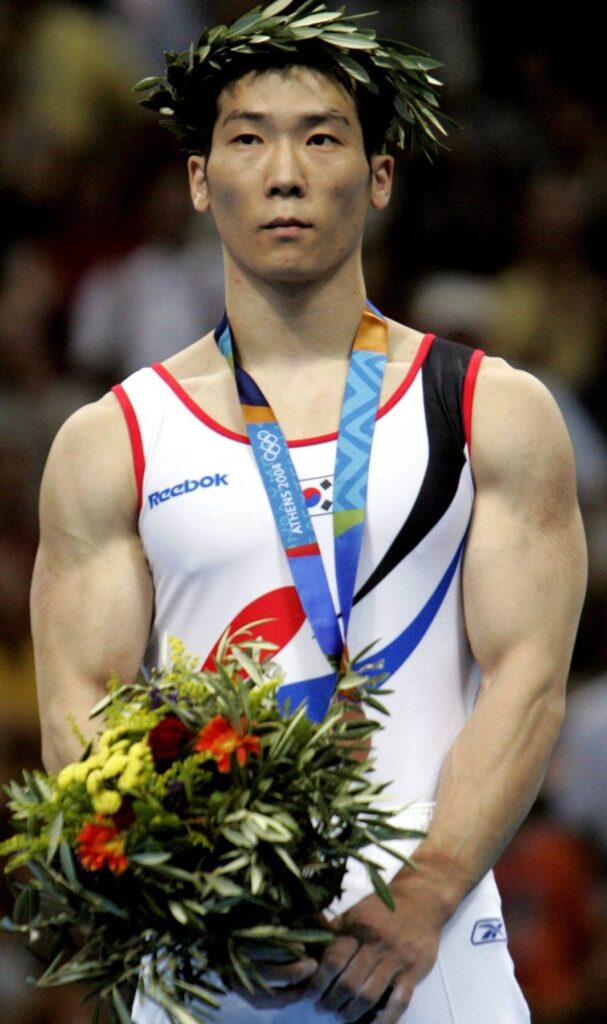
On September 22, 2004 — more than three weeks after the Athens Olympics closed — Yang Tae-young received a gold medal for the Olympic all-around.
The ceremony took place at the Lotte Hotel in Seoul, before officials of the Korean Olympic Committee (KOC) and the Korea Gymnastics Association, with the press in attendance. The KOC president, Lee Yeon-taek, placed a medal made from ten don of pure gold — 37.5 grams — around Yang’s neck. Engraved on its face were the words “28th Athens Olympics, Men’s Gymnastics Individual All-Around” (제28회 아테네올림픽 남자 체조 개인종합). Yang also received a $20,000 USD certificate, the bonus reserved for an individual Olympic champion.
“Although Yang Tae-young displayed the finest competitive performance at the Olympics, he suffered a genuinely unjust wrong,” Lee declared. “As one can see from the letter of FIG president Bruno Grandi, the true champion is, beyond any need for further discussion, Yang Tae-young” (양태영이 올림픽에서 가장 뛰어난 경기력을 발휘했음에도 참으로 억울한 일을 당했다. 국제체조연맹(FIG) 브루노 그란디 회장의 서한에서도 알 수 있듯이 진정한 우승자는 재론의 여지없이 양태영이다).
The Olympic record, however, says Yang won bronze.
That contradiction lies at the heart of the Yang Tae-young affair (양태영 사건). In South Korea, the controversy became known as the story of a “stolen gold medal” (도둑맞은 금메달) and has been remembered as “one of the most unjust incidents in Korean sports history” (한국 스포츠 역사상 가장 억울했던 사건 가운데 하나).
But the story was not always so clear-cut. In the days after the final, Korean newspapers offered competing explanations for what had happened. Some accepted Hamm’s victory; others blamed Korean officials, condemned the international federation, or accused the judges of stealing the gold. Over time, these competing accounts gave way to a more enduring story of a Korean athlete wronged by international sport. How that story took shape is as revealing as the judging error itself.