On October 21, 2004 — two months after the Athens all-around final — Paul Hamm received an Olympic gold medal.
He received it from himself, in his lawyers’ office in Manhattan. Hamm hung the medal around his own neck and smiled on cue, in effect, giving himself another Olympic medal ceremony, as the New York Times put it. The Court of Arbitration for Sport had dismissed Yang Tae-young’s appeal that morning, and the medal — which had spent much of the autumn tucked into a white gym sock at his parents’ Wisconsin farmhouse, kept safe because there was a real chance he would have to give it to someone else — was finally, irrevocably his.
“It feels like it’s mine now,” he said that day. “If I were to damage it in any way, it wouldn’t be going to anyone else. If I ruin it, it’s mine to ruin.”
And then, he produced the sentence that became the American epitaph for the whole affair: “There’s been a lot of fighting for this medal. I feel like I’ve won it three times,” he said. “I’ve won it in the competition and with the media and then finally in the court.”
Hamm’s three victories offer a useful way of understanding how the American story of Athens evolved. What began as a story of an improbable comeback became one of a champion under siege and, finally, of a champion vindicated. Each version drew on real events, but each also left something out. And at every stage, there were Americans who resisted the emerging consensus. What was gradually lost in those retellings is the subject of this piece.
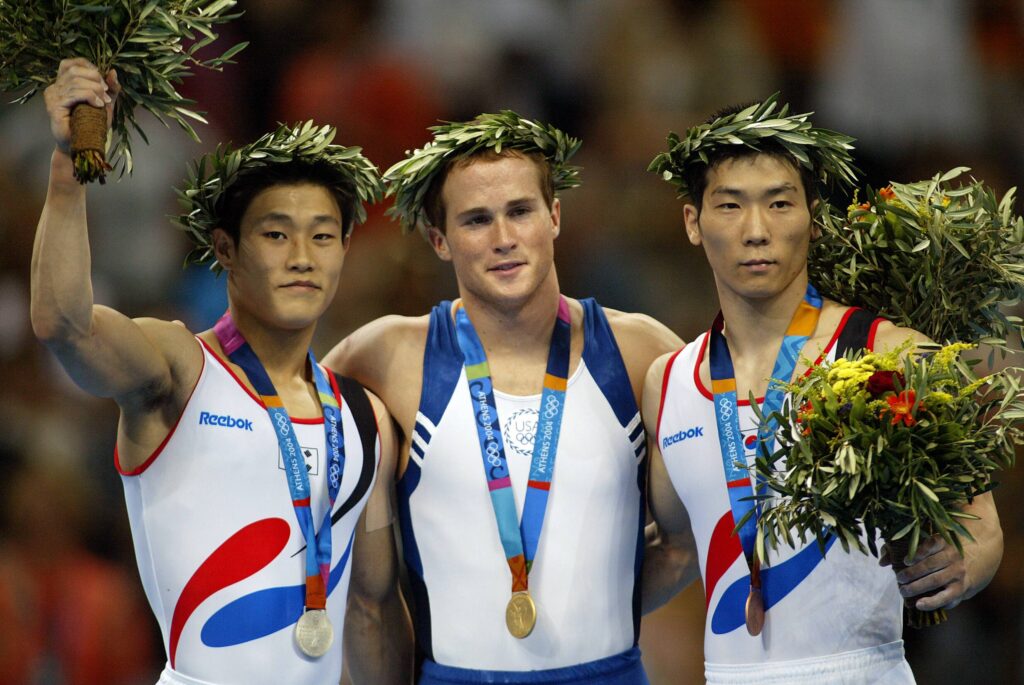
I. The Miracle
The first story was written before midnight on August 18. It was the story of a comeback so improbable that even Hamm’s coach had stopped believing it was possible.
Paul Hamm arrived in Athens as the reigning world champion and the favorite, and, as expected, he led through three rotations of the all-around final. Then, on vault, he destroyed his own position. His landing went sideways and kept going — off one mat, off another, until he came to rest against the judges’ podium, where one of the judges stood up to keep the world champion from rolling off it. “When I was in the air, I thought that my attempt was good,” Hamm said afterward. “Actually, I didn’t understand what I did.” His 9.137 was the third-lowest vault score in the twenty-four-man field. He fell to twelfth place.
“I told him that he would need to score a 9.8 on the last two events to possibly get the bronze,” his coach, Miles Avery, recalled. “I thought that the gold at that point was impossible.”
Then the leaders began to falter. Yang Wei of China, the new leader, lost his grip on a high bar pirouette and fell out of contention. Ioan Suciu of Romania buckled on a parallel bars handstand. Yang Tae-young of South Korea delivered a parallel bars routine in the fifth rotation that put him in the lead, and that would become the most scrutinized routine of the Games. Hamm, meanwhile, had scored 9.837 on parallel bars. On the final apparatus, Yang finished a high bar pirouette in the wrong grip, reducing his start value. Hamm, performing last and believing he was fighting for bronze, delivered a high bar routine with three consecutive release moves and a stuck dismount. Another 9.837 appeared on the scoreboard.
“Olympic champion!” Avery shouted.
“I was like, ‘What? Cool!'” Hamm told International Gymnast. (The Times heard “What? No way!”) “I was so shocked.”
Hamm had beaten Kim Dae-eun of South Korea by 0.012 points, with Yang Tae-young another 0.037 behind. No American man had ever won the Olympic all-around. Now one had come from twelfth place to win it with two extraordinary routines, by twelve-thousandths of a point.
The victory was instantly cast as a miracle. International Gymnast compared Hamm’s vault crash to the Parthenon sliding off the Acropolis and called him “a legend in the making.” For American columnists, the triumph redeemed an Olympics otherwise marked by disappointment: Venus Williams and Andy Roddick had been eliminated, the basketball team humiliated by Puerto Rico. Now a freckled twenty-one-year-old from Waukesha, Wisconsin, had given the country a hero. Béla Károlyi called it “Magical!” Peter Vidmar, whose 1984 silver had stood for twenty years as the best American men’s all-around finish, said, “I don’t know what to compare it to.”
The rewards followed quickly. Gold-medal bonuses had earned Hamm $200,000 that week, making him the highest-paid American man in gymnastics history, and his agent was already fielding corporate inquiries. “There is not a person who reads who doesn’t know about Paul Hamm today,” Sheryl Shade declared. Hamm himself offered a more charming measure of his sudden fame. Returning to the athletes’ village at 3 a.m. without his credential, he was waved through by a guard who recognized the medal around his neck. “It’s my get-in-free pass.”
But not everyone leaving the arena believed the result was deserved. Two Romanians questioned Hamm’s scores. “I do not have any complaints about my scores,” said Suciu, who finished fourth. “The only thing I can say is that U.S.A. got something more than it deserved.” Marian Drăgulescu, eighth, agreed: “Everyone got fair judgment with the exception of the U.S.A. that got a little bit more.” The American team offered no response; as the Times observed, it was too busy celebrating.
Yang’s reaction is harder to pin down. International Gymnast quoted him blaming his high bar mistake. But Jong Koo Young, a Dong-A Ilbo reporter in Athens, told the Los Angeles Times that Yang had told several Korean reporters that night that “he felt unfairly judged on the parallel bars and he also felt Mr. Hamm was given too much score on his bad vault.” According to Jong, Yang believed Hamm’s crash deserved no more than 8.900, rather than the 9.137 he received. Had Hamm been given that score, with everything else unchanged, Kim Dae-eun would have won gold and Yang silver.
Korean readers heard the vault complaint from their own correspondents. The next morning, Korea time, the Seoul Shinmun celebrated the country’s first Olympic all-around medals, but its reporters in Athens also recorded what had rankled the Korean gymnasts: “What stung for them was that Hamm had benefited from questionable judging. On vault, the fourth apparatus, he fell sideways on the landing. A score in the 8s or lower seemed likely, yet he received a surprisingly high 9.137.” (이들로서는 결과적으로 4번째 종목인 뜀틀에서 착지를 하다 옆으로 넘어져 8점대 이하의 점수가 예상되던 햄이 의외로 9.137점의 높은 점수를 받는 등 석연치 않은 판정으로 득을 본 게 못내 아쉬웠다).¹ From the start, the vault could be read as the beginning of a comeback or as a score too generous for a fall.
II. The Error
The vault complaint soon faded into the background. Parallel bars would drive everything that followed: the judges’ suspensions, the shared-gold proposal, the letter, the arbitration.
By August 20, news of the Korean protest had reached American readers, and the way it was received anticipated much of what was to come. In a column titled “Honor Among Peeves,” the Washington Post‘s Sally Jenkins had already labeled South Korea “Public whiner No. 4,” in a list that also included two American swimmers, treating its protest as an example of poor sportsmanship before the FIG had publicly acknowledged the error. The Los Angeles Times took a different tack. Its August 21 headline read: “Protest Targets Judging on Bars — South Koreans cry foul, but Hamm’s gold medal is not in jeopardy.” The reassurance came before the explanation.
The scoring error itself was straightforward. Yang Tae-young’s parallel bars routine — the same routine, with the same elements — had carried a start value of 10.0 in qualification and the team final. In the all-around final, the A-panel credited one of his Belles, an E-level element worth 0.2 in bonus, as a Morisue, a D-level element worth 0.1. The two skills end the same way but begin differently: a Morisue is a double back to the upper arms; a Belle is the same double back, entered from a giant swing. The misinterpretation lowered Yang’s start value to 9.9. The missing tenth was twice the margin by which he had lost the gold.
The FIG reviewed the tape and, on August 21, announced its findings under the headline “Judging Mistake Confirmed. Three Technical Officials Suspended.” “This judges’ error is confirmed by the FIG,” the statement read. To “protect the integrity of the FIG, the judges,” and to “maintain and ensure the highest possible judging standard,” the Executive Committee suspended the three officials concerned, pending inquiry: Benjamin Bango of Spain, Oscar Buitrago Reyes of Colombia, and the panel’s chair, George Beckstead of the United States, himself a member of the FIG’s technical committee.² But the result would stand. “The FIG Rules do not allow for a protest against judges’ marks,” the same statement said. “The judges’ marks have to be accepted as a final decision and cannot be changed.”
Even within the American gymnastics community, there were questions about the judges’ responsibility. In the October issue of International Gymnast, publisher Paul Ziert, who had known Beckstead for nearly thirty years, thought the routine “so easy to judge that it is impossible to believe that two—no three—competent judges… could have arrived at the same wrong SV.” His explanation was not conspiracy but deference: Beckstead, he suspected, had seen the 10.0, but the rules let a head judge intervene only when the two A-panel judges disagreed. Staying silent, Ziert wrote, was “legal, but not morally sound.”
The principal American defense was that the Koreans had protested too late. “It’s like a football game,” said Hamm’s coach, Miles Avery. “You can’t review the tape after the fact and say a flag should have been thrown in the third quarter, let’s change the score now.” USA Gymnastics president Bob Colarossi said American coaches checked every start value, score, and leaderboard position every time an athlete competed. The implication was clear: the Americans knew the procedure; the Koreans had failed to follow it.
Paul Hamm’s father, Sandy, offered the family’s first response, establishing the position it would maintain throughout: regret without concession. “We would feel badly if the game had been played unfairly,” he said. “But it’s not about Paul. When the game is over, it’s over. You can go back and question every referee call, but nothing is going to change.”
American reporting made the Korean delay seem even more egregious. “The South Koreans did not file a protest during the event,” the New York Times reported on August 22. “Instead, they waited two days, lodging a complaint on Friday.” The Los Angeles Times put the filing on Thursday. Peter Vidmar could not recall anyone filing a protest two days after a competition. “You file the second you get your scores,” he said. The Los Angeles Times columnist Bill Plaschke was less diplomatic: “The Koreans blew it.”
But the Koreans had not waited two days. As early as August 19, International Gymnast had reported that the Korean federation had submitted a written inquiry following a “heated verbal exchange” between the Korean delegation and Adrian Stoica, president of the FIG’s Men’s Technical Committee.
The subsequent arbitration would establish that the start value had been questioned even before the competition ended. Kim Dong-min, the Korean judge on the parallel bars execution panel, had raised the matter with Buitrago as the rotation ended. But Kim was not entitled to lodge a protest in his capacity as a judge, and the Korean coaches had difficulty seeing the start value from the competition floor. A television camera had obstructed their view. By the time the coaches approached the judges and Stoica, the competition was over.
Stoica, by the delegation’s account to International Gymnast Online, told them to submit their objection in writing. In the early hours of August 19, delegation chief Shin Park-je faxed Stoica an “Official Request for Correction of Start Value.” A fax to FIG president Bruno Grandi followed later that day.
The written protest had come within hours, not days. Whether it had come soon enough was another question, and the FIG was giving reporters different answers. In the Chosun Ilbo, federation officials were quoted as requiring a written protest within fifteen minutes. The Los Angeles Times, citing FIG spokesman Philippe Silacci, reported that protests had to come “before the start of the next rotation” and, a day later, that an inquiry had to be filed “within one event after the one in question.” None of these deadlines appeared in the regulations.³
The missing tenth was beyond dispute; the missed deadline was not. Yet it was on the deadline that much of the American defense of Hamm’s victory had come to rest.
III. Two Golds, One Arena
For a time, it seemed possible to resolve the controversy without resolving the dispute over the rules. The Olympic movement had faced what looked like a similar predicament just two years earlier.
At the 2002 Winter Olympics in Salt Lake City, the Russian pair Elena Berezhnaya and Anton Sikharulidze had won the pairs figure skating title over Canada’s Jamie Salé and David Pelletier, despite a visible error in the Russians’ free skate. Days later, the French judge was reported to have said she had been pressured to vote for the Russians. The International Skating Union and the IOC responded by awarding the Canadians gold medals of their own, without taking the Russians’ away.
Now, with the FIG acknowledging an error that might have cost Yang the Olympic all-around title, some American officials wondered whether the same solution might work in Athens. “You can’t replay what happened,” a senior USOC official told the Los Angeles Times. “But you can say an honest mistake was made, and let’s try to do something fair for both athletes.”
On August 22, officials from the U.S. and Korean Olympic committees approached the IOC together to propose awarding two gold medals. The Koreans were careful to frame the request as a compromise, not a demand to strip Hamm of his title. “We do not want to break Paul Hamm’s heart and take his gold medal away,” said delegation officer Yoo Jae-soon. “He is a proud Olympic champion. If they share the medal, that would be better.” The following day, a USOC spokesman confirmed that the organization was “willing to consider the notion of a second gold medal.”
But the IOC would not entertain the comparison with Salt Lake City. There, a judge had been pressured and the competition manipulated. In Athens, the judges had simply made a mistake. “The IOC never intervenes on a ranking issue,” president Jacques Rogge explained. “The only time is in a case like that in Salt Lake City, which involved manipulation. That is not the case here.” The IOC would accept a corrected result only if the FIG made the correction, and the FIG president Bruno Grandi insisted that his federation had no authority to do so: “I don’t have the possibility to change it. Our rules don’t allow it.”
Even within the American delegation, the shared-gold proposal had its opponents. One of the most emphatic was Hamm’s coach, Miles Avery. Asked whether he would support a second gold medal for Yang, Avery replied, “I would think Paul was cheated.” And if American officials endorsed the proposal? “I would say they were not supporting their athlete and I don’t think that would be right.” In Avery’s view, a medal awarded to Yang, even one that took nothing from Hamm, would itself be an injustice to Hamm.
Hamm was angry, too, though his anger was directed less at the Korean delegation than at the FIG for allowing the controversy to develop. “I shouldn’t even be dealing with this,” he said after the first night of event finals. “The people I’m a little bit upset with is FIG because this matter should have never even come up.” He questioned why the federation had reviewed the videotape at all. “If you start reviewing tapes of gymnastics, do you review every one? Who’s to say there weren’t other mistakes?”
He was equally firm about his title. “I truly don’t believe I am the silver medalist,” he said. His twin brother, Morgan, raised another objection: correcting Yang’s start value would not necessarily have produced the same competition. “How do you know how Yang would have done with the pressure of a lead?” It was an argument the arbitrators would eventually adopt.
Yet Hamm’s insistence that he had won fairly was accompanied by a willingness to accept whatever the authorities decided. “I will abide by whatever decision FIG comes to,” he said on August 22. “I guess it’s up to them if I share the gold medal or give it up, but I don’t feel that would be the right thing.” The following night he was more explicit: “If they tell me to return the medal, I will. If they tell me to share the medal, I will.” Remarks like these, gathered from the American press, would shortly be read with great care by the federation he had promised to obey.
He said it on the strangest night of the Games.
On August 23, during the high bar final, Alexei Nemov of Russia — a twelve-time Olympic medalist and former all-around champion — performed six release moves in a routine that brought the arena to its feet. He took a large step on his dismount, and the judges awarded him 9.725. The crowd erupted, not in celebration but in protest. For nearly ten minutes, spectators booed, whistled, and hissed at the judges, refusing to let the competition continue.
The next gymnast was Paul Hamm.
Twice he mounted the apparatus to begin his routine, and twice the noise forced him to retreat. In full view of the arena, two judges raised their marks, lifting Nemov’s score to 9.762, but the adjustment neither changed his placing nor satisfied the crowd. Finally, at Hamm’s urging, Nemov himself stood and appealed for quiet. Only then could Hamm compete.
He responded with one of the finest routines of his career, scoring 9.812 and losing the gold on a tiebreaker. The crowd booed his score, and the boos returned, mixed with cheers, at the medal ceremony. “It almost felt like a movie or something,” Hamm said afterward. He insisted the hostility was not directed at him — “It has nothing to do with me” — but not everyone in the arena agreed. “The all-around was fixed,” one European spectator told the Chicago Tribune. “It looks like they’re trying to give him this title as well.”
What received less attention was how Hamm responded afterward. About two hours after the competition, he issued a statement acknowledging Yang’s disappointment:
“I do understand and feel the disappointment that Yang Tae Young has been subjected to and I hope he understands what I have been through as well. We are both great athletes and should be proud of our performances… I will respect any decision of the Olympic governing bodies.”
It was as close as the two men came, in the record examined here, to addressing each other publicly. Nemov, who had helped quiet the crowd, also expressed sympathy for Hamm. “I didn’t think it was fair,” he said. “I felt really bad because of what he’s been through, none of it his fault.”
Back in Wisconsin, meanwhile, the controversy was becoming a story about an American champion under siege. In the Town of Waukesha, where a banner already hung on the town hall and the board had voted to rename a park for the Hamm twins, residents were debating start values and judging procedures. Even there, sharing the gold had a supporter in the town chairman, Rodney Stilwell. “It would be no shame for Paul to share the medal,” he said. “We wouldn’t have felt slighted if that happened.”
The Hamm family was less sanguine. Hans Hamm, the twins’ grandfather, had been kept awake by telephone calls and worried that the controversy was spoiling what should have been a national celebration. “We were so exuberant, and now this controversy has put a cloud over everything,” he said. Americans, he argued, were tired of war, terrorism, and bad news; here at last was a feel-good story about a young man who was “not a spoiled millionaire athlete.”
Then he offered a simpler answer to the controversy, one that would prove considerably more durable than the brief American willingness to share the gold.
“Paul is the Olympic champion. Get over it.”
IV. “Dear Paul”
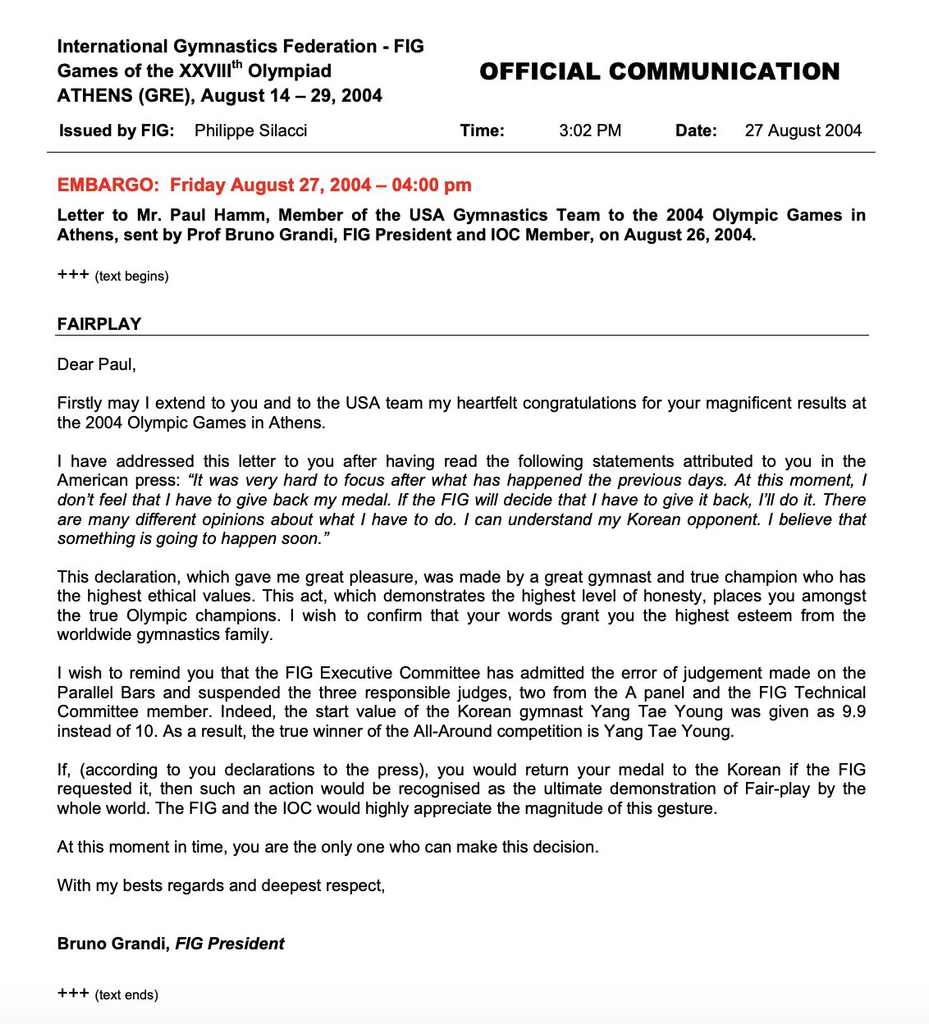
The letter arrived on the night of August 26 — by fax, according to Newsday; hand-delivered, according to the Times. Addressed to the U.S. Olympic Committee for delivery to Paul Hamm, who had already flown home to Wisconsin, it bore the FIG letterhead and a single-word heading: FAIRPLAY.
FIG president Bruno Grandi had built his appeal around Hamm’s own words. All week, Hamm had told reporters that he would surrender his medal if the federation instructed him to do so. Grandi quoted that promise back to him, praising it as the declaration of “a great gymnast and true champion who has the highest ethical values.” Then came the request. The FIG had confirmed the scoring error and suspended the judges. Yang Tae-young’s start value should have been 10.0, not 9.9. “As a result,” Grandi wrote, “the true winner of the All-Around competition is Yang Tae Young.”
Yet the FIG did not change the result itself. Instead, Grandi asked Hamm to make the correction voluntarily:
“If, (according to you [sic] declarations to the press), you would return your medal to the Korean if the FIG requested it, then such an action would be recognised as the ultimate demonstration of Fair-play by the whole world. The FIG and the IOC would highly appreciate the magnitude of this gesture. At this moment in time, you are the only one who can make this decision.”
The letter was not the federation’s first attempt to persuade Hamm. According to the FIG’s press office, it had already approached him through USA Gymnastics about a gesture of fair play toward Yang and received a negative response. Grandi wrote after reading Hamm’s declaration in USA Today: “If the governing body decides I should, then I will.” The Koreans, too, had encouraged the approach. As FIG deputy secretary-general André Gueisbühler told the Chicago Tribune: “The Koreans also asked us, ‘Well, look, Paul Hamm wants to return his gold medal if the FIG requests him to do so. You should do something.'”
There was even a precedent. As the Times noted, at the 2001 trampoline world championships, Russia’s Irina Karavaeva had asked the federation to change the results after learning that a judging error had given her the gold. She gave up her medal and later received the International Fair Play award. But in Athens, the federation had declared who deserved the gold while insisting it could do nothing to award it. The decision, and the cost of making it, now belonged to the twenty-one-year-old gymnast.
The U.S. Olympic Committee refused to deliver the letter. Its officials informed Hamm of the contents by telephone. In a reply to Grandi, whose language the committee repeated in a press release, chief executive Jim Scherr called the request “improper, outrageous and so far beyond the bounds of what is acceptable that it refuses to transmit the letter to Mr. Hamm.” At a news conference, chairman Peter Ueberroth went further. “They are deflecting their own incompetence and their problem onto a young athlete who came to the Olympics to perform and who performed very well.”
Whatever openness the USOC had shown toward awarding Yang a second gold medal was gone. The Korean Olympic Committee had proposed one, and the USOC had said it would consider the idea if the FIG and IOC approved. After Grandi’s letter, the committee declared, it was “no longer an option the USOC will consider.” Scherr even apologized for the committee’s earlier hesitation. “We were at fault as an Olympic committee for not more strongly, more directly stating our public support for Paul.”
The IOC distanced itself from the request, saying that it had not been consulted. The letter, a spokesman said, “does not at all reflect the IOC’s position.”
By Friday afternoon, Grandi was retreating. In a second letter, he wrote that the decision was Hamm’s alone. “If he says give back the medal, I respect it,” Grandi told the Associated Press. “Don’t give back the medal, I respect the decision. He is not responsible for anything.” Only a day earlier, he had written that Yang was the true winner.
For Hamm, the letter came at the end of a week in which he had felt abandoned. On August 20, USA Gymnastics had declared that it was “not involved in this process.” Hamm told the New York Times that he had followed the controversy on the internet at the Olympic Village and that he did not know where even his own federation’s president stood. “He said to some reporters that I should give my medal back,” Hamm said of Colarossi. “On TV, he said I should definitely keep it.”
“I felt really horrible that no one was defending me — not USA Gymnastics, not the F.I.G., who caused the whole thing, nobody.”
USA Gymnastics insisted that it had done everything it could to preserve his title. Its support, Colarossi said in a statement endorsing the USOC’s response to Grandi, had rested on a single premise: “the results as determined on the field of play must stand once the competition has concluded.” But from Hamm’s perspective, he had been left to defend his victory in the press. Now the president of the international federation was asking him to resolve the controversy himself.
In South Korea, however, the letter was significant less for what it asked of Hamm than for what it said about Yang. Delegation chief Shin Park-je reportedly obtained a copy directly from Grandi, believing it would become “crucial evidence” in arbitration. Nearly four weeks later, when the Korean Olympic Committee presented Yang with a gold medal of its own making at a Seoul hotel, it cited Grandi’s letter as justification.
Until then, much of the American response had been concerned with defending Hamm’s victory. Grandi’s letter made it possible to portray Hamm as a victim of the controversy in his own right.
It was a view that even members of the Korean delegation shared. As the USOC denounced Grandi’s letter on August 27, Yoo Jae-soon told the New York Times that the responsibility belonged to the federation. “The F.I.G. said they made a mistake, but no action was taken, so it is the F.I.G.’s leadership’s fault, and they should solve the problem,” she said. “Now Paul is the victim. Tae Young is the victim.” Her delegation chief, Shin Park-je, agreed: “The two athletes should not be victimized.”
V. The Public Square
The increasingly polarized positions of the American and South Korean Olympic committees did not necessarily reflect the divisions in public opinion. In the United States, at least, the question of who deserved the gold was far from settled.
In newspapers across the country, Americans were arguing about what made an Olympic champion: the official result or the score that should have been awarded. A Tacoma newspaper’s call-in line divided 19–16 in favor of Hamm keeping his medal. An unscientific USA Today online poll went overwhelmingly the other way, with 84 percent of some 26,000 respondents favoring gold for Yang — a result eagerly reported in South Korea, where journalists also acknowledged that Korean internet users may have flooded the voting. Neither was a reliable measure of American opinion. But in call-in columns and letters pages from Cleveland and Tacoma to Portland and Los Angeles, the disagreement was unmistakable.
Those defending Hamm returned to an argument his supporters had made in Athens: the Koreans had protested too late. But another argument had gained currency in the days following the FIG’s admission: that Yang himself had benefited from a judging error.
The same videotape showing Yang’s missing tenth, his critics claimed, also revealed four holds on the parallel bars, one more than permitted. The supposed infraction carried a two-tenths deduction, enough to cancel the scoring error and cost Yang his bronze medal besides.
The allegation traveled quickly. By August 23, Hamm’s uncle in Waukesha was invoking it to defend his nephew’s victory. That same day, it reached a national audience when NBC’s gymnastics analyst Tim Daggett explained on the air that Yang had not received the deductions he should have for an extra hold. By August 25, a Cleveland caller was insisting that the judges had overlooked a “2/10th’s mandatory deduction” and that “nobody’s yelling about that.” By month’s end, the allegation was appearing in newspaper letters pages as settled fact.
The claim had support among the judges themselves, including Buitrago, Beckstead, and Bjerke, as the subsequent arbitration award would reveal.⁴
But the confirmed error and the alleged one were of a different nature. Yang’s protest concerned his start value; the counter-allegation concerned his execution score. In its August 19 coverage, International Gymnast had explained that inquiries could be made into the findings of the A-panel, which determined the start value, but not into the individual marks of the B-panel, which assessed execution.
The deduction itself was also open to question. Writing weeks later, International Gymnast publisher Paul Ziert observed that any deduction for an additional hold would have fallen to the execution panel on which Bjerke had served. Bjerke, Ziert wrote, “would have made the deduction if he thought it was merited.” The magazine also noted that one of the alleged holds was borderline and that the Code of Points instructed judges to give gymnasts the benefit of the doubt.
The criticism within the American gymnastics press went beyond the technical merits of the deduction. In a column titled “Nobody Wins,” International Gymnast Online accused NBC of making “a flimsy attempt to discredit Yang and to sway public opinion in favor of Hamm.” The network, the column argued, had placed Yang on trial, with “prosecutor NBC presenting ‘Exhibit A.'” Applying NBC’s own method of counting holds to Li Xiaopeng’s bronze-medal routine in the parallel bars final, the writer had counted five. The point was not that Li, too, should have lost his medal, but that identifying holds was a more subjective exercise than determining Yang’s start value.
The column also asked American readers to imagine the controversy with the nationalities reversed. Had Yang won after a spectacular comeback, only for a scoring error on one of Hamm’s routines to come to light, would NBC have scrutinized Hamm’s performances for additional deductions to justify Yang’s victory?
Yet the column did not take Hamm’s side either. It doubted that adding a tenth to Yang’s score would have made him Olympic champion, since a different score in the fifth rotation might have produced a different sixth. “Do I think he probably would have won? Yes. But ‘probably’ isn’t good enough in this case.” Hamm, the writer thought, was “the most complete gymnast in the world right now.” But “the night of the all-around, Yang Tae Young probably had the better meet.” The column ended with a hope for both men: “I just hope that Paul Hamm and Yang Tae Young can emerge from all of this without too many scars.”
Outside the gymnastics press, some of Hamm’s defenders dispensed with the technical arguments altogether. A competition had to end sometime. “Once a competition is done, it’s done,” a woman waiting at a gym near Hamm’s hometown told the Chicago Tribune. “You don’t get do-overs in this world.” Beneath the procedural arguments lay sympathy for Hamm himself. “It’s a shame that this young man has been made to feel unworthy of receiving a gold medal,” a reader in Lakewood, Washington, told the Tacoma News Tribune.
Others believed that keeping the medal, however defensible under the rules, was the wrong thing to do. The FIG had acknowledged the error and declared Yang the rightful winner. For these readers, that settled the moral question even if the official result stood. “It’s not his decision to make,” one insisted. “The points clearly show Yang the winner.” Another imagined the gesture Hamm had declined: he could have been remembered as “not just the guy who won a gold medal but the guy who won a gold medal and gave it up.” A Los Angeles woman recalled beating her father at Scrabble, discovering an error on the saved score sheet, and voluntarily returning the victory. “I am embarrassed for Paul Hamm,” she concluded.
The professional columnists were no more united. The Oregonian‘s John Canzano urged Hamm to return the medal, calling his refusal “typically American,” a characterization that provoked a page of angry letters. The Los Angeles Times editorial board called the victory “Tarnished Gold,” while the paper’s Bill Plaschke dismissed talk of sharing the title as “blatant pandering, by U.S. officials and journalists so desperate for the rest of the world to like them.”
By the end of August, American Olympic officials had committed themselves to the principle that a result, once the competition was over, should stand. Some of their countrymen were still asking whether that was enough when the result was known to be wrong.⁵ The American debate was not simply about which gymnast deserved the gold. It was also about who should bear the consequences of a mistake that neither gymnast had made.
VI. Lausanne
The Korean delegation filed its CAS appeal in Athens on August 28, the day before the closing ceremony. The case was referred to full arbitration in Lausanne, and for the next month, the controversy quieted as both sides prepared.
As the dispute moved to arbitration, the American coverage focused on Hamm and the stakes of his defense: his gold medal tucked inside a gym sock at his Wisconsin farmhouse; the champion himself, “a shy, freckle-faced man more comfortable in a sweatsuit than a business suit,” as the New York Times described him, arriving in Lausanne to argue his case with six lawyers at his side. The USOC would spend more than $300,000 on his defense, presenting the expense as a matter of principle: athletes needed to know that “when they leave the field of play, their results should be final.” Hamm saw the struggle in more personal terms. In a BBC interview relayed by the Korean press, he said he had fought to win the competition, then to win public opinion, and now to win the case.
On September 27, the two sides met in a conference room at Lausanne’s Beau-Rivage Palace hotel. The hearing lasted nearly twelve hours, from 9:30 in the morning until 9:00 at night, interrupted only by a half-hour break for sandwiches. The American case rested on three arguments: courts should not overturn decisions made on the field of play; the Koreans had failed to protest in time; and correcting Yang’s start value would not establish that he would have won. One rotation remained after the parallel bars, and a gymnast competing with the lead might perform differently from one trying to catch up.
According to the Korean-language press, both gymnasts attended. Both were offered the opportunity to speak. Neither did. Hamm and Yang shook hands before the hearing, then sat through the day’s arguments about which of them should have been Olympic champion without addressing the arbitrators themselves.
“I’m just relieved that the hearing is over,” Hamm said afterward. He repeated that he would accept the ruling, even if it meant returning his medal. Asked by International Gymnast how he would have felt in Yang’s place, he gave an answer that anticipated the arbitrators’: “I would have, first of all, been upset with myself. I would have thought I had let myself down by not checking the Start Value … and I would have also been very upset with my coach Miles Avery for not protesting that Start Value at that time, as well.” Would he have pursued the case as Yang had? “No, I don’t think I would have.”
VII. Vindication
The decision came on October 21. “Ruling means Hamm keeps gold,” announced one American headline. “Court Rules Paul Hamm Can Keep Olympic Gold,” declared another. The New York Times added a qualifier: “In a Bittersweet Victory, Hamm Keeps Gymnastics Gold.” Others went further. The Associated Press reported that the arbitrators had affirmed Hamm as “the rightful champion,” and the Kansas City Star concluded that “all is as close to what it should have been as it can be.”
The court had said something narrower. It dismissed the appeal, leaving the official result intact without deciding who would have won had the judges not erred.
The Korean protest had come too late, the arbitrators ruled. But in reaching that conclusion, they had to confront a difficulty largely absent from the American coverage: the deadline that the Koreans were accused of missing was not explicitly stated in the regulations.
A strict protest procedure, with a fifteen-minute limit, had existed in the 1982 regulations but had since been deleted—an oversight the FIG could neither date nor explain. The regulations in force at Athens prescribed neither a deadline nor a form in which coaches or federations could submit a protest.
That did not mean the error was uncorrectable. The regulations empowered senior judges to act on “a grave error of judgement,” and the Code of Points allowed an apparatus chair, with the competition chair’s approval, to change “an extremely incorrect score.” What the rules did not say was how a coach could invoke that authority, or when the chance to do so ran out.
The arbitrators arrived at their conclusions via the headings of the rulebook. The provisions governing corrections appeared under headings describing the juries’ “functions during competition” and their responsibilities “at official competitions.” That, the panel held, “sufficiently identifies that any appeal must be dealt with during, not after a competition.”
Witnesses on the American side stressed that gymnasts needed to know their target before each new rotation began, so that the top seed, performing last, would know exactly what he needed to win, which pointed to a stricter limit. The arbitrators instead accepted the FIG’s working assumption that a protest could come at any time before the competition ended, a view with which, they noted, USA Gymnastics president Bob Colarossi appeared to agree. Allowing protests until the end of the competition, they acknowledged, might represent “a trade off between the ideal and the realistic, and between justice and certainty.”
Kim Dong-min had been the first to question the start value, but a judge, the arbitrators held, could not make a protest without compromising his judicial functions. “The prime candidate is surely the coach.” Nor, they found, had Kim pressed the point: after speaking with Buitrago, he “gave no indication of continued dissatisfaction.” The coaches’ approach to the judges and Stoica did count as a protest, but the panel determined that it had come “too late to affect the medal ceremony” and, in the panel’s view, after the competition had ended.
That left the coach on the floor. Lee Joo-hyung, whose accounts in the press had not always agreed,⁶ told the arbitrators that television cameramen had blocked his view of the screen and that he had learned of the error only from Kim. The panel accepted his explanation but noted his concession that he could have moved or asked the cameramen to move. Checking the start value, the American coaches had testified, was one of a coach’s principal responsibilities, and Lee had not given it “the priority it deserved.” Had he been alert to the change, the panel concluded, “events might – we stress might – have taken a different turn.”
Underlying the decision was a broader principle: even an acknowledged judging error did not justify reopening a completed competition. “An error identified with the benefit of hindsight, whether admitted or not, cannot be a ground for reversing a result of a competition.” A video replay studied at leisure, the arbitrators observed, might show that a goal should have been disallowed. “The Germans may still hold that view about England’s critical third goal in the World Cup Final in 1966.” But the remedy for error lay “within the framework of the sport’s own rules,” not in arbitration after the fact. “Finality is in this area all important: rough justice may be all that sport can tolerate.”
Nor could the court say what a correction would have changed. One rotation remained after the parallel bars, and no one could know how the gymnasts would have performed under different circumstances. Yang might have risen to the pressure of leading, or he might have faltered. “While the error may have cost Yang a gold medal,” the arbitrators concluded, “it did not necessarily do so.” They were equally unwilling to rule on Yang’s alleged fourth hold, a staple of the American defense, which the court said it was “in no position to adjudicate upon its merits.” The allegation was left neither confirmed nor disproved.
If the Korean coaches had fallen short, so, in the panel’s view, had the FIG, though it had acted “in entire good faith.” The federation had been moved by “an understandable anxiety to maintain public confidence in the judging of Olympic competitions,” but it had declared that Yang would otherwise have won, a claim “in realm of speculation, not of certainty,” and it had sought to persuade Hamm to surrender his medal “when there was no reason for him to do so.” The panel even took up the trampoline precedent the Times had cited. Karavaeva had given up her gold; Hamm had declined. “He is, in our view, not to be criticized for this,” the arbitrators wrote. “He was not responsible for the judges’ error.”
Their closing assessment was sympathetic to both men:
“There are two victims of this unusual sequence of events, Hamm and Yang. Hamm because, as he eloquently explained, a shadow of doubt has been cast over his achievement in winning the sport’s most prestigious prize. Yang because he may have been deprived of an opportunity of winning it… Nonetheless the Court of Arbitration is not Solomon.”
The FIG, meanwhile, was already preparing to change the sport. On the day of the ruling, Bruno Grandi opened the federation’s congress in Antalya by urging delegates to support a sweeping overhaul of judging.
The officials at the center of the case were dealt with first. In February 2005, after reviewing the footage from Athens, the FIG extended the suspensions of the parallel bars judges: Beckstead and Bango through the end of 2005, Buitrago for a year from August 2004. The larger change followed. Within a year of the ruling, the federation had adopted a new Code of Points, effective in 2006, that abandoned the traditional 10.0 as gymnastics’ maximum score. In its place came two separate marks: an open-ended score for difficulty and a score for execution. The federation’s own magazine would describe Athens as a dividing line: “there is a before and an after Athens 2004.”
Hamm welcomed the decision, though he was less triumphant than the headlines. He asked the FIG for an apology. “That’s one thing I would really love to have,” he said. “I don’t know if it’s going to happen, necessarily.” None appears in the coverage examined here. Nor had the ruling resolved his grievances closer to home. USA Gymnastics had sent no representative to his victory teleconference, an absence he pointedly noted. “It would have been nice if they had been a little more supportive,” he said. He had already complained formally to the federation’s board, and a dispute over competing post-Olympic tours had further strained the relationship. The first American man to win the Olympic all-around had secured his medal in court but remained at odds with his own federation.
“This is obviously a great day for me,” Hamm said. “The decision from CAS confirms what I’ve always felt in my heart, which is that I was champion that night.”
VIII. Soon Enough
Twenty years after Athens, the clock came back.
On the afternoon of August 5, 2024, Jordan Chiles was the last gymnast to compete in the women’s floor final in Paris. Her score, 13.666, left her fifth, just behind two Romanians tied on 13.700. Ana Bărbosu, believing the bronze was hers, picked up a Romanian flag. Then Chiles’s coach, Cecile Landi, filed an inquiry. The judges reviewed the routine, added a tenth, and Chiles moved into third.
Within a week, the medal was gone. The Romanian federation had taken the case to the Court of Arbitration for Sport, arguing that Landi’s inquiry had come too late, and the court agreed. The panel found that the inquiry had been lodged one minute and four seconds after the score appeared, four seconds past the limit. Chiles’s score reverted, and the bronze went to Bărbosu. In Milwaukee, the Journal Sentinel noted that the news “surely rings familiar for Wisconsinites” and retold Hamm’s story.
The newspaper had good reason to reach back to Athens. Each case turned on a single tenth of a point: the tenth missing from Yang’s start value, and the tenth the judges added to Chiles’s difficulty score. Each turned on when a coach had objected, and each went to the Court of Arbitration for Sport after the medals had been awarded. The Journal Sentinel‘s retelling covered the essentials of 2004, from the federation’s admission that Yang’s start value was wrong to Grandi’s letter declaring him the true winner. It ended with Hamm’s familiar line about having won the gold three times.
The resemblance ran deeper than the newspaper suggested. In Athens, there had been no explicit deadline in the regulations. The arbitrators had to find one in the headings of the rulebook, reasoning that the juries’ “functions during competition” ended when the competition did. In the year that followed, the FIG moved to fill the gap. An advisory symposium in April 2005 recommended that objections to start values be raised “as soon as the mark is posted” and resolved “before the next gymnast’s mark is posted.” Later that year, the federation adopted a formal inquiry procedure.
By Paris, that principle had become a stopwatch. An inquiry had to come “immediately after the publication of the score or at the very latest before the score of the following gymnast” was shown. For the last gymnast of a rotation, as Chiles was, the limit was one minute, and late verbal inquiries were to be rejected, according to the Technical Regulations. Where the arbitrators of 2004 had to infer a deadline, those of 2024 found one written into the rules. Article 8.5, they said, was “clear and unambiguous,” a limit that “on its face offers no exception or flexibility.”
But a deadline measured in seconds is only as good as the clock that measures it. At the hearing, every party accepted the official timekeeper’s figure of one minute and four seconds, and no one offered other evidence. Yet the panel also found that there was no “clear and established mechanism” in place “to address so important a matter as the timing of a request for an inquiry,” a failure it called “a default by the FIG.”
Twenty years after Athens, the federation had eliminated one ambiguity only to leave another. It had established precisely when a coach had to speak without establishing a reliable procedure for determining when she did. In both cases, the shortcomings of the federation’s procedures had become consequential for the gymnast rather than the institution that had devised them.
Within a day of the ruling, USA Gymnastics produced video that appeared to show Landi speaking up 47 seconds after the score was posted. The arbitrators declined to reconsider. Chiles kept fighting, and in January 2026, Switzerland’s Federal Supreme Court set the award aside and sent the case back to be heard again.
This time, it was an American gymnast whose claim to an Olympic medal depended on whether her coach had spoken soon enough.
Even the old compromise resurfaced. Some of the parties proposed that the bronze be shared. The panel declined: it was “not the function of the Panel to apply principles of equity, or to attribute medals, or to determine that there should be multiple recipients of the bronze medal.” Twenty years earlier, another panel had said it more briefly. The Court of Arbitration was not Solomon.
Coda
On May 19, 2018, Paul Hamm was inducted into the International Gymnastics Hall of Fame in Oklahoma City. Alexei Nemov, who had been unable to attend his own induction the year before, was there too. Fourteen years earlier, it was Nemov who had quieted the crowd in Athens so that Hamm could perform.
Hamm spoke for six minutes. He thanked his parents, his coaches, and his twin brother, Morgan, who had come back from a nerve injury to compete beside him in Athens. He remembered running through snow in ankle weights and missing high school functions. When he touched upon Athens, he did not mention the judges, the letter, or the court. He told the first story, the one written before midnight on August 18:
“For me, the most amazing thing happened when I fell on the vault at the 2004 Olympics and then came back to win the gold medal in the all-around.”
Notes
¹ During the all-around final, the vault jury was chaired by Xiao Guanglai (FIG), with Robert Paquin (FIG) and Kim Dae-won (Korea) on the A-panel and, on the B-panel, Borys Shakhlin (Ukraine), Siegfried Funk (Germany), Bjoern Magnus Tomasson (Iceland), José Antonio Mendes (Portugal), Javier Colón (Puerto Rico) and Butch Zunich (United States).
The parallel bars jury was chaired by George Beckstead (FIG), with Benjamin Bango (FIG) and Oscar Buitrago Reyes (Colombia) on the A-panel and, on the B-panel, Kim Dong-min (Korea), Teruaki Takeuchi (Japan), Diego Lazzarich (Italy), Anzor Gongadze (Georgia), Harry Bjerke (United States) and Yuliy Kuksenkov (Ukraine).
The official results give these marks, B1 to B6 in that order. Hamm, vault: start value 9.90; 9.00, 9.10, 9.05, 9.30, 9.20, 9.20; final 9.137. Hamm, parallel bars: start value 10.00; 9.85, 9.80, 9.85, 9.80, 9.85, 9.85; final 9.837. Yang, vault: start value 9.90; 9.70, 9.70, 9.70, 9.70, 9.70, 9.65; final 9.700. Yang, parallel bars: start value 9.90; 9.75, 9.70, 9.70, 9.75, 9.70, 9.65; final 9.712. The highest and lowest marks were dropped, and the middle four averaged.
On Hamm’s vault, the middle four (9.10, 9.05, 9.20, 9.20) reflect deductions of 0.70 to 0.85 from his 9.90 start value, a spread of 0.15. The Code of Points allowed a spread of up to 0.30 among the middle deductions in that range (0.55 to 1.00), so the marks were within the permitted range and required no adjustment by the jury chair. That said, the rule governed how closely the judges had to agree, not whether their deductions were large enough.
² This was not the first problem with the parallel bars panel in Athens. The 2001 men’s Code of Points limited how far apart the four counting deductions could be, from 0.20 for the smallest deductions to 0.50 for the largest, and required the apparatus chair to act when they were not: “The Chair of the Apparatus Jury will resolve excessive differences by making adjustments according to the allowable differences.” George Beckstead chaired the parallel bars jury in qualification, the team final, and the all-around final.
On August 14, in qualification, Matteo Morandi of Italy performed a parallel bars routine with a 9.60 start value. With the high and low marks dropped, the counting marks were 8.10, 8.40, 8.40, and 8.60, deductions of 1.00 to 1.50. Their spread of 0.50 exceeded the limit under Article 3.8.4 of the Code of Points: 0.40 for deductions of that size, or 0.30 for the 1.00. Morandi’s final mark, 8.375, was the plain average of the four, so no adjustment appears in the published result.
The suspension did not keep Beckstead out of the competition. According to an Athens official, Adrian Stoica told the judges’ meeting before the event finals that Beckstead would sit with him on the Superior Jury. The FIG’s August 21 statement did not specify what the suspension covered. As a member of the Men’s Technical Committee, Beckstead, under normal circumstances, would have been eligible for the Superior Jury, which consisted of the technical president and two experts appointed by the committee.
³ The 1997 Technical Regulations, signed by president Yuri Titov and secretary-general Norbert Bueche, contained no procedure by which a coach, gymnast, or federation could protest a score. Their Superior Jury (Regn. 8.8.1) could “take such action as they consider necessary” where there was “a grave error of judgement,” and their Jury of Appeal (Regn. 8.8.3), despite its name, heard only “appeals made by judges who have been warned or excluded by the Superior Jury,” not appeals against scores. The 2002 edition in force at Athens, quoted in the CAS award, kept the same structure. Under Reg. 7.8.1, the Superior Jury, made up of the technical president and two experts appointed by the Technical Committee, had four functions: to supervise the competition and deal with “any breaches of discipline or any extraordinary circumstances”; “where there is a grave error of judgement on the part of one, or several, judges to take such action as they consider necessary”; to review the judges’ marks “continually” and warn any judge whose work was “unsatisfactory or showing partiality”; and, if a warning failed, to “remove and replace any judging personnel.” None of these said in so many words that the Superior Jury could change a mark; most of them concerned controlling the judges. The clearer power lay in the Code of Points, under which the chair of an apparatus jury, “with the approval of the Chair of the Competition Jury,” could act “to change an extremely incorrect score” (Article 10.1(f)). The arbitrators read the Superior Jury’s mandate as “large enough to embrace reversing marks as well as disciplining judges” and concluded that “there is no doubt that a mechanism exists for reversing judging errors.” But they also found that “there did not appear to be universal familiarity with it even among those responsible for its operation,” including on “whether special forms had to be used for the purposes of protest.”
⁴ Beckstead and Bjerke were Americans. Buitrago, a Colombian, had “lived and worked in Ohio for several years,” according to International Gymnast, which reported that he was also a professional member of USA Gymnastics. None of the reports examined here connected his time in the United States to the misread start value.
⁵ The question was still being asked in October. On the day of the CAS ruling, the Los Angeles Times consulted ethicist Michael Josephson, a sometime USOC adviser, who argued that results needed to be accurate as well as final: “in the very unusual case — and I think it is unusual — that it is objectively clear that the wrong person was awarded the medal, they ought to correct the situation.”
⁶ On August 20, speaking alongside Yang and Yoo Jae-soon, the delegation told International Gymnast that a camera had blocked their view of the start value, but that they had noticed the 9.9 as they moved to high bar. Two days later, in the Chosun Ilbo, Lee said the coaches had held back until the competition was over for fear of being penalized on high bar. At a press conference in Athens on August 25, he said they had never checked the start value.
Sources
Arbitration and federation documents. CAS 2004/A/704, Yang Tae Young & Korean Olympic Committee v. International Gymnastics Federation, award of 21 October 2004 (Beloff, Martens, Rao). FIG Official Communication, “Letter to Mr. Paul Hamm, Member of the USA Gymnastics Team to the 2004 Olympic Games in Athens, sent by Prof Bruno Grandi, FIG President and IOC Member, on August 26, 2004,” issued by Philippe Silacci, 27 August 2004. “2004 Olympic Games – Athens: After the shock, the electroshock!”, World of Gymnastics (FIG), no. 45, June 2005. FIG press releases, Athens, 19, 21 and 27 August 2004 (the last a statement on the letter to Hamm), via web.archive.org captures of fig-gymnastics.com (19–21 August releases; 27 August statement).
Competition reporting. Dwight Normile, “Unbelievable!”, International Gymnast, October 2004. Juliet Macur, “Paul Hamm Wins All-Around Event” / “U.S. Gymnast Goes From Oops to a Gold Medal,” New York Times, 18–19 August 2004 (with correction of 20 August). Selena Roberts, “Hamm Hits Bottom, Lands on His Feet, and Flies Away With the All-Around Gold,” New York Times, 19 August 2004. Jill Lieber, “U.S. gold medalist Hamm nabs instant fame,” USA Today, 20 August 2004.
Controversy reporting, August 2004. “Koreans Protest Yang’s Score,” International Gymnast (intlgymnast.com), 19 August. Sally Jenkins, “Honor Among Peeves,” Washington Post, 21 August (online archive dated 20 August). Diane Pucin, “Protest Targets Judging on Bars,” Los Angeles Times, 21 August. “FIG, Gymnastics Judges Admit Mistake,” International Gymnast (intlgymnast.com), 21 August. Alan Abrahamson and Diane Pucin, “U.S. Gymnast May Share Gold Won in Scoring Error,” Los Angeles Times, 22 August. Juliet Macur, “Judges Suspended for Error, But Hamm Will Keep Gold,” New York Times (carried in the South Florida Sun Sentinel), 22 August. Abrahamson and Pucin, “Hamm Takes Issue With Medal Dispute,” Los Angeles Times, 23 August. “Hamm fires back,” Associated Press (carried in the Journal Times), 23 August. Marlen Garcia, “Judges, U.S. draw jeers” and “Yang’s hopes for gold scant,” and Michael Hirsley, “Hamm’s golden to gym-savvy hometown,” Chicago Tribune, 24 August. Bill Plaschke, “They’re All Setting the Bar Low in Uneven Sportsmanship Event,” Los Angeles Times, 24 August. Pucin and Abrahamson, “Gymnastics Fans Sound Their Fury in Athens,” Los Angeles Times, 24 August. Richard Sandomir, “NBC Sits on a Contentious Event, and Its Breathless Coverage, Until Prime Time,” New York Times, 24 August. “Hamm at Odds with USA Gymnastics,” International Gymnast (intlgymnast.com), 25 August. Juliet Macur, “Gymnastics Group Asks Hamm to Give Up Gold” and “Federation Requests Hamm Give Up Gold,” New York Times, 27–28 August. Michelle Kaufman, “Request spawns outrage, criticism,” Knight Ridder (carried in the Detroit Free Press), 28 August. Michael Rosenberg, “FIG is nuts,” Detroit Free Press, 28 August. Marlen Garcia, “‘It’s deplorable,'” Chicago Tribune, 28 August. Alan Abrahamson, “Hamm Asked to Give Up Gold,” Los Angeles Times, 28 August. John Jeansonne, “Return to sender,” Newsday, 29 August.
Opinion and letters. “Plain Speaking,” Plain Dealer, 25 August 2004. “BackTalk,” Tacoma News Tribune, 28 August 2004. “Feelings mixed, but strong, on Hamm’s decision to keep gold medal,” Sunday Oregonian, 29 August 2004 (responding to John Canzano’s column of 24 August). “Nobody Wins,” International Gymnast (intlgymnast.com), undated (Internet Archive capture, 4 September 2004). Paul Ziert, “Ziert Alert: The Best of Times, the Worst of Times,” International Gymnast, October 2004. “Legal Gymnastics Over an Olympic Gold Medal,” Los Angeles Times letters, 8 October 2004 (responding to the editorial “Tarnished Gold,” 2 October).
CAS phase and aftermath. Juliet Macur, “Hamm Pleads Case as One and Only,” New York Times, 28 September 2004. “10 Questions: Paul Hamm,” International Gymnast, November 2004. Mike DeArmond, “Ruling means Hamm keeps gold,” Kansas City Star, 22 October 2004. Nancy Armour, “Hamm can keep Olympic gold medal, court rules,” Associated Press, 22 October 2004. Lynn Zinser, “In a Bittersweet Victory, Hamm Keeps Gymnastics Gold,” New York Times, 22 October 2004. Alan Abrahamson, “Court Rules Paul Hamm Can Keep Olympic Gold,” Los Angeles Times, 21 October 2004. Helene Elliott, “Handling of Case Intensifies Rift With USA Gymnastics,” Los Angeles Times, 22 October 2004.
The Chiles case, 2024–2026. CAS OG 24/15 & CAS OG 24/16, Federation Romanian Gymnastics and Ana Bărbosu v. Fédération Internationale de Gymnastique and Donatella Sacchi and Federation Romanian Gymnastics and Sabrina Maneca-Voinea v. Fédération Internationale de Gymnastique and Donatella Sacchi, award of 10 August 2024 (Gharavi, Sands, Song). CAS media release, “The CAS Ad Hoc Division Publishes the Arbitral Award,” Lausanne, 14 August 2024. FIG Technical Regulations 2024, Art. 8.5, as quoted in the award. “Swiss Federal Supreme Court, judgments of 23 January 2026 (4A_438/2024, 4A_494/2024, 4A_510/2024, 4A_512/2024, 4A_594/2024), granting the requests for revision by Jordan Chiles and USA Gymnastics; press release, Lausanne, 29 January 2026.”. JR Radcliffe, “Hamm had Olympic gold questioned in ’04,” Milwaukee Journal Sentinel, 17 August 2024. “Court says it won’t reconsider case that took away Jordan Chiles’ bronze medal,” NPR, 11 August 2024. “USA Gymnastics Submits Video Refuting Jordan Chiles Ruling, Calls to Reinstate Her Bronze Medal and Score,” TheWrap, August 2024. “Saga over Jordan Chiles’ 2024 Olympic medal unlikely to be resolved before 2027,” Yahoo Sports, November 2026.
Cross-references to the Korean-language record (Silacci’s fifteen-minute rule in the Chosun Ilbo, 22 August 2004; the KBS chronology of 21 October 2004, including the time of the first Korean fax; Hamm’s BBC remarks as relayed in the Korean press; the Korea Times hearing report of 28 September 2004; Dong-A Ilbo coverage, including Jang Hwan-su’s column of 25 August 2004; the Korean delegation’s acquisition of the Grandi letter; the Seoul Shinmun’s medal report of 20 August 2004; SBS’s Byeolbyeol Sports retrospective of 10 June 2021) are documented in the companion essay, “‘The Stolen Gold Medal’: How South Korea Told the Story of the 2004 Athens All-Around.”
Appendix: Documents
FIG
August 21, 2004
MEN’S ALL AROUND FINAL
Judging Mistake Confirmed. Three Technical Officials Suspended.
Athens, August 21, 2004. After the Artistic Gymnastics Men’s All-Around Final, the Chef de Mission of the Korean Delegation to the Athens 2004 Olympic Games claimed, that the Korean Gymnast Yang Tae Young (Start Number 185) received the wrong start value on Parallel Bars. The gymnast was given a start value of 9.9, instead of a 10.
This judges’ error is confirmed by the FIG.
The FIG Rules do not allow for a protest against judges’ marks. The judges’ marks have to be accepted as a final decision and cannot be changed.
In order to protect the integrity of the FIG, the judges, and to be able to maintain and ensure the highest possible judging standard at the Olympic Games, the FIG Executive Committee has decided to suspend the three Technical Officials concerned pending inquiry.
The FIG regrets that such an occurrence took place.
ANALYSIS IN PROCESS
Athens, August 20, 2004 According to the announcement released by the FIG late on August 19 (see below), President and IOC Member, Prof. Bruno Grandi, invited his Executive Committee Members to attend an extraordinary meeting, on Friday August 20, at 11:00 am.
At this meeting, it was unanimously decided that the FIG will proceed to the immediate analysis of the Men’s All-Around competition. In the case that judging errors have occurred, appropriate steps will be made immediately.
Further information will be available as soon as this investigation is completed.
STATEMENT !
Athens, August 19, 2004. The Men’s All-Around Individual Final has created great enthusiasm but was also a matter of interrogation by the Gymnastic Community, to which the International Gymnastics Federation wishes to make the following comments.
The FIG Rules do not allow for a protest against judges’ marks. The judges’ marks have to be accepted as a final decision and cannot be changed.
To ensure the highest possible judging standards, the FIG analyses all judges’ marks after all its major events. The best judges are rewarded; those who did not judge correctly and made serious mistakes are severely sanctioned. This process will also be followed for the Olympic Games.
FIG
August 27, 2004
International Gymnastics Federation – FIG
Games of the XXVIIIth Olympiad
ATHENS (GRE), August 14 – 29, 2004OFFICIAL COMMUNICATION
Issued by FIG: Philippe Silacci
Time: 3:02 PM
Date: 27 August 2004
EMBARGO: Friday August 27, 2004 – 04:00 pm
Letter to Mr. Paul Hamm, Member of the USA Gymnastics Team to the 2004 Olympic Games in Athens, sent by Prof Bruno Grandi, FIG President and IOC Member, on August 26, 2004.
+++ (text begins)
FAIRPLAY
Dear Paul,
Firstly may I extend to you and to the USA team my heartfelt congratulations for your magnificent results at the 2004 Olympic Games in Athens.
I have addressed this letter to you after having read the following statements attributed to you in the American press: “It was very hard to focus after what has happened the previous days. At this moment, I don’t feel that I have to give back my medal. If the FIG will decide that I have to give it back, I’ll do it. There are many different opinions about what I have to do. I can understand my Korean opponent. I believe that something is going to happen soon.”
This declaration, which gave me great pleasure, was made by a great gymnast and true champion who has the highest ethical values. This act, which demonstrates the highest level of honesty, places you amongst the true Olympic champions. I wish to confirm that your words grant you the highest esteem from the worldwide gymnastics family.
I wish to remind you that the FIG Executive Committee has admitted the error of judgement made on the Parallel Bars and suspended the three responsible judges, two from the A panel and the FIG Technical Committee member. Indeed, the start value of the Korean gymnast Yang Tae Young was given as 9.9 instead of 10. As a result, the true winner of the All-Around competition is Yang Tae Young.
If, (according to you [sic] declarations to the press), you would return your medal to the Korean if the FIG requested it, then such an action would be recognised as the ultimate demonstration of Fair-play by the whole world. The FIG and the IOC would highly appreciate the magnitude of this gesture.
At this moment in time, you are the only one who can make this decision.
With my bests [sic] regards and deepest respect,
Bruno Grandi, FIG President
+++ (text ends)
August 27, 2004
On the judging error during the men’s all around individual final.
Athens, August 27th, 2004.
In the case of the judging error, which occurred last Wednesday August 18, during the Men’s All Around competition, the FIG releases the following statement:
– The FIG has written to Paul Hamm because of his statement published in the newspaper USA Today: “At this point in time I am not planning to give over the medal. If the governing body decides I should, then I will”.
– The FIG, through the President and CEO of USA Gymnastics, has previously verbally contacted Paul Hamm to personally consider a gesture of Fair Play towards the Korean gymnast.
– FIG has received a negative answer from USA Gymnastics.
– After this first verbal exchange, FIG has read the above mentioned declarations of Paul Hamm to the press.
– It is only after these declarations that the FIG has officially written to Paul Hamm via the USOC, asking him whether or not he has the intention to consider a possible gesture of Fair Play.
– The USOC refused to forward the letter to Paul Hamm.
– FIG wishes to confirm that it has suspended three judges after first video analyses. The three judges have accepted this decision in writing and admit to have made an error.
– Respecting its rules, the FIG has not modified the final score and the ranking.
– By suspending the 3 judges, the FIG recognised its error.
– The FIG would not have re-opened the discussion, if Paul Hamm would not have made the above mentioned statement to the press.
– Paul Hamm cannot be responsible for a judging error.
FIG
March 11, 2005
Contact: Philippe Silacci c/o FIG Press Officer
Phone: [redacted]
[redacted]@fig-gymnastics.org
www.fig-gymnastics.com+++
Judges Suspended in Athens
SEVERE SANCTIONS
Moutier, March 11, 2005: The Fédération Internationale de Gymnastique (FIG) has issued severe sanction to judges convicted of serious breaches in the execution of their responsibilities at the 2004 Olympic Games. The incidences originate on August 18, 2004, when the FIG suspended 3 judges on the spot for serious mistakes in judging at the Parallel Bars, Individual Competition.
On February 26, 2005, after a detailed examination of the images from every competition sequence, the FIG Executive Committee suspended former Men’s Technical Committee Member, Mr George Beckstead, and judge Benjamin Bango (ESP) until the end of 2005 and issued a one-year suspension for judge Oscar Buitrago (COL), starting end of August 2004, along with a Jury A ban for the 2005 World Championships in Melbourne (AUS).
The FIG has broadened its analysis of all competitions on the Olympic Programme, shedding light on other serious breaches, particularly in judging for the Men’s Vault Finals. The FIG Executive Committee suspended former Men’s Technical Committee Member, Xiao Guanglai, as well as three other members of the judges panel, Mr Jorge Sandoval (VEN), José Mendez (POR) and Xavier Colon (PUR) for a period of one year, starting February 26, 2005.
The FIG Executive Members have finally addressed a letter of warning to three judges, Mr Yuliy Kushenkov (UKR), Chris Grabowecky (CAN), Timur Amirbekov (KAZ), whose insufficient work appeared at the Men’s Team Competition.
In conformity with the Statutes of the Federation, the sanctioned persons have the right to appeal to the FIG Disciplinary Commission.
At the same time, the FIG has taken spectacular measures in updating its Regulations. Reforms are in progress, notably in the editing of a new Code of Points and the introduction of an open difficulty mark, all the while maintaining the idea of a “Perfect 10” in Execution evaluation.
+++
USA Gymnastics
August 27, 2004
Statement From Bob Colarossi, President/CEO of USA GymnasticsFor Immediate Release – Aug. 27, 2004
Brian Eaton, USA Gymnastics
USA Gymnastics is thrilled with the performances of all of our athletes at the 2004 Olympic Games in Athens. The nine medals won by the U.S. team, including the silver medal winning performances of both the men’s and women’s teams and the all-round gold medals captured by Carly Patterson and Paul Hamm, represent an unparalleled level of success for American gymnastics. They are important validations of the system we implemented during this quadrennium to support the efforts of our national team athletes and represent the commitment of our clubs, professional members, athletes, coaches, and administrators to make our sport better.You are by now aware of the controversy surrounding the men’s all-around competition, a controversy that unfortunately shifted the focus away from where it should have been — on the extraordinary performance of Paul and our other medalists. In recent days, we have worked closely with the United States Olympic Committee to put this controversy to rest.
We strongly endorse the position of the USOC that the FIG’s request that Paul voluntarily surrender his gold medal is “a blatant and inappropriate attempt on the part of FIG to once again shift responsibility for its own mistakes and instead pressure Mr. Hamm into resolving what has become an embarrassing situation for the Federation (FIG).” The USOC found the FIG’s request “to be improper, outrageous and … far beyond the bounds of what is acceptable”, and so do we. [For more on the USOC’s statement, click here.]
Our position is consistent with the principles that have guided the actions of everyone associated with USA Gymnastics since the first moment we were made aware of the judging controversy:
- We would (and did) do everything we could to fight to keep the all-around gold medal that Paul won;
- We would, as required by the Olympic charter, recognize and be bound by any decisions made by the FIG or IOC, and
- We would honor Paul’s personal wishes, in terms of both any decisions he made relating to his response to the controversy and the role he wanted us to play.
Throughout, our unwavering support of our Olympic champion was based on one fundamental and important premise – the results as determined on the field of play must stand once the competition has concluded. This premise is primary to the integrity of any sport.We will continue to celebrate the performances of all of the members of the 2004 U.S. Olympic Team. Their efforts on the floor and their conduct throughout the Games have made our gymnastics community and our country enormously proud.
August 27, 2004
United States Olympic Committee Rejects Request
From Federation Internationale De Gymnastique
To Further Pressure Olympic Champion Paul Hamm
For Immediate Release – Aug. 27, 2004
Darryl Seibel, USOC, 210-003-0801
ATHENS, Greece – Last night, the United States Olympic Committee (USOC) received a letter from Mr. Bruno Grandi, President of the Federation Internationale De Gymnastique (FIG). The letter was in reference to the continuing controversy surrounding the final results of the Individual Men’s All-Around, which was won by Mr. Paul Hamm of the United States.The USOC views this letter as a blatant and inappropriate attempt on the part of FIG to once again shift responsibility for its own mistakes and instead pressure Mr. Hamm into resolving what has become an embarrassing situation for the Federation. The USOC finds this request to be improper, outrageous and so far beyond the bounds of what is acceptable that it refuses to transmit the letter to Mr. Hamm.
The USOC has informed the FIG of this and requested that it immediately withdraw its letter.
It is the opinion of the USOC that Mr. Hamm did exactly what an Olympic champion should do: he performed to the best of his ability, he competed within the rules of his sport, and he accepted his gold medal with pride, honor and dignity.
The USOC had two lengthy telephone conversations last night with Mr. Hamm, his parents and his representatives. During these conversations, the USOC expressed its unwavering support for Mr. Hamm and indicated it will aggressively resist any attempt by any party to lay claim to his gold medal.
As stated repeatedly by Mr. Grandi and stipulated by the FIG rules, Paul Hamm is the Olympic gold medallist and Olympic champion in the 2004 Individual Men’s All-Around. The USOC shares this point of view and finds any attempt by the FIG to pressure Mr. Hamm, or any athlete, into resolving a dispute not of their creation both unacceptable and irresponsible.
The letter from FIG also indicates the International Olympic Committee (IOC) is supportive of the FIG position. However, conversations between the USOC and the IOC, as recently as this morning, indicate exactly the opposite. In fact, the IOC and its President, Dr. Jacques Rogge, have expressed displeasure over the fact the FIG would even consider placing an athlete in such an untenable position and strongly stated they do not support the letter or its contents.
When representatives of the Korean Olympic Committee suggested the awarding of a second gold medal as a possible remedy for this situation, the USOC expressed a willingness to consider this should the appropriate governing authorities – namely the FIG and IOC – find this acceptable. However, in light of this most recent and unacceptable maneuver by the FIG, as well as concern expressed by the IOC, this is no longer an option the USOC will consider.
The USOC considers this matter closed and looks forward to celebrating the tremendous success of the Athens Games and the inspiring performances of athletes from around the world, not the least of which is that of Olympic champion Paul Hamm.
“We are extremely proud of Paul Hamm and all he has accomplished,” said USOC Chair Peter Ueberroth. “His comeback in the Individual Men’s All-Around is emblematic of the spirit of an Olympic champion. In the face of adversity, he refused to give up and battled to earn his Olympic gold medal. Now, faced with more adversity, he will again not give up, and he will have the full support of the United States Olympic Committee with him.”
“As stewards of the Olympic movement, we all share a responsibility to protect, not sacrifice, the interests of athletes,” said USOC Chief Executive Jim Scherr. “We encourage Mr. Grandi and other officials within FIG who saw this as an appropriate remedy to begin taking this responsibility more seriously.”
International Gymnast Online
Koreans Protest Yang’s Score
Team officials: Judging error gave American gold over KoreanAugust 19, 2004 – The Korean Gymnastics Federation has filed an official protest into the judging of gymnast Yang Tae Young, bronze medalist in the men’s all-around final on Wednesday night.
The Koreans are contesting the Start Value given to Yang on the parallel bars in the fifth of six rotations. Though Yang’s Start Value was 10.00 on the first two days of competition, it was lowered to 9.9 in the all-around final.
The .1 discrepancy left American Paul Hamm with the gold medal. Hamm’s total score was 58.823 to Yang’s 58.774.
Following the final, there was a heated verbal exchange between the Korean delegation and Adrian Stoica, president of the Men’s Technical Committee of the International Gymnastics Federation. Finally, the Koreans presented a formal inquiry to the FIG.
Initial review of the video of Yang’s parallel bars routine in the all-around confirm that the routine meets the Code of Points requirements for a 10.00 Start Value.
Breakdown of parallel bars routine for Korea’s Yang Tae Young:
- Cast to upper arms (A), back uprise to handstand (B);
- Straight-arm peach (D) +1, giant to piked double back (Super E)+3 +2 connection bonus;
- Healy (D)+1, front 1 1/4 to upper arms (D)+1 +1 connection bonus;
- Giant to tucked double (E)+2;
- Piked double back dismount (D)+1.
- Base score: 8.8
- Total bonus: 1.2 points
- Start Value: 10.00
The gymnastics jury is composed of two separate panels. The A Panel (two judges) evaluates the Start Value of each routine (maximum of 10.0) based on the difficulty ratings assigned to each skill. The B Panel (six judges) evaluate the overall execution of the exercise. The B Panel’s deductions are subtracted from the Start Value produced by the A Panel. An FIG expert is provided to oversee the judges and to confirm that both panels judged correctly.
On Wednesday night, the A Panel on parallel bars was composed of a judge from Colombia and a judge from Spain. The FIG expert on the parallel bars is American.
Had the inquiry been immediately addressed, Yang’s score would likely have increased from 9.712 to 9.812. Hamm would have thus needed a score of 9.889 to top Yang in the sixth rotation. Hamm scored 9.837.
The Koreans placed a written inquiry into Yang’s Start Value but say they have yet to receive any explanation. (Of note, inquiries are only allowed into the findings of the A Panel. The individual marks from the members of the B Panel may not be protested.)
There has yet to be a formal statement from the FIG, only an informal statement that official rules prevent results from ever being changed after the conclusion of competition.
August 21, 2004
FIG, Gymnastics Judges Admit Mistake
Three judges suspendedAugust 21, 2004 – After two days of investigation, the FIG (International Gymnastics Federation) today confirmed that the score for Korea’s Yang Tae Young on the parallel bars during last Wednesday’s Olympic all-around final was mistakenly calculated.
Yang was given an incorrect Start Value of 9.9 instead of a 10.0, which resulted in Yang receiving the bronze medal instead of the gold. The FIG also announced the suspension of the three officials responsible for the judging error: American George Beckstead, Oscar Buitrago Reyes of Colombia, and Benjamin Bango of Spain.
On Friday evening, before this FIG decision had been announced, three members of the Korean delegation sat down with IG in Athens to describe their protest of Yang Tae Young’s score.
Yang, head coach Joo Hyung Lee (both pictured above) and Korean delegate Yoo Jae-Soon spoke exclusively to IG publisher Paul Ziert. Ziert asked them to recount the events that had transpired since Yang dismounted the parallel bars Wednesday night:
“We saw the score of 9.712, but we were unable to see the Start Value because it was very small and a camera was blocking the view. Then we were able to see a 9-point-something… As we moved to high bar, we noticed that the Start Value was 9.9 and we were very shocked. We knew that it was not correct and that there must have been some mistake. We found out that Kim Dong Min, a Korean judge on the B-Panel for parallel bars, went to George Beckstead, the FIG Head Judge on the parallel bars. Kim registered a complaint asking why the Start Value was 9.9 when the routine was obviously a 10.0. Mr. Beckstead replied that the 9.9 was correct and ended the conversation with Kim.
After the high bar, judge Kim came to Yoo and told her that the judgment on the Start Value was wrong. Then Yoo rushed to find the A-panel judges. She asked ‘Why is it 9.9?’ While she was writing the objection, the two judges opened their notes from the competition. Upon discussing the Yang’s routine, they suddenly realized that they had made a mistake. Near the end of Yang’s routine when he did the giant tuck double back (Belle) which is an E move, they incorrectly gave him credit for a tuck double back from support (Morisue) which is only a D move. The judges immediately admitted their error, and advised Yoo to quickly go to the technical chairman and apply for a written form for a correction. Other coaches were present when the two judges admitted that they had made a mistake.
We were looking for the technical chairman when we saw Istvan Karacsony (member of the FIG men’s technical committee who supervises the pommel horse event.) We told him what had happened, and he also encouraged us to immediately write an application for correction and give it to Technical Chairman Adrian Stoica, President of the FIG Men’s technical committee. Then, we rushed to find Mr. Stoica who also told us to write an official application for correction and they will do an analysis one day after. He told us that after we had prepared the document to please fax it to his hotel, and he gave us his number. Then we went back to the Olympic Village and prepared the document and faxed it to Mr. Stoica at around midnight.
When we called at around eight o’clock the next morning, to find out if he had received the fax, we were able to confirm with the hotel that the fax had arrived. Then Mr. Stoica said that he is not the one to make the decision; it is up to the superior judge. Then we went to the gymnastics hall where we met up with Mr. Andre Geisbuehler from the FIG office. He advised us to send an official letter to the President of the FIG, Mr. Bruno Grandi. Then, we went back to the Village and we sent a fax to Mr. Grandi about this situation and asked him take any necessary measures according to the outcome of analysis. We sent a video also. We have received a reply from the FIG today:
‘Thanks for letter… Our rules do not allow a protest against judges’ marks. The judges’ marks must be accepted as a final decision and cannot be changed. We can assure you that we are analyzing all of the judges’ marks and we take severe sanctions against all judges who have not judged correctly and made serious mistakes. As you know we had six judges suspended from the last Olympic Games and we are doing our best to ensure the highest possible judging standards; however, judging will always be subject to human errors. We are very sorry that such an occurrence took place and regret not being able to give you a bit more favorable action. [Signed by Bruno Grandi and Norbert Bueche.]’
Then we wrote a letter to the International Olympic Committee but have not yet heard back.”
On Saturday, the Korean delegation informed IG that the IOC responded, saying that the situation is a technical problem that should be resolved by the FIG. The Koreans plans to appeal to the Court of Arbitration for Sport.
August 21, 2004
Three Judging Officials Suspended
FIG “regrets occurrence”
August 21, 2004 – Three judging officials have been suspended following their actions during Wednesday’s men’s all-around final, announced the FIG on Saturday. The FIG confirmed that the wrong Start Value was given to Korean Yang Tae Young on the parallel bars.The FIG is acknowledging that Yang, who was given a Start Value of 9.9, should have been given a Start Value of 10.00. Yang won the all-around bronze medal, finishing less than .1 behind gold medalist Paul Hamm of the United States.
“In order to protect the integrity of the FIG, the judges, and to be able to maintain and ensure the highest possible judging standard at the Olympic Games, the FIG Executive Committee has decided to suspend the three Technical Officials concerned pending inquiry,” read a FIG media statement released today. “The FIG regrets that such an occurrence took place.”
The names and the nationalities of the suspended officials were not released, but there are three officials responsible for the Start Value on each event: two Start Value (A Panel) judges and the event expert. In this case, the two members of the A Panel on Wednesday night were judges from Spain and Colombia, and the event expert is American George Beckstead.
August 21, 2004
Colombian Judge Lives in Ohio
Judge was one of three suspended by the FIG for mistake in men’s all-aroundAugust 22, 2004 – IG has verified that Colombian judge Oscar Buitrago Reyes, one of three officials suspended by the FIG on August 21, has lived and worked in Ohio for several years.
Buitrago was suspended for incorrectly evaluating the Start Value for the parallel bars routine of Korean gymnast Yang Tae Young during the men’s all-around final, a mistake which cost Yang the gold medal. The gold medal was instead won by American Paul Hamm.
Buitrago is a coach of the girls’ team at Gymnastics World in Broadview Heights, Ohio. He is also a professional member of USA Gymnastics, the governing body which oversees the sport in the U.S.
Nobody Wins
There is good reason that the debate has raged endlessly over the rightful outcome of the Olympic men’s all-around. There was (and is) no logical solution. And to be honest, I am no longer concerned with who should get the gold medal. What I do care about is the well being of the two gymnasts who were unwittingly cast in this global melodrama.
Paul Hamm and Yang Tae Young have been batted around by the media and officials like shuttlecocks in a badminton game. Sports writers the world over have made compelling arguments for both sides.
Neither side is right. Yes, the judges miscalculated Yang’s Start Value on parallel bars. They admitted it and got suspended.
However, I don’t believe you can just add an extra tenth to Yang’s all-around score after the meet is over. You cannot, and should not, assume that the final rotation would have played out exactly the same had Yang received a 9.812 instead of 9.712 on parallel bars.
In gymnastics, as in life, every event influences the next. All the top gymnasts at the time would have approached their final events with a slightly different frame of mind. Yang certainly would have had a bigger lead as he mounted the high bar to close the deal, but that doesn’t mean he would have succeeded. Do I think he probably would have won? Yes. But “probably” isn’t good enough in this case. Hamm, on the other hand, might have performed differently on high bar too. An extra tenth at that point in the meet was huge.
Those who tried to rationalize Hamm’s victory have continually based their argument on the claim that Yang had four “holds” in his parallel bar routine, a .20 deduction (three holds is the limit). Why didn’t any of the six B-panel judges take the deduction if it was so obvious? (Perhaps one of the alleged holds could have been interpreted either way?)
That NBC even purported this as a flaw was a flimsy attempt to discredit Yang and to sway public opinion in favor of Hamm. As a student of the sport for 40 years, I was insulted by such a display of vigilantism. This was not an effort by the Olympic television network to illuminate fairness. Instead, it placed Yang on trial, with prosecutor NBC presenting “Exhibit A.” NBC didn’t prove anything, as Al Trautwig claimed, except that it was biased.
By NBC’s stopwatch, I counted five holds in Li Xiaopeng’s bronze medal routine in the apparatus finals. The point? Holds on parallel bars are not as cut and dried as Yang’s Start Value was. If they were, more than a just few judges would have been suspended in Athens.
I wonder what would have happened had the roles been reversed? What if Yang had made a brilliant comeback to win the gold, and then a scoring error surfaced on one of Hamm’s routines? Would NBC have gone out of its way to point out perceived mistakes in one of Hamm’s routines to justify Yang’s victory? I think it’s healthy for everyone to think about that before they claim a true winner.
In my mind, Paul Hamm is the most complete gymnast in the world right now. The night of the all-around, Yang Tae Young probably had the better meet. I’m not saying either should have won the gold over the other. I don’t think anyone can.
The Olympic all-around title is a great accomplishment, but the medal and wealth that may follow are still only worldly gifts. They don’t guarantee happiness. I just hope that Paul Hamm and Yang Tae Young can emerge from all of this without too many scars. I hope they can find peace with themselves, and with others. In the end, that’s far more valuable than a gold medal.
Dwight Normile
[Article undated]
The CAS Award
Full Transcript of Hamm’s Induction Speech
Paul Hamm: [00:00:00] First of all, thank you for this tremendous honor today. I have had such a great career, and I am extremely grateful for the experiences that I’ve had and for the friends that I’ve made along the way. The famous football player, Jerry Rice, once said, “Today, I will do what others won’t, so tomorrow I can accomplish what others can’t.” I guarantee you that every Hall of Fame inductee here today did things that other [00:00:30] people were not willing to do. I’m also willing to bet that they had people, friends, family, parents, or maybe even a whole team of people that went above and beyond for them, and because of all that effort, amazing things happened.
For me, the most amazing thing happened when I fell on the vault at the 2004 Olympics and then came back to win the gold medal in the all-around. It was that [00:01:00] effort by other people that it allows that to occur. That moment could not have happened without so many sacrifices. I ran through the snow with ankle weights. As a kid, I was out in the field doing circles on a boulder till my legs bled. I missed high school functions. I lived with Russian coaches.
[laughter]
Paul: [00:01:30] Sure. I watched videos studying technique until I nearly passed out at night, and all of that effort was what caused those moments to occur. For me to have just so many people supporting me in such an incredible thing, I have [00:02:00] been blessed to have my brother right there with me the entire time. He doesn’t know me just like a brother; he knows me like a twin. In 2001, Morgan had a near career-ending injury, and it was a nerve injury. I thought he might not make it back to competitive gymnastics. Morgan was a tough guy, and he fought his way [00:02:30] back, and he made it to that 2004 Olympic team and competed with me by my side.
I know for a fact that I would not have had the same level of success if Morgan wasn’t right there with me. There’s so many people I need to thank. My parents, obviously, they did so much for me. If I were to make a list of all the things that they did, it’d probably go straight through the floors. They were the most [00:03:00] selfless people, and I can’t thank them enough. Thank you, Mom and Dad. I love you.
I have to thank my coaches: Stacy Maloney, Miles Avery, Andrei Kan, and Konstantin Kolesnikov. A lot of you probably know some of those names, and you should also recognize that I was coached by some of the best people out there. I want to thank USA Gymnastics for supporting my [00:03:30] journey, and anyone else out there that really helped influence me. I definitely couldn’t have done it without them. The thing about putting in all that effort is you realize, “Why did you do that? Why did I go through that period where I was working so hard?” To me, it was for the Olympic dream.
It’s that [00:04:00] idea of reaching your potential, defeating your competitors, and then being put up on this pedestal above all other people. That’s the kind of thing that it gets inside of you; it’s like it pierces your soul. It influences you to act. Those things that drove you are just so important, and the push that you get from your friends, from your family, from your teammates [00:04:30] are still so important.
I want to thank International Gymnastics Hall of Fame for inviting me to the event. It’s a select group of people that gets to be a part of it. I heard from Bart that I think there’s maybe only like four or five other Americans that are even in the International Gymnastics Hall of Fame, so it’s a huge honor for me. I’ve had a tremendous [00:05:00] time making friendships, and the relationships that I’ve developed along the way are really invaluable.
I recently went to the NCAA Championships, and I looked out across the floor from the stands to see who I knew out there. I was just shocked to see how many people there were out there whose lives were somehow intertwined with my own. It’s an amazing feeling to [00:05:30] know that you’re connected with so many people, and it’s also an amazing feeling knowing that you have the ability to influence people in a positive way.
My journey in this sport has been incredible. It continues with me coaching. Every day I wake up, I’m just thankful for the fact that I got involved in this sport, and I every day put as much effort into it as I can. Again, [00:06:00] thank you for this wonderful honor. I truly appreciate it. Thank you.
[applause]