In April 1992, three teenage gymnasts—Maya Hristova, Milena Mavrodieva, and Mirela Peneva—were caught in a scandal that would cost them their Olympic dreams. The accusations: they had taken banned diuretics. The initial consequence: a two-year suspension, announced in April, right as the World Championships in Paris started.
What follows is the story as it unfolded in the Bulgarian press over the spring and summer of 1992—a chronicle of procedural battles, bribery allegations, broken sample jars, and a courtroom vindication that came too late. The journalists who covered the scandal raised questions that reverberate through their reporting: Were these teenagers manipulated? Who stood to gain from their downfall? And who, in the end, was truly guilty?
By the time you reach the conclusion, some of those questions will remain unanswered. This is not because the answers don’t exist, but because this is how the story emerged at the time—messy, contradictory, and incomplete. What remains clear is what journalist Emanuil Kotev wrote in his final column on the scandal: “The victims remain the girls.”

The Bombshell
On April 9, 1992, sports journalist Vanya Vlashka opened her column in the Bulgarian newspaper Trud with the words: “Yesterday the bomb dropped.”
Three gymnasts from Bulgaria’s women’s national team—Maya Hristova, Milena Mavrodieva, and Mirela Peneva, all from Sofia’s Levski-Spartak club—had tested positive for furosemide, a diuretic typically used for weight loss but also capable of masking other drugs, including anabolic steroids.
The initial positive tests had come through routine pre-competition screening. As usual before major competitions, a testing commission from the Republican Center for Sports Medicine had conducted checks. The men were tested on March 25; the women on March 27.
The timing of the revelation was devastating. It came exactly five days before the World Championships in Paris, where Bulgaria was expected to perform well, having placed fifth at the previous year’s championships in Indianapolis.
Days later, the Republican Doping Control Commission would announce its decision: all three gymnasts would be stripped of competitive rights for two years. The gymnasts would not only miss the World Championships in Paris; they would miss the 1992 Olympic Games in Barcelona, as well.
From the beginning, though, journalists felt like something was off. All national team athletes trained together, ate in the same facilities, and received the same recovery supplements. Why, then, had only gymnasts from a single club tested positive?
That question, posed early on, never received a simple answer.
The Statements
The next day, April 10, Vlashka’s follow-up piece carried a new headline: “A Criminal Doping Story—The Three Gymnasts Became Victims in the Struggle Against the Federation.”
Vlashka had read the girls’ written explanations—later reviewed by the doping control commission—and reacted with disbelief: “I simply cannot believe my eyes.”
Maya Hristova stated that two days before the urine test, the team doctor, Dr. Koychev, had given her a tablet, explaining it was for weight reduction. After the positive result, she wrote, he instructed her to admit she had taken furosemide and to claim it came from her aunt.
Mirela Peneva’s account was more disturbing. She claimed the doctor told her to go to her room and instructed another gymnast to provide the urine sample in her place. Later, he allegedly coached her to say the drug came from her grandmother.
Milena Mavrodieva described a similar experience. She wrote that another girl had appeared in her place to give the sample and that she had been told to say the drug came from a friend. She added that she had not been present when the urine was sealed and had not signed the vial.
Journalists struggled to comprehend the implications. How, Vlashka asked, was it possible that teenage girls were subjected to such manipulation? Writing in Podkrepa, Alexandra Nikova likened the team doctor’s behavior to that of an investigator from the totalitarian era, directing frightened athletes on what to say before authorities.
The doctor’s own account shifted repeatedly. Early reports suggested he admitted giving the gymnasts diuretics. In subsequent days, he denied doing so. At one point, he reportedly declared to the doping control commission, “I lied to you. I switched the samples,” without ever clarifying what that meant. The press never resolved these contradictions. In the end, Dr. Koychev was dismissed from his role as team doctor.
The Samples
From the perspective of the laboratory, the initial results appeared straightforward. The urine samples collected on the evening of March 27—later designated as the A samples—tested positive for all three gymnasts.
Under standard anti-doping procedure, a second set of samples was collected at the same time and sealed separately. Their opening was delayed, which was initially explained as a routine matter of procedure. According to Trud, there was no need to analyze them because the gymnasts had already admitted to taking diuretics, making further testing unnecessary.
Later reporting by 24 Chasa, however, pointed to a much more convoluted reality. The postponement of the second test until Monday, April 13, the paper wrote, resulted from a “strange agreement” between Levski–Spartak–Quadro and the Republican Doping Control Commission. According to sources close to the case, no formal order for a second test had been issued, and laboratory reagents were lacking. The article closed with a cynical aside from unnamed specialists: there was no reason to rush the B samples—the team’s World Championship performance, they said, was “already ruined anyway.”
The most troubling detail emerged in Podkrepa. When officials finally prepared to open the B samples in the presence of witnesses, Alexandra Nikova reported, one of the eight vials showed evidence of tampering. The original seal placed by Dr. Koychev, the team doctor, had been removed and replaced with a different one. According to Nikova, the discovery of the altered seal—not routine scheduling—forced officials to suspend the procedure beyond the deadlines stipulated in the regulations.
When the commission reconvened on April 13, the process collapsed entirely. During the proceedings, Maya Hristova’s personal coach, Elena Todorova, fainted in the room. Her fall shattered the jar containing Hristova’s second sample. In its official characterization, the doping control commission later described the collapse as “rather theatrical” and referred to “the criminal manner in which the jar with Maya Hristova’s urine was broken.”
Amid the chaos, bribery allegations surfaced. According to the commission’s chairman, Dr. Koychev, the team doctor, had asked laboratory technicians whether “there was anyone who would take 50,000 leva” to destroy the remaining samples. Writing in Trud, Vlashka expressed skepticism, doubting that a single team doctor could produce such a sum on his own. If the allegation were true, she suggested, someone else must have stood behind him. “Whether it is the federation, a club, coaches, businessmen, or sponsors—I do not know.”
Despite the irregularities, the commission proceeded. On April 15, it declared the B samples positive and imposed two-year bans. How a definitive conclusion was reached for Hristova remains unclear in the press record, given that her B-sample vial had been destroyed. Nevertheless, all three cases were treated as confirmed positives, resulting in the same sentence.
Professor Gachev, who conducted the analyses, emphasized the extraordinary concentration detected. The urine samples, he explained, had to be diluted two to three times because the amount of furosemide was so high—suggesting either ingestion shortly before testing or repeated dosing over several days.
Significantly, neither the gymnastics federation nor the athletes’ club disputed the laboratory findings themselves. That is, they never claimed that furosemide was absent or that the tests were false positives. Instead, they challenged something else entirely: the legitimacy of the process.
As Demokratsia pointed out, Regulation No. 9 of the Ministry of Public Health was explicit: “In the event of proven procedural violations, the Republican Commission for Doping Control annuls positive samples.”
| Date | What Happened |
|---|---|
| Mar. 27 | A & B samples collected from 8 gymnasts |
| Mar. 27–30 | Samples kept in Dr. Miloshev’s home |
| Mar. 30 | Samples registered at the lab |
| Early April | A samples analyzed → 3 positive |
| Apr. 9-10 | Results leaked publicly before B samples opened |
| Apr. 11-13 | Planned opening of B samples is delayed |
| Apr 14-19 | World Championships in Paris |
| Apr 14 | Second samples (B samples) opened for Mavrodieva & Peneva |
| Apr 14 | Hristova’s B vial broken during Todorova’s collapse; secondary testing for Hristova is unclear |
| Apr 14-15 | Commission declares second samples positive |
| Apr 15 | Two-year bans announced |
| July 25 | Opening ceremonies in Barcelona |
| July 27 | Court overturns sanctions on the gymnasts |
| July 28 | First day of gymnastics competition at the Barcelona Olympics |
The Procedural Violations
From the outset, the chairman of the gymnastics federation, Nikola Prodanov, argued that the entire test was invalid due to procedural violations.
The samples had been collected on Friday evening, March 27. Instead of being delivered directly to the laboratory, they were stored for three days in the home refrigerator of Dr. Emil Miloshev, head of both the testing commission and the Republican Center for Sports Medicine. The samples were not registered at the laboratory until Monday, March 30.
That was the first procedural error, according to Prodanov. The second was that the test itself had been unlawfully ordered. Under the regulations, he maintained, only the chairman or secretary of the Republican Doping Control Commission had the authority to initiate such a control. In this case, the order had come from elsewhere. In Prodanov’s view, that defect alone invalidated the entire test.
“With such gross procedural errors,” Prodanov stated, invoking Regulation No. 9, “the first sample is annulled regardless of whether it is positive or negative.”
The doping control commission acknowledged the existence of procedural errors but ultimately rejected the federation’s position. Professor Vlahov, the commission’s chairman, argued that extraordinary measures were necessary because of fears the samples might disappear before reaching the laboratory—and that they had reason to worry. Federation president Nikola Prodanov personally telephoned on the day of testing to ask whether the doping control could be postponed. At the testing site, senior coach Stanka Pavlova “caused a major uproar,” protesting that the control would disrupt preparations for the World Championships in Paris. Team doctor Dr. Koychev was described as “extremely agitated and nervous.”
In Vlahov’s telling, these circumstances justified storing the samples at Dr. Miloshev’s home rather than at the Republican Center for Sports Medicine. There had been previous cases of samples disappearing or being destroyed, he explained, and the refrigerator at the center “is in an easily accessible place.”
“This is not only our practice,” Prof. Vlahov said, pointing to similar procedures at the laboratory in Cologne.
Medical circles were unsympathetic to the federation’s arguments about procedural violations. “They do not deny taking doping; instead they are trying to get out of it through procedural errors—this is a disgrace,” sources told 24 Chasa.
The dispute hardened into two incompatible positions: one side insisting that the results were final, the other insisting that the test itself had never been lawful.
Yet amid the arguments over procedure, a larger question remained unanswered. Why?
Why did any of this happen?
Motive
The first sustained attempt at an explanation came from Levski–Spartak itself. In a formal letter of protest, the club described the affair as “yet another carefully prepared kompromat,” alleging that the doping case was being used to settle “old and new scores” within Bulgarian gymnastics. Club officials pointed to the broader political context. Dissatisfaction with the federation’s leadership had intensified in recent months, and calls for Prodanov’s removal had grown louder. A failure at the World Championships, the club’s chairman argued, would “open the way for the managerial ambitions of other people.” From this perspective, the timing of the tests—and the fact that only gymnasts from a single club were implicated—was not incidental.
This interpretation found sympathetic treatment in parts of the press. Writing in Trud, Vlashka openly wondered whether the scandal served interests beyond anti-doping enforcement, asking whether figures associated with the federation’s former leadership might “sleep peacefully” after destroying the work of athletes and coaches in pursuit of political victory.
A sharply different interpretation emerged later in April, after the suspension was already announced. Speaking on behalf of an initiative committee seeking the resignation of the federation’s leadership, Associate Professor Kiril Andonov rejected the framing of the scandal as an act of external sabotage. Instead, he presented it as evidence of entrenched practices within Bulgarian artistic gymnastics itself.
At a press briefing reported by Duma on April 25, Andonov made two specific accusations. First, he alleged that federation president Nikola Prodanov had previously claimed he could “provide medications that would secure European championship titles” for Bulgarian athletes, and that these medications had in fact been used by gymnasts under senior coach Stanka Pavlova, a coach at the three gymnasts’ club. Second, Andonov asserted that within the national team training hall “a system had been created for switching anti-doping samples.”
Andonov offered no documentary evidence in support of these claims, yet his intervention altered the public frame of the scandal. The question was no longer confined to whether a particular test had been mishandled, or whether the gymnasts had been sacrificed in a power struggle. It now extended to whether doping and sample manipulation had been tacitly tolerated within the sport and whether the events of March and April 1992 marked a moment when the federation’s entrenched practices surfaced.
Beyond this point, however, questions of motive stalled. In the press, neither camp succeeded in constructing a coherent, evidence-based account of what had actually occurred. The court’s resolution, for its part, addressed only procedural legality—not responsibility, intent, or institutional practice—leaving the central questions of culpability unresolved.
The Court Ruling
On July 27, 1992—one day before gymnastics competition began at the Olympic Games in Barcelona—Sofia City Court overturned the suspensions imposed on Maya Hristova, Milena Mavrodieva, and Mirela Peneva. Duma reported:
Sofia City Court has overturned the order of the chairman of the republican commission for doping control, by which Maya Hristova, Milena Mavrodieva, and Mirela Dimitrova were stripped of competitive rights for 2 years. The court’s decision is final. […]
Great moral and material damages were inflicted on the young competitors; it is still not known whether they will file a new case against the one who took away their right to realize many years of work.
In Case No. AH 232, the Sofia City Court’s reasoning was narrow and procedural. The order authorizing the doping control, it found, had been signed by K. Stoev, an official of the Bulgarian Union for Physical Culture and Sport who lacked the legal authority to do so. Under Regulation No. 9 of the Ministry of Public Health, proven procedural violations required positive samples to be annulled regardless of their chemical content. On that basis, the court treated the samples as invalid.
Formally, the gymnasts were cleared.
In practical terms, the ruling changed nothing.
By the time the decision was issued on July 27, 1992, the Bulgarian delegation was already in Barcelona. The women’s team competed without Maya Hristova, Milena Mavrodieva, or Mirela Peneva and finished twelfth—last—in the team standings. Delivered on the eve of competition, the ruling arrived too late to alter that outcome.
Compared with the explosive coverage that had accompanied the scandal in April, the court’s decision itself passed with remarkably little public notice, and the case closed quietly.
Only weeks later, after the Olympic Games had concluded, did one of the few sustained reflections appear. Writing in Sport in mid-August, journalist Emanuil Kotev returned to the court’s resolution and attempted to grapple with its meaning beyond the legal record. He shifted attention away from institutions and procedures and toward the human cost of the affair. He asked readers to imagine not officials at press conferences, but three adolescent girls—still children—entering a courtroom for the first time in their lives to prove their innocence.
In his telling, the ruling came after the decisive harm had already been done. The two-year suspension imposed in April was now void, but the opportunity it had erased could not be restored. The sanction had been annulled; the consequences were irreversible. The girls had trained for years with a single goal in mind—participation in the Olympic Games—and they had been barred from Barcelona not by a foreign authority, but by failures at home. As Kotev put it bluntly: “They were not allowed to go to Barcelona. Because it was not abroad, but here at home, that we organized our own doping scandal. We struck at three children’s souls.”
Kotev returned to the question of motive but found no answers. Why, during what he called that “unfortunate—malicious—April,” had the girls’ samples been kept for days in a private home? Why had an official without proper authority signed the order initiating the test? Why were these violations acknowledged only after the Olympic window had closed?
The question of accountability proved no easier to resolve. Responsibility, in his view, drifted away from identifiable decision-makers and settled instead on the very athletes the system was meant to protect.
His final questions were left deliberately unresolved, and deliberately uncomfortable: “In the end, who is guilty? How awful it sounds to accuse children! Who concocted this scandalous doping story—will anyone be held accountable? Perhaps no one? The victims remain the girls. Truly regrettable!”
Legally, the case closed on July 27, 1992; morally, it remained unresolved.
Videos of the Athletes
References
Andonova, Elena. “Our Gymnasts Were Said to Be ‘Pregnant’ from the Anabolics of the Weightlifters.” Pogled, No. 32, August 10, 1992, p. 11.
Antov, Trayan. “The Doping Scandal in Artistic Gymnastics: The Second Samples Are Also Positive; There Will Be a Trial, and the Girls Are Finished.” Sport, Vol. XLVIII, No. 66, April 15, 1992, p. 7.
Antov, Trayan. “The Doping Scandal in Artistic Gymnastics: We Heard the Commission Too—A Sinister Question Alarms Us.” Sport, Vol. XLVIII, No. 68, April 17, 1992, p. 3.
“Artistic Gymnastics: Committee Prepares Extraordinary Conference.” Duma, Year 3, No. 99, April 25, 1992, p. 8.
“Artistic Gymnastics: The Results of the Doping Samples Will Be Announced Today.” Demokratsia, 665, No. 89, April 14, 1992, p. 6.
“Artistic Gymnastics: Those Punished for Doping Will Appear in Court.” Duma, Year 3, No. 90, April 15, 1992, p. 8.
“The Case of the Doped Gymnasts Has Reached the Prosecutor’s Office.” 168 Chasa, Vol. III, No. 16, April 21, 1992, p. 31.
“Declaration on the Issue of Doping.” Sport, Vol. XLVIII, No. 140, July 25, 1992, p. 2.
“The Doping Commission Defends Itself.” Trud, Vol. XLVI, No. 173, July 26, 1992, p. 6.
Gatev, Gancho. “Bulgarian Version of the ‘Krabbe Case’ in Our Artistic Gymnastics.” Duma, Year 3, No. 87, April 11, 1992, p. 8.
Gigov, Aleksandar. “Artistic Gymnastics: The Doctors Are Categorical That Doping Was Taken and Are Submitting the Documents to the Court.” Demokratsia, 668, No. 91, April 17, 1992, p. 6.
Gigov, Aleksandar. “Artistic Gymnastics: The Doping Scandal Threw the Gymnasts Overboard. The Second Samples Are Also Positive. Hristova, Peneva and Mavrodieva Are Stripped of Their Competitive Rights for Two Years.” Demokratsia, 666, No. 90, April 15, 1992, p. 6.
“The Gymnasts of the CIS Are Once Again at the Olympic Summit, While the Bulgarians Could Not Withstand the Pressure.” Podkrepa, No. 175, July 30, 1992, p. 6.
“The Gymnastics Federation Evades Responsibility, Threatens Legal Action.” 24 Chasa, No. 91, April 15, 1992, p. 15.
Kotev, Emanuil. “A New Gymnastics Explosion: There Is Guilt—But Who Are the Guilty?” Sport, Vol. XLVIII, No. 64, April 11, 1992, p. 2.
Kotev, Emanuil. “There Are No Guilty Parties—The Girls Are the Victims.” Sport, Vol. XLVIII, No. 156, August 14, 1992, p. 3.
Manchenko, Metodi. “The Case of the Doped Gymnasts Reaches the Prosecutor’s Office: Officials Stage a Criminal Affair; Only the Doctor Is Dismissed.” 24 Chasa, No. 92, April 17, 1992, p. 15.
“Mavrodieva, Hristova, and Dimitrova Were Cleared, but This Didn’t Help the Bulgarians in Barcelona.” Duma, Year 3, No. 182, July 31, 1992, p. 7.
Nikova, Alexandra. “Doctor in the Role of Investigator.” Podkrepa, No. 90, April 18, 1992, p. 4.
Nikova, Alexandra. “The Bosses’ Version Doesn’t Hold Up: The Girls Were Taking Diuretics.” Podkrepa, No. 89, April 17, 1992, p. 6.
Nikova, Alexandra. “The Gymnastics Bosses Are Playing Cops and Robbers.” Podkrepa, No. 96, April 25, 1992, p. 4.
Nikova, Alexandra. “Mavrodieva, Peneva, and Hristova Missed the Plane to Paris.” Podkrepa, No. 86, April 14, 1992, p. 4.
Stoykova, Svetla. “Doctor Koychev Gives Doping to Minors.” 24 Chasa, No. 87, April 10, 1992, pp. 1, 15.
Stoykova, Svetla. “Our Gymnastics Officials Bend the Truth in Paris.” 24 Chasa, No. 91, April 16, 1992, p. 14.
Stoykova, Svetla. “There Will Be No Second Doping Test of the Gymnasts; It Has Been Postponed Until Monday.” 24 Chasa, No. 87, April 11-12, 1992, p. 14.
Vlashka, Vanya. “Another Scandal: Doping Brings Down Elite Artistic Gymnasts, ‘Kompromat’ Suspected.” Trud, Vol. XLVI, No. 82, April 9, 1992, p. 1.
Vlashka, Vanya. “A Criminal Doping Story: The Three Gymnasts Became Victims in the Struggle Against the Federation.” Trud, Vol. XLVI, No. 83, April 10, 1992, p. 4.
Vlashka, Vanya. “How Long Will There Be Innocents in the Doping Absurdities of Bulgarian Sport? Dr. Koychev Allegedly Offered 50,000 Leva to the Doping Commission to Bury the Scandal.” Trud, Vol. XLVI, No. 89, April 17, 1992, p. 4.
Notes
1. This is how the story is reported in the Bulgarian press today:
One month before the 1992 Olympic Games in Barcelona, 17-year-old Maya Hristova and her teammates were accused of using doping and missed their chance to participate in the world’s biggest sporting forum. Six days after the start of the Games, the girls were acquitted by the court.
The Bulgarian Gymnastics Federation, which testified on Maya Hristova’s behalf in the case, filed a financial claim for “lost benefits,” that is, compensation for the athlete. The sum—nearly one million leva—was calculated on the basis of the projected financial incentives awarded to Olympic medalists.
At the 1992 World Championships in Indianapolis, Maya Hristova was selected for the World All-Star Team and had a genuine chance of winning a medal in Barcelona.
There are clear factual errors in this account. For starters, the 1992 World Championships were in Paris; the 1991 World Championships were in Indianapolis.
2. In Bulgarian Gymnasts in Conversation, Hristova briefly mentions the incident:
Only seven years ago, I started doing gymnastics again … I hated it very much (I had suffered it after the incident of 1992, when they doped my sample to prove positive). I did not have the strength to enter the hall again, and for many years, there was no gymnastics as we know it.
Meanwhile, Milena Mavrodieva does not mention the incident at all. She chooses to end her competitive story at 1990:
I did not have the opportunity to participate in the Olympics. Shortly before the Olympics, I took part in the Goodwill Games in Seattle [in 1990]. There, I was injured; I pulled my shoulder out. Then I underwent surgery. I could not recover for the Olympics.
3. Throughout the coverage of the scandal, Milena Mavrodieva is described as a 16 year old, but she was born in 1974. She could not have been 16 in 1992.
4. Mirela’s name appears as Mirela Peneva in some articles; in others, it appears as Mirela Dimitrova. This is not uncommon with Bulgarian names. I’ve chosen to standardize her name as Mirela Peneva.
5. The actual number of the regulation is unclear. Demokratsia reported that it was Regulation No. 9 on April 15, 1992. Podkrepa reported that it was Regulation No. 29 on April 14, 1992. The substance of the regulation, however, is the same. If there are procedural violations, the doping commission annuls the positive samples.
6. Just days before the ruling, Sport published the following statement, which is not explicitly tied to the gymnasts’ case but could be relevant.
Declaration on the Issue of Doping
The editorial office has received a Declaration from the National Commission for Doping Control under the Ministry of Health and the National Doping Laboratory under the Bulgarian Union for Physical Culture and Sport (BSFS). It states that the tests conducted in recent months provide no grounds whatsoever for any doubts about the announced results. The affected individuals were present during the collection and testing of the samples and had the opportunity to submit their substantiated objections within the time frame prescribed by the regulations. Objections made after that are a tendentious attempt to exonerate the violators.
The Doping Control Commission and the Doping Laboratory distance themselves from the decision of the BSFS to discontinue doping control over athletes who are departing.
Sport, July 25, 1992
7. I could not obtain the court records for Case No. AH 232, which may contain details unavailable in the press coverage. This article reflects what an attentive Bulgarian newspaper reader in 1992 would have known. If I ever obtain the court records, I will update this piece.
8. I am grateful to the staff of the St. Cyril and Methodius National Library for their assistance in identifying and accessing the articles on the scandal. The foreign reporting on the issue did not capture the convolutions of the story.
Select Translations
If you want to read some of the primary materials, here are a few translations of the newspaper articles.
April 9
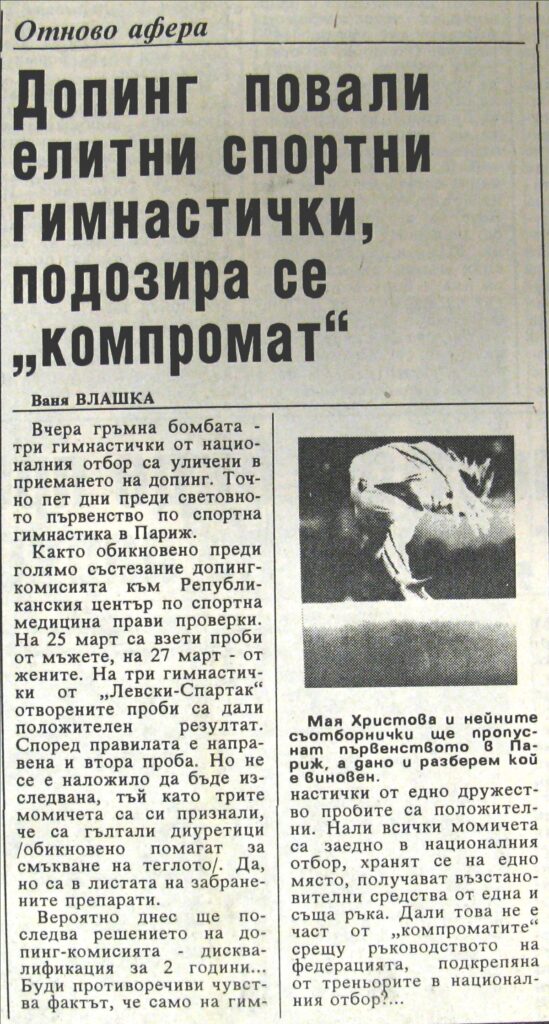
Влашка. Ваня. Отново афера. Допинг провали елитни спортни гимнастички, подозира се „компромат”. – В: Труд, XLVI, № 82, 9 април 1992, с. 1.
Another Scandal
Doping Brings Down Elite Artistic Gymnasts, “Kompromat” Suspected
Vanya VLASHKA
Yesterday, the bomb dropped—three gymnasts from the national team were caught taking doping substances. Exactly five days before the World Championship in artistic gymnastics in Paris.
As usual, before a major competition, the doping commission at the Republican Center for Sports Medicine conducts checks. On March 25, samples were taken from the men; on March 27—from the women. For three gymnasts from “Levski-Spartak,” the A samples gave positive results. According to the rules, a B sample was also taken. But it didn’t need to be tested, since the three girls admitted that they had taken diuretics (usually used to help with weight loss). Yes, but they are on the list of banned substances.
Probably today the doping commission’s decision will follow—a 2-year disqualification… The fact that only gymnasts from one club had positive samples raises conflicting feelings. After all, all the girls are together on the national team, eat in one place, and receive recovery supplements from one and the same hand. Could this be part of the “kompromat” against the leadership of the federation, supported by the coaches on the national team?…
April 10
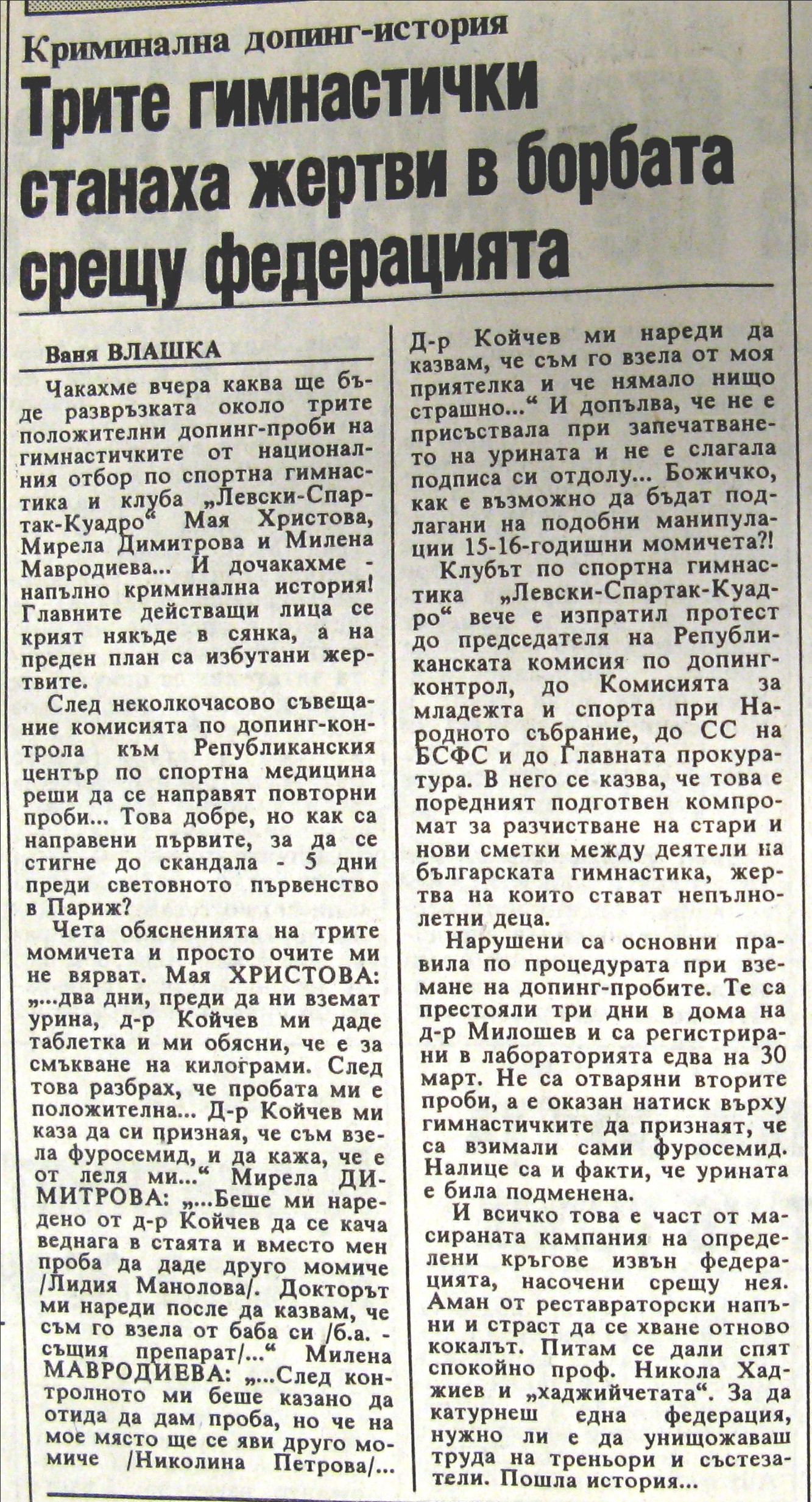
Влашка. Ваня. Криминална допинг-история. Трите гимнастички станаха жертва в борбата срещу федерацията. – В: Труд, XLVI, № 83, 10 април 1992, с. 4.
A Criminal Doping Story
The Three Gymnasts Became Victims in the Struggle Against the Federation
Vanya Vlashka
Yesterday we waited to see what the outcome would be around the three positive doping tests involving gymnasts from the national women’s artistic gymnastics team and the club “Levski–Spartak–Quadro”: Maya Hristova, Mirela Dimitrova, and Milena Mavrodieva… And what we got was a fully fledged criminal story! The main actors are hiding somewhere in the shadows, while the victims have been pushed to the foreground.
After several hours of deliberation, the Doping Control Commission at the Republican Center for Sports Medicine decided that repeat tests should be carried out… That is fine—but how were the first tests conducted, such that the scandal erupted five days before the World Championships in Paris?
I read the explanations given by the three girls, and I simply cannot believe my eyes.
Maya HRISTOVA:
“…Two days before they took our urine samples, Dr. Koychev gave me a tablet and explained that it was for reducing weight. Later I found out that my test was positive… Dr. Koychev told me to admit that I had taken furosemide and to say that it came from my aunt…”Mirela DIMITROVA:
“…I was instructed by Dr. Koychev to immediately go up to the room, and instead of me, another girl was to give the sample (Lidiya Manolova). Later, the doctor instructed me to say that I had taken it from my grandmother (editor’s note — the same substance)…”Milena MAVRODIEVA:
“…After the control, I was told to go and give a sample, but that another girl would appear in my place (Nikolina Petrova)… Dr. Koychev ordered me to say that I had taken it from a friend of mine and that there was nothing to worry about…”
She adds that she was not present when the urine was sealed and did not place her signature underneath…My God—how is it possible that 15–16-year-old girls are subjected to such manipulations?!
The artistic gymnastics club “Levski–Spartak–Quadro” has already sent a protest to the chairman of the Republican Doping Control Commission, to the Parliamentary Commission on Youth and Sport, to the Supreme Council of the Bulgarian Union for Physical Culture and Sport, and to the Chief Prosecutor’s Office. The protest states that this is yet another carefully prepared kompromat intended to settle old and new scores among figures in Bulgarian gymnastics, at the cost of underage children becoming the victims.
Basic procedural rules in the taking of doping samples were violated. The samples remained for three days in the home of Dr. Miloshev and were registered in the laboratory only on March 30. The second samples were not opened, and pressure was exerted on the gymnasts to admit that they had taken furosemide on their own. There are also facts indicating that the urine had been substituted.
And all of this is part of a large-scale campaign by certain circles outside the federation, directed against it. Enough of these restorationist ambitions and the obsession with grabbing the bone once again.
I wonder whether Prof. Nikola Hadzhev and the “little Hadzhevs” sleep peacefully. In order to overthrow a federation, is it really necessary to destroy the work of coaches and athletes?
A rotten story…
April 11

Гатев, Ганчо. Български вариант на „случая Крабе” в спортната ни гимнастика. – В: Дума, Година трета, № 87, 11 април 1992, с. 8.
Bulgarian Version of the “Krabbe Case” in Our Artistic Gymnastics
GANCHO GATEV
Although contrary to established rules, the scandal with the positive doping tests of three Bulgarian artistic gymnastics competitors has already become known to the public. In some publications, the team doctor, Dr. Koychev, is exposed, and what happened is evaluated as a malicious struggle for power by certain circles in this sport against the current leadership of the Bulgarian Gymnastics Federation. The doping control was conducted on March 27; yesterday the second samples were supposed to be opened, but this procedure was postponed until Monday. Regardless of the fact that he is not desired by some of his colleagues in the profession, Nikola Prodanov is not only an authoritative name in his sport, but is still the chairman of the federation, and it is proper to hear the official opinion on this scandal as well.
A Bulgarian version of the case with the German track-and-field athlete Katrin Krabbe is all of this that we are observing, is Prodanov’s categorical assessment. Until the Republican Commission on Doping Control gives its final position, all comments are superfluous or can only confuse those interested, to manipulate public opinion. There is a rulebook, there is an Olympic charter regarding doping, which categorically prohibits taking a position until there is a final decision from the relevant commission, because human fates are being decided. And now in our country someone couldn’t restrain himself, when it’s even a question of the fate of three children. But since so many people allowed themselves to cross the boundary of both the rules and morality, I am obliged to express the opinion of the federation’s leadership, Mr. Prodanov continued.
The Federation and the Levski-Spartak Quadro artistic gymnastics club submitted to the republican commission for doping control at the Ministry of Health a report regarding violations of procedure. The authority to sign an order for conducting a surprise check for doping use can only be signed by the chairman of the republican commission, which consists of eight people, or the secretary of the commission. Only they can assign a specific three-member commission to conduct a check. In the case of the gymnasts, it is exactly the opposite—a member of the republican commission tasks the secretary of that commission to form the “three-member commission” with chairman Dr. Miloshev and members his wife and Dr. Bozhidara, both from the Republican Center for Sports Medicine. The presence of two spouses in a three-member commission is the second violation, after which, according to Mr. Prodanov, several more follow. Every athlete has the right to place their own mark on the seals of the two samples, but this was denied to the eight gymnasts from whom samples were taken on the day of the control. The container in which the vials with the samples are stored must also be sealed and taken by the most direct route to the laboratory, where it must be specifically recorded under what circumstances this container was brought, and an acceptance-delivery protocol must be made. The samples were taken on Friday evening, and the container was brought to the laboratory on Monday. It stayed for three days in the home of Dr. Miloshev, who also has the seal, and all three members of the commission (the spouses) were there.
With such gross procedural errors, according to the chairman, the first sample is annulled regardless of whether it is positive or negative, stated the chairman of the federation. The republican commission acknowledged the existence of procedural errors but rejected the objection. In this situation, the leadership of the Levski-Spartak Quadro club is categorical—it will seek clarification of the case in court. As for the federal order, it was someone’s… we are only interested in the truth. And it, as is well known, is established only in court…
April 14
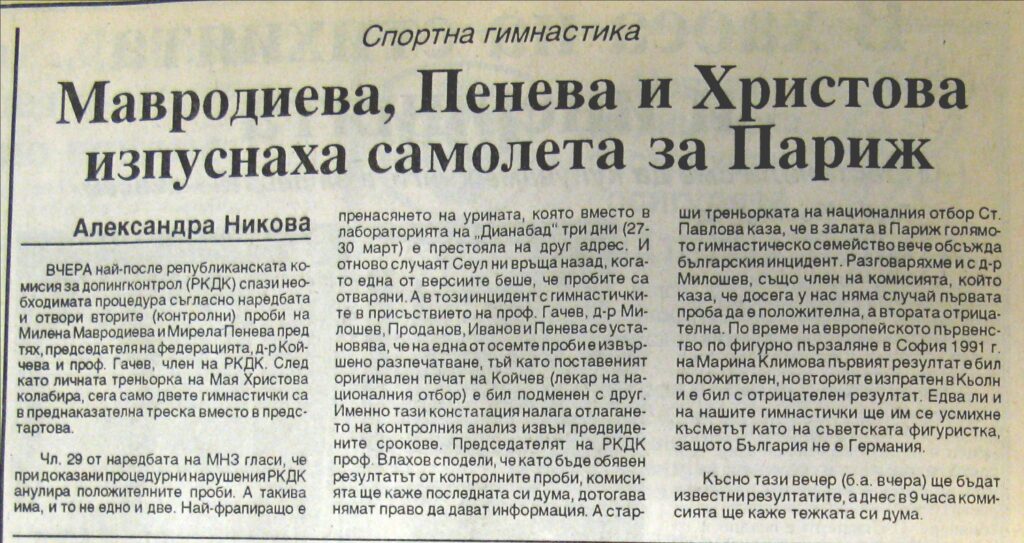
Никова, Александра. Мавродиева, Пенева и Христова изпуснаха самолета за Париж. – В: Подкрепа, № 86, 14 април 1992, с. 4.
Mavrodieva, Peneva, and Hristova Missed the Plane to Paris
Alexandra Nikova
YESTERDAY, finally, the Republican Commission for Doping Control (RKDK) followed the necessary procedure (according to the regulation) and opened the second (control) samples of Milena Mavrodieva and Mirela Peneva in front of them, the chairman of the federation, Dr. Koycheva, and Prof. Gachev, a member of RKDK. After Maya Hristova’s personal coach collapsed, now only the two gymnasts are in pre-punishment fever instead of pre-start.
Article 29 of the MNZ [Ministry of People’s Health] regulation states that with proven procedural violations, RKDK annuls the positive samples. And there are such [violations], and not just one or two. The most striking is the transport of the urine, which, instead of [being] in the Dianabad laboratory, stayed for three days (March 27-30) at another address. And again, the Seoul case takes us back, when one of the versions was that the samples were opened. And in this incident with the gymnasts, in the presence of Prof. Gachev, Dr. Miloshev, Prodanov, Ivanov and Peneva, it was established that one of the eight samples had been unsealed, since the original seal placed by Koychev (doctor of the national team) had been replaced with another. It is precisely this finding that necessitated postponing the control analysis beyond the stipulated deadlines. The chairman of RKDK, Prof. Vlahov, shared that when the result of the control samples is announced, the commission will have its final say; until then, they have no right to give information. And the senior coach of the national team, St. Pavlova, said that in the hall in Paris, the big gymnastics family is already discussing the Bulgarian incident. We also spoke with Dr. Miloshev, also a member of the commission, who said that so far in our country, there has been no case where the first sample was positive and the second negative. During the European Figure Skating Championship in Sofia in 1991, Marina Klimova’s first result was positive, but the second was sent to Cologne and was negative. It is unlikely that our gymnasts will have the luck smile on them like the Soviet figure skater, because Bulgaria is not Germany.
Late this evening (i.e., yesterday), the results will be announced, and today at 9 o’clock the commission will say its weighty word.
April 17
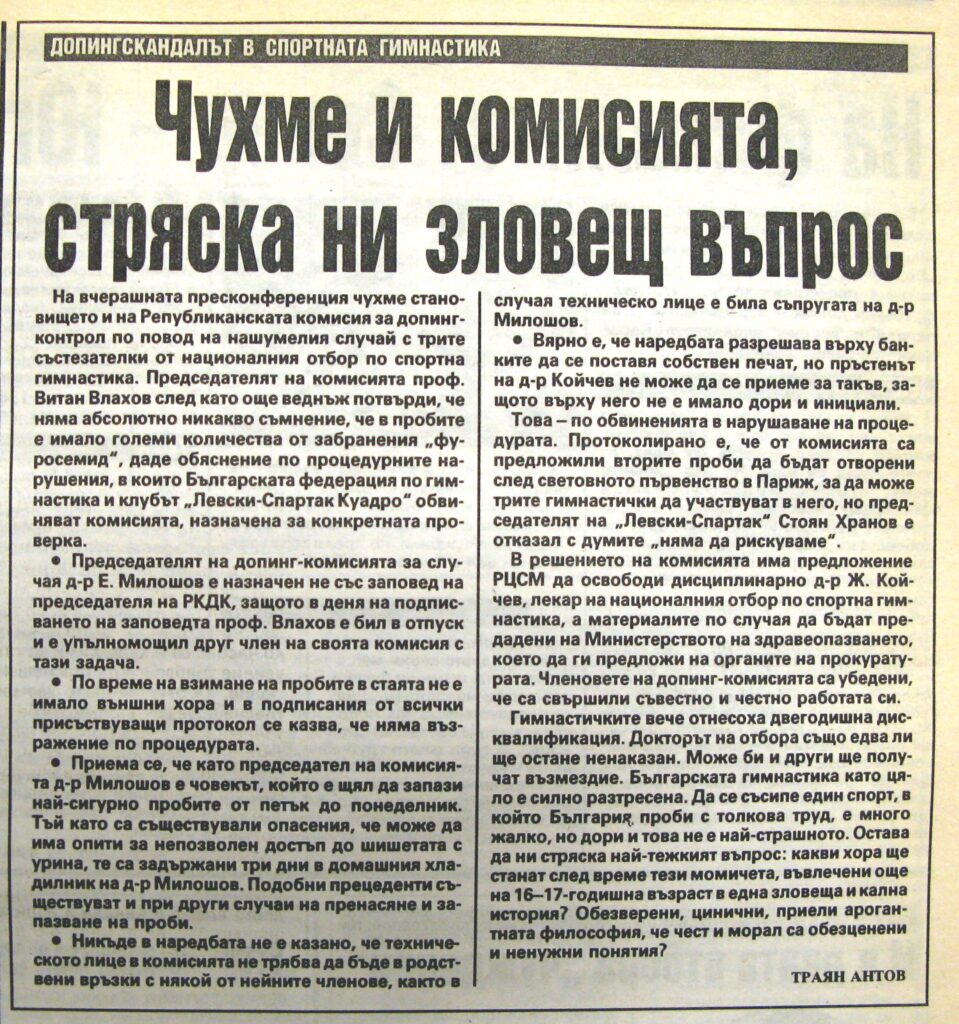
Антов, Траян. Допинг-скандалът в спортната гимнастика. Чухме и комисията, стряска ни зловещ въпрос. – В: Спорт, XLVIII, № 68, 17 април 1992, с. 3.
THE DOPING SCANDAL IN ARTISTIC GYMNASTICS
We Heard the Commission Too — A Sinister Question Alarms Us
At yesterday’s press conference, we also heard the position of the Republican Doping Control Commission regarding the widely publicized case involving the three athletes from the national artistic gymnastics team. After once again confirming that there is absolutely no doubt that large quantities of the banned substance “furosemide” were found in the samples, the chairman of the commission, Prof. Vitan Vlahov, explained the procedural violations of which the Bulgarian Gymnastics Federation and the club “Levski–Spartak Quadro” have accused the commission appointed for this specific test.
The chairman of the doping commission for this case, Dr. E. Miloshev, was not appointed by an order signed by the chairman of the Republican Doping Control Commission, because on the day the order was to be signed, Prof. Vlahov was on leave and had authorized another member of his commission to carry out this task.
• During the taking of the samples, there were no outside persons in the room, and the protocol signed by all those present states that there were no objections to the procedure.
• It is accepted that, as chairman of the commission, Dr. Miloshev was the person most likely to safeguard the samples securely from Friday to Monday. Because there were concerns that attempts might be made to gain unauthorized access to the urine bottles, they were kept for three days in Dr. Miloshev’s home refrigerator. Similar precedents exist in other cases involving the transport and storage of samples.
• Nowhere in the regulations does it state that the technical officer of the commission must not be related to one of its members, as in this case, the technical officer was Dr. Miloshev’s wife.
• It is true that the regulations allow vials to be sealed with a personal stamp, but Dr. Koychev’s ring cannot be considered such a stamp, because it did not even bear initials.That addresses the accusations of procedural violations. It is recorded in the protocol that the commission proposed opening the second samples after the World Championships in Paris so that the three gymnasts could compete there, but the chairman of “Levski–Spartak,” Stoyan Hranov, refused, saying, “We will not take the risk.”
In its decision, the commission proposes that the Republican Doping Control Commission discipline Dr. Zh. Koychev, the doctor of the national artistic gymnastics team, and that the case materials be forwarded to the Ministry of Health, which would then submit them to the prosecutor’s office. Members of the doping commission are convinced that they have carried out their work conscientiously and honestly.
The gymnasts have already received two-year disqualifications. The team doctor is also unlikely to remain unpunished. Perhaps others will receive retribution as well. Bulgarian gymnastics as a whole has been deeply shaken. To see a sport in which Bulgaria broke through with such effort, then collapse, is deeply regrettable—but even that is not the worst part. What continues to alarm us most is the gravest question of all: what kind of people will these girls become in the future, having been drawn at the age of just 16–17 into a grim and sordid affair? Disillusioned, cynical, having accepted the arrogant philosophy that honor and morality are devalued and unnecessary concepts?
TRYAN ANTOV
April 17
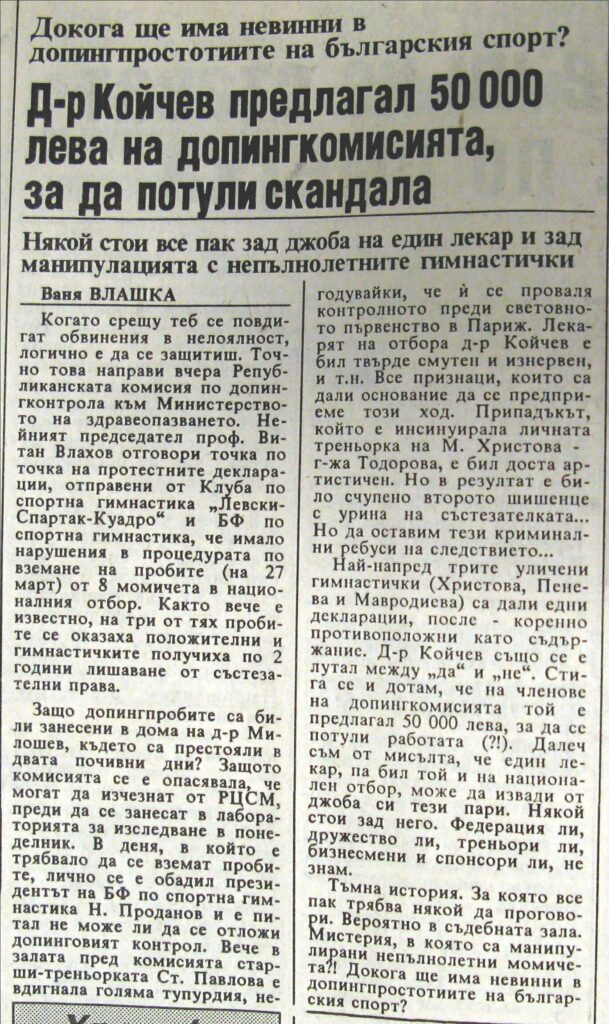
Влашка. Ваня. Докога ще има невинни в допингпростотиите на българския спорт? Д-р Койчев предлагал 50 000 лева на допингкомисията, за да потули скандала. – В: Труд, XLVI, № 89, 17 април 1992, с. 4.
How Long Will There Be Innocents in the Doping Absurdities of Bulgarian Sport?
Dr. Koychev Allegedly Offered 50,000 Leva to the Doping Commission to Bury the Scandal
Someone, after all, stands behind one doctor’s wallet—and behind the manipulation of underage gymnasts
Vanya Vlashka
When accusations of disloyalty are raised against you, it is logical to defend yourself. That is exactly what the Republican Doping Control Commission under the Ministry of Health did yesterday. Its chairman, Prof. Vitan Vlahov, responded point by point to the protest declarations submitted by the artistic gymnastics club “Levski–Spartak–Quadro” and the Bulgarian Gymnastics Federation, which claimed that there had been violations in the procedure for taking samples (on March 27) from eight girls on the national team. As is already known, three of them returned positive results, and the gymnasts were given two-year bans from competition.
Why were the doping samples taken to the home of Dr. Miloshev, where they remained over the two weekend days? Because the commission feared they might disappear from the Republican Center for Sports Medicine before being delivered to the laboratory for analysis on Monday. On the day the samples were to be taken, the president of the Bulgarian Gymnastics Federation, N. Prodanov, personally called to ask whether the doping control could be postponed. Already in the hall, in front of the commission, the senior coach St. Pavlova caused a major uproar, protesting that the control would ruin preparations before the World Championships in Paris. The team doctor, Dr. Koychev, was extremely agitated and nervous, and so on—admissions that provided grounds for taking this course of action. The fainting episode insinuated by Maya Hristova’s personal coach, Mrs. Todorova, was rather theatrical. As a result, however, the athlete’s second urine bottle was broken.
But let us leave these criminal riddles to the investigators.
First, the three accused gymnasts (Hristova, Peneva, and Mavrodieva) gave one set of declarations, and later gave statements that were fundamentally opposite in content. Dr. Koychev himself wavered between “yes” and “no.” Matters escalated to the point where he allegedly offered members of the doping commission 50,000 leva in order to bury the case (?!). I am far from believing that a single doctor—even one attached to the national team—could pull that kind of money from his own pocket. Someone stands behind him. Whether it is the federation, a club, coaches, businessmen, or sponsors—I do not know.
A dark story. One that nevertheless demands someone speak out. Most likely in a courtroom. A mystery in which underage girls were manipulated?! How long will there be innocents caught up in the doping absurdities of Bulgarian sport?
August 14
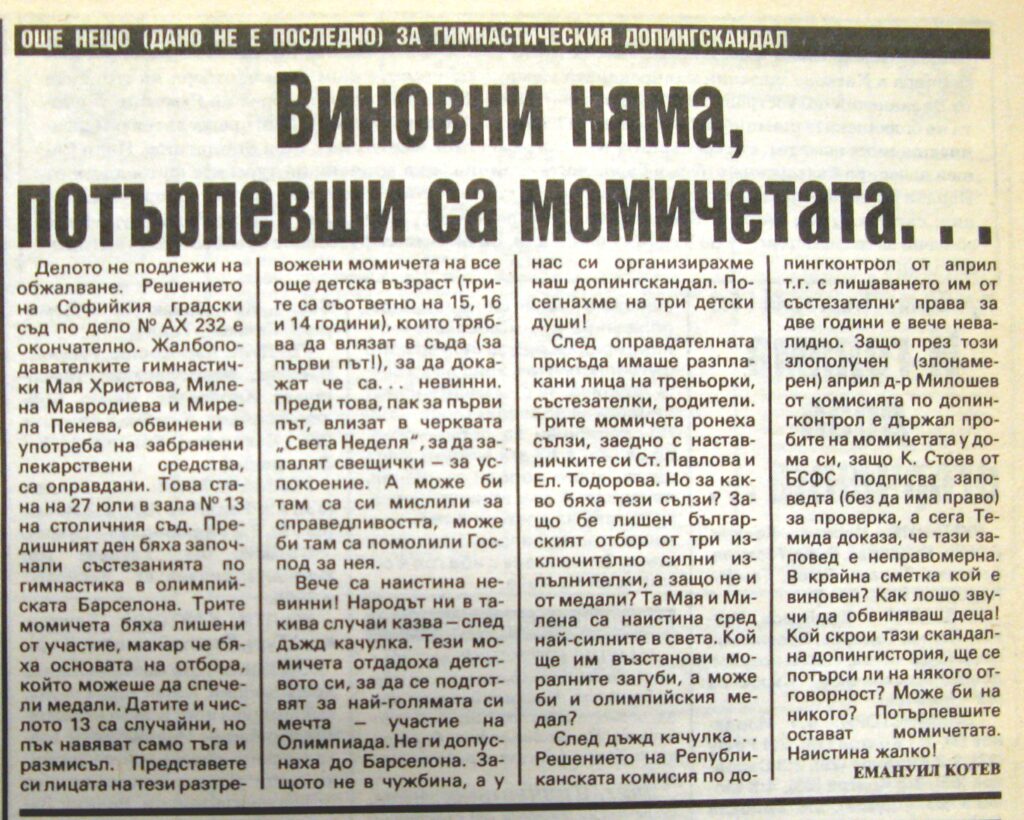
Котев, Емануил. Виновни няма, потърпевши са момичетата. – В: Спорт, XLVIII, № 156, 14 август 1992, с. 3.
ONE MORE THING (HOPEFULLY NOT THE LAST) ABOUT THE GYMNASTICS DOPING SCANDAL
There Are No Guilty Parties—The Girls Are the Victims…
The case is not subject to appeal. The decision of the Sofia City Court in case No. AH 232 is final. The appealing gymnasts Maya Hristova, Milena Mavrodieva, and Mirela Peneva—accused of using banned medicinal substances—have been acquitted. This took place on July 27 in Courtroom No. 13 of the Sofia City Court. The day before, the gymnastics competitions at the Olympic Games in Barcelona had begun. The three girls were barred from participation, even though they were the backbone of a team that could have won medals. Dates and the number 13 may be coincidental, but they evoke only sadness and reflection.
Imagine the faces of these anxious girls, still of childhood age (the three are respectively 15, 16, and 14), who had to enter a courtroom (for the first time!) to prove that they were… innocent. Before that, also for the first time, they entered the Church of St. Nedelya to light candles—for calm. Perhaps there they thought about justice; perhaps there they prayed to God for it.
They are now truly innocent! In such cases, our people say, “locking the barn after the rain.” These girls gave up their childhoods to prepare for their greatest dream—participation in the Olympic Games. They were not allowed to go to Barcelona. Because it was not abroad, but here at home, that we organized our own doping scandal. We struck at three children’s souls!
After the acquittal, there were tearful faces—coaches, athletes, parents. The three girls shed tears together with their coaches St. Pavlova and El. Todorova. But what were those tears for? Why was the Bulgarian team deprived of three exceptionally strong performers—and perhaps of medals as well? Maya and Milena are truly among the strongest in the world. Who will restore their moral losses, and perhaps even an Olympic medal?
Too little, too late… The decision of the Republican Doping Control Commission from April of this year—stripping them of competitive rights for two years—is now invalid. Why, during that unfortunate (malicious) April, did Dr. Miloshev from the doping control commission keep the girls’ samples in his home? Why did K. Stoev of the Bulgarian Union for Physical Culture and Sport sign an order (without having the authority) to conduct the test—an order that Themis has now shown to be unlawful?
In the end, who is guilty? How awful it sounds to accuse children! Who concocted this scandalous doping story? Will anyone be held accountable? Perhaps no one? The victims remain the girls. Truly regrettable!
EMANUIL KOTEV
More on Doping