In the spring of 1981, People’s Daily ran a glowing profile of Huang Qun, one of China’s most promising young gymnasts. The piece described her as 13 years old — a detail that would later take on significance. If the newspaper was correct, Huang was born in 1968. Yet when she stepped onto the podium at the 1984 Los Angeles Olympics to claim a bronze medal with her team, the official record listed her birth year as 1969. The discrepancy is modest by the standards of Cold War gymnastics, but it is documented in one of China’s own state-run publications, at a moment when there was no reason to misrepresent her age in either direction. The profile below, translated here in full, offers a rare contemporaneous snapshot of Huang Qun at the start of her international career — and another data point in the long history of age falsification in elite gymnastics.
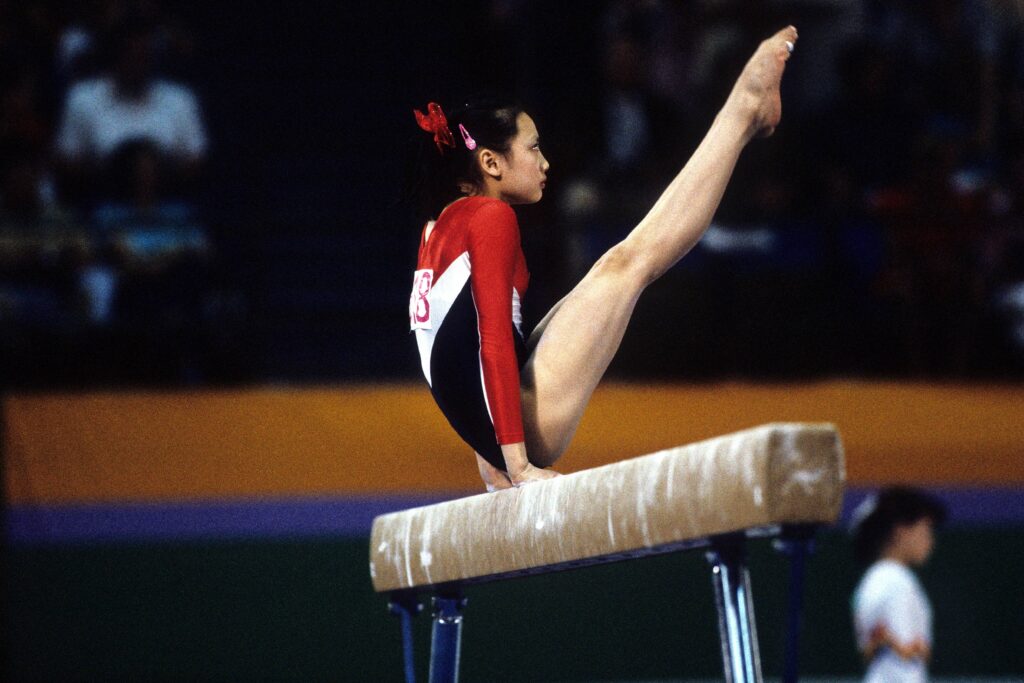
For the Raising of the Five-Star Red Flag
— Young Gymnast Huang Qun
Huang Qun, aged 13, is one of the youngest members of China’s national gymnastics team. In mid-March, she traveled to Fort Worth, United States, to compete in the American Cup Gymnastics Championships, where she won two silver medals.
Though young, she can already be considered a “veteran” among gymnasts. She fell in love with gymnastics at the age of six. Over the past six years, under the tireless care of her coaches, her strong interest gradually developed into the pursuit of a lofty ideal: to bring honor to her country through gymnastics. And so she leaps like a young deer across thick mats, darts like a spring swallow through the uneven bars, sometimes somersaulting on vault, sometimes dancing gracefully across the balance beam like a ballerina. Her movements are elegant and youthful, expansive and poised. Last October, at the national gymnastics championships, she defeated many older competitors to win third place on balance beam. In November, at the Sino-American gymnastics dual meet, she captured second place on floor exercise.
Competing against the world’s strongest athletes and making the Five-Star Red Flag fly high on the world sports stage is not merely a vow shining with the radiance of ideals—it is the product of her hard work and sweat. On one occasion, Huang Qun was practicing a double front somersault dismount on balance beam, a highly difficult skill. Weighing just 28 kilograms, and standing only nine centimeters taller than the beam itself, she developed thick calluses on her hands and feet in order to build the fundamental strength required for beam work. While attempting the double front dismount, her light frame and limited strength prevented her from gaining enough height; upon landing, her left foot was badly swollen. Although this was not her first injury, the piercing pain this time caused large beads of sweat to roll down her face.
Her coach ordered her to rest, but she rested for only one week. When she returned to training, the coach asked her, “Huang Qun, do you still dare to practice the double front dismount?” With her wide eyes shining, she answered firmly: “I dare.” That single word—dare—embodies Huang Qun’s resolute character: fearless in hardship, determined to bring honor to her country.
The People’s Daily, May 2, 1981, page 3
为了五星红旗的升起——少年体操运动员黄群
黄群,今年13岁,是国家体操队的最小队员之一。3月中旬,她去美国沃思堡参加美国杯体操锦标赛,荣获两枚银牌。
别看她年纪小,但作为一名体操运动员,可算是一名“老兵”。她从六岁开始,就爱上了体操。六年来,在教练员辛勤的哺育下,她从浓厚的兴趣,发展到追求崇高的理想:在体操这个领域里,要为祖国争光。于是,她象小鹿一样在厚垫子上跳跃,象春燕一样在高低杠上穿飞,有时在跳马上翻腾,有时又如舞蹈演员似的在平衡木上翩翩起舞。她的动作优美娴稚,舒展大方。去年10月,全国体操比赛中,她战胜许多大姐姐,获平衡木第三名。11月中美体操对抗赛,她又获得自由体操第二名。
与世界强手争雄,让五星红旗在世界体坛上高高飘扬,这不仅仅是她闪着理想光辉的誓言,而且是她辛勤汗水的结晶。有一次,黄群在平衡木上练习前空翻两周下高难动作。体重28公斤、身体只比平衡木高九厘米的黄群,为了练出平衡木上的硬功,脚、手都磨出了厚厚的老茧。当她向前空翻两周下的高难动作冲击时,由于体瘦力小,跳不高,落地后一下子把左脚板挤肿了。虽然这不是她第一次受伤,但这一次钻心的疼痛却使她掉下了大颗大颗的汗珠。教练员强制她休息,她只休息了一个星期。当她重新开始训练时,教练问她:“黄群,还敢练习前空翻两周下吗?”她闪着大眼睛坚定地回答:“敢!”这个敢字,代表了黄群为国争光不怕困难的坚毅性格。
Videos of Huang Qun
Note #1: USGF News also described her as a 13-year-old at the 1981 American Cup. “The size and age of the women competitors should be noted. Wei and Huang Qun (PRC) are age 13, a little over 4′ tall and under 60 pounds each. Their difficulty included full-ins and pike double-backs on FX and BB.” (USGF News, Volume 10.3, May/June, 1981)
By contrast, the television commentary from the 1981 American Cup referred to her as 12. This discrepancy may simply reflect that she was still 12 at the time of the competition and turned 13 later that year.
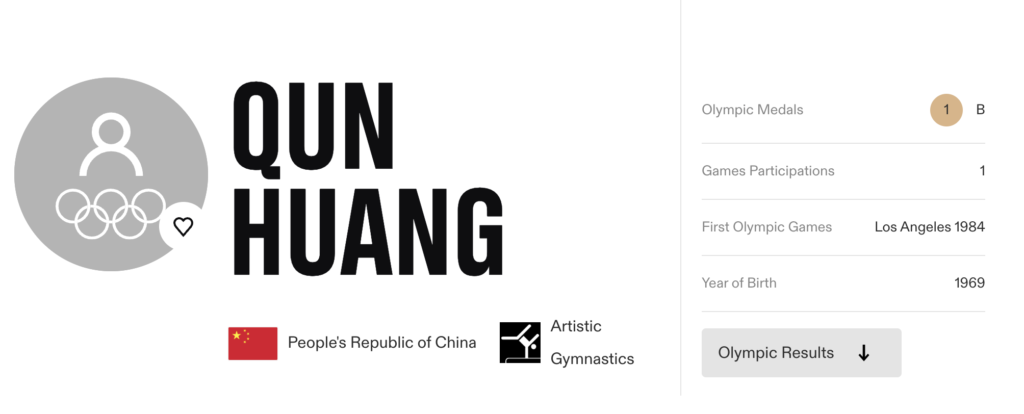
Note #2: Her IOC biography lists her year of birth as 1969.
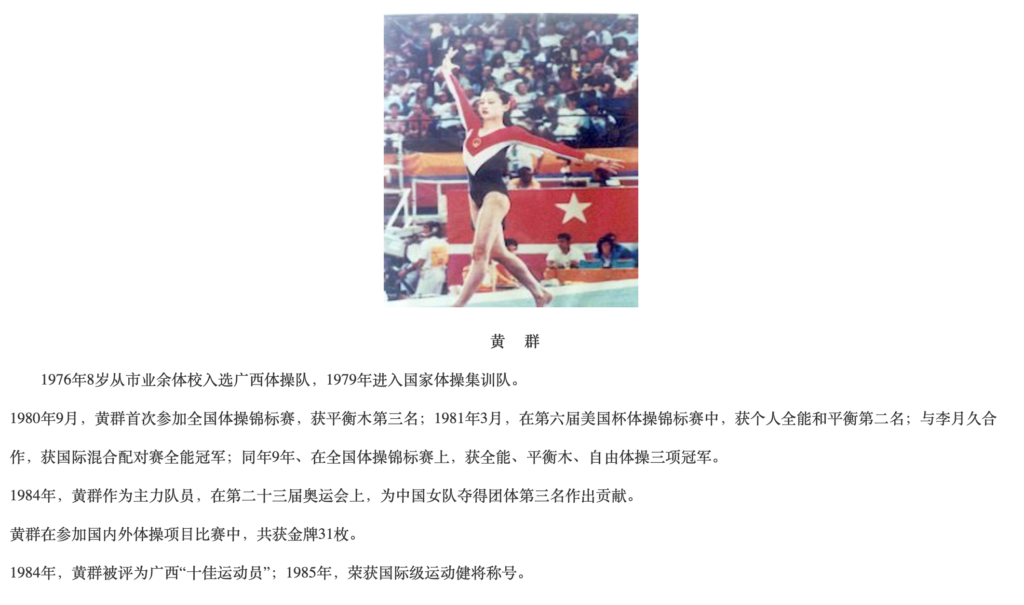
Note #3: An article from the Liuzhou City Archives in the Guangxi Zhuang Autonomous Region suggests a 1968 birth year, noting that she was eight years old in 1976.
In 1976, at the age of eight, she was selected from a municipal amateur sports school to join the Guangxi gymnastics team; in 1979, she entered the national gymnastics training squad.
In September 1980, Huang Qun competed in the National Gymnastics Championships for the first time and won third place on balance beam. In March 1981, at the Sixth American Cup Gymnastics Championships, she placed second in the all-around and on balance beam; partnering with Li Yuejiu, she won the all-around title in the international mixed pairs competition. Later that year, in September, at the National Gymnastics Championships, she won three titles: all-around, balance beam, and floor exercise.
In 1984, as a key member of the team, Huang Qun contributed to China’s women’s team winning third place in the team competition at the 23rd Olympic Games.
Over the course of her domestic and international gymnastics career, Huang Qun won a total of 31 gold medals.
In 1984, Huang Qun was named one of Guangxi’s “Top Ten Athletes”; in 1985, she was awarded the title of International Master of Sport.
1976年8岁从市业余体校入选广西体操队,1979年进入国家体操集训队。
1980年9月,黄群首次参加全国体操锦标赛,获平衡木第三名;1981年3月,在第六届美国杯体操锦标赛中,获个人全能和平衡第二名;与李月久合作,获国际混合配对赛全能冠军;同年9年、在全国体操锦标赛上,获全能、平衡木、自由体操三项冠军。
1984年,黄群作为主力队员,在第二十三届奥运会上,为中国女队夺得团体第三名作出贡献。
黄群在参加国内外体操项目比赛中,共获金牌31枚。
1984年,黄群被评为广西“十佳运动员”;1985年,荣获国际级运动健将称号。
Note #4: Somehow, after competing as a senior at the 1984 Olympics with a 1969 birth year, Huang Qun competed at the 1985 Asian Junior Championships.
Chinese Athletes Win Thirteen Titles at the Third Asian Junior Gymnastics Championships
Sports section, Page 3
At the Third Asian Junior Gymnastics Championships, which concluded on the 19th in Seoul after three days of competition, Chinese athletes won thirteen of the fourteen events contested in the men’s and women’s competitions. Athletes from South Korea and Japan each captured one title.
The Chinese women’s team and Huang Qun claimed the gold medals in the women’s team competition and the women’s individual all-around, respectively. In the six men’s apparatus finals, Chinese athletes won five titles, while in the women’s apparatus finals, Chinese competitors swept all of the gold medals.
The People’s Daily, May 21, 1985
第三届亚洲青年体操锦标赛中国运动员夺得十三项冠军
中国运动员19日在汉城结束的为时三天的第三届亚洲青年体操锦标赛中,共夺得男、女十四个项目中的十三项冠军。南朝鲜和日本选手各获一项冠军。
中国女队和女选手黄群夺得女子团体和女子个人全能两枚金牌。在男子六个单项决赛中,中国选手夺得五项冠军。女子单项决赛,中国选手夺得所有金牌。 (据新华社)
Note #5: For many Chinese gymnasts, it is possible to identify age discrepancies, but not to establish a definitive birthdate based on public data. This is one of those cases. As Liu Hongbo observed in Southern Metropolis Daily in 2010, “Even the specific days and months of Chinese athletes’ birthdays are impossible to determine. There are too many versions and revisions: student status records, athlete registrations, identification cards, and work permits often conflict with one another. Even the athletes themselves waver when asked about their own birthdays—and that, in itself, is a problem.”
More on Age