In August 2006, at the Asian Artistic Gymnastics Championships in Surat, India, Hong Su Jeong stood on the vault podium with a silver medal around her neck. The gold went to her younger sister, Hong Eun Jeong—a result that seemed to mark an early challenge to the sibling hierarchy. Four months later, at the Asian Games in Doha, Qatar, the order reversed. Hong Su Jeong again won silver on vault, but that time, she finished ahead of her younger sister, who took bronze.
The results fit neatly into the story that surrounded them. Hong Su Jeong was cast as the elder sister—more experienced, more seasoned—while Hong Eun Jeong, three years younger, was presented as the promising successor rising in her wake. A profile in the Beijing Evening News in 2006 reinforced the contrast, noting that Hong Su Jeong had trained for nine years, while her younger sister had trained for only six.
The story of two sisters competing together was endearing, and over the years, the math was stable, with the sisters always being three years apart.
But it turned out to be false.
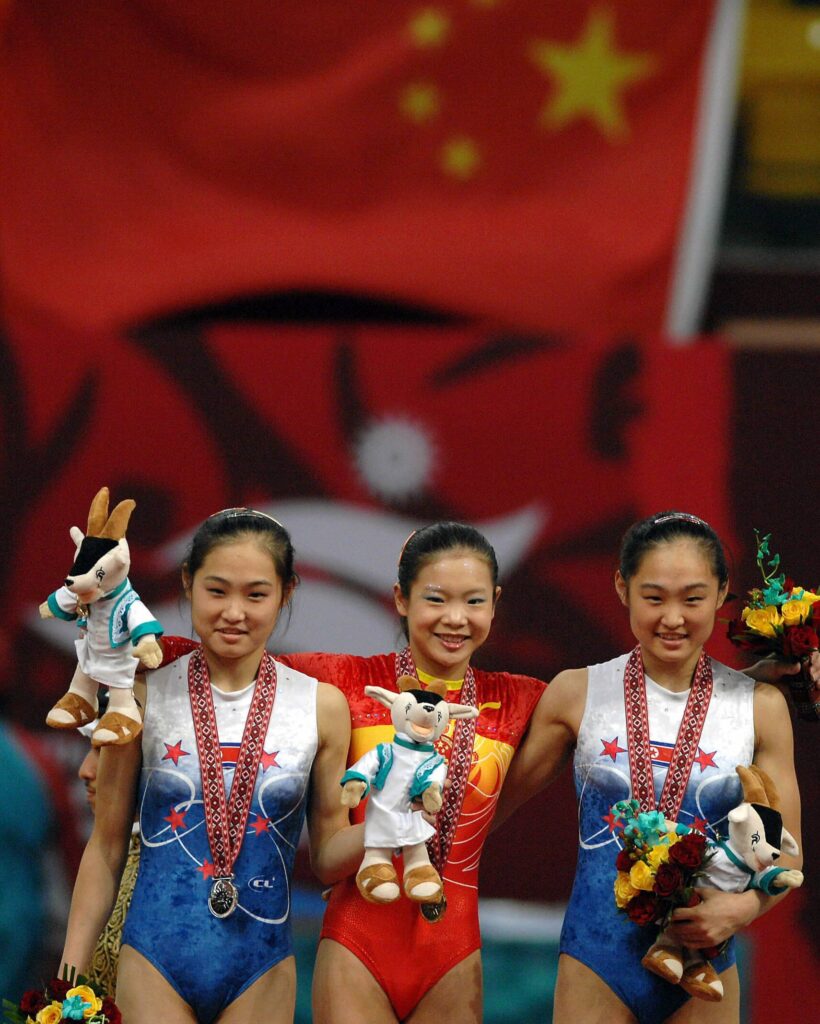
Note: Throughout this piece, I’ve bolded Hong Su Jeong’s name to help visually differentiate her name from her younger sisters’ name.
The First Falsification
It is difficult to say which came first—the story or the paperwork. But when Hong Eun Jeong was added to the start list at the 1996 Asian Games, her birthdate was listed as March 9, 1989, and her older sister’s age had shifted by a year. Hong Su Jeong, once registered as born on March 9, 1985, suddenly appeared as March 9, 1986. By changing one digit, the North Korean federation made the sisters three years apart.
| Competition | Date | Registered Birth Year | Claimed Age |
| Universiade, Daegu | August 2003 | 1985 | 18 |
| Olympic Games, Athens | August 2004 | 1985 | 19 |
| World Championships, Aarhus | October 2006 | 1985 | 21 |
| Asian Games, Doha | December 2006 | 1986 | 20 |
No one seemed to notice that Hong Su Jeong’s birth year had changed. Nor did anyone remark on the fact that the sisters shared the same birthday—March 9—three years apart.
They continued competing. At the 2007 World Championships in Stuttgart, the older sibling again finished ahead of the younger. Hong Su Jeong won silver on vault with a score of 15.812, behind China’s Cheng Fei. Hong Eun Jeong placed fourth, behind Alicia Sacramone of the United States.
Then came 2008, and with it, a sharper test. As it was framed in the Korean-language press, North Korea was permitted to send only one female gymnast to Beijing to compete on vault. According to contemporaneous reporting, the decision was made through a head-to-head trial between the sisters. Hong Eun Jeong, the younger sister, won. She would go to Beijing. Hong Su Jeong would stay home.
The aftermath was carefully narrated through the lens of sacrifice rather than disappointment. In an interview published in Chosŏn Sinbo on August 21, 2008, Hong Su Jeong spoke with striking candor. “At first, I really wanted to be the one to go,” she admitted. But once the decision was made, she devoted herself fully to supporting her sister’s preparation.
When Hong Eun Jeong won gold in the women’s vault final on August 17, Su Jeong recalled, “I cried when I heard the news. I was as happy as if it were my own achievement.” Before her sister left for Beijing, she offered a single piece of advice: “Don’t think of it as a competition—approach it as if it were training.” Eun Jeong, she said, “was filled with confidence, believing that all the preparations were complete.”
The portrait Chosŏn Sinbo constructed was one of sisterly devotion transcending rivalry. In the weeks leading up to the Olympics, Su Jeong shared meals and daily life with her sister, drawing on “all the experience she had accumulated” to support her. It was, the paper concluded, “thanks to the presence of such an older sister that Eun Jeong’s gold medal in the women’s vault at Beijing became possible.”
In the profile, older sister Su Jeong looked to the future. Her dream was to compete alongside her sister at the 2012 London Olympics. “If the two of us can go together,” she said, “it will feel even better.”
They never did.
The Second Falsification
In October 2010, as the World Championships in Rotterdam approached, the International Gymnastics Federation reviewed the nominative list submitted by North Korea. There, Hong Su Jeong’s birthdate appeared as March 9, 1989.
According to FIG and Asian Gymnastics Union summaries, Hong Su Jeong had previously competed using a 1985 birth year at the 2004 Athens Olympics and the 2006 World Championships in Aarhus. She was then registered as born in 1986 for the 2006 Asian Games in Doha and the 2007 World Championships in Stuttgart. Now, suddenly, she was listed as being born in 1989. That was four years younger than when her career started.
If the 1989 date were accurate, Hong Su Jeong would have been only fifteen when she competed at the Athens Olympics—below the minimum age required by FIG regulations. This was no longer a matter of rumor. It was a contradiction embedded in the federation’s own records, and thus, this case met the precedent that the FIG had set for itself.
The FIG moved quickly. On October 6, 2010, the president of the FIG Disciplinary Commission provisionally suspended both Hong Su Jeong and the North Korean federation for thirty days, barring the entire team from the Rotterdam World Championships. North Korea appealed. Five days later, the FIG Appeal Tribunal rejected the appeal, concluding that the explanations offered did not justify reconsideration.
On November 5, 2010, the FIG Presidential Commission confirmed the sanction: a two-year suspension for Hong Su Jeong and the Democratic People’s Republic of Korea’s gymnastics federation, effective from October 6, 2010, to October 5, 2012, and a fine of 20,000 Swiss francs.
The offense, the FIG stated, was age falsification—specifically, the use of three different birth years between 2003 and 2010. The decision, it emphasized, was intended to send “a clear warning” to those who would disregard age regulations.
For longtime observers, the case felt familiar. In 1993, North Korea was banned from the 1993 World Championships after the FIG discovered that Kim Gwang Suk, the 1991 world champion on uneven bars, had been registered under three different birthdates. The Hong Su Jeong case appeared to follow the same template: inconsistent paperwork, delayed discovery, decisive punishment.
And yet something about this case was different.
The Twin Revelation
Hong Su Jeong had a sister whose age had never changed. Hong Eun Jeong was always born in 1989. And then, in 2010, the sisters were no longer three years apart, as was often discussed in the press. They suddenly shared the same birthdate: March 9, 1989.
Was this an administrative error? Or could the two sisters actually be twins?
Years later, a different kind of document surfaced: a video interview recorded for North Korean state media sometime around 2014. In it, Hong Eun Jeong recounts her career in the familiar cadence of official commemoration. She describes her first international competition at age seventeen, at the Third Asian Championships, where she won gold. She lists her victories—World Cups, World University Games, Asian Championships, World Championships—nine major wins in all. She names the honors bestowed upon her by the state: Merited Athlete at seventeen, the Kim Il Sung Youth Honor Award at nineteen, and later the title of People’s Athlete.
Everything aligns with the public record. Nothing sounds unusual.
Then the interview shifts, almost casually, away from medals and results.
She begins talking about her family. Her father is absent. Her mother works as a cook at the Pyongyang Sports Club. She has three siblings: an older brother—and then, without emphasis or hesitation, she adds a sentence that quietly collapses the story that preceded it.
She and her sister are twins. And she is the younger one.
There is no pause. No explanation. No acknowledgement that this fact conflicts with years of published material about the sisters’ relationship. The statement is delivered plainly, as background—offered with the same matter-of-fact certainty as her list of titles or her mother’s occupation. But its implications are unmistakable.
They were twins. That is why they shared the same birthday in Rotterdam: March 9, 1989.
If Hong Su Jeong and Hong Eun Jeong are twins, then the premise that framed their entire international careers—that one sister was three years older than the other—was not merely imprecise. It was fabricated.
The terminology still works linguistically. In Korean family structures, twins are distinguished by birth order: one is 언니, the other 동생. The labels survive. What does not survive is the chronology that once gave those labels meaning. The carefully maintained three-year age gap—repeated across languages, competitions, interviews, and official documents—collapsed.
Hong Su Jeong’s two-year suspension expired in October 2012, after the London Olympics. She never returned to international competition. North Korea reportedly banned Su Jeong for life and ordered her to return all medals and titles “as the result of grave negligence and damage caused to the Association’s reputation,” according to an FIG press release. According to later remarks by Eun Jeong, her older sister went off to college.
By contrast, the younger sister, Hong Eun Jeong, continued competing into the mid-2010s, adding to her medal haul before retiring.
The larger questions remain unanswered. If the sisters are twins, why falsify only Hong Su Jeong’s age? Why maintain a three-year gap so consistently—only to abandon it in 2010 by assigning both sisters the same birth year? Whether the explanation lies in bureaucratic error or internal miscommunication, North Korea never offered a public account.
It remains another North Korean mystery—like Kim Gwang Suk’s actual age.
Note: There is no way to prove that the sisters are twins, but the current evidence strongly suggests that they are.
Hong Su Jeong’s Registered Birth Dates and Competition Ages
| Competition | Date | Registered Birth Date | Claimed Age | Actual Age (if born 1989) |
| 2003 Universiade, Daegu | August 2003 | March 9, 1985 | 18 | 14❌ |
| 2004 Olympics, Athens | August 2004 | March 9, 1985 | 19 | 15 ❌ |
| 2006 World Championships, Aarhus | October 2006 | March 9, 1985 | 21 | 17 |
| 2006 Asian Games, Doha | December 2006 | March 9, 1986 | 20 | 17 |
| 2007 World Championships, Stuttgart | September 2007 | March 9, 1986 | 21 | 18 |
| 2010 World Championships, Rotterdam | October 2010 | March 9, 1989 | 21 | 21 |
References
Primary Sources
International Gymnastics Federation Disciplinary Proceedings
“North Korean Gymnast Two Years Suspension!” Asian Gymnastics Union Office, Doha, November 5, 2010. https://agu-gymnastics.com/north-korean-gymnast-two-years-suspension/
“North Korean Gymnast – Appeal Rejected.” Asian Gymnastics Union Office, Doha, October 14, 2010. https://agu-gymnastics.com/north-korean-gymnast-appeal-rejected/
“North Korea’s Gymnasts Have Been Suspended from the WC 2010.” Asian Gymnastics Union Office, Doha, October 14, 2010. https://agu-gymnastics.com/north-koreas-gymnasts-have-been-suspended-from-the-wc-2010/
“Federation and Gymnast Suspended.” FIG Press Release, October 6, 2010.
“North Korean Gymnasts: Disciplinary Procedure Filed.” FIG Press Release, October 1, 2010.
Video Interview
Hong Eun Jeong. Interview. North Korean state media, circa 2014. YouTube video. https://www.youtube.com/watch?v=-AxRUKAtiXE
News Coverage
Korean-Language Sources
“North Korean Gymnast Hong Su Jeong Banned for Two Years: Age Falsification at International Competitions.” Korea Times, November 5, 2010.
“[People] North Korea’s ‘Fairy Gymnasts’: Sisters Hong Su Jeong and Eun Jeong.” DailyNK, September 4, 2007.
“North Korea Reports on East Asian Games Results.” DailyNK, November 4, 2005.
“North Korea’s ‘Fairy Gymnast’ Hong Su Jeong Wins Silver on Vault.” Khan, September 9, 2007.
“‘I Cried When I Heard the News of the Gold Medal’: Hong Su Jeong, Sister of North Korean Vault Gold Medalist Hong Eun Jeong.” Tongilnews, August 22, 2008.
“Brothers and Sisters Competing: Olympic ‘Families.'” By Kim Tae-gyu. Hankyoreh, August 5, 2008.
Chinese-Language Sources
“Two Beautiful Azaleas in the Gymnastics Hall: Sisters Share Vault Medals.” Beijing Evening News, December 8, 2006. Republished at CCTV.
Romanian-Language Sources
“Gymnast Found to Have Three Different Birthdates.” Renaşterea Bănăţeană, October 4, 2010 (Year 22, No. 6306).
Appendix A: A Transcript of the Hong Eun Jeong Video
Note: This video appears to have been filmed circa 2014, after Hong Su Jeong’s ban had ended and after her medals were reportedly stripped. However, because the video still refers to Su Jeong’s titles, it remains unclear whether the North Korean federation in fact revoked all of the elder sister’s honors.
Title: A peerless world-class athlete — Pyongyang Sports Club gymnast, our athlete Hong Eun Jeong.
[00:00:00]
[music]
[00:00:30]
[cheering]
[On-screen text: How many international competitions have you taken part in so far?]
Hong Eun Jeong:
My first competition was when I was 17, at the Asian Championships. Yes, I went to the 3rd Asian Championships and took first place right away—at my very first competition. Then the second one was in 2008; that was a World Cup event. After that, I went to the Olympics and took first place. Then I won first place again at another World Cup, then twice at the World University Games, then once at the 17th Asian Championships, and once at the World Championships—yes, nine wins in total.
[On-screen text: What honors or awards have you received?]
At 17, I was awarded the title of Merited Athlete, and then at 19 I received the Kim Il-sung Youth Honor Award and was named a People’s Athlete.
[On-screen text: Please tell us about your family.]
I don’t have a father. My mother works as a cook at the Pyongyang Sports Club. [chuckles]
There are three siblings. I have an older brother, and we are twin sisters. I’m the younger one. My older sister attends a sports university, and my older brother works at the Three Revolutions Exhibition Hall.
[On-screen question: I’ve heard that your older sister was also a gymnast…]
[On-screen scroll: Her older sister, Hong Su Jeong, won first place on the uneven bars at the 15th Asian Games and went on to post strong results in many other international competitions.]
My sister was actually better than me—she really was—but she got injured and quit earlier, and went to university first. I came up later, so when I first started competing, my sister had already performed those skills before me. But then she couldn’t continue because of her injury.
[On-screen text: About Hong Eun Jeong’s highest-difficulty skills.]
They say a Chinese athlete named Cheng Fei did it first, but in our country, my sister was the first to do it, and then I did it after her.
[On-screen text: What is your favorite hobby?]
Well, my uncles also did some gymnastics.
My hobby is music. I enjoy playing the guitar a bit.
[On-screen text: How did you feel about meeting the Respected Marshal Kim Jong Un? October 2014.]
I met the Respected Marshal for the first time. Honestly, it felt like I was wandering around in a dream—like, did I really meet the Respected Marshal?
He told me that at the next, the 31st Olympics, I must take first place. [chuckles]
So I decided that I would train well and absolutely not fall short of his expectations, and that I would definitely take first place at the 31st Olympics.
Yes—that’s how it is.
[00:03:00]
[music]
[00:00:00]
[music]
[00:00:30]
[cheering]
홍은정: 처음 경기가 17살 때, 아시아 선수권 대회. 예, 제3차 아시아 선수권 대회 가서 먼저 1등 했습니다, 그 첫 경기 가서. 예, 그다음에 두 번째는 2008년도, 그땐 세계컵 경기. 예, 그다음에 올림픽 경기 가서 1등하고, 그다음에 세계컵 한 번 더 1등하고, 그다음에 세계 대학생 경기 두 번 1등하고, 그다음에 아시아 선수권 대회 제17차 그거 한 번 하고, 세계 대회 한 번 1등하고, 예, 9개. 17살에 공훈체육인 받고, 그다음에 19살에 김일성청년영예상하고 인민체육인 받았습니다. 아버지는 없습니다. 엄마는 평양체육단에서 [chuckles] 요리사입니다. 형제는 셋입니다. 오빠 있고 우리 여자 쌍둥이입니다. 내가 동생입니다. 언니는 체육대학에 다니고 오빠는 3대혁명전시관에서 일하고 있습니다. 언니는 나보다 더 잘했습니다. 더 잘했는데, 아파서 먼저 관두고 대학에 먼저 갔습니다. 나는 늦게 올라섰으니까, 그러니까 그 전에 경기만 나갔을 때, 언니가 먼저 이렇게 내 동작을 먼저 했단 말입니다. 근데 그다음에 언니가 아프면서 못 했습니다. 예, 중국에 청페이라는 선수가 먼저 했다는데, 그 뒤에 우리나라에서 처음으로 언니가 하고 그다음에 제가 했습니다. 아니, 우리 삼촌들이 체조를 좀 했습니다. 취미는 음악입니다. 기타 좀 즐깁니다. 경애하는 원수님 처음 만나 뵈었습니다. 내가 진짜 경애하는 원수님 정말 만나 뵈었는지, 아, 꿈속에서 진짜 헤맨 느낌이 들었습니다. 원수님께서 이렇게 다음 제31차 올림픽에서 무조건 1등 하라고. [chuckles] 훈련을 잘해서 무조건 이게 원수님 기대에 어긋나지 않게, 무조건 제31차에서 1등 하겠다고 결심했어요. 예, 그렇게. [00:03:00]
[music]
Note: I asked native speakers if the Korean word for “twin” could refer to sisters who were born on the same day, just three years apart. A somewhat poetic use of the term. They said no.
Appendix B: The Profile of the Sisters in the Beijing Evening News
Two Beautiful Azaleas in the Gymnastics Hall: Sisters Share Vault Medals
Source: Beijing Evening News, December 8, 2006
At the Doha Asian Games, a pair of sisters from the North Korean gymnastics team attracted widespread attention. The elder sister, Hong Su-jeong, won the gold medal on uneven bars and the silver medal in the vault, while her younger sister, Hong Eun-jeong, followed closely behind to claim the bronze medal in the vault.
At the gymnastics venue, reporters met the two sisters. Their faces were filled with excitement—at times cheering for athletes from both North and South Korea on the competition floor, at other times laughing and joking with friends nearby. According to the introductions, both Su-jeong and Eun-jeong are students at a sports school. The elder sister, Su-jeong, has been training in gymnastics for nine years, while the younger sister has trained for more than six years.
Younger sister, Eun-jeong
Eun-jeong said she was very happy that foreign journalists were able to recognize her while she was abroad, and even spoke to her in a language she was familiar with. She said, “This time I won a bronze medal. At the next major competition, I will surpass my older sister.”
The elder sister, Su-jeong, revealed that although she trains very hard, she has fallen behind in her academic studies, whereas her younger sister performs better in school and is smarter overall. She said that in the future, her sister will be able to attend a good university. As for herself, Su-jeong said her dream is to study at Pyongyang University of Physical Education.
When the reporter shook the sisters’ hands once again to congratulate them, he noticed that their palms were covered with thick calluses. Eun-jeong explained that these were the result of years of training in wind and rain. But when the topic turned to winning medals, smiles immediately bloomed on both sisters’ faces—like two beautiful golden azalea (jindallae) flowers in full bloom.
体操馆两朵美丽金达莱 亲姐妹分享跳马奖牌
在多哈亚运会上,朝鲜体操队一对亲姐妹引起了大家的注意,姐姐洪秀晶获得了高低杠比赛的金牌和跳马银牌,妹妹洪银晶紧跟其后获得了跳马铜牌。
在体操馆,记者见到了这对小姐妹。她们脸上流露出兴奋的表情,一会儿为场上的南北朝鲜队员加油,一会儿和旁边的朋友嬉笑玩耍。据介绍,秀晶、银晶姐妹俩都是体校学生,姐姐秀晶学体操已有九年,妹妹也有六年多了。
非常高兴在异国他乡有外国记者能认出自己,还用自己熟悉的语言交谈。她说,“我这次是拿铜牌,下一次大赛我会超过姐姐的。”
姐姐秀晶透露,自己训练刻苦,但学校功课落了不少,而妹妹学习比自己好,人也聪明,将来能上好大学念书。她说,自己的梦想就是上平壤体育大学。
记者握着姐妹俩的手再次祝贺她们,发现她们手上全是厚厚的茧。银晶说,那是几年来风里雨里训练的结果。不过,说起夺得奖牌,姐妹俩脸上立即展放笑容,仿佛两朵美丽的金达莱花。
Appendix C: The 2007 Article
North Korea’s “Fairy Gymnasts”: Sisters Hong Su-jeong and Eun-jeong
By DailyNK — September 4, 2007
North Korea’s sister “fairy gymnasts,” Hong Su-jeong (21) and Hong Eun-jeong (18), are training intensively with the goal of competing in international competitions.
According to the September issue of Kŭmsugangsan, a North Korean magazine used for external promotion that was obtained on the 4th, the sisters were born in Hamhung, South Hamgyŏng Province, and began gymnastics while still attending kindergarten.
Sports officials recall that they happened to see the sisters performing rhythmic movements at the time and remarked that they possessed “outstanding athletic sense,” selecting them as promising young gymnasts.
After dedicating themselves to steady training for more than ten years, the sisters made their names known last August by competing side by side in the women’s team event at the 3rd Asian Artistic Gymnastics Championships held in India, where they finished in second place.
Later that same year, at the Doha Asian Games, the older sister Su-jeong won a gold medal on the uneven bars and a silver medal in vault, earning the nickname “fairy of gymnastics” in South Korean media. Her younger sister Eun-jeong followed in her footsteps by winning a bronze medal in vault.
In January, both sisters were selected as “Top Ten Outstanding Athletes of 2006” by the North Korean Sports Guidance Committee, firmly establishing themselves as representative star athletes of North Korean sports.
Kŭmsugangsan cited the secret of the sisters’ success as their dedication to carrying out demanding daily training plans and perfecting high-difficulty gymnastics elements, noting that “they often remained absorbed in training late into the night without seeking rest.”
The magazine also reported that, with the goal of becoming world-class athletes, the sisters “sometimes even spent what little vacation time they could have enjoyed in their hometown at the training center instead.”
In an interview with Kŭmsugangsan, the younger sister Eun-jeong recalled that during international competitions, “having my older sister by my side gave me strength,” to which her sister replied, “Seeing my younger sister happy made me happy as well.” / Yonhap
Appendix D: The 2008 Article
“I Cried When I Heard the News of the Gold Medal”
Hong Su Jeong, sister of North Korean vault gold medalist, Hong Eun Jeong
By Reporter Lee Gwang Gil, Tongil News
Published: August 22, 2008
On the 17th, North Korea won its second gold medal at the Beijing Olympics. The protagonist was gymnast Hong Eun Jeong (19, Pyongyang City Sports Club), who competed in the women’s vault.
In its August 21 Pyongyang-datelined online edition, Chosŏn Sinbo, the organ of the General Association of Korean Residents in Japan, reported the reaction of Hong Su Jeong (21, Pyongyang City Sports Club), Eun Jeong’s older sister and a fellow gymnast: “When I heard the news that my younger sister had won the gold medal, I was as happy as if it were my own achievement. I cried.”
Su Jeong, who had represented North Korea in the women’s team event at the 2004 Athens Olympics, said that before her sister left for Beijing, she advised her, “Don’t think of it as a competition—approach it as if it were training.” Still, she recalled, her sister “was filled with confidence, believing that all the preparations were complete,” and from the look on her face before departure, she already sensed that a medal was coming.
Su Jeong began gymnastics at the age of seven at a sports club in Hamhung, South Hamgyŏng Province. Eun Jeong later followed her into the sport, and the sisters grew into national-team gymnasts while relying on each other. Beginning in 2006, however, the younger sister started to overtake the elder. At the Asian Gymnastics Championships held in India, Eun Jeong defeated Su Jeong to win the vault title, relegating her sister to second place and earning the title of Merited Athlete.
According to Chosŏn Sinbo, at the World Gymnastics Championships held in Germany in October 2007, the rankings reversed again, with Su Jeong finishing second and Eun Jeong fourth. Based on those results, Su Jeong herself was selected as a Merited Athlete.
“During training, we help and guide each other, but in competition, everyone wants to be first,” Su Jeong said. Ultimately, in the lead-up to the Beijing Olympics, the sisters once again found themselves competing—this time for a single Olympic berth in the vault. In their fateful head-to-head match in June, it was Eun Jeong who secured the ticket to Beijing.
Reflecting on that moment, Su Jeong admitted candidly, “At first, I really wanted to be the one to go.” From that day on, however, she shared meals and daily life with her sister, drawing on all the experience she had accumulated to support her. Chosŏn Sinbo reported that it was thanks to the presence of such an older sister that Eun Jeong’s gold medal in the women’s vault at Beijing became possible.
Su Jeong’s current goal is to compete together with her sister at the 2012 Olympics. “If the two of us can go together, it will feel even better.”
More on Age