Fan Ye was the only Chinese woman to win a gold medal at the 2003 World Championships in Anaheim, California, and she did it in record style. Her 9.812 on balance beam was the highest score recorded by any female gymnast at an Olympics or World Championships during the 2001–2004 quadrennium.
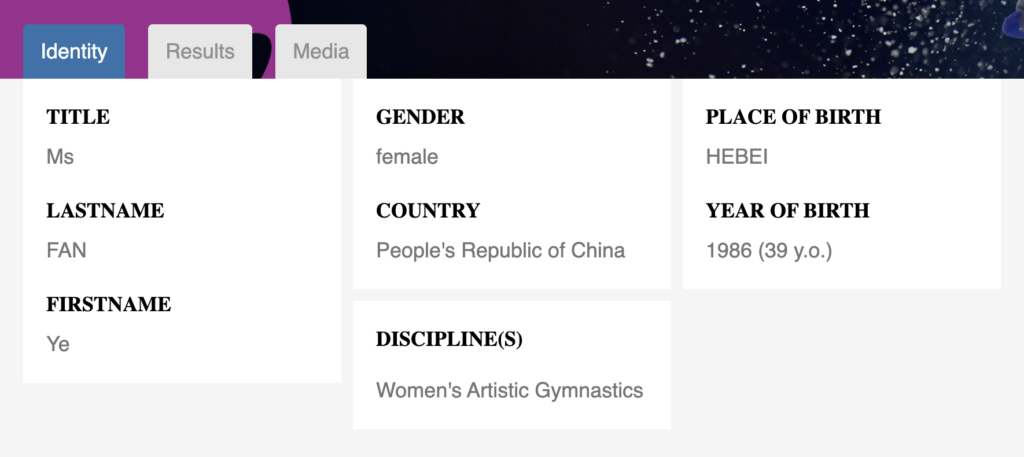
How old was the recorder holder in 2003? According to the Chinese press that celebrated her victory, she was fifteen. According to the FIG registration records that governed her eligibility, she was sixteen, turning seventeen later that year.
That gap of roughly two years is documented in the two Chinese-language profiles translated below. The first appeared within days of her victory in August 2003: a reported feature in Hebei Daily based on interviews with her parents and provincial coaches. The second, a retrospective profile published by Great Wall Net in November 2018, looks back on her career fifteen years after Anaheim, in the context of the children’s gymnastics centers she later founded. Neither article flags any discrepancy. Taken together, however, they reveal one.
The Hebei Daily report states that she was fifteen when she won the title in Anaheim. The Great Wall Net retrospective notes that she entered the provincial training camp in 1997 at age nine. Both details imply a 1988 birth year, while the FIG’s official record lists 1986.
The discrepancy does not diminish what Fan Ye accomplished on the balance beam in Anaheim. It only raises the question of how old she was when she accomplished it.
Below are translations of the two profiles (and a few more in the appendices). Enjoy!
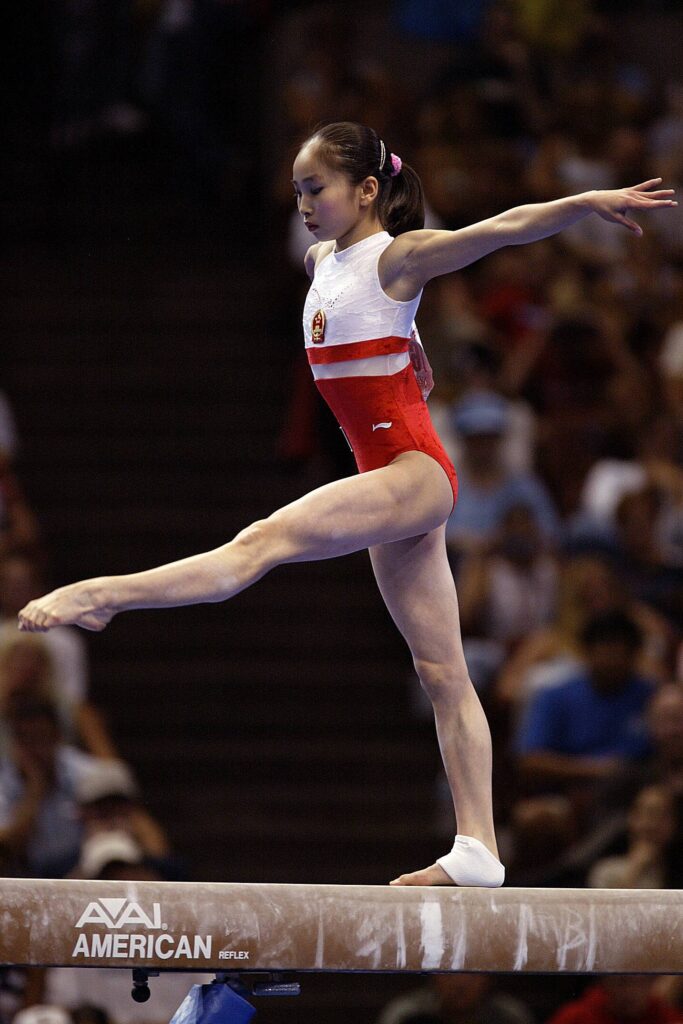
August 26, 2003: The Hebei Daily
A Hebei Girl Bursts Onto the Scene — The Graceful Fan Ye Wins Beam Gold
— Fan Ye’s Parents and Coaches Recall the Story of Her Rise
The Hebei Daily (河北日报)
August 26, 2003
At 8:00 a.m. Beijing time on August 25, in the Arrowhead Pond Arena in Anaheim, USA, a young girl from Baoding, Hebei—Fan Ye—transformed from an “ugly duckling” into a beautiful “swan.”
At just 15 years old, she won the only gold medal for China’s women’s gymnastics team at the 2003 World Gymnastics Championships.
Our reporter immediately interviewed her parents and coaches.
Fan Ye began training in gymnastics at four and a half years old. At home, her mother Xu Shuling, who works at Baoding No. 1 Hospital, recalled that Fan Ye had always been a poor eater and was thin and small as a child. To improve her physical condition, Xu Shuling originally planned to send her to learn swimming at the Baoding Sports Kindergarten, but the coach suggested she try gymnastics instead.
“On the form where we selected the sport, we actually wrote ‘artistic gymnastics’—meaning rhythmic gymnastics,” Xu said. “Only a year later did I learn the difference between rhythmic gymnastics and competitive artistic gymnastics.”
No one expected that a simple idea for improving the child’s health would ultimately produce a world champion.
When Xu Shuling and her husband, Fan Jianchang, the deputy director of Baoding Children’s Hospital, gradually realized how demanding gymnastics training was, they hesitated.
“I don’t even dare watch her training; it’s too hard,” Fan Jianchang said. He hated the idea of letting their only daughter endure such hardship.
But coaches Wang Changjiang and Song Lili refused to give up this diamond in the rough they had discovered. They visited the family again and again, trying to persuade them. Song Lili even volunteered to take responsibility for picking Fan Ye up and dropping her off for training.
The parents were moved, and Fan Ye stayed with the team.
In November 1996, Fan Ye was selected by provincial coach Zhang Hui to join the Hebei provincial gymnastics team. In February 2001, she was selected for the Chinese national gymnastics team, where she trained under renowned coach Liu Guicheng.
One year later, at the 2002 National Gymnastics Championships in Ningbo, she placed fourth on uneven bars and seventh on floor exercise.
In March 2003, at the Gymnastics World Cup series in Germany and France, Fan Ye reached the top eight in both uneven bars and balance beam.
For any athlete, injuries are one of the hardest obstacles, and Fan Ye was no exception. Seeing their daughter constantly bruised and battered naturally pained her parents.
In 2000, Fan Ye underwent two knee surgeries.
“At the time, I stayed in Beijing with her for the operations,” Xu Shuling recalled. “One doctor who was studying in the U.K. told me that if she couldn’t achieve results, she might still be able to walk normally, but she would never be able to run or jump again.”
Xu was heartbroken. Stroking her daughter, she said, “Just say the word. If you don’t want to continue, we’ll stop training and go home.”
But the 12-year-old girl lying in the hospital bed replied, “Mom, I can’t give up.”
The young girl possessed astonishing determination.
At the 2001 National Games, Fan Ye shared a dormitory with Dong Fangxiao. Watching “Sister Fangxiao” win the floor exercise championship and seeing many people ask her for autographs, Fan Ye resolved to follow in her footsteps.
When Dong Fangxiao gave Fan Ye one of her training outfits, Fan Ye immediately took off the new clothes her mother had bought and changed into the champion’s uniform. She wanted to constantly feel the encouragement and expectations of her senior teammate.
Fan Ye grew up quickly. In fact, after the Gymnastics World Cup circuit in March of that year, she suddenly realized her goal: to become a world champion.
“Fan Ye has outstanding physical qualities. Her movements are beautiful and precise, with high difficulty, and she is also very expressive artistically. It was only natural that she won the championship,” said Liu Yajuan, a former provincial coach who had once overseen her training, speaking through tears after Fan Ye’s victory.
Before the World Championships, Fan Ye called home to tell her parents she would likely travel to the United States as a main team member. For Fan Jianchang and Xu Shuling, it felt as though part of their long-held dream had already come true—their daughter would finally represent the country in a major international competition.
After the qualification round, her first coach, Wang Changjiang, immediately called with exciting news:
“Fan Ye is first in the preliminaries—the girl is competing like crazy!”
Her parents could no longer sit still. The night before the final, neither of them slept. They paced the house the entire night.
When the live broadcast began the next morning, they didn’t even dare turn on the television.
They were afraid to witness either failure or success.
But they smiled.
When Fan Ye, the fifth competitor, delivered a flawless routine on the balance beam and received a high score of 9.812, her parents smiled.
That smile carried more than ten years of hardship, more than ten years of expectation, and more than ten years of perseverance, finally rewarded.
The vice mayor of Baoding responsible for sports, Jia Tixin, came. The director of the Baoding Sports Bureau, Dong Lufeng, came. Friends, relatives, neighbors—all arrived to offer congratulations.
“Fan Ye winning the gold medal was truly unexpected,” said Wang Zhihui, director of the Provincial Weightlifting, Wrestling, and Center, with great excitement.
“Not only is she the first world champion produced since our center was established; she is also the first individual-event world champion in the history of the Hebei gymnastics team.”
The provincial head coach, Zhang Zifeng, noted that under the new competition rules, Fan Ye, competing in her major international competition, was able to withstand tremendous pressure. In doing so, she both tested and proved her own strength—and more importantly, secured her position as a mainstay of the national team.
Every laugh was joyful, every congratulation sincere.
On the champions’ wall at the Baoding Sports Bureau, there would soon be another photograph of a world champion. At 9:00 a.m. on August 27, the champion’s portrait would officially be added.
After the victory, for nearly an hour Xu Shuling said almost nothing—she simply smiled.
The “ugly duckling,” dancing like a swan upon the narrow beam, had conquered both judges and spectators. The little girl who soared into fame had become a princess.
She had grown up.
She would dance at the 2004 Athens Olympics and continue dancing all the way to Beijing in 2008.
* * *
河北小丫横空出世 靓丽范晔独木折桂
——听范晔父母和教练讲那过去的故事
北京时间8月25日上午8时,美国阿纳海姆箭池体育馆,河北保定小姑娘范晔由“丑小鸭”变成了美丽的“白天鹅”。年仅15岁的她为中国体操女队摘取了惟一一块2003年世界体操锦标赛金牌。本报记者在第一时间对她的父母和教练进行了采访。范晔4岁半开始练体操。在范晔的家里,范晔的母亲、在保定市第一医院工作的徐淑玲回忆说,那时范晔总是不好好吃饭,人长得又瘦又小。为增强孩子的体质,徐淑玲想让她在保定市体育幼儿园练游泳,但教练却建议她练体操。“我们孩子选择项目的表格上填的是艺体(艺术体操)。一年后,我才知道什么是艺体,什么是竞技体操。”谁也没想到,一个健身的念头最终塑造了一位世界冠军。当徐淑玲和担任保定市儿童医院副院长的爱人范建场弄明白了体操的艰辛后,他们动摇了。“孩子的训练我都不敢看,太苦了。”范建场实在不愿让独生女受这个罪。但教练王长江和宋丽丽却不甘心放弃这块好不容易发现的璞玉。他们一次次家访,一次次做工作,宋丽丽还主动承担了范晔的接送任务。家长被感动了,范晔留在了队里。1996年11月,范晔被省体操队教练张慧选入省体操队训练,2001年2月她又入选了国家体操队,师从我国著名体操教练员刘桂成。一年之后,2002年全国体操冠军赛(宁波),她就获得了高低杠第四名及自由操第七名的成绩。2003年3月,在体操世界杯系列赛(德国和法国站)中,范晔在高低杠和平衡木项目上均闯入了前八名。运动员最难过的是伤病关,范晔也不例外。看着爱女身上常常青一块紫一块,父母哪有不心疼的。2000年,范晔两个膝盖先后动了手术。“当时我在北京陪着范晔做手术。”徐淑玲讲,“那是一个在英国读研究生的大夫,他对我说,如果再出不了成绩,范晔走路还行,但不能跑跳了。”当时,心如刀绞的徐淑玲抚摸着心爱的女儿:“你说一句话,咱不练了,这就跟妈妈回家。”躺在病床上的范晔看着妈妈说:“妈,我不能放弃呀。”12岁的小姑娘有着惊人的毅力。2001年九运会上,范晔同董芳霄住在同一间宿舍,看着芳霄姐姐拿了自由操冠军,不少人来索要签名,范晔立志要向芳霄姐姐看齐。当董芳霄把自己的运动服送给范晔后,范晔立刻脱下妈妈给买的新衣服,换上那套冠军的运动服。她要时刻感受大姐姐对自己的鼓励,对自己的期望。范晔长大了,确切地说,从今年3月份世界体操巡回赛之后,范晔猛然间意识到了自己的目标,那就是要拿世界冠军。“范晔的身体条件突出,动作漂亮、规范、难度大,而且她的相貌出众,动作又具有较强的艺术表现力,夺得冠军属情理之中。”曾主管范晔的省体操队教练刘亚娟在范晔夺冠后流着眼泪说。世锦赛前,范晔给家里打电话,告诉父母自己很可能以主力身份去美国。范建场和徐淑玲觉得多年的心愿完成了一部分,自己的孩子终于可以在大赛中为国出征了。预赛结束后,启蒙教练王长江立刻打来电话报告喜讯:“范晔预赛第一,小丫头比疯了。”两口子这下子坐不住了,决赛前一天,他们俩谁也睡不着,整整在屋里走了一晚,早晨直播时间到了,而他们却没有勇气打开电视。他们不敢看自己的女儿失败或成功。笑了,当第五个出场的范晔在平衡木上以完美的表现获得9.812分的高分时,范建场和徐淑玲笑了。那笑容,是10多年来的辛酸,是10多年来的期盼,是10多年来坚持不懈的回报。保定市主管体育的贾体新副市长来了,保定市体育局局长董路锋来了,亲朋好友街坊四邻都来报喜了。“范晔能拿金牌绝对是个意外。”省体举柔中心主任王志辉在谈到范晔夺金时异常欣喜,“范晔不仅是我们中心成立之后获得的首个世界冠军,也是省体操队的首个单项世界冠军。”省体操队总教练张子峰认为,在新规则下,范晔作为首次参加世界大赛的新人,能经受住如此巨大的考验,实属不易。既锻炼了自己,又检验了自身实力,更重要的是还为自己确立了在国家队中的主力地位。所有的笑声都是那么开心,所有的祝福都是那么真挚。保定市体育局冠军墙上又将多一幅世界冠军的照片,8月27日上午9时,冠军就会登榜了。笑了,在夺冠之后的近1个小时内,徐淑玲就没说什么话,只是笑。丑小鸭在独木上的一曲天鹅之舞征服了裁判,征服了观众,一飞冲天的小丫头变成了公主。她长大了,她要到2004年的雅典起舞,一直舞到2008年的北京。
November 16, 2018: Great Wall Net
Fan Ye: “China’s Khorkina”
Great Wall Net (长城网)
Nov. 16, 2018
By reporter Duan Tao
Russian women’s gymnast Svetlana Khorkina is praised as the “Queen of Gymnastics.” With her well-proportioned figure, elegant temperament, and exceptional artistic expression, she has long been beloved by gymnastics fans.
In Hebei Province, however, there is also a strikingly attractive gymnast. Because of her sweet smile and graceful, open movements, she has been called “China’s Khorkina.” She is Fan Ye, the famous Hebei gymnast and women’s gymnastics world champion.
“Opening a children’s sports center is meant to promote and popularize gymnastics so that kids can experience the joy that gymnastics brings,” Fan Ye told reporters on November 16. When the reporter met her, she was at a children’s sports center in Baoding, playing a ball-tossing game with children.
In 2015, Fan Ye founded a children’s sports center named after herself. Today, these centers have expanded to five locations in Baoding and Beijing.
When the reporter arrived, Fan Ye came to the adjoining break room and told the story of how she first came to be involved in gymnastics.
Fan Ye, who was bright and attractive as a child, was also lively and mischievous. However, she was physically weaker than other children her age. Her parents, therefore, sent her to the Baoding Sports Kindergarten to learn gymnastics. At the time, their goal was simply to help her develop a healthier body, not to put her on the path to becoming a professional athlete.
From kindergarten through elementary school, Fan Ye trained in gymnastics as an amateur. After several years, she not only developed a strong physique but also fell in love with the sport.
In 1997, at age nine, Fan Ye took part in a Hebei provincial gymnastics training camp. Coaches Zhao Haitao and Liu Yajuan selected her for the provincial team. Reluctantly leaving her parents, she began living a collective training life.
She trained five to six hours every day. The physical work itself did not feel especially difficult to her—the hardest part was missing her parents.
“Throughout my entire athletic career, I never once spent the Lunar New Year at home with my parents. During Spring Festival, I was always competing or training. I never fulfilled my responsibilities as a daughter,” Fan Ye said with a sigh.
Joining the National Team
In 2001, Fan Ye represented Hebei in a training camp for the Chinese national gymnastics team. Coach Liu Guicheng noticed her good movement quality and strong physique and brought her into his training group.
Not long after joining the national team, Fan Ye suffered an injury in training and required knee surgery. During her first year with the national team, her only task was recovering from the injury. By the time she resumed training, her competitive level had fallen far behind her teammates.
But Fan Ye was headstrong and determined not to fall behind. She resolved to rebuild her ability, starting from her weakest physical qualities.
To strengthen her legs, she performed squats with her coach on her back. To build arm strength, she practiced handstands every day.
Enduring such monotonous training required remarkable perseverance. She constantly told herself:
“Just hold on a little longer.”
When she could no longer run, she told herself to hold on a little longer. When she could barely grip the uneven bars, she held on for five more seconds, then ten, then twenty—as long as she possibly could.
Breakthrough at the 2003 World Championships
Hard work eventually paid off. In 2003, less than two months before the World Gymnastics Championships, Fan Ye was promoted from the national team’s second squad to the first squad, becoming a key athlete.
Yet she did not feel happy about it. Other members of the first team had already achieved success, while she had never won an Asian or national championship. Determined to prove herself, she trained even harder than before.
In November 2003,* Fan Ye traveled with the Chinese team to the World Championships in the United States. During qualification, she shocked the international gymnastics world, advancing to the finals first on uneven bars and second on balance beam.
[*The World Championships were in August.]
However, during the uneven bars final, she fell from the apparatus, losing her chance at the gold medal. She cried uncontrollably.
The balance beam final was the very next day. Could such a young newcomer recover from the disappointment?
Everyone was nervous for her.
In the final, Fan Ye delivered a textbook routine, earning the highest score of the competition and winning the first world championship gold medal of her career.
Athens and the Struggle with Injury
The success at the World Championships brought Fan Ye not only a gold medal but also confidence. After returning to China, she voluntarily intensified her conditioning training and practiced the all-around events, even adding extra sessions during her rest time.
As the 2004 Athens Olympics approached, she hoped to continue performing well and help the Chinese team win medals. The psychological pressure grew enormous.
Three days before the Olympic team competition, several national teams—including China—were training together. During a tumbling pass, Fan Ye suffered a strained lower-back muscle and a displaced lumbar vertebra.
“I didn’t dare call my teammates or coaches. I had to endure it by myself,” she recalled. “In major competitions, team strategy matters. I was a key athlete expected to win medals. If foreign teams knew I was injured, they might adjust their tactics, which would be disadvantageous for China.”
For the honor of the country, she endured the pain and slowly climbed to her feet alone.
Comeback
Competing while injured, Fan Ye could not perform at her best in Athens. Afterward, many people in the gymnastics world wondered whether her career was already declining.
A year later, she answered those doubts decisively.
Fan Ye won fourteen championships in a single year, including:
- Balance beam gold at the National Gymnastics Championships
- All-around champion at the 10th National Games
- Team and beam champion at the East Asian Games
- Uneven bars champion at the Cottbus World Cup
- Team and all-around champion at the Universiade
- Balance beam and floor exercise titles at the National Gymnastics Champions Final
Each gold medal carried enormous weight.
“China’s Khorkina”
When asked about the nickname “China’s Khorkina,” Fan Ye said, “Khorkina was once my idol. This title is both recognition and encouragement for me, and it can also help promote gymnastics.”
Life After Retirement
After retiring, Fan Ye did not leave the sport she loved. Her greatest wish now is to inspire more children to enjoy gymnastics.
“I hope that after several years of training, the children who come out of my sports centers will all be healthy, lively, and cheerful. If that happens, I’ll feel completely satisfied.”
* * *
范晔:“中国的霍尔金娜” 长城网 2018-11-16 长城新媒体官方账号 关注 长城网讯(记者段涛)俄罗斯女子体操队员斯维特拉娜·霍尔金娜被誉为“体操皇后”,她身材匀称气质优雅,艺术表现力出众,深受广大体操爱好者喜爱。在燕赵大地上,也有一位高颜值的美女体操运动员,她因笑容甜美、动作舒展大方被誉为“中国的霍尔金娜”,她就是河北体操名将、女子体操世界冠军范晔。 范晔近照。范晔供图 “创办儿童运动馆是为了推广、普及体操运动,让孩子们体会到体操带来的快乐。”11月16日,记者见到范晔时,她正在保定市的儿童运动馆里和孩子们玩抛接球游戏。2015年,范晔创立了以自己名字命名的儿童运动馆,如今,这样的运动馆在保定和北京两地已发展到五家。 见到记者来访,范晔来到旁边的休息室,向记者讲述了她与体操结缘的经过。 范晔(右)与儿童运动馆内的小朋友“小苹果”合影。范晔供图 聪明、漂亮的范晔从小调皮、好动,但是体质比同龄的孩子弱一些,父母于是把她送到保定市体育幼儿园学体操,当时只是想让她锻炼出个好身体,并没有打算让她走职业运动员这条路。从幼儿园到小学,范晔一直坚持业余训练。几年下来,范晔不仅拥有了健康的体魄,还喜欢上了体操这项运动。 1997年,9岁的范晔参加了河北省体操集训,被省体操队教练赵海涛、刘亚娟两位教练选中,她依依不舍地离开了父母,开始了集体生活。每天五六个小时的训练,范晔并不觉得有多累,最让她难熬的,是对父母的思念。“我职业生涯这十几年,都没能陪父母在家过一次年,春节期间不是在比赛就是在训练,没有尽到女儿应尽的责任。”说着,范晔叹了口气。 2001年,范晔作为河北省的代表参加了国家体操队的集训。当时教练刘桂成看到范晔作动作的感觉还不错,身材也比较好,便将范晔留到了自己的组里。刚进国家队不久,范晔就在训练中受了伤,还接受了膝关节手术。在国家队的第一年里,范晔唯一的事就是养伤,她痊愈后才开始恢复性训练。此时,她的竞技水平已经比队友低了许多。倔强的范晔当然不甘心落在别人后面,她暗下决心,要从自己最差的素质训练做起,争取以最短的时间超过别人。为了实现自己的目标,范晔付出了比其他队员更多的辛苦:为了增强腿部力量,范晔身上背着教练练蹲起;为增强臂力,范晔天天练倒立……面对枯燥的训练,没有惊人的毅力是坚持不下来的。范晔总是告诉自己要“再坚持一下”,跑步跑不动了要“再坚持一下”,高低杠抓不住了还要“再坚持一下”,5秒、10秒、20秒……能坚持多久,就坚持多久。 儿童运动馆举办的秋冬亲子运动会。范晔供图 付出总会有回报,2003年,在出征体操世锦赛不到两个月的时候,范晔从国家体操队二队调整到一队,成为国家队里的重点队员。但她并没有感到高兴,因为一队的其他队员都小有成就,只有自己是一个既没拿过亚洲冠军,也没拿过全国冠军的“白丁”。为了证明自己的实力,范晔训练得比之前更加刻苦,这也为她以后夺取世锦赛冠军打下了坚实的基础。当年11月,范晔随队前往美国参加体操世锦赛。预赛时,范晔就让国际体操界大吃一惊,她以高低杠第一名和平衡木第二名的身份挺进决赛。但在高低杠决赛时,范晔出现掉杠的意外失误,无缘金牌,她哭得稀里哗啦的。第二天就是平衡木决赛,这位初出茅庐的小姑娘能不受失利的影响,正常发挥自己的水平吗?所有人都为她捏了一把汗。决赛当天,范晔以一套教科书般的动作一战成名,赢得了全场的最高分,摘得了自己的职业生涯首金。 世锦赛的成功,范晔不仅收获了金牌,还收获了自信。回国以后,她主动要求加强素质训练,加练全能项目,为了尽快提高成绩,休息时间她还要自己增加训练时间。 离2004年雅典奥运会越来越近,范晔想延续出色的表现,更想带队争金夺银,因此,她每天都顶着巨大的心理压力进行训练。就在雅典奥运会女子体操团体比赛前三天,包括中国队在内的几支国家队在一起训练。范晔在做踺子后空翻两周动作时腰肌拉伤、腰椎错位。“当时不敢喊队友和教练,只能自己一个人忍着。国际大赛讲究团队战略,我又是队内夺金的关键人物,如果国外选手知道我受伤了,会调整相应的战术,这样会对中国队不利。”范晔说道。为了国家荣誉,范晔强忍疼痛,一个人艰难地爬起来……对此,范晔无怨无悔。 范晔在自己发起的“乐冠军公益宣讲”活动中与学生家长亲切互动。范晔供图 带伤上阵的范晔,雅典奥运会没有发挥出自己的最好水平。范晔还行吗?范晔是不是从此就要一落千丈了。很多圈里的人都在猜测。一年后,她迎来了全面爆发,收获了大大小小14个冠军,回应了外界对她的质疑。全国体操锦标赛平衡木冠军,十运会全能冠军,东亚运动会团体、平衡木冠军,体操世界杯科特布斯站高低杠冠军,世界大学生运动会团体冠军、个人全能冠军,全国体操冠军赛总决赛平衡木、自由体操冠军……每一块金牌都是沉甸甸的。 说到“中国的霍尔金娜”这个称号,范晔说:“霍尔金娜曾是我的偶像。这个称号是对我的肯定和鼓励,对体操项目的推广也会起到一定的积极作用。” 退役后的范晔并没有离开心爱的体操事业,她最大的心愿就是让更多的孩子爱上体操:“希望通过几年锻炼,从我的运动馆培养出来的小朋友,个个身体健康、活泼开朗,我就心满意足了。”
A Note on Fan’s Age
Today, the birth year 1988 circulates widely on the Chinese-language internet, including on the website for the Baoding Municipal Sports Bureau.
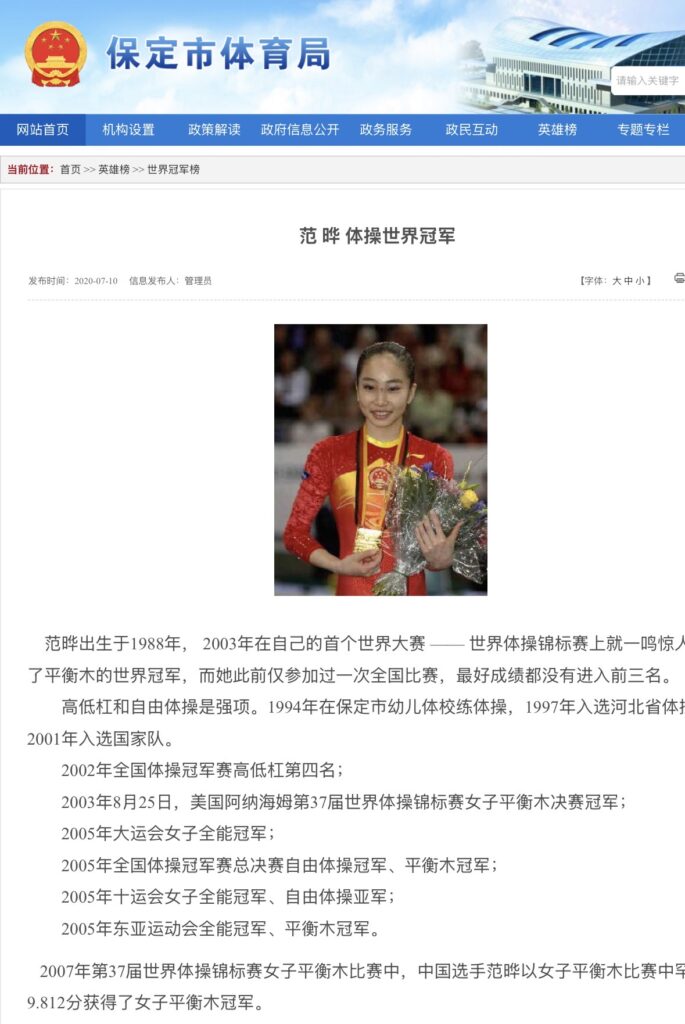
However, a 2006 journal article suggests that Fan Ye could be even younger:
However, at the 2004 Athens Olympic Games, a group of fifteen-year-old girls—represented by Fan Ye, Li Ya, Zhang Yufei, Wang Tiantian, and others—left a deep impression on spectators not because of outstanding technique, but because they fell from the apparatus one after another “like dumplings.” The oldest among them was team captain Zhang Nan, who was only sixteen at the time. The younger team members were around thirteen years old.
One thing is certain: Fan Ye was not born in 1986.
Appendix A: Another 2003 Profile
The Confused Youth of a Girl in Bloom — A Profile of Balance Beam World Champion Fan Ye
Dayoo.com (大洋网)
August 28, 2003
When she first fell from the uneven bars onto the mat, people responded with understanding and sympathy for a young athlete competing in such a major event for the first time. When she fell again from the uneven bars, people could only shake their heads and sigh. Two major mistakes in a first international competition—such cruelty seemed too much for a fifteen-year-old girl.
Yet when this young girl, who had just suffered two setbacks, stood firmly on the mat like a nail driven into wood, the narrow balance beam before her became the bridge leading to her championship. Applause erupted, cameras flashed, and a smile finally bloomed on the youthful face of the girl in her prime. For the first time, people remembered the name—Fan Ye, the newly crowned queen of the balance beam.
Fifteen-year-old Fan Ye looked far smaller and more delicate than girls her age. Although her face still carried traces of childish innocence, as she stood on the podium listening to the national anthem and watching the national flag rise, she felt a pride that few others could share.
“Before, I just listened to the national anthem. Today it’s being played especially for me.”
That kind of pride is a privilege belonging only to champions.
The balance beam that carried her to a world title resembled her life up to that point—though not very long, it had been narrow and difficult.
“Because I Loved Moving Around Too Much”
At age five, Fan Ye wandered somewhat innocently into a gymnastics training hall. At that time, neither she nor her parents understood the path that lay ahead.
Both of Fan Ye’s parents were medical workers, and her gymnastics career had nothing to do with family influence. In fact, she was almost “forced” into it. As a child, she was extremely energetic and rarely stayed still. The kindergarten teachers simply couldn’t manage her and finally asked her parents to take her home.
“They even took me to the hospital to check. Fortunately, I just barely missed being diagnosed with hyperactivity disorder!” Fan Ye said with a mischievous smile.
So this little girl, suspected of being hyperactive, left the ordinary kindergarten and began her journey into gymnastics almost by accident. One day, her parents were taking her out and discovered a sports kindergarten near their home that was enrolling new students. Since the location was convenient and their daughter needed somewhere to burn off energy, they signed her up.
After measuring her height and arm span, the staff immediately said:
“This child should train in gymnastics.”
And so the little girl walked into the gymnasium. At that time, Fan Ye had no idea what gymnastics even was—and her parents assumed it was simply something like school calisthenics. Thus, the future world champion began a new life among unfamiliar apparatus, filled with hardship but also hope.
“Now I’m the Laziest One in the Group”
Ironically, the girl who once exhausted her kindergarten teachers with her boundless energy now considers herself the laziest member of the team. After training, she simply wants to sleep.
“When I was on the provincial team, it wasn’t like this. Training wasn’t as exhausting. On the national team, the workload is huge, and we train full routines every day. After practice, I just want to sleep.”
As she spoke, Fan Ye looked at the thick yellow calluses on her hands—the marks of sweat and effort, but also a form of protection.
“Without them, grabbing the bars would hurt terribly.”
Perhaps for energetic children, sports training is both an effective and demanding way to channel their energy.
“I’m the one who sleeps the most in our group. Sometimes when the team has a day off, everyone goes out, but I stay in the dorm sleeping. Coach Lu opens the door and says, ‘Fan Ye! Why are you still sleeping? Get up!’”
She laughed mischievously as she told the story.
Growing Up Inside the Gym
For athletes, everyday life unfolds inside the training hall. Yet fifteen is usually the age of colorful dreams and imagination. Compared with other girls her age, however, the life of a gymnast carries both hidden sweetness and hidden hardship.
Many girls her age are obsessed with Korean or Japanese pop culture, cartoons, manga, and cosplay. But these things are far removed from Fan Ye’s life.
“We don’t have much time to watch TV. Maybe a few days a week. But after training, showering, eating, soaking our hands and feet, and sometimes getting treatment, it’s already after nine o’clock.”
Occasionally, older teammates bring DVDs, and when she has time, she watches them.
“They’re all idol dramas—Lavender, Meteor Garden, things like that. Sometimes, I suddenly like a celebrity, but after a while, I forget and stop liking them. I don’t know why—I just never become obsessed.”
When asked whether she currently admired any celebrity, she thought hard but couldn’t name one. Perhaps she hadn’t yet realized that after winning gold, she herself had become someone others admired.
“Two Years in the Gym and You’ll Turn Pale”
Like most girls, Fan Ye also loves beauty, but she rarely uses skincare products and knows little about famous brands. Her skin is naturally good, and she attributes it to a simple “secret”:
“We spend every day inside the gym—no wind, no rain, no sun—so of course we stay pretty fair. One girl on the team had darker skin, and Coach Lu joked: ‘Just stay in the gym for two years—you’ll naturally turn pale!'”
Before competitions, members of the women’s team must wear makeup. Usually, the coaches help them, but this time Fan Ye tried doing it herself. “Some of them are really good at makeup, but I’m not. I tried it once and couldn’t even stand looking at it, so I washed it off.”
Girls are said to be born lovers of shopping, though Fan Ye has little to show for it. “Coach Lu usually takes us to Xinshijie, but on my own, I tend to go to Hongqiao—it’s cheaper there. The problem is I can’t bargain. They’ll ask thirty yuan for a T-shirt, which is way too much, but I can never get them down to ten yuan!”
Dreams of Khorkina and the Future
Before traveling to the United States for the world championships, Fan Ye’s results in internal trials had been poor.
“I thought I had no chance to go, but the coach still brought me. So I told myself I had to perform well.”
During qualification, she performed brilliantly, and the Chinese women’s team unexpectedly ranked first.
In the finals, however, she fell during a simple grip transition on the uneven bars.
“I don’t know why it happened. I just watched the bar slip past my fingertips.”
She was devastated.
Later, during the apparatus finals, another mistake cost her the uneven bars title.
“If I had simply completed the routine, the championship would have been mine.”
That night, she called home. Her parents’ unconditional support helped her regain confidence. The next day, she stepped onto the narrow balance beam—an apparatus even more prone to mistakes.
This time, she performed nearly flawlessly and stuck her landing.
The gold medal was hers.
Looking Toward the Future
“I want to be like Khorkina—still beautiful and technically strong after another seven or eight years.”
Her words moved many people. For years, Chinese women’s gymnastics had struggled with short athletic careers. Many promising athletes disappeared soon after achieving success.
“Girls tend to gain weight around 17 or 18. When that happens, many skills become difficult.”
Would Fan Ye follow the same path?
“I don’t think so. Training might be hard, but I believe I can do it.”
Her goal was not just the Athens Olympics, but also Beijing 2008. When the Olympic rings would fly above Beijing, Fan Ye would be twenty years old. Perhaps the girl from Baoding would bring fans not only difficulty and stability, but also the charm of a mature athlete, much like Liu Xuan did in 2000.
A Name People Won’t Forget
Sometimes people mispronounce the character “晔” in her name.
“One teammate first called me ‘Fan Hua.’ I said that’s wrong. Then she tried ‘Fan Ri.’ I said that’s even worse—it’s pronounced like ‘Ye.’”
Fan Ye laughed happily while telling the story.
What she may not have realized at that moment was that from the instant she won her gold medal, her name had already spread across China—and no one would ever mispronounce it again.
* * *
花季女孩的懵懂青春——记平衡木世界冠军范晔
大洋网讯 当她第一次从高低杠上摔倒垫子上,人们所有的是对一个初次参加此类大赛的小选手的理解和同情;当她又一次从高低杠上跌落,人们不得不摇着头叹息,首次参赛却两次出现重大失误,对一个只有15岁的小女孩来说实在是太残酷了。
然而,当这个刚刚经历了两次打击的小姑娘像钉子一般牢牢的扎在垫子上,她面前狭窄的平衡木却成就了她通向冠军的桥梁。掌声响起、闪光灯亮起,笑容终于绽开在了花季女孩青春的脸上,人们也第一次记住了这个名字–范晔,新诞生的平衡木女皇!
十五岁的范晔看起来远比她同龄的女孩子显得娇小玲珑得多,虽然脸上还有不少稚气的表情,可是,站在领奖台上聆听着国歌响起、目送着国旗升起的她心中却有着别人无法分享的自豪感:“以前听国歌就是听着,今天是特别为我演奏的。”这种骄傲是独属于冠军的特权。
那条送她登上世界冠军的平衡木就像她此前的人生一样,虽然并不漫长,却狭窄而艰辛。
因为那个时候我太爱动
五岁的范晔懵懵懂懂的走进了体操房,然而那个时候,无论是她还是她的父母,大概都还不清楚自己将面对的是怎样的一条路。
范晔的爸爸妈妈都是医务工作者,她开始练体操与家庭没有一点儿关系,而是“被逼”出来的,小小的范晔特别好动,几乎一天到晚都停不下来,幼儿园的阿姨实在没有办法只好请来了她的家长,实话实说:这个孩子我实在管不了,你们还是领回去吧。“当时还真是去医院查了查,好在差一点,不是多动症!”范晔一边说着一边露出了调皮的笑。
于是这个有“多动症”嫌疑的小丫头就告别了普通孩子的幼儿园,而她走上体操之路根本是误打误撞,一次父母带她出去玩,却发现离家不远的地方有一家“体育幼儿园”,刚好那天幼儿园正在招收新生,范晔的父母想着反正孩子天天在家待着也不好,这里离家又近,所以就给范晔报了名。工作人员给范晔量了量身高、臂长之后就说:这个孩子去练体操吧!于是小小的范晔就走进了体操馆,那个时候别说范晔不懂体操究竟是个什么东东,就连她的父母也以为不过是让她去练“广播体操”而已!就这样,未来的世界冠军在陌生的器械上开始了充满艰辛也充满希望的新生活。
现在我是组里最懒的
谁也不知道小时候爱玩爱动得让幼儿园阿姨头疼的范晔,现在却是组里最懒的一个,用她的话说,平时训练完了,她就爱躺在床上睡觉。
“以前在省队的时候还不这样,那个时候练的也没有这么累,在国家队不单训练量大,而且都是成套的动作,每天练完就只想睡觉了。”范晔一边说,一边看着两只手上黄色的老茧,那都是汗水的见证,当然也是一种保护,“没有它们,握杠子的时候手会非常疼的。”也许,对于爱动的孩子来说,让他们去练体育实在是个有效却又艰苦的法子。
“我现在是组里最能睡的,有的时候队里放假,别人都出去了,我就窝在宿舍里睡觉,陆指导打开门一看,就会喊‘范晔,怎么就你还在睡啊,快起来!’”范晔一边说着一边促狭的笑着。
在体操馆里闷两年就白了
作为运动员,平常的生活都是在训练馆中渡过的,而15岁的年纪正是充满幻想、五彩斑斓的花季,可与其他同龄少女比起来,体操选手的生活却有着不为人知的“甜蜜”与“苦涩”。
时下哈韩、哈日的女孩子很多,迷卡通、漫画,COSPLAY的同样不在少数,可那些和范晔离得却很远,“我们平常也没有时间看电视啊,一周里面只有几天可以看,可是训练结束了,洗完澡、吃完饭,再泡泡手和脚,有的时候做做治疗,很快就9点多了。”不过,有的时候,队里比较大的队员也会带来一些盘,有了时间,范晔也会蹭着看,“都是偶像剧啊,比如《熏衣草》啊,《流星花园》什么的,其实也会突然很喜欢某个明星,可是往往过了一阵子就忘了,很快就不喜欢了,我也不知道为什么,就是不会特别迷恋。”问她现在有没有崇拜的明星,她努力的想了想,也没有答案,其实,她或许还没有意识到,挂金归来的她现在也已经是别人崇拜的偶像了。
爱美是女孩子的天性,可范晔却很少用什么护肤品,那些名牌她也不甚了了,不过她的皮肤一直很好,这可是有“秘诀”的,“我们天天在体操房里,风吹不着,雨淋不着,太阳也晒不着,当然就比较白了,我们队里一个女孩子长的比较黑,陆指导就说‘没关系,在体操馆里闷两年,自然就白了!’”这果然是个不错的增白方法,虽然见效慢些,却没有副作用,或许那些天天和自己的脸较劲的女孩子们可以换个思路想问题了。
参赛之前,女队的队员们都要化妆,虽然往往是让队里的教练代劳,但这次范晔也“自食其力”了一回,“她们有的人很会化妆,我就不会,这次试着化了一回,结果自己都看不过去,又给洗掉了……”
大约女孩子天生都爱逛街,不过范晔对此倒是没什么心得,“平常陆指导喜欢带我们去新世界,不过要是我自己,就比较常去红桥,那里便宜啊!可我不会砍价,那里一件T恤都敢要30块钱,太贵了,可我就怎么都砍不下来,所以就常叫着我们这里比较能砍价的,她一般都能砍到10块钱成交呢!”说着这些的范晔,对自己的能力不济颇有些恨铁不成钢的架式。
其实,练体操的女孩子也有很多说不出的“苦涩”,比如她们的身材往往都比同龄人小不少,看起来总要比实际年龄小个三四岁,“我们的确显得小,也不光是身材,到队里的时候总是最小的,虽然慢慢的就成大的了,可是又总会来更小的队员,常和她们在一起,可能就是不容易长大吧!”15岁的女孩子大多都已经在衣装上打扮自己了,甚至还可以穿些“性感”的,可这和范晔也是无缘的,平常她们都是穿着训练服,外出往往又是统一的队服,哪儿有时间穿自己的衣服呢?“我们手小、脚也小,买鞋的时候都快要去买童鞋了!”范晔笑着说道,丝毫没有将这些放在心上,也许对她来说,这一切早就习惯了。打篮球的队员总是为过高的身高而烦恼,而娇小的体操队员也一样有本难念的经。
霍尔金娜和2008
“去美国之前,队里的几次测验,我的成绩都不好,当时意味没希望了,但教练还是带上了我,那我就一定要好好表现。”范晔是带着这种心情去的,团体的预赛上她的表现也非常出色,中国女队出人意料的排在了预赛的第一名。
“决赛前,教练和我们说不用紧张,随便比,反正前八也已经进了,其实那是为了消除我们的压力,可我给当真了,决赛的时候在场上特别放得开,那个高低杠的抓杠动作很简单,我也不知道为什么会掉下来,就看着杠子从指尖滑过去了……”提到那次失误,范晔依然轻松不起来,毕竟,她们曾经离奖牌那么近。
“单项决赛时,那个失误就更不应该了,只要我完成了全套动作,冠军就是我的了,可惜……”那天,连续失误的范晔打电话回家,正是父母无条件的支持才让她第二天信心百倍的站在了窄窄的平衡木上,在这个比高低杠更容易失误的项目中,范晔的表现几近完美,稳稳落地的她也稳稳的将金牌握在了手中。
“也没想什么更多的,就是想想动作要领,一个一个做呗,都没想最后的结果。”正是这种良好的心态成就了体操女队这块金光熠熠的冠军,15岁的范晔也一举成名了,这一天距离她第一次走进体操馆,已经过去了10年。
“我也想像霍尔金娜一样,再练七八年,还那么美,技术还那么高。”范晔夺冠后的话让很多人的心中充满了感动,中国女子体操队长期以来都面临着优秀的女子选手运动生涯太短的问题,不少刚刚出了成绩的女孩子很快沉寂下来,匆匆远离了人们的视线。“女孩儿到了17、8岁就容易长胖,一胖起来,很多动作就练不动了,成绩自然就不好。”那么,范晔会不会也步她们的后尘呢?“我想不会的,顶多是练的时候比较辛苦,可我想我没问题的!”范晔说得很坚决,因为她的目标并不仅仅是明年的雅典,还有5年之后的北京,当奥林匹克五环旗在北京上空飘扬的时候,范晔将20岁,或许这个来自保定的小姑娘将像2000年的刘璇一样,带给人们的不仅是难度和稳定性,更是成熟少女才独有的魅力。
范晔的“晔”字有的时候会被叫错,她说:“我的一个队友刚见我面的时候,就叫‘范华’,我说不对,她又改口叫‘范日’,我说那就更离谱了,应该念‘叶’的音。”说起这些趣事,范晔笑得很开心,不过,她也许没有想到的是,从她挂上金牌的那一刻起,她的名字已经传遍了祖国,再也没有人会叫错了。(绿衣)
Appendix B: SARS
The SARS (Severe Acute Respiratory Syndrome) outbreak of 2002–2003 originated in southern China and spread rapidly across Asia and into Canada, ultimately infecting over 8,000 people in 29 countries and killing nearly 800. By the summer of 2003, the outbreak had been contained, but it had caused significant disruption to public life, international travel, and major events across the region in the months preceding that November’s World Championships in Anaheim.
Below, you can find an article that discusses this forgotten part of gymnastics history.
Chinese Gymnastics Team Heads into World Championships Lightly Burdened
People’s Daily, Page 8
By Li Changyun
From August 16 to 24, the 37th World Artistic Gymnastics Championships will be held in Anaheim, United States. The Chinese gymnastics team will send its full first-choice lineup to compete. Although the team’s primary objective at this World Championships is to gain experience rather than to pursue a clearly defined gold-medal target, China’s strong overall strength means that, while honing the squad, it will also mount multi-pronged challenges for gold. With an eye toward preparations for next year’s Olympics, the Chinese team is expected to present a fresh look at the World Championships, laying a solid foundation for Olympic participation.In a recent interview, Chinese team leader Ye Zhennan said that at the 36th World Artistic Gymnastics Championships in 2001, China competed with a second-string team. At this year’s Worlds, however, the team will field all first-choice athletes, with the aim of building toward the 2004 Athens Olympic Games while still striving for the best possible results. This World Championships features major changes to the competition format—for example, no pre-final warm-up sessions are scheduled for either apparatus finals or team finals. This will be a significant test for China’s young athletes, many of whom have little or no experience in major international competitions and tend to take longer to find their competitive rhythm.
In addition, the team competition format has changed from the previous “6-5-4” to “6-3-3”—six athletes per team, with three competing and all three scores counting. This poses challenges for China’s men’s team, whose strengths are relatively evenly distributed. Nevertheless, the Chinese team has made thorough preparations in training. If they perform normally, China has the strength to contend for titles in the men’s team event, men’s all-around, men’s vault, parallel bars, pommel horse, as well as women’s uneven bars and balance beam. Chinese gymnasts already possess championship-level ability; whether they ultimately win gold will depend on competition-day performance, judging factors, start order, and other variables.
According to Ye Zhennan, preparations were adversely affected earlier by the SARS outbreak, which led to the cancellation or postponement of several gymnastics competitions. This was particularly unfavorable for World Championships preparation. The Chinese women’s team, in particular, has relatively limited experience in major competitions, with several athletes having never competed internationally—making competitive exposure especially important for them. During the SARS period, out of concern that athletes’ immunity might decline, training loads were kept relatively moderate. After the World Health Organization announced the “double lifting” of restrictions in Beijing, both the men’s and women’s teams resumed high-intensity, high-volume, competition-oriented training. The team also organized multiple simulation tests to help athletes acclimate to the competitive atmosphere in advance.
At present, key members of the men’s team such as Li Xiaopeng and Yang Wei are in very good form. Younger athletes including Teng Haibin and Liang Fuliang have also shown improvement after recent training. On the women’s side, Zhang Nan has become more mature after gaining experience at last year’s apparatus World Championships and World Cup events. She is strong on balance beam and floor exercise and also has a certain level of all-around ability. In regular training, she clearly stands out above the younger athletes. In Ye Zhennan’s view, Zhang Nan has essentially acquired the qualities of a team leader.
The Chinese gymnastics team will finalize its roster of seven men and seven women before departing for the World Championships in late July, after which they will undertake two weeks of acclimatization training in the United States.
中国体操轻装出战世锦赛
本报记者 李长云
8月16日至24日,第三十七届世界体操锦标赛将在美国的阿纳海姆举行,中国体操队将派出一线阵容参赛。虽然中国体操队在本届世锦赛上的主要目的是锻炼队伍,并没有明确的夺金任务,但有强大的整体实力依托,在锻炼队伍的同时,中国队也将从多点冲击金牌。立足于备战明年奥运会的中国体操队将在世锦赛上有一个崭新的面貌,为参加奥运会打下良好的基础。
近日在接受记者采访时,中国体操队领队叶振南说:2001年的第三十六届世界体操锦标赛上,中国体操队以二线队伍参赛。本届世界体操锦标赛,中国队则全部以一线主力队员参赛,其目的是为2004年雅典奥运会锻炼队伍,但也要尽量争取好成绩。由于本届世锦赛在赛制上有了很大改动,如单项和团体比赛的决赛均不安排赛前准备活动,这对很少参加国际大赛甚至没有参加过国际大赛、比赛经验欠缺、进入状态较慢的中国年轻队员来说将是一个不小的考验。而团体比赛将以往的654的出场阵容改为633,即每队6名队员,出场3人累计3人的成绩,也对实力比较平均的中国男子体操队带来一定麻烦。不过,中国体操队在训练中对此都做了较为充分的准备。如果发挥正常,中国队在男子团体、男子全能、男子跳马、男子双杠、男子鞍马、女子高低杠和女子平衡木等项目上均有实力争夺冠军。中国运动员已经具备冲击冠军的实力,最后能否拿到金牌则要看临场发挥、裁判因素、出场顺序等各方面情况。
据叶振南介绍,前一段时间受非典疫情的影响,多项体操赛事被取消或推迟,这对世锦赛的备战工作很不利。中国女队大赛经验相对较少,有好几名队员没有参加过国际比赛,比赛经验对她们来说尤其重要。非典期间,因为担心运动员们免疫力下降,队里在训练安排上比较平稳,没有安排太大的运动量。世界卫生组织对北京“双解除”之后,男女队都进行了高强度、大运动量、从实战出发的训练。此外,队里还组织了多次模拟测试,帮助队员们提前感受比赛气氛。目前中国体操男队中的李小鹏、杨威等几名主要选手都保持着很好的状态,滕海滨、梁富亮等年轻选手经过前一段时间的训练也有所提高。女队中,张楠经过去年单项世锦赛和世界杯赛的磨练之后更加成熟。张楠在平衡木、自由操项目上的实力不俗,全能方面也有一定的实力。在平常的训练中,她比其他小队员也明显高出一截。在叶振南看来,张楠已基本具备一名领军人物的素质。
中国体操队将在7月底出征体操世锦赛前确定最终的7男7女人选,他们还要在美国进行为期两周的适应性训练。
Appendix C: International Gymnast‘s Interview from May 2005
Fan Ye
NAME: Pronounced FAN YEH
BORN: Oct. 23, 1986, Baoding, Hebei Province, China
BEGAN GYMNASTICS: Age 5½
COACHES: Liu Guicheng (who coached world champions Mo Huilan and Ling Jie), He Hua
FAMILY: Father is a doctor; mother is a nurse
BEST FRIEND ON THE TEAM: Liu Juan
MOST FAMOUS FOR: Winning the 2003 world title on beam with the highest score (9.812) for a female gymnast in world or Olympic competition from 2001-2004
Fan Favorite
Best Thing About Being a Gymnast:
I actually like competing the most. Once I arrive at a meet, doing full sets there actually feels easier than training skills over and over in the gym. I get really excited when I’m at a competition.
Worst Thing:
I don’t really like conditioning, unless I feel that the exercises I’m doing are efficient and yielding fast results. I’m not really an “endurance” type of athlete.
Favorite Events:
I like beam and bars the best, as those two events are easiest for me to train. I pick up new skills rather quickly on them. But in competition, my favorite event is actually floor, because I love performing and dancing for an audience. I love the thrill of being on stage and having a crowd watch and enjoy my performance.
Favorite Gymnast:
Svetlana Khorkina, because she’s so unique and independent-minded; she always strives to be different and stand out. Also, her lanky body type is kind of similar to mine, so I can relate to her in a way.
Healthy Outlook:
I enjoy resting and sleeping when-ever I have free time — it helps me refresh my body and get me re-energized. I like spending time taking care of my body and health. For example, I love drinking whole milk — it helps keep me healthy.
“It’s essential to always feel your movement throughout, not just do leaps and jumps robotically….”
Those Incredible Leaps:
It’s not just a matter of genes or a matter of starting young in the Chinese training system. I feel that having a keen understanding of music and a solid dance background help a lot. Even with simple leaps and jumps, I pay attention to how they fit in as part of my routine, how they fit into the big picture — rhythm, flow, and fluidity of movement are key. So whenever I find myself starting to lose rhythm on the beam, I have to re-adjust myself, or else I won’t do so well on the remaining leaps or jumps. It’s essential to always feel your movement throughout, not just do leaps and jumps robotically as if they were stand-alone elements, adding no aesthetic value to a routine.
I think the other reason why people tend to like my leaps is that I perform and train with the audience in mind. That’s actually what got me hooked on gymnastics in the first place — I’ve always loved performing and having an audience appreciate and find beauty in what I’m doing; I remember when I first started gymnastics, I’d get so happy whenever someone complimented me on a particular move. That just grew on me, and so when I train, I like to look over and review videos of me practicing, and whenever a certain skill doesn’t look pretty, I go back and perfect it. So I’d say that a big chunk of my motivation comes from my desire to please the audience — I try to visualize my routine from the angle of an audience member, and that makes the end product more appealing.
Disappointing Olympics:
Going into Athens, I knew my body wasn’t in top shape. During the intense pre-Olympic preparations, I didn’t do too well in the training sessions that had included full sets of all the routines. So arriving in Athens, I didn’t feel too confident about myself because I hadn’t really been hitting my routines that well in training, and I was quite unsure as to whether I could win beam again. That doubt about myself, combined with the injuries I was nursing at the time, all contributed to the poor performance. As for our team as a whole, it was disappointing to see the level of gymnastics we performed on competition night to be so much lower than the level we do in daily training. That’s an issue we’re resolved to correct over the next four years.
After Athens, my coaches helped me a lot in getting over that huge disappointment. They didn’t give up on me. They got me back on track, re-motivated me, and made me realize that I’m still young and still have a future in the sport. Now, I feel quite determined to fight for a spot at the 2008 Olympics in Beijing. I’d like to continue gymnastics for as long as I can, till 2008 or even after that, just as long as my body can handle it.
Goals for 2005:
I want to defend my beam title at the world championships in Melbourne. I hope this will also be a way for me to acknowledge and thank everyone who has enjoyed my gymnastics and cheered for me.
Later in Life:
My immediate goal after gymnastics is to go to college. I want to branch out and try something new — something that’ll challenge and stretch my mind in different ways. I need to acquire more knowledge, and that’s why I know for sure I have to go to college. But I do have an interest in becoming a judge later on and staying connected to the sport that way.
— Amanda Turner; Lisa Wang
More on Age