At the 1983 Mediterranean Games in Casablanca, Morocco, Spain’s wunderkind, Laura Muñoz, emerged as one of the competition’s standout figures, winning gold medals with her team, in the all-around, and on beam. Contemporary coverage consistently framed her as older than she was. As one report put it, she was a fifteen-year-old prodigy:
Among the athletes who have taken part in this edition of the Games, perhaps the most outstanding figure—not only on the Spanish side, but among all the competitors who attended—has been the young gymnast Laura Muñoz, who at just fifteen years old has won three gold medals and one silver, showing herself to be a world-class athlete.
Diario de Burgos, Sept. 18, 1983
Entre los atletas que han tomado parte en esta edición de los Juegos, quizá la figura más sobresaliente, no sólo por el lado español, sino entre todos los concursantes que han acudido, haya sido la joven gimnasta Laura Muñoz, que a sus quince años ha conseguido tres medallas de oro y una de plata, y ha demostrado ser una figura de talla mundial.
If Muñoz was indeed 15 in 1983, that would imply a 1968 birthdate, placing her comfortably within the age requirements for both the 1983 World Championships and the 1984 Olympic Games. But that was not her actual year of birth. Laura Muñoz was born in 1970, which would have made her just thirteen in Budapest and fourteen in Los Angeles. With a minimum age requirement of fifteen, Muñoz should have never competed in either competition.
If anything, one might expect age falsification to belong to an earlier political era in Spain. But Francisco Franco had died in 1975, ending his brutal dictatorship, and Muñoz’s case unfolded during Spain’s transition to democracy, within a newly established constitutional monarchy under Juan Carlos I.
Today, the Spanish press is honest about Muñoz’s true birthdate: June 9, 1970. One recent profile of Muñoz is translated below, followed by additional context on her performance at the 1983 Mediterranean Games, the competition that earned her the nickname the “Queen of Casablanca.”
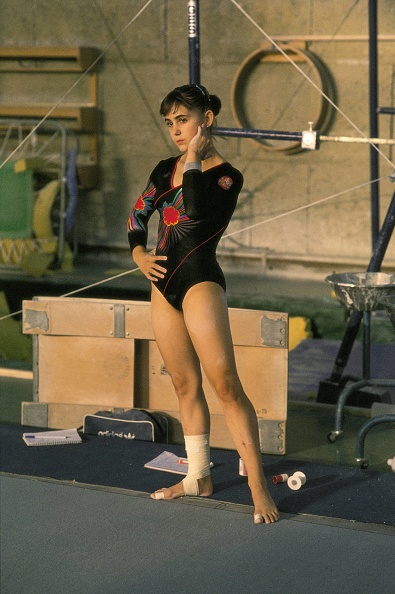
Laura Muñoz, the first Spanish woman to score a 10 in artistic gymnastics, who was failing physical education: “I closed the gap with the Romanians, Czechoslovaks, and Russians”
Since 2008, she has been with the Madrid Sports Foundation. She also helps athletes navigate the decision to retire.
Relevo, Íñigo Corral, February 16, 2025
Can a physical education teacher fail the student who became the first person in Spain to score a perfect ten in artistic gymnastics? It’s hard to believe, but it happened. Laura Muñoz, a 54-year-old woman from Madrid, had been called up to compete at the Mediterranean Games, which were held in Morocco in 1983. There, the gymnast collected three gold medals and one silver. The press dubbed her the “Queen of Casablanca.” Her success immediately attracted the attention of journalists. One of them was curious to know whether she got tens in gymnastics at school. He had no idea how far-reaching his question really was. The answer left more than a few people speechless. “The truth is, they failed me,” she confessed without embarrassment.
The explanation lies in the old grading system. The young gymnast had to take two exams to pass the subject. She earned the highest grade on the first, but could not take the second because she was already competing with the Spanish national team. Her teacher simply averaged the grades—and she failed. “I made her famous when I told that story,” the teacher later recalled. Three years later, Muñoz achieved the only perfect ten ever awarded to a Spanish gymnast in artistic gymnastics.
From the age of three, she showed clear signs that she wanted to be a gymnast. “I was very restless; I spent all day at home doing handstands and somersaults.” At seven, while studying with nuns at Stella Maris school, her parents took her and her sister to the La Concepción sports center to try swimming. It didn’t appeal to her. She would sneak away, “tiptoeing down the hallway to peek through a little window and watch other girls doing gymnastics.” Eventually, after persistent pleading, she convinced her parents. “They didn’t mind much; they just wanted me to do some kind of sport.” It soon became clear this was no passing whim. She won a developmental competition and shortly afterward became the top junior gymnast in Castile. In the summer of 1980, a coaching change brought Jesús Carballo (“Fillo”), who persuaded her to train with the national team.
Years later, Carballo was accused by two former gymnasts of sexual abuse and mistreatment. Criminal charges were dropped due to the statute of limitations. He then filed a civil suit for defamation, but Spain’s Supreme Court ultimately dismissed it, ruling that the allegations had “sufficient indications of seriousness and a certain plausibility.”
Laura does not avoid the issue: “He was my coach from the time I was ten until I retired, and I’m still in contact with him. All I can say is that he treated us with respect and took very good care of us. I find it very hard to believe that story.”
Competing at the highest level came at a cost she was willing to pay. She trained three hours a day, Monday through Friday. “I even skipped birthday parties because I preferred to train.” Her parents also made sacrifices, picking her up every day and taking her home—something she still deeply appreciates. “Family is incredibly important in all of this.”
When she began competing internationally, she had to learn how to manage her time. Balancing gymnastics and school at such a young age was no easy task. “Since I trained in the afternoons, I used every spare moment to study—during recess, at lunchtime, or late at night when I got home.” Her parents’ support was crucial. “They never demanded top grades, but they did tell me I couldn’t give up school for gymnastics.”
That was the level of maturity with which she approached the 1984 Los Angeles Olympics—at just 14 years old. Shortly after arriving in the Olympic Village, she unexpectedly encountered Carl Lewis, who would go on to become the star of the Games, winning four gold medals and matching Jesse Owens’s 1936 record. “I was so small that I probably ran into other famous athletes too, but didn’t even realize it,” she laughs.
Muñoz particularly enjoyed the balance beam and vault. She was less fond of uneven bars and floor, though she remained consistent across all apparatus. At her first Olympics, she qualified for the final round of 36 gymnasts and finished 14th—an impressive result for a newcomer, especially competing against Eastern European athletes who were far ahead of the Spanish at the time. “It may sound immodest, but I think I was one of the first Spanish gymnasts to start closing the gap with the Romanians, Czechoslovaks, and Russians, who had seemed untouchable.”
At the time, athletes from the Soviet bloc were often suspected of doping or using hormones to delay growth, allowing them to compete longer at the elite level. “Gymnastics is a very technical sport—it doesn’t require doping to improve,” she explains. Her parents, she adds, would “never” have allowed her to take such substances. Still, people were curious about gymnasts’ flexibility. “They even asked whether we had ribs removed to bend more easily,” she recalls. The reality was much simpler: gymnasts tend to be small—just as basketball players tend to be tall. “Taller athletes have a higher center of rotation, which makes somersaults more difficult. We’re smaller, with a lower center of gravity, so we maintain balance better.”
Domestically, her career was highly successful. She won Spanish national titles in 1984, 1985, and 1987 (missing 1986 due to injury). Not because she was vastly superior, she says, but because of her competitive mindset: “Other girls trained very well, but they sometimes got nervous. I could control my nerves.”
In 1987, at the Spanish championships in Sabadell, she delivered a defining performance. She executed a Yurchenko vault—named after the Soviet gymnast Natalia Yurchenko—with near perfection. After scoring a 9.90 on her first attempt, she realized a perfect ten was within reach. On her second attempt, she delivered. “They stopped the competition, and everyone started applauding.” Her mother witnessed the moment; her father, too nervous, missed it. It would remain the only perfect ten of her career.
Internationally, however, recognition was harder to earn. “It was difficult because we weren’t well known,” she says. Judges tended to favor gymnasts from established powerhouses like China, Romania, and the Soviet Union. “We needed just one more step to reach the podium.” Gradually, respect grew, and Spanish performances were judged more fairly. In 1987, she capped her success with five more gold medals at the Mediterranean Games in Latakia, earning a new nickname: “The Empress of Latakia.”
At the 1988 Seoul Olympics, now more experienced, she again reached the final group of 36. But a mistake on beam dropped her from near tenth place to twenty-third. Returning to Spain, she underwent elbow surgery and took time to recover. After a modest comeback in 1989, she decided to retire in 1991. “I didn’t feel physically capable of lasting three more years to reach Barcelona, and since I knew I wouldn’t be at 100%, I preferred to step aside.”
She remained involved as a coach until the Olympics, then left gymnastics entirely. She returned to her studies, completed a teaching degree, and pursued doctoral coursework in educational psychology before becoming a schoolteacher in Madrid.
After ten years, however, “life circumstances” drew her back to sport—this time in management rather than coaching. Since 2008, she has worked with the Madrid Sports Foundation, helping provide scholarships to Olympic and Paralympic athletes and promoting social inclusion through sport.
She also supports athletes during retirement transitions. “It’s a very difficult moment, when you stop and think: what now?” she says. Having spent her life training and competing from age 7 to 21, she found it challenging as well—but less so than athletes who retire later without formal education. Her work now focuses on helping them build a future beyond sport: “When you’ve devoted yourself completely to something you love, it’s very hard to find something else that fills that void.”
Notes
1. I have yet to find an interview in which Muñoz discusses her age falsification. Most articles note her age but skip over the FIG’s age requirements for senior competition at the time.
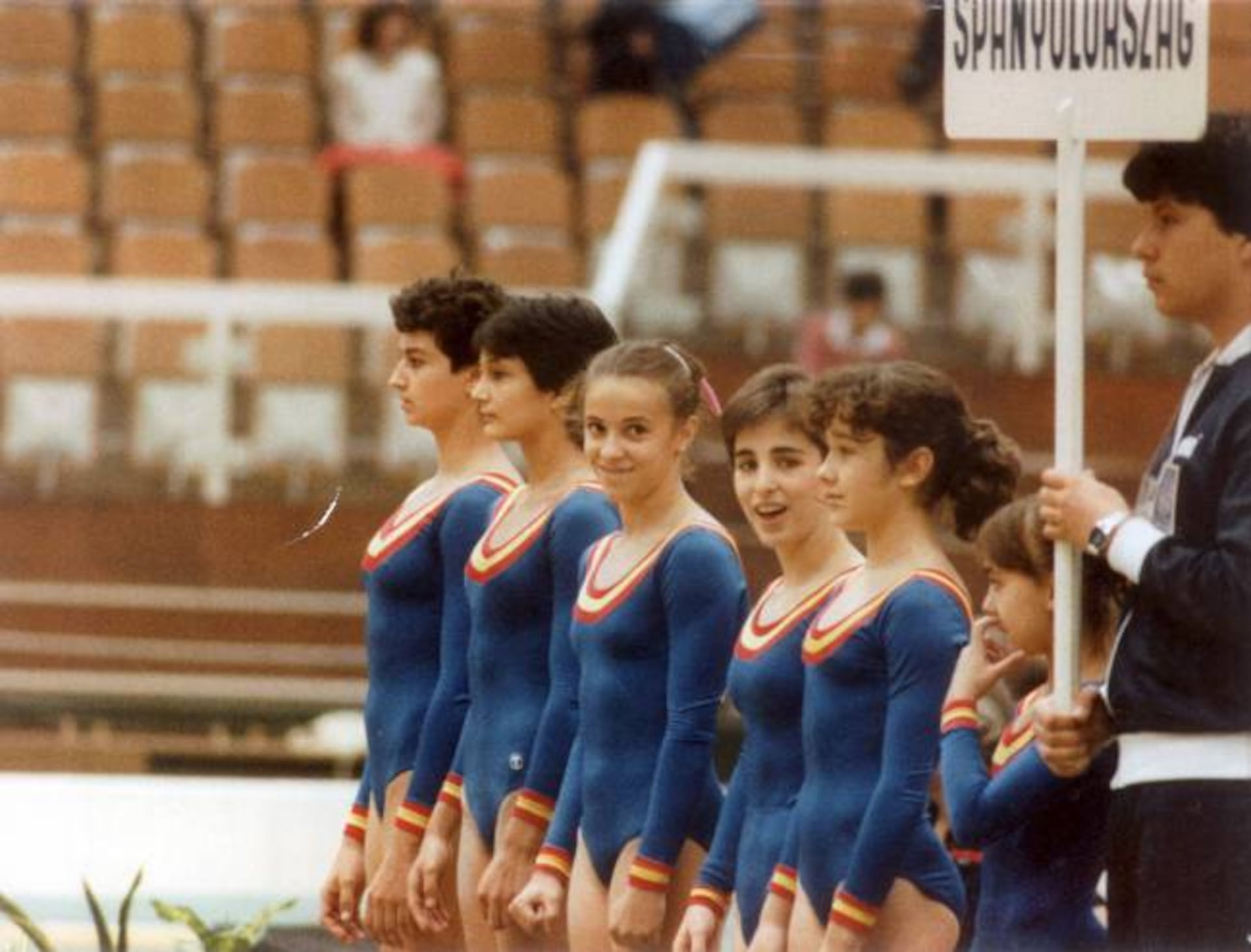
2. If you’re wondering how a 13-year-old looked next to her teammates, check out this photo of the Spanish team in 1983.
Appendix: Her Performance at the 1983 Mediterranean Games
Rafael Escalas and López Zubero, Gold Medals in Swimming
Spain Has Won 31 MedalsEl diario palentino, Sept. 10, 1983
Casablanca, Sept. 9 (EFE). — The Spanish gymnasts competing in the Mediterranean Games have been a surprise. Of the four apparatus finals contested, our representatives did not let a single one slip away.
Ana Manso clearly defeated her rivals in the vault. Special mention should be made of this gymnast’s performance, since during the warm-up for the vault final she failed to complete even one of her intended vaults, unable to find the right measure for her run. To the astonishment of even the national coach, Jesús Carballo, Ana scored an excellent 9.55 on her first attempt in competition. On her second, she improved further to 9.65, which earned her the gold medal—a medal that, after her warm-up attempts, had seemed almost unattainable.
Irene Martínez and the very young Laura Muñoz—whom Spanish gymnastics regards as its most promising talent—took the top two places on the uneven bars. In the qualifying round for the final, they were tied for first with 9.65 points, making a Spanish gold all but certain; the only question was which of the two would take it. In the final, Laura Muñoz performed first and scored 9.60. Irene Martínez, with an almost perfect routine, surpassed her compatriot by one tenth (9.70), taking the gold, while Laura earned the silver.
A VICTORY THAT, A PRIORI, NO ONE EXPECTED
On the balance beam, young Laura Muñoz had the chance to make up for the uneven bars. Her 9.65 from the first day, combined with a 9.75 in the final, left no doubt about her victory. This event was the most hotly contested: aside from the gold medal, all other places were shared. Spain’s Margot Estévez tied for second with France’s Florence Laborderie, while third place was also shared between Italy’s Leonilde Ianazu and France’s Corine Ragazzacci.
The women’s gymnastics competition concluded with yet another Spanish triumph. This time, to ensure that none of the four Spanish gymnasts went without a gold medal, Margot Estévez took first place in the floor exercise, scoring a total of 19.10. And to complete the success, another Spaniard, Irene Martínez, finished second in this event.
In summary, it was a major triumph for Spanish women’s gymnastics—something that, a priori, no one had expected. Not even the national coach, Jesús Carballo, imagined before arriving in Casablanca that the Spanish anthem would be played at the medal ceremony in all four events.
In men’s gymnastics, Miguel Soler (rings) and Fernando Siscar (vault) won bronze medals in the apparatus finals held yesterday afternoon at the Mohamed V sports complex.
According to the national team coach, the judges’ scoring was responsible for the male representatives not being able to secure more medals.
RAFAEL ESCALAS y LOPEZ ZUBERO, MEDALLAS DE ORO EN NATACION .
ESPAÑA LLEVA CONSEGUIDAS 31 MEDALLAS
El diario palentino, Sept. 10, 1983
Casablanca, 9. (Efe). — Las gimnastas españolas que participan en los Juegos del Mediterráneo, han dado la sorpresa. De las cuatro finales por aparatos a disputar, nuestras representantes no han dejado que se les escapara una sola.
Ana Manso batió claramente a. sus competidoras en salto dé caballo. Hay que destacar especialmente la labor de esta gimnasta, puesto que en los ejercicios de calentamiento para la final de salto, no logró realizar uno solo de los saltos previstos dado que no conseguía encontrar la medida de su carrera. Ante el asombro del mismo entrenador nacional, Jesús Carballo, Ana conseguía una excelente puntuación, 9’55, en su primer intento dentro ya del concurso. En su segundo logró, una mejor puntuación 9’65, que le valdría la medalla de oro, una medalla, que, después de los saltos de calentamiento, se veía casi como inalcanzable.
Irene Martínez y la jovencísima Laura Muñoz, en la que la gimnasia española tiene a su más firme promesa, ocuparon las dos primeras plazas en {paralelas asimétricas. En la primera ronda de ejercicios, clasificatoria para la final, marchaban empatadas para el primer puesto con 9’65 puntos, por lo que la medalla de oro para España estaba casi asegurada y lo único que quedaba por decidir era cuál de las dos gim. nastas conseguiría el oro. Ya en la final, la primera en actuar fue Laura Muñoz, que consiguió 9’60 puntos, Irene Martínez, con un ejercicio casi perfecto, superó a su compatriota en 10 décimas (9’70) por lo que se adjudicaría la medalla de oro y Laura la de plata.
UN TRIUNFO QUE “A PRIOR!”, NO CABIA PENSAR
En barra de equilibrios, la joven Laura Muñoz tuvo la oportunidad de sacarse la espina de las paralelas asimétricas. Los 9’65 puntos que consiguiera el primer día, más los 9’75 que consiguió en la final, hicieron que su triunfo no ofreciera ninguna duda. Esta modalidad fue la más disputada, puesto que, excepto la medalla de oro, todas las demás estuvieron compartidas. La también española Margot Estévez obtuvo un segundo lugar ex-aequo con la francesa Florence Laborderie. Para el tercer puesto también hubo empate entre la italiana Leonilde lanazu y la francesa Corine Ragazzacci.
El concurso de gimnasia femenina iba a terminar con otro triunfo español. Esta vez y para que ninguna de las cuatro españolas se quedara sin medalla de oro, correspondió a Margot Estévez en suelo, con 19’10 puntos en el total de sus ejercicios, subir al lugar más alto del podio. Pero para que la cosa no quedara ahí, otra española, Irene Martínez, sería la que ocupara la segunda posición en esta modalidad.
En resumen, un gran triunfo de la gimnasia femenina española, algo que, a priori, nadie podía pensar. Ni el mismo entrenador nacional, Jesús CarbaJlo imaginaba, antes de llegar a Casablanca, que el himno español sonara en la entrega dé trofeos en las cuatro modalidades.
En gimnasia masculina, Miguel Soler en anillas y Fernando Siscar en saltos, han obtenido la medalla de bronce en las finales de aparatos, que se disputaron ayer tarde en la sala del complejo deportivo Mohamed V.
Las puntuaciones de los jueces, según el seleccionador nacional, han sido las responsables de que los representantes masculinos no hayan podido conseguir más medallas.
More on Age