Yang Wei spent the better part of a decade within touching distance of being the best gymnast in the world—a narrow but unforgiving gap. He won team gold at Sydney in 2000 and was part of every Chinese team that captured the World Championships title from 1999 through 2007. (China did not finish on the podium in 2001, when it sent a B team.) He claimed the all-around at back-to-back Asian Games (2002 and 2006). And yet, at the sport’s biggest moments, the individual all-around title kept slipping away.
Though the gymnastics press gave him a nickname: 千年老二 — the perennial runner-up, he finished second only twice: in Sydney (2000) and in Anaheim (2003), and was seventh in Athens (2004).
Then everything shifted. He captured the World Championships all-around titles in 2006 and 2007, becoming the first champion of the open-ended Code of Points. By 2008, he arrived in Beijing as the clear favorite. On August 14, he finally claimed the Olympic title, defeating Kohei Uchimura by more than 2.5 points.
The three articles collected here trace different moments in Yang Wei’s life: the promising teenager from Xiantao who fell in love with gymnastics and wanted nothing to do with the attention that came with winning; the twenty-three-year-old who held himself together through injury and exhaustion in Anaheim and then broke down in front of a CCTV camera; and the retired champion who returned to Hubei to run the provincial gymnastics program, bringing his toddler son with him to the training hall. Together, they fill in what the medal record cannot.
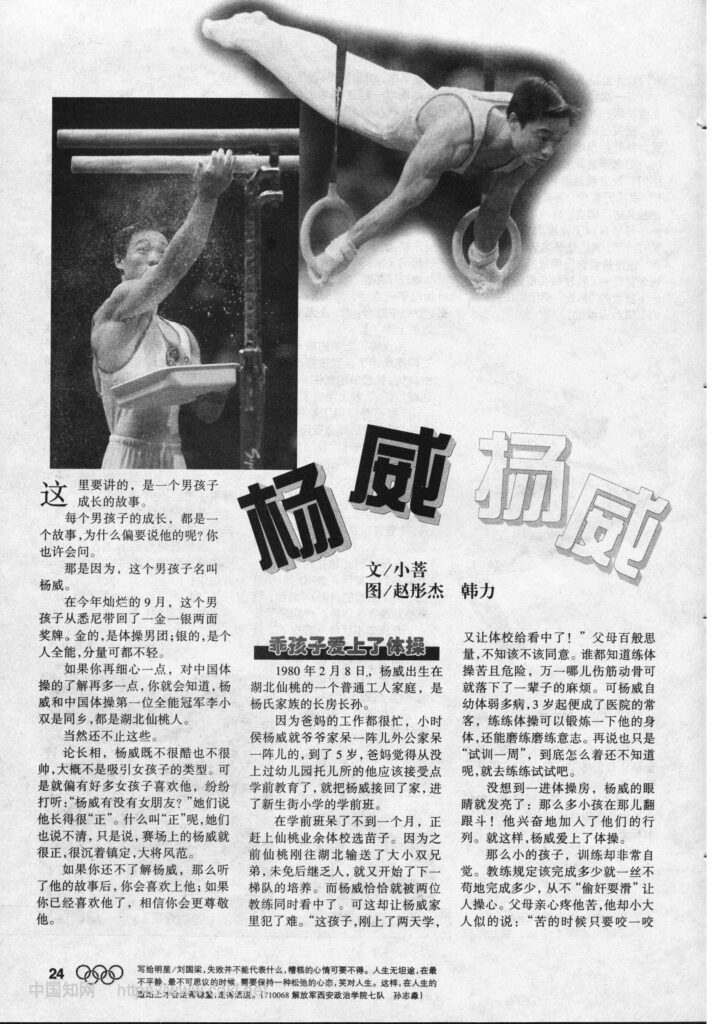
Yang Wei, Bringing Glory
Text by Xiao Jing / Photos by Zhao Tongjie and Han Li
New Sports, November 15, 2000
* * *
What we want to tell here is the story of a boy growing up.
Every boy’s growing up is a story, so why tell his in particular? you might ask.
Because this boy is named Yang Wei.
In this glorious September, this boy returned from Sydney with two medals: one gold, one silver. The gold was for the men’s team; the silver was for the individual all-around — neither one a small matter.
If you pay a little more attention and know a little more about Chinese gymnastics, you’ll realize that Yang Wei and Li Xiaoshuang — China’s first all-around champion — are from the same place: Xiantao, Hubei.
And there’s still more.
In terms of looks, Yang Wei is neither particularly cool nor particularly handsome — not quite the type to turn girls’ heads. Yet many girls like him anyway, constantly asking around: “Does Yang Wei have a girlfriend?” They say he looks very “zheng” — upright, right. What exactly “zheng” means, they can’t quite explain, except to say that Yang Wei on the competition floor is very zheng — composed, steady, with the bearing of a great general.
If you don’t yet know Yang Wei, listening to his story will make you like him; if you already like him, you will come to respect him even more.
A Good Boy Falls in Love with Gymnastics
On February 8, 1980, Yang Wei was born into an ordinary working-class family in Xiantao, Hubei — the firstborn grandson of the senior Yang branch.
Because both his parents were busy with work, little Yang Wei shuttled between his paternal grandfather’s home and his maternal grandfather’s home. When he turned five, his parents decided that a boy who had never attended kindergarten or nursery school needed some early education, so they brought him home and enrolled him in the preschool class at Xinsheng Street Primary School.
He had barely been in preschool a month when the Xiantao amateur sports school came around to scout for talent. Since Xiantao had recently sent the Li brothers — the “Big and Little Twins” — up to Hubei province, and was worried about having no one to follow in their footsteps, the school had begun cultivating the next generation. Yang Wei happened to catch the eye of two coaches simultaneously. This threw the Yang family into a dilemma. “This child has barely been in school two days, and already the sports school wants him!” His parents deliberated endlessly, unsure whether to agree. Everyone knew that gymnastics was grueling and dangerous — one wrong move could mean a lifelong injury. But Yang Wei had been sickly since birth, a regular at the hospital from the age of three; gymnastics might strengthen his body and temper his willpower. Besides, it was only a “one-week trial” — who knew how it would turn out? They might as well give it a try.
To their surprise, the moment Yang Wei walked into the gymnastics hall, his eyes lit up: so many children tumbling around! He excitedly joined their ranks. And just like that, Yang Wei fell in love with gymnastics.
For such a young child, he trained with remarkable self-discipline. Whatever the coach set as the standard, he completed without the slightest corner-cutting, never “slacking off” in a way that gave anyone cause for concern. His parents fretted that the work was too hard on him, but he replied with an air far beyond his years: “When it gets tough, you just grit your teeth, hold on a little longer, and you get through it.”
The amateur sports school was one kilometer from the Yang home. Along this road, Mr. and Mrs. Yang Yuanpin ferried Yang Wei on their bicycle for five full years — early to rise, late to sleep, in all weather. Every morning at five o’clock, one parent would rouse their sleeping son, settle him on the back rack of the bicycle, and pedal him to the sports school.
His father’s job took him on the road constantly — he was a salesman, always traveling, working extremely hard. The perceptive Yang Wei learned early to be considerate of his parents. One morning, he woke up, glanced at the alarm clock, and saw it was already time to leave, but his father — who had only just returned from a business trip the night before — was still deep in sleep. Rather than wake him, Yang Wei dressed himself, slipped out the door, and ran all the way to the sports school on his own.
Back home, chaos broke out: his half-asleep mother reached over and felt that her son was gone. Alarmed, she shook her husband awake: “Yang Wei has disappeared!” They searched the kitchen, the bathroom — no child anywhere. His father threw on his coat and ran out after him.
When the father arrived at the sports school and spotted his son on the training ground, drenched in sweat, Yang Wei had already been running laps for a long time. The boy was perfectly fine. His father felt the weight lift from his chest — and then a fresh surge of frustration:
“How could you just run off without a word?!”
“I didn’t want to disturb your rest!” The boy had his own grievance to air.
“Don’t ever do that again — you nearly scared your parents to death!”
The boy called out an acknowledgment and ran on. Watching his small figure recede, Yang Yuanpin felt a swirl of emotions — gratified, yet somehow guilty.
When Yang Wei Met Ding Jie
In 1987, Yang Wei won his first championship: team gold at the Hubei Provincial Children’s Gymnastics Competition, along with fourth place in the all-around and third place in three individual events. In 1989, he represented Hubei Province at the National Junior Gymnastics Championships, winning one gold, three silvers, and two bronzes, and was called into the Hubei provincial team training camp.
After a year in the training camp, he never managed to earn a permanent spot on the team, leaving him in an uncomfortable in-between position. The distinction between official and unofficial membership quietly stung the sensitive pride of a young boy. Meanwhile, his parents faced pressure from the extended family. Yang Wei was, after all, the firstborn grandson of the senior Yang line, and since childhood had been well-behaved and obedient — his aunts and uncles doted on him. Now, with no clear path ahead, the family began saying: “You, parents, are being too hard-hearted — you’re not thinking of the child’s future at all. Keep this up, and you’ll ruin him for sure! Bring him home to study, and he can take the college entrance exam.” His parents wavered; after all, the situation was embarrassing and couldn’t go on indefinitely.
It was at this moment that Yang Wei met Ding Jie.
Ding Jie had first noticed Yang Wei at a competition in Xuzhou. The boy was young, but everything he did was methodical and precise — he had real substance about him. His results were decent, too: two silvers and a bronze. Ding Jie was at the time scouting the country for talent on behalf of the Wuhan Institute of Physical Education, and a boy this good was not to be missed.
Ding Jie approached Yang Wei: “Would you like to train under me?”
Yang Wei was vaguely bewildered — he was still a child, and had not yet grasped what was really at stake in his future. Ding Jie sensed he would get nowhere talking to the boy directly. “Tell you what — have your parents come.”
Yang Yuanpin came to Wuhan and found himself fairly satisfied with this unexpected opportunity for his son. Above all else, the fact that the boy could study alongside training — that his academic education would not be entirely neglected — put the parents at ease. As an aside: Yang Wei is still enrolled at Beijing Sport University, is proficient in English, and is considered the most academically accomplished member of the entire gymnastics team.
And so Yang Wei entered the Wuhan Institute of Physical Education on a special recruitment basis, becoming Ding Jie’s student. Today, when asked who has had the greatest influence on his life, Yang Wei thinks for a moment and answers: “Ding Jie.”
Ding Jie was young, but his demands on his athletes were strict. If anyone was late for morning training, he said nothing, showed no anger — he simply had them stand outside in their undershirts for fifteen minutes, then run ten laps. And this was in winter, with snow falling outside the windows.
One morning, Yang Wei and the others again failed to get up on time, and again Ding Jie had to come to the dormitory and rouse them one by one. The boys’ hearts were pounding — they’d been warned before and still hadn’t learned. What “fascist” punishment would the coach devise this time?
Ding Jie said little. He led them to the doorway: “Stand here for ten minutes.”
The boys exhaled in relief. Just standing — easy enough, nothing to worry about. But then came the new directive: “All of you — look up at the sky.”
In the gray, cold sky, a lone wild goose flew alone into the north wind. The wind was strong. The goose struggled forward, and after a long time had moved only a little distance. But the goose beat its wings without the slightest slackening, pressing toward a destination that might have been impossibly far away.
After ten minutes, the boys’ necks were stiff and aching. Ding Jie, as usual, said little: “Go train.”
But that lone goose had left a deep imprint on Yang Wei’s heart. He was barely ten years old — and yet something in him became firmer, clearer.
Three years after coming under Ding Jie, in September 1992, Yang Wei competed in the National Junior Gymnastics Championships held in his hometown of Xiantao. At the opening ceremony, there was an amusing scene: when the announcer read out “Wuhan Institute of Physical Education delegation,” only a single small child was seen standing there alone.
And yet on the strength of that one child, the Wuhan Institute of Physical Education won all five gold medals on offer — with the exception of the team event and one individual event. That individual event’s gold medal was one that Yang Wei deliberately stepped aside for. Yang Wei made a tremendous impression before the people of his hometown, and naturally became the brightest star of the entire meet.
The media swarmed in. Newspapers, magazines, and television stations — they all clamored for Yang Wei to give interviews. The boy had never seen anything like this, and he was by nature introverted and shy. Confronted with the gaudy spectacle of the adult world, Yang Wei felt a little panicked, a little bewildered, and more than anything else… what a hassle!
When trouble comes, and you can’t fight it, the best move is to avoid it. The Wuhan Institute was adjacent to East Lake, and so Yang Wei took to slipping away to the lakeside every day — to fish for carp and shrimp. The old men and women practicing their exercises and playing chess along the shore, the fellow fishermen sharing his hobby. To Yang Wei, all of them were far more interesting and far more welcoming than cameras, microphones, and tape recorders.
Ding Jie came looking for him. “Why have you stopped training?”
“If things keep going like this, I’m quitting!”
“Why?”
“I never imagined — becoming a champion would be this much trouble!”
“That’s just how it is.”
“I don’t care! If being a champion means putting up with all this, then I’m not training anymore!”
Normally, Yang Wei was a model of compliance with his coach, but that day, his stubbornness flared up, and once his determination was set, there was nothing even Ding Jie could do. The reason he gave for abandoning training on his own authority was so absurd that Ding Jie couldn’t decide whether to laugh or cry. With no other option, Ding Jie urgently phoned Yang Yuanpin and his wife and asked them to come talk their son around.
His parents reasoned with him, pleaded with him, cajoled and coaxed him, and finally managed to steady Yang Wei. His indifference toward fame and fortune also left both his parents and his coach surprised — and quietly pleased.
In 1995, with Hubei Province preparing for the 8th National Games, Yang Wei was seconded from the Wuhan Institute to the provincial sports work team, where he trained under Cao Qingmin. Shortly afterward, Ding Jie went abroad, and with no coach left at the Institute, Yang Wei officially transferred into the Hubei provincial team.
One departure, one arrival — with five years in between. Somewhere in young Yang Wei’s heart, there was an undercurrent of feeling. But he had no time to dwell on it, because he already had a new goal in sight: the national team.
Days in the “Champions’ Group”
At the end of 1996, a fax from the National Training Bureau arrived, and Yang Wei left Wuhan for Beijing.
Yang Wei first trained under Coach Xiao Yuan for three months, then represented China at a China-U.S. dual meet, bringing back team gold. This set something of a record — never before had a national team member competed internationally within less than half a year of joining the squad.
In 1998, Yang Wei became a member of the group under “young marshal” Huang Yubin.
“Only after entering this group did I feel like I’d really joined the national team.” On their first day in the group, Huang Yubin’s opening words to them were: “This group — this is the Champions’ Group.”
Training in the Champions’ Group, Yang Wei felt energized and, surprisingly, at ease. Even when the first day’s training left him so exhausted he nearly lost heart, by the time he got up the next morning, it was all forgotten, and he threw himself into training with full spirit again.
Huang Yubin’s strict command of his athletes was legendary, and Yang Wei received his share of tongue-lashings from the coach. Yet the training session that left the deepest impression on Yang Wei was not one in which the coach was especially ferocious, but one in which his strictness was particularly deft.
It was New Year’s Eve — the first one after Yang Wei joined the Champions’ Group. During that afternoon’s training session, everyone was quietly thinking that surely things would ease up a little: it was New Year’s, after all! Tomorrow was even a day off! The young men couldn’t help feeling pleased with themselves at the thought. Even so, in deference to Coach Huang’s authority, no one dared slack off; the training remained serious.
Just as the session was nearing its end, and people had already begun daydreaming about the New Year’s Eve dinner that night, Huang Yubin spoke: “Everyone — keep going for another forty-five minutes.” And he stood there watching.
Everyone was stunned by the command, but no one said a word. They all threw themselves back into training. They encouraged one another, completed the task admirably, and the training atmosphere that day was exceptionally charged — and that evening, the New Year’s Eve meal tasted exceptionally good.
Yang Wei had now witnessed firsthand the art of Huang Yubin’s coaching: at exactly the right moment, without a word of drama, to apply precisely the right amount of heat. The culture of striving upward in the Champions’ Group, along with that cohesive force binding them together, filled Yang Wei with passion throughout training. And they carried that passion with them onto the competition floor.
1998: Asian Games in Bangkok — team gold.
1999: World Championships in Tianjin — team gold.
2000: Sydney Olympics — team gold!
Yang Wei is still young. Through his own hard work and as part of the Chinese gymnastics team, he and his teammates will surely go on to even more beautiful and more distant places.
Editor: Cai Peiying
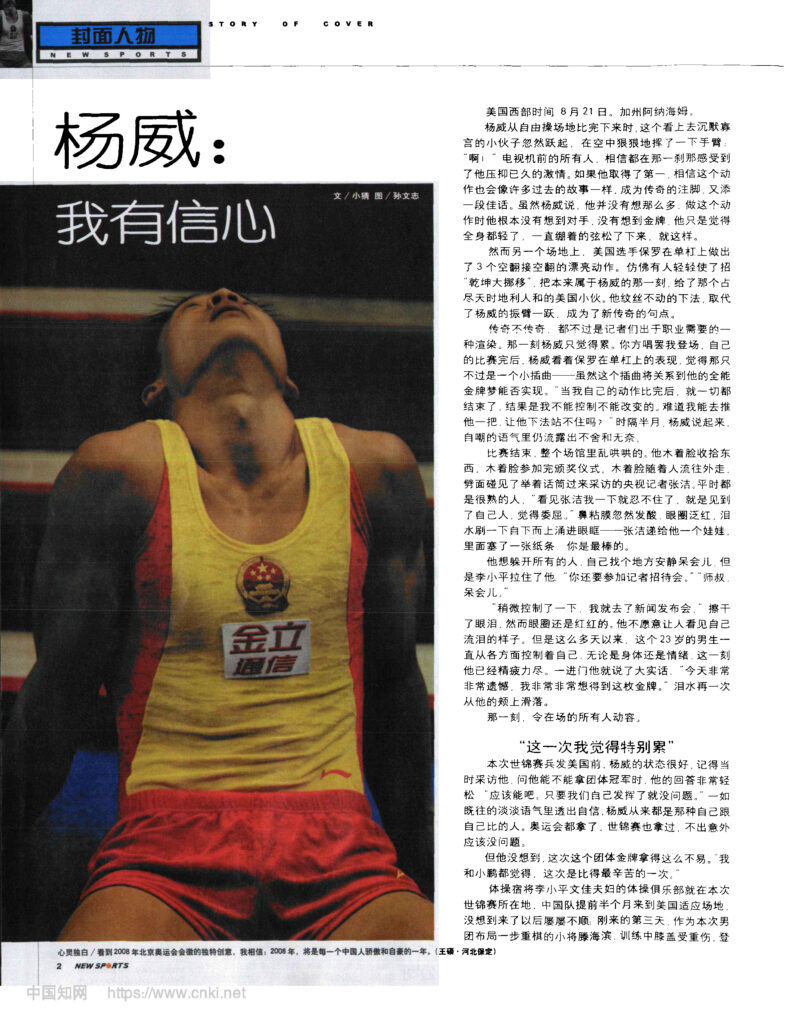
Yang Wei: I Have Confidence
August 21, Pacific time. Anaheim, California.
When Yang Wei came down from the floor exercise, this young man who normally seems so quiet and reserved suddenly leaped into the air and pumped his fist with all his might: “Yeah!” Everyone watching on television, one can be certain, felt in that instant the passion he had suppressed for so long. Had he taken first place, that gesture would surely have joined the ranks of legendary footnotes in gymnastics history, another glorious moment to be told and retold. Though Yang Wei says he hadn’t thought about any of that — when he made that gesture, he had no thought of his rivals, no thought of gold. He simply felt a lightness flood through him, the string that had been stretched taut for so long finally going slack. That was all.
But on another apparatus, the American Paul Hamm executed three beautiful release-and-catch moves on the high bar. It was as if some invisible hand had quietly worked a sleight of hand — “a shift of heaven and earth” — and delivered to that American boy, who had every advantage of home ground, the moment that had seemed destined for Yang Wei. His rock-steady landing dismount displaced Yang Wei’s leaping fist-pump as the defining image of a new legend.
Whether something is legendary or not is merely the way journalists color events for professional purposes. In that moment, Yang Wei only felt exhausted. One performer exits, and another takes the stage; once his own routines were done, Yang Wei watched Paul’s performance on the high bar and saw it as no more than a small digression — even though that digression would determine whether his dream of an all-around gold could be realized. “Once I’d finished my own routines, it was over — the result was something I couldn’t control or change. What was I supposed to do, go push him so he couldn’t stick his landing?” Half a month later, recounting it with self-deprecating humor, Yang Wei’s voice still carried the unmistakable weight of regret and resignation.
When the competition ended, the arena was in chaos. Blank-faced, he gathered his things; blank-faced, he got through the awards ceremony; blank-faced, he filed out with the crowd — and there, beside him, was CCTV reporter Zhang Jie, microphone extended. They knew each other well. “When I saw Zhang Jie, I couldn’t hold it together anymore — she was one of my own people, and I suddenly felt so wronged.” His sinuses burned, his eyes went red, tears surged upward into them — Zhang Jie handed him a little stuffed doll. Tucked inside was a slip of paper: You are the best.
He wanted to hide from everyone and find a quiet corner to be alone. But Li Xiaoping held him back. “You still have a press conference.” “Senior uncle — just a little while.”
“I controlled myself a bit, then went to the press conference.” He had wiped his tears, but his eyes were still red. He hated for anyone to see him cry. But for so many days now, this twenty-three-year-old had been holding himself together in every way — body and emotions alike — and at this moment, he was utterly spent. The moment he walked in the door, he told the plain truth: “Today I am deeply, deeply disappointed. I wanted this gold medal so much, so very much.” Tears slid down his cheeks once more.
In that moment, everyone present was moved.
“This Time I Felt Especially Exhausted”
Before the team departed for the World Championships in America, Yang Wei had been in excellent form. When interviewed at the time and asked whether the team could win gold, he had answered with easy confidence: “We should be able to. As long as we perform the way we can, there won’t be a problem.” His characteristic understated manner carried its usual self-assurance — Yang Wei had always been the kind of person who competes against himself. They had the Olympics; they had the Worlds before. Barring anything unexpected, it should be fine.
But he hadn’t expected this particular team gold to be so hard-won. “Xiaopeng and I both feel that this was the hardest competition we’ve ever fought through.”
Gymnastics veteran Li Xiaoping and his wife Wenjia have their gymnastics club in the same city where the World Championships were held; the Chinese team arrived in America two weeks early to acclimatize. But from the start, nothing went smoothly: just three days after arrival, Teng Haibin — a key piece in the men’s team strategy — suffered a serious knee injury in training, instantly throwing the entire team’s preparation into disarray. The training hall fell abruptly silent. “My heart sank. I thought, how can things be going this badly?”
For Yang Wei, worse was still to come. “That morning, Coach Huang had arranged some supplementary training, mainly to get used to the floor. The American spring floor has more ‘bounce’ than back home — your tumbling goes higher, which should be a good thing; I was the first to go, front flip into front flip, and my ankle just went crack.”
His first thought was: “Is it serious?” His second: “Even if it is, I’m competing no matter what.” On the surface, Yang Wei seems quiet and sparing with words, but when he does speak, he often says something striking — he has a dry wit, and with people he’s close to, he can be quite playful. But when it counts, the iron will inside him yields to no one. Falling apart under pressure was simply not something that had ever happened to him.
Ordinarily, an injury like this takes about a week to heal; with ten days still remaining before the competition, there was just enough time. That afternoon, to be safe, Yang Wei had the team doctor give him two injections to speed recovery. The next day, he began light movement; the day after that, gritting his teeth against the pain, he was back in training… By the time the competition began, the injury had largely healed.
But the real problem was not the ankle itself. It was the cumulative effect of injury after injury, which had cast a shadow over the young men’s confidence. At the Sydney Olympics, the four pillars of the team had arrived in full force and in high spirits — “it felt easy, like the gold was already ours.” But this time, of the original four stars, Huang Xu and Aowei were both not in peak form; the much-anticipated Haibin had suffered his serious injury; and now Yang Wei himself had gone down. Truly, only Xiaopeng was left standing. “This time we kept feeling like something was missing — hard to put into words, just a kind of energy that wasn’t there. In the past there was an unspoken cohesion; this time we were still united, no question, but the confidence just wasn’t quite there. And then the ‘633’ scoring format — we’d never competed under it before — there was always something a little off.”
No matter how his state of mind wavered, Yang Wei kept gritting his teeth, kept telling himself to hold on. And somehow, through all the setbacks, the team competition proceeded quietly according to the Chinese team’s plan. When the injured Haibin landed cleanly from the high bar, the Chinese boys fell into each other’s arms. Nobody else could know how hard-won this seemingly expected gold medal really was.
After the elation, Yang Wei waited in tense anticipation for August 21. That day, the Arrowhead Pond would be his stage.
“I Held On”
“The day before the all-around, I was very nervous, very excited — I couldn’t sleep. I kept thinking about the next day’s competition. I wanted this gold medal so badly. Of course, at the same time I worked to settle myself — after all these years, I know how to bring myself to a calm place.”
The first event was pommel horse. “The first event is crucial — if the first event goes well, the rest tends to follow.” At the 1999 Tianjin World Championships, Yang Wei had faltered on the first event, and it had affected everything that followed. “I absolutely have to hold it together on pommel horse!” Before going up, Yang Wei showed nothing outwardly, but inside, he shouted it with full force. 9.587 — a decent score.
Then came rings; his cross was slightly short, but he stuck the landing. 9.625. After two events, America’s Paul Hamm led with 19.325; Yang Wei was second with 19.212.
The third event was vault — Yang Wei’s strongest event, with a starting value of 10, and his primary opportunity to accumulate points. At the previous year’s individual World Championships, he had placed second on this event. The execution was very solid — aside from a small step on landing, his form in the air was near perfect. It was the best vault he had performed since arriving in Anaheim. By the rules, a small step means a 0.1 deduction, plus a little more for other things — not a 9.8 or 9.75, but “a 9.7 at the very least,” the Director of the Gymnastics Center Gao Jian murmured nearby. The score that came up was a shock: only 9.637 — lower than his previous two events. Still, it was enough to move him past Hamm into first place.
At this moment, the greatest pressure and threat Yang Wei faced came not from his rivals, not from the judges, but from his own body. For the past year, he had often felt completely drained after training — once he could simply sleep it off and be fresh the next morning, but now he invariably needed the team doctor’s massage and recovery treatment, or he simply couldn’t keep up. Throughout this competition, after each event, he sat quietly off to the side, not saying a word, conserving every scrap of energy. “Yes, I’m only twenty-three — I don’t feel old. But the fact that my stamina isn’t what it used to be is just a fact I have to face.” There was an unmistakable note of bitterness in his voice.
From start to finish, he never compared himself to anyone else, never gave a thought to who his rivals might be. “At this level, everyone is your competition. Thinking about it does no good — the first thing is to perform your own routines well.” Nor was he ever heard to complain about the judges, even though the role of judging in a scored sport like gymnastics goes without saying. “That’s not something I can control” — in this young man from Hubei, there is a quality of focused composure; he competes only against himself, and surpassing oneself is often harder than surpassing any rival.
He did it. Across six events, not one major error. On the final two events — high bar and floor — his body was running on empty, but he gritted his teeth and held on through both. On the floor exercise especially, his performance was quite beautiful; on the final tumbling pass — a tucked double-back with a 360-degree twist — he stuck it. One small step only. And just a few days earlier, in the qualifying round, he had made an error on that very same element.
In that moment, he felt his whole body had been hollowed out, as though he had become a shell, weightlessly adrift. And so the scene described at the opening of this article came to pass.
“I’m Very Much at Peace Now”
Interviewing Yang Wei felt deeply uncomfortable — making him go over and over experiences he would rather not revisit, pressing him for details — but he recounted everything with quiet composure.
After returning home, many people had talked with him, including his fellow Xiantao native and older brother Li Xiaoshuang. Xiaoshuang analyzed his performance carefully, pointing out the areas where he had fallen short: reinforcing his stronger events, improving landing stability, and refining his rings routine. “There are still eight months left — plenty of time!” That’s how Xiaoshuang encouraged his younger brother.
“And Coach Huang — what did Coach Huang say to you?”
“Coach Huang just said to get some rest first.” He paused, then added: “Between us, there’s no need for a lot of words. We understand each other.”
So he went home. He saw his beloved family. He ate his favorite dish — eel rice noodles — three bowls the first day, another two the day after. Then he had surgery for the sinus condition that had long troubled him, and rested properly and completely.
“I’m very much at peace now, truly. I don’t know whether that’s a good thing or not. Maybe I need to wait until we move into the new training facility — a change of environment to shake things up — before I can find that old fire again.”
New Sports, October 1, 2003
Text by Xiao Qing; Photos by Sun Wenzhi
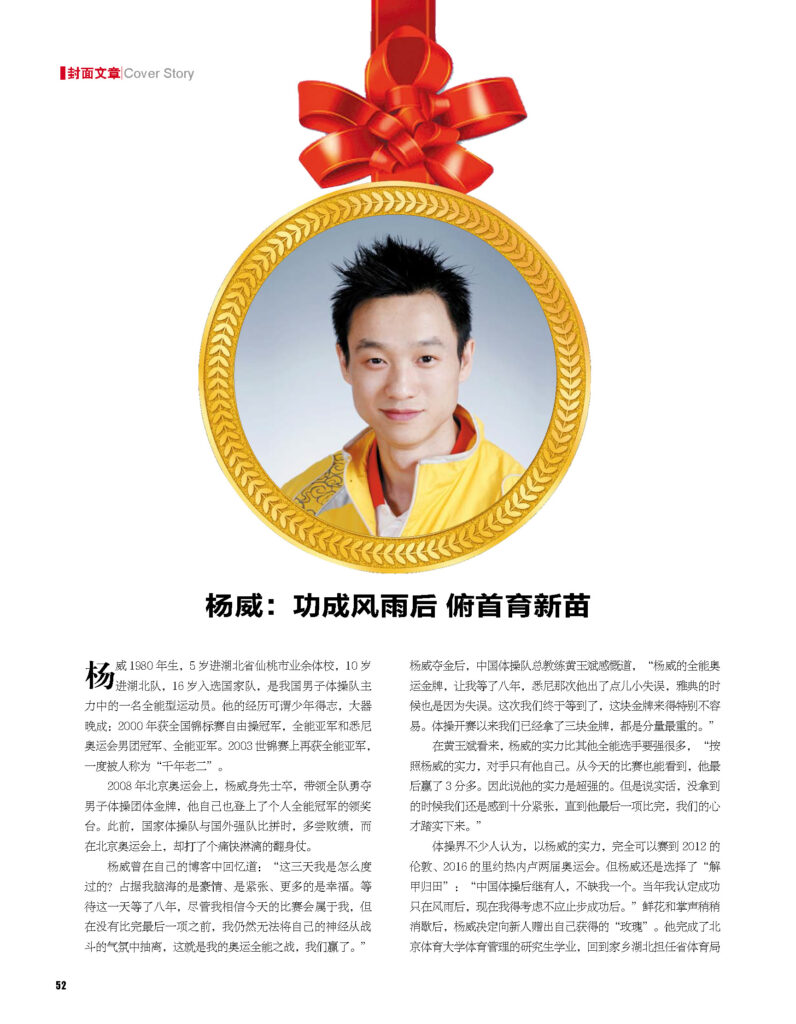
Yang Wei: After the Storm Comes Glory, Now Nurturing New Shoots
Yang Wei was born in 1980. At five, he entered the amateur sports school in Xiantao, Hubei; at ten, he joined the Hubei provincial team; at sixteen, he was selected for the national team. He was one of the all-around mainstays of China’s men’s gymnastics squad. His career was one of early promise fulfilled late: in 2000, he won the floor exercise title at the National Championships, took silver in the all-around, and won team gold and all-around silver at the Sydney Olympics. At the 2003 World Championships, he again took all-around silver, earning him the nickname “perennial runner-up.”
At the 2008 Beijing Olympics, Yang Wei led from the front, guiding the full team to men’s team gold, and himself stepped onto the podium as individual all-around champion. Before Beijing, the national gymnastics team had suffered repeated losses against the world’s strongest programs; in Beijing, they fought back decisively and triumphantly.
Yang Wei later wrote in his blog: “How did I get through those three days? What filled my mind was pride, tension, and above all, happiness. I had waited eight years for this day. Even though I believed this competition would be mine, until the very last event was finished, I could not pull my nerves free from the atmosphere of battle. That was my Olympic all-around fight — and we won.”
After Yang Wei’s gold, head coach Huang Yubin reflected with emotion: “Yang Wei’s all-around Olympic gold made me wait eight years. In Sydney, he had a small mistake; in Athens, again a mistake. This time, we finally got there — this gold was especially hard-won. Since gymnastics began at these Games, we have taken three golds, all of the heaviest weight.”
In Huang Yubin’s view, Yang Wei’s ability far surpassed those of other all-around contenders. “Given Yang Wei’s level, his only real opponent is himself. Today’s competition showed that. He won by more than three points in the end. [He won by 2.600.] His strength is simply exceptional. But honestly, until it was actually in hand, we were still very nervous. Only after his last event did our hearts finally settle.”
Many in the gymnastics world believed that Yang Wei, given his ability, could easily have competed through the 2012 London and 2016 Rio Olympics. But Yang Wei chose to lay down his arms and return to the fields: “China’s gymnastics has plenty of successors — they don’t need me. When I was young, I believed that success only comes after weathering the storm; now I have to think about what I should not stop at once success is achieved.” When the flowers and applause had faded somewhat, Yang Wei decided to pass on the roses he had received to the next generation. He completed a graduate degree in sports management at Beijing Sport University, then returned to his home province of Hubei to serve as deputy director of the gymnastics management center under the provincial sports bureau. After taking up the post, he led the Hubei team at the City Games and the National Gymnastics Championships, and the team produced a national champion. Yang Wei said happily: “I feel that children from Hubei are well-suited to gymnastics — the rate at which they develop into real athletes is high.”
Yang Wei spent twenty-six years as a gymnast; gymnastics is an indispensable part of his life. He appears to be in good physical condition, but says, “In reality, I carry many lingering injuries — the most serious are in my cervical spine and my ankles. While preparing for the Beijing Olympics, compression of blood vessels in the cervical spine caused dizziness and vertigo. Since retiring, I’ve kept up a weekly football match and occasionally play golf. Gymnastics demands both self-protection and risk-taking.”
In early 2012, Yang Wei spoke about his hopes for Xiantao, for Hubei, and for Chinese gymnastics: “Xiantao has already fulfilled its historic mission of achieving greatness under the national talent-development system. Today, both Xiantao and Hubei’s sports schools face the hard challenge of moving toward a market-oriented model and achieving sustainable development. The old non-market mechanism has run its course. Going forward, the way ahead must combine talent cultivation with market operation — forming a clear direction, surviving financially while still producing athletes, building a foundation for elite training, while also setting a good example for public fitness. Our sports schools need to expand enrollment, but coaches and facilities are both insufficient. Xiantao is relatively better off.”
Yang Wei’s relationship with gymnastics is layered and complex. The sport tests human willpower to an extreme degree — the relentless daily grind of suffering and endurance, the spatial instinct required in split seconds of flight — none of it can be dispensed with. Athletes must not only endure thousands of repetitions and hard falls; they must also bring their bodies to peak condition at the critical moment. So many factors, such brief and rare convergences of opportunity and luck, are what allow a very small number of people to achieve success. Yang Wei says, “On the road of gymnastics, I climbed step by step, and each stage is unrepeatable. I experienced an independence and maturity that went far beyond what my peers went through, and I grasped the opportunities that fate extended to me.”
Before he took up gymnastics, Yang Wei was sickly and not good at communicating with people. Gymnastics brought him into a world he could never have imagined and gave him physical and psychological health. He is deeply grateful to the sport for this, and considers it more important than any gold medal he has ever won.
“I am now deputy director of the provincial gymnastics management center — on the surface, it looks like I haven’t left my field, but in reality, there has been a fundamental change,” Yang Wei reflects. In the past, his role was primarily to be directed by others, and at most to manage himself and look after younger squad members; now it is everything — professional matters, administrative matters, important matters, and trivial ones — all requiring attention, including his obligations to his hometown of Xiantao. Where once his task was to make himself bloom, now it is to cultivate new shoots; where once he stood on the shoulders of those who came before him, now he is himself the shoulders lifting others up.
Yang Wei places particular emphasis on building a high-quality, well-educated team: “China’s gymnastics — and Xiantao’s gymnastics — has earned global renown. The task now is to sustain that standing, and sustaining it requires constant forward movement. Gymnastics has always started with children; when developing elite athletes, one absolutely cannot neglect their general education. More must be demanded of it, given greater weight, without allowing it to fall behind normal academic progress. This is not only to ensure that when athletes eventually retire, they have more options for integrating into society — even looking at it from a purely short-term, results-oriented perspective, cultivating excellent, high-achieving athletes requires them to have a solid cultural foundation; at minimum, they should not fall behind ordinary people. In today’s world, it is neither possible nor appropriate to isolate athletes in a training hall, cut off from society. They are connected to the internet at all times and face constant temptations. If you want them to form correct values from an early age and resist unhealthy influences, you must draw on the power of education and knowledge.”
With the intangible assets of his championship titles and gold medals, Yang Wei could probably have made quick money if he had gone into business. He jokes about it himself: “After retiring, I didn’t consider business, because I have always had a nature that thinks of others. If I tried to do business with a heart too soft to do what sometimes has to be done, I would probably lose money.”
People still remember Yang Wei and Yang Yun’s celebrated wedding vividly, but few know that they already have a child of over two years old. Yang Wei says: “I believe that Yang Yun and I can guide our child toward a correct outlook on life and on values. I feel that everyone’s life should include a period as an athlete, because that is an invaluable treasure. I go to the gymnastics hall every day now, and I bring my son along to do some basic training. Whether he makes gymnastics his career is for him to choose. Only the life one chooses for oneself is a life without regret.”
Money China, March 1, 2012
More Interviews and Profiles