On April 21, 1989, young gymnasts from mainland China and Taiwan competed against one another in Beijing, marking a historic moment in cross-strait relations. The occasion was the fourth Asian Junior Gymnastics Championships, but the significance of the competition extended far beyond gymnastics. For the first time in four decades of political separation, a sports delegation from Taiwan had traveled to the mainland to compete. People’s Daily, the official newspaper of the Chinese Communist Party, celebrated the visit as the beginning of a new chapter in cross-strait sports exchanges. Yet the seemingly straightforward act of sending a team to a gymnastics competition had required weeks of delicate negotiations over questions of national identity, political recognition, and even the Chinese translation of a team’s name.
The controversy began in February, when the Chinese Taipei Olympic Committee approved the Taiwan Gymnastics Association’s application to compete in Beijing. Taiwan’s Ministry of Education, however, returned the application for further consideration. At issue was the designation “Chinese Taipei,” the name under which Taiwanese athletes competed internationally. Although both sides had participated in dozens of international sporting events together, competing on Chinese soil presented a different problem: Should the delegation be called 中国台北 (Zhongguo Taipei) or 中华台北 (Zhonghua Taipei)? Both names could be translated into English as “Chinese Taipei,” but their political implications differed. Zhongguo referred to China as a state, potentially implying that Taiwan was subordinate to Beijing, whereas Zhonghua evoked a broader Chinese cultural and historical identity without explicitly placing Taiwan under the authority of the People’s Republic of China. Taiwanese officials sought assurances about which name would be used, and as the registration deadline approached, the unresolved dispute threatened to derail what could have been a landmark sporting exchange.
The breakthrough came on April 7, when Chinese Olympic Committee Vice President He Zhenliang announced that Taiwan would participate in the championships. Following negotiations in Hong Kong on April 4–5, mainland officials had agreed to respect Taiwan’s preferred Chinese designation, 中华台北 (Zhonghua Taipei), while both sides would observe International Olympic Committee rules governing names, flags, and anthems. He downplayed the linguistic dispute, arguing that the two Chinese renderings involved no fundamental difference in principle. Ten days later, a 27-member delegation of Taiwanese gymnasts, coaches, judges, and officials arrived in Beijing to an extraordinary reception. More than a hundred journalists gathered at the airport, where delegation leader Zhuang Xiushi expressed optimism about future cooperation, including the possibility of inviting mainland gymnastics coaches to Taiwan. “As long as we sit down and talk,” he declared, “no obstacle is insurmountable.”
The articles reproduced below trace this episode through the pages of People’s Daily, from the initial bureaucratic obstacles in February to the diplomatic breakthrough in April and the opening day of competition. They offer more than a record of gymnastics results. They reveal how sport became an instrument of soft diplomacy at a moment when direct exchanges between the two sides remained politically fraught.
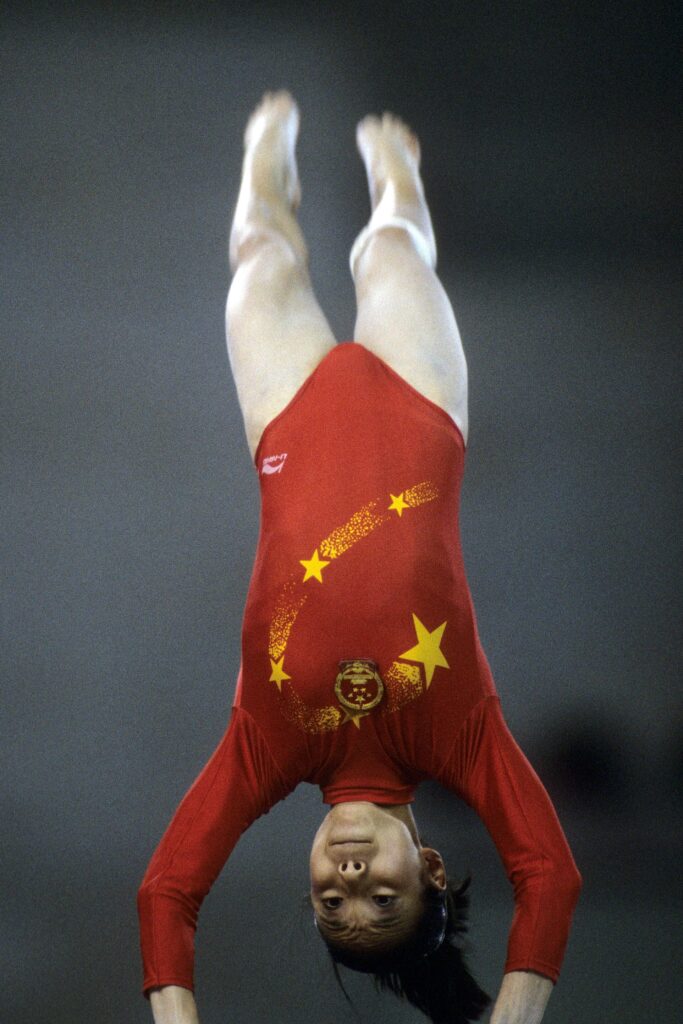
Zhang Xia won the all-around title at the 1989 Asian Junior Championships
Note: You can read a Taiwanese version of events here.
February 15, 1989
Taipei Olympic Committee Approves Application
Taiwan Gymnastics Association Likely to Compete on the MainlandChina News Service, Hong Kong, February 14
According to reports from Taipei, the Chinese Taipei Olympic Committee yesterday approved the Taiwan Gymnastics Association’s application to travel to the mainland to compete in the Asian Junior Gymnastics Championships, scheduled to be held in late April in Beijing. The application has been forwarded to Taiwan’s Ministry of Education (Taiwan) for final review.
The Taipei Olympic Committee’s review panel concluded that the application complied with all relevant regulations, including the invitation letter, competition rules, entry forms, and the association’s participation plan. The Taiwan Gymnastics Association emphasized that it would compete using the English designation “CHINESE TAIPEI” only, and not a Chinese-language name.
It is understood that the registration deadline for the Asian Junior Gymnastics Championships is March 10.
In addition to the Taiwan Gymnastics Association, Taiwan’s badminton, archery, and judo associations have also applied to compete on the mainland, where events in those sports are likewise scheduled to be held.
台北奥委会审查通过申请
台湾体操协会可望赴大陆参赛
中新社香港2月14日电 台北消息:台北奥委会昨天审查通过台湾体操协会赴大陆参加4月下旬在北京举行的亚洲青年体操赛的申请,该申请并送台湾“教育部”审核。
台北奥委会审查小组认为,台湾体协申请内容符合一切规定,包括比赛邀请函、竞赛规程、报名表、体协参加计划等,不过体协强调赴大陆参赛只使用英文CHINESETAIPEI”名称,而不用中文译名。
据悉,亚洲青年体操锦标赛报名截止日期是3月10日。
与台湾体操协会同时申请赴大陆参赛的还有台湾羽毛球、射箭、柔道等协会。上述项目的比赛也将在大陆举行。
February 17, 1989
Taiwan Education Authorities Return Gymnastics Association’s Application to Compete on the Mainland
China News Service, Hong Kong, February 16 — Taipei
Taiwan’s Ministry of Education (Taiwan), which oversees sports affairs, returned on February 14 the Taiwan Gymnastics Association’s application to participate in the Asian Junior Gymnastics Championships to be held in late April in Beijing. The move has sparked dissatisfaction in Taiwan’s public discourse.
The championships are scheduled for late April in Beijing, with a registration deadline of March 10. On February 13, the Chinese Taipei Olympic Committee approved the Taiwan Gymnastics Association’s application and forwarded it to the Ministry of Education for review. On February 14, Zhang Zhiman, Director-General of the Sports Department under the Ministry, phoned Li Qinghua, Secretary-General of the Taipei Olympic Committee, stating that the mainland’s position regarding the name under which Taiwan athletes would compete was unclear. On that basis, the Ministry returned the application for further study.
Taiwanese newspapers noted that the alleged “lack of clarity” refers to the Chinese-language rendering of “Chinese Taipei.”
On February 14, Yu Meili, Secretary-General of the Taiwan Gymnastics Association, said it was puzzling that Zhang Fengxu, President of the Taipei Olympic Committee, had recently told the association’s chairman Zhuang Xiushi at an IOC members’ meeting that a guarantee letter from the Asian Gymnastics Federation would suffice—yet the Ministry was now requesting a guarantee from the mainland side.
It is understood that among a series of international sporting events to be held on the mainland this year, ten competitions meet the conditions set by Taiwan’s authorities for participation by Taiwan athletes. The Taiwan Gymnastics Association’s application was the first to be approved by the Taipei Olympic Committee, but it too was rejected by the Ministry of Education. Taiwan’s China Times commented that this development casts a shadow over the future of cross-strait sports exchanges.
台湾教育当局退回体操协会赴大陆参赛申请
中新社香港2月16日电 台北消息:主管台湾体育事务的台湾“教育部”14日退回“台湾体操协会”参加将在北京举行的亚洲青年体操锦标赛的申请,此举引起台湾舆论的不满。
亚洲青年体操锦标赛定于4月下旬在北京举行,报名截止日期是3月10日。2月13日,台北奥委会审查通过了“台湾体协”参加该项比赛的申请,并将申请送台湾“教育部”审核。2月14日“教育部体育司司长”张至满打电话给台北奥委会秘书长李庆华,认为大陆对台湾运动员赴大陆参加比赛使用的名称问题所持态度不明确,退回“台湾体协”的申请,再作研议。
台湾报纸指出,所谓大陆方面的态度不明确,乃指“Chinese Taipei”的中文译名问题。
台湾体操协会总干事余美丽14日说,令人不解的是台北奥委会主席张丰绪在前不久的奥委会委员大会上,曾亲口答复体协理事长庄秀石,只要亚洲体操联合会的保证书即可,为什么现在又要大陆方面的保证书?
据悉,今年在大陆举行的一系列国际性体育比赛中,有10项比赛符合台湾当局规定的条件,可使台湾运动员参加。台湾体操协会申请赴大陆参赛案,是台北奥委会审查通过的首件申请,但都被台湾“教育部”打了回票。台湾《中国时报》说,这给海峡两岸体育交流的未来蒙上了一层阴影。
April 5, 1989
Chinese Taipei Registers for Asian Junior Gymnastics Championships
Participation Hinges on the Chinese Name UsedXinhua News Agency, Beijing, April 4 (Reporter Wang Jiuxun)
The Chinese Gymnastics Association announced today that the relevant bodies of the Chinese Taipei Olympic Committee have registered with the Asian Gymnastics Union to participate in the Asian Junior Gymnastics Championships, scheduled for April 21–23 in Beijing.
Whether athletes from Chinese Taipei will ultimately travel to compete will depend on the Chinese-language name used by the delegation. At present, sports organizations on both sides of the Taiwan Strait are conducting consultations through appropriate channels regarding this issue.
中国台北报名参加亚洲青年体操赛 能否成行取决于参赛使用的中文名称
中国台北报名参加亚洲青年体操赛
能否成行取决于参赛使用的中文名称
新华社北京4月4日电 (记者王久荪)中国体操协会今天宣布,中国台北奥委会有关机构已通过亚洲体操联盟报名参加订于4月21日至23日在北京举行的亚洲青年体操锦标赛。
中国台北运动员能否成行参加这次锦标赛,还将取决于参赛队使用的中文名称。目前中国海峡两岸的体育有关组织正通过适当途径就此问题磋商。
April 8, 1989
Asian Junior Gymnastics Championships to Be Held in Beijing
Taiwan to Compete Under the Name “Chinese Taipei Team”Beijing, April 7 — Reported by Wang Dazhao
At a press conference this morning, He Zhenliang, Vice President of the Chinese Olympic Committee, announced that Taiwan will send a team to participate in the Asian Junior Gymnastics Championships, to be held in Beijing from April 21 to 23, as well as other Asian single-event championships to take place subsequently on the Chinese mainland.
He Zhenliang explained that sports officials from both sides of the Taiwan Strait, acting in a spirit of seeking common ground while reserving differences, held multiple rounds of friendly consultations. On April 4–5, representatives from both sides met formally in Hong Kong, where they agreed that when Taiwan athletes and sports officials participate in official competitions, meetings, and activities organized by international sports bodies, they should comply with the International Olympic Committee regulations regarding flag, anthem, and name. The English designation is “Chinese Taipei.”
The Chinese Olympic Committee respects Taiwan’s customary Chinese rendering of the name and will use “中华台北队” (Chinese Taipei Team) as the official designation for Taiwan’s delegation.In response to questions from journalists from the mainland, Taiwan, Hong Kong, and Japan, He noted that outside China there is no issue of Chinese-language translation; last year alone, both sides jointly participated in 43 international sports activities. As for competitions held within China (including Taiwan), whether the Chinese name is rendered as “中国台北” or “中华台北” involves no difference in principle. Many mainland organizations also use the term “中华,” such as the 中华全国体育总会 (All-China Sports Federation). “中华,” he emphasized, is not a designation exclusive to any single group of Chinese people.
亚洲青年体操赛即将在京举行
台湾以“中华台北队”名称参赛
本报北京4月7日讯 记者汪大昭报道:中国奥委会副主席何振梁今天上午在新闻发布会上宣布,台湾将派队参加4月21日至23日在北京举行的亚洲青年体操锦标赛以及随后在大陆举行的其他单项亚洲锦标赛。
何振梁透露,海峡两岸体育界官员本着求同存异的精神,多次进行友好协商。4月4日至5日,双方代表在香港正式会晤中议定,台湾运动员和体育界人士参加国际体育组织举行的正式比赛、会议和活动,应遵守国际奥委会关于旗、歌、名称的规定,英文为Chinese Tai pei。中国奥委会尊重台湾方面中文名称的习惯译法,以“中华台北队”作为台湾参赛队的正式名称。
何振梁在回答中国大陆、台湾以及香港、日本记者提问时说,由于在中国以外的地区比赛不存在中文译名问题,仅去年双方就共同参加了43起国际体育活动。至于在中国境内(包括台湾)比赛,中文名称是“中国台北”还是“中华台北”,译法上没有原则区别。大陆的不少组织也用“中华”的名称,如中华全国体育总会。“中华”不是某一部分中国人所特用的名称。
April 17, 1989
Cross-Strait Sports Exchanges Open a New Chapter
Taipei Junior Gymnastics Team Arrives in Beijing for the Asian Junior Gymnastics ChampionshipsBeijing, April 17 — By Miao Lu, this newspaper —
This afternoon, sports exchanges across the Taiwan Strait opened a new chapter. The Chinese Taipei Youth Gymnastics Team, crossing a separation of forty years, arrived in Beijing to reunite with compatriots on the mainland.The delegation, composed of 27 athletes, coaches, judges, and sports officials, is in Beijing to compete in the 4th Asian Junior Gymnastics Championships. The delegation head is Zhan Jide, Deputy Secretary-General of the Chinese Taipei Olympic Committee; the team leader is Zhuang Xiushi, Chairman of the Chinese Taipei Gymnastics Association and a member of the Chinese Taipei Olympic Committee. All members entered the mainland using Taiwan Compatriot Permits.
Officials from the Chinese Olympic Committee, including Deputy Secretary-General Tu Mingde, and from the Chinese Gymnastics Association, including Secretary-General Feng Jibo, were present at the airport to welcome the delegation.
海峡两岸体育交流揭开序幕
台北青年体操队抵京
参加亚洲青年体操锦标赛
本报北京4月17日讯 记者缪鲁报道:今天下午,海峡两岸体育交流揭开了新的一页。中国台北青年体操队跨越了40年的阻隔,来到北京,和大陆同胞欢聚一堂。
由27名运动员、教练、裁判和体育官员组成的这支运动队是前来参加第4届亚洲青年体操锦标赛的。团长为中国台北奥委会副秘书长詹基德、领队是中国台北体操协会理事长、台北奥委会委员庄秀石。他们均持台胞证入境。
中国奥委会副秘书长屠铭德、中国体操协会秘书长冯冀柏等到机场迎接。
April 17, 1989
Warm Affection, One Family
— A Side Note on the Arrival of the Chinese Taipei Youth Gymnastics Team in BeijingAmid dazzling camera flashes, sports exchanges across the Taiwan Strait opened a new chapter.
At around 4:00 p.m. on April 17, the Chinese Taipei Youth Gymnastics Team, a delegation of 27 members, appeared in the satellite terminal of Capital Airport. More than a hundred Chinese and foreign journalists, already waiting to record this historic moment, spontaneously formed a grand welcome scene. Microphones and tape recorders thrust forward like a sudden forest of raised arms.
The delegation head, Zhan Jide, an official of the Chinese Taipei Olympic Committee, said excitedly, “I never expected such a large welcome.” Team leader Zhuang Xiushi, chairman of the Chinese Taipei Gymnastics Association, turned back to pull a young gymnast forward and joked, “It’s their first time facing such a big scene — they’re a bit overwhelmed.”
Travelers in the airport were drawn by the moment and joined in with their cameras. In the warm atmosphere, officials from the Chinese Taipei youth team answered questions from reporters one by one.
Zhuang Xiushi spoke candidly: “Asian gymnastics is developing very rapidly. Compared with others, our level is not high, but at this Asian Junior Championships we are confident of reaching the top ranks in certain events.” He then confirmed a remark made by a Taiwanese journalist: “Given this situation, we plan to invite high-level mainland gymnastics coaches to Taipei to help raise our standards as quickly as possible.” He added that he was confident such cooperation could be achieved, noting that “the fact that we are here in Beijing this time is the best example — as long as we sit down and talk, no obstacle is insurmountable.”
Delegation head Zhan Jide also outlined the team’s schedule in Beijing: “We will give our all in the competition. Afterward, we plan to visit the Great Wall, the Ming Tombs, and the Forbidden City. We also hope to observe the upcoming China Cup International Gymnastics Competition.”
— By Miao Lu, this newspaper
情意融融一家亲
——中国台北青年体操队抵京侧记
在令人目眩的闪光灯强光辉映下,海峡两岸体育交流揭开了新的一页。
4月17日下午4时许,由27人组成的中国台北青年体操队出现在首都机场卫星厅。早已守候在那里等着记录这一历史时刻的百余名中外记者无形中组成了盛大的欢迎场面。他们蜂拥而上,举着话筒、录音机的胳膊犹如平地冒出的密林。中国台北奥委会官员、詹德基团长兴奋地说:“真没想到,欢迎场面如此盛大。”庄秀石领队则回身揽过后边的一位小队员,开玩笑道:“他们初次经历这种大场面,都不知所措了。”正在机场的中外游客们为这个场面所吸引,也纷纷掏出相机,加入记者行列。在热烈的气氛中,中国台北青年体操队的官员,逐一回答了记者们的发问。
庄秀石坦率地说:当前,亚洲体操水平发展很快,相比之下,我们水平不高,但这次亚洲青年锦标赛上,我们有信心在个别项目上进入前列。接着,他证实了一位台湾记者的说法,“鉴于这种情况,我们打算邀请高水平的大陆体操教练赴台北执教,以尽快提高我们的运动水准。”他说,“对此,他同样充满信心,相信两岸的奥委会会就此达成协议。因为这次能够成行北京本身就是最好的例子。只要坐下来谈,没有什么障碍不能消除的。”
詹德基团长还详细地介绍了该队在京的具体安排,他说,“我们将全力以赴参加比赛,但在赛后,打算让小队员们游览长城、十三陵、故宫,此外,还希望能观摩即将举行的中国杯国际体操赛。”
本报记者 缪鲁
(附图片)
April 20, 1989
Asian Junior Gymnastics Championships Open Today
Host Nation Warmly Welcomes Friends from Across Asia
Beijing, April 20 (by staff reporter Miao Lu)
This evening, the State Physical Culture and Sports Commission held a grand reception in Beijing to welcome the athletes, coaches, and sports officials attending the Fourth Asian Junior Gymnastics Championships.
A total of seven teams are participating in this competition: North Korea, Iraq, Iran, Japan, South Korea, Chinese Taipei, and China. The championships will be held in Beijing from April 21 to 23. All delegations arrived by yesterday and have already begun their pre-competition training. Artistic gymnastics will be included in the program for the first time at this edition of the championships.
At the reception, Yoshiharu Koguchi, Secretary-General of the Asian Gymnastics Association, expressed his gratitude to the Chinese Gymnastics Association for hosting the event. He said that thanks to the organizers’ support, Asia’s leading gymnastics teams have gained a valuable opportunity to warm up ahead of next year’s Asian Games, and he expressed hope that the competitors would perform at their best and contribute to raising the standard of gymnastics in Asia.
Prior to the reception, Wu Shaozu, Director of the State Physical Culture and Sports Commission, and He Zhenliang, President of the Chinese Olympic Committee, met with the heads and team leaders of the seven delegations. Also attending the evening event was Wu Ching-kuo, Vice President of the Chinese Taipei Olympic Committee, serving as the representative of Juan Antonio Samaranch, President of the International Olympic Committee.
Samaranch Sends Congratulatory Message on Asian Junior Gymnastics Championships
Beijing, April 19 (Xinhua)
A reporter learned this evening from the State Physical Culture and Sports Commission that IOC President Juan Antonio Samaranch, from Lausanne, Switzerland, sent a telegram to IOC Executive Board member and Chinese Olympic Committee President He Zhenliang, conveying his warm congratulations on the upcoming Fourth Asian Junior Gymnastics Championships, to be held in Beijing.
In the telegram, Samaranch also entrusted He Zhenliang and IOC member and Vice President of the Chinese Taipei Olympic Committee Wu Ching-kuo to serve as his official representatives at the championships.
Mr. Wu Ching-kuo and his wife arrived in Beijing this evening via Hong Kong.
亚洲青年体操锦标赛今日开始
东道主热情欢迎各方朋友
本报北京4月20日讯 记者缪鲁报道:今晚,国家体委在京举行大型招待会,欢迎前来参加第四届亚洲青年体操锦标赛的运动员、教练员和体育官员。
参加这届赛事的共有七支代表队,它们是朝鲜、伊拉克、伊朗、日本、南朝鲜、中国台北和中国队,比赛将于21日至23日在北京举行。各参赛队均已于昨天之前到达,并先后开始了赛前训练。这届比赛将首次列入艺术体操项目。
在招待会上,亚洲体操协会秘书长古口良治向主办此次比赛的中国体操协会表示感谢。他说,由于主办者的支持,亚洲各体操劲旅得以在明年亚运会前有了一次宝贵的热身机会,他希望参赛选手大显身手,为提高亚洲体操运动水平作出自己的贡献。
国家体委主任伍绍祖、中国奥委会主席何振梁等在招待会前会见了七支代表队的团长和领队。国际奥委会主席萨马兰奇的代表、中国台北奥委会副主席吴经国也参加了今晚的这一活动。
萨马兰奇电贺亚洲青年体操锦标赛
新华社北京4月19日电 记者今晚从国家体委获悉,国际奥委会主席萨马兰奇从瑞士洛桑打电报给国际奥委会执委、中国奥委会主席何振梁,对即将在北京举行的第四届亚洲青年体操锦标赛表示热烈祝贺。
萨马兰奇还在电报中委托何振梁和国际奥委会委员、中国台北奥委会副主席吴经国作为他的代表,出席第四届亚洲青年体操锦标赛。
吴经国先生及其夫人今晚经香港抵达北京。
April 21, 1989
Gymnastics Juniors from Both Sides of the Strait Compete on the Same Floor
Chinese Men’s Team Captures First Two Titles
Beijing, April 21 (by staff reporter Wang Dazhao)At the 1989 Asian Junior Gymnastics Championships, which began this afternoon, Chinese athletes displayed a clear advantage. They not only captured the men’s team title and swept the top three places in the men’s individual all-around, but also took commanding leads in both the first round of the rhythmic gymnastics team competition and the rhythmic gymnastics individual all-around preliminaries.
In the men’s artistic gymnastics team competition, the top three teams were China, South Korea, and North Korea.
The top three finishers in the men’s individual all-around were all Chinese athletes: Ma Jun, Nong Qiang, and Huang Huadong.Although attendance at the Capital Indoor Stadium was modest, spectators showed strong interest in the Chinese Taipei gymnastics team, which appeared here for the first time. Cheer squads frequently applauded and shouted encouragement as athletes from both sides of the Taiwan Strait competed on the same apparatus.
Experts observing the competition noted that this new Asian team possesses a certain level of strength. Nearly all of its athletes were able to complete high-difficulty elements such as the L-sit cross on rings. However, due to insufficient consistency, the team narrowly lost to North Korea by just 0.15 points, missing a place on the men’s team podium.
All participants in this competition are under 18 years of age, and the standout performers are likely to become important contenders at the next Olympic Games. Among the notable routines, Guo Linyue of China performed a double-somersault to an upper-arm hang on parallel bars with excellent execution, while Ma Jun’s one-and-a-half forward somersault over the high bar to regrasp was particularly impressive.
海峡两岸体操小将同场竞技
中国男队先夺两项冠军
本报北京4月21日讯 记者汪大昭报道:在今天下午开始的1989年亚洲青年体操锦标赛上,中国选手显示出很大优势,不仅获得了体操比赛男子团体冠军和个人全能前三名,在艺术体操第一轮团体赛和个人全能预赛中也遥遥领先。
体操男子团体前三名依次为中国队、南朝鲜队和朝鲜队,个人全能前三名依次为中国选手马俊、农强和黄华东。
尽管首都体育馆内观众不多,但对首次出现在这里的中国台北体操队仍然很感兴趣,拉拉队不时为海峡两岸选手同台角逐高声助威。行家们发现这支亚洲体坛新军有一定实力,几乎个个都能完成像吊环直角十字支撑这样的高难动作,只是稳定性不够,才以0.15分的微小分差输给朝鲜队,没能登上男子团体赛的领奖台。
参加这次比赛的都是18岁以下的年轻运动员,其中的佼佼者很可能是下届奥运会体操比赛的生力军。中国选手国林跃的双杠空翻两周挂臂、马俊的单杠前空翻一周半越杠抓杠都做得很漂亮。
April 22, 1989
Asian Junior Gymnastics Championships, Day Two
Chinese Women Add Four More Gold Medals
Beijing, April 22 (by staff reporter Wang Dazhao)
On the second day of competition at the Asian Junior Gymnastics Championships, the Chinese women’s team swept all gold medals in the events they entered.
In the six-person rhythmic gymnastics group exercise, the only event not contested by China, Japan won its first gold medal of the championships. The Chinese Taipei team placed second in this event, earning its first podium finish of the competition.
In the women’s artistic gymnastics team and individual all-around competitions, the scores among several teams were tightly contested for much of the day. However, as rival teams began to commit errors, the Chinese athletes Zhang Xia, Li Yan, Wu Lei, and Li Yifang delivered increasingly steady performances. Zhang Xia recorded the highest score of the past two days, earning 9.875 on uneven bars. The Chinese team ultimately pulled away decisively to claim the team gold medal, with North Korea and Japan taking second and third place respectively.
Zhang Xia also captured the women’s individual all-around title with a total score of 39.025 points.
The rhythmic gymnastics competition, which was included for the first time in the Asian Junior Gymnastics Championships, concluded today as well. China, North Korea, and Japan finished first through third in the team standings. In the individual all-around, China’s Bai Mei and Liu Yu won the gold and silver medals, while Han Liangyu of North Korea took the bronze.
亚洲青年体操锦标赛第二天
中国女将又添四枚金牌
本报北京4月22日讯 记者汪大昭报道:亚洲青年体操锦标赛第二天的比赛,中国姑娘在所参加的各项角逐中,夺尽金牌。中国队没有参加的艺术体操集体项目6人带操比赛,日本队取得了锦标赛开始以来的第一块金牌。中国台北队也有所获,名列该项第二位,首次踏上了领奖台。
在女子体操团体和个人全能比赛中,几个队的积分一度咬得较紧。在对手接连出现失误的情况下,中国队的张霞、李燕、吴蕾和李亦芳反而发挥得更好,张霞在高低杠上获得了两天来的最高分9.875分。中国小将终于以较大优势甩开追兵,获得团体冠军。朝鲜队和日本队分获第二、三名。张霞还以39.025分夺得个人全能冠军。第一次列为亚洲青年体操锦标赛项目的艺术体操比赛今天结束了赛事。中国队、朝鲜队和日本队分获团体前三名。中国的白梅和刘宇包揽了个人全能的金、银牌,朝鲜的韩良玉获得第三名。
April 23, 1989
Event Finals at the Asian Junior Gymnastics Championships
China Claims Six Event Titles
Beijing, April 23 (Xinhua)
In the event finals held this evening at the Asian Junior Gymnastics Championships, the Chinese team captured six of the ten individual titles contested in men’s and women’s artistic gymnastics.
Chinese men’s gymnast Nong Qiang delivered an outstanding performance, winning three gold medals. He took first place outright in floor exercise and rings, and shared the pommel horse title with his teammate Huang Huadong. Another Chinese gymnast, Ma Jun, performed a series of high-difficulty skills on horizontal bar, including a one-and-a-half somersault release move, earning 7.825 points, the highest score of the evening, and winning the event title.
The parallel bars title went to Bae Gil-su of North Korea, while the vault gold medal was claimed by Yoo Hong-chul of South Korea.
In the women’s events, China’s Zhang Xia and Japan’s Sugane Mari each won two championships. Zhang Xia dominated the floor exercise and uneven bars, while Sugane Mari impressed on vault and balance beam.
Competing on the mainland for the first time, the Chinese Taipei team recorded its best individual results through Zhang Fengzhi, who finished fourth in both men’s floor exercise and pommel horse.
It was also revealed that the Chinese Taipei Gymnastics Association has expressed interest in hosting the next edition of the championships.
亚青体操赛单项之争
我获六项冠军
据新华社北京4月23日电 中国队今晚夺得亚洲青年体操锦标赛男女十个单项中的六个冠军。中国男队的侬强今晚表现出色,一人独得3枚金牌。他在自由体操和吊环上独占鳌头,并与队友黄华东并列鞍马第一。中国队的马俊在单杠上成功地完成了空翻一周半越杠抓杠等高难动作,获得了7.825的今晚全场最高分,夺得了这个项目的冠军。
朝鲜队的裴吉洙获双杠第一名,男子跳马金牌被南朝鲜队的俞洪哲夺走。
在女子项目的争夺中,中国队的张霞和日本队的小管麻里各夺得两项冠军。张霞在自由体操和高低杠比赛中一枝独秀,小管麻里则在跳马和平衡木上表演出色。
首次赴大陆参赛的中国台北队在单项比赛中的最好名次是张峰治,他在男子自由体操和鞍马中都名列第四。
据透露,目前中国台北体操协会有意举办下届赛事。
April 24, 1989
Asia’s Gymnastics Talent Pipeline Shows Progress
Coach Gao Jian Reviews the Asian Junior Gymnastics Championships
Beijing, April 23 (Xinhua — reporter Bi Jing)
As the Asian Junior Gymnastics Championships concluded, the reporter interviewed Gao Jian, head coach of the Chinese national gymnastics team, this evening at the competition venue. Gao said that this meet served as an inspection of Asia’s reserve gymnastics talent and that, overall, the outlook was encouraging, with clear improvement compared to the past.
Gao recalled: “In 1975, I led a team to the second Asian Junior Championships in the Philippines. Many of the young athletes who competed back then later became the backbone of their national teams—Japan’s Gushiken, Sotomura, Kajitani, among others. Those gymnasts went on to compete against us for a full decade.” He added, “The age requirements for the men at this competition are younger than before. If these athletes are trained well, they will begin to grow and mature as early as next year’s Asian Games.”
Asked about the Chinese team’s performance, Gao said: “The men performed somewhat better than the women, with fewer mistakes. Some of these athletes can be absorbed into our first-line national squad, which would help ease the problem of gaps between generations on the men’s side. In this competition, our team performed especially well on parallel bars, pommel horse, and horizontal bar, and some routines are at world-class level.”
He cited specific examples: Guo Linyue’s parallel bars dismount with a double back salto to arm hang and his piked front salto release on horizontal bar; Nong Qiang’s back salto with 180-degree twist over the bar to catch on horizontal bar; and Huang Huadong’s pommel horse sequence of Thomas flairs to handstand with turn, followed by a Thomas spindle.
Regarding the women’s competition, Gao observed that the overall level among the teams was relatively even, with the strongest squads being China, North Korea, and Japan. “From the competition, North Korea looked quite good,” he said, “but made too many mistakes and therefore finished behind China. Among these three teams, several promising gymnasts emerged, showing strong ability and high-difficulty skills.” He pointed to Kim Gwang-suk of North Korea, who performed a giant swing with a 540-degree turn connected to a front salto on uneven bars, and Japan’s Sugane Mari, whose floor exercise routine both began and ended with a piked full-twisting salto, making it especially distinctive.
When asked about the performance of the Chinese Taipei team, Gao responded: “For their first appearance in this competition, they performed very well—better than I had expected. Their men’s team defeated Japan and finished only 0.25 points behind third-place North Korea, which shows they already have a certain level within Asia. Colleagues from Taipei hope to strengthen technical exchanges with us. We are very willing to do so. When conditions are ripe, they could come to train with us, and we could also go to Taiwan to give lectures, run training courses, and conduct teaching.”
Gao concluded by noting that, judging from this competition, the young athletes are still not fully mature—especially in strength-intensive events such as rings. In addition, many issues remain with fundamentals and basic technique. “For example,” he said, “the Japanese women have good difficulty, but their execution is not standardized, which makes it hard to reach the very highest level.” Finally, he emphasized that the overall base of gymnastics development in Asia remains relatively narrow, with only four or five strong teams. “More countries and regions need to take up the sport,” he said, “so that the level can continue to rise.”
亚洲体操后备力量有长进
高健教练评述亚洲青年体操锦标赛
新华社北京4月23日电(记者毕靖)在1989年亚洲青年体操锦标赛结束之际,记者今晚在赛场边访问了中国体操队总教练高健。他说,本次比赛是对亚洲体操后备力量的一次检阅,从总体上看还不错,比过去有不少长进。
高健说:“1975年我带队去菲律宾参加第二届亚洲青年锦标赛,当时参赛的年青选手,后来都成为各国的主力。如日本的具志坚、外村、梶谷等。这些选手后来与我们对抗了十年之久。”“这次比赛,男队的年龄要求比过去小,这些选手如果训练得好,明年亚运会就会开始成长和成熟起来。”
记者问到中国队的情况,高指导说:“男队相对比女队好一些,失误少,其中有些队员将可以充实到我国一线队伍中去,以缓解男队青黄不接的局面。在这次比赛中,我队在双杠、鞍马、单杠中表现出色,有些动作具世界一流水平。如国林跃的双杠后空翻两周挂臂、单杠屈体前空翻越杠抓杠,侬强的单杠后空翻转体180度越杠抓杠,黄华东的鞍马托马斯倒立转体接托马斯全旋等。”
关于女子比赛,高健认为,参赛各女队实力比较平均,最强的是中国、朝鲜和日本队。从比赛看出,朝鲜队相当不错,可惜失误较多,居中国队之后。这三个队中出现了一些好手,她们能力强,有不少动作难度很高,如朝鲜队的金光淑,她在高低杠上表演了大回环转体540度接前空翻;日本小管麻里的自由体操成套动作以屈体旋开始,屈体旋结束,也很突出。
记者问:“这次比赛中国台北队表现如何?”高健回答说:“中国台北队第一次参加比赛表现很不错,比我预想的要好得多。男队战胜日本队,比第三名朝鲜队仅差0.25分,在亚洲已有一定水平。台北的同行们希望加强与我们之间的技术交流。这一点,我们是非常愿意的,一旦条件成熟他们来我们这里训练也可以,我们去台湾讲学、开办学习班和教学都可以。”
高指导最后说,当然,从本次比赛看,年轻选手尚不成熟,尤其像吊环那样的力量性较强的项目。另外,基本功、基本技术也有不少问题,像日本女队,动作难度不错,但不规格,很难上到最高水平。另外,亚洲体操运动的发展面还小一点,只有那么四五个队,还需要有更多的国家和地区开展这项活动,提高水平。
Results
MAG
| Place | Team | Score |
|---|---|---|
| 1 | China | 171.40 |
| 2 | South Korea | 165.30 |
| 3 | North Korea | 164.60 |
| 4 | Chinese Taipei | 164.45 |
| 5 | Japan | 163.45 |
| 6 | Iran |
| Place | Gymnast | Team | Score |
|---|---|---|---|
| 1 | Ma Jun (馬駿) | China | 56.50 |
| 2 | Nong Qiang (儂強) | China | 56.45 |
| 3 | Huang Huadong (黃華東) | China | 56.15 |
| 4 | Lee Ju-hyung (李周炯) | South Korea | 55.95 |
| 7 | Chang Feng-chih (張峰治) | Chinese Taipei | 55.15 |
| 8 | Chen Han-ting (陳翰廷) | Chinese Taipei | 54.95 |
WAG
| Place | Team | Score |
|---|---|---|
| 1 | China | 115.475 |
| 2 | North Korea | 112.875 |
| 3 | Japan | 112.475 |
| 4 | Chinese Taipei | – |
| 5 | South Korea | – |
| Place | Gymnast | Team | Score |
|---|---|---|---|
| 1 | Zhang Xia (張霞) | China | 39.025 |
| 2 (tie) | Li Yan (李燕) | China | 38.125 |
| 2 (tie) | Kosuge Mari (小管麻里) | Japan | 38.125 |
| 2 (tie) | Kim Gwang Suk (金光淑) | North Korea | 38.125 |
| 5 | Wu Bei (吳蓓) | China | 37.550 |
| 6 | Choe Gyong-hui (崔京姬) | North Korea | — |
| 7 | Hiramoto Takako (平元貴子) | Japan | — |
| 8 | Pak Mi-yong (朴美英) | North Korea | — |