On the afternoon of April 17, 1989, a flight touched down at Beijing Capital International Airport carrying a Taiwanese delegation, including fifteen young gymnasts, their coaches and judges, and three representatives of the Chinese Taipei Olympic Committee (CTOC), dispatched to handle whatever might go wrong. It had taken nine months of policy-making and negotiation, a secret trip to Beijing by the gymnastics association’s chairman, an argument over a single Chinese character, and back-channel talks between Olympic officials from both sides in Hong Kong to get them there.
As the delegation stepped off the plane at Gate 5, it was met at the cabin door by Tu Mingde, deputy secretary-general of the mainland Olympic Committee, one of the officials who had just returned from Hong Kong, where he had helped negotiate the terms of the visit. He shook hands with Chan Te-chi, the delegation head, and said one word: “Welcome.”
Reporters from Taiwan, Hong Kong, and the local press crowded into the VIP lounge, their cameras flashing. Tu would later describe the Taiwanese reporters as “fierce and sharp.” But even he seemed moved by the occasion. “Forty years of history,” wrote Yun Ta-chih, the Minsheng Daily‘s special correspondent in Beijing, “condensed in an instant.”
Outside, along the airport roadside, willow catkins drifted through the spring air like snow.
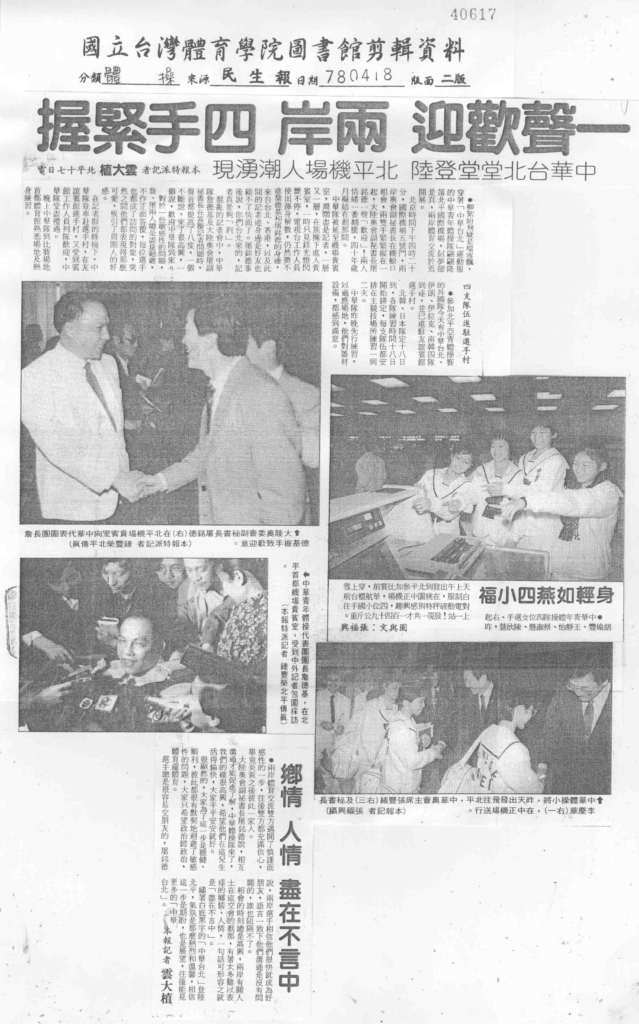
Minsheng Daily, April 18, 1989
Eighteen years earlier, another group of athletes had helped open a diplomatic door that had long been closed. In April 1971, an American table tennis team visited the People’s Republic of China, setting in motion what became known as ping-pong diplomacy; Richard Nixon followed to Beijing the next year. The comparison was irresistible in the spring of 1989, though the Minsheng Daily‘s own editorial page resisted it: Taiwan’s athletes, it pointed out, had already competed alongside the mainland’s more than a hundred times at venues abroad. What was new was the venue. Still, the underlying idea was much the same: sport could create opportunities for contact where politics had made direct engagement nearly impossible.
The division dated to 1949, when Chiang Kai-shek’s Nationalist government, defeated by Mao Zedong’s Communists in the civil war, retreated to Taiwan. Two governments—the People’s Republic of China in Beijing and the Republic of China in Taipei—each claimed to rule all of China. In 1971, the United Nations gave China’s seat to Beijing. The Olympic movement had its own, older version of the dispute. It dated to the 1952 Helsinki Games, and for decades it kept one side or the other away from the Olympics. It was settled in 1981, when the International Olympic Committee and Taiwan’s Olympic Committee agreed on the name “Chinese Taipei.” Taiwanese athletes could compete internationally without either side abandoning its position—but not under Taiwan’s flag or anthem.
By the late 1980s, relations across the strait were beginning to change. Taiwan lifted martial law in 1987, and restrictions on contact with the mainland gradually eased. The Asian Junior Gymnastics Championships, scheduled for April 1989 in Beijing, would test whether the two sides could agree on the basic conditions of an exchange.
The greatest obstacle was not travel, security, or even the prospect of Taiwanese athletes competing in Beijing. It was what the mainland would call them.
II.
But “in principle” was not a travel itinerary. When the gymnastics association applied that October to send a team to a meet in Shenzhen, the CTOC set the application aside: there were not yet any rules under which it could say yes. The rules came by the end of the year, and they ran in one direction only. Taiwanese teams could go to the mainland; mainland teams could not come to Taiwan.
By then, the gymnastics association had another invitation in hand: the Asian Junior Gymnastics Championships, April 21–23, 1989, in Beijing. The association wanted to go, and the government was increasingly willing to let it. But first, officials in Taipei needed assurances about how the team would be identified once it arrived.
What followed was a dispute over a single Chinese character that threatened to derail the entire exchange.
III.
Under the 1981 Olympic agreement, Taiwan competed internationally as “Chinese Taipei.” The agreement fixed the English name but said nothing about the Chinese one, and the two sides read it differently. Taipei rendered it 中華台北 (Zhōnghuá Táiběi); Beijing generally preferred 中國台北 (Zhōngguó Táiběi). The difference was a single character, 華 versus 國, but it carried real weight. Zhonghua evoked a broad Chinese cultural and historical identity without placing Taiwan under the authority of the People’s Republic. Zhongguo referred more directly to China as a state, implying that Taiwan was subordinate to Beijing. For officials in Taipei, one formulation preserved the ambiguity of Taiwan’s negotiated Olympic status; the other threatened to undo it.
Gymnastics seemed to offer a way around the problem. At its 1986 congress in Seoul, the Asian Gymnastics Union had resolved that “Chinese Taipei,” in English, was the standard name for Taiwan’s association. In early 1989, as the Chinese Taipei Gymnastics Association prepared its application to compete in Beijing, the AGU’s secretary-general, Ryoji Taniguchi, provided a written pledge on that basis: only the English name would be used at the championships.
The pledge was meant to settle the matter. Instead, the parsing began. The association’s chairman, Chuang Hsiu-shih, telephoned Taniguchi for clarification. During the call, Taniguchi told him: the guarantee ran both ways. The AGU would ensure that only “Chinese Taipei” was used; Taiwan, in turn, must use no language but English. The guarantee that kept 中國台北 off the scoreboard also meant giving up 中華台北.
The Chinese Taipei Olympic Committee approved the application on February 13 and sent it to the Ministry of Education. The next day, the ministry sent it back.
Its director of physical education returned the file in person, with no written ruling. The AGU’s guarantee, the ministry reasoned, bound only the federation. Beijing had said nothing about using English alone in all of its publications, and its Asian Games bulletins already called Taiwan 中國台北 rather than 中華台北, Taiwan’s preferred nomenclature. For the Ministry of Education, a promise from the AGU was no substitute for a commitment from Beijing.
The gymnastics association was exasperated. Its secretary-general, Yu Mei-li, told the Minsheng Daily that the CTOC’s president, Chang Feng-hsu, had personally assured Chuang that the AGU’s guarantee would suffice. Why, she asked, was there now a demand for a guarantee from the mainland side as well? “One moment they want this guarantee,” she said, “the next moment that one.” The shifting requirements had left the association, she said, like someone reaching for the head of a twelve-foot monk, a Chinese expression for utter bewilderment.
On February 17, the Minsheng Daily’s Yun Ta-chih wondered whether even a guarantee from Beijing would settle the matter. His commentary ran under the headline “Once We Have the Guarantee, Can We Go to the Mainland?” The subheading was equally telling: “Individual Associations at a Loss.”
The next day, Education Minister Mao Kao-wen made the condition explicit: if the mainland guaranteed that it would not call the team 中國台北, it could go. But he did not authorize the CTOC to negotiate with Beijing. Finding a way to negotiate took another month.
IV.
On March 19, barely a month before the championships, Chuang Hsiu-shih boarded a Cathay Pacific flight to Beijing via Hong Kong. Before leaving, he told reporters he was going only to understand the situation, not to negotiate. His visit was kept quiet: the mainland gymnastics association handled his registration at the Qianmen Hotel. On the morning of March 20, he spent three hours with representatives of the All-China Sports Federation, the mainland Olympic committee, and the mainland gymnastics association. Their discussions covered the name, reception arrangements, and the competition itself. A dispatch from Beijing put the whole visit at thirty-two hours.
In between, he visited the Capital Gymnasium, the competition venue, an 18,000-seat arena with, he noted approvingly, good equipment, and the Friendship Hotel, which would serve as the athletes’ village. He also met Li Ning and Lou Yun, the mainland’s most celebrated gymnasts, both of whom were in Beijing.
He returned optimistic. The mainland, he told reporters, had agreed that the team could compete as 中華台北. Asked what name the mainland itself would use for the team, he would not say.
The next morning, Chuang briefed Lee Ching-hua, the CTOC’s secretary-general, behind closed doors. When the two men came out to face reporters, Lee told a different story: according to what Chuang had brought back, the mainland had not yielded an inch. The government’s condition stood. Wherever the organizers used Chinese—on documents, results sheets, name cards, signs, announcements—it had to read 中華台北.
A column on the same page explained the gap. Through other channels, the mainland had already set out its terms: Taiwan could call itself 中華台北 and wear the name on its uniforms, but the card carried in the parade of teams, and the announcer’s voice, would say 中國台北, the mainland’s preferred nomenclature. A dispatch from Beijing was blunter still. The two sides, senior mainland Olympic officials said, remained seriously divided.
V.
Even before Chuang’s trip, the talks had moved into Olympic channels. Wu Ching-kuo, Taiwan’s IOC member, had been meeting secretly in Hong Kong with He Zhenliang, the mainland’s IOC member and Olympic Committee vice chairman. He would confirm only that the two sides were talking.
Then, on the morning of April 7, the two sides announced simultaneously—in Taipei and in Beijing—that an agreement had been reached. The Chinese Taipei gymnastics team would compete on the mainland under the name 中華台北, Taiwan’s preferred nomenclature.
Who had brokered it, neither side would say. The intermediary, both Olympic committees told reporters, was a Chinese businessman based in Hong Kong, with good relations on both sides and a direct line to the highest levels of mainland decision-making. Hong Kong newspapers guessed at names; neither committee confirmed any of them.
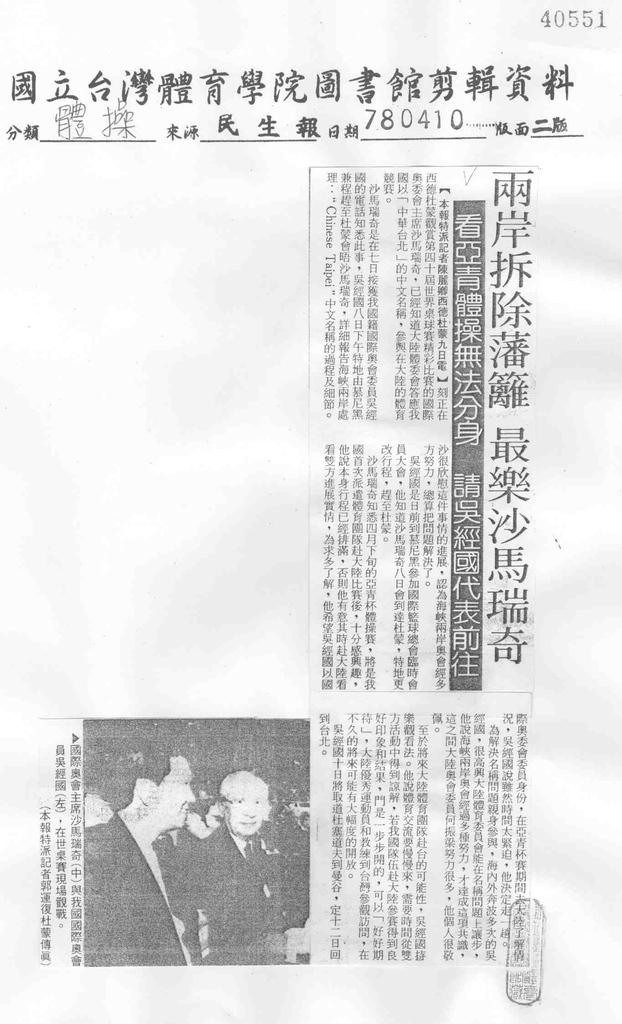
On April 7, Wu Ching-kuo telephoned Samaranch with news of the breakthrough. Wu was in Munich for a meeting of the International Basketball Federation; knowing Samaranch would reach Dortmund, where the World Table Tennis Championships were under way, the next afternoon, he changed his plans and went to brief him in person. The IOC president was delighted. His schedule was too full for him to attend the gymnastics championships, so he asked Wu to go in his place, as an IOC member, and see for himself how things stood between the two sides. He later named He Zhenliang as well, making the two men his representatives and the IOC’s observers in Beijing. Wu, for his part, gave much of the credit to his mainland counterpart. He Zhenliang had worked very hard, he said, and he admired him greatly.
VI.
On April 16, the day before departure, the Chinese Taipei Junior Gymnastics Team assembled for a flag ceremony and press conference. Under the age rule Taipei had been sent, every gymnast had been born between the last day of 1974 and the end of 1977. The oldest were fourteen. The youngest, Chen Hsin-hui, was a sixth-grader who had not yet turned twelve when she won her first international meet, in Vancouver ten weeks earlier, against adult opponents.
Chang Feng-hsu, chairman of the CTOC, handed the national flag and the association flag to the delegation head, Chan Te-chi, and then spoke to the children who would carry the weight of the occasion. Don’t lose sight of the pure spirit of sport, he told them, simply because all eyes are on you. Compete with a plain and ordinary heart. In your conduct and speech, embody the dignified manner befitting a nation of propriety (禮儀之邦).
The instructions behind the words were concrete. The gymnasts were to answer no questions about anything but sport, family, and school. Their clothing, belongings and gifts were to carry no flags or political messages. At banquets, they were to sing not patriotic songs but “High Green Mountains” (高山青). Diplomats spend careers learning where the landmines lie; these children were given a short list of rules and told to be polite.
Even the flags would stay out of sight. During the team’s time on the mainland, the Minsheng Daily reported, both would be put away, making it “the first team to go out and compete without carrying its flags.”
The next morning, the delegation boarded its flight. For forty years, no team from Taiwan had competed on the mainland. The first one would be made up of children.
VII.
At Gate 5 of Beijing Capital Airport, where the flight landed at 4:20 p.m., the scene that greeted the delegation was notable for what was absent. There were no welcome banners for “Chinese Taipei”—no slogans, no decorations. According to Tu Mingde, deputy secretary-general of the mainland Olympic Committee, there was no special program for the team at all; the mainland was treating every delegation alike. It also meant that no one had to commit, in a public place, to any rendering of the name in Chinese characters. Passengers, airport staff and locals touting for business watched the unusual group of travelers with curious eyes.
In the crush of the VIP lounge, Chan Te-chi and Tu fielded questions, both men raising their voices to be heard. One kept saying how happy the team was to be there; the other kept welcoming it. Whenever a question turned political, both sidestepped it.
Asked about the “Chinese Taipei” name placard and directional signage, Tu said they had been placed in a “confidential location” and could not be viewed in advance. Why the secrecy? Tu declined to explain, saying only that it was “of course necessary.” The Taiwanese had no way of knowing whether the placard said what the agreement required it to say.
The team boarded a bus for the Friendship Hotel, which served as the athletes’ village, and was welcomed by the hotel staff. That evening, it went to the Capital Gymnasium for its first practice session and pronounced itself satisfied with the equipment.
VIII.
On April 18, the placard surfaced, and it read 中華台北, Taiwan’s preferred nomenclature. The organizers’ printed documents used the same name. “We will abide by our promises,” a mainland Olympic official told reporters.
Not everything had reached Taipei as cleanly. At the team leaders’ meeting that evening, Chuang Hsiu-shih learned that two notices sent by the organizers on April 10—one adding a fourth apparatus to the rhythmic program, one changing the age limit for the women’s competition—had never arrived. The rhythmic problem was easily solved: the meeting let every gymnast count her best three of four apparatus, so Taiwan’s could skip the hoop. The age limit was not. Two strong gymnasts left at home under the old rule turned out to have been eligible after all. Chuang protested and lost.
In the gymnasium that evening, practicing alongside the mainland team, the Chinese Taipei women moved through their routines. Chen Hsin-hui lost her grip transitioning to the low bar. Then Tsai Shu-hui, on a double back salto dismount from the high bar, struck her head on the bar on her way down. The meet’s medical staff rushed over immediately, checking for concussion—taking her blood pressure, checking her pulse. Yun Ta-chih, watching from the hall, was moved by what he called the “compatriot warmth” in the care they showed. Tsai was not seriously hurt, but she had given the coaches a scare: with only four women on the team, and the rules requiring four to compete while counting the top three scores, one injury would be costly.
IX.
The opening ceremony of the Asian Junior Gymnastics Championships was held on the evening of April 21 at the Capital Gymnasium, before an audience of nearly eight thousand. Red banners reading “Go China!” were scattered through the stands. Among the spectators were members of visiting-relatives groups from Taiwan—an irony available only in that particular spring: families separated for forty years, watching young athletes from both sides of the strait compete in the same arena under the name that had taken so long to agree upon.
When the teams entered, they marched behind their name placards in this order: Japan, Chinese Taipei, South Korea, North Korea, the mainland, Iran, and the rest of the field. The “Chinese Taipei” placard—the object of nine months of negotiations—was rendered in red characters: simplified Chinese on the upper line, English on the lower. 中華台北. Chinese Taipei. Everything on it said what it was supposed to say. The agreement had held.
The Chinese Taipei team’s appearance generated the biggest cheer from the audience—”the atmosphere in the arena reached a boiling point,” the Minsheng Daily reported. He Zhenliang and Wu Ching-kuo, the two IOC members dispatched by Samaranch, watched from the stands. The Minsheng Daily‘s correspondent noted, with quiet satisfaction, that the advertising hoardings around the arena had been supplied almost entirely by Taiwanese companies—so that “at first glance, one felt as if one were in Taipei’s Chunghwa Gymnasium.”
X.
The competition itself was, by any honest assessment, a measure of how much ground the Chinese Taipei program still had to cover. The mainland’s dominance was nearly total, and no one—not the coaches, not the reporters, not the expert commentators—pretended otherwise.
In the men’s team event, the mainland won, South Korea took second, and North Korea third. Chinese Taipei finished fourth, just 0.15 points behind North Korea and a full point ahead of Japan, a team with a long tradition in Asian and world gymnastics. Several of the men were nursing minor injuries, yet on the final apparatus, the high bar, every one of them hit his routine. It left them 0.15 short of a medal.
| Place | Team | Score |
|---|---|---|
| 1 | China | 171.40 |
| 2 | South Korea | 165.30 |
| 3 | North Korea | 164.60 |
| 4 | Chinese Taipei | 164.45 |
| 5 | Japan | 163.45 |
| 6 | Iran |
| Place | Gymnast | Team | Score |
|---|---|---|---|
| 1 | Ma Jun (馬駿) | China | 56.50 |
| 2 | Nong Qiang (儂強) | China | 56.45 |
| 3 | Huang Huadong (黃華東) | China | 56.15 |
| 4 | Lee Ju-hyung (李周炯) | South Korea | 55.95 |
| 7 | Chang Feng-chih (張峰治) | Chinese Taipei | 55.15 |
| 8 | Chen Han-ting (陳翰廷) | Chinese Taipei | 54.95 |
In the women’s team event, the mainland again won, but not easily. Its gymnasts fell repeatedly on their first apparatus, the balance beam—“their coaches’ faces went green,” the Minsheng Daily reported—and after the first rotation North Korea led. Every North Korean gymnast opened her floor routine with a full-twisting double back, a sight that set the other teams’ coaches’ hearts pounding. On uneven bars, North Korea’s Kim Gwang Suk swung a giant with a 540-degree turn straight into a front-salto release; she went on to tie for second in the all-around. The mainland regained the lead and held it, winning by 2.6 points. Chinese Taipei finished fourth of five. Its bright moment came on beam, where Chen Hsin-hui performed a back handspring connected to two back saltos for a 9.4 that lifted the whole team.
| Place | Team | Score |
|---|---|---|
| 1 | China | 115.475 |
| 2 | North Korea | 112.875 |
| 3 | Japan | 112.475 |
| 4 | Chinese Taipei | – |
| 5 | South Korea | – |
| Place | Gymnast | Team | Score |
|---|---|---|---|
| 1 | Zhang Xia (張霞) | China | 39.025 |
| 2 (tie) | Li Yan (李燕) | China | 38.125 |
| 2 (tie) | Kosuge Mari (小管麻里) | Japan | 38.125 |
| 2 (tie) | Kim Gwang Suk (金光淑) | North Korea | 38.125 |
| 5 | Wu Bei (吳蓓) | China | 37.550 |
| 6 | Choe Gyong-hui (崔京姬) | North Korea | — |
| 7 | Hiramoto Takako (平元貴子) | Japan | — |
| 8 | Pak Mi-yong (朴美英) | North Korea | — |
In the event finals, Chang Feng-chih, the team’s most consistent performer, placed fourth on both floor exercise and pommel horse. His pommel routine—three Thomas flairs and a finishing handstand pirouette—was, in Yun Ta-chih’s words, “smooth and unobstructed from beginning to end.” Chen Hsin-hui, who might have contended for the beam gold, placed fifth with a 9.325, a score the Minsheng Daily‘s correspondent thought too low for a routine with three D-level skills.
Zou Limin, formerly the mainland’s best horizontal bar gymnast and now a national team coach, thought that the Taiwanese men’s team had deserved third. Watching the Chinese Taipei men in person had surprised him: they were considerably better than he had heard. Their difficulty was already at international standard, and their build, flexibility and explosive power were strong. What they lacked was training volume and competition experience—too few meets, too little time on the podium under pressure. The gap to North Korea, he said, was not large.
The rhythmic gymnastics program was the most lopsided. In the team event, Chinese Taipei finished last of five. The one bright spot came in the six-person group ribbon, where only Chinese Taipei and Japan competed. Chinese Taipei took silver—”better than nothing,” as Yun Ta-chih put it with admirable economy.
The Minsheng Daily’s own verdict, a week later, was blunt: the athletes always fell “just a little short of perfection,” and that small margin kept them off the podium.
The mainland took twelve gold medals. Chinese Taipei left with fourth place in both team events and a single silver: in absolute terms, a modest return; in the context of what it had taken to get there, something else entirely.
XI.
Around the competition, a different contest was under way—one for human connection, conducted with considerably more warmth than the results table suggests.
Jiang Yumin, a former mainland record holder in the women’s 100 meters and now a member of its Olympic committee, put it simply. If the Chinese and the Japanese could become friends after all that had passed between them, she told the Minsheng Daily’s correspondent, how much more so the two sides of the strait, “who are the same family.” She hoped the Taiwanese would come this time, and that mainland athletes could one day go the other way. “That,” she said, “would be true exchange.”
Deng Yaping—sixteen years old, nicknamed “Little Deng,” freshly returned from winning the women’s doubles gold at the World Table Tennis Championships in Dortmund—had not known the gymnastics team was coming. She had been away in West Germany for nearly a month. When Yun Ta-chih told her that the Taiwanese gymnasts would arrive in two days, she could not conceal her delight. He asked: If you had the chance to compete in Taiwan one day, would you go? “Of course,” she said, without hesitation.
At a banquet he gave for Wu Ching-kuo at the Beijing Hotel, He Zhenliang—the mainland IOC member who had worked out the name agreement with Wu in Hong Kong—made the same point to Taiwanese reporters. Exchange had to run both ways, he said. The natural next step was for mainland athletes to compete in Taiwan; only then could the bond between compatriots truly be strengthened.
The reciprocity question was the one that everyone knew had no near-term answer. Under Taiwan’s policy, mainland athletes—most of whom were Communist Party members—faced restrictions on entry to Taiwan that the current framework had no mechanism to dissolve. Tu Mingde, deputy secretary-general of the mainland Olympic Committee, put his hand on Yun Ta-chih’s shoulder and said: “Don’t be so pessimistic. We’re more optimistic than you are.” The correspondent, filing his notebook piece on April 23, remained skeptical. “The key obstacle,” he wrote, “lies in the flag and anthem problem, which is not easy to overcome.” He saw one way out: don’t host international championships. That way, no mainland flags could be required to fly over Taiwan, no mainland anthem could be required to play. It was, he wrote, the easiest excuse for keeping mainland teams away.
XII.
On April 27, ten days after they had arrived, the Chinese Taipei gymnasts flew home. They left behind more than their results. A team of teenagers—the youngest of them a sixth-grader—had set the pattern for every Taiwanese team that would follow.
The day after the gymnasts left Taipei, the CTOC announced that all future delegations to the mainland would follow their model: a committee official traveling alongside to handle the protocol, guidance on dress and gifts, and orders to compete and come straight home. Eleven teams were expected to make the crossing that year. When the table tennis association, next to go, proposed staying on to watch the China Open in Shanghai, the committee told it not to. Adult athletes and officials were now following a path laid down by teenagers.
Not everyone in Taipei was ready to celebrate. The Minsheng Daily’s own editorial page had warned against reading too much into one gymnastics meet, or treating it as a template for everything that followed. Yun Ta-chih was more hopeful. “A good beginning is half the battle,” he wrote from Beijing on the eve of the team’s departure. “Future delegations will surely find the path even smoother.”
If they did, it was because fifteen young athletes had walked it first.
XIII.
There is one thing that the archived Minsheng Daily clippings on the April 1989 gymnastics trip do not mention: the Chinese Taipei delegation had arrived in Beijing just as the protests that would culminate in the Tiananmen Square massacre were beginning.
On April 15, two days before the team’s departure from Taipei, Hu Yaobang, the former general secretary of the Chinese Communist Party, died at the age of seventy-three. Hu had been a leading advocate of political and economic reform, but he was forced from office in 1987 after conservative party leaders accused him of being too tolerant of student demonstrations. To many young Chinese, he represented the possibility of a more open and democratic society. His death became a rallying point for frustrations that had been building for years: government corruption, rising inflation, restrictions on free expression, and the slow pace of political reform.
Students began gathering in Tiananmen Square to mourn Hu. What started as a memorial soon became a protest movement. Students demanded greater freedom of speech and the press, an end to official corruption, and a dialogue with the country’s leaders. On April 17, the day the gymnastics delegation arrived, the first large student marches reached the square. On April 22, while the Taiwanese gymnasts were competing at the Asian Junior Championships, some 100,000 people, by most estimates, gathered for Hu’s official memorial service. Demonstrations were spreading to other Chinese cities.
The movement continued to grow. On April 26, the Communist Party’s official newspaper, the People’s Daily, condemned the demonstrations as a threat to political stability. The following day, April 27, an estimated hundred thousand students marched through Beijing in defiance of the authorities. It was one of the largest demonstrations the capital had yet witnessed.
That was the day the Chinese Taipei delegation returned home.
None of this appears in the archived gymnastics coverage in the Minsheng Daily. Whether correspondent Yun Ta-chih witnessed the demonstrations, whether any of the twenty-four members of the delegation understood what was unfolding around them, the surviving reports do not say. Yet at least one Taiwanese journalist who traveled to Beijing that April was paying close attention to what was happening beyond the gymnastics arena.
Hsieh San-tai (謝三泰), a photojournalist for the Independence Evening Post, had been dispatched to cover the gymnastics championships and other events in Beijing. According to his later recollections, the student demonstrations were already underway when he arrived. Rather than going to his hotel, he headed straight to Tiananmen Square, still carrying his luggage.
Hsieh remained in Beijing for more than a month as the demonstrations grew. When his newspaper urged him to return to Taiwan because of safety concerns, he resigned rather than leave. His photographs would not be published as a collection until thirty years later, in a book titled Howling 1989 (吼叫一九八九).
Two Taiwanese newspapers sent journalists to Beijing during the same historic opening across the Taiwan Strait. One surviving account tells the story of young gymnasts competing under a name that had taken months to negotiate. The other documents the beginnings of a political movement that would end in bloodshed.
Both stories were unfolding in the same city, at the same time.
Notes
1. A note on sources and perspective: This reconstruction draws primarily from the archives of the Minsheng Daily (民生報), a major Taipei-based newspaper, and reflects the perspective of the Republic of China—Taiwan—on these events as they were reported and understood at the time. The principal correspondent on the ground in Beijing was Yun Ta-chih (雲大植). A companion piece will examine the same events through the lens of People’s Daily reporting.
2. You can read a retrospective from the Taiwan Times here.
3. The FIG voted to admit the People’s Republic of China (i.e., mainland China) in 1978.
Appendix A: A Timeline of Taiwan’s Decision to Participate
| Date | Summary |
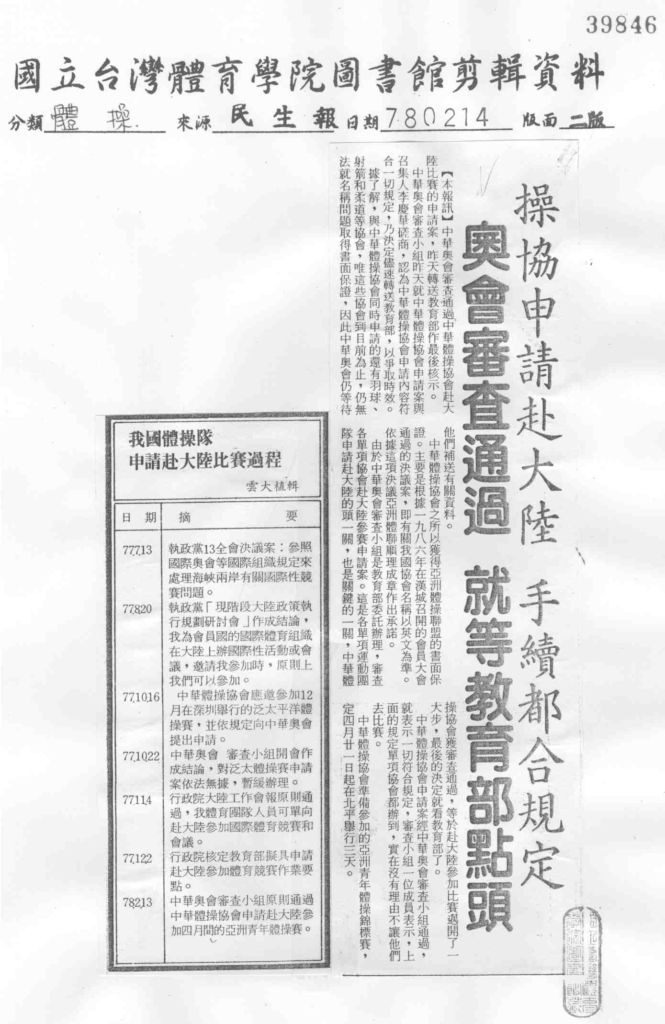
| July 13, 1988 | Resolution of the ruling party’s 13th Plenary Session: to handle cross-strait matters relating to international competitions by reference to the regulations of the IOC and other international organizations. |
| August 20, 1988 | The ruling party’s “Seminar on the Implementation Plan for Current Mainland Policy” reached a conclusion: when international sports organizations of which we are a member hold international events or meetings on the mainland and invite us to participate, we may in principle attend. |
| October 16, 1988 | The Taiwanese Gymnastics Association was invited to participate in the Pan-Pacific Gymnastics Competition to be held in Shenzhen in December, and submitted an application to the Taiwanese Olympic Committee per regulations. |
| October 22, 1988 | The Taiwanese Olympic Committee review committee convened and concluded that the Pan-Pacific Gymnastics Competition application lacked legal basis, and deferred processing. |
| November 4, 1988 | The Executive Yuan Mainland Affairs Council in principle approved that our sports teams may travel unilaterally to the mainland to participate in international sports competitions and meetings. |
| December 22, 1988 | The Executive Yuan approved the Ministry of Education’s draft operational guidelines for applying to travel to the mainland to participate in sports competitions. |
| February 13, 1989 | The Taiwanese Olympic Committee review committee in principle approved the Taiwanese Gymnastics Association’s application to travel to the mainland to participate in the Asian Junior Gymnastics Championships in April. |
Appendix B: A Few Articles from the Minsheng Daily
February 5, 1989
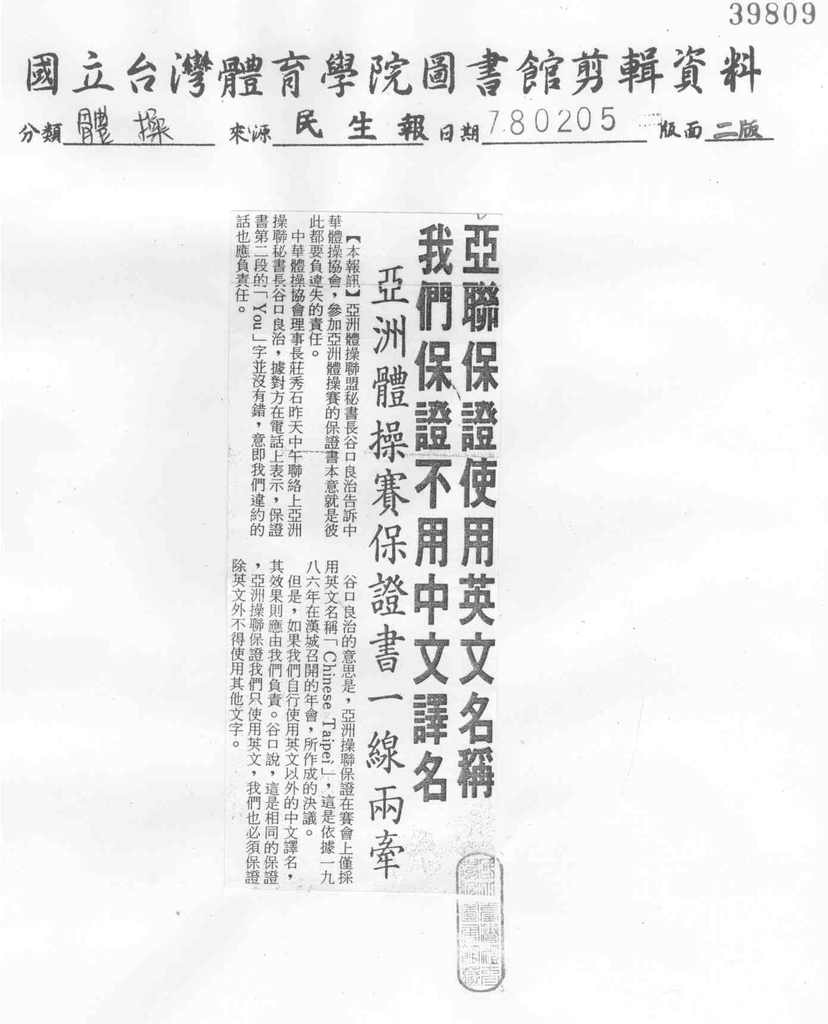
Asian Union Guarantees the English Name; We Guarantee Not to Use a Chinese Version
Asian Gymnastics Championships pledge binds both sidesStaff report. Taniguchi Ryoji, secretary-general of the Asian Gymnastics Union, has told the Chinese Taipei Gymnastics Association that the pledge required for entry to the Asian Gymnastics Championships was always meant to hold both parties responsible for any breach.
Chuang Hsiu-shih, chairman of the Chinese Taipei Gymnastics Association, reached Taniguchi by telephone at noon yesterday. Taniguchi said the word “You” in the second paragraph of the pledge was not a mistake. It means that if we break the agreement, we too are responsible.
Taniguchi explained that the AGU guarantees only the English name “Chinese Taipei” will be used at the competition, in line with a resolution adopted at its 1986 annual congress in Seoul.
If we use a Chinese-language version of the name other than the English one on our own initiative, however, we must bear the consequences. Taniguchi said the guarantee runs both ways: the AGU guarantees that only English will be used for us, and we in turn must guarantee that we will use no language other than English.
Headline: 亞聯保證使用英文名稱 我們保證不用中文譯名
Subhead: 亞洲體操賽保證書一線兩牽
【本報訊】亞洲體操聯盟秘書長谷口良治告訴中華體操協會,參加亞洲體操賽的保證書本意就是彼此都要負違失的責任。
中華體操協會理事長莊秀石昨天中午聯絡上亞洲操聯秘書長谷口良治,據對方在電話上表示,保證書第二段的「You」字並沒有錯,意即我們違約的話也應負責任。
谷口良治的意思是,亞洲操聯保證在賽會上僅採用英文名稱「Chinese Taipei」,這是依據一九八六年在漢城召開的年會,所作成的決議。
但是,如果我們自行使用英文以外的中文譯名,其效果則應由我們負責。谷口說,這是相同的保證,亞洲操聯保證我們只使用英文,我們也必須保證除英文外不得使用其他文字。
March 19, 1989
Can We Cross the Strait for the Gymnastics Meet? Chuang Hsiu-shih Goes for Talks Today
Staff report. Can Taiwan compete in the Asian Junior Gymnastics Championships in Peiping? Chuang Hsiu-shih, chairman of the Chinese Taipei Gymnastics Association, is flying to the mainland today to find out.
Chuang takes a Cathay Pacific flight at 4 p.m. today, flying to Peiping via Hong Kong. The leaders of the gymnastics associations on the two sides of the Strait will meet on the 20th.
Minister of Education Mao Kao-wen and Chinese Taipei Olympic Committee Secretary-General Lee Ching-hua received Chuang yesterday. Mao held to his consistent position on the “name” issue: the Chinese-language form 中華台北 has been used in international sport for years and cannot be changed again and again.
Chuang said the purpose of his trip was only to understand the situation, not to negotiate.
Besides the “name” issue, he said, there are many other details to understand. The point of talking in advance is simply to avoid needless trouble once exchanges begin.
Chuang is scheduled to fly home at 2:45 p.m. on the 21st.
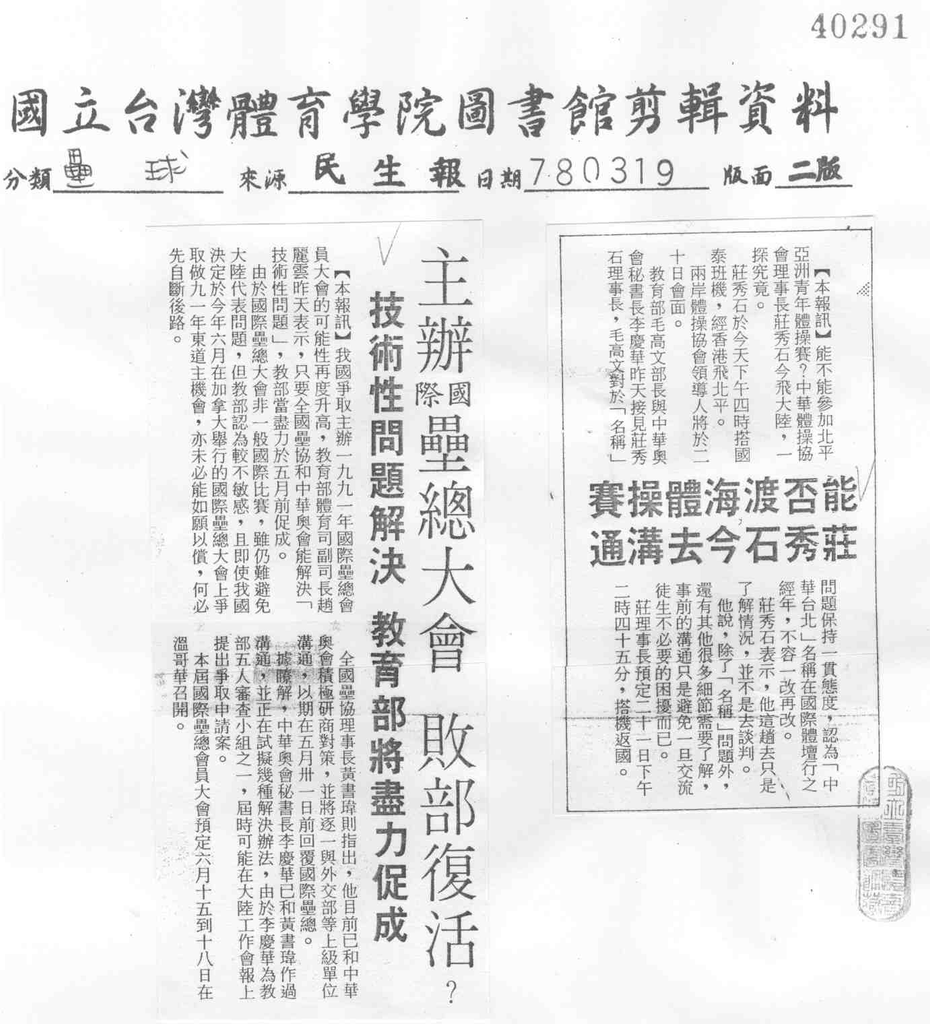
Headline: 能否渡海體操賽 莊秀石今去溝通
【本報訊】能不能參加北平亞洲青年體操賽?中華體操協會理事長莊秀石今飛大陸,一探究竟。
莊秀石於今天下午四時搭國泰班機,經香港飛北平。兩岸體操協會領導人將於二十日會面。
教育部毛高文部長與中華奧會秘書長李慶華昨天接見莊秀石理事長,毛高文對於「名稱」問題保持一貫態度,認為「中華台北」名稱在國際體壇行之經年,不容一改再改。
莊秀石表示,他這趟去只是了解情況,並不是去談判。
他說,除了「名稱」問題外,還有其他很多細節需要了解,事前的溝通只是避免一旦交流徒生不必要的困擾而已。
莊理事長預定二十一日下午二時四十五分,搭機返國。
“Peiping” was the Taiwanese press’s standard name for Beijing at the time, and the choice is political. In 1928 the Nationalist government moved China’s capital to Nanjing and renamed Beijing (北京, “Northern Capital”) as 北平 (Beiping, “Northern Peace”). The People’s Republic restored the name Beijing in 1949. The Republic of China on Taiwan never recognized the change, and the Taiwanese press went on using 北平 for decades, as this 1989 report does. “Peiping” is the conventional English spelling of that name.
March 22, 1989
Competing as “Zhonghua Taibei,” the Gymnastics Team Looks Set to Go
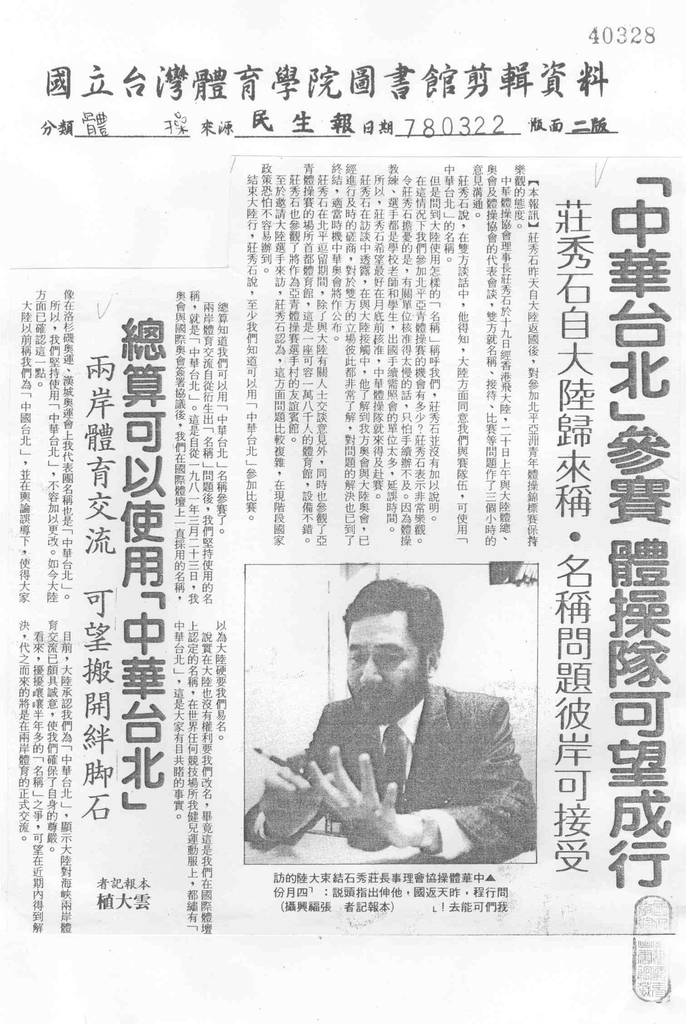
Back from the mainland, Chuang Hsiu-shih says the other side can accept the nameStaff report. Chuang Hsiu-shih returned from the mainland yesterday optimistic about Taiwan’s participation in the Asian Junior Gymnastics Championships in Peiping.
Chuang, chairman of the Chinese Taipei Gymnastics Association, flew to the mainland via Hong Kong on the 19th. On the morning of the 20th he met representatives of the mainland’s All-China Sports Federation, its Olympic committee and its gymnastics association, and the two sides spent three hours exchanging views on the name, hospitality arrangements, the competition itself and other matters.
Chuang said he learned during the talks that the mainland had agreed that our team may compete under the name 中華台北 (Zhonghua Taibei).
Asked what name the mainland itself would use to refer to us, however, Chuang gave no explanation.
What, then, are our chances of competing in the Asian junior championships in Peiping? Chuang said he was very optimistic.
His worry is that if the relevant agencies are slow to give approval, the paperwork will not be finished in time. The team’s coaches and gymnasts are all schoolteachers and students, and their travel abroad must be cleared with too many agencies, which takes time.
Chuang therefore hopes approval comes before the end of the month at the latest. Then the Chinese Taipei team will be able to make it to the competition.
In the interview, Chuang revealed that through his contacts on the mainland he had learned that our Olympic committee and the mainland’s had already held timely consultations. Each side fully understands the other’s position, the matter is close to being settled, and the Chinese Taipei Olympic Committee will make an announcement at the appropriate time.
During his stay in Peiping, besides exchanging views with mainland officials, Chuang visited the Capital Gymnasium, the venue for the championships. It holds 18,000 people and is well equipped.
He also toured the Friendship Hotel, which will serve as the athletes’ village for the competition.
As for inviting mainland athletes to visit Taiwan, Chuang thinks the issue is more complicated. Under current national policy, he said, it will probably not be easy to arrange.
Summing up his trip, Chuang said: at least we know we can compete as 中華台北.
Photo caption: Chuang Hsiu-shih, chairman of the Chinese Taipei Gymnastics Association, returned home yesterday from his visit to the mainland. Holding up his fingers, he said: “We may go in April!” (Staff photo by Chang Fu-hsing)
Headline: 「中華台北」參賽 體操隊可望成行
Subhead: 莊秀石自大陸歸來稱・名稱問題彼岸可接受
【本報訊】莊秀石昨天自大陸返國後,對參加北平亞洲青年體操錦標賽保持樂觀的態度。
中華體操協會理事長莊秀石於十九日經香港飛大陸,二十日上午與大陸體總、奧會及體操協會的代表會談,雙方就名稱、接待、比賽等問題作了三個小時的意見溝通。
莊秀石說,在雙方談話中,他得知,大陸方面同意我們與賽隊伍,可使用「中華台北」的名稱。
但是問到大陸使用怎樣的「名稱」稱呼我們,莊秀石並沒有加以說明。
在這情況下我們參加北平亞青體操賽的機會有多少?莊秀石表示非常樂觀。
令莊秀石擔憂的是,有關單位核准得太慢的話,只怕手續辦不及。因為體操教練、選手都是學校老師和學生,出國手續需照會的單位太多,延誤時間。
所以,莊秀石希望最好在月底前核准,中華體操隊就來得及赴賽。
莊秀石在訪談中透露,在與大陸接觸中,他了解到我方奧會與大陸奧會,已經進行及時的磋商,對於雙方的立場彼此都非常了解,對問題的解決也已到了終結,適當時機中華奧會將作公布。
莊秀石在北平逗留期間,除了與大陸有關人士交談意見外,同時也參觀了亞青體操賽的場所首都體育館,這是一座可容一萬八千人的體育館,設備不錯。
莊秀石也參觀了將作為亞青體操賽選手村的友誼賓館。
至於邀請大陸選手來訪,莊秀石認為,這方面問題比較複雜,在現階段國家政策恐怕不容易辦到。
結束大陸行,莊秀石說,至少我們知道可以用「中華台北」參加比賽。
Photo caption: ▲中華體操協會理事長莊秀石結束大陸的訪問行程,昨天返國,他伸出指頭說:「四月份我們可能去!」(本報記者 張福興攝)
March 22, 1989
Visit Lasts 32 Hours as Mainland Gymnastics Body Hosts Secret Guest
Two sides still divided on the namePEIPING, March 21 (by staff reporter Kou Wei-yung): Senior figures in the Chinese Communists’ “Chinese Olympic Committee” said today that Chuang Hsiu-shih, chairman of the Taiwan Gymnastics Association, had come to Peiping and reached agreement with Jiang Youzhen, chairman of the gymnastics association here, on sending a team to the Asian gymnastics championships in Peiping. The two sides remain seriously divided, however, over the name.
According to these sources, Chuang said Taiwan’s team should compete under the name 中華台北 (Zhonghua Taibei). That name, they said, could not possibly be accepted by the Chinese Communist foreign ministry.
Chuang, chairman of our gymnastics association, came to Peiping on a secret visit. After 32 whirlwind hours he left Peiping for Taipei at about 6 a.m. today. Sports leaders here hope his visit will bring a breakthrough in sports exchanges across the Taiwan Strait.
Chuang arrived in Peiping late on the night of the 19th and checked into the Qianmen Hotel. Because his movements were kept secret, the mainland gymnastics association handled his hotel registration for him.
On the 20th, Chuang reportedly held talks with Jiang Youzhen, chairman of the mainland gymnastics association. They discussed a wide range of matters: our participation in the Asian gymnastics championships in Peiping in late April and the Asian judo championships in Peiping in May, and the sports federation’s plan to hire top mainland coaches to teach in Taiwan. Accompanied by Zhang Jian, head coach of the mainland gymnastics team, Chuang also toured the mainland’s gymnastics training center and its facilities.
The mainland’s star gymnasts Li Ning and Lou Yun both said they welcomed Chuang’s visit. Li Ning, who is currently in Peiping, met with Chuang.
It is understood that, because of Chinese Communist rules, “outstanding talents” like Li Ning and Lou Yun are invariably Communist Party members. They therefore cannot be invited to Taiwan as distinguished persons.
Headline: 32小時訪問 大陸操協秘密迎賓
Subhead: 對於名稱問題 雙方仍有歧見
【本報記者寇維勇北平廿一日電】中共「中國奧委會」高層人士今天表示,台灣體操協會理事長莊秀石來北平,與此間體操協會主席蔣佑楨,雖然在派隊參加北平舉行亞洲體操賽一事上達成共識,但是對於名稱問題,雙方仍有嚴重歧見。
據指出,莊秀石曾表示台灣派隊伍應以「中華台北」名義與賽,但不可能被中共外交部所接受。
前來北平作祕密訪問的我國體操協會理事長莊秀石,在經過卅二小時的旋風式訪問後,已於今天凌晨六時許離開北平返回台北。此間體育界領導人士期望莊秀石的來訪,能對海峽兩岸體育交流帶來突破。
莊秀石於十九日深夜抵達北平,住進前門飯店,由於行動保密,住宿登記係由大陸體操協會代為處理。
據知,莊秀石於廿日曾與大陸體操協會主席蔣佑楨晤談,廣泛討論我國參加四月下旬在北平舉行的亞洲體操賽,五月在北平舉行的亞洲柔道賽,以及體協聘請大陸優秀教練來台任教等事宜,並由大陸體操隊總教練張健陪同,參觀中國大陸體操選手訓練中心,以及各種設施。
中國大陸傑出體操選手李寧、樓雲,對莊秀石來訪,均表示歡迎,目前在北平的李寧,曾與莊秀石晤面。
據了解,李寧和樓雲因中共規制的因素,「優秀人才」,必然是共產黨員,因此無法以傑出人士身分受邀訪台。
March 23, 1989
Name Issue Still Going in Circles
CTOC tries again to negotiate; decision on whether team can go expected in early AprilStaff report. Lee Ching-hua, secretary-general of the Chinese Taipei Olympic Committee, said yesterday that the committee is still working hard to persuade the mainland to accept 中華台北, and that one way or another there will be an outcome in early April.
Chuang Hsiu-shih, chairman of the Chinese Taipei Gymnastics Association, just back from the mainland, went to the CTOC yesterday morning to brief Lee on his trip.
After 30 minutes behind closed doors, the two men held a joint press conference.
Lee said that under current government policy, teams may go to the mainland to compete, but the name we use must be 中華台北. As for where 中華台北 must appear, the government’s position is that it covers every Chinese-language usage by the organizers: the event’s official documents, handbooks, results sheets, letters, name cards and signs, and the announcements at the venue must all call us 中華台北.
Lee said the government’s position remained the same and had not changed.
According to the information Chuang brought back, Lee said, the mainland had not yielded an inch on this point.
Even so, Lee said, the CTOC is following the matter closely and has it fully in hand. It hopes for a breakthrough that will allow the Chinese Taipei gymnastics team to compete in time.
Lee stressed in closing that whatever happens, the committee’s efforts will be concluded in early April, and the government will then make a definitive announcement.
CTOC to Ask Ministry to Allow Early Paperwork
Staff report. So that the gymnastics team does not miss the competition, the CTOC will ask the Ministry of Education to let it begin the team’s paperwork early.
The name question is expected to be resolved in early April. If the team is then cleared to go, there may not be enough time to complete the formalities for the Asian Junior Gymnastics Championships, which will be held in Peiping from April 21 to 23.
For this reason, Lee Ching-hua said yesterday, he will ask the Ministry to allow the gymnastics team to begin its paperwork as soon as possible.
The Road to Normal Sports Relations Across the Strait
Jinren’s NotebookBefore gymnastics association chairman Chuang Hsiu-shih went to the mainland, a former basketball coach had also been to Peiping. There he met Ding Guangen, director of the Communist Chinese State Council’s Taiwan Affairs Office, and other officials. Their talks came down to one point: sports exchanges across the Strait should be normalized.
The conclusions of those talks were quite specific. First, the mainland welcomes teams sent from Taiwan. Second, Taiwan may call itself 中華台北 and put that name on its uniforms. Third, the name cards carried at the parade of teams will read 中國台北, and the announcements will also use 中國台北. Fourth, the team may compete under the flag of the Chinese Taipei Olympic Committee.
It is understood that Wu Ching-kuo, the IOC member from Taiwan, also held secret talks in Hong Kong with He Zhenliang, the mainland’s member of the IOC executive board, and reached the same result. Both sides already agree that we wish to take part in international competitions and that the mainland welcomes us.
In other words, both sides want to push for normal sports relations. Some differences remain, but the mainland thinks they can be worked out and that the two sides can talk.
Since our sports authorities still have doubts, and since it is impossible to ask the other side for a written guarantee, why not talk? Wu Ching-kuo, Chuang Hsiu-shih and others are all free to go and talk, and the mainland itself wants talks. What is there to fear in formally replying that we agree to somewhat higher-level talks?
Chuang, as chairman of the gymnastics association, made the trip himself, and the differences remain unresolved. Now the invitation to the Asian Cup basketball tournament has arrived. The fact before us is that the remaining differences must be faced. The testing period is over, and there are three paths ahead. One: face the differences and negotiate. Two: play them down, with each side doing things its own way and using its own name. Three: refuse, and reject the other side’s terms. The third path would do too much damage to both sides and cannot be taken. The first two may present difficulties for now. But seen without political lenses, they would help normalize sports relations. The basketball team could go to compete, and so could gymnastics, track and field, and the Asian Games teams. What would be wrong with that?
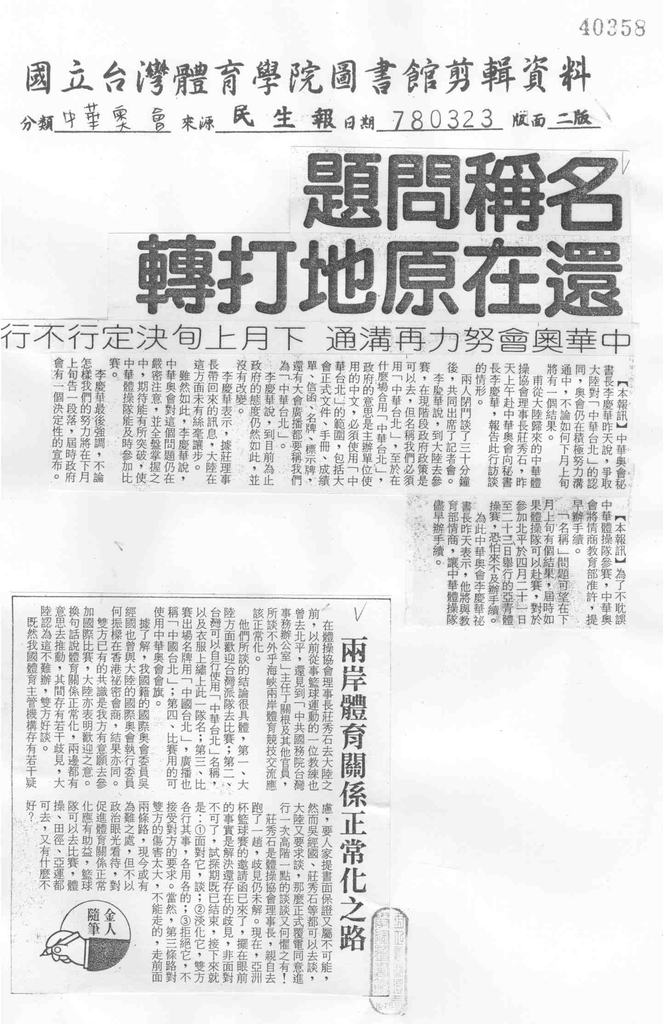
Headline: 名稱問題 還在原地打轉
Subhead: 中華奧會努力再溝通 下月上旬決定行不行
Article 1
【本報訊】中華奧會秘書長李慶華昨天說,爭取大陸對「中華台北」的認同,奧會仍在積極努力溝通中,不論如何下月上旬將有一個結果。
甫從大陸歸來的中華體操協會理事長莊秀石,昨天上午赴中華奧會向秘書長李慶華,報告此行訪談的情形。
兩人閉門談了三十分鐘後,共同出席了記者會。
李慶華說,到大陸去參賽,在現階段政府政策是可以去,但名稱我們必須用「中華台北」,至於在什麼場合用「中華台北」,政府的意思是主辦單位使用的中文,必須使用「中華台北」的範圍,包括大會正式文件、手冊、成績單、信函、名牌、標示牌,還有大會廣播都要稱我們為「中華台北」。
李慶華說,到目前為止政府的態度仍然如此,並沒有改變。
李慶華表示,據莊理事長帶回來的訊息,大陸在這方面未有絲毫讓步。
雖然如此,李慶華說,中華奧會對這個問題仍在嚴密注意,並全盤掌握之中,期待能有所突破,使中華體操隊能及時參加比賽。
李慶華最後強調,不論怎樣我們的努力將在下月上旬告一段落,屆時政府會有一個決定性的宣布。
Article 2
【本報訊】為了不耽誤中華體操隊參賽,中華奧會將情商教育部准許,提早辦手續。
「名稱」問題可望在下月上旬有個結果,屆時如果體操隊可以赴賽,對於參加北平於四月二十一日至二十三日舉行的亞青體操賽,恐怕來不及辦手續。
為此中華奧會李慶華祕書長昨天表示,他將與教育部情商,讓中華體操隊儘早辦手續。
Column: 兩岸體育關係正常化之路 (金人隨筆)
在體操協會理事長莊秀石去大陸之前,以前從事籃球運動的一位教練也曾去北平,還見到「中共國務院台灣事務辦公室」主任丁關根及其他官員,所談不外乎海峽兩岸體育競技交流應該正常化。
他們所談的結論很具體,第一、大陸方面歡迎台灣派隊去比賽;第二、台灣可以自行使用「中華台北」名稱,以及衣服上繡上此一隊名;第三、比賽出場名牌用「中國台北」,廣播也用「中國台北」;第四、比賽用的可用中華奧會會旗。
據了解,我國籍的國際奧會委員吳經國也曾與大陸的國際奧會執行委員何振梁在香港祕密會商,結果亦同。雙方已有的共識是我方有意願去參加國際比賽,大陸亦表明歡迎之意。
換句話說體育關係正常化,兩邊都有意思去推動,其間存有若干歧見,大陸認為這不難辦,雙方好談。
既然我國體育主管機構存有若干疑慮,要人家提書面保證又屬不可能,然而吳經國、莊秀石等都可以去談,大陸又要求談,那麼正式覆電同意進行一次高階一點的談談又何懼之有!
莊秀石是體操協會理事長,親自去跑了一趟,歧見仍未解。現在,亞洲杯籃球賽的邀請函已來了,擺在眼前的事實是解決還存在的歧見,非面對不可了,試探期既已結束,接下來就是:①面對它,談;②淡化它,雙方各行其事,各用各的;③拒絕它,不接受對方的要求。當然,第三條路對雙方的傷害太大,不能走的,走前面兩條路,現今或有為難之處,但不以政治眼光看待,對促進體育關係正常化應有助益,籃球隊可以去比賽,體操、田徑、亞運都可去,又有什麼不好?
April 7, 1989
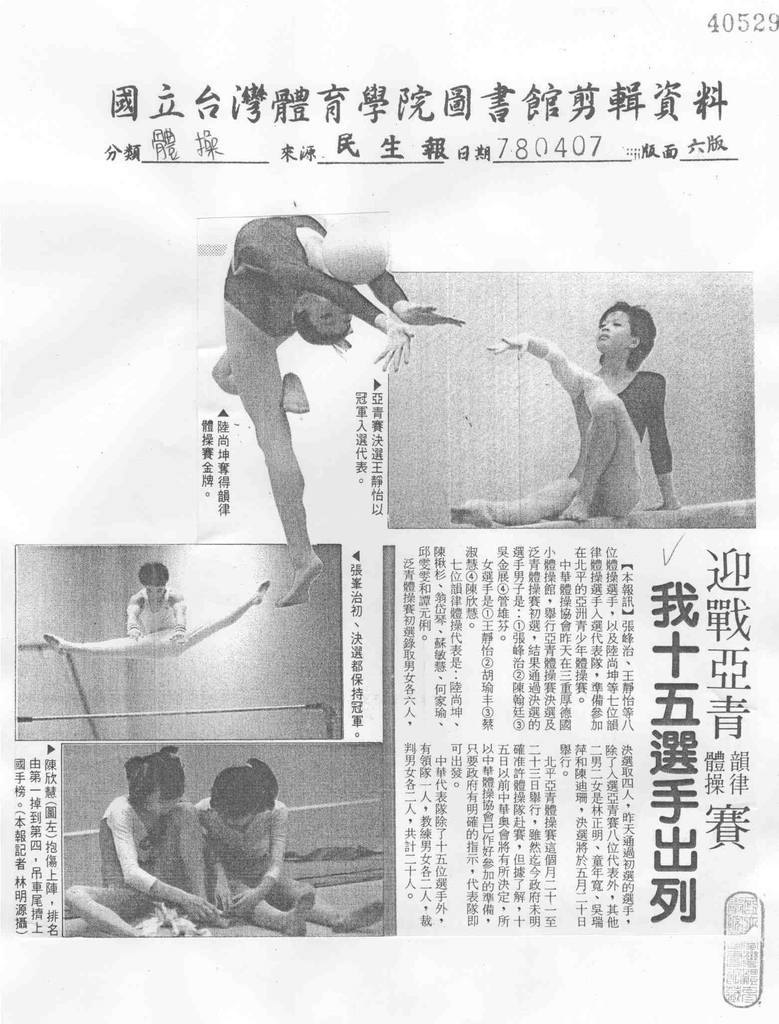
Taking On the Asian Junior Rhythmic and Artistic Championships: Our 15 Gymnasts Named
Staff report. Eight artistic gymnasts, led by Chang Feng-chih and Wang Ching-yi, and seven rhythmic gymnasts, led by Lu Shang-kun, have been named to the national team for the Asian Junior Gymnastics Championships in Peiping.
The Chinese Taipei Gymnastics Association held the final trials for the Asian junior championships, along with the preliminary trials for the Pan-Youth gymnastics competition, yesterday at the Houde Elementary School gymnasium in Sanchung. The men who made the team were (1) Chang Feng-chih, (2) Chen Han-ting, (3) Wu Chin-chan and (4) Kuan Hsiung-fen. The women were (1) Wang Ching-yi, (2) Hu Yu-feng, (3) Tsai Shu-hui and (4) Chen Hsin-hui.
The seven rhythmic gymnasts are Lu Shang-kun, Chen Chiu-shan, Weng Tai-chin, Su Min-hui, Ho Chia-yu, Chiu Wen-wen and Tan Yuan-li.
Six men and six women advanced from the Pan-Youth preliminaries, and four of each will be chosen in the final trials. Besides the eight Asian junior team members, the two men and two women who advanced yesterday were Lin Cheng-ming, Tung Nien-kuan, Wu Jui-ping and Chen Ti-shan. The final trials will be held on May 20.
The Asian junior championships in Peiping run from the 21st to the 23rd of this month. The government has not yet clearly approved the team’s trip. However, the Chinese Taipei Olympic Committee is understood to be reaching a decision before the 15th, so the gymnastics association has made all its preparations. As soon as the government gives clear instructions, the team can leave.
Besides the 15 athletes, the Chinese Taipei delegation will include one team leader, two coaches each for the men and the women, and two judges each for the men and the women, for a total of 20.
Photo captions:
▶ Wang Ching-yi made the team by winning the Asian junior final trials.
▲ Lu Shang-kun won the gold medal in rhythmic gymnastics.
◀ Chang Feng-chih finished first in both the preliminary and final trials.
▶ Chen Hsin-hui (left) competed injured and fell from first to fourth, squeezing onto the national team in last place. (Staff photo by Lin Ming-yuan)
Headline: 迎戰亞青韻律、體操賽 我十五選手出列
【本報訊】張峰治、王靜怡等八位體操選手,以及陸尚坤等七位韻律體操選手入選代表隊,準備參加在北平的亞洲青少年體操賽。
中華體操協會昨天在三重厚德國小體操館,舉行亞青體操賽決選及泛青體操賽初選,結果通過決選的選手男子是:①張峰治②陳翰廷③吳金展④管雄芬。女選手是①王靜怡②胡瑜丰③蔡淑慧④陳欣慧。
七位韻律體操代表是:陸尚坤、陳楸杉、翁岱琴、蘇敏慧、何家瑜、邱雯雯和譚元俐。
泛青體操賽初選錄取男女各六人,決選取四人,昨天通過初選的選手,除了入選亞青賽八位代表外,其他二男二女是林正明、童年寬、吳瑞萍和陳迪珊,決選將於五月二十日舉行。
北平亞青體操賽這個月二十一至二十三日舉行,雖然迄今政府未明確准許體操隊赴賽,但據了解,十五日以前中華奧會將有所決定,所以中華體操協會已作好參加的準備,只要政府有明確的指示,代表隊即可出發。
中華代表隊除了十五位選手外,有領隊一人,教練男女各二人,裁判男女各二人,共計二十人。
Photo captions:
▶亞青賽決選王靜怡以冠軍入選代表。
▲陸尚坤奪得韻律體操賽金牌。
◀張峯治初、決選都保持冠軍。
▶陳欣慧(圖左)抱傷上陣,排名由第一掉到第四,吊車尾擠上國手榜。(本報記者 林明源攝)
April 10, 1989
Cross-Strait Barriers Come Down, and Samaranch Is Delighted
Unable to attend Asian junior gymnastics himself, he asks Wu Ching-kuo to go in his placeDORTMUND, West Germany, April 9 (by special correspondent Chen Li-ching): IOC President Juan Antonio Samaranch, who is in Dortmund, West Germany, watching the 40th World Table Tennis Championships, has learned that the mainland’s sports commission has agreed that Taiwan may compete in sporting events on the mainland under the Chinese-language name 中華台北.
Samaranch learned of this on the 7th in a telephone call from Wu Ching-kuo, the IOC member from Taiwan. On the afternoon of the 8th, Wu hurried from Munich to Dortmund to meet Samaranch and report in detail how the two sides of the Taiwan Strait had settled the Chinese-language form of “Chinese Taipei.”
Samaranch was very pleased with this development. He said that after efforts on many fronts, the Olympic committees on the two sides of the Strait had finally resolved the problem.
Wu had recently gone to Munich for an extraordinary congress of the International Basketball Federation. Knowing that Samaranch would arrive in Dortmund on the 8th, he changed his plans and hurried there.
Samaranch was very interested to learn that the Asian Junior Cup gymnastics competition in late April will be the first time Taiwan sends a sports team to compete on the mainland. He said his schedule was already full. Otherwise he would have liked to go to the mainland himself at that time and see for himself how things stand between the two sides. To learn more, he asked Wu to go to the mainland during the competition, in his capacity as an IOC member, and assess the situation. Wu said that although time was very tight, he had decided to make the trip.
Wu has been personally involved in resolving the naming question and has traveled back and forth many times, at home and abroad. He said he was very glad that the mainland’s sports commission had been willing to give ground on the name. The two sides’ Olympic committees had reached this consensus only after many kinds of effort, he said, and along the way He Zhenliang, a member of the mainland’s Olympic committee, had worked very hard. Wu said he personally admired him greatly.
Wu was optimistic about mainland sports teams eventually coming to Taiwan. Sports exchange has to proceed slowly, he said, and it will take time for each side to build understanding through joint activities. If Taiwanese teams competing on the mainland come away with good impressions and good results, the door will open step by step. He said there is “a great deal to look forward to,” and that visits to Taiwan by top mainland athletes and coaches may be opened up substantially in the near future.
Wu will travel via Düsseldorf to Bangkok on the 10th and is scheduled to return to Taipei on the 12th.
Photo caption: IOC President Samaranch (center) and IOC member Wu Ching-kuo of Taiwan (left) watch the action at the World Table Tennis Championships. (Faxed from Dortmund by special correspondent Kuo Yun-fu)
兩岸拆除藩籬 最樂沙馬瑞奇
看亞青體操無法分身 請吳經國代表前往
【本報特派記者陳麗卿西德杜蒙九日電】刻正在西德杜蒙觀賞第四十屆世界桌球賽精彩比賽的國際奧委會主席沙馬瑞奇,已經知道大陸體委會答應我國以「中華台北」的中文名稱,參與在大陸的體育競賽。
沙馬瑞奇是在七日接獲我國籍國際奧會委員吳經國的電話知悉此事,吳經國八日下午特地由慕尼黑兼程趕至杜蒙會晤沙馬瑞奇,詳細報告海峽兩岸處理”Chinese Taipei”中文名稱的過程及細節。
沙很欣慰這件事情的進展,認為海峽兩岸奧會經多方努力,總算把問題解決了。
吳經國是日前到慕尼黑參加國際籃球總會臨時會員大會,他知道沙馬瑞奇八日會到達杜蒙,特地更改行程,趕至杜蒙。
沙馬瑞奇知悉四月下旬的亞青杯體操賽,將是我國首次派遣體育團隊赴大陸比賽後,十分感興趣,他說本身行程已經排滿,否則他有意其時赴大陸看看雙方進展實情,為求多了解,他希望吳經國以國際奧委會委員身份,在亞青杯賽期間去大陸了解情況,吳經國說雖然時間太緊迫,他決定走一趟。
為解決名稱問題親身參與,海內外奔波多次的吳經國,很高興大陸體育委員會能在名稱問題上讓步,他說海峽兩岸奧會經過多種努力,才達成這項共識,這之間大陸奧會委員何振梁努力很多,他個人很敬佩。
至於將來大陸體育團隊赴台的可能性,吳經國持樂觀看法。他說體育交流要慢慢來,需要時間從雙方活動中得到諒解,若我國隊伍赴大陸參賽得到良好印象和結果,門是一步步開的,可以「好好期待」,大陸優秀運動員和教練到台灣參觀訪問,在不久的將來可能有大幅度的開放。
吳經國十日將取道杜塞道夫到曼谷,定十二日回到台北。
Photo caption: ▶國際奧會主席沙馬瑞奇(中)與我國國際奧會委員吳經國(左),在世桌賽現場觀戰。(本報特派記者郭運復杜蒙傳真)
April 17, 1989
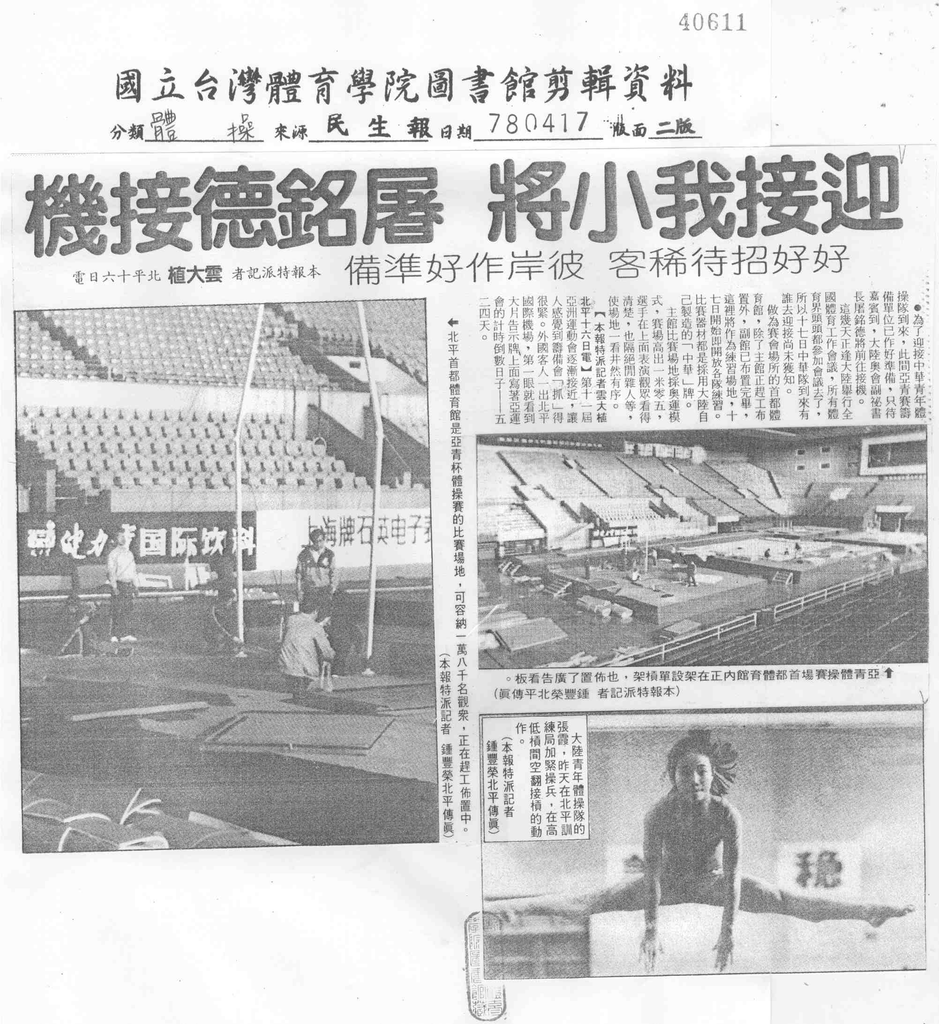
Welcoming Our Young Athletes: Tu Mingde to Meet Their Flight
Rare guests to be well looked after as the other side of the Strait makes readyPEIPING, April 16 (by special correspondent Yun Ta-chih): Organizers of the Asian junior gymnastics championships here have finished preparing to welcome the Chinese Taipei junior gymnastics team, and now they are just waiting for their guests to arrive. Tu Mingde, deputy secretary-general of the mainland’s Olympic committee, will go to the airport to meet the team.
The mainland is holding its National Sports Work Conference this week, and all of the top sports officials are attending. So it is not yet known who will greet the Chinese Taipei team when it arrives on the 17th.
The competition venue is the Capital Gymnasium. Work on the main hall is still being rushed to completion, but the auxiliary hall is finished. It will serve as the practice venue and will open to the teams for training from the 17th. All of the competition apparatus is the mainland’s own “Zhonghua” brand.
The competition floor in the main hall follows the Olympic format and is raised 1.05 meters. Spectators can see the gymnasts clearly as they perform, and anyone with no business on the floor is kept off it, so the arena looks orderly at a glance.
PEIPING, April 16 (by special correspondent Yun Ta-chih): As the 11th Asian Games draw closer, it is clear that the organizing committee is keeping a firm grip on preparations. The first thing foreign visitors see as they leave Peiping’s international airport is a huge billboard counting down the days until the Asian Games: 524.
Photo captions:
← The Capital Gymnasium in Peiping, venue for the Asian Junior Cup gymnastics competition, seats 18,000 spectators. Crews are working to finish setting it up. (Faxed from Peiping by special correspondent Chung Feng-jung)
↑ Inside the Capital Gymnasium, the gymnastics venue, a high bar is being installed, and advertising boards have also been put up. (Faxed from Peiping by special correspondent Chung Feng-jung)
Zhang Xia of the mainland junior gymnastics team trained hard yesterday at the training bureau in Peiping, working on a salto between the high and low bars to catch the bar. (Faxed from Peiping by special correspondent Chung Feng-jung)
Headline: 迎接我小將 屠銘德接機
Subhead: 好好招待稀客 彼岸作好準備
Byline: 本報特派記者 雲大植 北平十六日電
●為了迎接中華青年體操隊到來,此間亞青賽籌備單位已作好準備,只待嘉賓到,大陸奧會副祕書長屠銘德將前往接機。
這幾天正逢大陸舉行全國體育工作會議,所有體育界頭頭都參加會議去了,所以十七日中華隊到來有誰去迎接尚未獲知。
做為賽會場所的首都體育館,除了主館正趕工布置外,副館已布置完畢,這裡將作為練習場地,十七日開始即開放各隊練習。比賽器材都是採用大陸自己製造的「中華」牌。
主館比賽場地採奧運模式,賽場高出一米零五,選手在上面表演觀眾看得清楚,也隔絕閒雜人等,使場地一看井然有序。
【本報特派記者雲大植北平十六日電】第十一屆亞洲運動會逐漸接近,讓人感覺到籌備會「抓」得很緊。外國客人一出北平國際機場,第一眼就看到大片告示牌,上面寫著亞運會的計時倒數日子——五二四天。
Photo captions:
←北平首都體育館是亞青杯體操賽的比賽場地,可容納一萬八千名觀眾,正在趕工佈置中。(本報特派記者 鍾豐榮北平傳真)
↑亞青體操賽場首都體育館內正在架設單槓架,也佈置了廣告看板。(本報特派記者鍾豐榮北平傳真)
板看告廣了置佈也,架槓單設架在正內館育體都首場賽操體青亞↑.
大陸青年體操隊的張霞,昨天在北平訓練局加緊操兵,在高低槓間空翻接槓的動作。(本報特派記者 鍾豐榮北平傳真)
April 18, 1989
“Welcome!” Hands from across the Strait Clasped Tightly – Chinese Taipei Team Landed with Dignity, while Crowds Surged at Beijing Airport
By our special correspondent Yun Ta-chih, Beijing, 17th
It’s the time of the year when willow catkins appear to be drifting as snow. The Chinese Taipei junior gymnastics team dressed in Chinese Taipei sportswear gracefully landed at Beijing International Airport. It was like a dream that came true as cross-strait sports exchanges kicked off from there.
At 4:20 pm Beijing time, at Gate 5 of the Beijing International Airport, the Deputy Secretaries General of the Olympic Games from both sides of the Taiwan Strait met at the cabin entrance. Their hands were tightly clasped together, and the Deputy Secretary General of the Chinese Olympic Committee, Mingde Tu, exclaimed “Welcome”! Their emotions churned, and forty years of history condensed in an instant.
The Chinese Taipei team was led to the VIP lounge at the airport, surrounded by a crowd of reporters. Following by reporters, they entered the lounge, and for a moment, they saw nothing but flashing lights. Staff from TV stations tried their best, but still couldn’t get close enough to Te-chi Chan and Mingde Tu. Reporters from Taipei, Hong Kong, as well as those from local news outlets, could no longer care about their manners, even if they are close friends. Mingde Tu said afterwards that the journalists from Taipei were really “fierce and sharp”.
During the chaotic press conference, both Te-chi Chan who led the Chinese Taipei team and Deputy Secretary General Tu of the Chinese Olympic Committee had to raise their voices when answering questions from reporters. One kept saying that they were very happy to be here; One kept welcoming the Chinese Taipei team.
When asked about some sensitive issues, Tu and Chan always tried to avoid giving any answers. Each of the payers present also became the target of the interview, and suddenly they all appeared so lovable, attracting the favour of those around them.
Under the rush of reporters, the Chinese Taipei team boarded a bus and headed to the athlete village. At the Friendship Hotel, which serves as the Athlete Village, they received a welcome parade from hotel staff. The Chinese Taipei team received full respect.
In the evening, the Chinese Taipei team went to the Capital Gymnasium to familiarize themselves with the venue and carry out warm-up exercises.
Four Teams have Entered the Athlete Village
Teams from Chinese Taipei, Iran, Iraq, and Korea participating in the Beijing Asian Junior Gymnastics Competition have arrived today, and have already settled in the Friendship Hotel’s Athlete Village.
The DPRK and Japanese teams are scheduled to arrive on the 18th, and the practice time for each team will be scheduled on the 18th. Each team will be arranged to practice once or twice in the main gymnasium.
The Chinese Taipei team practiced first last night to adapt to the field. They were satisfied with the equipment and facilities.
Vice Secretary General of the Chinese Olympic Committee, Deming Tu (right), shook hands with the head of the Chinese Taipei delegation, Te-chi Chan, in the VIP lounge at Beijing Airport to extend a warm welcome. (Fax by our special correspondent Feng-rong Chung from Beijing)
Light as Swallows, Our Four Little BlessingsFour female athletes from the Chinese Taipei Junior Gymnastics Team, starting from the right, Yu-feng Hu, Ching-yi Wang, Shu-hui Tsai, and Hsin-hui Chen, wore snow-white uniforms and showed special interest in electric scales at the China Airlines counter at Taoyuan Chung-Cheng Airport before departing for Beijing yesterday morning to participate in the competition. The four national elite athletes stood on the scale and found that they weighed only 149 kilograms in total. (Photo and text: Fu-hsing Chang)
Te-chi Chan, the head of the Chinese Taipei Junior Gymnastics delegation, was surrounded and interviewed by Chinese and foreign journalists in the VIP lounge of Beijing Capital International Airport. (Fax by our special correspondent Feng-rong Chung from Beijing)
The young Chinese Taipei gymnasts departed yesterday and flew to Beijing. Chinese Taipei Olympic Committee President Feng-shu Chang (third from right) and Secretary General Ching-hua Li bid farewell at Chung-Cheng Airport. (Photo by our reporter Fu-hsing Chang)Hometown and Human Feelings Expressed in Silence
The cross-strait sports exchange has taken a cautious and emotional step forward, and both sides are full of confidence in the future, after all, they are one family descending from our ancestors.
Mingde Tu, Deputy Secretary General of the Chinese Olympic Committee, said that mutual communication is necessary to promote understanding. “We are indeed delighted that the Chinese Taipei gymnastics team has arrived. I hope they will have a pleasant time here and everyone will be safe and sound.”
It is obvious that everyone has tacitly avoided sensitive issues in order to ensure that this step is steady and smooth. Everyone only hopes that politics belongs to politicians and sports belong to athletes.
“Contestants are always easy to make friends with”, said Tu Mingde. “I believe that cross-strait contestants will soon become good friends. Speaking the same language, there is no problem for them to communicate. Nobody can prevent this from happening.”
At the moment of meeting, people from both sides of the Taiwan Strait are always happy. At this moment, there are a lot to express as for homesickness and emotions, which can maybe only be described as “everything is said despite the silence”.
The “Chinese Taipei” embroidered with black letters on a white background landed in Beijing, and the atmosphere was so warm and lively. I believe this step is both an expectation and a prospect. We just look forward to seeing more of Chinese Taipei in the future.
By our reporter Yun Ta-chih
For the original text, see the image at the top of this article.
April 19, 1989
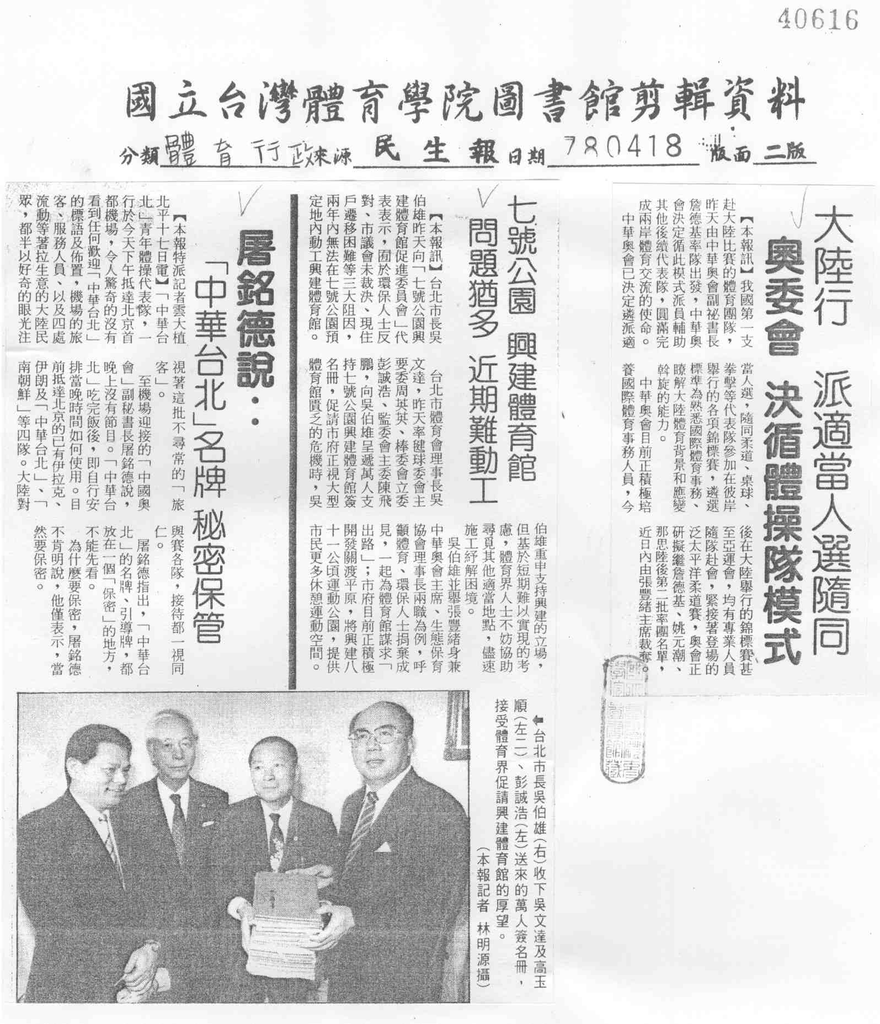
Tu Mingde: “Chinese Taipei” Name Cards Kept Under Wraps
PEIPING, April 17 (by special correspondent Yun Ta-chih): The Chinese Taipei junior gymnastics team arrived at Beijing Capital Airport this afternoon. Surprisingly, there were no banners or decorations welcoming “Chinese Taipei.” Travelers, airport staff, and the mainlanders milling about looking for business all eyed this unusual group of “travelers” with half-curious stares.
Tu Mingde, deputy secretary-general of the “Chinese Olympic Committee,” met the team at the airport. He said Chinese Taipei had nothing scheduled for the evening; after dinner, the team would decide for itself how to spend the night. Four teams have arrived in Beijing so far: Iraq, Iran, Chinese Taipei and “South Korea.” The mainland is treating all participating teams alike.
Tu said the “Chinese Taipei” name cards and placards were being kept in a “secure” place and could not be seen in advance.
Tu would not say why they had to be kept secret. He said only: “Of course they must be kept secret.”
屠銘德說:「中華台北」名牌 秘密保管
【本報特派記者雲大植北平十七日電】「中華台北」青年體操代表隊,一行於今天下午抵達北京首都機場,令人驚奇的沒有看到任何歡迎「中華台北」的標語及佈置,機場的旅客、服務人員、以及四處流動等著拉生意的大陸民眾,都半以好奇的眼光注視著這批不尋常的「旅客」。
至機場迎接的「中國奧會」副秘書長屠銘德說,「中華台北」晚上沒有節目。「中華台北」吃完飯後,即自行安排當晚時間如何使用。目前抵達北京的已有伊拉克、伊朗及「中華台北」、「南朝鮮」等四隊。大陸對與賽各隊,接待都一視同仁。
屠銘德指出,「中華台北」的名牌、引導牌,都放在一個「保密」的地方,不能先看。
為什麼要保密,屠銘德不肯明說,他僅表示,當然要保密。
April 19, 1989
The Telegram Didn’t Arrive Again? This Time We Really Took a Beating!
Two Athletes Miss the Chance to Compete; Zhuang Xiushi Protests at Team Leaders’ Meeting[Special correspondent Yun Ta-chih, Beijing, 18th] The team leaders’ meeting for the Asian Junior Gymnastics Championships was held this evening. Besides losing out in rhythmic gymnastics, the Chinese team was also disadvantaged by the age limit: several older athletes did not get to come. The Asian Gymnastics Union had originally notified our gymnastics association that competitors must have been born between December 31, 1974 and December 31, 1977. On the 10th of this month, however, the AGU moved the limit back to January 1, 1974. Our side never received this telegram, so our athletes were in effect put at a one-year age disadvantage relative to other countries. Chinese team leader Zhuang Xiushi lodged a protest at the meeting, but a vote upheld the earlier decision of January 1. Zhuang has asked the mainland side and the AGU to provide us with written proof that the telegram was not received.
Under the rule of birth on or after January 1, 1974, Chen Shuangyan and Shen Yanlan, capable athletes now training at Zuoying, could have competed here. They would have strengthened our team considerably.
[Special correspondent Yun Ta-chih, Beijing, 18th] In tonight’s draw, the Chinese junior men’s gymnastics team was placed in Group One, a very favorable schedule. The women’s team was drawn into the same group as the mainland team and will compete alongside it. The whole room applauded, considering it a clever and meaningful draw.
New Rules Never Received, Added Event Unknown
Our Rhythmic Gymnasts Will Compete Only in Rope, Clubs and Ball● Whether the rhythmic gymnastics individual competition would be contested on three apparatus or four caused a dispute at the team leaders’ meeting. After discussion, it was decided that of the four apparatus, gymnasts may choose to compete on three, with the best three scores counted.
The organizing committee’s materials originally received by the Chinese team listed three apparatus: rope, clubs and ball. On the 10th, however, the organizers issued supplementary new competition rules changing the program to four apparatus, adding the hoop. The Chinese team never received this notice. After discussion, it was agreed that gymnasts competing on all four apparatus may count their best three scores. Because the Chinese team has not prepared a hoop routine, it will compete only in rope, clubs and ball.
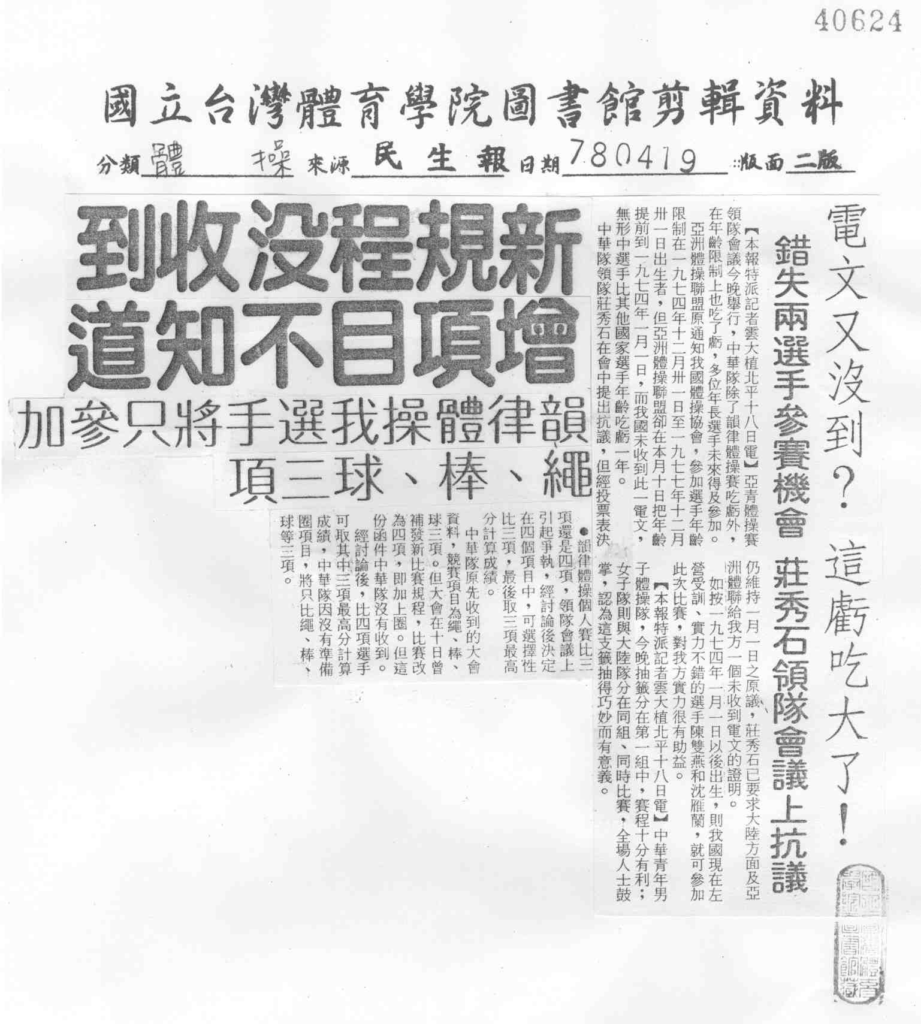
電文又沒到?這虧吃大了!
錯失兩選手參賽機會 莊秀石領隊會議上抗議
【本報特派記者雲大植北平十八日電】亞青體操賽領隊會議今晚舉行,中華隊除了韻律體操賽吃虧外,在年齡限制上也吃了虧,多位年長選手未來得及參加。亞洲體操聯盟原通知我國體操協會,參加選手年齡限制在一九七四年十二月卅一日至一九七七年十二月卅一日出生者,但亞洲體操聯盟卻在本月十日把年齡提前到一九七四年一月一日,而我國未收到此一電文,無形中選手比其他國家選手年齡吃虧一年。中華隊領隊莊秀石在會中提出抗議,但經投票表決,仍維持一月一日之原議,莊秀石已要求大陸方面及亞洲體聯給我方一個未收到電文的證明。
如按一九七四年一月一日以後出生,則我國現在左營受訓、實力不錯的選手陳雙燕和沈雁蘭,就可參加此次比賽,對我方實力很有助益。
【本報特派記者雲大植北平十八日電】中華青年男子體操隊,今晚抽籤分在第一組中,賽程十分有利;女子隊則與大陸隊分在同組、同時比賽,全場人士鼓掌,認為這支籤抽得巧妙而有意義。
新規程沒收到 增項目不知道
韻律體操我選手將只參加繩、棒、球三項
●韻律體操個人賽比三項還是四項,領隊會議上引起爭執,經討論後決定在四個項目中,可選擇性比三項,最後取三項最高分計算成績。
中華隊原先收到的大會資料,競賽項目為繩、棒、球三項。但大會在十日曾補發新比賽規程,比賽改為四項,即加上圈。但這份函件中華隊沒有收到。經討論後,比四項選手可取其中三項最高分計算成績,中華隊因沒有準備圈項目,將只比繩、棒、球等三項。