Categories
1998 China Goodwill Games WAG

1998: How China Reported Sang Lan’s Accident

Sang Lan came to the 1998 Goodwill Games in New York as China’s reigning national vault champion. During warm-ups for the vault final on July 21, however, her career ended in an instant. Attempting a front handspring timer, she visibly hesitated on her approach, failed to complete the rotation, and landed on her head. Rushed by ambulance to Nassau County Medical Center, she underwent emergency surgery three days later. Doctors ultimately concluded that the damage to her cervical spinal cord was irreversible, and she was told that she would never walk again. The accident became an international news story, drawing intense media attention in both China and the United States, visits from senior political figures including Chinese Vice Premier Qian Qichen and former U.S. President Jimmy Carter, and an outpouring of public support that transformed Sang Lan into a national symbol of resilience.

What follows are four contemporaneous accounts of those events, each offering a different vantage point on the same weeks. First, there’s a reported feature that lays out the chronology in full—the injury itself, Sang Lan’s path from a Ningbo sports school to the national team, and the political and civic response that followed. In addition, there are three more pieces: a reflection from the team’s physician, who was present at the moment of injury and remained at Sang Lan’s bedside through the days that followed; an essay from her coach, written from Beijing in the grip of his own grief; and a short public letter attributed to Sang Lan herself, composed from her hospital bed in the United States.
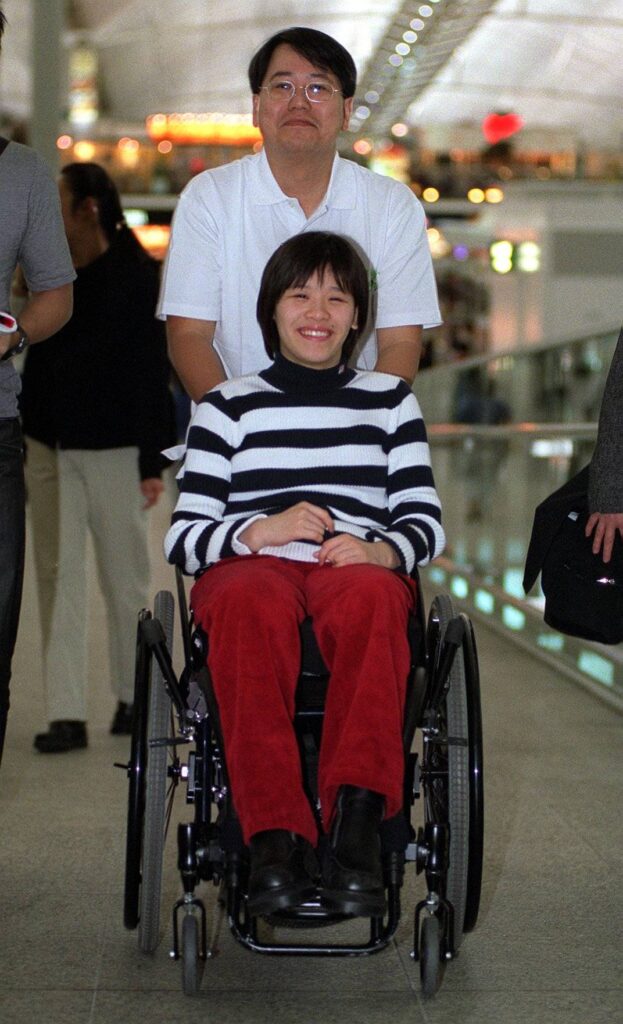

Sang Lan in Hong Kong, 2001
Categories
1998 Asian Games Doping South Korea WAG

1998: Four South Korean Gymnasts Suspended for Furosemide

Furosemide is the most common doping violation in women’s artistic gymnastics. Publicly documented cases include those of Nadzeya Vysotskaya (2006), Đỗ Thị Ngân Thương (2008), Daiane dos Santos (2009), Kristina Goryunova (2009), Luisa Galiulina (2012), Angelina Simakova (2022).

But not all cases make their way onto the widely circulated lists. In 1998, just weeks before the Asian Games, four South Korean gymnasts tested positive for furosemide—a banned diuretic used for weight loss and, in some cases, to mask other prohibited substances, including anabolic steroids. When all was said and done, South Korea’s national team had only three members because the other four members had been suspended.

What follows is their story, as it unfolded in the pages of the Dong-A Ilbo.

South Korea Flag
Categories
1998 Interviews & Profiles USSR WAG

1998: An Interview with Olga Mostepanova – “I Just Love Children”

In the mid-1980s, Olga Mostepanova was the Soviet team’s golden child—the gymnast who achieved the impossible: a perfect 40.000 at the 1984 Friendship Games, the alternate Olympics for the boycotting socialist nations. Then, just as suddenly as she appeared, she was gone. After Yelena Shushunova replaced her in the all-around at the 1985 world championships, her dazzling career was extinguished almost overnight. (I discuss this more in the introduction to her 1989 interview.)

When Sovetsky Sport caught up with her in 1998, she was no longer the teenage prodigy who floated through beam routines but a mother of four, balancing domestic life with memories of an extraordinary, abbreviated rise. In this interview, Mostepanova reflects on the pressures of early fame, the injuries that ended her career, and the secret that allowed her to start it so young: a falsified birth certificate. Like other gymnasts of her generation, her age was quietly “adjusted” so she could compete at the senior level before the rules allowed.

What emerges here is not only a portrait of one of gymnastics’ most luminous talents, but also a human story—about ambition, obedience, and the cost of being perfect in a system built on illusions.

Note: In a 2008 interview with International Gymnast, she stated that she had never given an interview about her age before: “I can respond to anyone who says that my age was changed. It was. But I never discussed that in any interview, official or unofficial.” That calls into question the authenticity of this interview. That said, both interviews confirm the same birthdate: January 3, 1969.

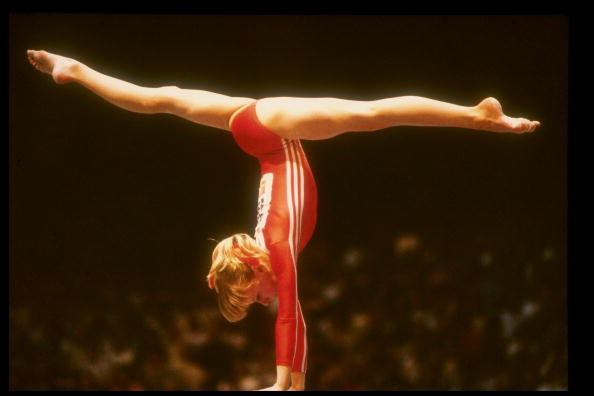
1983: Olga Mostepanova does her routine on the balance beam. Mandatory Credit: Tony Duffy /Allsport