In October 1978, gymnasts gathered in Strasbourg, France, for the XIX World Artistic Gymnastics Championships. Among the Bulgarian women was Krassimira Toneva, who, like many gymnasts in the sport’s history, was technically too young to be there. She was born in 1965.
In April 1992, three teenage gymnasts—Maya Hristova, Milena Mavrodieva, and Mirela Peneva—were caught in a scandal that would cost them their Olympic dreams. The accusations: they had taken banned diuretics. The initial consequence: a two-year suspension, announced in April, right as the World Championships in Paris started.
What follows is the story as it unfolded in the Bulgarian press over the spring and summer of 1992—a chronicle of procedural battles, bribery allegations, broken sample jars, and a courtroom vindication that came too late. The journalists who covered the scandal raised questions that reverberate through their reporting: Were these teenagers manipulated? Who stood to gain from their downfall? And who, in the end, was truly guilty?
By the time you reach the conclusion, some of those questions will remain unanswered. This is not because the answers don’t exist, but because this is how the story emerged at the time—messy, contradictory, and incomplete. What remains clear is what journalist Emanuil Kotev wrote in his final column on the scandal: “The victims remain the girls.”
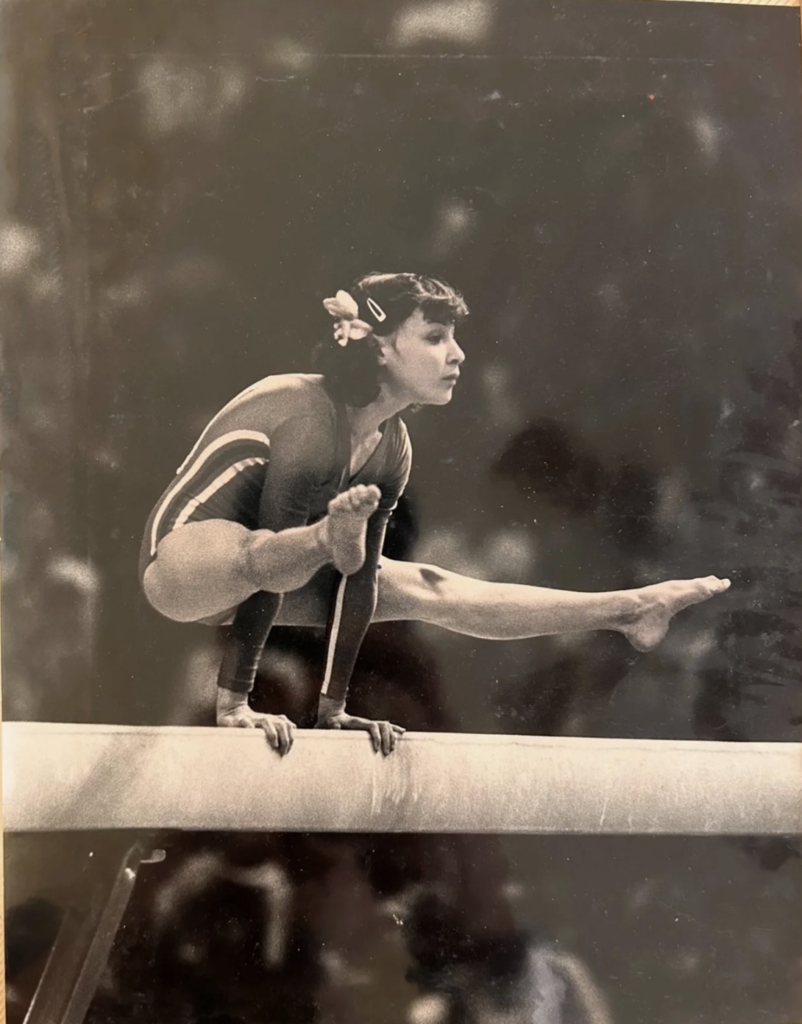
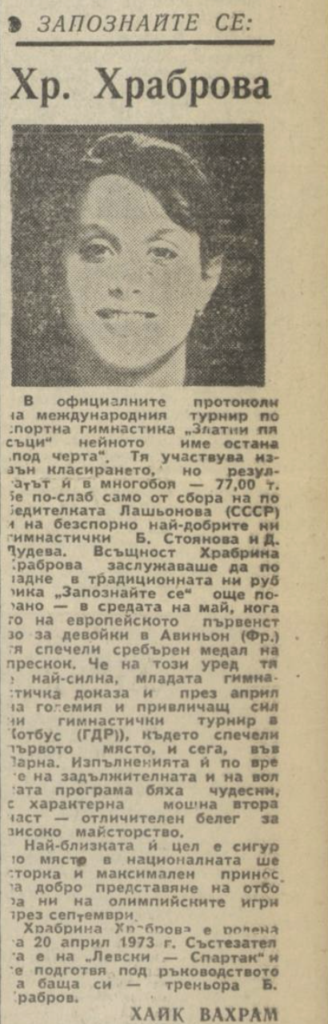
Most age-falsification cases involve making gymnasts older so they can enter senior competition earlier. But what if the goal were the opposite—to make a gymnast younger, allowing her to compete in both junior and senior events?
That appears to be what happened with Bulgarian gymnast Hrabrina Hrabrova, who competed at both the 1988 Olympic Games and the 1988 Junior European Championships under a falsified age.
On October 30, 1983, the Budapest Sports Palace erupted as a Bulgarian gymnast in a red leotard stuck her first vault with textbook control. She shuffled back on her second vault, but her score was good enough. For the first time at a women’s World Championships, the Bulgarian anthem—Mila Rodino—played in the arena. Boriana Stoyanova had become the first Bulgarian woman ever to win a world championship gold medal in artistic gymnastics.
Back home, the press called it a zlatna nedelya, a golden Sunday. Bulgaria’s “golden account,” as one paper put it, had finally been opened.
The moment would be replayed, narrated, and commemorated for decades. What took longer to register was that Stoyanova was not 15 when she won gold.
Stoyanova on the front page of the October 31, 1983 edition of Naroden Sport, Bulgaria’s main sports newspaper.
In the April of 1952, two of the world’s gymnastics powerhouses—Hungary and Czechoslovakia—faced off during Hungary’s Liberation Day competition. The Hungarian men’s and women’s teams emerged victorious.
But the pre-Olympics rivalry didn’t end there. Weeks later, the two nations met again, this time in Prague, with Bulgaria joining the fray for a tri-nation showdown. Once again, Hungary reigned supreme, besting Czechoslovakia in a decisive repeat performance.
On the women’s side, the ongoing duel between Hungarian stars Ágnes Keleti and Margit Korondi continued, with Keleti winning the all-around—one more twist in a season-long back-and-forth between the two. But it was on the men’s side that perhaps the biggest revelation emerged: Bulgaria’s Stoyan Koev surprised the competition by claiming second place in the all-around.