Categories
Age North Korea WAG

The Twin Deception: How North Korea Fooled International Gymnastics for Years

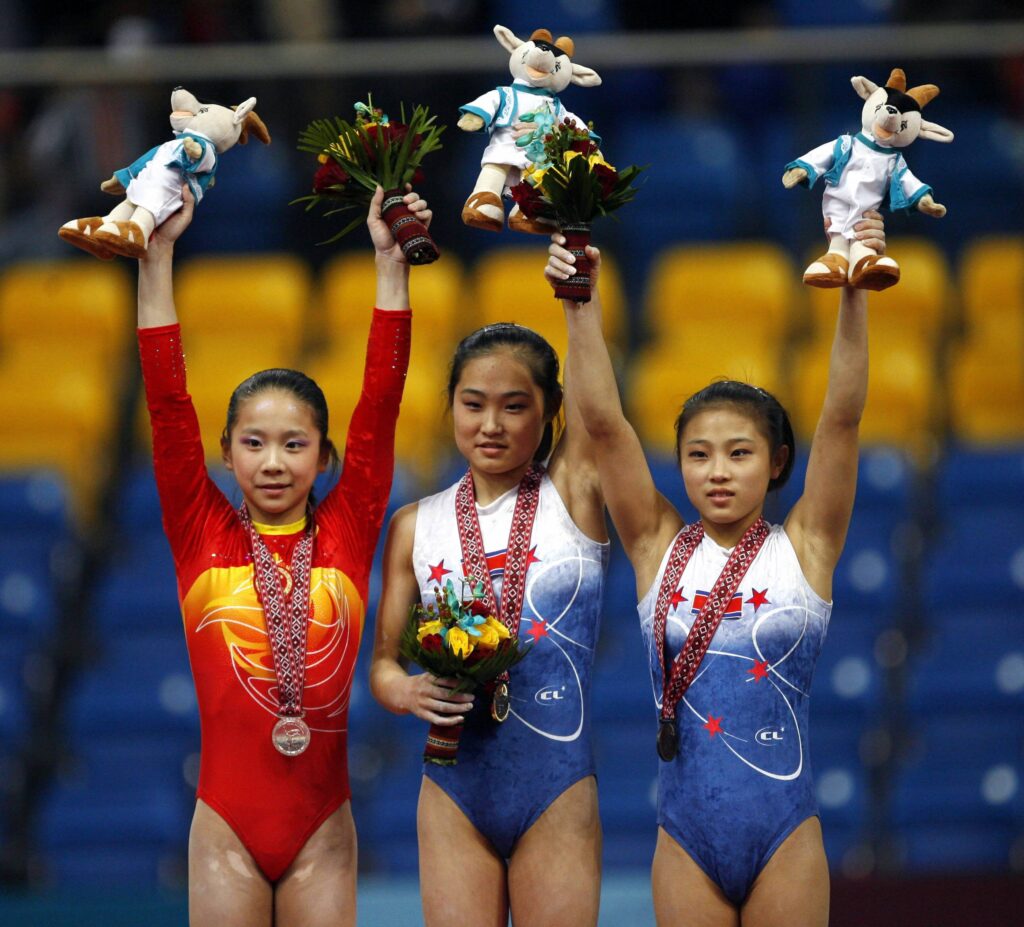
In August 2006, at the Asian Artistic Gymnastics Championships in Surat, India, Hong Su Jeong stood on the vault podium with a silver medal around her neck. The gold went to her younger sister, Hong Eun Jeong—a result that seemed to mark an early challenge to the sibling hierarchy. Four months later, at the Asian Games in Doha, Qatar, the order reversed. Hong Su Jeong again won silver on vault, but that time, she finished ahead of her younger sister, who took bronze.

The results fit neatly into the story that surrounded them. Hong Su Jeong was cast as the elder sister—more experienced, more seasoned—while Hong Eun Jeong, three years younger, was presented as the promising successor rising in her wake. A profile in the Beijing Evening News in 2006 reinforced the contrast, noting that Hong Su Jeong had trained for nine years, while her younger sister had trained for only six.

The story of two sisters competing together was endearing, and over the years, the math was stable, with the sisters always being three years apart.

But it turned out to be false.

Cheng Fei, 1st place; Hong Su Jeong, 2nd place; Hong Eun Jeong, 3rd place; Asian Games, 2006

Note: Throughout this piece, I’ve bolded Hong Su Jeong’s name to help visually differentiate her name from her younger sisters’ name.

Categories
Age North Korea WAG

Kim Gwang Suk: The First Official Case of Age Falsification in Women’s Gymnastics

In early January 1993, the International Gymnastics Federation announced a decision that was unprecedented in the sport’s history: the Democratic People’s Republic of Korea’s women’s gymnastics team would be banned from that year’s World Championships in Birmingham. The reason? The federation had entered Kim Gwang Suk into international competition with three different birthdates—October 5, 1974, at the 1989 World Championships; February 15, 1975, at the 1991 Worlds; and February 15, 1976, at the 1992 Barcelona Olympics.

“This is not a case of doping, and under no circumstances is she guilty,” FIG Secretary General Norbert Bueche told reporters in Geneva. “The dates of birth were deliberately falsified by the association. Such actions cannot be tolerated.”

Kim Gwang Suk’s case marked the first time the FIG had publicly exposed and sanctioned age falsification in elite gymnastics, though the practice was widely suspected to have occurred for years. The case revealed both the lengths to which some federations would go to gain a competitive advantage and the challenges international sports bodies faced in enforcing their own age eligibility rules.

Thirty years after Kim Gwang Suk’s competitive career ended, her life is still a mystery. What survives are fragments: competition reports, newspaper descriptions, brief quotations filtered through translators—almost all produced outside North Korea. This essay follows the traces she left on the international stage between 1989 and 1993, as recorded by foreign journalists and officials, and concludes by examining the narrow but consequential precedent her case set for how the FIG would confront age falsification in the years that followed.

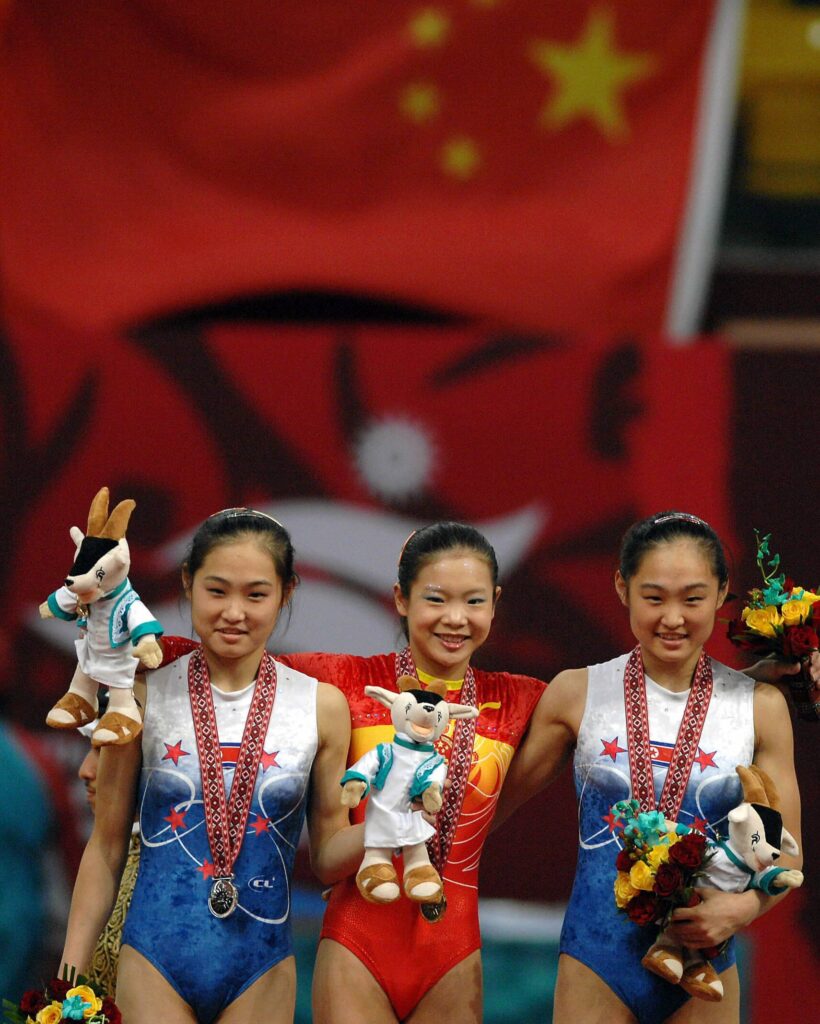
Kim Gwang Suk, 1989
Categories
1971 East Germany MAG North Korea

1971: The East Germans Defeat the North Koreans

North Korea was supposed to participate in the 1970 World Championships, but the team did not show. So, prior to the Munich Olympics, the gymnastics world did not know much about North Korean gymnasts. A 1971 dual meet with East Germany was one of the DPRK’s few international appearances.

What follows are the results and an article about the competition. Reportedly, Kim Song Zu performed a triple twist off rings.

Note: This competition was referenced repeatedly in East Germany’s coverage of the 1972 Olympic Games.

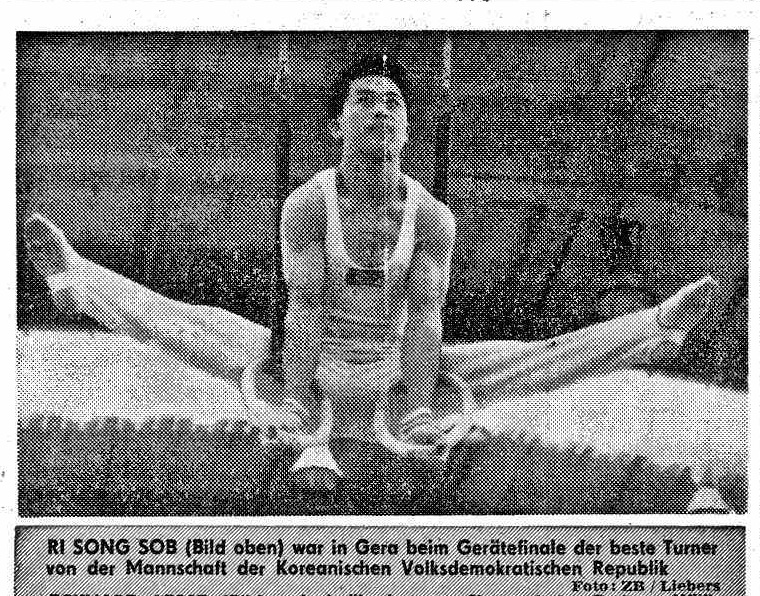
Li Song Sob, North Korea; Source: Neue Zeit, November 30, 1971
Categories
1966 Japan North Korea South Korea

1966: South Korea, North Korea, and an FIG Judges’ Course in Japan

North Korea caused a lot of excitement before the 1970 World Championships. The country’s gymnasts were supposed to compete, which left many gymnastics pundits speculating about North Korea’s chances of placing in the men’s competition. For example, this is what a Swiss newspaper wrote:

The Koreans, in the opinion of Bulgarian specialists, who visited them, do not train less than eight hours a day, at the rate of five practices per week, and, when one knows their natural gifts, one can be certain that their participation “will hurt.” From there, we will have, in our opinion, a peloton comprising the United States, Czechoslovakia, Poland, and Switzerland fighting for 5th place.

L’Express, Oct. 22, 1970

Les Coréens, de l’avis de spécialistes bulgares, qui les visitèrent, ne s’entraînent pas moins de huit heures par jour, à raison de cinq entraînements par semaine et, lorsqu’on connaît leurs dons naturels, on peut être certain que leur entrée « fera mal ». Dès lors, on aura, à notre avis, un peloton comprenant, les Etats-Unis, la Tchécoslovaquie, la Pologne et la Suisse luttant pour la 5me place. 

North Korea’s road to participating in FIG competitions and events was a bumpy one, to say the least. While it was hard to gain information on North Korean gymnastics in the 1960s, one story was reported extensively.

At the end of June 1966, the FIG hosted a judges’ course in Tokyo. North Korean delegates were supposed to attend, but there were some hiccups. Let’s take a look at what happened.

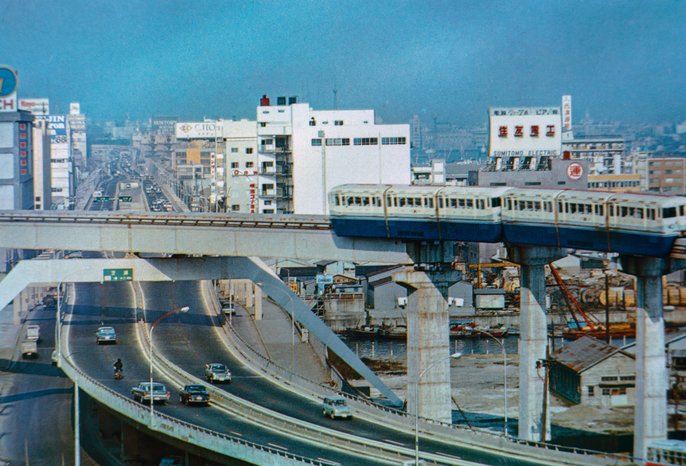
Downtown Tokyo streetscape, 1966, Japan, incorporating flyovers and elevated railways