Categories
1980 Olympics Politics West Germany

“The Boycott Achieved Nothing”: West German Gymnasts Remember 1980

When the Soviet Union invaded Afghanistan in December 1979, governments across the Western alliance were forced to decide whether to support the American-led boycott of the Moscow Olympics. Most Western European countries ultimately found ways to send their athletes to the Games, often under the Olympic flag rather than their national colors. West Germany was different. As one of the largest and most influential countries in Western Europe, it joined the boycott.

That decision has usually been told as a story of Cold War diplomacy: alliance politics, relations with Washington, and the struggle to balance political principles against Olympic ideals. But for the athletes whose careers had been built around Moscow, the boycott was something far more personal. Olympic opportunities vanished, training cycles lost their purpose, and years of preparation suddenly led nowhere.

Among those affected were members of West Germany’s gymnastics team. Below, we’ll look at the reactions of Eberhard Gienger and Volker Rohrwick.
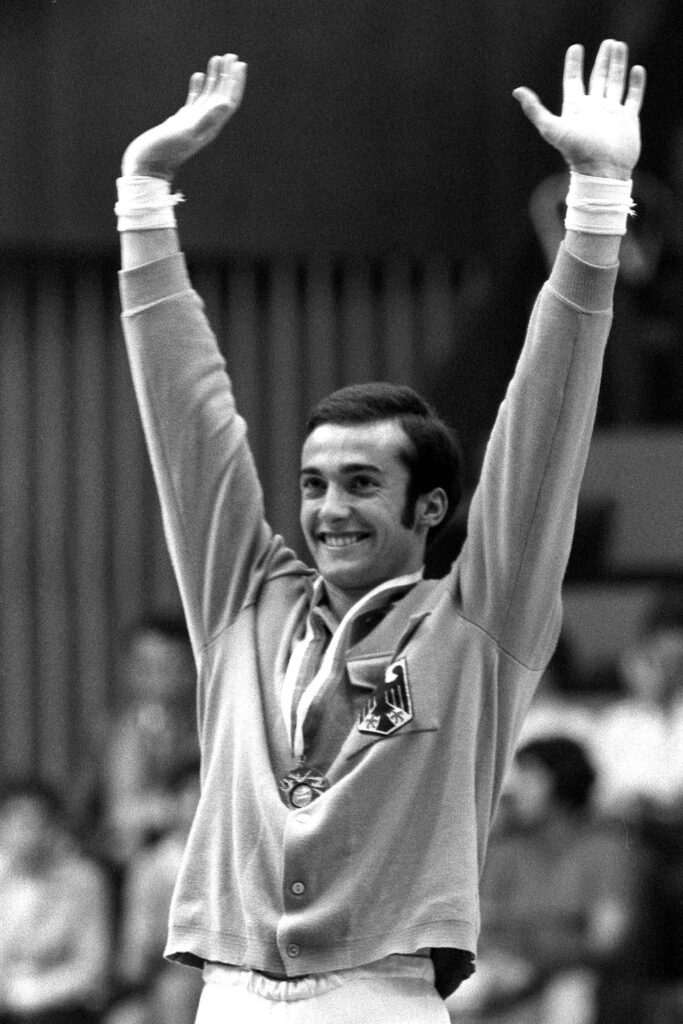
Eberhard Gienger, 1974
Categories
Doping MAG West Germany

Beyond the East German Shadow: What Gienger’s Steroid Admission Reveals

Two stories dominate the history of doping in gymnastics. The first is a story of incompatibility: the widespread belief that performance-enhancing drugs simply don’t work in a sport built on precision, balance, and spatial awareness rather than brute strength. The second is a story of geography: the assumption that systematic doping was an Eastern Bloc problem, a product of Communist sports systems that treated athletes as instruments of national prestige. Both narratives contain elements of truth. But both also obscure a more complicated reality.

The case of Eberhard Gienger dismantles both myths at once. Gienger was not an East German athlete subjected to a centralized doping program. He was a West German star—1974 world champion on high bar, 1976 Olympic bronze medalist, inventor of the Gienger release, and later a member of the Bundestag (the lower house of the German federal parliament)—and decades after his competitive career ended, he acknowledged using anabolic steroids. His admission unsettles the comfortable boundaries of doping history. Doping in gymnastics was not impossible. And it was not uniquely Communist. It was, instead, embedded in a broader landscape of sports medicine, scientific authority, and permissive norms that transcended Cold War divides.

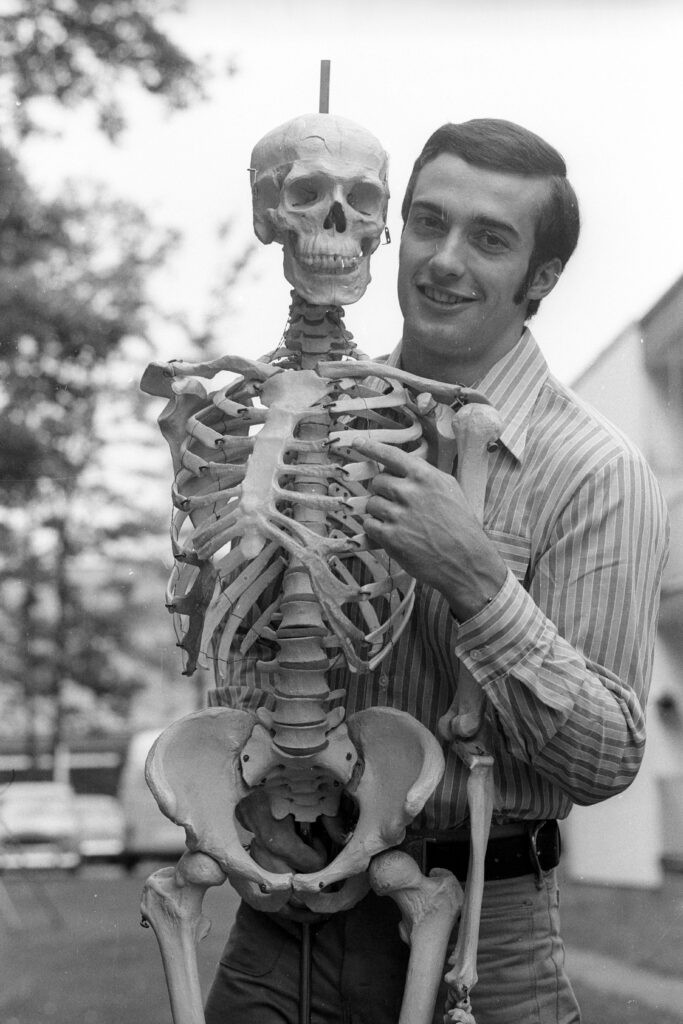
Eberhard Gienger
Categories
East Germany European Championships MAG Politics West Germany

1975: Wolfgang Thüne Defects from East Germany with the Help of Eberhard Gienger

At the 1975 European Championships in Bern, Switzerland, Nikolai Andrianov defeated Eberhard Gienger by a mere 0.050. But the real drama didn’t happen on the competition floor; it unfolded behind the scenes. East German gymnast Wolfgang Thüne, the 1974 silver medalist on high bar, vanished during the post-competition banquet, defecting to the West in an act that stunned his teammates and confused officials. For decades, whispers swirled. Had he hitchhiked across the border?

It wasn’t until 1999 that the truth came out. Eberhard Gienger, the legendary gymnast behind the eponymous high bar release move, had been keeping a secret for 24 years. It was he who had secretly driven Thüne across the border, and their story began in the most unlikely of places: in a bathroom.

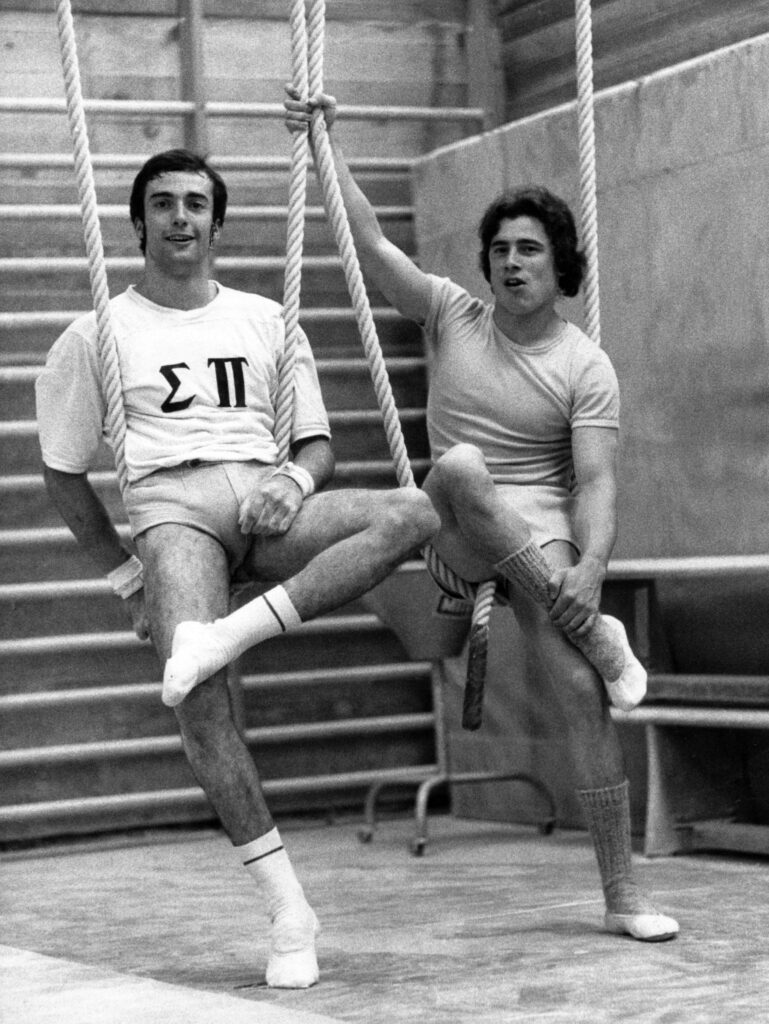
Datum: 17.09.1975, Eberhard Gienger (Left), Wolfgang Thüne (Right)