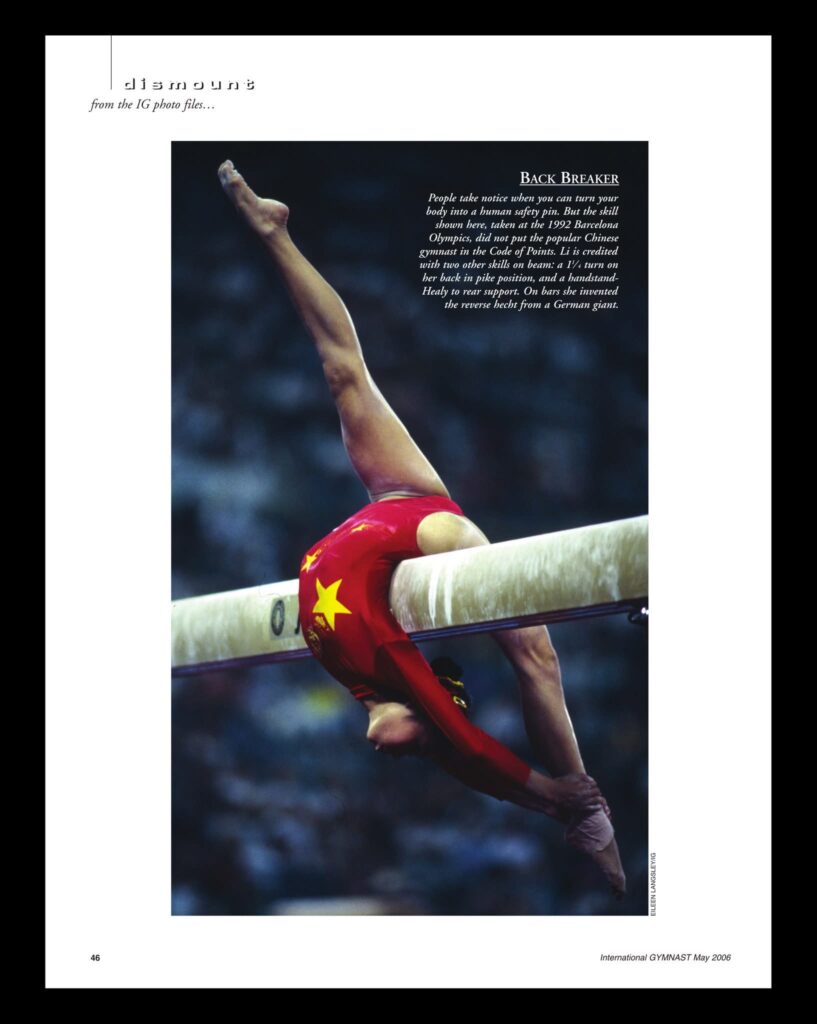
Even though Li Li never won a medal at the Olympics or World Championships, she remains a gymnastics icon. Her uneven bars routine was something special: German giants directly connected to a Tkatchev, borrowing an old skill from men’s high bar and adding a release to the end. On beam, she unveiled a back spin that few gymnasts could execute cleanly on the floor, let alone on ten centimeters of suede. And then there is the photograph: Li Li, draped over the balance beam, back arched, legs in a perfect split. For a generation of fans, that image is Chinese gymnastics at the dawn of the 1990s.
But like many gymnasts of her era, Li Li had two ages: her official birth date and her competitive birthdate, which had been adjusted to meet the age requirements for the 1990 World Cup and the 1990 Asian Games.
1988: An 11-Year-Old in Romania
When Li Li competed at the Romanian International in May of 1988, here’s what the People’s Daily, China’s main newspaper, recorded:
Chinese Gymnasts Win Two Silver Medals at the Romanian International Gymnastics Meet
The Romanian International Gymnastics Championships were held from April 29 to May 1 in Constanța, a coastal city on the Black Sea.
Chinese gymnast Zhang Zhihui successfully completed a handspring double front in the men’s vault final, earning a shared silver medal alongside a Cuban competitor.Another Chinese gymnast, Zhou Fuqiang, finished third on pommel horse, taking bronze.
In the women’s apparatus events, two Chinese gymnasts competing internationally for the first time—Yang Yu (age 14) and Li Li (age 11)—placed second and fourth, respectively, on uneven bars.
The People’s Daily, May 2, 1988, page 3
罗国际体操赛我获两枚银牌
罗马尼亚国际体操锦标赛4月29日至5月1日在黑海海滨城市康斯坦察举行,中国选手张志辉在男子跳马决赛中,成功地完成了前空翻两周半高难动作,与古巴选手并列第二名。中国的周福强获得鞍马第三名。在女子单项比赛中,第一次参加国际比赛的杨宇(14岁)和李莉(11岁)分别获得高低杠第二名和第四名。
The Chinese text was unambiguous: 李莉(11岁). An eleven-year-old in May 1988, with a February birthday, would have been born in 1977.
At the time, the FIG required female gymnasts to turn fifteen during the calendar year of competition in order to be eligible for senior international events. An athlete born in February 1977 would have been just thirteen in 1990—two years shy of eligibility.
And yet, by 1990, Li Li’s official birth year had become 1975. That revision made her fifteen in the year of the Beijing Asian Games—where she won team gold and uneven bars silver—and the Eighth World Cup, where she claimed silver on balance beam.
1991: A Gymnastics Hopeful
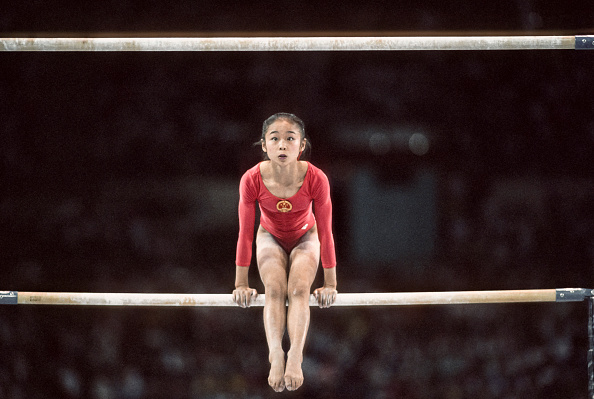
Li’s updated birth year appears in later profiles, including a 1991 feature in China Sports titled “A Gymnastics Hopeful,” which describes her as “born to a worker’s family in Xingning County in south China’s Guangdong Province in 1975.” The article presents a seamless narrative: national team selection in 1987, carefully constructed world-class routines by 1989, international breakout in 1990. Nothing in that story hints at arithmetic problems.
But the arithmetic remains. If she had been eleven in 1988, she could not have been fifteen in 1990. If she had been born in 1975, she could not have been eleven in 1988. One of those records is wrong, and it’s likely the 1975 birth year.
And here’s the thing: with a 1977 birth year, she would have been age-eligible for both the 1991 World Championships and the 1992 Olympic Games. (Fourteen-year-olds were permitted to compete at the 1991 Worlds.) But China did not wait for her to reach senior eligibility naturally. Instead, her age was adjusted so that she could compete a year earlier, in 1990.
This is how China Sports framed Li Li’s rise in 1991:
A Gymnastics Hopeful
With the retirement of veteran gymnasts Chen Cuiting and Fan Di after the 11th Asian Games last year, the Chinese women’s gymnastics team had some new blood infused into it. A number of promising youngsters had gradually matured, among them Li Li and Li Yifang attracted the most attention.
Though her name is still not very familiar to most people, Li Li is now a top gymnast on the national team. Making her debut at the 1990 Eighth World Cup Gymnastics Tournament, she astounded the spectators with her high-caliber performance. A total of four newly-created world-class value parts were performed for the first time at that tournament, and she accounted for three, namely in the uneven bars and the balance beam.
“Li Li is a technically all-around gymnast and is especially good at the uneven bars,” commented coach Lu Shanzhen on the national women’s gymnastics team. “At present, she could be said to be peerless in the world; but of course our gymnasts have been traditionally strong in this event.”
Born to a worker’s family in Xingning County in south China’s Guangdong Province in 1975, Li Li started regular training at six, first in a gymnastics class in the Guangdong Provincial Stadium, and then in the provincial gymnastics team. She donned the national colors in 1987.
This sounds as if promotion was hers for the asking. But she thinks otherwise.
“The odds were not in my favor at the beginning,” she said. “For at that time the one chosen for training at the provincial stadium gymnastics class was not me but another girl. I was just a substitute, but later that girl had an arm injury, and it was after I had proved my worth that I became a regular member of the class.”
She recalled she was not the only lucky one. The well-known woman gymnast Wu Jiani was also a substitute before she became a regular member of the national team. So was their teammate Zhu Zheng. Their experience both gave her consolation and encouraged her to train hard in order to achieve success.
When she first joined the national team, her coach Lu Shanzhen worked out a special program to strengthen her physique. Following that was persistent training in basic skills. It was not until 1989 that the coach designed a few value parts for her, including “Steinemann stemme backward and stemme followed by Tkachev” on the uneven bars and “revolving on back with 1 1/4 turns” on the balance beam. To concentrate her efforts on mastering these new movements, she stayed away from practically all domestic and international competitions, and took part only once in a national tournament in which she won a gold in the floor exercise.
In 1990 she began to appear in major international competitions. At the Eighth World Cup she clinched a silver medal in the balance beam event, and at the 11th Asian Games she cooperated with her teammates in winning the team title.
Small in stature but agile in her movements, Li Li is a favorite among her coaches and teammates. Like other girls of her age, she loves to collect toys, play electronic games, and see animated cartoons on TV. She is always looking forward to Sundays, for on that day she can have a thorough rest and does not have to worry about morning exercises and technical training.
The 26th World Gymnastics Championships and the 25th Olympic Games are not far away. To Li Li, these are golden opportunities to show her prowess after the retirement of several veterans. Experts are of the opinion that she is a strong contender for the uneven bars title, and she might be the third Chinese gymnast to win the world title in this event after Ma Yanhong and Fan Di.
Yun Xin, China Sports, 1991
The Beauty of Li Li
Before turning back to your day, it’s worth pausing for a moment to appreciate the beauty of Li Li’s gymnastics.
More on Age
One reply on “Li Li: The Gymnast Who Aged Four Years in Just Two”
Have we done Lu Li yet? I am very curious about her.