For many Western gymnastics fans, Chinese gymnastics can feel like a black box—a program that produces world-class results while remaining largely opaque to outside observers. Articles like this one, from the state-run People’s Daily on the eve of the 1999 World Championships in Tianjin, offer a rare window into how Chinese coaches and journalists understood their own program’s strengths, limitations, and ambitions.
The men’s team, averaging under 20 years old and led by Huang Xu, Yang Wei, and Lu Yufu, was tasked with defending the team title won in Lausanne two years earlier. Coaches were frank that a repeat blowout was unlikely; Russia had studied the loss and had come prepared. But the program was deep enough across all six apparatus that a second consecutive gold remained the explicit goal.
The women’s team entered under different expectations and with a striking demographic fact embedded in the preview coverage. The squad’s average age was just 16, the precise minimum required for senior international competition under FIG rules. Only Liu Xuan had previous World Championships experience; the other six were making their debuts. Coaches quietly acknowledged that Romania and Russia were out of reach and framed the real contest as a three-way battle for bronze against the United States and Ukraine. For the balance beam final, China deployed what it called the “5-2-1 plan”: field five gymnasts capable of winning, ensure at least two reach the top eight, and convert one into a champion.
The full article, translated below, appeared in the pages of People’s Daily on October 9, 1999.
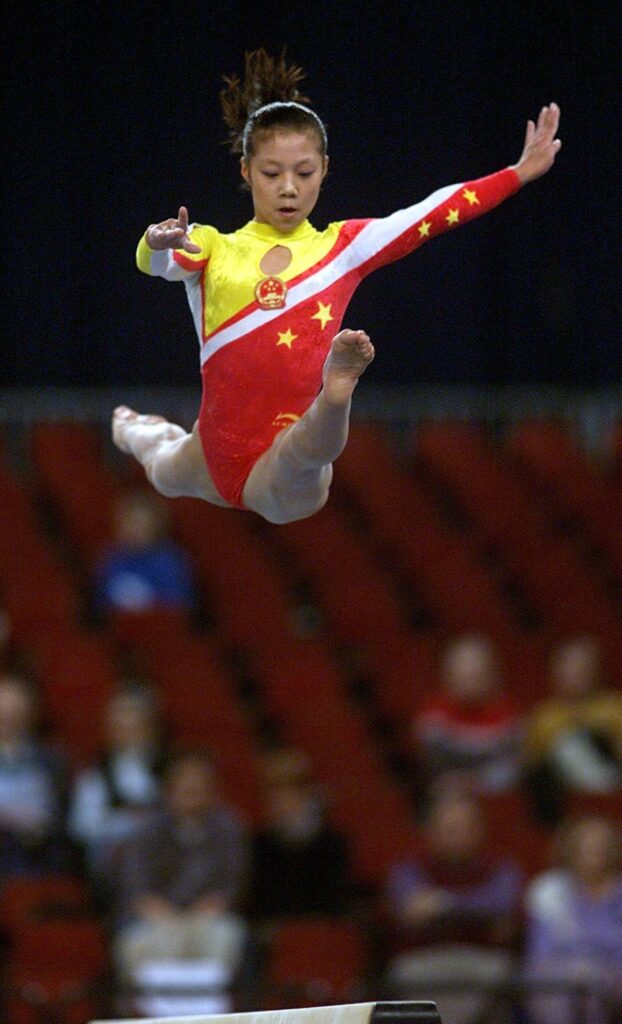
Dong was a member of the 1999 team that later lost its bronze medal after the FIG determined that she had been born in 1986, meaning she was only 13 at the time of the competition in Tianjin.
A Contest at the Turn of the Century
Written on the Eve of the World Gymnastics Championships
By staff reporter Xu Liqun
People’s Daily, October 9, 1999, Page 4 (Major News)
The final world championship to be held in China in this century—the 24th World Gymnastics Championships—has sounded the overture on the beautiful banks of the Haihe River. Gymnastics elites from around the globe will compete on what is the grandest stage in the history of the World Championships, staging a contest of strength and beauty. As the most spectacular “parade” of the gymnastics world ahead of the Sydney Olympic Games, every delegation is sure to display its full brilliance.
Four years ago, in the same majestic Tianjin Gymnasium, the Chinese team swept all the gold medals at the 43rd World Table Tennis Championships. This time, can the Chinese gymnastics team continue that legend on this auspicious ground?
Defending the Men’s Team Title: A Must-Win Mission.
Chinese gymnastics head coach Huang Yubin is full of confidence in the men’s team, believing this fresh squad to be “the best lineup in the history of Chinese men’s gymnastics.”
The seven athletes selected for this competition share several standout characteristics:
- Youth and drive.
With an average age of under 20, all team members are in excellent physical condition, free of major injuries. - Comprehensive skills and solid fundamentals.
Take the straight-body 720-degree twisting salto on floor exercise as an example: in the past, only Lu Yufu, Li Xiaopeng, and Yang Wei could perform it, but now every team member has mastered the skill. China has strong contenders on all six apparatus, with no weak links. In the all-around, Huang Xu, Yang Wei, and Lu Yufu all possess formidable strength and are strong gold-medal contenders. - Diversity of strengths, excellence across the board.
On vault, Lu Yufu’s Tsukahara double tuck—known as the “Lu Yufu vault”—is unmatched. His handspring piked front somersault with a 900-degree twist is also a rarity even among world elites. Huang Xu’s newly restructured parallel bars routine is high in difficulty and quality and extremely competitive. Xing Aowei’s pommel horse is world-class, earning him the title “King of Pommel Horse.”
[Note: A Tsukahara double pike is a Lu Yufu on vault, but the article clearly says Tsukahara double tuck (团身).] - High start values and strong execution.
The vast majority of the team’s routines carry start values of 10.0, reflecting extremely high difficulty paired with quality execution.
China’s strongest rival in the team competition remains Russia. At the 1997 World Championships in Lausanne, Switzerland, the Chinese men’s team won comfortably by more than five points after mastering the new rules. This time, having learned from that defeat, their experienced rivals are well prepared. Even with the advantages of competing at home, China is unlikely to repeat a runaway victory. Experts predict that the traditional “China–Russia duel” in the men’s team event will be even more gripping. While Belarus, Ukraine, and Japan boast top individual gymnasts, their overall strength is slightly weaker, making a challenge for team gold or silver unlikely.
Compared with the relatively clear outlook of the men’s team event, the men’s all-around and apparatus competitions are expected to be fiercely contested. With many athletes of similar caliber, gold medals will likely hinge on consistency and performance under pressure.
Belarus hopes Ivanov will retain his all-around crown. China’s team captain Huang Xu, the daring and technically gifted Lu Yufu, and the solid Yang Wei are all seen as strong contenders. Russia’s “risk-loving genius” Alexei Nemov and fellow star Bondarenko are also powerful challengers.
Apparatus finals are traditionally unpredictable and prone to upsets—especially since the FIG abolished compulsory routines, giving specialists greater opportunities to reach the podium. With elite contenders on every apparatus, China hopes to collect medals “in abundance,” focusing particularly on pommel horse, parallel bars, and vault.
Women’s Team: Aiming for a Team Medal, Hoping for Individual Gold
The Chinese women’s team at these championships has an average age of just 16. Only Liu Xuan has prior World Championships experience; the other six are all making their debut at this level. Team leader Qian Kui joked that the squad is “one big sister leading six little sisters.”
China’s goal in the women’s team competition is to fight hard for a medal. At present, Romania and Russia are the strongest contenders for gold. China does not yet possess the overall strength to challenge them directly. The United States and Ukraine, however, are roughly on par with China, making the battle for bronze particularly intense.
After a major overhaul in 1998, the U.S. team invested heavily in hiring Romanian and Russian coaches and emphasized scientific training, with clear results. In recent competitions, the Americans have emerged as a rising force. Experts note their high difficulty, innovative choreography, strong psychological resilience, and tendency to perform better on bigger stages.
Ukraine, meanwhile, boasts solid fundamentals, balanced athletes, and stable execution. At the previous World Championships, they narrowly lost to China and finished fourth. Returning this time, they will not go down quietly.
A Chinese team dominated by newcomers faces a severe test. In terms of technique and difficulty, they are not inferior to the veterans and, in some cases, even surpass them. However, they lack major competition experience and have yet to establish a strong “impression score” with judges.
In the women’s all-around, Russia’s Svetlana Khorkina stands out head and shoulders above the rest; barring mistakes, the gold medal is hers to lose. Romania and the United States also have contenders, while China’s Liu Xuan, Ling Jie, and Dong Fangxiao could challenge for the podium with strong performances.
China’s greatest hopes for women’s gold lie on balance beam and uneven bars. Ling Jie defeated Khorkina twice last year on uneven bars; if she can successfully perform her high-difficulty, cleverly connected routine, gold could once again belong to this graceful gymnast. To secure beam gold, China has devised a “5–2–1 plan”: five gymnasts with medal potential, ensure at least two make the top eight, and then aim for one to win gold.
Winning many golds and medals is always desirable. But China’s coaches place even greater value on giving their young men and women the chance to be tested and tempered at these championships. After all, the Sydney Olympic Games next year are the ultimate stage.
At the turn of the century, Chinese gymnastics is looking toward the future.
(Filed from Tianjin, October 8)
世纪之交的较量——写在世界体操锦标赛开赛之际
第4版(要闻)
专栏:
世纪之交的较量
——写在世界体操锦标赛开赛之际
本报记者 许立群
本世纪在我国举行的最后一次世界大赛——第二十四届世界体操锦标赛已在美丽的海河之滨奏响序曲。全世界的体操精英将在世锦赛历史最硕大的舞台上展开力与美的较量。作为悉尼奥运会前体操界最盛大的一次阅兵式,各代表队必将绽放所有的光彩。
4年前,也是在气势恢宏的天津体育馆,中国队囊括了第四十三届世乒赛的全部金牌。此番,中国体操队能否在这块风水宝地续写神话呢?
男队:卫冕团体冠军志在必得
中国体操队总教练黄玉斌对中国男队信心十足,认为这支新军是中国男子体操队“有史以来的最好阵容”。
这次参赛的7名选手特点突出:一是队员年轻,有冲劲。他们的平均年龄不到20岁,个个身体状况良好,无大伤病。二是技术全面,基本功扎实。如自由操直体720度旋,过去只有卢裕富、李小鹏、杨威会做,现在所有参赛队员都能熟练地掌握。在全部6个单项上,都有精兵强将扼守,没有一项拖后腿的。而且在全能项目上黄旭、杨威、卢裕富都具备很强的实力,志在必得。三是百花齐放,各有所长。男子跳马侧手翻团身后空翻两周的“卢裕富跳”无人能比,前手翻屈体前空翻转体900度这个动作,除卢裕富外也没有几人能做。黄旭在双杠上重新组合的一套全新动作,难度大,质量高,具有很强的竞争力。邢傲伟的鞍马世界顶尖,被誉为“鞍马王”。四是动作起评分高,质量好。参赛选手的绝大部分技术动作都达到了起评分10分的高难度。
中国队在团体比赛中的最强对手依然是俄罗斯队。在1997年瑞士洛桑世界锦标赛上,中国男队得益于吃透了新规则,以超俄罗斯队5分多的优势轻松夺冠。如今,吸取了教训的老对手有备而来,“家门口”作战的中国男队即便有天时、地利、人和的有利条件,也很难重演“一骑绝尘”的一幕。行家预测,男团赛多年来几成传统的“中俄双雄会”将更加扣人心弦。白俄罗斯、乌克兰和日本队虽均有顶尖好手,但是整体实力稍逊,对男团金银牌恐怕是望尘莫及。
比起男团比赛的明朗形势,男子全能和单项的角逐将是一片混战,众多实力在同一水平线的选手都有摘金的可能,关键看谁的临场发挥更稳定。
白俄罗斯队希望伊万科夫继续扼守个人全能的桂冠。中国队队长黄旭和身怀绝技且胆量过人的卢裕富也被寄予厚望,实力不俗的杨威也有可能成为“黑马”。当然,俄罗斯队“爱冒险的天才”涅莫夫,以及另一位名将邦达连科也是金牌极为有力的竞争者。
单项比赛历来扑朔迷离,往往更容易爆冷门。特别是国际体联取消规定动作比赛后,众多“术业有专攻”的选手更多几分走上领奖台的机遇。而每个项目都有精兵强将把关的中国队则希望奖牌“多多益善”。中国队在单项的摘金重点项目是鞍马、双杠和跳马。女队:团体全力争牌 单项有望摘金
参加本届世锦赛的中国女队平均年龄仅16岁。只有刘璇一人参加过世锦赛,其他6人都是第一次参加如此高规格的世界大赛。钱奎领队戏称“女队是一个大姐姐领着6个小妹妹”。
中国女队的目标是全力争取团体奖牌。从目前状况看,罗马尼亚队和俄罗斯队是女团冠军最有力的争夺者。而中国队尚不具备与她们抗衡的整体实力。而美国队和乌克兰队却与中国队旗鼓相当,铜牌的争夺也很激烈。
美国队在1998年进行了大换血后,重金聘请了罗马尼亚和俄罗斯教练。该队注重科学训练,成效显著,在新近的一系列大赛中已崭露头角。行家们评价,美国队动作难度大,编排新颖,而且队员心理素质好,表现欲强,越是大赛,越是发挥出色。
乌克兰队基本功扎实,队员实力均衡,技术发挥稳定,上届世锦赛上仅以微弱差距输给了中国队,屈居第四,此次卷土重来,不会善罢甘休。
主要由新人担纲的中国队无疑面临着严峻的考验。从技术和动作难度上她们与老队员相比并不逊色,甚至有所超越。但她们的大赛经验十分缺乏,而且在裁判心目中还未树立起足够的印象分。
在女子个人全能项目上俄罗斯的霍尔金娜一枝独秀,如不出闪失,金牌非她莫属。此外罗马尼亚队和美国队也有夺金选手,中国队刘璇、凌洁和董方霄如有出色表现,有望进入前三。
中国女队夺金最大希望寄托在平衡木和高低杠两个单项上。凌洁去年曾两度在高低杠项目上战胜霍尔金娜夺冠,如果她能将自己那套难度大、连接巧妙的动作顺利完成的话,金牌将再次光顾这个灵秀的女孩。为确保平衡木金牌,中国队制定了“521”计划,即在参赛的5名队员都有夺金实力的基础上,确保两人进入前八,最后争取一人夺金。
在世界大赛上多拿金牌奖牌当然是人们所乐见的。但中国队的教练们更希望年轻的男女选手们能在本次大赛中经受考验,得到锻炼。毕竟明年悉尼奥运会才是最重要的舞台。世纪之交的中国体操正在眺望未来。
(本报天津10月8日电)
More on China