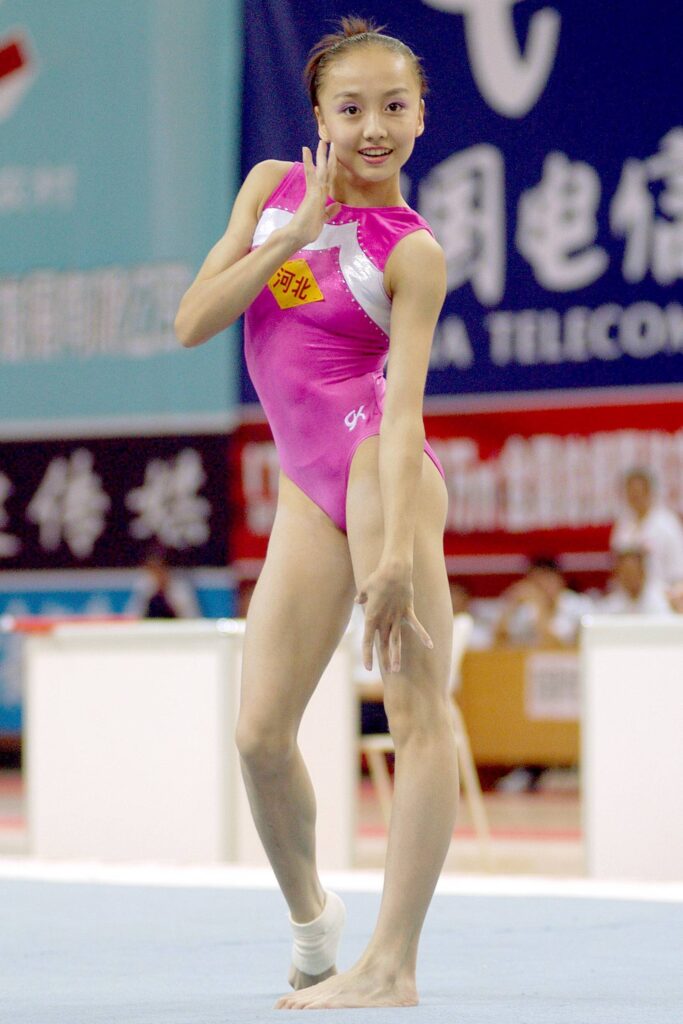
Pang Panpan emerged as one of China’s unexpected heroes at the 2006 World Championships in Aarhus, Denmark, where she competed three times in the women’s team final, contributing to China’s first-ever women’s team world title. She went on to compete at the 2006 Doha Asian Games, winning team gold and a floor exercise silver.
The three sources translated below — two local newspaper profiles published the day after China’s 2006 team victory and a 2016 Hebei Provincial Sports Bureau charity feature — consistently give her birth year as 1990. That would make her 16 at the 2006 World Championships and just 15 — and therefore underage — when she won medals at the 2005 World Cup in Brazil, the Dutch Open, and the East Asian Games. Her internationally registered birthdate, however, was 1988. The adjustment appears aimed at making her eligible for selection to the 2004 Olympic team, for which a 1988 birth year would have placed her within the required age limits.
Enjoy these articles about the “Oriental Beauty.” (Their words — not mine.)
2006
World Championships Dark Horse Pang Panpan: The Introverted “Oriental Beauty”
October 20, 2006, — Yanzhao Metropolis Daily
Stepping in for Li Ya, who had performed poorly in the preliminaries, Pang Panpan showed no nerves at all in the finals — uneven bars, balance beam, floor exercise — scoring highly in all three events. China’s “dark horse” ultimately surpassed the defending champion United States to take the title. But where does this surprise weapon come from? Panpan is a thoroughly Hebei girl, from Fangbei Village in Shijiazhuang.
At last year’s Jiangsu National Games [10th National Games], Pang Panpan competed for Hebei for the first time, finishing fourth in both the balance beam and the individual all-around — no medals. Panpan cried after the competition. The Hebei gymnastics head coach at the time, Huang Jian, consoled her: “You’re still young, there will be chances.” Sure enough, earlier this year at the National Gymnastics Championships, Pang Panpan claimed the individual all-around title and was directly selected for the national team’s World Championships roster.
Pang Panpan was born in 1990, selected for the provincial team in 2000, and entered the national team in 2003. Her technique is graceful, her standards high, and her appearance striking — she earned the nickname “Oriental Beauty” from the very start of her career. Huang Jian still remembers the moment he chose her: “She had already been training at a Shijiazhuang amateur gymnastics school for several years. The moment I saw her, I could tell she was a beauty and had the makings of a gymnast. Hebei’s women’s gymnastics program has always placed great importance on a competitor’s appearance.” Shortly after joining the provincial team, two Hebei athletes, including Pang Panpan, were selected for the 2003 national team training camp. The national team training was grueling; her teammate, who went with her, gave up, but the persevering Pang Panpan stayed.
“Panpan has a clingy personality, quite introverted — she’s the kind of child who keeps things to herself. She loves gymnastics deeply; since joining the national team in 2003, she has only come home once.” So said Pang Panpan’s mother, Zhang Haling, in an interview. In September 2003, Pang Panpan’s father suffered a serious heart attack. Panpan, the family’s only daughter, was training in Beijing when the family sent her a critical-illness notice. She rushed back to Fangbei Village overnight to see her father, then returned to Beijing to continue training after just one night. Speaking of how his illness had disrupted his daughter’s training, Pang Panpan’s father, Pang Jianqiao, was still a little embarrassed about it. Yesterday, upon learning that Panpan had won the world championship, he hosted a banquet at home for family and friends, celebrating Panpan’s glory for the nation. (Staff reporter: Li Qiang)
世锦赛奇兵庞盼盼:性格内向的”东方美人”
2006年10月20日 燕赵都市报
顶替预赛表现欠佳的李娅参加决赛,庞盼盼一点都不紧张,高低杠,平衡木,自由操,三项得分都很高。中国队杀出”奇兵”,最后压倒卫冕冠军美国队夺冠。但你知道庞奇兵来自何方?盼盼是一位地地道道的河北姑娘,她是石家庄市方北村人。
去年江苏十运会,庞盼盼首次为河北征战,获平衡木和个人全能两个第四名,没有拿到奖牌,盼盼赛后还哭鼻子。当时带队的河北体操(体操新闻,体操说吧)队总教练黄健安慰她说:“你还小,以后有机会。“果然,今年上半年全国体操锦标赛,庞盼盼就捧回了个人全能冠军,并直接入选中国队世锦赛阵容。
庞盼盼1990年出生,2000年被省队挑中,2003年进入国家队。她动作优美,规格高,形象姣好,一出道就赢得”东方美人”称号。黄健至今还记得当年挑中庞盼盼的一刻,“当时她在石家庄业余体校都练了好几年了,我第一眼就发现这孩子很靓,是块练体操的料。河北女子体操选材一向注重选手形象。“进入省队不久,2003年国家队集训,河北队两名队员入选,其中就有庞盼盼,国家队训练是很苦的,一同去的队友放弃了,能吃苦的庞盼盼最终留下了。
“盼盼性格粘粘的,比较内向,属于心里做事的孩子。她非常喜欢体操,从2003年进国家队到现在,只回过一次家。“庞盼盼的母亲张哈玲接受采访时说。2003年9月,庞盼盼父亲心脏病发作,情况很危险,盼盼是家中惟一的女儿,家里给在北京训练的盼盼发了父亲病危通知书,她连夜赶回方北村和父亲见面,过了一夜就回北京继续训练了。说起因为自己发病给女儿训练带来影响,庞盼盼的父亲庞建桥还有点不好意思,昨天获悉盼盼夺得世界冠军后,老庞在家中设宴招待亲朋,庆祝盼盼为国争光。(本报记者栗强)
2006
Delicate in Appearance, Strong in Character — The Founding Coach Speaks About Pang Panpan
Shijiazhuang Daily, October 20, 2006
Competing three times in the final — tied with team captain Zhang Nan as the most-used member of the Chinese squad — she made an enormous contribution to China’s first-ever women’s team world championship. She is our city’s young gymnastics star, Pang Panpan.
Yesterday, the moment the Chinese women’s team claimed the title, this reporter immediately sought out Pang Panpan’s founding coach, Li Guiping of the municipal youth sports school. Coach Li had stayed up through the night before to watch the World Championships live, then watched the recorded broadcast again yesterday morning. He said happily: this is Shijiazhuang’s first gymnastics world champion, and Pang Panpan, who competed as an absolute frontline member in the final, has brought honor to our city.
The 16-year-old Pang Panpan is from Fangbei Village in our city, and her parents are ordinary workers. In 1997, with the aim of building their daughter’s physical fitness, her parents sent the 7-year-old Pang Panpan to the municipal youth sports school. The well-behaved girl quickly took to the sport, entering the Hebei provincial team in January 2001 and the national team in early 2003 — a smooth, uninterrupted rise. Li Guiping said that despite her delicate outward appearance, Pang Panpan is meticulous in training and keeps her composure in competition — she is a rare gymnastics talent.
Uneven bars 15.05, balance beam 15.55, floor exercise 15.425 — every event above 15 points. Coach Li explained that despite a setback in the preliminaries and the heavy responsibility placed on her by the coaching staff for the final, Pang Panpan held firm under pressure, performed at a high level, and fulfilled her competition duties completely. This shows that the young girl has truly come into her own.
Huang Jian, deputy director of the provincial gymnastics and weightlifting center, told reporters that Pang Panpan performed superbly in the final. As a newcomer competing in a major world event for the first time, she demonstrated her hallmark qualities of all-around consistency and strong reliability, adding weight to her case for selection at the 2008 Beijing Olympics. (Photo caption: Chinese team member Pang Panpan on the uneven bars.) (Staff reporter: Guo Liqun)
外表柔弱个性坚强——启蒙教练谈庞盼盼
2006年10月20日 石家庄日报
决赛中三次上场,与队长张楠同为中国队上场次数最多的队员,为中国队夺得建队以来的首个女子团体世界冠军作出了巨大贡献,她就是我市体操小将庞盼盼。
昨天,在中国女队夺冠的一刻,记者第一时间采访了庞盼盼的启蒙教练——市少体校李桂平教练,李教练昨天凌晨一直熬夜观看了世锦赛的直播,昨天上午又看了一遍比赛录像。李教练高兴地说,这是石家庄首位体操世界冠军,在决赛中,作为绝对主力上场的庞盼盼为我市争得了荣誉。
16岁的庞盼盼来自我市方北村,父母都是普通工人。1997年,庞盼盼的父母出于锻炼女儿身体的目的,把7岁的庞盼盼送到市少体校,个性乖巧的庞盼盼很快喜欢上了这项运动,2001年1月进入河北省队,2003年初进入国家队,庞盼盼可谓一路顺风。李桂平说,外表柔弱的庞盼盼训练时一丝不苟,比赛中沉得住气,是个不可多得的体操苗子。
高低杠15.05分、平衡木15.55分、自由体操15.425分,每项得分均在15分以上,李教练介绍,在预赛失利、决赛中教练委以重任的情况下,庞盼盼顶住了压力,发挥了高水平,圆满地完成了比赛任务。从这点可以看出,小姑娘已经成长起来。
省体举柔中心副主任黄健向记者介绍,庞盼盼在决赛中发挥得非常好,作为头次参加世界大赛的新人,庞盼盼发挥了自己各项均衡、稳定性强的特点,为2008年北京奥运会的入选增添了砝码。图为中国队队员庞盼盼在高低杠比赛中。(本报记者郭立群)
2016
Pang Panpan Joins You on the “Happy Playground”
Source: Hebei Sports Lottery | April 22, 2016
The “Happy Playground” public welfare donation initiative was jointly launched by the Hebei Provincial Sports Lottery Administration Center and Yanzhao Metropolis Daily. Nearly 100 schools applied to participate in this year’s program, and ultimately 32 were selected as beneficiaries.
On April 20, the “Happy Playground” initiative set out once again, visiting Wangdu County, Anguo City, and Yi County in Baoding, delivering sports equipment filled with care and goodwill to local children. World gymnastics champion Pang Panpan also joined the team, entering school campuses alongside staff and personally instructing students in proper athletic movements. For these children, it was a rare opportunity—they could witness the presence of a world champion without ever leaving their hometown.
“With so much equipment, I don’t even know what to play!”
On the afternoon of April 20, reporters and staff from the provincial sports lottery center first arrived at Jiacun School in Wangdu County, delivering sports equipment to the students.
“The ‘Happy Playground’ program is wonderful—it’s truly a timely help for schools like ours that lack sports equipment,”
said Principal Lu Lijun, watching students playing happily on the playground.
According to Lu, Jiacun School was founded in 1956 and was restructured in September 2010 into a nine-year compulsory school. With more than 500 students, it is the only school in Wangdu County that includes a rural junior middle school.
For many years, the school’s sports equipment had been limited in variety, insufficient in quantity, and in some cases unusable, restricting students’ physical activities. Most equipment had been purchased in 2003 and had since become outdated.
When the new equipment arrived, students excitedly gathered around, eagerly choosing what to try. Fifth-grade student Li Siyuan told reporters that the school previously had very little equipment—even their soccer balls were worn out. “In PE class, we could only play soccer or run. I love hula hoops the most. Now that there are so many new things, I want to try everything—I don’t even know where to start!”
“PE class is going to be so much more fun now!”
After the donation event at Jiacun School, the team continued on to Guxi Primary School in Anguo and Tsinghua Hope Primary School in Yi County, delivering table tennis tables, soccer balls, basketballs, and other equipment.
Guxi Primary School is a rural school with only 16 teachers and just over 200 students. Its playground is simply a large dirt field; when strong winds blow, dust fills the air. Due to limited funding, students previously had almost no sports equipment, and the equipment room was empty.
So when the donated equipment arrived, students lined up neatly to welcome it, their eyes filled with excitement and anticipation.
PE teacher Li Peng said he had applied for the “Happy Playground” program online on February 27, just to try his luck. “I never expected that by April 8, I would find out our application had been approved.” He spoke with visible excitement.
“I’m responsible for all the school’s PE classes. Before, we could only run or do long jump—activities were very limited. Now, with all this equipment, PE classes are going to be so much more interesting!”
After the ceremony, staff members joined the children in games. The dirt playground turned into a sea of laughter. They even held a tug-of-war competition, with both sides pulling with all their strength while surrounding students cheered them on.
World Champion Pang Panpan Supports “Happy Playground”
During this donation event, world gymnastics champion Pang Panpan joined the team on campus visits. On the playground, she not only demonstrated simple athletic movements but also played table tennis and other games with the children, filling the scene with laughter.
At Tsinghua Hope Primary School in Yi County, which has only 120 students, the children initially did not realize that this petite young woman was a world champion. After being introduced, the students collectively gasped in surprise, mouths open in astonishment.
At each school, Pang demonstrated movements such as cartwheels and backward rolls. Her graceful and precise form drew repeated exclamations of admiration. She also guided students hands-on, teaching them proper technique so they could learn standard movements.
Pang expressed her hope that through her efforts, more children would be encouraged to participate in sports:
“Only with a healthy body can you learn better. I hope children can experience the spirit of perseverance through sports—developing the courage to face and overcome whatever challenges they encounter in life.”
Sidebar: Pang Panpan — The Gentleness and Resilience of an “Oriental Beauty”
Pang Panpan is a native of Hebei, born in June 1990 in Shijiazhuang. Before retiring, she was a member of China’s women’s gymnastics team. At the 2006 World Gymnastics Championships, she and her teammates won the women’s team gold medal, making her an outstanding representative of Hebei athletes.
When she learned that “Happy Playground” was a large-scale charity initiative—especially one providing much-needed sports equipment to under-resourced schools—Pang readily accepted the invitation.
At 10 a.m. on April 20, she emerged from the provincial training center dressed in athletic wear—slender, upright, fair-skinned, and still carrying her signature “Oriental beauty” smile: reserved, gentle, and warm.
When asked about her path to becoming a world champion, the modest Pang repeatedly said:
“There’s nothing special about it—I just kept going step by step. Of course, it was difficult, but persistence is the most important thing.”
In 1997, while studying at Fangbei Primary School in Shijiazhuang, Pang was spotted by a coach scouting gymnastics talent. She had the ideal physique, and despite her slight frame, she showed intelligence and agility. From that moment, she began her gymnastics journey.
She entered the national team in 2003 but had to rest for nine months due to injury before resuming training. In 2005, just after turning 15, she won a silver medal on balance beam at a World Cup event in Brazil and two gold medals at the Dutch Open. Local media gave her the nickname “Oriental Beauty.” Together with Cheng Fei’s power, Fan Ye’s softness, and Panpan’s vivacity essentially captured the most distinctive technical qualities of Chinese women’s floor exercise that year.
Behind her seemingly fortunate success lay countless tears and hardships. Pang summarized it all with a single word: persistence.
After being selected by coaches at age 7, she entered the provincial team for professional training. Of the ten-odd athletes from Shijiazhuang in the same intake, only three or four persevered. Six years later, she was the only one selected for the national team.
Before the 2008 Beijing Olympics, during uneven bars training, the skin on her palms tore open, but she didn’t make a sound—she gritted her teeth and completed her routine. Sweat and blood flowed together, leaving stains on the bars. She said this was “a common occurrence.”
“People often see gymnasts competing with bandaged feet. Before the 2008 Olympics, I had a stress fracture in the navicular bone of my left foot. I kept training with injections,” she said. Even now, she still occasionally feels pain in that foot.
Participating in the “Happy Playground” initiative and interacting with rural children brought her great joy. She noted that some children showed good coordination and physical potential—they were lively, loved sports, but lacked opportunities.
Seeing that the schools in Wangdu, Anguo, and Yi County still had dirt playgrounds made her feel deeply concerned.
She hopes that everyone can contribute in small ways to help these children—because perhaps, in doing so, their futures might change.
More on Age