In Gymnastics’ Greatest Stars, Kathy Johnson introduced American audiences to a rising Chinese gymnast:
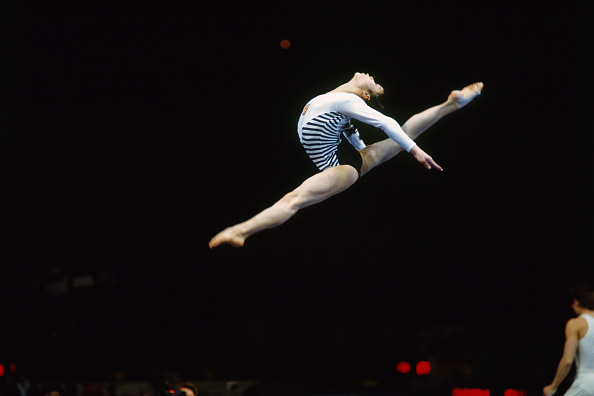
“Her name is Yang Bo, and in Chinese, Bo means waves, which is exactly what she made at the ’89 Worlds with this move on the beam. She is one of the fresh new faces who has pushed the Chinese women back into the top three.”
The move Johnson was describing was a layout step-out directly into a high Rulfová—one of the most breathtaking combinations ever performed on balance beam.
Yang Bo has long since earned her place in the pantheon of great beam workers. But there is one small complication. She should not have been at the 1989 World Championships at all.
Officially, Yang Bo competed with a 1973 birthdate. In reality, she appears to have been born in 1975, according to her profile on the Beijing Sport University website. That would have made her just fourteen in Stuttgart.
In other words, one of the most celebrated beam routines of the late 1980s may also have been performed by an underage gymnast.
And in a twist that feels almost ironic, Yang Bo herself never particularly loved the sport. As she reflected years later:
“Choosing gymnastics was not really my decision. I didn’t actually love gymnastics—I just happened to be good at it. After becoming an athlete, I sometimes wanted to quit, but my parents told me to persevere.”
Her real passion, it turned out, was singing.
The article below—published in 2007 by Bund Pictorial—captures Yang Bo years after her gymnastics career ended, as she attempted to reinvent herself on an entirely different stage.
Note: The interview itself appears to assume a 1974 birth year, while Yang Bo’s Beijing Sport University profile lists 1975.
Exclusive Interview with Yang Bo: From the “Little Swallow” on the Balance Beam to a Stage Singer
Sohu Olympics – Aug 15, 2007
Bund Pictorial
By Xie Qing
Yang Bo: “I Am Just a Passing Traveler”
At the 1992 Barcelona Olympics, she left behind a dazzling impression. Yet she disappeared almost as quickly—like the light, magical leap that now bears her name. You may not know that on another stage, under dim lights, she quietly sings a song titled “Passing Traveler.”
Disappointment once led her to gain so much weight that she could no longer return to the gymnastics world. Now she is a calm and composed singer.
In the world of gymnastics, Yang Bo was like an epiphyllum—brilliant but fleeting. She began training at seven, entered the national team at ten, and officially left the team at nineteen. Her gymnastics career left the world with a single legacy: the “Yang Bo Jump.”
In June, inside a dimly lit bar in Shanghai, Yang Bo performed her new single “Passing Traveler.”
Together with friends from the music industry, she founded Xisuo International Culture Media Co., Ltd. Last October, she effectively “bought herself out,” officially signing with the company and transforming from an athlete into a singer.
Yang Bo, the Gymnast
Yang Bo’s parents were both “sent-down youth” (知青). She grew up in Heilongjiang until the age of four, when her parents brought her back to Ningbo.
At Hongqi Kindergarten in Ningbo, coaches from the city’s youth sports school came to scout gymnastics talent. Yang Bo stretched the top of her foot perfectly straight. A coach walked over and said, “Hmm… this child will do.”
“Choosing gymnastics was not really my decision. I didn’t actually love gymnastics—I just happened to be good at it. After becoming an athlete, I sometimes wanted to quit, but my parents told me to persevere. When you stand on the podium and look back at all the hardships you endured, it suddenly doesn’t seem like such a big deal.”
Yang Bo first won a world-level title at the 1987 Japan Gymnastics Invitational, where she helped win the team title and took silver on balance beam. Her beam performances were outstanding, and she was widely seen as a rising star.
At the 1989 World Championships in Stuttgart, she performed her balance beam routine perfectly. The judges were already preparing to raise their 10.0 scorecards. Even before finishing the routine, Yang Bo realized she might become a world champion.
But an accident occurred.
When she dismounted, she failed to stick the landing and stumbled five steps forward. When she finally regained her balance and looked up, she saw one judge holding up a sign—with tears in her eyes.
Yang Bo had narrowly missed the world championship.
Reaching the Peak
In 1990, Yang Bo finally reached the peak of her athletic career.
At the 8th Gymnastics World Cup in Belgium, she won gold on the balance beam, becoming China’s first women’s balance beam world champion.
In that competition, she performed a split ring jump—elegant and precise—that two years later the International Gymnastics Federation (FIG) officially named the “Yang Bo Jump.”
She began dreaming of an Olympic gold medal.
Because she was too young, Yang Bo did not qualify for the 1988 Seoul Olympics. By the 1992 Barcelona Olympics, she entered the Games in excellent form and was considered a strong gold-medal contender.
However, in both the uneven bars and balance beam finals, she fell during her routines. In the end, the Chinese team finished fourth.
“The 1992 Olympic competition remains my greatest regret. It seems I was destined never to win an Olympic gold medal. It’s a regret, but not something I truly regret in my heart. For an athlete, every challenge deserves your best effort, no matter the level of competition. Honors are not defined only by gold and silver medals.”
After the Barcelona Olympics, the “Yang Bo Jump” was officially recognized by the FIG—somewhat easing the disappointment she felt.
But she had not expected that Barcelona would also mark her farewell to the sport.
“Before the Olympics, I never thought about retiring. After the competition, I took a break and accidentally ate myself into a little butterball. When I returned to the national team, it was very difficult to get my body back into condition.”
In 1993, at just 19 years old, Yang Bo officially left the national team.
“People often ask me what my life would have been like if I hadn’t chosen gymnastics. I can’t answer that question, and I don’t think it needs answering. Gymnastics gave me so much. That chapter is already part of my life’s history. I can’t change it, and there was never really another path. I never regret the things I’ve done. I’ve always been challenging myself in life, whether I succeed or fail.”
Yang Bo in the Entertainment World
On the day she left the national team, Yang Bo stood at the entrance to the team dormitory with her luggage.
A staff member who had once heard her sing called out. “Yang Bo, I hope to see you again on stage someday.”
Even during her time on the national team, she was famous for having a beautiful singing voice.
In 1987, during her first trip to Japan for competition, she bought herself a portable cassette player. Whenever the gymnastics team had performances or talent shows, Yang Bo was always pushed onto the stage to sing.
She even participated in an Athlete Singer Competition, where other contestants included Deng Yaping [table tennis] and Li Yongbo [badminton]. Her singing voice was considered the most promising.
After retiring, she first studied English at the Beijing Foreign Affairs College.
After hearing her sing, Hong Kong’s Starlight Records believed she had strong potential and approached her—through Li Ning—about becoming a recording artist. Another gymnast they were interested in at the time was Li Xiaoshuang. Li Ning asked her: “Would you like to record an album?” She loved singing, so of course, she wasn’t going to pass up an opportunity like that. She agreed without a second thought.
But Yang Bo was deeply in love at the time, and her boyfriend opposed the idea. She ultimately gave up the opportunity.
Later, she enrolled at Xiamen University, studying advertising.
During a visit by the music television channel Channel V, a director asked if she would consider becoming a host. She accepted the offer. Hosting was not her first choice, but she instinctively saw it as a bridge toward becoming a singer.
Because she lacked experience, she never formally signed with Channel V. Two years later, she left and began hosting entertainment programs on various local TV stations.
While guest-hosting the show “Tong Yi Shou Ge” (The Same Song), she met Zhao Xiaoyuan, the manager of Olympic champion Liu Xuan. After several conversations, Zhao decided to help produce Yang Bo’s first single.
Yang Bo also released a photo book and debuted her single “Why Are the Flowers So Red?”
Entering the music industry was difficult. There was no sponsor to cover production or promotion costs. Yang Bo paid for everything herself.
“Doing what I truly want to do—I’ve only recently become more proactive about that. Changing careers was extremely difficult. Going from a world champion to a university student felt strange. The effort I had put in before no longer seemed to count. No matter how hard I studied, I couldn’t catch up with others. I used to be strong—but becoming an ordinary person again was hard to adjust to.”
Singing Her Dream
Last November, after signing with Xisuo International Culture Media, Yang Bo released her single “Your Tears Flow in My Eyes” at the Third Pole Bookstore in Zhongguancun.
At the press conference, she broke into tears, “Practicing gymnastics was something others chose for me. Fortunately, I did not disappoint my coaches or my parents. But singing is my dream. I’m very lucky that I can now realize that dream.”
She possessed astonishing gymnastics talent, yet she admits she never truly loved the sport.
She says the lyrics of “Passing Traveler” feel as though they were written about her own life:
“After shedding the final tear, I leave without looking back,
afraid that if I turn around, I might regret it.
I’m only a passing traveler—
your life was never meant to be mine.
One must eventually face everything that comes with waking up.”
Appendix A: More on Yang Bo’s Age
The English-speaking internet regularly lists Yang Bo’s birthdate as July 8, 1973. However, she was registered at the 1989 Chunichi Cup with a September 8, 1973, birthdate.
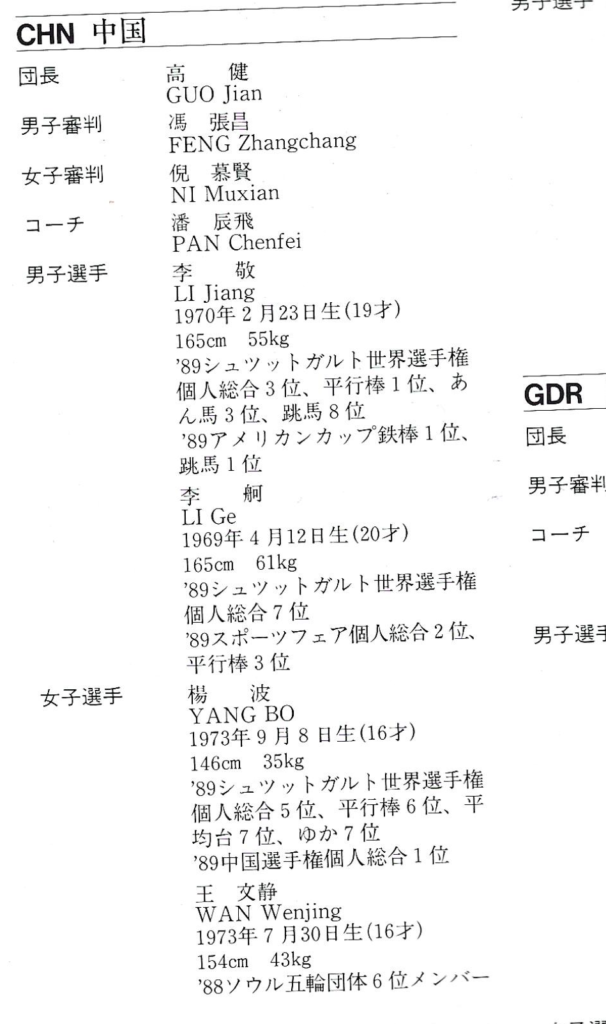
In actuality, her birthdate is July 8, 1975. At least, that is the birthdate that she currently uses, according to her profile on the Beijing Sports University’s website.

That means she was 14 in 1989, when the Chinese team won bronze at the World Championships—one year shy of the 15-year age minimum. But my goodness, that beam routine was a thing of beauty.
Appendix B: A Short Profile of Yang from the People’s Daily
From Tears on the Floor to a Gold Medal Smile
— Yang Bo, Women’s All-Around Champion at the China Cup
By reporters Huang Zhenzhong and Wu Hua
People’s Daily, April 28, 1990, page 3
Dressed in a red leotard, Yang Bo sprang high off the vault table, flashing red through the air before landing solidly on the mat like a nail driven home.
In the women’s all-around final, her first event was uneven bars. Like a small swallow darting between the high and low bars, she opened strongly with a score of 9.875. She then mounted the balance beam—the event that had once brought her bitter disappointment at the World Championships. This time, however, she performed with great success: steady execution, increased difficulty, and a single-arm back handspring connected to a Lalotte. Her dismount—a double back somersault—was landed securely, earning 9.925. With these two events combined, she had already pulled ahead of her teammate Chen Cuiting and Cuba’s Ann Botuando.
Floor exercise is not Yang Bo’s strongest event, yet her routine featured innovative choreography, beautiful music, and graceful movement, earning a high score of 9.95.
If the fourth event—vault—went smoothly, the all-around title would be hers. At this critical moment, the young gymnast remained calm and composed, scoring 9.90 once again. Successful and impressive on all four events, she captured the championship with a total of 39.65 points.
At last year’s World Championships, Yang Bo had left the competition floor in tears after mistakes. Upon returning to Beijing, she vowed to fix her unstable beam dismount. Time after time, she leapt onto the beam, time after time she practiced the double-back dismount, until she could stand firmly every time.
Through hard training, she sharpened her skills; through sweat, she found hope. This young woman from the watery towns of Zhejiang is now spreading her wings, preparing to win more medals at the 11th Asian Games.
从泪洒赛场到笑挂金牌
——记中国杯体操赛女子全能冠军杨波
身穿红色体操服的杨波从跳马上高高地弹起,在空中闪出道道红光,然后像钉子一样稳稳地扎在垫子上。
在女子体操全能决赛中,她第一个项目是高低杠,只见其像一只小燕在高杠和低杠中穿梭,以9.875分的成绩旗开得胜。接着她又跃上平衡木,这是杨波在世界锦标赛上吃过苦果的项目,现在却做得非常成功,不但动作稳,而且增加了难度,做出了单臂后手翻接拉拉提。下法更妙,后空翻两周后稳稳落地,获得9.925分。两项成绩相加,已超过她的队友陈翠婷和古巴的安·波图昂多。
自由体操并非杨波的强项,但由于整套动作编排新、音乐美、动作漂亮,反而得到9.95高分。
如果第四项跳马不出意外,那么全能冠军就到手了。此时,小姑娘表现很镇静,阵脚不乱,又夺得9.90分。她参加的4项比赛,项项成功,项项精采,以39.65分夺魁。
去年世界锦标赛,她因失误洒泪赛场。回到北京,她发誓要解决平衡木下法不稳的弱点。一次次飞身跃上平衡木,一次次空翻两周下,直到牢牢站稳为止。
在苦练中提高了技艺,在汗水中看到了希望。这个来自江南水乡浙江的姑娘,正展翅高飞,准备在第十一届亚运会上多夺奖牌。
本报记者 黄振中 吴骅
More on Age