The women’s all-around final at the Sydney Olympics began at 7:00 p.m. on Thursday, September 21, 2000. Maria Olaru, competing for Romania alongside Simona Amânar and Andreea Răducan, had made a prediction before the competition started. She told her coaches that all three Romanians would make the podium. When Octavian Belu, Romania’s head coach, relayed this to reporters afterward, he added with affectionate exasperation: “She has the instincts of a witch. She scares me. From now on, anyone who wants to win the lottery should ask her what numbers will come up.”
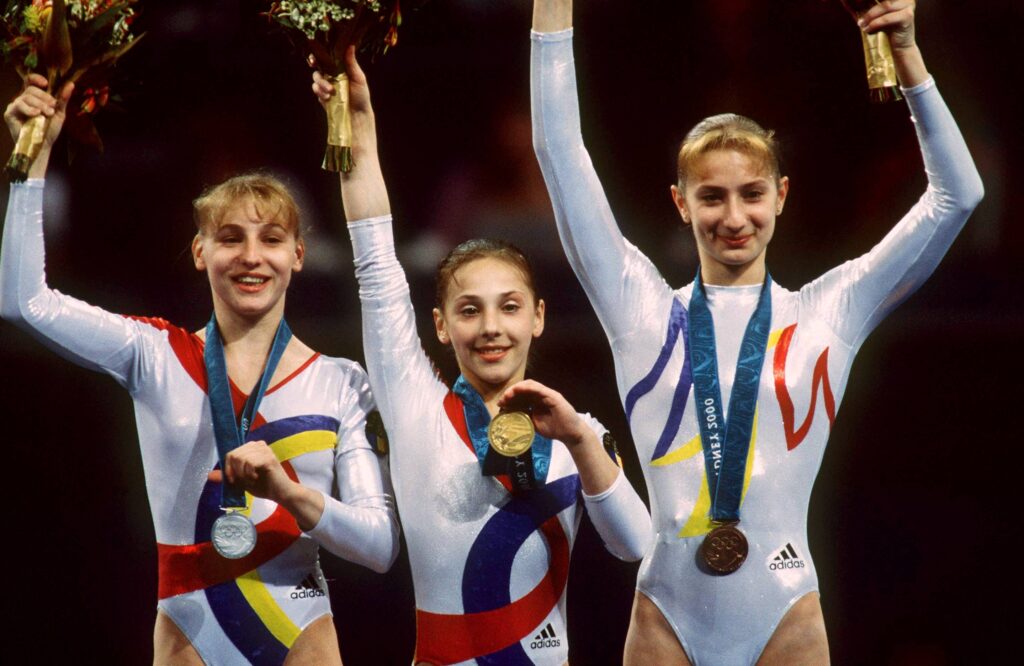
By the end of the night, the witch had been proven right. Răducan stood atop the podium with a score of 38.893, flanked by Amânar (38.642) and Olaru (38.581). It was the first time since the 1960 Rome Olympics that a single nation had swept all three medals in the women’s all-around at the Games.
What Olaru could not predict—what no one in the SuperDome that night could have imagined—was what followed.
Doping Control
Once Răducan stepped off the podium, celebration gave way to procedure. As is routine for Olympic champions, she was escorted to doping control. In the designated testing room, she was given a sealed vial and instructed to provide 100 milliliters of urine. The team doctor recorded the substances she had taken in the preceding days: Tonotil and Vitamax for recovery, Voltaren for inflammation, and Nurofen for a headache.
But the sample did not come easily.
Exhausted and severely dehydrated after the all-around competition, Răducan struggled to produce enough urine to meet the minimum requirement. She had sipped some water after leaving the arena, but it did little. The first attempt yielded 40 milliliters. She walked the corridors of the testing area, clutching the partially filled vial, the details of the competition still vivid: the blue floor carpet, the 9.825 on exercise, the three Romanian flags rising together. An hour later, she managed another 22 milliliters. Still short.
The regulations required 100 milliliters. By then, it was approaching 2:00 a.m. The officials, apparently unwilling to wait longer, agreed to split the 62 milliliters she had produced into two bottles—one designated Sample A, the other Sample B. After nearly five hours in doping control, the Olympic all-around champion returned to the Village with no reason to suspect that anything about the night had gone wrong.
The Vault Final
The women’s vault final was held at 4:00 p.m. on Sunday, September 24—three days after the all-around. Romania’s Simona Amânar entered as the defending Olympic champion and the 1999 silver medalist on the event, and expectations were high.
Amânar debuted her Yurchenko 2½, but unsteady landings on both vaults dragged her average down to 9.537, leaving her outside the medals. Russia’s Elena Zamolodchikova followed and effectively ended the contest, posting an untouchable 9.731.
When it was Răducan’s turn, she opened with a stretched Podkopayeva, scoring 9.712. To challenge Zamolodchikova, she needed near perfection on her second vault—a laid-out Cuervo, capped at 9.90. She received a 9.552, giving her an average of 9.693 and the silver medal. It was her third medal of the Games—team gold, all-around gold, and now vault silver—with the floor final still ahead.
But on Monday, September 25, her Olympic Games were turned upside down.
The Notice
The letter arrived at the Romanian Olympic House in Sydney at 1:08 p.m. on Monday, September 25, 2000—the final day of artistic gymnastics competition. It summoned Romanian officials to the Renaissance Hotel at 11:00 p.m., where the IOC Medical Commission would discuss the case of Andreea Răducan, who had tested positive. The communiqué reportedly did not specify which substance was involved.
The initial response was denial. Belu erupted. “They’re trying to fix us. It’s a setup,” he said, threatening to withdraw the Romanian team from the apparatus finals. Assistant coach Mariana Bitang, speaking to Cronica Română and Adevărul, denied that Răducan had been ill at all. “Simona—yes, that was the case with her, and we notified them,” Bitang said, referring to Amânar. “But Andreea was not, at any moment, sick with the flu.” Only vitamins and supplements had been administered, she insisted.
At 2:00 p.m., the Romanian Olympic Committee responded to the IOC with a list of medications that team doctor, Ioachim Oană, had given Răducan. According to ProSport, the list included Voltaren and Nurofen for back pain. The response concluded by formally contesting the test result.
Răducan found out just hours before the floor exercise final was scheduled to begin. The coaches asked her over and over again, “Andreea, did you take anything? Did you eat anything? Did you drink anything from a bottle of water that someone else had left around, or did you leave it yourself and drink from it later, maybe?” She insisted that she had not. She went on to compete, anyway, finishing seventh with a score of 9.275—a muted echo of the 9.825 that had carried her to all-around gold days earlier.
Later that night, Belu, Răducan, Dr. Oană, and Romanian gymnastics federation president, Nicolae Vieru, appeared before the IOC Medical Commission. The hearing stretched past midnight into the early hours of September 26. Oană admitted that he had treated Răducan with Nurofen Cold and Flu, two tablets per day, but claimed he did not know that some Nurofen formulations contained pseudoephedrine while others did not. According to ProSport, the medicine was for back pain and a cold. Other Romanian outlets offered more elaborate descriptions: infected eyes, a blocked nose, difficulty breathing. In her memoir, Răducan recalls only a headache.
Whatever the precise diagnosis, the test result left little room for ambiguity: 90 micrograms of pseudoephedrine per milliliter of urine, more than three times the permitted limit of 24 µg/ml.
The IOC Medical Commission voted 28 to 4 to recommend stripping Răducan of the all-around gold medal. The Executive Committee, meeting immediately afterward, upheld the recommendation. The podium was reshuffled: Amânar moved to gold, Olaru to silver, and China’s Liu Xuan received the bronze.
Răducan retained her team gold and vault silver because she tested negative after the vault final; no test was conducted after the team competition, leaving the team results untouched. Dr. Oană was expelled from the Sydney Games and barred from attending the 2002 and 2004 Olympics.
The Court of Public Opinion
The Romanian press was soon saturated with reactions. Jaques Rogge, an IOC executive committee member, told the AFP: “The Romanian athlete cannot be considered guilty, but this is a case of serious negligence by the doctor of the Romanian gymnastics team, Ioachim Oană, who in fact admitted that he made a mistake when he prescribed that medication to Andreea for treating a cold.”
He added, “We applied the smallest possible sanction. We did not decide to exclude the athlete from the Olympic Games, as we have done in other doping cases. We did not even request that the Romanian Gymnastics Federation suspend her, and moreover, the athlete kept the other two medals she won.”
Prince Alexandre de Merode, head of the IOC Medical Commission, went further in absolving the gymnast personally: “I consider this to have been an unfortunate accident, and the only fault lies with the doctor who treated her for the flu.”
Romanian medical professionals responded with astonishment and, like de Merode, focused their criticism on Dr. Oană. Professor Ursula Stănescu, dean of the Faculty of Pharmacy at Iași’s “Gr. T. Popa” University of Medicine, explained the pharmaceutical details to Monitorul de Iași on September 26: “Nurofen for colds and flu contains, in addition to ibuprofen, 30 mg of pseudoephedrine. Just one tablet contains 30 mg, and already at 60 mg, practically from 50 mg upward, this substance can easily be detected in blood analysis.” Oană had given Răducan two tablets—60 milligrams total, well above the detection threshold.
Grațiela Vâjâială, head of the doping laboratory at the National Institute of Sports Medicine, confirmed to Mediafax that “an athlete can be declared positive for ephedrine when the quantity of the substance detected in the body exceeds 10 milligrams per milliliter.” She added a detail that made the error harder to defend: “There are products used to unblock the respiratory tract that do not contain ephedrine.” Alternatives existed. Oană did not need to use Nurofen at all—if, in fact, he was treating a cold rather than a headache or backache.
Implicitly, much of the coverage turned toward a single variable: her body. Professor Ioan Drăgan, head of the Bucharest Institute of Sports Medicine and present in Sydney as part of the Romanian delegation, offered what became the most repeated formulation: “The high quantity of pseudoephedrine detected in her body was amplified by the gymnast’s very low body weight—only 37 kilograms.”
Outside of Romania, however, the focus shifted. Writing in the Australian newspaper The Age, Linda Pearce observed that “the Russian silver medallists are peeved, with some justification, that the team result has not also been adjusted.” Others, she noted, pointed to the stimulating effects of pseudoephedrine and suggested that it may have been “just the pep pill Raducan required before starting a gruelling third day of competition.” Whatever the intention, Pearce emphasized, the substance appeared on the banned lists of both the IOC and the International Gymnastics Federation “for a reason.”
In the United States, Christine Brennan of USA Today dispensed with the language of accident altogether. “I don’t buy [Răducan’s] excuse, or that of her doctors,” she wrote. After years of hearing athletes blame tainted supplements or clerical errors, Brennan expressed little patience for another claim of mistake. The prohibited list, she argued, was publicly available and not impossibly complex. “If I were a world-class athlete, I would put that list on the refrigerator and make sure any food I ate or any drug I took was not on it.” Whether Răducan and her doctors had intended to cheat or had committed “a really horrible mistake,” Brennan concluded, the responsibility ultimately lay with them.
The CAS Appeal
Within hours of the IOC’s decision, Ion Țiriac, the president of the Romanian Olympic Committee, hired three lawyers and filed an appeal with the Court of Arbitration for Sport. The hearing was scheduled for September 27 at 1:00 p.m. on Harrington Street in The Rocks, Sydney’s bohemian quarter. The setting was unglamorous: a round table, three judges in civilian clothes, no robes or insignia. An Australian volunteer of Romanian origin provided translation.
After four and a half hours, the judges informed the Romanian delegation that they needed more time to deliberate. The decision would be issued by 3:00 p.m. Sydney time the following day, September 28. As Cotidianul put it, Răducan’s ordeal extended another twenty-four hours.
The verdict arrived page by page on September 28 at 3:10 p.m. ProSport’s Cătălin Tolontan reconstructed the scene with novelistic precision. At the Romanian Olympic House, Răducan, Amânar, Olaru, Belu, Bitang, Nadia Comăneci, and Țiriac gathered around the fax machine. Țiriac sat on the arm of a couch, reading glasses perched on the tip of his nose, checking his watch, wiping his forehead with a handkerchief. Nadia paced back and forth over a small square of tile. Outside behind the house, Belu and Bitang walked in opposite directions, as if unable to endure reading the same apprehension on each other’s faces.
The communiqué ran to thirteen pages. Țiriac read each page carefully, placed it face down, and asked for a fluorescent yellow marker to underline passages. Nadia leaned in to read over his shoulder.
The Court of Arbitration for Sport—the ad hoc panel chaired by Justice Tricia Kavanagh of Australia, with Mr. Stephan Netzle of Switzerland and Mrs. Maidie Oliveau of the United States—considered and rejected each of Romania’s legal challenges to the IOC’s decision. Răducan was no longer the 2000 all-around champion. (You can read the full CAS decision below.)
The closing section acknowledged the human cost with striking directness: “The Panel is aware of the impact its decision will have on a fine, young, elite athlete. It finds, in balancing the interests of Miss Răducan with the commitment of the Olympic Movement to drug-free sport, the Anti-Doping Code must be enforced without compromise.”
Inside the Romanian Olympic House, Țiriac read the underlined passages aloud to the gymnasts and coaches. “To you, little one, I have nothing to reproach you for, nothing to condemn you for,” he told Răducan. “If some officials refused to take our arguments into account, that’s how it is. We didn’t buy the medals at the supermarket—we looked, but they don’t sell them there. Maybe others got theirs there. I know you earned yours; you worked for them. But this is the result.”
ProSport reported that the girls stared at his face, hoping it was a joke. The seconds passed. No smile appeared.
The Press Conference
The press conference that followed was held in the Main Press Center’s principal room—a 500-seat hall normally reserved for events involving Juan Antonio Samaranch or the American and Australian delegations. It was the first time Romania had been granted the space. Nearly 150 journalists and dozens of television cameras waited.
Țiriac sat at the table, flanked by the three gymnasts and Nadia Comăneci. Răducan spoke with a composure that drew applause from the foreign press corps.
“I suffered, but now I’ve come to terms with it,” she said. “My conscience is clear because I only took a pill given to me by the team doctor—a medicine that didn’t even help me and actually made me dizzy during the competition. It’s not my place to judge what happened, but I don’t understand why it is always the small ones who must pay for the mistakes of the powerful. Honestly, I don’t even know why they took my medal.”
Asked what she would do next, she answered: “I will continue gymnastics and climb back to first place to show those who decided today to take my medal that they were wrong. It isn’t right for children to be punished for the mistakes of adults.”
Amânar and Olaru struck patriotic notes. “I accepted it because it belonged to Romania, but I don’t want it. It belongs to Andreea,” Amânar said. Olaru added, “I didn’t want to become the silver medalist this way. What matters is that the podium was Romanian.”
Comăneci, who had held Andreea’s hand as the fax arrived, was visibly emotional. “This is not a fair decision,” she said. “I understand that at these Olympic Games, doping is not tolerated in any form, and that is normal—but each case is different and must be judged individually. Imagine telling an athlete that she is innocent, yet taking away her medal.”
The Doctor
In public, nearly all blame settled on Dr. Ioachim Oană, who maintained that he had treated a legitimate medical condition and had simply failed to read the leaflet. Mircea Cinteză, the president of the Romanian College of Physicians, announced that Oană would be investigated upon his return to Romania. “We cannot begin the investigation in his absence, but we can say this is a very serious mistake, with a major image impact and, above all, a profound moral impact on this child,” Cinteză said.
In October 2000, the Hunedoara County College of Physicians found Oană not guilty, determining that “the treatment administered to Andreea Răducan by Dr. Oană was in accordance with the diagnosis and the patient’s clinical condition” and that “there are no elements of medical malpractice.” (Deva is the capital of Hunedoara County.)
But the national body—the College of Physicians of Romania—launched its own investigation. Gheorghe Borceanu, president of the Superior Disciplinary Commission, announced that Oană had “admitted that he is at fault for not reading the information leaflet of the medication he administered to gymnast Andreea Răducan before the competition.” On December 15, 2000, the National Council suspended Oană from medical practice for six months, which was described as “almost the most severe penalty” available short of a lifetime ban.
By December 2000, the Romanian national gymnastics program had been without a team doctor for more than two months. The twenty gymnasts at the Olympic Center in Deva were attended only by a medical assistant, Margareta Turcu. “We’ve been waiting for a doctor to be appointed, but it still hasn’t happened,” Belu told ProSport. “The real problem concerns the girls who stay at home—about fourteen of them—not those who travel to competitions. Not to mention that a doctor handles everyday issues—flu, colds—but also sets menus, recovery treatments, and coordinates the entire medical team’s activity.”
Oană, who had worked with Romanian gymnasts since the era of Nadia Comăneci, eventually returned to the national team in 2009.
Lausanne and Montréal
After the Olympics, the Romanian Olympic Committee filed one final appeal to the Federal Tribunal in Lausanne, Switzerland’s Supreme Court—the highest judicial authority available for the case. But by mid-December, the appeal was rejected.
IOC Secretary General François Carrard stated, “The Court decided that there were no grounds for the Raducan case and rejected it. At first look, they determined it was without merit and threw it out.”
In 2004, the World Anti-Doping Agency, headquartered in Montréal, removed pseudoephedrine from the prohibited list entirely. In 2010, it was reinstated—but with a urinary threshold raised to 150 µg/ml, six times higher than the 24 µg/ml threshold that had cost Răducan her medal.
Under the 2010 threshold, a urine concentration of 90 µg/ml would not have triggered a positive test. In another regulatory era, Andreea Răducan would have kept her Olympic gold.
The Entire Team
Over time, the 2000 incident has often been told as a singular case: one gymnast, one test, one medal. What has received less sustained scrutiny is how close Romania came to a far broader catastrophe.
According to the September 27, 2000 edition of Cotidianul, all three Romanian all-around medalists had followed the same Nurofen treatment: “An extremely important detail is that all three Romanian gymnasts were tested, yet only Răducan tested positive, despite the fact that both Amânar and Olaru had followed the same Nurofen treatment.”
But FIG officials from the time indicate that it was not only the all-around medalists who had been given Nurofen. The entire Romanian women’s team allegedly had taken the drug.
Read that again. The entire team. Were they all sick?
In Degrees of Difficulty, Georgia Cervin paints this picture: “One FIG executive committee member who was present at the emergency meetings in Sydney said that the Romanian team leader pleaded for leniency with Răducan, arguing that everyone on the team had taken pseudoephedrine, she just got caught because she was the smallest, and it had not passed through her body yet.”
Răducan even alludes to the idea that she was not the only teammate given the drug. “Even if I was not the only team member who took a Nurofen, only my test was positive,” she wrote. “Maybe my other teammate drank enough water, as is normal, and the pill dissolved much faster. Even my weight at that moment was against me because my 37 kilos (81.5 lbs) body had processed the substance differently.”
What unfolded in Sydney was luck—sheer luck. If the allegations are true, the outcome could have been catastrophic for the Romanian team: not a single stripped medal, but the loss of the entire Romanian all-around podium—perhaps even the team gold itself.
That scenario never materialized. But the admission behind it did.
And yet, institutionally, nothing followed.
Despite clear acknowledgment that a banned substance had been administered across the team, the FIG launched no investigation into Romania’s medical protocols. There was no inquiry into how or why the drug had been distributed, no audit of oversight failures, no accountability beyond the athlete and her doctor. The team leader was not asked to step down after his confession. The system continued unchanged.
Instead, the consequences settled where they were easiest to place.
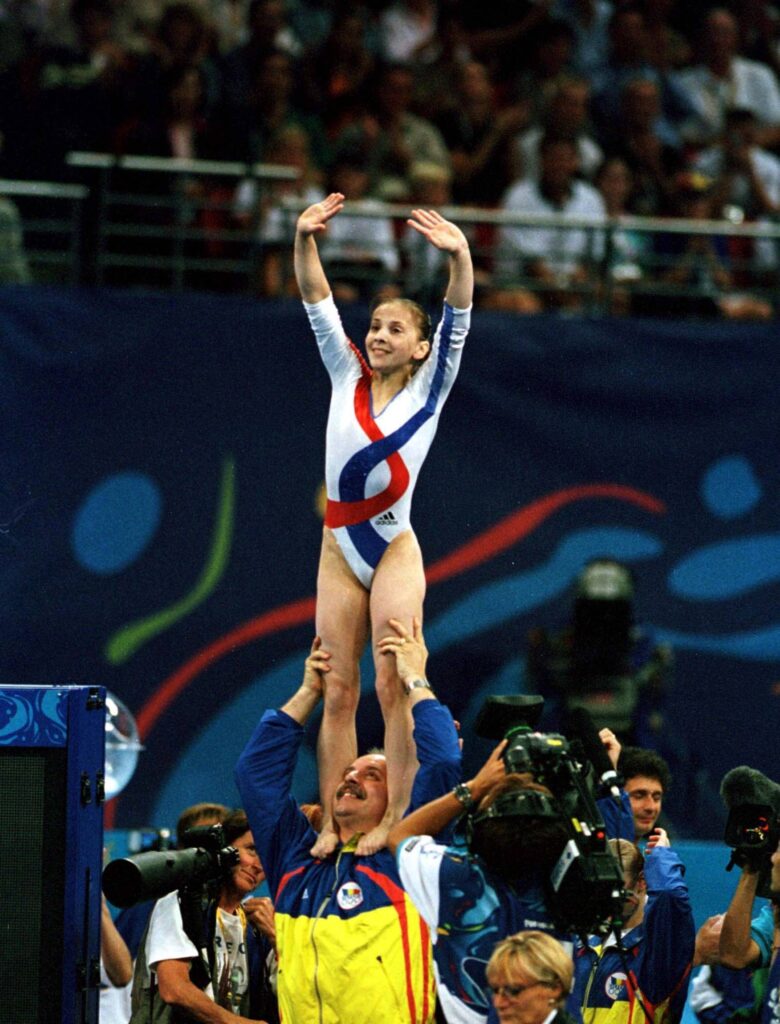
On the smallest body in the room.
Notes
1. In the Romanian media—and later in Răducan’s own account—it was stated that pseudoephedrine appeared on the IOC’s prohibited list but not on that of the International Gymnastics Federation. The claim was quickly rejected in the international press and by FIG officials who discussed this case with me. Writing in The Age, Linda Pearce observed: “Regardless, several dubious claims have been floating about in the past 24 hours, including one that pseudoephedrine is banned by the IOC but not the FIG. Untrue.” An executive committee member at the time also confirmed this.
Significantly, this argument does not appear in the Court of Arbitration for Sport’s summary of the case. Either the Romanian Olympic Committee chose not to advance it at the hearing, recognizing that it was unsustainable, or the CAS panel regarded it as too insubstantial to merit discussion in its final ruling.
2. The Romanian media reported that Răducan fainted when she heard the news about her positive test. However, in her memoir, she does not recall fainting.
3. Pseudoephedrine was top of mind for the Olympic sports world in 2000. The Russian pairs skaters Elena Berezhnaya and Anton Sikharulidze were not allowed to compete at the 2000 world championships because, during the preceding European Championships, Berezhnaya took a medication for bronchitis that contained pseudoephedrine. The positive test led to the revocation of her European title.
4. The press routinely reported that the threshold for pseudoephedrine was 24 or 25 µg/ml. However, the 2000 IOC document that I have states 10 µg/ml. (See below.) It’s possible that the guidelines were updated after the documents went to print.
5. Romania has a long history of questionable use of drugs. Rodica Dunca, a gymnast from the late 1970s and early 1980s, described being forced to take an obscene amount of drugs. Lavinia Agache had an adverse reaction to a medication given to her at the 1984 Olympics.
Georgia Cervin has argued that doping in Romania was more systematic: “[D]oping in Romania was more systematic, at least until the year 2000, when Răducan was stripped of her gold medal in the all-around after the team doctor gave her, and allegedly the entire team, pseudoephedrine. This evidence shows that over the last four decades, at least, coaches, officials, and even medical staff have conspired to break the rules in order to win medals, thereby jeopardizing gymnasts’ careers and health.”
6. I have independently verified the confession of Romania’s team leader.
7. In January 2001, International Gymnast magazine published a short news item on its website. Claudia Presăcan, the veteran Romanian gymnast who had helped her team win gold at the Sydney Olympics, had retired and was easing into her role as a coxswain for the Romanian rowing team.
“This is a completely new sport for me,” Presăcan told IG, “but I must admit practicing as a coxswain is much easier than gymnastics.”
The article ended with a detail that seemed almost an afterthought:
“After her retirement, it was revealed that Presăcan had competed in Sydney while suffering from severe anemia. Anemia, a disease most often caused by iron or vitamin B12 deficiencies, is accompanied by symptoms such as fatigue, rapid heartbeat, shortness of breath, headaches, and dizziness. Despite her condition, Presacan told IG she felt it did not affect her performance. ‘I have always had a problem with anemia, but I am cured now,’ Presacan says. ‘It did not affect me at all during the Olympics.’
“(Romanian team doctor Ioachim Oană, who cleared Presăcan to compete despite the anemia, was fired after the Olympics for dispensing cold medicine containing a banned substance to Presăcan’s teammate Andreea Răducan. Răducan was subsequently stripped of her all-around gold medal when the substance was detected.)”
Appendix A: The Doping List
Appendix B: The CAS Decision
Appendix C: Oană Returns to the National Team
Doctor Oană Returns to the National Team
Mirela Băsescu
REMEMBER / The Sydney 2000 Olympic moment, when he administered a pill containing a substance banned by the IOC to Andreea Răducan, has been forgotten.
For more than 23 years, he was the doctor responsible for the health of the girls on Romania’s Olympic gymnastics team. For Dr. Ioachim Oană, the story began with Nadia, continued with Silivaș, Dobre, Miloșovici, Gogean, Amânar, and now returns to the present through Izbașa.
Dr. Ioachim Oană’s name has been linked to the women’s national team since the opening of the training center in Deva. “I was the director of the local polyclinic, and I loved sport. Béla Károlyi told me he needed my help. He explained that he wasn’t asking me to be there permanently; what mattered was that I be close to the team and help when needed—especially since I was volunteering financially—just to come by from time to time,” recalls Dr. Oană, now 70 years old.
All of this was happening around 1976, when he officially became the team doctor. Recently, after a break of nearly eight years, the doctor has returned to working with the gymnasts.
“The girls back then were, biologically speaking, built differently. They adapted much better to physical effort and responded better to training. I don’t know why today there are so many problems,” he confesses.
The hardest trial: Sydney 2000
The defining moment—one he remembers with a heavy heart—came at Sydney 2000, when he gave Andreea Răducan a pill for a cold (Nurofen) that contained pseudoephedrine, a substance that was banned by the IOC at the time and has since been removed from the list of prohibited substances.
The gymnast was stripped of her Olympic all-around title, and he himself was suspended for six months and barred from two editions of the Olympic Games.
“These are things that are hard to explain, things that stay with you. I got through that moment together with the team, with Andreea, even though there were many who attacked me,” Dr. Oană recalls.
Pro Sport, May 8, 2009
References
Books
Răducan, Andreea. The Other Side of the Medal. Trans. Magda Petrescu. Wiseman, 2012.
Cervin, Georgia. Degrees of Difficulty: How Women’s Gymnastics Rose to Prominence and Fell from Grace. Urbana: U of Illinois P, 2021.
Newspaper Articles
22 September 2000
Cotidianul. “Romanian Women Write History in Sydney.” Cotidianul, Anul 10, no. 2776, 22 September 2000.
—. “All-Romanian in Sydney.” By Ignuț Socaciu. Cotidianul, Anul 10, no. 2776, 22 September 2000.
Pro Sport. “Made in Romania.” Pro Sport, Anul IV, no. 978, 22 September 2000.
—. “I Wouldn’t Trade Her for Ten Boys.” By Florian Pricop (Bârlad). Pro Sport, Anul IV, no. 978, 22 September 2000.
23 September 2000
Agenda. “Romanian Gymnasts Reaffirm Their World Supremacy.” Agenda, Anul 11, no. 39, 23 September 2000.
Agenda Zilei. “Agence France-Presse Says the Women’s All-Around Final Should Be Repeated.” Agenda Zilei, Anul 5, no. 226, 23 September 2000.
Pro Sport. “ION ȚIRIAC: ‘I’M BANKRUPT.’” Pro Sport, Anul IV, no. 979, 23 September 2000.
24 September 2000
Curierul Naţional. “‘Andreea Răducan, a Successor to Nadia Comăneci’: The Glory from Sydney Is Due, Above All, to the Famous Champions’ School in Deva.” Curierul Naţional, Anul 11, no. 2908, 24 September 2000.
25 September 2000
Pro Sport. “Simple Gestures.” By Ovidiu Ioanițoaia (Sydney). Pro Sport, Anul IV, no. 980, 25 September 2000.
—. “Andreea Takes Silver.” By Luminița Paul (Sydney). Pro Sport, Anul IV, no. 980, 25 September 2000.
26 September 2000
“The Golden Radiance of Gabrielei Szaró.” Adevărul, September 26, 2000 (Anul 12, nr. 3115).
“Will Andreea Remain the Olympic All-Around Champion?” Adevărul, September 26, 2000 (Anul 12, nr. 3115).
Cocea, Eugen. “Andreea Răducan will lose the all-around title.” Agenda Zilei, September 26, 2000 (Anul 5, nr. 228).
Teodor, Ion, and Nicolae Grecu. “Andreea, Doped—the Dream of a 17-Year-Old Child Shattered Because of an Irresponsible Doctor.” Monitorul de Iași, September 26, 2000 (Anul 10, nr. 229).
Cănănău, Mihaela. “‘What kind of doctor is the one who does not know that Nurofen contains doping substances?'” Monitorul de Iași, September 26, 2000 (Anul 10, nr. 229).
Călin, Răzvan. “‘A child like Andreea could not do such a thing!'” Monitorul de Iași, September 26, 2000 (Anul 10, nr. 229).
Florian, Ana Maria. “Andreea Răducan Is Accused of Doping!” Cotidianul, September 26, 2000 (Anul 10, nr. 2779).
“Andreea Răducan, Suspected of Doping!” Cronica Română, September 26, 2000 (Anul 7, nr. 2345).
“Andreea Răducan’s mother stated that her daughter had used Rinofug since she was little.” Cronica Română, September 26, 2000 (Anul 7, nr. 2345).
“Grațiela Vâjâială: Rinofug Contains Ephedrine.” Cronica Română, September 26, 2000 (Anul 7, nr. 2345).
Dicu, Andrei. “A Doping Accusation Stains Andreea Răducan’s Image.” Curierul Național, September 26, 2000 (Anul 11, nr. 2910).
“Mariana Bitang, Assistant Coach of Romania’s Team: ‘A Setup Meant to Destabilize the Romanian Delegation.'” Curierul Național, September 26, 2000 (Anul 11, nr. 2910).
“The unofficial fax that stirred things up before the start of the women’s apparatus finals.” Curierul Național, September 26, 2000 (Anul 11, nr. 2910).
“Grațiela Vîjîială, Head of the CNMS Doping Laboratory.” Curierul Național, September 26, 2000 (Anul 11, nr. 2910).
Ciornei, Laurențiu, Matei Udrea, Horia Hașnaș, and Silviu Tănase. “Gold Smeared with Mud.” Evenimentul Zilei, September 26, 2000 (Anul 9, nr. 2516).
Ștefan, Marian. “The Ephedrine Bluff.” Jurnalul Național, September 26, 2000 (Anul 8, nr. 2239).
“The Hours and Minutes of a Horrifying Day.” Pro Sport, September 26, 2000 (IV, nr. 981).
“Joachim Oană: ‘I Can’t Believe It.'” Pro Sport, September 26, 2000 (IV, nr. 981).
Vladu, Cristina. “The Effect of Ephedrine.” Ziua, September 26, 2000 (Anul 7, nr. 1912).
27 September 2000
Cocea, Eugen. “Although she received the minimum penalty for doping cases, Andreea Răducan lost the all-around title.” Agenda Zilei, September 27, 2000 (Anul 5, nr. 229).
“Ioachim Oană Cost Răducan Her Gold Medal!” Cotidianul, September 27, 2000 (Anul 10, nr. 2780).
“Andreea Răducan Appeals to the Court of Arbitration for Sport.” Cotidianul, September 27, 2000 (Anul 10, nr. 2780).
“Simina Răducan: ‘We Pray to God That Justice Will Be Done.'” Cotidianul, September 27, 2000 (Anul 10, nr. 2780).
“Nadia Comăneci: ‘We Are Devastated.'” Cotidianul, September 27, 2000 (Anul 10, nr. 2780).
“Ion Țiriac: ‘This Is the Story of the Best Gymnast in the World.'” Cotidianul, September 27, 2000 (Anul 10, nr. 2780).
Alexandrescu, Horia. “Guilty Without Guilt.” Cronica Română, September 27, 2000 (Anul 7, nr. 2346).
“We Did the Damage with Our Own Hands… Romanian Olympic Committee – Statement” [Cristian Gațu]. Cronica Română, September 27, 2000 (Anul 7, nr. 2346).
“There Is No Peace under the Olympic Olive Trees.” Cronica Română, September 27, 2000 (Anul 7, nr. 2346).
Hossu, D. “Răducan Has Appealed.” Cronica Română, September 27, 2000 (Anul 7, nr. 2346).
“Jacquetin Puts His Hand in the Fire for the Romanians.” Cronica Română, September 27, 2000 (Anul 7, nr. 2346).
“In Craiova, Students Took to the Streets.” Cronica Română, September 27, 2000 (Anul 7, nr. 2346).
“Rogge: ‘Andreea is innocent!'” Cronica Română, September 27, 2000 (Anul 7, nr. 2346).
“Țiriac Defends Andreea.” Cronica Română, September 27, 2000 (Anul 7, nr. 2346).
Dicu, Andrei, Alexandru Rostoțchi, and Laurențiu Georgescu. “Andreea Răducan, Crucified by the IOC.” Curierul Național, September 27, 2000 (Anul 11, nr. 2911).
“Jacques Rogge: ‘She is innocent, but she must be sanctioned.'” Curierul Național, September 27, 2000 (Anul 11, nr. 2911).
“The President of the Romanian Olympic Committee and gymnast Andreea Răducan appeal to the Court of Arbitration for Sport.” Curierul Național, September 27, 2000 (Anul 11, nr. 2911).
“The ‘perfidiousness’ of the IOC’s Director General.” Curierul Național, September 27, 2000 (Anul 11, nr. 2911).
“The Stolen Gold.” Jurnalul Național, September 27, 2000 (Anul 8, nr. 2240).
“The Appeal, the Last Hope.” Jurnalul Național, September 27, 2000 (Anul 8, nr. 2240).
“Do Justice!” Jurnalul Național, September 27, 2000 (Anul 8, nr. 2240).
“In Gymnastics You Don’t Need Steroids to Lift the Beam on Your Back: Interview with Nadia Comăneci.” Jurnalul Național, September 27, 2000 (Anul 8, nr. 2240).
Popescu, Oana. “Ephedrine Forbidden to Athletes.” Jurnalul Național, September 27, 2000 (Anul 8, nr. 2240).
Chimoșiu, Loredana. “Students in Craiova Stand by Andreea.” Jurnalul Național, September 27, 2000 (Anul 8, nr. 2240).
“Verdict in the Răducan case.” Monitorul de Iași, September 27, 2000 (Anul 10, nr. 230).
“Brought to Her Knees by the IOC.” Monitorul de Iași, September 27, 2000 (Anul 10, nr. 230).
Buzărin, Alin. “Forgive Them, Andreea!” Pro Sport, September 27, 2000 (IV, nr. 982).
“Andreea Didn’t Sleep All Night.” Pro Sport, September 27, 2000 (IV, nr. 982).
“Joachim Oană: ‘I Want to Take Full Responsibility.'” Pro Sport, September 27, 2000 (IV, nr. 982).
“What the IOC Statements Say.” Pro Sport, September 27, 2000 (IV, nr. 982).
Pearce, Linda. “Two Sides to Romanian Drug Scandal.” The Age, September 27, 2000.
Brennan, Christine. “Games’ Demise Lies in Drug Use.” USA Today, September 27, 2000.
Wieberg, Steve. “IOC: Romanian Deserved Better.” USA Today, September 27, 2000.
28 September 2000
Gordea, Liviu. “Today, the Court of Arbitration for Sport Delivers Its Verdict in the Răducan Case.” Agenda Zilei, September 28, 2000 (Anul 5, nr. 230).
Cocea, E. “Americans Are Also Outraged.” Agenda Zilei, September 28, 2000 (Anul 5, nr. 230).
“Romanians Stand with Andreea Răducan.” Agenda Zilei, September 28, 2000 (Anul 5, nr. 230).
“Andreea’s Nightmare Continues.” Cotidianul, September 28, 2000 (Anul 10, nr. 2781).
“Amânar Refuses the Olympic Title.” Cotidianul, September 28, 2000 (Anul 10, nr. 2781).
“RomTelecom Rewards Andreea with $30,000.” Cotidianul, September 28, 2000 (Anul 10, nr. 2781).
“Politicians Have Turned the Andreea Răducan Case into an Electoral Issue.” Cotidianul, September 28, 2000 (Anul 10, nr. 2781).
Goncearu, Raluca. “‘Andreea, We Love You!'” Cotidianul, September 28, 2000 (Anul 10, nr. 2781).
Alexandrescu, Horia. “The Disaster.” Cronica Română, September 28, 2000 (Anul 7, nr. 2347).
Fântâneanu, Emanuel. “‘In the Răducan case, the decision will be taken today.'” Cronica Română, September 28, 2000 (Anul 7, nr. 2347).
“The Olympic spirit is dead; duplicity reigns at the IOC.” Curierul Național, September 28, 2000 (Anul 11, nr. 2912).
“‘It is shameful that no distinction can be made between athletes who truly dope and those who are victims.'” Curierul Național, September 28, 2000 (Anul 11, nr. 2912).
“‘Andreea Răducan is and remains the true champion'” [Vassilios Tsakoniatis, RomTelecom]. Curierul Național, September 28, 2000 (Anul 11, nr. 2912).
“The IOC Has Made a Fool of Itself.” Jurnalul Național, September 28, 2000 (Anul 8, nr. 2241).
Socaciu, Ionuț. “Correct the Injustice!” Jurnalul Național, September 28, 2000 (Anul 8, nr. 2241).
Toma, Mihai. “First Time in a Courtroom.” Libertatea, September 28, 2000 (Anul 12, nr. 3092).
“Letters of Support for the Gymnast.” Libertatea, September 28, 2000 (Anul 12, nr. 3092).
Mazilu, Constantin. “Several Hundred People in Iași Chanted ‘Champion!'” Monitorul de Iași, September 28, 2000 (Anul 10, nr. 231).
Grecu, Nicolae. “The Harsh Law of Sydney.” Monitorul de Iași, September 28, 2000 (Anul 10, nr. 231).
Teodor, Ion. “Today We Will Know—Andreea Răducan Awaits the Verdict of the Court of Arbitration for Sport.” Monitorul de Iași, September 28, 2000 (Anul 10, nr. 231).
“Andreea Is Not Condemned—International Press Writes with Sympathy and Compassion.” Monitorul de Iași, September 28, 2000 (Anul 10, nr. 231).
Geambașu, Cristian. “From Love.” Pro Sport, September 28, 2000 (IV, nr. 983).
“It Will Be Decided Today!” Pro Sport, September 28, 2000 (IV, nr. 983).
Diculescu, Luminița. “There Is a Precedent.” Pro Sport, September 28, 2000 (IV, nr. 983).
“The Medical College Will Investigate Ioachim Oană.” Pro Sport, September 28, 2000 (IV, nr. 983).
Rădulescu, Decebal. “Simina Răducan: ‘The Coaches Share the Blame.'” Pro Sport, September 28, 2000 (IV, nr. 983).
Tolontan, Cătălin. “‘I Know I’m Innocent.'” Pro Sport, September 28, 2000 (IV, nr. 983).
29 September 2000
“From the Office of Mr. Adrian Năstase” [Written Declaration to the Parliamentary Assembly of the Council of Europe]. Adevărul, September 29, 2000 (Anul 12, nr. 3118).
“Andreea Răducan Remains Without Olympic Gold.” Adevărul, September 29, 2000 (Anul 12, nr. 3118).
Cordea, L. “Andreea Răducan definitively lost the all-around Olympic gold medal.” Agenda Zilei, September 29, 2000 (Anul 5, nr. 231).
Gordea, L. “Ion Țiriac will resign.” Agenda Zilei, September 29, 2000 (Anul 5, nr. 231).
Drăgușin, Ionel. “Țiriac resigns!” Cotidianul, September 29, 2000 (Anul 10, nr. 2782).
Drăgușin, Ionel, and Raluca Goncearu. “The Court of Arbitration for Sport Did Not Deliver Justice.” Cotidianul, September 29, 2000 (Anul 10, nr. 2782).
Dicu, Andrei. “History Repeats Itself in Australia.” Curierul Național, September 29, 2000 (Anul 11, nr. 2913).
“The Height of Cynicism: Just 25 Lines Were Enough to ‘Justify’ the Injustice Done to Our Gymnast.” Curierul Național, September 29, 2000 (Anul 11, nr. 2913).
“Ion Țiriac: ‘I Did Not Expect the Court of Arbitration for Sport to Reject the Romanian Gymnast’s Appeal.'” Curierul Național, September 29, 2000 (Anul 11, nr. 2913).
“Andreea Răducan: ‘My conscience is clear.'” Evenimentul Zilei, September 29, 2000 (Anul 9, nr. 2519).
“Țiriac Wants to Resign from the Leadership of the ROC.” Monitorul de Iași, September 29, 2000 (Anul 10, nr. 232).
“Justice Walks with a Cracked Skull.” Monitorul de Iași, September 29, 2000 (Anul 10, nr. 232).
Ioanițoaia, Ovidiu. “Guilty Without Guilt.” Pro Sport, September 29, 2000 (IV, nr. 984).
“22 Maddening Minutes Next to a Fax.” Pro Sport, September 29, 2000 (IV, nr. 984).
“CAS Communiqué.” Pro Sport, September 29, 2000 (IV, nr. 984).
Buzărin, Alin. “How Many of Us Can Look Ourselves in the Eye?” Pro Sport, September 29, 2000 (IV, nr. 984).
“Țiriac announced he will resign.” Pro Sport, September 29, 2000 (IV, nr. 984).
Paul, Luminița. “‘I am calm and at peace.'” Pro Sport, September 29, 2000 (IV, nr. 984).
Rădulescu, Decebal. “Simina Răducan: ‘I didn’t sleep all night.'” Pro Sport, September 29, 2000 (IV, nr. 984).
“Champion Without a Medal.” Ziua, September 29, 2000 (Anul 7, nr. 1915).
Chaudhary, Vivek. “Bitter pill as tiny gymnast loses gold.” The Guardian, September 29, 2000.
Dillman, Lisa. “Romanian Gymnast Caught in Middle.” Los Angeles Times, September 29, 2000.
Arbitration CAS ad hoc Division (O.G. Sydney) 00/011, Andreea Raducan v. International Olympic Committee (IOC), award of 28 September 2000. Panel: Justice Tricia Kavanagh (Australia), President; Mr. Stephan Netzle (Switzerland); Mrs. Maidie Oliveau (USA).
30 September 2000
11 October 2000
Monitorul. “The Ocean of Negligence: The Unpleasant Situations Faced by Andreea Răducan, Mihaela Melinte, and Dorel Simion Share a Common Denominator.” By Nicolae Grecu. Monitorul, Anul 10, no. 241, 11 October 2000.
14 October 2000
Cotidianul. “Ioachim Oană Found Innocent by the Hunedoara County College of Physicians.” By Ana Maria Florian. Cotidianul, Anul 10, no. 2795, 14 October 2000.
15 October 2000
Jurnalul Național. “Doctor Oană Is Innocent.” Jurnalul Național, Anul 8, no. 2255, 15 October 2000.
16 October 2000
Evenimentul Zilei. “Doctor Ioachim Oană and the College of Physicians of Deva.” Evenimentul Zilei, Anul 9, no. 2533, October 16, 2000.
26 October 2000
Curierul Naţional. “The College of Physicians of Romania Launches an Investigation into Doctor Ioachim Oană.” Curierul Naţional, Anul 11, no. 2936, October 26, 2000.
1 November 2000
Cotidianul. “Țiriac and Sturdza Take Legal Action Over Andreea Răducan’s Innocence: An Austrian, a Swiss, and an Australian Attempt to Prove IOC Abuse.” By Ionel Drăgușin. Cotidianul, Anul 10, no. 2810, November 1, 2000.
8 December 2000
Pro Sport. “Gymnasts Without a Team Doctor.” By Călin Tebies (Deva). Pro Sport, Anul IV, no. 1043, December 8, 2000.
13 December 2000
Pro Sport. “Appeal Rejected in the ‘Răducan Case.’” By Oana Dușmănescu. Pro Sport, Anul IV, no. 1047, 13 December 2000.
—. “All Doctors Are Avoiding the Olympic Champions.” By Adina Oșan. Pro Sport, Anul IV, no. 1047, December 13, 2000.
14 December 2000
Curierul Naţional. “The Federal Tribunal in Lausanne Rejected Andreea Răducan’s Appeal: The Romanian Olympic Committee Has Not Received an Official Response; The Ruling Was Issued on December 5.” By Gabriela Alexe. Curierul Naţional, Anul 11, no. 2977, December 14, 2000.
16 December 200
Cronica Română. “Ioachim Oană Suspended for Six Months.” Cronica Română, Anul 7, no. 2414, December 16, 2000.
Monitorul. “The Medical Profession Suspended Oană.” Monitorul, Anul 10, no. 298, December 16, 2000.
8 May 2009
Băsescu, Mirela. “Doctor Oană Returns to the National Team.” Pro Sport, May 8, 2009.
More on Doping
2 replies on “Andreea Răducan: The Only One Who Tested Positive”
The IOC, The Court Of Arbitration In Sport and the Swiss Supreme Court all threw out lawsuits aimed at giving Raducan the gold medal.
There have been various claims and counter claims made over the years but i don’t know how factual they are, for example how long before the competition did Raducan take the tablet? One person on a gymnastics message board stated that Maria Olaru said that half the team – but not herself – had taken furosemide.The drug is banned because it masks other drugs and is also a diuretic, used to lose weight quickly However they didn’t provide the source for this alleged statement.
RADUCAN’S SUPPORTERS :
“Being fair to Raducan. It sounds like she had the head cold virus or the flu both which have been rampant in Sydney.- its a vicious variety and apparently its this virus at the Olympic Village. Andreea received the drug from cold medication. Andreea was unaware that the drug was in the cold medication”.
“It is also true that Pseudoephidrene has no known performancing enhancing effect in gymnastics if taken for one day in a flu medication, maybe it even
gymnastics,maybe it even diminishes performance”.
“The medication did not affect her performance. She performed in Comp 2 the way she performed in Comp 1 and 4. I’d call that consistent. No one has proven that her performance was artificially enhanced throughout Comp 1, 4, 2, and 3. The FIG & IOC even recognizes that the drug had no effect on her performance”.
“The IOC accepted limit was 25mg/litre and Raducan’s result was 90mg/litre. The doctor coordinating the Romanian delegation did not give all the doctors from the various Romanian teams the IOC and FIG lists of banned drugs. All the medicines the Romanians brought to Sydney with them were listed and this list was approved by the Sports Medicine Institute who had a copy of all the rules related to allowable and banned substances. It was malpractice by the doctor who gave Raducan the tablet but it was given for a medical emergency. In 2010 when Psedoephidrene was put back on the banned substances list it was only if it exceeds 150mg/litre”.
“If nothing else the IOC and the media have been very very clear to the public on the non-intentional nature of Raducan’s error. I feel certain no-one could believe that she has knowingly tried to enhance her performance through doping”.
“Romanian assistant coach Maria Bitang said Raducan had taken the Nurofen Cold and Flu pill to relieve a headache. She felt bad, she went to the doctor one-and-a-half hours before the competition and she said, I have a headache and my nose is starting to have problems, give me something. The Nurofen pill was declared to the IOC prior her competition”.
“The doctor involved has been a volunteer doctor for the Romanian gymnasts since 1977. The medication he prescribed has been on sale in Romania for only a year. The active ingredients were clearly displayed on the outside packaging but the doctor said it was a mistake and happened beause he was unfamiliar with the drug. The two medications Raducan apparently took were Voltarin and Nuerofen Cold & Flu not the standard Nuerofen. Both these medications were declared before drug testing”.
“On NBCOlympics.com, their medical chief correspondent, Dr. Bob Arnott said it was because the doctor did not give Raducan the correct dosage according to her weight and height. The article goes on to say that Simona Amanar, the silver medalist (now the gold) had also taken the same drug, but because of her bigger body and higher body fat vs. weight ratio, the test came out negative while unfortunately for Raducan, it came out positive”.
SKEPTICS :
What is to stop the next athlete from saying “I took the medication for a cold” and for a doctor to say “I am so sorry but don’t take away their medal”.
“The IOC had no choice. I mean, if they let Raducan keep her medal, what does that mean to all the other athletes out there who had to compete sick because they knew they couldn’t take anything for it?”.
” Pseudoephidrene is a stimulant: It’s perfectly possible to buy over-the-counter cold remedies that don’t contain it. It doesn’t matter that she had a cold, for other athletes, this drug is very helpful to their performance and they could make the same excuse she did, if they allowed it, “I had a cold”. The reason the FIG doesn’t ban it, is because the only thing it is really good for in gymnastics, is weight loss (which is why I thought it should have been banned, but nevermind).Pseudoephedrine is a stimulant. The couple of times I have taken it, it has gotten me off my death bed and into the workplace. You cannot say that she would have performed just as well without it”..
“Pseudoephedrine is a refined product of ephedrine, which has lead to the deaths of at least three teenage athletes in the last two years. It is a bronchiodialator, and in large doses is a strong stimulant.Ephedrine is also an active ingredient in many diet-pills, which athletes take to maximize their weight-to-strength ratio. If it is banned, it is banned. The rules say that the athlete is responsible for what goes into their body.These are very simple facts. Why the controversy?”.
“Raducan did know that she was taking the drug. It was found, it was there. She did not have to take the medicine. Or should maybe have made sure it was legal to take. One should think before doing things. When you get caught doing something wrong, whether you meant to do it or not,then you must suffer the consequences”.
“This is not the 1st time this has happened concerning sudafed,and in every other case the athlete has paid the price (ever heard of Rick Dumont? Elena Berezhnyia?). This is one of the oldest banned substances on the books – if the romanians were stupid enough to take drugs DURING a competition, they should take the penalty when it blows up in their faces”
“The drug rules are clear, published and well known to all who participate in high level sport. Apart from the examples provided of other athletes being stripped for similar reasons I can remember several instances of Australians who have also had medals and world times stripped for taking flu or hay fever meds. Until the IOC changes its rules they have no choice but to impart punishment across the board. In Raducan’s instance they have been more lenient than ever before and not taken all medals as they have done to other athletes”.
“On the BBC site there is a quote from the doctor saying ’10 minutes before the competition she had a cold and I gave her a nuerofen without thinking of the
consequnces’.(please can I have a cold pill that works in ten minutes:).I would have thought it was rather common knowledge that one should check and recheck any drugs taken at a major sports competition where you KNOW there WILL be drug tests. I find it hard to believe that the team doctor could be this negligent”.
“The doctor is quoted in some sources saying he gave her the pills for her back pain, and some say for her cold, and some say for both — the story keeps changing –in any case, why would you give someone a cold pill ten minutes before the competition begins? You can’t tell me this Romanian doctor was THAT clueless. Perhaps this med was taken to cover up another med?”.
“As the doctor had been involved with the Romanian team since 1977 he must have been around when Dunca,Ruhn and others have said they were given all kinds of pills – diuretics and diet pills – on a daily basis.. If Raducan showed 4 x the acceptable level of ephedrine in her urine test, where did that come from when neither of the meds given her by her physician seemed to contain ephedrine?”.
“Re: ‘I took it for a cold’. That’s the same excuse I would give, had I been taking the drug for performance enhancing or weight loss reasons. Would’t you? The IOC cannot open itself up to any athlete using the excuse “I had a cold” for a positive test. If cold medication is allowed, don’t you think it makes it easier for people in sports where stimulants would be beneficial, to get “colds”?
“And yet, if Raducan had symptoms that this medicine took away, that’s a benefit right there — everyone else with a cold had to compete sick”.
” You didn’t see Belu saying anything when his athletes won medals in a tainted competition. He didn’t think that special treatment should be given to the women who suffered because of the vault mishap, but now he thinks his athlete should be given special treatment ABOVE that given to any other Olympian or World Championship athlete.Romania are using the basically its so unfair angle. My comment: Yes damn unfair! But why Belu do you scream only when the boot is on the the other foot? You said nothing about accepting the 3 medals originally after a very unfair AA competition. Me thinks ethics are not so transferrable. You should have set an example of not accepting the medals right back when the AA was competed. If you want to battle for Raducan then battle for all 36 AAers to have the fair competition they deserved”.”.
“As a writer in USA Today points out, if the coaches were attempting to cheat with drugs and were caught, the first thing they would say is “oh we didn’t know, she had a cold.” I think the IOC has already been extremely lenient in this case, allowing Raducan to keep her EF and Team medals. It’s within their jurisdiction to take ALL Raducan’s medals, Romania’s Team gold and ban her from competition. They gave her the benefit of the doubt in only taking the
AA medal”.
“In athletics (track and field), where athletes take sole responsibility for the medications they take, this happens not infrequently and the governing body regularly slaps 3-month bans on sportspeople. Raducan is fortunate that she had the team doctor to take the responsibility”.
“Andreea was NOT stripped for taking a cold medication, she was stripped for ingesting 4 times the legal limit of an IOC banned stimulant. Can you get that much in your system from just one tablet? ALL Officials are given the list of banned substances as are the coaches and the team doctors. Andreea was NOT tested after the team medal. We can only go on the Romanian’s word that the positive test was _solely_due to cold medication”.
“If Andreea were a North Korean boxer, would people be so supportive in her getting her medal back?”.
“Nicolae Vieru, the President of the Romanian Gymnastics Federation,in his biography, claimed it had been all a Russian plot – a ridiculous, childish claim trying to evade any Romanian responsibility”.
“I wish someone would explain to me how the Official Team doctor of a delegation that had already lost some of their members to the banned drug bug would not check absolutely everything that went into the athletes’ mouth.Either this man was a total buffoon or there is something else going on. And where was Belu in all this? Didn’t the removal of Romanian athletes from the village catch his attention? This man has skirted the rules for too long.Did he think he wouldn’t get caught?”.
Georgia Cervin in “Degrees of Difficulty”, 2021, p.123, “One FIG executive committee member who was present at the emergency meetings in Sydney said that the Romanian team leader pleaded for leniency with Raducan, arguing that everyone on the team had taken pseudoephedrine, she just got caught because she was the smallest and it had not passed through her body yet. Romanian Olympic head Tiriac later made these claims in public. Such public admissions of doping should have disqualified the entire team on the basis of the drug been banned at the time. But the narrative never became one of systematic doping, it simply focused on the personal tragedy of Raducan, a sixteen-year-old who had wrongly put her faith in the team doctor”.
Editor British Gymnast Magazine “The A sample tested was from Andreea Raducan after the presentation of her individual Olympic gold medal 2 days previously. The test proved that Raducan was positive for a banned substance.An investigation concluded that she had taken the drug as part of an over-the-counter cold remedy prescribed by the Romanian team doctor. Two appeals proved unsuccessful and so Andreea Raducan was stripped of her Olympic title.
The B sample tested positive. A sample taken after the apparatus finals tested negative. She had not been tested after the qualification rounds or the team finals.
Despite a positive test Raducan’s scores were allowed to stand for the team championships. Without Raducan Russia would have been Olympic champions.She was allowed to keep her vault silver medal and to retain her Olympic accreditation. The blame and the shame were heaped upon the team doctor.
Credible? Incredible. Should a positive test not result in complete removal from the Games? Why was she allowed to continue in the competition after a positive test? Did no one in the delegation question what was being given to Raducan? Would a team at the cutting edge of gymnastics for so many years not understand the common-sense rules to avoid the accidental ingestion of a banned substance? Would a team doctor at this level of sport prescribe this medication? And all this within days of the Romanian weightlifting drugs expose. Credible? Incredible”.
Bela Karolyi gave a rather confused answer in IG Magazine on this subject.
From Laura Dagenhart in Denver, Colo.: “How do you feel about the “doping” scandal involving Andrea Raducan? Do you think that IOC members should be able to exercise discretion for situations like these?”.
Bela Karolyi : “The scandal wasn’t a scandal, just a finding. It was a routine finding that a younger athlete with a banned substance in her system. Based on the rule of IOC, and based on this desperate war on drugs, performance enhancers and doping in sports, it was given the same consideration for this young gymnast, just as it was applied for all athletes, wrestlers, swimmers, and track and field athletes, regardless of age or sport. The fact is that this young athlete has been found with a substance which is a very strong performance enhancer in her system, and there is no proof that it had been provided by a cold medication or an intentional administration of that particular substance, resulting in a superior performance in her athletic event. This is a finding that breaks my heart, thinking that it was applied on a 15 year old young gymnast. But at the same time, I’m glad this finding and the result of the finding will be definitely an incredible warning sign from now, putting every young gymnast to think twice before they are reaching for these banned, prohibited, destructive substances to enhance their athletic performances”.