In the autumn of 2002, a sixteen-year-old Beijing gymnast named Zhang Nan arrived at the Busan Asian Games as a relative unknown and left as a star. Competing in her first major international competition, she helped a Chinese women’s gymnastics program — then in the depths of a generational transition — win a team gold medal. She went on to capture three individual golds in the all-around, floor exercise, and uneven bars, announcing herself as the new face of Chinese women’s gymnastics.
The two People’s Daily profiles translated here document Zhang Nan at the very beginning of her rise. The first, published on October 4, 2002 — the morning after her all-around victory — is a brief dispatch from Busan, capturing the immediate excitement of a breakthrough performance. The second, published six months later in April 2003, is a longer portrait that situates her achievement within the harder story of how she got there: a childhood of financial hardship in western Beijing, a training regimen of brutal physical demands, and parents who pushed her—literally—precisely because they understood what was at stake.
Together, the two pieces offer a double exposure — the public triumph and the private formation behind it. They also preserve something of the particular texture of Chinese sports journalism in the early 2000s, which moved freely between match reporting and the kind of intimate biographical detail that Western sports media typically reserved for longer-form features. Read side by side, they sketch a portrait of a young athlete who had already learned, at sixteen, that nothing came easily — and who, by all appearances, was only getting started.
But was she really sixteen in 2002? A Chinese journal article suggests that she was not.
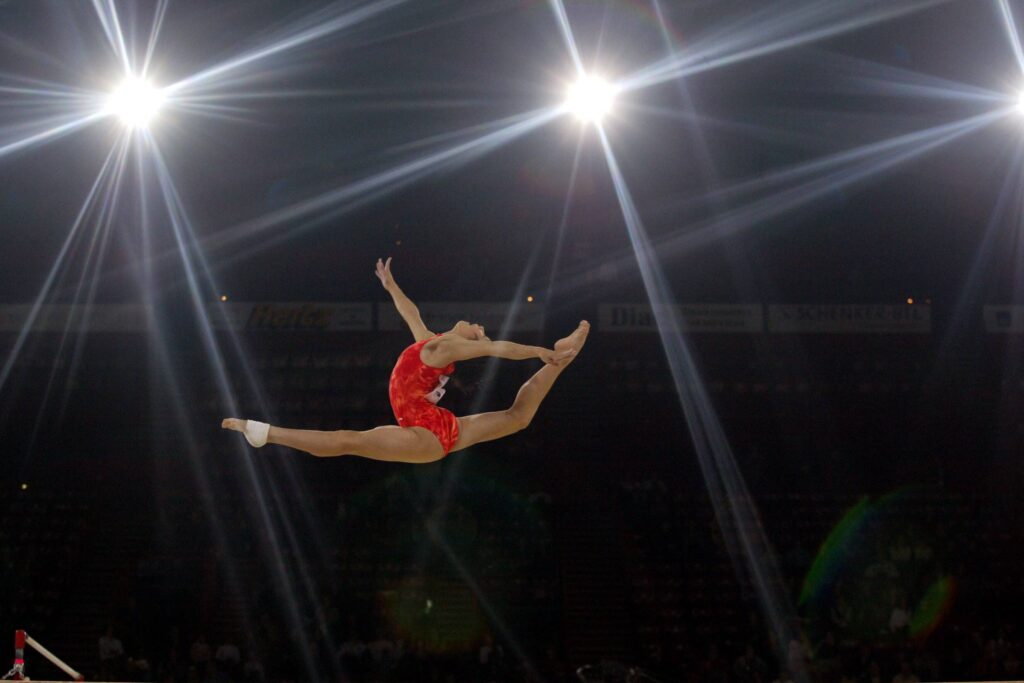
Note: For readers who grew up following gymnastics in the United States, it is worth remembering that while the Pan American Championships and Pan American Games received relatively little attention domestically, continental championships carried significant prestige elsewhere — the Asian Games being a prime example for China.
2002
Young Athlete, Great Ambition
— Profile of Women’s Artistic Gymnastics All-Around Champion Zhang Nan
Tracing a beautiful arc through the air, Zhang Nan landed her vault. Because her center of gravity was unstable, she took a large step forward on the landing, and the judges awarded her a score of 8.975. Even so, the relatively low score did not prevent Zhang Nan from winning the gold medal in the women’s artistic gymnastics all-around.
Thanks to her outstanding performance in yesterday’s team competition, the young Beijing gymnast Zhang Nan advanced to today’s final with the highest overall qualifying score. Her order of events today was uneven bars, balance beam, floor exercise, and vault. Aside from placing second on the first event, Zhang scored higher than all other competitors on the remaining three events, finishing first in each.
Sixteen-year-old Zhang Nan is one of the most technically well-rounded among China’s new generation of women’s gymnasts. This was her first international competition, yet she and fellow youngster Kang Xin were entrusted with major responsibilities in the women’s team event. They lived up to expectations, helping a Chinese women’s gymnastics program in a low period win a highly significant team gold medal.
“Zhang Nan’s performance under pressure was better than I expected,” said Zhang Jian, director of the Gymnastics Management Center, in evaluating her showing today. Zhang Nan will also compete in all of the apparatus finals except vault in the upcoming competitions. “I’ll strive to win more gold medals in the individual events,” said Zhang, already wearing two golds and brimming with ambition.
(Reported from Busan, October 3)
Zhang Fan
People’s Daily, October 4, 2002, page 4
小将雄心
——记女子体操个人全能冠军张楠
张帆
随着一条漂亮的弧线,张楠从跳马落下,由于重心不稳,她往前跨出了一大步,裁判给了她8.975分,但这个低分并没有影响张楠夺得女子体操个人全能的金牌。
由于昨天团体赛的出色发挥,北京小将张楠以个人总分第一进入今天的决赛。张楠今天的出场顺序分别是高低杠、平衡木、自由体操和跳马,除第一项得分居第二外,张楠在随后三项的得分都高于其他选手而列第一位。
16岁的张楠是中国女子体操新人中技术比较全面的选手,这是她第一次参加国际大赛,但她和另一名小将康欣在女团比赛中就被委以重任,结果她们不负重托,为处于低谷的中国女子体操夺得了意义重大的团体金牌。
“张楠的临场发挥比我预料的要好。”体操管理中心主任张健这样评价张楠今天的表现。张楠在随后的比赛中还将参加除跳马外的单项比赛,“我将争取在单项中再拿金牌。”已身挂两金的张楠显得雄心勃勃。
(本报釜山10月3日电)
2003
The Little Sprite Becomes a Leading Figure
— Profile of China’s Emerging Gymnastics Talent Zhang Nan
As veterans such as Liu Xuan and Kui Yuanyuan have retired one after another, China’s women’s gymnastics team has been going through a difficult period of transition between generations over the past one to two years. At this critical moment, Zhang Nan has gradually emerged as the team’s leading figure.
Last year in Busan, Zhang Nan rose to fame in a single competition. With her steady performances, she helped the team win the women’s team gold medal. She also claimed three gold medals by a decisive margin in the women’s floor exercise, uneven bars, and individual all-around. Soon afterward, at the 30th World Artistic Gymnastics Apparatus Championships, Zhang Nan competed in three events and swept first place in the qualification rounds of floor exercise and balance beam.
Zhang Nan was born in April 1986. At seventeen, she still looked unmistakably youthful: just 1.44 meters [4 ft. 8.7 in.] tall, with short hair, clear eyes, and a smile that revealed a pair of sweet dimples. When she spoke, her voice was bright and crisp. Cute as she was, she seemed—at least at first glance—like nothing more than an ordinary Beijing girl.
Sixteen or seventeen is the age when most girls are free to dream, but for a gymnast who sets extremely high standards for herself, the pressure Zhang Nan carried was beyond what her peers—or even many adults—could imagine. Despite her young age, many people were struck by her calmness and strong self-discipline. There is a Chinese saying, “Children from poor families grow up early,” and it fits Zhang Nan well.
After she won gold at the Busan Asian Games, reporters visited her home and discovered that the family did not even have a telephone installed. Her father did not own a mobile phone either. In a city like Beijing, such living conditions could fairly be described as impoverished. People were astonished that such a modest household could produce a gymnastics prodigy. Zhang Nan herself, however, never avoided talking about her family background.
“I really admire my dad,” she said. “When he was little, growing up in the countryside in Jiangsu, my grandfather would give him ten cents, and he’d be so happy he wouldn’t even know what to buy. After school, my dad would help my grandfather with farm work. Later, he came to Beijing and met my mom. My mom repairs televisions. She was twenty-three when she had me, and my dad is exactly twenty-four years older than I am.”
In fact, Zhang Nan’s path into gymnastics was largely accidental. As a child, she was extremely thin, picky with food, and often refused to eat properly. Her father sent her to train at the Shijingshan Amateur Sports School in Beijing. On the day of registration, he saw many children playing in the foam pit and told her, “Go play with the other kids.” Zhang Nan was too scared to jump in. Her father, annoyed, said, “If you’re this timid, how will you ever train in gymnastics?” He pushed her into the foam pit—and to his surprise, once inside, she refused to come out. She played there until the gym closed, leaving only reluctantly.
Zhang Nan also seemed destined for the balance beam. Early in her training, she once climbed onto the beam while the coach wasn’t looking. The beam was narrow and high off the ground, but little Zhang Nan wasn’t afraid at all—she found it fascinating.
Gradually, gymnastics revealed its cruel side. Yet the more she invested in it, the harder it became for her to give it up. Under her parents’ strict supervision, the mature-beyond-her-years Zhang Nan persevered. The experiences that left the deepest impression on her were being beaten by her mother once and the hardships of weight loss.
As a child, near the end of one training session, the coach noticed her upper-body strength was insufficient and had her hang from the bar to train her abdominal muscles: four sets of thirty repetitions each. The younger girls finished and were told to watch “Sister Zhang Nan” demonstrate. But Zhang Nan lacked strength—she would fall off after twenty-plus repetitions and have to start over again.
That day, her mother happened to come pick her up. To push her on, her mother stood nearby holding a small stick and warned that if Zhang Nan fell again, she would be hit ten times. Sure enough, Zhang Nan fell again at around twenty repetitions. Her mother showed no mercy, striking her repeatedly on the buttocks. It hurt terribly. The coach, distressed, lowered the requirement to twenty-five per set. Crying, Zhang Nan started again—but still couldn’t finish. Her mother clenched her teeth and struck her again.
Training ended after 10 p.m. The food at home had long gone cold. Zhang Nan was in such pain that she could only lie face-down to sleep. The next day at school, she couldn’t sit at all—whenever she touched the bench, her buttocks burned with pain—so she stood through her classes.
Compared with that, her weight-loss story was almost amusing. When she was on the Beijing team, Zhang Nan hadn’t yet learned to control her diet. Once, when the senior athletes were away at a competition, Zhang Nan and several younger teammates indulged themselves and ate freely for a whole week. When the coach returned, the order was immediate: lose weight.
Three meals a day became one meal a day—lunch only. While others piled their plates high, Zhang Nan barely dared to take anything, sticking to vegetables, fruit, and at most a cup of yogurt. At night, she suffered terribly—the nights felt endless, her stomach growling so loudly she couldn’t fall asleep.
On weigh-in day, she checked her weight herself that morning and found she had lost three kilograms, meeting the coach’s requirement. Overjoyed, she ate a full lunch. That afternoon, the coach checked again: she had gained one kilogram back. With diet control failing, the coach’s face darkened, and he came up with another “killer move”: “Go—run laps around the track!”
It was the height of summer, with temperatures over 40°C [104 °F]. Zhang Nan had to wear padded cotton clothing and run lap after lap around the field. She ran and cried at the same time, sweat and tears streaming down her face. Afterward, the weight was gone—but so was her desire to continue gymnastics.
The coach, however, was unwilling to give up such a promising talent. After learning of her thoughts, he had a long talk with her. Sensible as she was, Zhang Nan realized how hard it had been to reach that level—and that quitting now would mean all her past suffering had been for nothing. After much reflection, she stayed in the gym.
Growing up in hardship, Zhang Nan understood that nothing in life comes easily. Though she appeared carefree and outspoken in daily life, she was exceptionally demanding of herself. After she gained some fame, her father became especially worried that excessive praise and attention might make his daughter arrogant. He specifically asked the women’s team coaches to be strict with Zhang Nan, telling them to make sure she “kept her tail tucked in.”
Zhang Nan’s greatest wish now is to win an Olympic gold medal. Although she still trails the outstanding athletes from Russia and Romania, her dedication to her sport and her serious sense of responsibility toward her own life make it easy to believe that the day she fulfills her dream is not far away.
Zhong Xin
People’s Daily, April 21, 2003, page 8
小精灵成了领军人物
——记中国体操新秀张楠
钟欣
随着刘璇、奎媛媛等一批老将相继退役,这一两年正处在新老交替阶段的中国女子体操队面临很大困难。这个时候,张楠渐成了队里的领军人物。去年在釜山,张楠一战成名,她凭借稳定的发挥,帮助全队夺取了团体金牌,她还以绝对优势拿到了女子自由操、高低杠和个人全能的3块金牌。随后,张楠参加第三十届世界体操单项锦标赛,在所参加的3个项目中,她独揽了自由操和平衡木两个项目的预赛第一名。
张楠出生于1986年4月,17岁的她看上去稚气未脱——1米44的个头,短短的头发,清澈的双眼,笑起来唇边会漾出一对甜甜的酒窝,说起话来声音响亮、干脆利落——虽然可爱,但似乎也只是个很普通的北京女孩。
十六七岁正是女孩子做梦的季节,而对自己要求很高的体操运动员张楠承受的压力是她的同龄人、甚至是许多成年人无法想象的。小小年纪的张楠,很多人都很惊异于她的冷静和良好的自制能力,中国有句老话叫做“穷人的孩子早当家”,用在她的身上很合适。张楠在釜山亚运会上获得冠军后,有记者去她家里采访,发现这个简陋的家连电话也没有装上,张楠的父亲也没有一部手机,在北京,如此的家境,完全可以用贫寒来表示。人们惊讶如此清贫的家庭竟然会出一个体操天才。但张楠从来不回避谈论自己清贫的家庭。
“我挺佩服我爸爸。爸爸小时候在江苏农村,爷爷给他一毛钱,他高兴得都不知道买什么好。我爸爸放学回来,就帮爷爷干活。后来我爸爸来北京,认识了我妈妈。妈妈的工作是修理电视,我妈23岁有了我,爸爸正好比我大两轮。”
其实张楠成为体操运动员也是出于偶然。小时候,张楠特别瘦,挑食,不好好吃饭。她爸爸就把她送进北京石景山业余体校练体操。报名那天,看到很多小朋友都在海绵坑里玩,爸爸就对张楠说:“去和小朋友们一块玩吧。”张楠就是不敢往海绵坑里跳。爸爸一生气,说道:“胆子这么小,以后可怎么练体操啊!”一下子把张楠推进了海绵坑里,没想到,一进海绵坑,张楠就不愿出来了,一直玩到体操馆关门,才恋恋不舍地离开了。
张楠和平衡木也挺有缘。刚练体操那会儿,有一天,她趁教练不注意,爬到平衡木上去玩。木面那么窄,离地还高,可是小张楠一点儿不害怕,反而觉得特有意思。
体操逐渐向张楠展示了残酷的一面。不过在其中投入得越多,张楠越觉得难以割舍,在父母严厉的督促下,懂事的张楠坚持了下来,这其中,她印象最深的就是一次挨妈妈的打和减体重遇到的艰辛。
小时候有一次训练快结束时,因为上肢力量不足,教练让她抓杠练腹肌,做4组动作,每组30个。体校的小妹妹们练完了,教练让她们过来看张楠姐姐做示范,可是张楠力量不够,每每做到20多个时就掉了下来,于是又重新开始……
那天正好是妈妈来接张楠放学,为了督促她,妈妈就拿着小棍儿在一边站着,说如果再掉下来一次就打你10下,结果她又是做到20多个时掉了下来……妈妈毫不留情地打了屁股,一下下抽在身上,真疼啊……当时教练很心疼,把要求降到每组25个,张楠哭着又开始做,但还是没能完成要求,妈妈咬着牙狠下心又打……那天练完回家已经晚上10点多了,家里饭菜都凉了,张楠疼得只能趴着睡觉。第二天到学校上课,她一直是站着的,根本不能坐,一挨板凳,屁股就火烧火燎地疼。
相比较而言,减体重的故事更具趣味性。在北京队时,张楠还不会自我控制饮食。有一次教练带老队员出去比赛,以她为首的几位小队员见没人管了,就放开肚皮猛吃了一星期。教练一回来,不用说,马上下了命令:减肥!
一天三顿改为一日一餐,只能在中午进一次食堂。别人进了食堂都把盘子装得满满的,只有张楠不敢多盛,每次总是装些蔬菜水果,最多再捎带一杯酸奶,到了晚上就难受了,夜那么长,肚子饿得咕咕叫,怎么也睡不着……
到了称体重的日子,张楠早上起来自己先量一量,居然降了3公斤,达到了教练的要求!心里一高兴,中午进食堂时,张楠好好地饱餐了一顿,结果下午教练检查:居然长回去了1公斤!饮食控制没效果,教练脸一沉又想出了另外一个“绝招”:“去,自个儿到操场跑圈儿去!”三伏天,室外气温40多摄氏度,但张楠必须穿着棉衣棉裤绕着田径场跑。跑了一圈又一圈,一边跑一边哭,汗水和着泪水往下滴……跑完了,虽然体重下来了,但张楠也有了不再练体操的念头。
教练可舍不得这个好苗子。得知张楠的想法后,教练找她长谈了一次。懂事的张楠也觉得练到这种程度不容易,如果现在放弃,那么以前的苦可全都白吃了……想来想去,张楠还是留在了体操房。
苦孩子出身的张楠很明白,生活中所有的一切都来之不易,生活中的她表面上大大咧咧,其实对自己的要求特别高。张楠有了点名气后,父亲就特别担心,怕过多的褒奖和关注会让刚起步的女儿心生傲气。爸爸特意请求女队的教练一定要对张楠严格要求,让她“把尾巴夹紧点儿”。
张楠现在最大的心愿是夺得奥运会金牌,虽然同俄罗斯、罗马尼亚等国的优秀选手相比,她还有差距,但凭着她对事业的执着,对自己人生的认真负责,相信张楠圆梦的那一天并不遥远。
The Age Discrepancy
Contrary to what the profile claims, Zhang Nan may not have been born in April 1986. A 2006 academic article suggests she was born two years later, in 1988.
That article, published by Wang Cunha in the journal of Puyang Vocational and Technical College, was titled “On the Competitive Age and Athletic Longevity of Today’s Chinese Women’s Gymnastics Team.” Among other things, it explained how the National Games system shaped the age profile of China’s elite gymnasts:
The most important reason for the low-age trend among Chinese female gymnasts is the National Games system. In order to link talent development with Olympic strategy, the national team established regulations more than ten years ago regarding female gymnasts’ participation in the National Games: athletes must be at least fourteen years old to compete in individual events; in team competition, four of the six athletes must be at least fourteen, while two may be thirteen.
据悉,为了将培养新人与奥运会战略挂钩,国家队在十多年前便对女运动员参加全运会作出规定:参加个人比赛须达到十四周岁;团体赛六人中,必须有四人达到十四周岁,允许两人十三周岁。
Thirteen- and fourteen-year-olds were thus competing at the National Games while the FIG’s senior eligibility threshold stood at sixteen. That would explain why gymnasts like Dong Fangxiao found themselves on the senior national team when they were underage. Competitions like the National Games identified the country’s top talent, and sometimes, the top talent did not meet international age requirements. (Such an arrangement was not without precedent. In the Soviet Union of the 1980s, fourteen-year-olds could make the national team even though the international age minimum was set at fifteen.)
The article also claimed, curiously, that the FIG had voted in May 2005 to raise the age limit from fifteen to sixteen, with the new rule taking effect in 2009. In fact, the sixteen-year minimum had been in force since 1997, and the change had been widely covered in the Chinese press at the time. Whatever the source of Wang’s confusion, the claim drew a response from Gao Jian, Director of the Chinese Gymnastics Center, who discussed this nonexistent resolution:
“There is no doubt that this resolution will have a profound impact on China’s women’s team and may even influence the future direction of Chinese gymnastics. China must make corresponding adjustments to athlete deployment, selection, and training plans within each Olympic cycle. Domestic age requirements for the National Games and Youth Games must also change.”
“无疑,这一决议将对中国女队产生深远影响,甚至左右中国体操未来发展的方向。中国在一个奥运会周期的女运动员部署、选调及训练计划的安排上,都应作出相应调整。国内全运会和城运会的年龄,也要有变化。”
Tucked within this same article was a small but significant detail about China’s 2004 Olympic team:
The oldest among them was team captain Zhang Nan, who was only sixteen at the time. The younger team members were around thirteen years old.
她们中最年长的是队长张楠,当时才十六岁。而比张楠更年轻的队员都是十三岁左右。
If this account is accurate, Zhang Nan would have been just fourteen when she swept four gold medals at the 2002 Asian Games and competed later that year at the World Championships. And she would have been fifteen when she won all-around bronze at the 2003 World Championships in Anaheim. Her rise would still have been extraordinary, but it would also have unfolded a full year ahead of when it should have occurred naturally. (Fifteen-year-olds were eligible to compete at the 2003 World Championships, and with a 1988 birth year, Zhang would have been fifteen in 2003.)
The implications also extend beyond Zhang. For example, if Wang’s chronology is correct, then Fan Ye would have been underage when she captured the 2003 world balance beam title. The same would be true of the other Chinese team members who made event finals in Athens in 2004. In other words, this is not a minor clerical inconsistency; it is a timeline that, if taken seriously, unsettles an entire era.
And the source of that timeline is important. This is not an accusation circulating on internet message boards or a theory advanced by foreign critics. It appears in a Chinese academic journal article, where a leader of China’s gymnastics program is quoted.
Sometimes, the most consequential discrepancies are not exposed from the outside. They are printed, matter-of-factly, in mainland China itself.
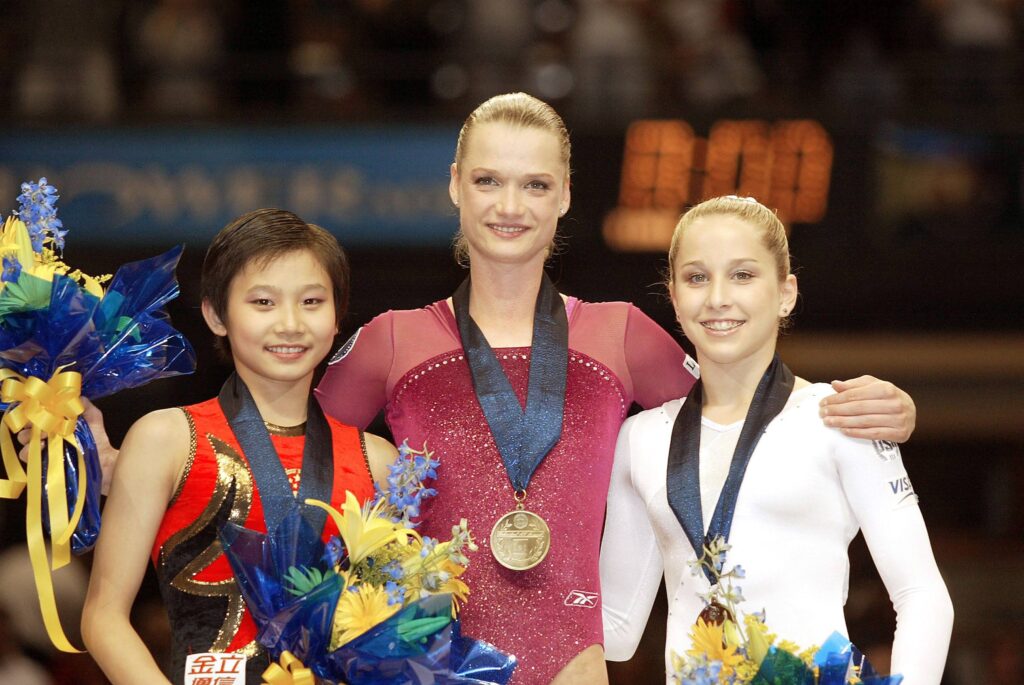
If the journal article is correct, Zhang and Patterson were born in the same year: 1988.
Appendix: The Journal Article
Below is a translation of the journal article. It is worth noting that the piece quotes Gao Jian, head of China’s gymnastics program, who discusses this fictional FIG rule change and how it will impact the Chinese women’s program.
⁂ ⁂ ⁂
On the Competitive Age and Athletic Longevity of Today’s Chinese Women’s Gymnastics Team
Wang Cunhua
Puyang Vocational and Technical College
Abstract
In May 2005, the International Gymnastics Federation (FIG) decided that beginning in 2009, female gymnasts must be at least sixteen years old to participate in international gymnastics competitions. In light of international developments, and in combination with the analysis of Gao Jian, Director of the Chinese Gymnastics Center, this paper discusses the current situation of China’s women’s gymnastics team—including age structure, athletic longevity, and existing problems—and proposes corresponding countermeasures.
Introduction
Early specialization in gymnastics training has greatly lowered the age at which athletes reach elite levels. Winners at major international competitions such as the Olympic Games and World Championships are almost all adolescents; in general international competitions, it is even more often younger athletes who stand out—especially female gymnasts. A few years later, that is, at sixteen or seventeen, regardless of whether their results are good or bad, many of them retire. Numerous facts demonstrate that early specialization causes severe physical and psychological harm to female athletes. If this situation is not improved, women’s gymnastics is very likely to devolve into “children’s gymnastics.”
In May 2005, at the FIG Congress in Finland, what was called a “revolutionary resolution” was passed: starting in 2009, female gymnasts must be at least sixteen years old to compete internationally. Gao Jian, Director of the Chinese Gymnastics Center, stated: “There is no doubt that this resolution will have a profound impact on China’s women’s team and may even influence the future direction of Chinese gymnastics.”
I. The Current Situation of China’s Women’s Team
In artistic gymnastics, whether for individual skills or complete routines, athletes are required to demonstrate coordination, large amplitude, strong rhythm, and aesthetically pleasing form. Through the light, lively, lyrical, and elegant posture displayed in competition and performance, along with stable and superb technical execution, gymnasts provide audiences with aesthetic enjoyment and lasting impressions.
However, at the 2004 Athens Olympic Games, a group of fifteen-year-old girls—represented by Fan Ye, Li Ya, Zhang Yufei, Wang Tiantian, and others—left a deep impression on spectators not because of outstanding technique, but because they fell from the apparatus one after another “like dumplings.” The oldest among them was team captain Zhang Nan, who was only sixteen at the time. The younger team members were around thirteen years old.
Three years later, they would theoretically all be over sixteen. During the 2008 Olympic cycle, age restrictions did not affect the Chinese team. But what about 2009? As this generation of athletes gradually retires, can even younger gymnasts quickly step in? Will they all meet the minimum age of sixteen when competing in world-class events? The outlook is not optimistic.
II. Main Reasons for the Youthification of China’s Women’s Team
(1) The National Games System
The most important reason for the low-age trend among Chinese female gymnasts is the National Games system. In order to link talent development with Olympic strategy, the national team established regulations more than ten years ago regarding female gymnasts’ participation in the National Games:
- Athletes must be at least fourteen years old to compete in individual events;
- In team competition, four of the six athletes must be at least fourteen, while two may be thirteen.
(2) Physiological Factors and Technical Demands
Young female gymnasts are lighter, have smaller pelvises, and carry less body fat, making them well-suited for high-difficulty skills. As technical difficulty increases, the tendency toward younger training ages has become increasingly apparent. The distinction between junior and senior female gymnasts has nearly disappeared.
Under this mindset, Chinese female gymnasts are generally required to master basic skills at eight or nine years old (with initiation beginning even earlier), learn intermediate foundational skills around age ten, and only become eligible to compete in the National Games at fourteen. After 2008, many of these National Games athletes would be “promoted” to the national team. While they may meet Olympic age requirements, they were clearly not eligible to compete in World Cup events a year earlier.
For this reason, Gao Jian emphasized that the cultivation of female gymnasts must begin immediately and with long-term planning. He stated: “China must make corresponding adjustments to athlete deployment, selection, and training plans within each Olympic cycle. Domestic age requirements for the National Games and Youth Games must also change.”
The goals are twofold: first, to align talent development with international standards; second, to curb early specialization.
“Although the competition age has increased by only one year, it affects the entire system of athlete deployment and must be taken seriously. Extending female gymnasts’ athletic longevity has become imperative.”
Gao Jian once described China’s short athletic lifespan as a “meteor phenomenon.” He recalled: “I once welcomed a world champion back at the airport and asked her what her next plan was. Without hesitation, she replied: retirement. I was deeply shocked—she was only sixteen years old.”
From initial training at six or seven to competing internationally at fifteen or sixteen, the state invests seven or eight years of resources. Yet when athletes reach their prime, many retire within less than one Olympic cycle—an enormous waste of resources for both the nation and the athletes themselves.
III. Extending Athletic Longevity Requires Changing Traditional Concepts
The belief that female athletes are “old” at seventeen or eighteen—and male athletes at twenty-five or twenty-six—must be abandoned. Misconceptions that puberty inevitably leads to increased fat, widened hips, lowered center of gravity, and declining physical capacity must be corrected.
From the perspectives of technical and physical training, effective methods must be found to ensure that female gymnasts maintain high athletic capacity after entering puberty. Athletes should be regularly educated about the relationship between physiology and training.
Around age eleven, female athletes enter puberty. During this period, hormonal activity intensifies, height and weight increase rapidly, muscular development lags behind skeletal growth, cardiovascular and respiratory systems fail to keep pace with the musculoskeletal system, and the central nervous system’s ability to regulate motor skills declines. This creates a period of extreme imbalance and lack of coordination. Because gymnastics requires athletes to overcome their own body weight, these imbalances are particularly pronounced.
As a result, many female gymnasts experience declines in physical qualities and technical performance, affecting competition results. Psychological changes during puberty can also produce doubts, concerns, and even reluctance to continue training.
Thus, puberty becomes a crucial “barrier” determining whether female gymnasts can maintain and improve performance. If this stage is successfully overcome, conditions improve significantly.
Examples include:
- Oksana Chusovitina of Uzbekistan, who at thirty-four continued competing internationally, winning the women’s vault at the 2003 World Championships and silver at the 2004 Olympics—after her child was already four or five years old.
- Yordan Yovchev of Bulgaria, world champion on rings, still powerful at thirty-two.
- Marius Urzică of Romania, the “Pommel Horse King,” still active at thirty.
Gao Jian explained: “I always call older athletes ‘senior athletes,’ never ‘old athletes.’ I hope to change their mindset—and to see more ‘evergreens’ among Chinese athletes.”
IV. The National Team Should Reform Educational and Management Approaches
(1) Emphasizing Technical Accuracy
- Training should focus on developing event-specific physical qualities based on individual characteristics and technical trends, using apparatus training for shoulder and arm strength, acrobatics and jumping for leg strength, and full-routine repetition for endurance.
- Technical training should prioritize learning new and difficult skills—twists, vaults, and somersaults—while selecting focal points that shape individual technical style and improve execution success rates.
(2) Psychological Education
Competition density and intensity should be increased, particularly the ability to compete continuously. Psychological training should be planned before competitions to improve success rates.
- Training should become increasingly individualized, avoiding uniform approaches and tailoring loads, schedules, and methods to each athlete.
- Education and management should emphasize correct attitudes toward honor, success, and failure, cultivating resilience and patriotic motivation, while strictly managing daily life routines.
(3) Goal-Oriented Education
Success requires lofty, correct, and firm goals that inspire relentless pursuit and dedication. Many world-class coaches believe that strong professional commitment and clear training objectives are the foundation of success.
Renowned women’s volleyball coach Yuan Weimin wrote in My Coaching Philosophy that athletes must let “all their excitement revolve around volleyball—true pursuit requires obsession.”
Although gymnastics demands ideal physique, some Chinese athletes have overcome physical limitations through lofty ideals and firm goals, creating miracles—such as Li Yuejiu, Li Ning, and Lou Yun.
Such dedication stems from patriotism, national pride, and a strong sense of responsibility. These values enable athletes to endure hardship, train consciously, and overcome difficulties. This spirit is the foundation of success.
- Coaches should integrate goal education into training, share exemplary athlete stories, organize viewing of competitions and films, and encourage discussion.
- Scientific training and tangible results should foster athletes’ love for their sport and confidence in achieving goals.
- Training should cultivate individuality and intelligence, with democratic coaching styles encouraging initiative and deeper commitment.
In conclusion, coaches must combine long-term overarching goals with short-term, concrete objectives. Through the accumulation of small successes, athletes can ultimately achieve major goals and tasks.
More on Age