Imagine being born on January 22, 1995. That would make you perfectly timed for senior competition in 2011 and 2012. But if your national team needed you in 2010, you would miss eligibility by just 22 days. Now imagine that your birthdate could be moved by exactly one month—to December 22, 1994—making you eligible for the 2010 season.
That appears to be what happened with Wu Liufang.

In 2008, cybersecurity specialist Mike Walker uncovered cached spreadsheets from the Chinese government’s official sports website. At the time, most attention focused on He Kexin and the January 1, 1994 birthdate listed there. But Wu Liufang’s name also appeared in the 2005 registration records.
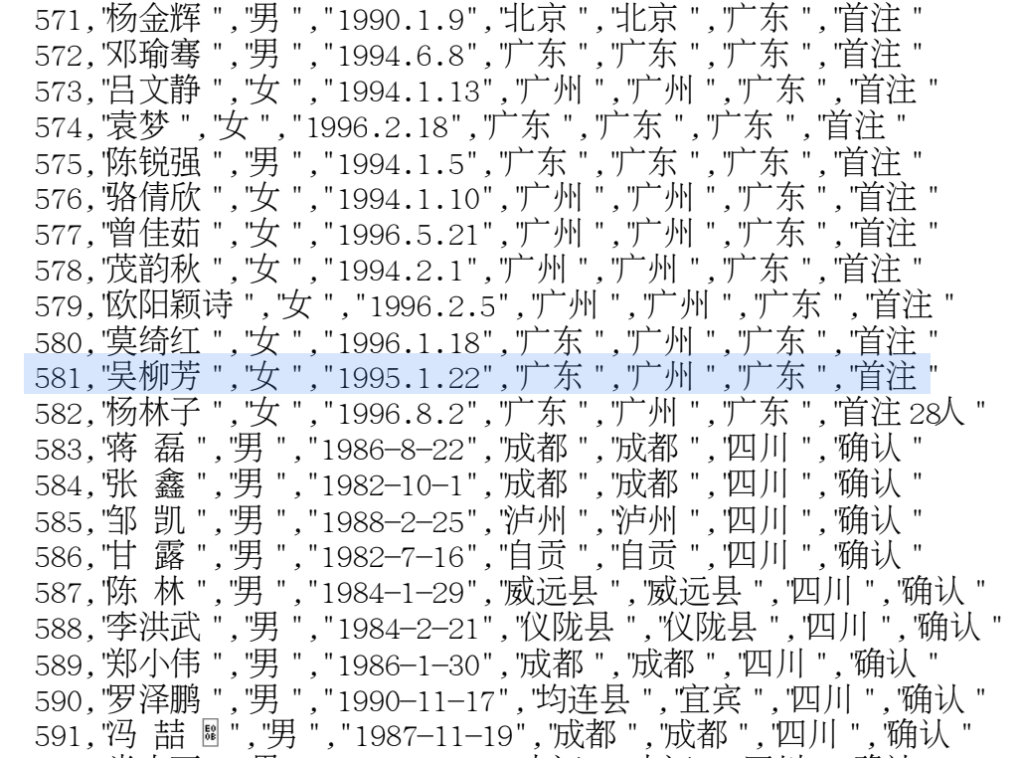
There, her birthdate was listed as January 22, 1995. If accurate, she would have been only 15 in 2010, when she won gold on balance beam and floor exercise, and silver on uneven bars, at the Doha World Cup. Yet the birthdate used for her that year was December 22, 1994—a change of exactly one month that made her age-eligible.
The cached spreadsheets were not the only source to give Wu Liufang a 1995 birth year. In 2012, after she was injured on her beam dismount at the National Championships and Olympic Trials, the Metropolitan Express (都市快报) described her as born in 1995:
Gymnastics girl Wu Liufang loses balance on back flip, lands neck-first on the ground
May 13, 2012, Source: Hangzhou.com – Metropolitan Express
Compiled report — “Ah!” A massive collective gasp suddenly erupted from the stands. Yesterday, the [2012] National Gymnastics Championships and Olympic Trials entered their final day in Shanghai. During the afternoon’s women’s balance beam final, Wu Liufang, competing for Guangdong, made an error on one skill and landed neck-and-back-first on the ground. The incident bore an uncanny resemblance to Sang Lan’s accident years ago, and the hearts of the entire audience leapt into their throats.
This competition was the last major domestic selection event before the London Olympics, and athletes’ performances here were critical to securing a place on the Olympic team, so every competitor was giving everything they had in this final push for qualification.
Born in 1995, Wu Liufang joined the national team in 2008 and had always been a fringe figure within it, narrowly missing selection for the World Championships in both 2010 and 2011. Her strengths were uneven bars and balance beam, and over the previous two-plus years, she had won five World Cup event titles on one apparatus or the other.
Yesterday, the error occurred as she was executing her dismount — a back flip — when her left foot missed its mark, severely disrupting her center of gravity. When she came down, her neck and upper back struck the ground first. Although the surface was a foam mat, the impact produced a tremendous thud that drew an audible gasp from the crowd. Years ago, Sang Lan had broken her neck on a similar skill, resulting in high-level paralysis.
[Note: Sang Lan was injured on vault at the 1998 Goodwill Games.]
Just as everyone looked on in alarm, Wu Liufang somehow staggered to her feet and walked off the competition floor under her own power. Under the guidance of on-site medical staff, she first lay flat on the ground to be observed and examined. She was subsequently transported to Shanghai Sixth People’s Hospital for more detailed assessment. Late yesterday afternoon, word came from the hospital: Wu Liufang had been diagnosed with “traumatic mild protrusion of the sixth and seventh cervical vertebrae.” Doctors indicated that one to two weeks in a cervical collar should bring a full recovery.
体操小丫吴柳芳空翻失去平衡 颈背部先砸在地上
2012年05月13日
来源:杭州网-都市快报
本报综合报道 “啊!”看台上突然爆发出一阵巨大的惊呼。昨天,2011年全国体操锦标赛暨奥运会选拔赛在上海进入收官日。在下午的女子平衡木决赛中,广东队选手吴柳芳在做一个动作时出现失误,颈背部着地。这个像极了当年桑兰的意外事件,让全场观众的心都提到了嗓子眼。
本次比赛是伦敦奥运会国内最后的一次大型选拔赛,选手们在本次比赛上的表现对能否参加伦敦奥运会至关重要,因此选手们都竭力表现,为奥运资格做最后的冲刺。
1995年出生的吴柳芳2008年起进入国家队,一直都是国家队的边缘人物,2010年和2011年险些参加世锦赛。吴柳芳的强项就是高低杠和平衡木,过去两年多曾5次获得世界杯站的高低杠或平衡木冠军。
昨天她是在做结束动作正在后空翻的时候出现了失误,左脚踩空,导致自己重心严重受到影响,随后落地的时候她颈背部率先着地,虽然地面是海绵垫,但也发出一声巨大的碰撞声,引起看台上观众的一阵惊呼当年桑兰也是一个类似的动作摔断了脖子,导致高位截瘫。
就在大家紧张不已的时候,吴柳芳竟然摇摇晃晃地爬了起来,自己走下了赛场。在现场医务人员的指导下她先是平躺在地上,接受医务人员的观察治疗。随后吴柳芳已经被送往上海第六人民医院,接受更详细的检查。昨天傍晚从医院传来消息,吴柳芳的诊断结果为“外伤性第六七节颈椎轻度突出”,医生表示,用颈托固定一到两周就能恢复。
Archived here.
If the spreadsheet and the article are both accurate, Wu Liufang’s case raises a broader question about the arbitrariness—and cultural specificity—of age regulations. Under the Gregorian calendar, adopted in China in the early twentieth century, she was too young for 2010. But shifting her official birthdate by one month did not move her into a different zodiac year or a different lunar year. Under the traditional Chinese calendar, both dates still fell in the Year of the Dog.
This is not meant to absolve the guilty parties; whoever altered her age knew what they were doing. But it is a reminder that the rule they manipulated was more culturally contingent than it first appears.
Note
As cases like Sun Xiaojiao, Jiang Yuyuan, and Huang Qiushuang suggest, gymnasts’ birthdates could shift more than once. Whether 1995 represents Wu Liufang’s true age or simply one point in a series of revisions is impossible to determine.
More on Age