There’s a fact that the Chinese media likes to print:
July 28, 1996, was the day of the women’s uneven bars final at the Atlanta Olympics, and it was also Bi Wenjing’s 15th birthday.
她们的的故事要从亚特兰大说起,1996年7月28日这一天是亚特兰大奥运会女子高低杠决赛的日子,这一天也是毕文静15岁的生日。
“Nothing Is Impossible—The Girl Who Defeated the Queen” (做不到没有想不到 战胜皇后的女孩), Sohu Sports, April 16, 2007
There’s one problem with that story: Bi Wenjing didn’t turn 15 in 1996. She turned 13.
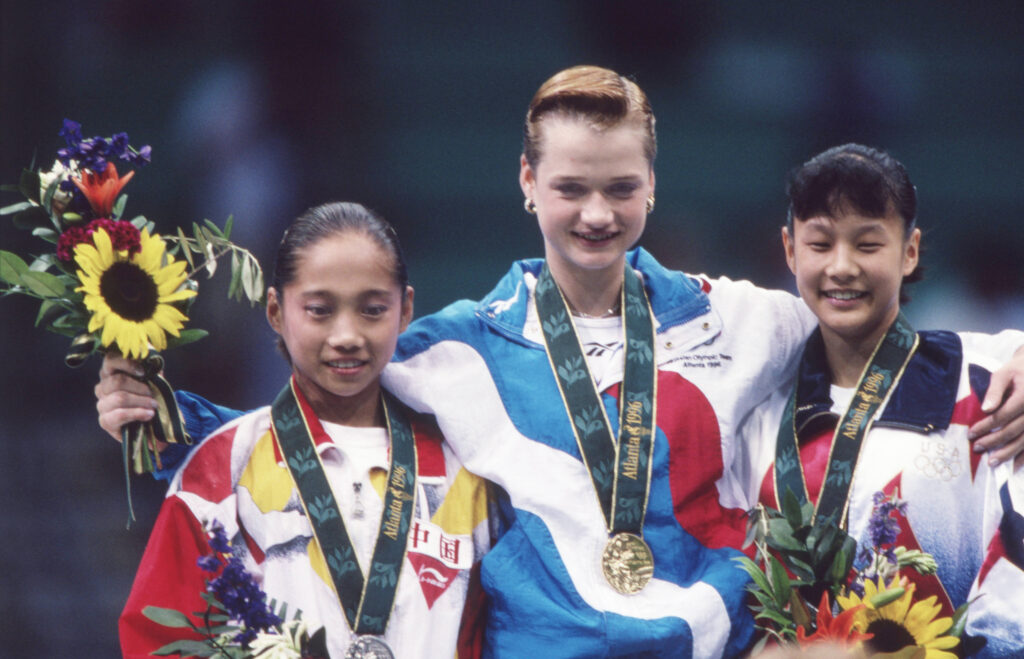
The Gymnast Who Was Born in 1983
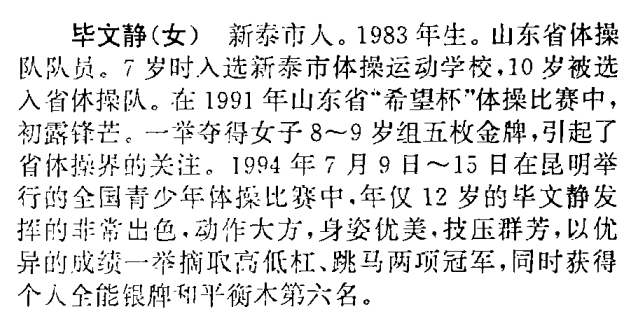
The Tai’an Yearbook recorded the local achievements of Tai’an (泰安), a prefecture-level city in western Shandong, China. The 1995 edition included a brief biography of Bi Wenjing, which mentioned that she was born in 1983:
Bi Wenjing (female) — A native of Xintai city. Born in 1983. Member of the Shandong provincial gymnastics team. Enrolled in the Xintai City Gymnastics School at age 7, and was selected into the provincial gymnastics team at age 10. At the 1991 Shandong Province “Hope Cup” gymnastics competition, she made her first notable mark, winning five gold medals in the girls’ 8–9 age group in one sweep and attracting the attention of the provincial gymnastics community. At the National Junior Gymnastics Championships held in Kunming from July 9–15, 1994, the then 12-year-old Bi Wenjing performed outstandingly — her movements generous and assured, her bearing graceful and beautiful, her technique surpassing all rivals — sweeping gold on uneven bars and vault in a single stroke, while also claiming the individual all-around silver medal and sixth place on balance beam.
Liu Binfan, Dai Yonghe, Editors-in-Chief, 泰安年鉴, 1995
毕文静(女)新泰市人。1983年生。山东省体操队队员。7岁时入选新泰市体操运动学校,10岁被选入省体操队。在1991年山东省”希望杯”体操比赛中,初露锋芒。一举夺得女子8~9岁组五枚金牌,引起了省体操界的关注。1994年7月9日~15日在昆明举行的全国青少年体操比赛中,年仅12岁的毕文静发挥的非常出色,动作大方,身姿优美,技压群芳,以优异的成绩一举摘取高低杠、跳马两项冠军,同时获得个人全能银牌和平衡木第六名。
Note: She couldn’t have been 12 in 1994 with a 1983 birth year.
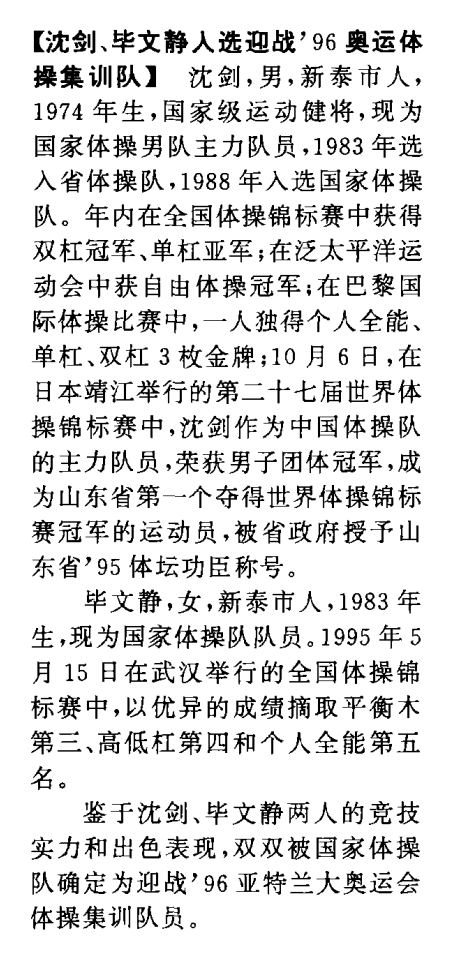
One year later, in the 1996 edition of her local yearbook, the same birth year appeared:
Bi Wenjing, female, a native of Xintai city, born in 1983, currently a member of the national gymnastics team. On May 15, 1995, at the National Gymnastics Championships held in Wuhan, she achieved excellent results: third place on balance beam, fourth on uneven bars, and fifth in the individual all-around.
In recognition of the competitive strength and outstanding performances of both Shen Jian and Bi Wenjing, the two were jointly designated by the national gymnastics team as members of the training squad preparing for the ’96 Atlanta Olympic Games.
Dai Yonghe, Editor-in-Chief, Tai’an Yearbook (泰安年鉴), 1996
毕文静,女,新泰市人,1983年生,现为国家体操队队员。1995年5月15日在武汉举行的全国体操锦标赛中,以优异的成绩摘取平衡木第三、高低杠第四和个人全能第五名。
鉴于沈剑、毕文静两人的竞技实力和出色表现,双双被国家体操队确定为迎战’96亚特兰大奥运会体操集训队员。
If these yearbooks are correct, this means that Bi Wenjing was only 13 when she won silver in Atlanta, only 14 when she won team bronze and uneven bars bronze in Lausanne, and only 15 when she won the World Cup Final in Sabae, Japan, in 1998.
All of her major accomplishments, including defeating Svetlana Khorkina in 1998, happened while she was underage.
This was not an anomaly, but rather consistent with the broader pattern of Chinese women’s gymnastics. As Chinese scholars have observed, many athletes in the system were selected early and developed to peak around the age of fifteen.
Yet this developmental model sat uneasily alongside international regulations. In 1997, the International Gymnastics Federation raised the minimum age for competition from fifteen to sixteen. By contrast, Chinese gymnasts typically began training at around five, reached their peak by fifteen, and retired just two to three years later. One study by Su Jianliang and colleagues found that the average age of peak performance among Chinese female gymnasts was 15.20, while the average retirement age was 17.57—leaving a competitive “contribution window” of just 2.37 years.
In 1997, the International Gymnastics Federation established a minimum age of 16 for women competing at the Olympic Games. China’s female gymnasts begin training at around age 5, typically reach peak performance at around 15, quickly arrive at the apex of their results, and retire 2–3 years later. They peak early and retire early — cases have occurred in which an athlete returns from her first major world competition having just won gold, only to retire immediately upon arriving home, which is a genuine waste. According to a survey by Su Jianliang and colleagues, the average age at which China’s female gymnasts achieve their best results is 15.20, while the average retirement age is 17.57. In other words, the contribution period from peak result to retirement averages a mere 2.37 years — a flash in the pan. Coaches and athletes invest enormous effort over roughly ten years of training before finally forging a capable competitor, yet the contribution period after peak results amounts to only 2.37 years. The athletic lifespan is already very short; the contribution period is shorter still. It is only within this 2.37-year window that an athlete can participate in major world competitions, and her opportunity to compete at the Olympic Games amounts to one appearance at most.
Wang Kangle, Chen Ruiqin, Tai Chongxi (School of Physical Education, Suzhou University, Suzhou, Jiangsu, 215021), “Reflections on Extending the Athletic Longevity of China’s Female Gymnasts,” (对延长我国女子体操运动员运动寿命的思考), Journal of Beijing Sport University, 27.5, 2004
1997年国际体联规定参加奥运会女子参赛年龄最低为16岁。我国女子体操运动员从5岁左右开始训练往往在15岁左右就出成绩并很快就达到运动成绩的巅峰期2~3年后就退役了出成绩早退役也早出现了第一次参加世界大赛刚夺得金牌回国就退役的现象实为可惜。据苏俭亮等调查得出:我国女子体操运动员取得最好成绩的平均年龄为15.20岁退役平均年龄为17.57岁[2]。即从最好成绩到退役的贡献年限平均只有短短的2.37年可谓昙花一现。教练员与运动员辛辛苦苦投入训练经过10年左右终于磨练成才但出成绩后的贡献年只有2.37年运动寿命非常短其贡献年限更短。只有在其2.37年这一时间段内可以参加世界大赛而参加奥运会比赛的机会最多只有1次。由此可见我国进入专项训练的运动员人数本来就少尽管训练的科学性高、成才率高于其他体操强国但运动寿命短、贡献年限短、成本高造成了非常严重的体操人力资源的浪费制约着我国女子体操运动技术水平的迅速提高。假如我国也有几位同霍尔金娜那样运动寿命长的优秀运动员则我国女子体操近几年世界大赛团体成绩也不会老停留在第3~4名次上了。假如霍尔金娜也像我国运动员一样只有约3年的贡献年限寿命其最多只夺得7枚金牌也不会有今天的辉煌成就。我国只有极个别运动员运动寿命较长如刘旋5岁开始训练到了21岁还参加悉尼奥运会并夺得平衡木金牌后才退役参加了2届奥运会为国家做出了很大的贡献。因此我国不仅要训练运动员快出成绩而且更重要的是要延长运动员的运动寿命才能改变现状、迅速提高我国女子体操运动竞技水平才有可能战胜美国、罗马尼亚队而夺取桂冠也是为夺取各种世界大赛金牌为祖国赢得更大荣誉而具有十分重要的战略意义。
What these scholars make clear is that the system’s “contribution window”—a brief 2.37-year span beginning around age fifteen—did not neatly align with the FIG’s age requirements. What they could not state outright is how 15-year-old athletes were able to compete in events with a minimum age of 16. Nor could they acknowledge that, in practice, this window often opened earlier than the rules allowed. Bi Wenjing’s career brings that implicit reality into focus: by the time she reached her official peak at fifteen, she had already spent years competing—and winning—on the world stage.
Note
1. In case you were wondering, the 1997 yearbook left out any reference to Bi Wenjing’s birth year or age:
[Shen Jian and Bi Wenjing Each Win Silver Medal at the 26th Olympic Games]
From July 19 to August 4, at the 26th Olympic Games held in Atlanta, USA, Tai’an athletes Li Mingcai, Shen Jian, and Bi Wenjing from the Chinese sports delegation each competed in events including race walking and gymnastics. In fierce competition against strong rivals, they showed no fear on the field and dared to fight, achieving historic results. Among them, Shen Jian won 1 team silver medal and placed fifth in the individual all-around; Bi Wenjing won 1 silver medal on uneven bars and placed fourth in the women’s team competition, achieving a breakthrough from zero medals for Tai’an in Olympic competition. They received commendation from the National Sports Commission and the provincial sports commission, and the Tai’an Municipal Sports Commission was awarded the “Outstanding Contribution Award for Welcoming the Olympic Games and Preparing for the Eighth National Games” by the provincial sports commission.
Chen Zhanfeng, 泰安年鉴, 1997
沈剑、毕文静分获第26届奥运会银牌】7月19日~8月4日,在美国亚特兰大举行的第26届奥运会上,中国体育代表团中的泰安市运动员李明才、沈剑、毕文静分别参加了奥运会的竞走、体操等项目的比赛,他们在强手如林的比赛中,临场不惧,敢于拼搏,取得历史性的好成绩。其中沈剑夺得1枚团体银牌和1项个人全能第五名,毕文静获得高低杠1枚银牌和1项女子团体操第四名,实现了泰安市参加奥运史上奖牌零的突破,受到国家体委和省体委的表彰,泰安市体委被省体委授予”迎战奥运会,备战八运会”突出贡献奖。
2. The Chinese scholars cited above appear to assume that the age minimum of sixteen applied only to the Olympic Games, and not to the World Championships. At the time, gymnasts could be 15 during the pre-Olympics World Championships (e.g., the 2003 World Championships).
Appendix: Profiles of Bi Wenjing
1998: New Sports
“The Wonder Girl” Bi Wenjing
Interviewing Bi Wenjing was an absolute delight. She is very candid, very cheerful, wonderfully quirky, and funny.The day I went to meet them, these world-champion-caliber athletes were in the middle of preparing for a performance tour to visit the motherland’s precious island of Taiwan. The clock had already passed six in the evening, yet head coach Huang Yubin showed no sign of calling it a day. When Wenjing spotted me, she secretly patted her stomach and made a pained face — I took this to mean she was on the verge of starving to death, so I quickly tried to encourage her: “Hang on a little longer, you can eat plenty once it’s over.” She immediately broke into a happy smile, no doubt already picturing the good meal waiting for her after training.
At seven o’clock, Huang Yubin finally took pity on them and brought the day’s session to a close. Wenjing and the others were grinning as they got ready to shower and then eat, when their supervising coach, Lu Shanzhen, stepped in and intercepted them. “Starting today, you’re all going on weight control. Come on — over here to be weighed!” I watched as Wenjing was the first to stick out her tongue, while the even cheekier Kui Yuanyuan shrank her neck in alarm: “That’s it, we’re done for!”
When Wenjing’s turn came, Coach Lu glanced at the scale, then glanced at her: “Look at you — you’re getting so chubby you’re practically becoming a little housewife. You must lose two jin before training tomorrow!” Wenjing heard this and very nearly burst into tears: “That’s it! Dinner is completely ruined!”
The weigh-in results: Liu Li was to maintain her current weight, Yuanyuan had to lose 1 jin [≈ 1.102 lbs.], and Wenjing had to lose 2 jin [≈ 2.2046 lbs]. The three of them put their heads together and didn’t even dare set foot through the cafeteria door. Wenjing said that if she went in, she wouldn’t be able to resist the temptation.
But even with her stomach growling, the ever-quotable Wenjing couldn’t help saying: “Just two days ago they were saying I looked like a little piglet! And now the little piglet has already turned into a little housewife! How strange!”
I was a little curious: “What will you do tomorrow if you can’t lose the two jin?”
Wenjing gestured dramatically as she explained: “After the midday training session, under that blazing sun, running 20 laps around that enormous practice field. By the time I finish, I’ll have turned into the moon!”
That evening, Wenjing kept chatting with me all the way until nine-thirty. As we parted, she clasped my hand again and again to thank me: “If you hadn’t come tonight, how would I have survived on an empty stomach! Thank you, Sister Ma Yin [the author of this piece]!” Her gratitude left me not quite knowing what to say, so I asked her just one question: “Wenjing, is gymnastics hard?”
“Hard!” Wenjing answered without a moment’s hesitation.
But more than ten years ago, when Wenjing watched her sister Xuejing — three years her senior — being taken by their father to train in gymnastics, her eyes held nothing but envy.
Wenjing loved gymnastics. In her eyes, gymnastics meant bouncing and jumping and turning somersaults without stop — a far more advanced game than her favourite pastimes of playing in the mud and digging in the sandpit.
One day when Wenjing was five years old, she tagged along again as her father drove the jeep to drop her sister off at gymnastics practice. Her father and sister got out and went in, while she stayed behind and couldn’t keep still — bouncing by herself from one end of the car to the other, having a wonderful time.
Her sister’s coach, Chu Cuiping, was chatting with Wenjing’s father at the entrance when she was caught by the sight of the little figure bobbing back and forth inside the car, and asked: “Who’s that jumping around in the car?” “It’s Xuejing’s little sister!” — and with that, father had introduced Wenjing to the coach. “Bring her along to train too!” Coach Chu said, and it was from that day forward that little Wenjing set out on the path of gymnastics.
Wenjing’s gymnastics journey was, in fact, a relatively smooth one. After three years at a local sports school laying the foundations, she moved smoothly into the provincial team; after honing her basic skills there for five years, she was noticed by the national team. Once in the national team, her strong foundation and nimble technique meant that within just one year she was competing as a key member at the Atlanta Olympics — and had the judges not been so unfamiliar with this fresh-faced young girl, they would have hung a gold medal, not a silver, around Wenjing’s neck… Even so, Wenjing was fortunate: before she had even turned seventeen, she had already claimed a world championship title.
With gymnastics going well, Wenjing’s life was a happy one. It was hard to find much that troubled her — even when the subject of chemistry came up, a subject she could never quite get her head around no matter how hard she tried, Wenjing still launched into storytelling with great enthusiasm:
“Chemistry completely baffles me. The teacher says mix this solution with that solution and it changes colour — how am I supposed to remember that?”
“Don’t you do experiments?” I asked.
“Don’t even mention experiments. Once our teacher did a pure-oxygen combustion experiment for us, and before he lit it, we all ran to the back of the classroom. He kept telling us not to be scared, that it wouldn’t explode. And then there was this enormous bang, and it blew up! We girls screamed and leapt all over the place. After that, we were absolutely terrified of experiments!” Wenjing told it so vividly that I was doubled over with laughter.
I’d heard they had just finished their exams, so I quickly asked Wenjing how she’d done. She didn’t answer directly — instead she offered a metaphor: “After the exams, I combed my hair, and you know what? A huge clump of it fell out!” Some exam that must have been!
Recently, Wenjing got a haircut with bangs, but from the day she had it done, she’s had to use enormous quantities of hair gel every day to plaster it flat against both sides of her forehead. She explained, “Before I had the bangs cut, everyone was against it. They all said it would definitely look terrible on me. Even the barber who cut it tried to talk me out of it. At the time, I was absolutely determined: I was going to have it cut no matter what! But once it was done, I realized it really does look terrible. No solution but to slap it down with gel! I brought it on myself!” Well, at least Wenjing is honest about these things!
New Sports, Ma Yin (马寅), New Sports, September 15, 1998
“神女孩儿”毕文静
采访毕文静让人感到十分愉快,她很坦率,很快乐,又很神,很逗。
那天见面时,她们几个世界冠军级的队员正在准备访问祖国宝岛台湾的表演。时钟已经指向下午6点,可总教练黄玉斌还没有收兵的意思。文静看见我来了,偷偷朝我拍拍肚子,作痛苦状,我想可能是说她快要饿死了,就赶紧鼓励她说:”再忍忍,呆会儿多吃点儿。”她马上开心地笑了,想必是想到了训练后的一顿美餐。
7点,黄玉斌终于开恩结束了一天的训练,文静她们正笑嘻嘻地准备洗澡,然后吃饭,主管教练陆善真截住了她们。”从今天起,你们开始控制体重,来,过来称称!”我看见文静第一个吐了吐舌头,更调皮的奎媛媛吓得缩了缩脖子:”这下完了!”
轮到文静时,陆指导看了看秤,又看了看她:”瞧你胖得快成小妇女了,明天训练前必须减掉两斤!”文静一听差点儿没哭出来:”完了!晚饭又泡汤了!”
称重结果是刘璃要保持现重量,媛媛减1斤,文静减2斤,小姐仨一商量,连食堂门都没敢进。文静说进去会挡不住诱惑的。
不过饥肠辘辘的文静还是很爱说:”前两天还说我像小猪呢!这么快小猪就变成小妇女了!真奇怪!”
我有几分好奇,”明天要是减不了两斤怎么办?”
文静连比划带解释:”中午训练完,顶着那么大的太阳,围着那么大的操场跑20圈,跑完我就成月亮咦!”
那天晚上,文静一直跟我聊到9点半,临别时她一再握着我的手谢我:”要不是今天晚上你来,我饿着肚子可怎么过哟!谢谢马寅姐!”她这一谢真让我不知道说什么才好,我只问了她一句:”文静,练体操苦吗?”
“苦!”文静没有犹豫。
但10多年前,文静看着大她3岁的姐姐雪静被爸爸送去练体操时,她的眼中却只有羡慕。
文静喜欢体操,在她眼里,体操就是不停地蹦着跳着翻跟斗,是比她最喜欢的玩泥巴、掏沙坑更高级的游戏。
文静5岁那年的一天,她又跟着爸爸开着吉普车去送姐姐练体操,爸爸和姐姐下车去了,她留在车上还不老实,一个人从车这头蹦到车那头,玩得可高兴呢!
姐姐的教练储翠萍在门口和文静的爸爸聊了起来,很快她被车上晃来晃去的小身影吸引,便问文静的爸爸:”车上跳来蹦去的是谁?””是雪静的妹妹!”爸爸算是把文静介绍给了教练。”叫她一块儿来练吧!”储教练发话说,也就是从这一天起,小文静走上了体操之路。
其实文静的体操之路算是比较平坦的:业余体校启蒙她3年,她就顺顺当当地进了省队;到省队磨了5年基本功,她就被国家队看中;进国家队后因为基础好,动作灵活,仅1年就以主力身份参加了亚特兰大奥运会,如果不是裁判太不熟悉这个初出茅庐的小姑娘,他们那时就会把金牌而不是银牌挂到文静的脖子上……尽管这样,文静依然是幸运的,在她还不到17岁时,就拿下了世界冠军。
体操练得顺利,文静活得也开心。在她的生活中,很难找出些烦心事儿,就连提起她怎么也学不懂的化学,文静依然兴致勃勃给我讲故事:
“化学真让我搞不懂,老师说这个溶液跟那个溶液兑到一块儿就变色儿了,我哪记得住呀?”
“那你们不做实验吗?”我问。
“别提做实验了,那回我们老师给我们做纯氧燃烧的实验,他点火之
前我们都躲到教室最后头去了,他还说别害怕,爆不了,结果就听’嘭’的一声巨响,爆炸了!我们几个女孩子吓得又喊又跳。从那以后,我们害怕死做实验了!”文静讲得绘声绘色,笑得我前仰后合。
听说她们刚刚考完试,我赶忙问文静考得怎么样,文静没直说,她作了个比喻:”考完试我一梳头,你猜怎么着,掉了一大把头发!”听听,文静这哪是考试呀!
最近文静新剪了个刘海儿,可从剪了刘海儿那天起,每天她都要浪费大量发胶把刘海儿贴在脑门两边,她解释说:”我剪刘海儿之前,她们都不同意,说我剪了肯定不好看,连给我剪头的叔叔都劝我别剪,当时我还挺坚决的,非剪不可!剪完以后我才知道,确实难看。没办法,只好拿发胶贴上!这就叫自作自受!”瞧,文静还挺实事求是的!
2000: New Sports
Where Has Bi Wenjing Gone?
A reader named “popo” from Jinan, Shandong wrote in and called, wanting to know the whereabouts of her fellow provincial native and gymnastics world champion Bi Wenjing, and asking: did Bi Wenjing come straight to New Sports to work as assistant to Sister Ma Yin after retiring?
Ma Yin replies: My “little sister” Bi Wenjing officially retired from the national team at the end of last year. During the two-plus months she spent in Beijing making arrangements for school, my colleague Lu Xuezhou and I became her closest friends — we were New Sports‘ famous “trio” — and Bi Wenjing also became a special correspondent for New Sports magazine.
But those happy times have now come to an end, because from March onwards, Wenjing has already reported to Shanghai University of Finance and Economics. As a member of the class of 2000, she will officially begin her university life this coming September.
Here is another little secret to share with everyone: while at university, Wenjing will also be undertaking professional aerobics training with the university’s aerobics team. So if one day you come across a vivacious aerobics athlete by the name of Bi Wenjing — that is entirely possible!
We are sharing Bi Wenjing’s email address here so that those with time can write to her and have a chat.
E-mail: [redacted]
New Sports, April 15, 2000
毕文静去哪儿了?
山东济南的popo读者来信打电话,就想知道他的老乡、体操世界冠军毕文静的”下落”,并问:是不是毕文静退役后就直接到《新体育》来给马寅小姐当助手了?
马寅回答:我的”妹妹”毕文静已于去年底正式从国家队退役,在她留在北京联系学校这两个多月时间里,我和同事卢学周和她成了最好的朋友,是《新体育》有名的”三人组”,毕文静也因此成了《新体育》杂志的特约记者。
不过这样的快乐时光已经结束了,因为从3月份起,文静就已经前往上海财经大学报到了,她作为上海财经大学2000级的新生,将于今年9月份正式开始她的大学生活。
另外透露一个秘密给大家,毕文静在上大学期间还将跟随校健美操队进行健美操的专业训练,如果有一天你看见一个充满活力的健美操运动员叫毕文静,那是完全有可能的哟!
在这里把毕文静的电子信箱告诉大家,有时间你可以给她写信,跟她谈心。
E-mail: [Redacted]
2006: People’s Daily
Bi Wenjing: “My Olympic Memories”
People’s Daily Overseas Edition (via Sina), October 13, 2006During the Olympic uneven bars competition, two people greeted her with, “Hello, Director Bi!” and “Hello, Coach Huang!” One was Huang Yubin, head coach of the national gymnastics team; the other was Bi Wenjing, the silver medalist on uneven bars at the Atlanta Olympics.
“I’m hardly any ‘director’—that’s just a trendy way people address others nowadays. Don’t get the wrong idea; Coach Huang always jokes with me like that,” Bi Wenjing explained to those nearby, even giving Huang a playful salute. Though she is no longer on the national team, gymnastics has become an inseparable part of her life.
A Delicate Girl Who Was Well-Liked
The gymnastics team has always produced beauties, and Bi Wenjing was one of its representatives. Not only did she have bright, expressive eyes, but also a constant smile and glossy black hair that brought out her feminine grace to the fullest. The Li-Ning logo pin on her chest, paired with a black knit sweater, made her look both lively and elegant.
“Actually, when I trained in gymnastics, I was quite delicate and a real crybaby,” she said, reflecting on her career. The most painful memory she recalled was competing in France in 1996 while running a fever. Her coach was not there to accompany her, and no one understood her habits, which made her illness worsen and affected her performance.
“At that time, I really wanted to go home. There was no one with me—I just cried alone in my room… But situations like that became less frequent afterward. I never felt gymnastics was too hard. I became a world champion and won an Olympic silver medal—it gave me a great sense of achievement. Once you feel that, you don’t feel the hardship anymore.” As she said this, a trace of satisfaction appeared on her face.
“What I miss most is the friendship we had on the national team—Sang Lan, Mo Huilan, Kui Yuanyuan… they were all my close friends. We were very united. Even though we were competitors, no one had selfish motives; we were like sisters. Back then, I was everyone’s ‘happy pill.’”
Indeed, her lively personality made her popular with teammates, who all enjoyed being around her. She even earned the nickname “Bi Shen” (“Spirit Bi”). Recalling those joyful memories, she added with a laugh:
“I was pretty mischievous in training, and I was often punished for my weight. I just couldn’t control myself and ate too much. But I took punishment in stride; otherwise, the weight wouldn’t come off!”
The Regret of 0.013 Points
When it comes to the women’s uneven bars final at the 1996 Atlanta Olympics, no one can help but feel it was a pity for Bi Wenjing. After two routines, she scored 9.837, while the gold medalist, Russia’s Khorkina, scored 9.850—a difference of just 0.013 points. Some calculated that this tiny gap could have come down to a single judge deducting 0.050 more from Bi.
“I don’t feel regret; I performed well,” she said, recalling the event as clearly as if it had just happened. She explained the 0.013-point gap with a popular phrase:
“I made a mistake that the whole country knows about.”
She was referring to a form break on the low bar—a slight pike—which she later explained was caused by a sudden fear that the high bar felt too far away. Even so, she was not overly upset about the loss:
“I was quite satisfied. Before the competition, we were aiming for a medal. I was young and didn’t feel much pressure.”
Indeed, at just 15 years old, this was only her second major international competition, whereas Khorkina was already a European and world champion.
From Athlete to Sales Representative
Her deep attachment to gymnastics led Bi Wenjing, after graduating from Shanghai University of Finance and Economics, to join the Li-Ning company as a marketing sales representative. As a sponsor representative, she evaluates how well athletic apparel fits. At times, she also models the clothing herself and offers suggestions on design.
Outside the gymnastics world, Bi continues to lead a full life. In her spare time, she plays tennis and golf for fitness. When she feels frustrated, she likes to vent at karaoke. She also hopes to gain more experience while she is still young and eventually pursue further studies abroad.
“Gymnastics has given me so many experiences and honors. Every time I look back, I feel incredibly moved. It also taught me endurance and perseverance, and gave me confidence and passion in everything I do. As for my current job, I believe I’m fully capable of handling it.”
People’s Daily (Overseas Edition), October 13, 2006
2008: Bund Pictorial
Note: The framing of this article is not true. Luo Li defeated Khorkina at the 1994 World Championships in Brisbane.
Bi Wenjing: The Only Chinese Uneven Bars Gymnast to Defeat Khorkina
Bund Pictorial, May 5, 2008Bi Wenjing Off the Competition Floor
Chinese uneven bars gymnast Bi Wenjing first competed at the Olympics at age 15. In the uneven bars final at Atlanta, her opponent was Svetlana Khorkina, and Bi won the silver medal. In 1998 in Canada, she faced Khorkina again—but this time, she took the gold.
“Khorkina is better suited to a one-shot deal; I’m better suited to a marathon.”
Bi Wenjing now works as a sports marketing specialist in the Olympic Projects Department of Li Ning’s marketing division. At the company, each office is named after a former Olympic host city. So Bi often walks from “Melbourne” to “Tokyo,” then from “Tokyo” to “Helsinki,” circling the globe every day. The “Atlanta” office is especially meaningful to her, as it reminds her of her first Olympic experience as an uneven bars gymnast, where she competed against Khorkina.
Losing to Khorkina
“I’m someone with great coordination, strong natural talent, and a lot of luck. People always say I was lucky; I got to go abroad right after joining,” Bi said. By “going abroad,” she meant that after entering the national team in 1995, she was already representing China at the 1996 Atlanta Olympics.
But Bi herself knew nothing was accidental. Back in the provincial team, she had already mastered many difficult elements, though her execution was inconsistent. After three months of adjustment on the national team, she represented China at a China–USA–Romania gymnastics meet. A few months later, she earned a spot in the Atlanta Olympic uneven bars competition.
Before the Games, she had heard Khorkina’s name countless times. Since winning the uneven bars title at the 1995 World Championships in Sabae, Khorkina had nearly monopolized every world title on the event. Not only was she dominant on bars, she was also strong on floor and beam—“basically excellent at everything.”
On July 28, 1996—the day of the uneven bars final—Bi had just turned 15. She didn’t fully grasp what such a formidable opponent meant. After the Olympics, her coach wrote her a phrase: “A newborn calf is not afraid of the tiger.” Bi felt it described her perfectly at the time.
Before Bi took the stage, Khorkina had already posted the top score of 9.850 with a highly artistic routine. The inexperienced Bi went last, walking onto the podium trembling.
She performed well that day, with no major mistakes. “I was really happy afterward, because for a gymnast, as long as you don’t fall off the bars or beam, you feel like you’ve done your job—like all those years of hard work weren’t wasted,” she recalled.
In the end, Bi placed second, just 0.013 points behind Khorkina. “My coach was shaking his head and slapping his thigh, saying, ‘What a pity, what a pity—only second place.’ But I didn’t feel it was a pity at all. Second place was pretty good.”
Years later, after becoming an international gymnastics judge, Bi revisited the footage and came to see the judging as unfair:
“She didn’t stick her landing, and several elements weren’t fully completed. I had a small error on the bars, but overall I performed better. For a while, I was very upset—if I had the level to win, why was I given second place? It was hard to accept.”Yet it was precisely that Olympic loss that drove her to chase first place. “That’s why the 1998 World Cup title meant so much to me—even though it wasn’t an Olympic gold.”
Beating Khorkina
The World Cup featured specialists on each apparatus, and many countries didn’t send their top athletes. But that year, Khorkina showed up—and didn’t skip a single round. Across four qualifying meets and the final, the two faced off repeatedly.
In every qualifying round, they took first and second, then met again in the final—making for an intense, electric atmosphere.
“I think the Olympics are a one-shot deal—no matter luck or performance, the champion is the champion. But the World Cup is different. If you don’t perform well in the earlier stages, you might not even qualify for the final.”
This competition deepened her understanding of both herself and Khorkina: “Khorkina is better suited to a one-shot deal; I’m better suited to a marathon.” In the end, Bi relied on endurance and consistency to defeat her.
“She was a very reasonable and approachable athlete. She’d chat with you and answer whatever you asked. We spoke Chinese, she spoke Russian, and with some gestures, we could communicate quite a bit. Our English wasn’t great, but we still managed to piece together conversations—asking things like how many domestic competitions you have each year, or how old you are.”
Retirement and Reflection
Bi Wenjing retired in 1999, missing the 2000 Sydney Olympics—and with it, another chance to compete against Khorkina for Olympic gold. But she has no regrets:
“I knew my skills were declining, my physical condition was dropping, and my weight was increasing. My form was really poor, and younger athletes had already surpassed me. When it’s time to retire, you retire. As long as you gave your all during your competitive years.”
Olympic Questionnaire
Q: When did you first learn about the Olympics?
A: 1991. The 1992 Olympics were coming up, so the word was mentioned everywhere.Q: What frightened you most on the Olympic stage?
A: Losing control of myself. Like when your mind suddenly goes blank—you freeze and don’t know what to do. That’s what I feared most.Q: What was your proudest Olympic moment?
A: The 1996 Games—that’s the only Olympics I competed in.Q: Which Olympic athlete do you admire most?
A: Li Ning. He influenced us step by step. His achievements and post-career development were better than ours in every way, so I really admire him.Q: Which athlete would you most like to compete against?
A: Still my old rival Khorkina—I’d love to compete against her again, but that’s no longer possible.Q: Besides your own sport, which Olympic sport do you like most?
A: Rhythmic gymnastics. They’re so beautiful—we all admire them. It’s still gymnastics, but they develop such long, elegant physiques. I really envy that.
More on Age