Yang Yun was fifteen years old—officially—when she competed at the 2000 Sydney Olympics. Her registered birthdate, December 2, 1984, meant she turned sixteen in the Olympic year, clearing the minimum age requirement set by the International Gymnastics Federation in 1997. She won bronze medals in both the team event and on uneven bars.
In 2001, she competed in the Goodwill Games, but ultimately, the Sydney Olympics were her first and last major competition. After retiring, she enrolled at the Communication University of China to train as a broadcaster. By 2008, she had established herself as a sports commentator and was engaged to Yang Wei, who would go on to win the men’s all-around champion in Beijing.
In the months leading up to the Beijing Olympics, Yang Yun was cast as a supporting figure in a love story, not the subject of scrutiny.
Then the documents began to surface.
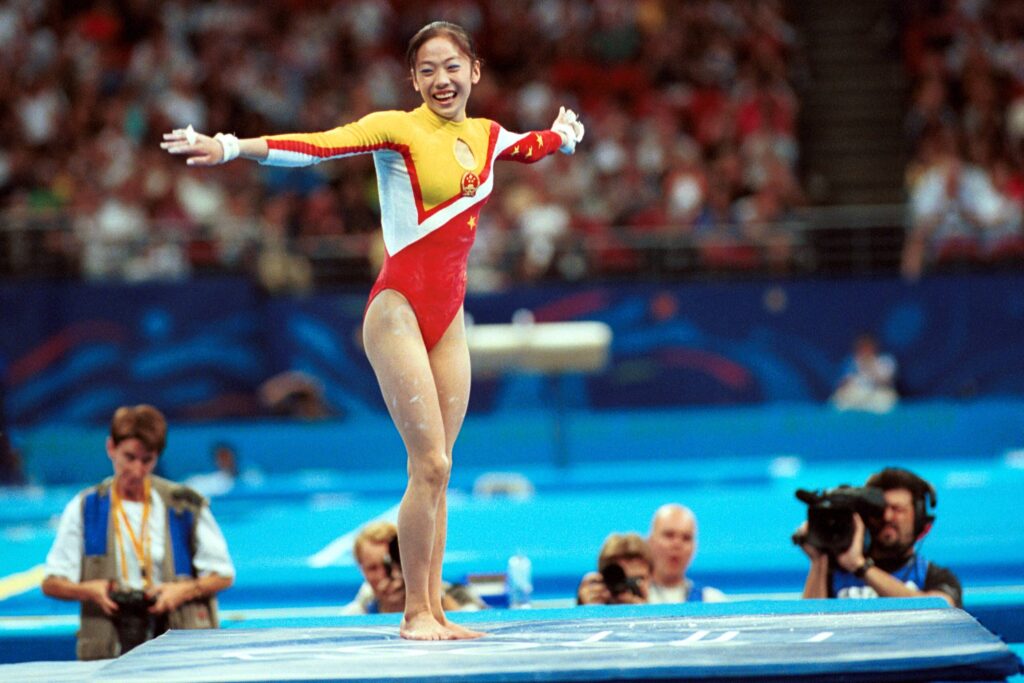
What Was Said
Before the opening of the 2008 Beijing Olympics, journalists and internet sleuths uncovered an October 17, 2000, report by Fu Guoliang, delivered at a Hunan provincial summary meeting after the Sydney Games. In passing, the report referred to Yang Yun’s “actual age”:
Gymnast Li Xiaopeng is 19 this year and will be 23 at the next Olympics—the prime age for a male athlete. Gymnast Ling Jie will still be under 20 in actual age at the next Olympics and has expressed the ambition to follow Liu Xuan’s example and win gold in Athens. Gymnast Yang Yun is just 14 years old in actual age; she made her debut in Sydney, immediately attracted attention, and won a bronze medal—her future is boundless.
体操运动员李小鹏今年19岁,下届奥运会时23岁,正是男运动员的黄金年龄。体操运动员凌洁到下届奥运会实际年龄还没有20岁,她表示要以刘璇为榜样,争取在雅典奥运会上夺得金牌。体操运动员杨云实际年龄才14岁,在悉尼初试身手,就引起体操界的注目并夺得一枚铜牌,前程不可限量。
Depending on her birth month, that remark places Yang Yun’s birth year in either 1985 or 1986. In either case, she would have been underage at the Sydney Olympics.
A June 2007 interview on CCTV reinforced the same timeline. Reflecting on Sydney, Yang said, “At the time, I was only 14. I thought that if I failed this time, I would try again next time. There was still hope.”
That same chronology matched the story of her personal life, as told by the Chinese media. In 2007, Golden Age printed a profile on the gymnastics “power couple.” The piece recounted the early stages of Yang Yun’s relationship with Yang Wei and explicitly noted their age difference:
Both from Hubei, Yang Wei and Yang Yun trained at the same gymnastics center. In that enclosed environment, feelings grew with time—Yang Wei was 20, while Yang Yun was not yet 15…
同为湖北人,杨威与杨云在一个体操中心训练,封闭的环境,日久生情,杨威20岁,而杨云还不满15岁……
Yang Wei’s birth year has been consistently reported as 1980. In this framing, that would place the birth year of his fiancée, Yang Yun, around 1986.
And indeed, a birthdate of March 2, 1986, was widely used across Chinese-language websites in the lead-up to the Beijing Olympics. A Phoenix TV feature on Olympic champion couples, published during the Games, listed her birth year as 1986.
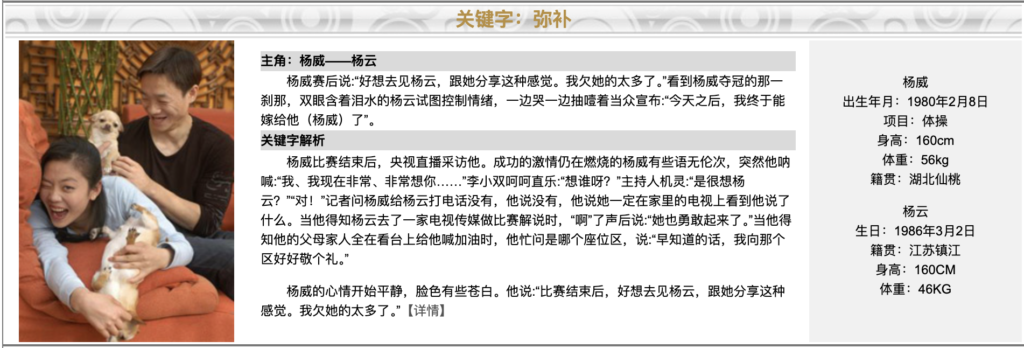
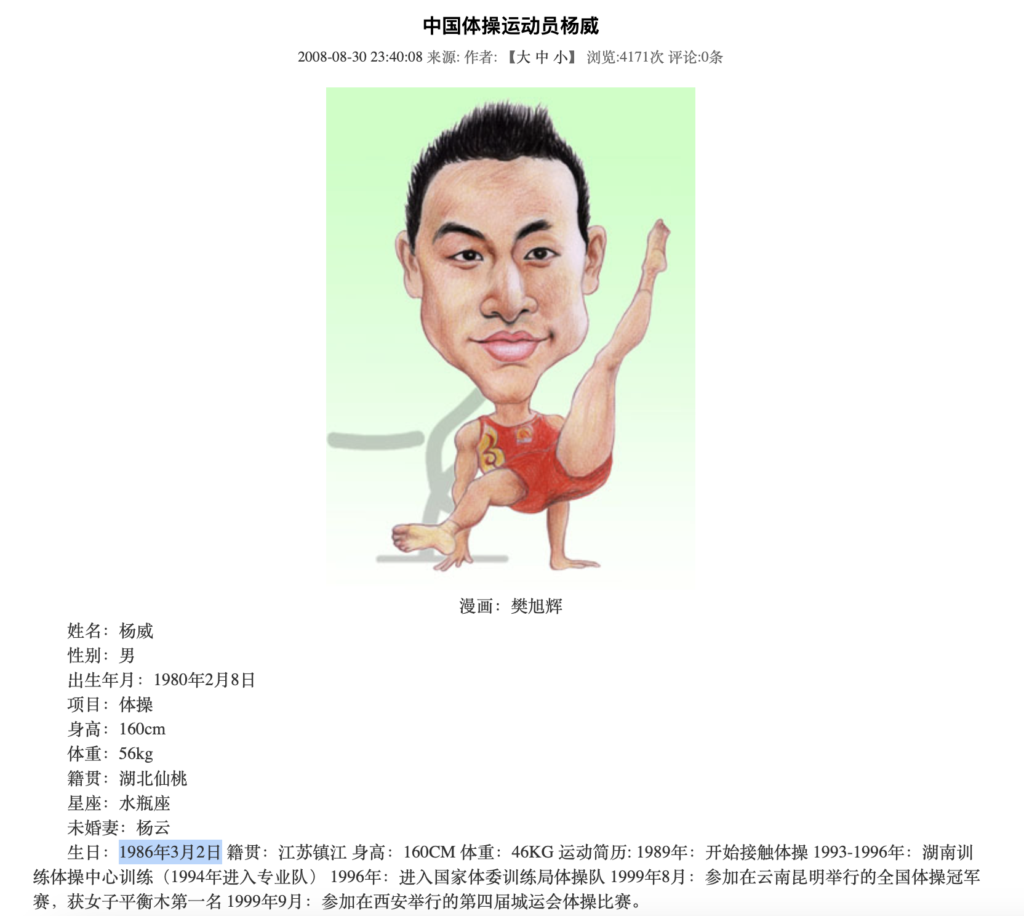
March 2, 1986, appeared everywhere, especially in wedding coverage. It even appeared on a caricature artist’s page.
In retrospect, Yang Yun’s remark on CCTV in 2007 was not an isolated anomaly, but a clear, first-hand account that seemed to corroborate all the evidence online.
The Investigation
In its initial report on the ages of the 2008 Chinese team, The New York Times pointed to Yang Yun in a brief paragraph, suggesting that age manipulation was not an isolated concern, but a documented issue within the Chinese program:
Yang Yun of China won individual and team bronze medals at the 2000 Sydney Olympics and later said in an interview on state-run television that she had been 14 at the time. A Hunan Province sports administration report also said she had been 14 when she competed in Sydney.
“Records Suggest Chinese Gymnasts Might Be Underage,” New York Times, July 27, 2008
The passage followed a warning from FIG official Nellie Kim: If it is true that underage gymnasts are competing, “it’s a bad thing. It should not be acceptable.”
During the Beijing Olympics, most of the focus was on He Kexin, but by the close of the Games, Yang Yun’s statement had taken on new significance. In October 2008, the FIG closed its investigation into the Beijing team, satisfied by the documentary record. It declined, however, to do the same for Yang Yun and her former teammate Dong Fangxiao, stating that “the explanations and evidence provided to date… [were] not satisfactory.” In one of her few statements to the press, Yang said that she had misspoken: “Everyone has misspoken before… On television shows, there are always slips of the tongue.”
The FIG pursued the matter further. After seeking legal advice from the Court of Arbitration for Sport and confirming its jurisdiction despite the passage of time, it referred both cases to its Disciplinary Commission in June 2009.
The outcomes diverged, and the contrast is instructive.
Dong Fangxiao had applied for accreditation at the 2008 Beijing Games using documents listing her birth year as 1986, which would have made her fourteen in Sydney. The same athlete had used different documents to enter Olympic venues in 2000 and 2008, and during her disciplinary commission, she produced a passport with a 1986 birth year.
For the FIG, this was decisive. Her Sydney results were annulled, her 1999 World Championships results voided, and the case was forwarded to the IOC with a recommendation to strip the team’s bronze medal.
Yang Yun’s case was different. The commission relied primarily on her televised statement and lacked evidence of comparable weight. As a result, the commission issued a warning to Yang for her statement.
A warning occupies an uncertain place in the grammar of institutional discipline. It is not a sanction; Yang was not stripped of her individual results. But neither is it an acquittal. The commission’s language was precise: “the concrete and objective evidence available is insufficient to prove that the birth date indicated on the official documents was falsified.” This was a statement about the limits of proof, not a declaration of truth. The FIG did not affirm the documents as genuine; it concluded only that they could not be disproven.
In this sense, the warning functioned as an institutional compromise—a way of acknowledging suspicion without establishing guilt. It allowed the FIG to hold two positions at once: that the evidence was insufficient to prove a violation, yet her statement on TV was unacceptable and warranted a clear caution against any recurrence.
Yang Yun’s case differed from previous cases. In 2002, when Romania’s age scandal broke, Alexandra Marinescu openly confessed that her birthdate had been falsified. Pro Sport published her government-issued documents, revealing discrepancies between her birth certificate and her federation passport. But nothing happened. Romania investigated itself, and no medals were stripped, and no warnings were issued.
Given that precedent, one might assume that a gymnast could admit her actual age publicly and have her actual birthdate printed in the press without repercussions. But for whatever reason—be it racial bias, a decision to crack down on age falsification, or something else—both Yang Yun and Dong Fangxiao faced scrutiny and repercussions that their European counterparts never did.
A “Slip of the Tongue” Reappears
Today, neither the Chinese nor the English web uses Yang Yun’s competitive birthdate. Most sources instead give March 2, 1984—not December 2, 1984, as originally registered with the FIG. In recent interviews, Yang Yun rarely mentions her age, but Chinese state media has. In 2011, Xinhua, the official news agency of the Chinese state, published an exposé on age falsification in gymnastics and admitted that Yang Yun was 14 in Sydney:
At the same time, the International Gymnastics Federation sets a minimum age of 16 for Olympic participation. By that age, many gymnasts have grown taller or gained weight, losing some of their earlier lightness. To get around this, ages are adjusted upward.
This dynamic surfaced in a well-known incident involving Yang Yun. In a 2007 interview with CCTV, she let slip that she had won her Sydney Olympic medal at age 14. She later claimed it was a verbal mistake, but the implication was obvious.
偏偏国际体操联合会规定参加奥运会最低年龄限制在16岁。而16岁时大部分女队员已经出现个子长高或者发胖的迹象,不如以前灵巧了。为此就要将年龄改大。
其实女孩谁不喜欢年轻点呢?因此退役之后,很多队员又都把年龄改回去了,去年轰动一时的董芳霄被查出年龄造假,就是因为改回去时露了马脚。
Then, in 2012—two years after the IOC stripped the Chinese women’s team of its bronze medal—CNTV.com, the online portal of CCTV, retold the love story of Yang Yun and Yang Wei. In that account, Yang Yun was again described as fourteen in Sydney:
How Yang Wei “Won Over” Yang Yun
In 1996, 16-year-old Yang Wei and 10-year-old Yang Yun both entered the national team. It may have been from their very first meeting that Yang Wei began to like the beautiful and innocent girl from Hunan. But the naïve Yang Yun didn’t notice his feelings at all.
Four years later, at the Sydney Olympics, 14-year-old Yang Yun—then the youngest member of the team—competed in her first Olympics. Yang Wei, who had long had feelings for her, began his first “pursuit.” Whether on or off the competition floor, he took special care of the young teammate, showing constant attentiveness. Gradually, they grew closer. After the Olympics, their relationship noticeably warmed—Yang Wei’s first attempt had succeeded.
After Sydney, Yang Yun was hospitalized for appendicitis surgery. One night, long after visiting hours had ended, she lay alone in her hospital bed. Suddenly, Yang Wei appeared—having somehow gotten past the hospital’s restrictions—and brought with him his “secret weapon”: a bouquet of flowers. When he placed them by her bedside, Yang Yun was deeply moved. In just one night, Yang Wei won her heart.
楊威“拐騙少女”兩招得手
96年,16歲的楊威和10歲的楊雲同時進入國家隊,可能就是從他們第一次見面開始,楊威就喜歡上了美麗單純的湖南小姑娘楊雲,不過懵懂的楊雲卻完全沒有感覺到楊威對自己的關注。
四年後的悉尼,14歲的楊雲作為隊中年齡最小的一個參加了自己的首屆奧運會,心裏早有打算的楊威也開始發動對小師妹的第一輪“追擊波”。不論是場上場下,楊威都對第一次參加大賽的小妹妹格外照顧,可以説是體貼入微。兩人因此逐漸熟悉起來。奧運會結束後,兩人關係明顯升溫,楊威的第一次出手“得逞”了。
悉尼奧運會之後,楊雲因為闌尾炎做手術住進了醫院。夜深了,已經過了醫院的探視時間,楊雲一個人孤零零地躺在病床上。正在這個時候,楊威竟然突破了醫院的重重防線,從天而降,同時還帶來了“殺手锏”,一束鮮花。當鮮花放上楊雲的床頭,楊雲被徹底感動了。楊威只用了一個晚上的時間,就讓楊雲喜歡上了自己。
That page has remained online, uncorrected, for over a decade. Even after everything that transpired, China’s state media was not aware that Yang Yun was supposed to be 16 in Sydney.
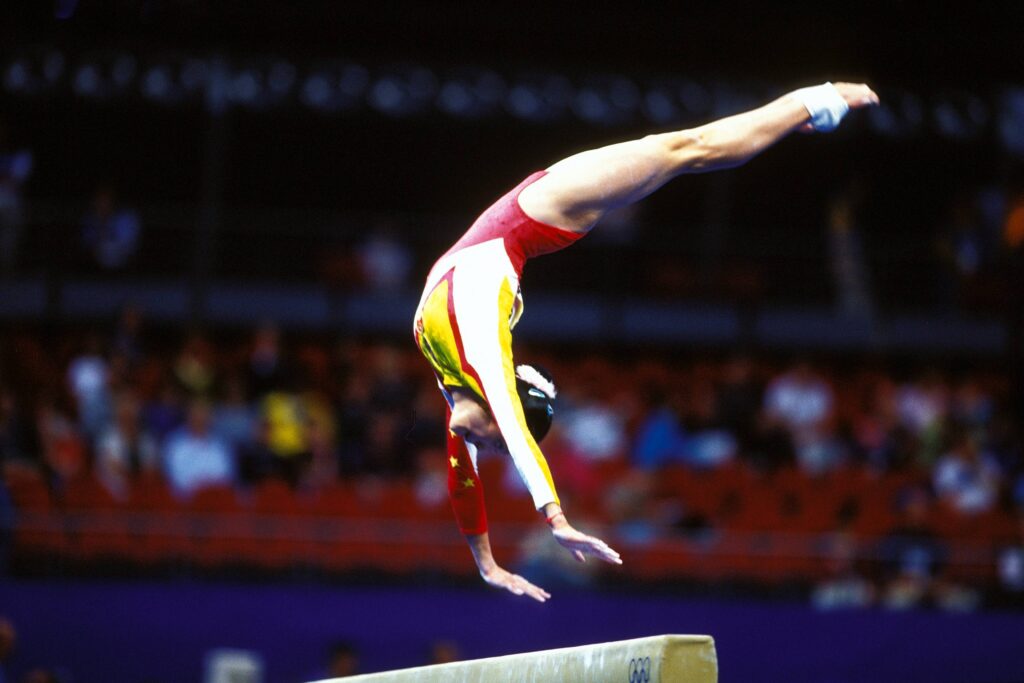
Appendix A: A 2001 Profile
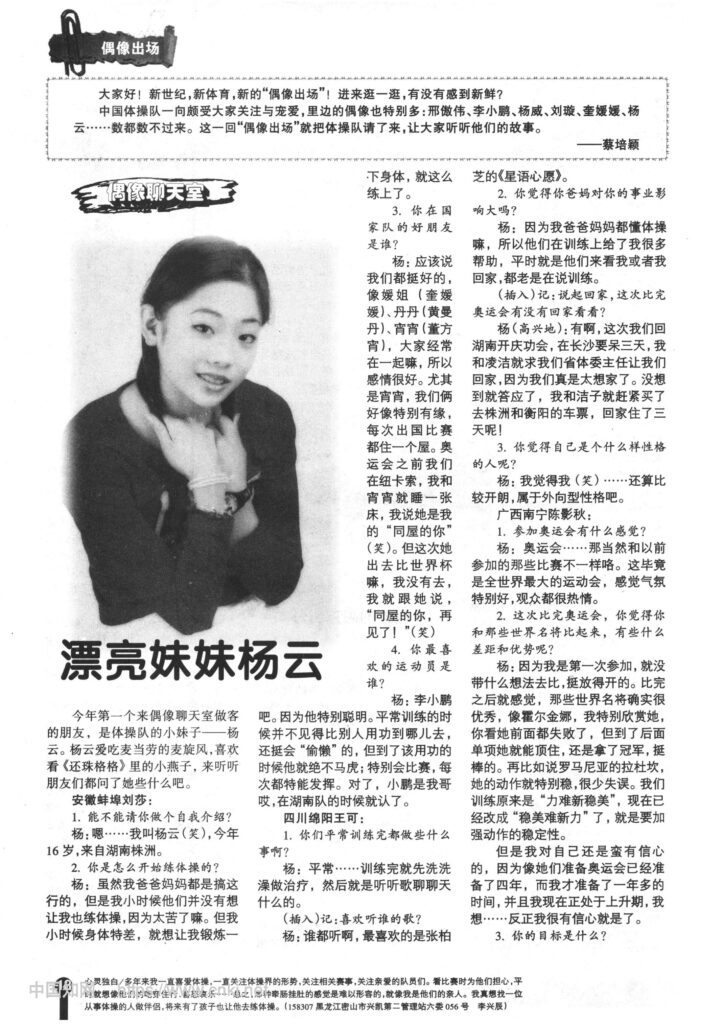
Hello everyone! A new century, a new New Sport, new “idol appearances”! Come on in and browse — does it feel fresh? The Chinese gymnastics team has always enjoyed tremendous attention and affection from the public, and it has no shortage of idols: Xing Aowei, Li Xiaopeng, Yang Wei, Liu Xuan, Kui Yuanyuan, Yang Yun… too many to count. This edition of “Idol Appearances” has invited the gymnastics team, so let’s hear their stories.
— Cai Peiying
––
Idol Chat Room
Pretty Little Sister Yang Yun
The first guest to visit the Idol Chat Room this year is the gymnastics team’s youngest girl, Yang Yun. Yang Yun loves McDonald’s McFlurries, and her favorite character from the TV drama My Fair Princess is Xiao Yanzi. Come and read what her fans asked her.
Liu Sha, Bengbu, Anhui: 1. Could you introduce yourself?
Yang: Um… my name is Yang Yun (laughs), I’m 16 years old, and I’m from Zhuzhou, Hunan.
2. How did you start doing gymnastics?
Yang: Although both my parents work in this field, they never actually intended for me to practice gymnastics when I was little — it’s just too hard. But I was in very poor health as a child, so they wanted me to build up my body, and that’s how I ended up training.
3. Who are your closest friends on the national team?
Yang: I’d say we all get along really well. There’s Yuan-jie [Kui Yuanyuan], Dandan [Huang Mandan], Xiaoxiao [Dong Fangxiao] — we spend a lot of time together, so we’re very close. Xiaoxiao and I especially seem to have a special bond; every time we go abroad for competitions, we share a room. Before the Olympics, we were in Newcastle, and Xiaoxiao and I even slept in the same bed — I told her she was my “roommate of yours” (laughs). But this time she went off to the World Cup, and I didn’t go, so I said to her, “Roommate of mine, goodbye!” (laughs)
4. Which athlete do you admire most?
Yang: Li Xiaopeng, I’d say, because he’s exceptionally smart. In regular training, he doesn’t necessarily seem to work any harder than anyone else — he’s quite good at “slacking off” — but when it matters, he never cuts corners. He’s a brilliant competitor; he always delivers when it counts. Oh, and Xiaopeng is my big brother — we became like siblings back when we were both on the Hunan provincial team.
Wang Ke, Mianyang, Sichuan: 1. What do you all do after training?
Yang: Usually, after training, we shower first and get treatment, then it’s just listening to music and chatting and things like that.
(Interjection) Reporter: Whose music do you like listening to?
Yang: All kinds, really. My favorite is Zhang Baizhi’s Xingyu Xinyuan [Star Wishes].
2. Do you feel your parents have had a big influence on your career?
Yang: Because both my parents understand gymnastics, they’ve given me a great deal of help with my training. Whenever they come to see me, or I go home, training is always what we end up talking about.
(Interjection) Reporter: Speaking of going home, did you manage to visit home after the Olympics?
Yang (delightedly): Yes! This time we went back to Hunan for a victory celebration — we were supposed to stay in Changsha for three days. Lingjie and I begged the head of our provincial sports commission to let us go home because we were desperately homesick. We never expected him to agree, but he did, so Jie and I quickly bought tickets to Zhuzhou and Hengyang and went home for three days!
3. How would you describe your own personality?
Yang: I think I’m (laughs)… reasonably outgoing — more of an extrovert, I’d say.
Chen Yingqiu, Nanning, Guangxi: 1. What was it like participating in the Olympics?
Yang: The Olympics were, of course, completely different from any competition I’d been to before. After all, it’s the biggest sporting event in the world — the atmosphere was extraordinary, and the spectators were incredibly enthusiastic.
2. Now that the Olympics are over, how do you think you compare to the world’s top gymnasts — where do you fall short, and where do you have an edge?
Yang: Because it was my first time competing, I went in without any particular expectations and felt quite relaxed about it. Afterward, I came away feeling that the world’s top gymnasts are truly outstanding. Take Khorkina — I really admire her. You saw how she stumbled earlier in the competition, but she held on through the individual events and still won gold. Impressive. And then there’s Romania’s Răducanu — her technique is exceptionally consistent, with very few errors. Our training priority used to be ordered as “power, difficulty, innovation, consistency, artistry,” but it’s now been changed to “consistency, artistry, difficulty, innovation, power” — meaning we need to strengthen the stability of our execution.
But I still have plenty of confidence in myself, because gymnasts like them had four years to prepare for the Olympics, while I only had just over a year. And right now I’m still in an ascending phase, so I think… anyway, I’m very confident.
3. What is your goal?
Yang: To win the all-around world championship. My vault is relatively strong compared to others on the team, and my uneven bars and balance beam are also fairly good, so I think I have a real chance. (laughs)
(Interjection) Reporter: Have the new rules come out yet?
Yang: We’re still in the recovery training phase right now, so I don’t know the new rules very well yet. I’ll just take it step by step — once the new rules are in effect, I’ll need to raise my difficulty level.
Idol Profile: Yang Yun
Birthday: December 2, 1984
Blood type: O
Star sign: Sagittarius
Favorite people: Coach Lu (Shanzhen), Coach Liu (Qunlin)
Favorite colors: Pink, sky blue
Favorite dish: Stir-fried pork with chili peppers
Favorite animal: Puppy
Favorite cartoon character: Hello Kitty
Favorite song: Star Wishes
Greatest dream: To win an Olympic gold medal
New Sport, January 15, 2001, 漂亮妹妹杨云
Appendix B: The Official Text of the FIG’s Press Release
Lausanne (SUI) FIG Office, February 27, 2010: The FIG Executive Committee has ruled in the case involving two Chinese gymnasts suspected of having falsified their dates of birth for the Olympic Games in Sydney (AUS) in 2000, putting an end to the proceedings.
In the case of Dong Fangxiao, the Executive Committee constituted that there was a violation to the FIG Statutes and Regulations. Consequently, the results obtained by Dong Fangxiao at the 2000 Sydney Olympic Games have been cancelled. The FIG Executive Committee decision was forwarded to the IOC Executive Board with the recommendation to withdraw the Bronze medal obtained by the Chinese Team, including the results of Dong Fangxiao in Sydney. In addition, the FIG Executive Committee pronounced the cancellation of all results obtained by Dong Fangxiao at the 34th Artistic Gymnastics World Championships 1999 in Tianjin (CHN), of all results obtained at the FIG World Cup Series 1999 – 2000 and at the Artistic Gymnastics 2000 World Cup Final in Glasgow (GBR) The costs of the disciplinary procedure are awarded to the Chinese Gymnastics Association.
The Committee decided that in the case of Yang Yun the concrete and objective evidence available is insufficient to prove that the birth date indicated on the official documents was falsified. Ms. Yang Yun is awarded with a warning for the declaration she made during the interview with CCTV5. The only mention of age in this case was on a television interview. The costs of the disciplinary procedure are awarded to the Chinese Gymnastics Association.
Considering the case of the Chinese Gymnastics Association, the FIG Executive Committee has decided to award the costs of all three proceedings of the Disciplinary Commission, for not having adequately controlled the birth dates of the gymnasts.
The decisions made by the FIG Executive Committee are final and effective immediately.
Case summary of Dong Fangxiao
The International Gymnastics Federation (FIG) was confronted with two cases of presumed violation of the age limit for participation in the 2000 Sydney Olympic Games. Qualification rules for the 2000 Sydney Olympic Games required that an athlete be a minimum of 16 years old in the year of the Olympic Games.
Ms Dong Fangxiao, competing for the Chinese Gymnastics Association (NF) from 1997 to 2001, participated in the 2000 Sydney Olympic Games and won a team Bronze medal. The gymnast was registered with the IOC, the FIG and her NF based on identification indicating a January 20, 1983 date of birth, implying therewith that she would have been 17 years old during the Sydney Olympics.
At the Beijing Olympic Games of 2008, the FIG discovered that the gymnast was accredited to act as Secretary at vault, for which she officially declared her birth date as January 23, 1986.
This birth date implies that she would have been 14 years old during the Sydney Olympic Games.
Case summary of Yang Yun
Formerly competing for the Chinese Gymnastics Association (NF), Ms YANG Yun participated in the 2000 Sydney Olympic Games where she won a team Bronze medal and a Bronze medal at the Uneven Bars.
The gymnast was registered with the IOC, the FIG, and her NF based on identification indicating a December 2, 1984 date of birth, implying therewith that she would have been 16 years old during the Sydney Olympics.
Before, during and after the Olympic Games of Beijing 2008, the media discovered an interview on CCTV5 where the gymnast admitted that she was 14 years old when she took part in the Sydney Olympics. The television report was the starting point for a FIG investigation and the launch of a legal process.
The process
Following these declarations, the FIG launched an investigation in October of 2008. Legal advice from the Court of Arbitration for Sport (CAS) in Lausanne confirmed the FIG as the competent authority to investigate the case and draw its own conclusions as to whether the age limit had been violated, and which subsequent sanctions should be issued. On June 20 2009, The FIG Executive voted to mandate the Disciplinary Commission to investigate and adjudicate the case involving the two gymnasts. On December 19 and 20, the Commission held a hearing at FIG headquarters in Lausanne, and submitted its findings and conclusions to the FIG Executive Committee.
The President stands firm
FIG President Prof. Bruno Grandi (ITA) has been a strong advocate of healthy age in gymnastics. The President does not waiver. He rigorously maintains that “young gymnasts cannot be manipulated. Athletes must be protected. To prevent such fraud in the future, a new licensing system has been implemented by the FIG.”
More on Age