In 2011, in the wake of Dong Fangxiao’s verdict and amid a skating age scandal, Chinese journalists wrote openly about the problem of age falsification in sport. Even the China Youth Daily addressed the issue, underscoring just how messy age adjustments could be:
In Chinese sport, athletes falsifying their ages has long been an open secret. This reporter has frequently encountered a revealing phenomenon when interviewing athletes: ask them how old they are, and they often have to think for a long time, sometimes even consulting teammates before answering — because some athletes have changed their ages not once but multiple times, and have lost track of their own versions.
Ci Xin, China Youth Daily, February 18, 2011, p. 8
在中国体坛,运动员改年龄早已是公开的秘密,记者在采访不少运动员时就常常遇到一个奇怪的现象,当问及这些运动员的年龄时,他们往往要思考半天,甚至要与自己的队友讨论一番,因为有的运动员不仅改了年龄,还改了不止一次,年龄改来改去,连自己都糊涂了。
The China Youth Daily is the official newspaper of the Central Committee of the Communist Youth League of China.
Though the article did not mention Jiang Yuyuan, her case illustrates the phenomenon clearly. Depending on the document consulted, she appears to have been born in 1993, 1992, or 1991.
1993: The National Identification Card Number
In U.S. coverage of the 2008 Olympics, attention centered primarily on He Kexin, but media outlets did uncover one piece of evidence suggesting that Jiang Yuyuan might have been underage in Beijing. As reported by the New York Times, her national identification number indicated a birthdate of October 1, 1993:
A different birth date, indicating Jiang is not yet 15, appears on a list of junior competitors from the Zhejiang Province sports administration. The list of athletes includes national identification card numbers into which birth dates are embedded. Jiang’s national card number as it appears on this list shows her birth date as Oct. 1, 1993, which indicates that she will turn 15 in the fall, and would thus be ineligible to compete in the Beijing Games.
“Records Say Chinese Gymnasts May Be Under Age,” NYTimes, July 27, 2008
At the time, U.S. reporting was focused on establishing potential ineligibility, and did not note that Jiang herself had used a different birthdate in domestic media.
1992: According to Jiang Yuyuan
At the Group A gymnastics competition in 2006, Jiang Yuyuan spoke with reporters, and she told them that she was born in 1992:
Jiang Yuyuan — Zhejiang Gymnastics’ New Hope
Zhejiang Online, October 17, 2006
At last night’s Group A gymnastics competition held at Jiaojiang District Gymnasium, 14-year-old Jiang Yuyuan became the center of attention. Representing Wenzhou, she was already a member of the Chinese national women’s gymnastics team. Although she made an unexpected mistake on the uneven bars and finished third in that event, she still comfortably won first place in vault, floor exercise, and balance beam, demonstrating her all-around strength and strong mental resilience. These are precisely the qualities admired by Zhejiang team head coach, Wang Yingshi, who is very optimistic about her chances of representing China at the Beijing Olympics.A lively and spirited young girl
Wearing a red competition leotard and possessing a notably petite frame, Jiang already displayed superior confidence and ability during warm-ups, immediately attempting the highest-difficulty routines. Across all events, her routines carried some of the highest difficulty levels, and her execution appeared more precise, decisive, and fluid. Even minor wobbles did not affect her high scores.
Only on the uneven bars did she encounter trouble: while transitioning from the low bar to the high bar, she failed to catch the bar and fell. However, she quickly remounted and completed the remainder of her routine with high quality.
After the competition, Jiang shed her serious and quiet demeanor from the floor and revealed a lively, cheerful, and even mischievous personality. She told reporters that she was born in 1992 in Liuzhou, Jiangxi, and began gymnastics training at three and a half years old. At age eight, she was selected by the Zhejiang gymnastics team and moved to Hangzhou, where her talent quickly became evident. By the end of 2003, she had been selected for the national team.
When asked about her performance, she replied modestly, “Not great—just average.” Speaking about her uneven bars mistake, she stuck out her tongue and explained, “My foot got caught on the low bar.”
Coach Wang’s full confidence
At the venue, Zhejiang head coach Wang Yingshi did not hide his expectations: “In two years, we’re counting on her to revive the glory Zhejiang women’s gymnastics had 20 years ago.”
“We discovered her in Guangxi in 2001,” Wang explained. “After two years of systematic training, she entered the national training squad under coach Xiong Jingbin, who previously trained Olympic champion Lu Li. Over the past two-plus years, she has improved rapidly and now has the ability to serve as a key athlete in major international competitions.”
Jiang had not yet competed internationally, Wang noted—not due to lack of ability, but because of age. In fact, her age was seen as a major advantage for the 2008 Olympics:
“International competitions require female gymnasts to be at least 16 years old. She is only 14 this year, yet already quite mature. By the time of the 2008 Olympics, she will just reach the eligible age—and 16 is also the golden age for Chinese female gymnasts.”
Wang added: “She has unique advantages for the Olympics. Beyond her physique and personality, her technical profile is especially well-suited. Her greatest strength is her all-around ability combined with standout events—she is strong across the board, with particular excellence on floor exercise and balance beam.”
Archived here.
江钰源——浙江体操新希望
在昨晚的椒江区体育馆举行的男女甲组体操比赛中,14岁的小女孩江钰源成了全场的焦点。这位温州代表队的女子体操选手,已是国家女子体操队正式队员。昨晚,她虽然在高低杠比赛中出现了意外失误屈居第三,却还是轻松地获得了除此以外的跳马、自由体操、平衡木三项第一,体现了全面的实力和良好的心理调整能力。而这两方面正是浙江体操队总教练汪瀛士所欣赏的,他对江钰源代表中国亮相北京奥运会的前景十分乐观。
小女孩古灵精怪
昨天,一身红色比赛服、身材特别娇小的江钰源,在赛前适应场地时就显露出高人一筹的实力与自信,一上来就是最高难度的比赛动作。在各项比赛中,她的动作难度几乎都是最高的,而技术动作也显得更加规范、果断、流畅,即使出现了一些小小的摇晃也没有影响她得到高分。只有在高低杠比赛中,她在做从低杠上高杠的高难度动作中未能抓住高杠,跌了下来。但是她马上再度上杠,高质量地完成了剩下的动作。
赛后,江钰源一改场上的沉默和严肃,展现了活泼、开朗甚至古灵精怪的另一面。江钰源告诉记者,1992年她出生于江西柳州,3岁半就开始体操训练,8岁被浙江体操队看中来到了杭州。从此她开始充分展示出她的体操天赋,并于2003年底被选入国家体操队。被问及今天的发挥时,她回答:“不怎么样,一般般吧!”说到高低杠比赛的那次失误,她吐了吐舌头,解释说:“脚被低杠勾住了。”
汪教头信心十足
在现场,浙江体操队总教练汪瀛士毫不掩饰对江钰源的期待:“两年后,我们寄希望于她,重现浙江女子体操20年前的辉煌。”
“我们是2001年在广西发现她的。”汪瀛士介绍说,“经过两年系统训练,江钰源进入国家集训队,师从曾经培养出奥运冠军陆莉的熊景斌教练。两年多来,她进步神速,已经具备了担当国际大赛主力队员的实力。”
江钰源目前还没有参加过国际大赛,汪瀛士解释说,原因不在于实力而在于年龄,而年龄也是她参加北京奥运会的巨大优势。“国际体操大赛对女选手的年龄限制是至少16岁,而今年她才14岁,已经相当成熟。到2008年奥运会的时候,她恰好到达能够参加国际大赛的年龄,而16岁也是中国体操女选手的黄金年龄。”
“参加奥运会,江钰源有自己的独特优势。”汪瀛士透露,“江钰源除了身材和性格特长以外,技术特点也非常适合代表中国参加奥运会。她最大的技术优势在于全面而且有单项优势,她的各项能力都具备很高水准,而自由体操和平衡木尤其突出。”
The sentence construction is telling. The local newspaper could have simply stated that she was born in 1992. Instead, it specifies that “she told reporters” she was born in 1992. That distinction matters: the article is not presenting the date as an uncontested fact, but as a claim attributed to Jiang herself. In doing so, it subtly distances the publication from the assertion, suggesting that other understandings of her age may have existed locally.
The article’s afterlife makes this even more significant. It was later republished on the website of China Central Television. In other words, 1992 was not merely a date circulated among the provincial media; it was elevated to the national stage, effectively endorsed through circulation by the state broadcaster. The result is a layered record: a birthdate framed as the athlete’s own statement, then amplified as an authoritative version at the national level.
By the lead-up to the Beijing Olympics, this 1992 birthdate appears to have been widely circulated in the media. For instance, Hong Kong’s Apple Daily described Jiang as 15 years old in January 2008, consistent with a 1992 birthdate.
Women’s Gymnastics Returns to the Top
Apple Daily — January 31, 2008Since the 2000 Sydney Olympics, when “beauty queen” Liu Xuan won gold on the balance beam, no Chinese women’s gymnast has stood atop the Olympic podium. At these Games, with China enjoying home advantage, as long as Cheng Fei performs steadily, the vault gold should be well within reach. But can the women’s team add a second—or even a third—gold medal?
Jiang Yuyuan Emerges as a New Champion
Like Cheng Fei, Li Shanshan—also from Huangshi, Hubei—has risen rapidly in recent years. Li, who only turns 16 on February 22 this year, was once rejected by the Hubei, Zhejiang, and Guangxi provincial teams. It was not until 2002 that she was “taken in” by the Guangdong team. In 2006, she won the national balance beam title, and at the 2007 World Championships in Stuttgart, she stunned the crowd in the beam final with a routine carrying a 7.3 difficulty score.
Given the overall strength of the Chinese women’s team, which includes experienced veterans such as Cheng Fei and Zhang Nan alongside rising talents like Li Shanshan and Jiang Yuyuan, the chances of winning gold are high. As for their rivals, the United States—led by Shawn Johnson—defeated China at the recent World Championships and is naturally a favorite for gold, while Romania, though in a transitional period, could still pose a threat.
As Cheng Fei has chosen to focus on individual apparatus and has withdrawn from the all-around, the spot will likely be filled by 15-year-old Jiang Yuyuan from Liuzhou. Known in the domestic media as the “porcelain doll” for her sweet smile, Jiang competed on vault, uneven bars, and floor exercise in the World Championships team event, delivering consistently solid performances. In addition, she won the all-around title at the “Good Luck Beijing 2007 International Gymnastics Invitational” last November. Even against the world’s best at the Beijing Olympics, she is not without a chance of winning a medal.
Other Chinese Medal Hopes
Apple Daily — January 31, 2008
- Athlete: Li Shanshan
Event: Balance Beam
Gold Medal Chances: ★★★★- Athlete: Jiang Yuyuan
Event: All-Around
Gold Medal Chances: ★★
(Five stars is the maximum)
Archived here
女子體操重上高台
自00年悉尼奧運,「璇美人」劉璇在平衡木奪金後,之後再沒有中國女子體操選手,能站上奧運頒獎台最高位置;今屆中國擁主場之利,程菲只要有穩定發揮,跳馬金牌相信手到拿來,但女隊能否再添第2、甚至第3金呢?
江鈺源出爐冠軍
與程菲同樣生於湖北黃石的李珊珊,是中國女隊近年冒起甚快的隊員。今年2月22日才滿16歲的李珊珊,曾被湖北、浙江及廣西省隊放棄;直至02年獲廣東隊「收留」,06年贏得了平衡木全國賽冠軍,07年出戰9月斯圖加特世錦賽,在平衡木決賽以一套難度系數7.3的動作,震驚全場。
當然以中國女隊平均實力,既有程菲、張楠等經驗豐富的「老將」,亦有李珊珊、江鈺源等後起之秀,奪金機會亦高;對手方面,由莎恩莊遜領軍的美國,剛於世錦賽擊敗中國,自然是爭金大熱,羅馬尼亞處於交接期,亦可能給予威脅。
由於程菲專心單項,已宣佈退出個人全能項目,留下位置應由15歲的柳州姑娘江鈺源頂上;江鈺源憑可愛的笑容,被國內傳媒封為「瓷娃娃」,她在世錦賽女團比賽中,出戰跳馬、高低槓及自由體操3個項目,表現亦十分穩定;加上上年11月在「好運北京07年國際體操邀請賽」奪得全能冠軍,在京奧遇上世界強敵,也不是完全沒有奪牌機會。
中國女隊其他爭金希望
選手:李珊珊
項目:平衡木
奪金機會:★★★★
選手:江鈺源
項目:個人全能
奪金機會:★★
以5★為最高
1991: The Date on Her Passport
According to her government-issued passport, however, Jiang Yuyuan was born on November 1, 1991, which would have made her 16 in January 2008, turning 17 after the Games.
The other gymnast, Jiang, is listed on her passport—issued March 2, 2006—as having been born on Nov. 1, 1991, which would make her 16.
“Records suggest Chinese gymnasts might be underage,” New York Times, July 27, 2008
This creates a conflicting timeline: as of March 2006, her passport listed 1991, yet just seven months later, in October 2006, she told reporters she was born in 1992. Either she was unaware of the discrepancy, or—echoing the phrasing from the China Youth Daily—she may simply have “lost track” of which birthdate she was supposed to use.
In October 2008, after reviewing additional documents, the FIG determined that China’s team in Beijing was of age. Reportedly, Jiang Yuyuan’s family went to extraordinary lengths to prove her age:
American media made much of the ages of Jiang Yuyuan, He Kexin, and Yang Yilin, arguing that their real ages fell below the minimum standard for Olympic participation. In fact, Jiang Yuyuan was born on November 1, 1991 — fully meeting the eligibility requirements — and her identity card and passport both bear this date, placing her nearly seventeen years old. Nevertheless, to dispel the doubts of certain parties, Jiang Yuyuan’s father, Jiang Tao, spent many busy days tracking down documentation: going to the public security bureau to retrieve the original household registration records from her birth, and going to the hospital to locate the original records from his wife’s admission and delivery. Since computers were not yet widespread in 1991 and archival management was less standardized, Jiang Tao went to considerable effort to gather the relevant materials before submitting them to the appropriate authorities.
Guangxi News Network – Nanguo Morning Post, August 10, 2008
美国媒体在江钰源、何可欣与杨伊琳的年龄上大作文章,认为她们的实际年龄不够参加奥运会最低标准。其实,江钰源出生于1991年11月1日,完全符合参赛标准,而且江钰源的身份证和护照上写的也是这个日期,已经接近17岁。不过,为了打消某些人的怀疑,江钰钰的父亲江涛忙碌了很多天,又是去公安部门翻查出生上户口时的原始登记材料,又是去医院查找江钰源妈妈当年住院生产的原始资料。由于1991年电脑还不普及,档案管理也不够规范,江涛费了很大的劲才找齐相关资料,并送交有关部门。
Nevertheless, some suspected that those documents had been altered. Here’s what Life Daily (生活报) had to say in 2008:
Before the Beijing Games, He Kexin and Yang Yilin were both accused by foreign media of being under the FIG-required age of 16. In response, the Chinese gymnastics team produced birth certificates, household registration documents, identity cards, and passports to demonstrate that every member of the team met the age standard — but suspicion remained that all of these documents had been altered.
February 20, 2011
在北京奥运会前,何可欣和杨伊琳就被外国媒体指责未到国际体联规定的16岁。对此,中国体操队以出生证明、户口簿、身份证、护照来证明中国体操队所有人的年龄都达到标准,但是被怀疑这些资料都做了修改。
What makes the Life Daily passage especially revealing is that this critique comes from within China rather than from foreign skeptics. A Chinese newspaper was openly stating that, even after authorities produced the full suite of official records—birth certificates, household registrations, identity cards, and passports—many still suspected those materials had been revised. That framing matters because it shifts the controversy from a dispute driven solely by outside accusation to a deeper domestic recognition of credibility problems. Even the most authoritative state documents were treated as contestable evidence, including by voices inside China itself.
As we’ll see in our next article, Jiang Yuyuan was not the only Chinese gymnast to have three different ages on the record.
Appendix: Jiang Yuyuan’s Sports Illustrated profile
“Yuan — Ineffably Wonderful”
Jiang Yuyuan — born 1991.11.01, from Liuzhou, Guangxi. Height: 1.40m, weight: 32kg.
Achievements: Runner-up in the women’s team event at the 2006 Stuttgart World Championships; champion on uneven bars and floor exercise at the 2007 World Cup, Shanghai leg.
Characteristics: Small in stature, her movements are light and beautiful. A power-type athlete with well-rounded ability across all events. Her beam difficulty rating is the highest in the world, having already reached 7.1. On vault, she also commands the highest-difficulty Yurchenko: an Amanar.
Olympics Special Correspondent: Hu Jinyi.
Photography: Zhang Wening.
Sixteen-year-old Jiang Yuyuan says she will “never forget for the rest of her life the day she entered the national team.” That was 3 February 2004. The weather was a little cold, the wind a little strong. She and some newly made friends took the shuttle bus from the entrance of the General Administration’s Tiantan apartment complex to the training hall — but on the way back, she got inexplicably lost.
“It took me a very long time to find my way back to the dormitory. At the time, I just felt the General Administration training complex was enormous. In the compound, I saw many people I had only ever seen on television, and gymnastics moves I had only ever seen on TV.” This was the first impression the place — known in foreign media as the “cradle of champions” — left on the little girl who was then just 1.27 metres tall. After China’s dismal showing at the 2004 Olympics, the national gymnastics team resolved to start afresh, pinning their hopes on the selection of 300 new athletes from across the country by year’s end — Jiang Yuyuan among them. Chinese women’s gymnastics head coach Lu Shanzhen acknowledged that Jiang’s “spark” made her “impossible to forget.”
Yet in Jiang Yuyuan’s own telling, that spark for gymnastics first appeared in the guise of rejection — at least during the phase when, at age four, her parents took her to enroll at the Liuzhou Municipal Sports School. Her most vivid initial impression of gymnastics was: “Stretching the legs, pressing the knees — it hurt!” But because she was well-behaved and sensible, her most extreme form of protest was simply to come home and make a fuss. By the time the next day’s training came around, “she was obedient again,” her father Jiang Tao recalls.
At the 1996 Olympics, the gymnastics broadcast on television captivated Jiang Yuyuan. “It would be wonderful if I could compete at the Olympics too.” Many years later, when asked why she harboured an ambition that surpassed that of her peers, she replied simply: “Anyone who does sport thinks about it.” At the age of five, she had already defined herself as someone who “does sport.”
But her Olympic dream nearly collapsed two years later. In 1998, after a year of training at the Guangxi Autonomous Region Sports School, Jiang Yuyuan was selected for the Guangxi Provincial Sports Work Brigade — only for the coaching staff to decide, after a month’s intensive training, that her physical qualities were not yet up to standard, and to send her back to the district sports school.
Devastated, her father, Jiang Tao, and his wife, Ou Fengzhen, began contemplating her future, and at one point considered having her quit gymnastics and return to Liuzhou to continue her schooling. But under the repeated persuasion of Jiang Yuyuan’s first coach, Yang Guoxiu, Jiang Tao reluctantly agreed to let his daughter stay on and keep waiting for an opportunity.
As it turned out, that wait stretched to two years. For Jiang Yuyuan, still too young to fully understand her situation, it registered only as the comings and goings of the friends around her. But for her parents, Jiang Tao and Ou Fengzhen, it was a source of deep anguish — their daughter’s uncertain future was a constant worry. Whenever they had time, they would make the journey from Nanning to Liuzhou to visit Jiang Yuyuan, to ask her coaches about her training, and to seek out any news from the Provincial Sports Work Brigade.
In the autumn of 1999, Zhejiang’s Wenzhou — which had secured the right to host the 2002 Provincial Games — sent scouts across the country to recruit athletes. Xie Yizhong, principal of the Wenzhou Municipal Sports School, and the Zhejiang provincial gymnastics coach travelled to Guangxi to scout talent. The moment they saw Jiang Yuyuan, they were captivated, sensing she had the potential to contend for gold at the Provincial Games. At the time, Jiang Yuyuan’s coach, Deng Lan, could see no prospect of her returning to the Autonomous Region Sports Work Brigade any time soon, and Wenzhou was able to offer considerably better training conditions. And so he, too, encouraged the child to go to Wenzhou — “it will be good for her.” The distance from Nanning to Hangzhou is 1,863 kilometres. Could an eight-year-old child bear it? Faced with a choice between returning to Liuzhou and going to train in Zhejiang, she chose to leave home.
In the spring of 2000, having completed the necessary paperwork, Jiang Yuyuan arrived in Hangzhou alone. Though she shed many tears along the way, seeing West Lake for the first time, the little girl’s spirits lifted again. Registered officially under Wenzhou, once she arrived in Zhejiang, she went directly into the provincial team to begin training. The provincial coaches gave Jiang Yuyuan special individual attention, adding extra sessions on weekends. Two years later, she lived up to expectations and won a gold medal for Wenzhou at the Provincial Games.
Zhu Yibin, the Zhejiang provincial team coach who began training Jiang Yuyuan in 2002, spared no effort on her. “Yuanyuan’s mind is exceptionally quick. I might be coaching three to five children at the same time, all learning the same move together — she would always learn it faster than the other athletes. But this child was also famously prone to slacking off. For instance, if you told her to do twenty-five hanging leg raises, if you didn’t keep a close eye on her, she would definitely do fewer.” So when the time came to send Jiang Yuyuan to the national team, Zhu Yibin gave her a particular warning: “The national team is no place for slacking off. Whether you make it to the Olympics is entirely up to you.”
It is hard for many people to imagine that Jiang Yuyuan — who now commands the highest-difficulty vault in women’s gymnastics, the Tsukahara back handspring with straight-body 900-degree twist — had vault as her weakest event when she first entered the national team. Back then, when she watched Cheng Fei complete the Yurchenko with a 720-degree twist in training, her reaction was nothing but open-mouthed astonishment and pure admiration. “At the time, I especially admired Elder Sister Cheng’s legs. I thought she was just incredible.”
Two years later, Cheng Fei’s twists had increased to 900 degrees, and the Chinese women’s team achieved a dream that had gone unfulfilled for 53 years, winning the world team title in Denmark. Meanwhile, Jiang Yuyuan completed a 5.8-difficulty 720-degree twist in a domestic competition — the point at which she formally began training this element.
Cheng Fei had asked her parents to buy her a telescope so she could watch the stars every night; Jiang Yuyuan had treated herself to a camera and went everywhere photographing scenery. Cheng Fei had an HP mobile phone that Jiang Yuyuan was particularly fond of. The two of them were always finding things to talk about. Besides both being athletes, they were both sports fans — though Cheng Fei supported Italian football, while Jiang Yuyuan was a devoted fan of Liu Xiang.
Although at the Stuttgart World Championships the Chinese women’s gymnastics team won only a silver medal, failing to repeat their previous glory, Jiang Yuyuan performed solidly in every event she entered without making a single error. At the subsequent Good Luck Beijing gymnastics test event, she went further and won the gold medal in the women’s all-around. Afterwards, even Gymnastics Centre director Gao Jian praised her, saying:
“Her natural attributes are excellent, her leg strength is very strong, and across all four events, she has the capacity to execute high-difficulty elements — she is a rare all-around type of female gymnast. Furthermore, she is outgoing and vivacious. She has done away with the weakness common to Asian girls of being unable to express themselves freely on the competition floor and being overly reserved. She can absorb the atmosphere of the moment and, while executing her routines, never fails to capture the attention of both judges and audience.”
Although in the gymnastics team’s internal test competitions in the first half of this year, Jiang Yuyuan’s performances were unremarkable — in the first test, she failed three of the four events — she remained, as ever, all smiles. “This year, I’ve added new difficulties across the board. Missing doesn’t matter — everyone has days when they’re not at their best. I’ll come back for it next time!”
At age five, during a national junior competition in Liuzhou, Guangxi, she spotted her father in the stands and fell off the balance beam. From that day forward, she never again let her parents come to watch her compete. At seven, the first time she stood on a podium, it was in third place, and she resolved inwardly that she would stand on the highest step. At thirteen, watching Cheng Fei’s astonishing vault on television, she could only stand at the airport with a bouquet of flowers waiting to welcome “Elder Sister Cheng” home. At fifteen, Jiang Yuyuan was at the airport — and now she was the one being welcomed.
At sixteen, the wish Jiang Yuyuan made twelve years ago is on the verge of coming true. But she says: as her height grows, as her age grows, so too her ambitions grow. “China has never won a gold medal in the women’s all-around. Perhaps I am still a long way from that — but I’ve already dared to dream of it.” ■
源,妙不可言
江钰源 1991.11.01,广西柳州人,1.40米,32公斤 战绩:2006年斯图加特世锦赛女团亚军;2007年世界杯上海站高低杠、自由操冠军 特点:个子小,动作轻盈漂亮,属于力量型选手,各项实力平均。其中平衡木难度世界第一,已经达到了7.1分。跳马项目中,她也掌握着练全世界难度最高的”踺子后手翻直体900度”。
奥运特刊记者 胡金一 图 张文宁
16岁的江钰源”一辈子都忘不了进国家队的那天”。那是2004年的2月3日,天有点冷,风有点大,她和新结识的小伙伴一起在总局天坛公寓门口坐上班车去训练馆,但回来的时候却连自己都找不到宿舍了。
“绕了好久好久才找到宿舍,当时就是觉得总局训练局太大了。在大院里,我看到了很多只在电视上才见过的人,还有电视里才看到的体操动作。”这是被国外媒体称为”冠军摇篮”的地方当时才1.27米的小丫留下的初始印象。2004年奥运会惨败而归后,中国体操队决定从头再来,他们将希望寄托在年底从全国选出300名新人身上,包括江钰源。中国女子体操队主教练陆善真承认,江的”灵气”,让人”过目不忘”。
但在江钰源看来,自己在体操方面的灵气,最初是以抛弃者的姿态出现的,至少在她4岁被父母带进柳州市体校的那个月份里是如此。
在最初的联系中,体操带给她最直接的感受是”练压腿、压腰、劈叉”,不过,因为玩得懂,她最极端的反应方式也只是回家哭闹而已。等待第二天要训练时,”她还是乖乖的”,父亲江涛回忆。
1996年奥运会,电视里面的体操比赛转播吸引了江钰源,”自己也能参加奥运会就好了。”很多年后,当有人问她为什么会有去奥运会这个超越同龄人的愿望时,回答说:”一般搞体育的都会想过。”她把5岁的自己,已经定义为一个”搞体育的”。
但她的奥运会的梦想差一点就在两年后破灭。1998年,进入广西自治区体校练了一年的江钰源入选广西省自治区体工大队,但一个月的集训后,体工队的教练觉得她身体素质还不行,于是把她退回到体校。
遭受打击的江涛和妻子欧凤珍为孩子未来发愁,一度产生了让她放弃体操回到柳州继续上学的念头。但在江钰源的启蒙教练杨国秀的再三劝说下,江涛勉强同意让女儿留下,继续等待机会。
难熬的,女儿不确定的未来却是他们的心头病。只要有时间他们就会从南宁到柳州来看望江钰源,向教练询问她的训练情况,也到处打听省体工大队方面的消息。
1999年的秋天,取得了2002年省运会举办权的浙江温州,到全国各地招选运动员。温州市体育运动学校校长谢益中和当时浙江省队体操教练到广西选材,一眼就相中了江钰源,觉得她有在省运会上冲击金牌的可能。当时江钰源的教练邓岚,见江钰源重返自治区体工大队遥遥无期,而温州方面又可以提供比较好的训练条件。于是,他也劝说孩子去温州,”这对孩子有利”。南宁到杭州1863公里的距离,一个8岁的孩子是否能承受得起?她在回柳州和去浙江训练之间,选择了远走他乡。
2000年春节,办好了手续的江钰源只身来到了杭州,虽然一路上流了不少眼泪,但是第一次来到杭州,看到西湖,小女孩又开始兴奋起来。挂名在温州,江钰源实际上到了浙江之后就直接进入了省队开始训练。省里面的教练特地为江钰源”开小灶”,周末还会给她加练。两年后,她不负众望地为温州市获得了省运会比赛的金牌。
2002年开始带江钰源训练的浙江省队教练朱毅诚在她身上下了功夫,”源源的脑袋特别好使,我同时带三五个孩子,大家一起学一个动作,她肯定比其他队员学得快。但这孩子也是出名的爱偷懒,比如说,让她做’悬垂举腿’25个,你不盯紧她肯定会少做几个。”所以把江钰源送到国家队的时候,朱毅诚特别叮嘱了她,”国家队可不是能偷懒的地方,能不能参加奥运会都看你自己的。”
很多人都无法想像,现在掌握了女子跳马最高难度”踺子后手翻接直体后空翻转体900度”的江钰源当初进入国家队时的弱项竟然是跳马。那时候的她看到程菲在训练中成功完成”踺子后手翻接直体后空翻转体720度”的时候,除了目瞪口呆以外,就只剩下羡慕了。”那时候特别羡慕程姐的那双腿,觉得她特别了不起。”
两年后,程菲的转体增加到了900度,中国女团在丹麦实现了1953年以来的梦想。此时的江钰源,在一次国内比赛中完成了难度为5.8的720转体,她正式练习这个动作的时同只剩短短一周。世锦赛女团夺冠的时候,除了“程菲跳”以外,中国另外两名上场的女运动员的难度系数都只是5.5。2006年体操世锦赛回来,陆善真主教练表示,“2007年世锦赛以及2008年奥运会,我们如果还想要拿金牌,必须要提高跳马的整体水平。”
跳马成绩突出的江钰源成为重点培养对象。2007年7月,她第一次参加国际赛事,上海的体操世界杯,一人独得自由操和高低杠两金。赛后陆善真点名表扬了江钰源,”几名小将在这次世界杯上的表现都不错,特别是江钰源,在自己的主项上都发挥了不错的水平,这让我们对即将到来的世锦赛充满信心。”
由于最初在高低杠项目上的优势,很多人把江钰源和当年的陆莉相比,但江钰源一直以来的偶像只有一个人:程菲。
“赛场下,我们经常一起玩。但训练场上,我就会把她当做自己的榜样。原来觉得程姐那双腿一定是天生的,现在知道先天条件再好,也得苦练,所以自己也就没理由偷懒了。”程菲让父母给自己买了个天文望远镜,天天看星星,江钰源则送了自己一个照相机,到处照风景。程菲有一个惠普的手机,江钰源也特别喜欢,两个人还能找到同样的话题。除了自己是运动员以外,两个人都是体育迷,只不过程菲是意大利的球迷,而江钰源则是个刘翔迷。
虽然在斯图加特世锦标赛上,中国体操女队只获得了一枚银牌,没有蝉联上届的辉煌,但江钰源在自己参赛的项目上全部发挥正常,没有出现失误。随后在北京体操项目的测试赛上,她更是获得了女子全能项目的金牌。赛后连体操中心主任高健都称赞她:”她的先天条件不错,腿部力量也很强,四个项目上都具备了完成高难度动作的能力,是很好的女子全能型选手。而且,她开朗、活泼,一改亚洲女孩子到了赛场上腼腆的姿势,能够结合现场的气氛,完成动作的同时不忘吸引裁判和观众的目光。”
虽然在今年上半年的体操队内部测试赛中,江钰源的表现一般,在第一次测试中更是失误了全部四个项目中的三项,不过她仍然是那张笑脸。”今年都上了新难度,失误也没什么,人总有状态不好的时候,下次再来呗!”
5岁时,在广西柳州市的一次全国少儿比赛中,由于在看台上发现了爸爸的影子,江钰源从平衡木上掉了下来。从此,她再也不让父母来看自己的比赛;7岁时,第一次的领奖台是第三位,江钰源不服气地想要站在最高的那一级;13岁,在电视上看到程菲一跳惊天下,那时候的她只能捧着鲜花在机场等待”程姐”归来;15岁,江钰源在机场,看到接机的人。
16岁,江钰源12年前的愿望即将成真,但她说身高在长,年纪在长,自己的愿望也会长大,”中国还没拿过女子全能的金牌,也许我离那个还有点远,但是我已经敢去想了。”
Appendix B: A Stray, Nonsensical Reference to 1993
On the Zhejiang Daily website, an article about Jiang Yuyuan contains a reference to 1993, but it makes no logical sense. There is no plausible way she could have entered the national team in 1993.
Zhejiang Daily
October 17, 2006Provincial Games Gymnastics Group A Apparatus Finals
Jiang Yuyuan Stands Alone Above the Rest
Last night, the gymnastics arena at the Provincial Games was buzzing with excitement. Spectators throughout the venue applauded and cheered the brilliant performances of national team member Jiang Yuyuan, and Jiang, relying on her outstanding form, swept all of the gold medals in the women’s apparatus finals.
In 2001, Zhejiang gymnastics head coach Wang Lanshi went to Nanning, Guangxi, to scout young gymnastics talent. There he unexpectedly discovered Jiang Yuyuan, who at the time was not especially outstanding in any respect, and brought her into the Zhejiang gymnastics team. Since entering the national training squad in 1993 and training under renowned coach Xiong Jingbin—who had previously coached Olympic champion Lu Li—Jiang’s results improved rapidly, and she was considered to have a strong chance of making the core team for the 2008 Beijing Olympics.
Staff reporters Liang Zhen and Chen Gan (photo).
浙江日报
2006年10月17日
体操甲组单项决赛
江钰源 一枝独秀
昨天晚上的省运会体操场热闹非凡,全场观众都在为国家队队员江钰源的精彩表演击节叫好,而江钰源也凭借自己出色的发挥包揽了女子体操单项决赛的所有金牌。
2001年,浙江体操队总教练汪澜士去广西南宁选拔体操苗子,却意外发现了当时各方面并不怎么出色的江钰源,并将她引进到浙江体操队。自从1993年进入国家集训队师从曾经带出奥运冠军陆莉的著名教练熊景斌之后,江钰源成绩提高很快,很有希望在2008年作为主力参加北京奥运会。
本报记者 梁臻 陈敢 摄
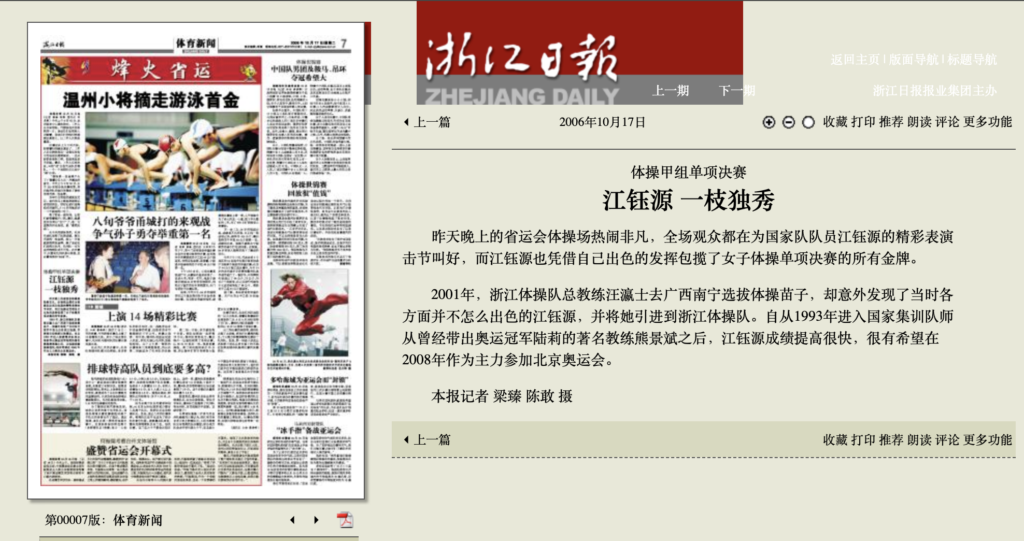
Unfortunately, the PDF version of the article no longer works, so I cannot verify what the original said.
Appendix C: Athlete Registrations
The New York Times was able to locate Jiang Yuyuan’s national identification number in a list of junior competitors. Today, that kind of discovery would be far less likely. Athlete registration lists typically provide only “competition ages” (参赛年龄) rather than full identifying information. For example, the 2024 registration list for athletes from Guangzhou—including gymnasts—uses that format, and competition ages may or may not be the same as athletes’ actual birth ages.
More on Age