On the website for CCTV, Yang Yilin’s athlete profile no longer loads. The page it once pointed to is gone. But the underlying source code—the part of the page that tells a browser what to render—was never fully updated. Embedded in it, invisible to any reader who does not know how to look, is a birthdate: August 26, 1993.
Yang Yilin’s official birthdate is August 26, 1992. The difference of one year is not trivial. Under International Gymnastics Federation eligibility rules, a gymnast born in 1993 would have been too young to compete at the 2007 World Championships in Stuttgart and the 2008 Beijing Olympics. She competed at both. Her results stand in the FIG’s database, her eligibility certified, the case formally closed.
What remains is the discrepancy. The page is gone, but the data persists on the website for China’s official state broadcaster—an earlier value embedded in a system that was never fully overwritten.
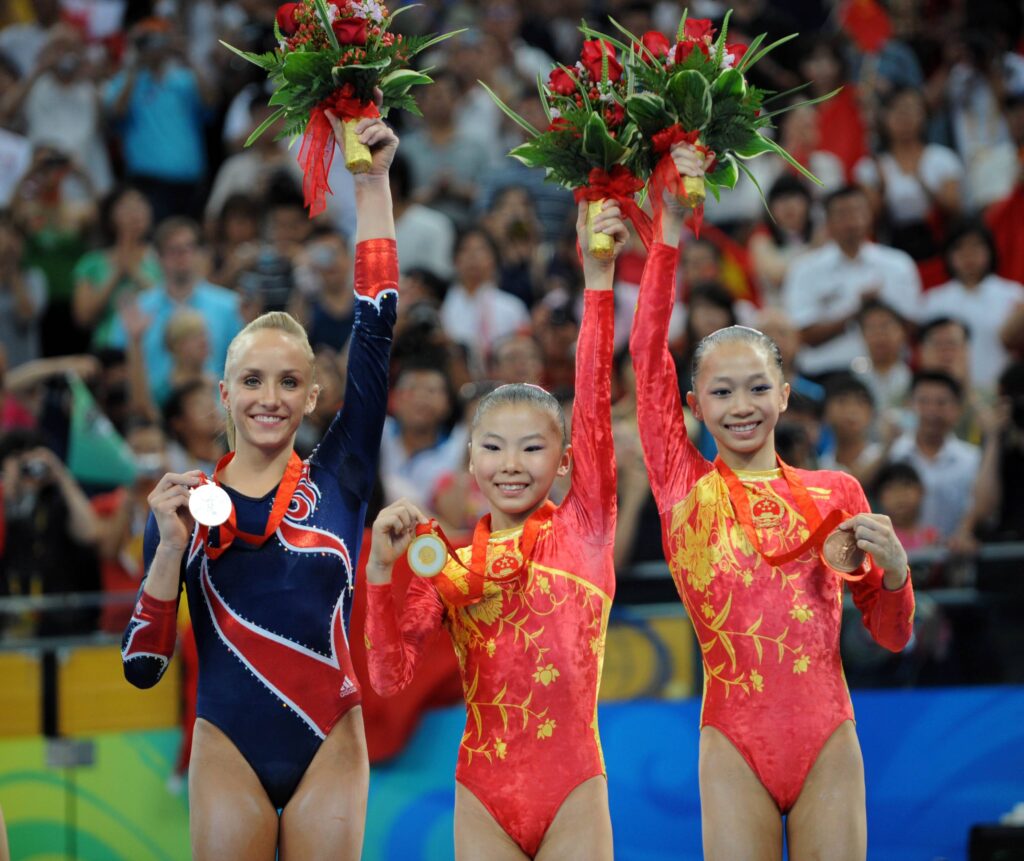
Left to right: Nastia Liukin, He Kexin, Yang Yilin
In 2011, in the wake of Dong Fangxiao’s verdict and amid a skating age scandal, Chinese journalists wrote openly about the problem of age falsification in sport. Even the China Youth Daily addressed the issue, underscoring just how messy age adjustments could be:
In Chinese sport, athletes falsifying their ages has long been an open secret. This reporter has frequently encountered a revealing phenomenon when interviewing athletes: ask them how old they are, and they often have to think for a long time, sometimes even consulting teammates before answering — because some athletes have changed their ages not once but multiple times, and have lost track of their own versions.
The China Youth Daily is the official newspaper of the Central Committee of the Communist Youth League of China.
Though the article did not mention Jiang Yuyuan, her case illustrates the phenomenon clearly. Depending on the document consulted, she appears to have been born in 1993, 1992, or 1991.
In 2008, criticism was not limited to age. It extended to the Chinese gymnasts’ makeup, as well, with the two themes often treated as inseparable. Writing for NBC News, Thomas Boswell wrote:
But if it’s tears you want, the kind you feel inside when you see a small girl in glittery makeup trying to pretend she’s 16 — and eligible for the Olympics — when she may only be 14, then National Indoor Stadium was the place to come for that emotion, too.
Thomas Boswell, NBCNews.com
He returned to the subject later in the piece:
Next to He, accepting praise, was Jiang Yuyuan, an amazing uneven-bar performer. Both looked extremely young despite thick makeup, sparkles, and fairly sophisticated hairstyles.
Thomas Boswell, NBCNews.com
Across the Atlantic, Sonia Oxley echoed that sentiment in a Reuters piece pointedly titled “Makeup Cannot Cover up Age Issue.” She argued that makeup was being used to make the gymnasts appear older. The article opened:
Even with their eyeshadow and mascara, gymnasts look young. The question is, exactly how young? China’s tiny leotard-clad athletes have repeatedly had to fend off questions about not being old enough to compete at the Olympics. On Friday, the International Olympic Committee called for an investigation into exactly how old one gold medallist is.
Sonia Oxley, Makeup cannot cover up age issue, Reuters
The piece continued:
The nature of the sport means gymnasts often look younger than they really are because they are shorter than average and also very light. The glitter and the makeup helps them look a bit older.
Sonia Oxley, Makeup cannot cover up age issue, Reuters
While much of the U.S. coverage of He Kexin focused on her age, there were many profiles of He Kexin in the Chinese press. They painted a portrait almost entirely different in emphasis: not a suspicious document trail, but a girl from Beijing with trembling hands and an idol named Khorkina.
The American story was essentially demographic — a birth year, an age, a discrepancy. The Chinese story was biographical, and its details had the texture of something lived rather than constructed. A coach named Shang Chunyan remembered going to a kindergarten near Yonghegong in 1997, looking for recruits among five-year-olds. She noticed a small girl — not tall, not overweight, nothing exceptional yet. She took her anyway. That girl, years later, would win China’s seventh gold medal of the Beijing Games.
The road was not straight. When the national team selectors visited the Beijing squad to scout for Olympic prospects, their first impression of He Kexin was unflattering. She was “bent everywhere,” one coach recalled — her movements awkward, her form uninspiring. The only time she looked graceful was when she was upside down. They took her on that basis, as something of a gamble, and she rewarded the gamble almost immediately. A foot injury that ruled out balance beam and floor exercise forced her coaches to try an experiment: put her entirely on the uneven bars. In two months, she had mastered the Li Ya salto, one of the most demanding release skills in the sport. Her coaches were astonished. The nickname “Princess of the Uneven Bars” was not far behind.
But the profiles also preserved the setbacks. At the 2007 City Games, she fell off uneven bars. Afterward, she sat alone in the stands and watched the rest of the competition in silence, refusing to eat, refusing to rest — as if she were punishing herself. It was, reporters noted, the most heartbroken she had ever been. That moment of private devastation appears in multiple accounts, always in the same register: not as a scandal but as evidence of seriousness, of how much it mattered to her. The same attentiveness extended to smaller details. During a team training check, coaches discovered she had skipped lunch and eaten only a piece of chocolate before the afternoon competition. She told them she was afraid of feeling heavy on the apparatus. She never threw a temper tantrum when disciplined. When a surprise dormitory inspection ended with everyone else quietly slipping away, she stayed and cleaned the room herself.
By the time the Beijing Olympics arrived, these stories had accumulated into a coherent character: diligent, self-possessed, quietly stubborn. On the night of the uneven bars final, competing first against a field that included three recent world champions, she admitted afterward that her hands had been shaking. She said she hadn’t let herself think about the gold medal, because the more you think about gold, the more pressure you feel. She performed a flawless routine. When American star Nastia Liukin matched her score of 16.725, He Kexin didn’t yet know the tie-breaking rules that would ultimately decide in her favor; she thought they might simply share the gold. When the rankings appeared on the screen, and she realized she had won outright, she ran over to Yang Yilin, who had just finished her own routine, and lifted her up.
The profiles collected here were published across several days in August 2008, in outlets ranging from the People’s Daily and Oriental Sports Daily to the PLA Daily, which capped its coverage with an earnest poem comparing He Kexin to a swallow in flight. These profiles are historical documents not only of what she accomplished, but of how China chose to present her.
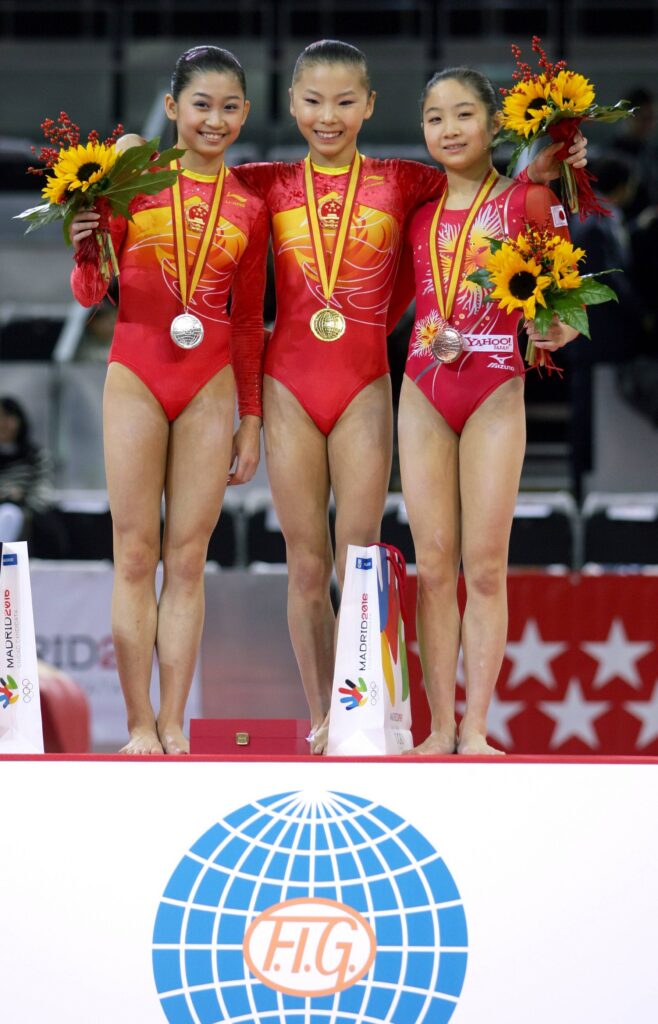
Jiang Yuyuan, He Kexin, and Tsurumi Koko, December 2008, World Cup Final, Madrid, Spain
The story of He Kexin’s age has been told many times, but nearly always from the same vantage point. Western readers know the New York Times investigation, the deleted spreadsheets, and Béla Károlyi’s comments about baby teeth. What they do not know — because almost none of it has been translated or discussed in English — is how Chinese mainland media told the same story.
This essay traces that mainland narrative across a single year, from the first stray press mentions of He Kexin’s age in late 2007 through the International Gymnastics Federation’s formal resolution of the controversy in October 2008. It is not, primarily, a story about whether she was 14 or 16. It is a story about how the same events, covered by journalists working under different constraints and writing for different audiences, can produce such divergent accounts.
Nastia Liukin, He Kexin, and Yang Yilin, 2008 Olympics, Copyright: imago/Xinhua