Wu Jiani was one of the most accomplished gymnasts of the early 1980s. At sixteen, she won three gold medals at the 1982 Asian Games and received the only perfect 10 awarded in the women’s competition. A year earlier, she had claimed a bronze medal on balance beam at the World Championships in Moscow, and her shoulder-destroying uneven bars release—commonly called the “Jiani Leap”— was recognized by the International Gymnastics Federation. She would later help China earn its first Olympic team medal in women’s artistic gymnastics, taking bronze at the 1984 Los Angeles Games.
The four profiles translated here, written between 1980 and 1983, are less interested in those achievements than in explaining how they became possible. Each returns to her unlikely beginning in the sport. Wu arrived at the national team with protruding knee joints, stiff ankles, and legs so weak that coaches compared them to those of a child recovering from polio. She failed to finish among the top thirty at her first national championships. Coaches reportedly decided three separate times to send her home, only to relent after watching her climb back onto the apparatus following yet another fall. Again and again, the articles attribute her transformation not to extraordinary talent but to extraordinary persistence: endless repetitions, late-night conditioning sessions, and an almost preternatural refusal to complain.
Read together, the profiles reveal something larger than the career of a single gymnast. They belong to a recognizable genre of Chinese sports writing in which athletic excellence serves as evidence of moral character. Wu’s story—frail child, repeated setbacks, silent perseverance, eventual triumph—was a narrative that readers would have recognized from countless profiles of elite athletes during the reform era. The details vary from article to article, but the structure remains remarkably consistent.
The differences are equally revealing. Three of the profiles were written for readers inside China and dwell on physical shortcomings, repeated failure, and the harsh demands of elite training. The fourth profile appeared in the English-language edition of China Pictorial, a Chinese state magazine published for overseas readers. Unlike the domestic profiles, it smooths away many of the rough edges. The malformed joints disappear, the coaches no longer contemplate sending her home, and the emphasis shifts to a determined girl practicing on a log in her bedroom before emerging as an international champion. Read side by side, the four articles offer not only a portrait of one of China’s pioneering gymnasts but also a glimpse of how the country chose to tell different versions of the same sporting success to domestic and international audiences.
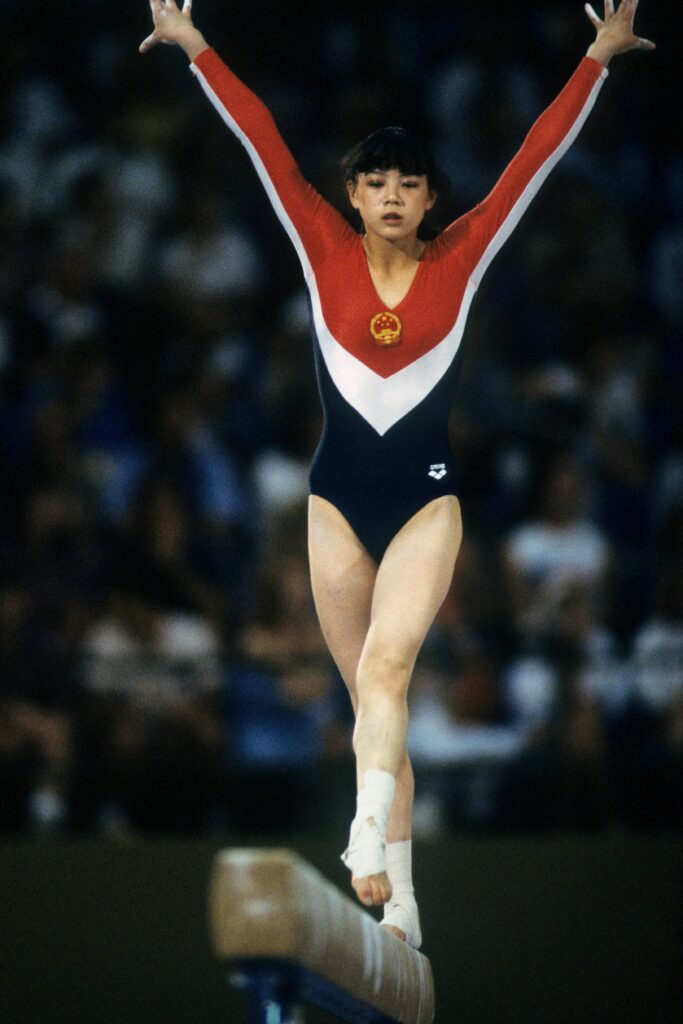
1980
The Beauty of Will and Character
Shanghai female athlete Wu Jiani won both the all-around championship and the balance beam championship at the 1980 National Gymnastics Championships. In the gymnastics world, this was considered a small—but not insignificant—miracle.
At the time, the national training team intended to transfer in a female gymnast with the surname Ni, but by mistake they brought in Wu Jiani, whose given name happens to include the character “Ni”. She had poor physical qualities and little strength. As the coaches put it, her legs looked as if she had suffered from polio: her knees protruded, and her ankle joints were also problematic. It was truly laughable. But since she had already arrived, they decided to let her train and see how it went.
Training was extremely grueling. Every movement required her to pay several times the price others did; she fell dozens of times just practicing a single routine. Yet little Jiani never uttered a word of complaint. Each time she fell, she would get back up and climb onto the apparatus again. The coaches were moved. Three times they had decided to send her back, but each time they couldn’t bring themselves to do it, because of the tenacious fighting spirit she displayed during training.
After three years of sweat and repeated falls, little Jiani’s physical qualities changed from poor to excellent, her strength from weak to strong. Her knees and the tops of her feet even altered their original shape through nearly a thousand nights of overtime conditioning and intensive pressure training.
Today, the Wu Jiani who appears before the public is a new gymnastics star, renowned for the beauty of her physique and movements. Watching her gracefully complete one difficult balance-beam maneuver after another, who among those who know her story would not exclaim that this is truly the beauty of will and character?
(This column is based on Xinhua News Agency reports.)
PLA Daily, October 7, 1980
Note: At the 1979 Junior International Championships in Japan, Wu Jiani competed alongside Ni Peiyao. It is possible that Ni was the gymnast referred to in this article.
意志和性格的美
上海女运动员吴佳妮获得一九八○年全国体操锦标赛全能冠军和平衡木冠军,这在体操界算是一个不大不小的奇迹。
当初,国家集训队要调一个姓倪的女运动员,不想把名字中有个“妮”字的吴佳妮给调来了。她素质差,没劲,用教练的话说,两条腿好象得过小儿麻痹症,膝关节突出,踝关节也不好。真叫人啼笑皆非。但既然已经来了,也只好练练看。
真艰苦啊!练每一个动作都要付出比别人多出几倍的代价,光摔跤就是好几十次。但小佳妮一声不吭,摔了,站起来又往器械上爬。教练被感动了。本来三次决定要把她送回去,却因为她在训练中表现出的顽强作风而舍不得让她走。
三年的汗水和摔打,小佳妮的素质由劣变优,体力由弱变强,膝盖和脚背也居然在她近千个夜晚加班压练下改变了原来的形状。
现在出现在人们面前的吴佳妮,是以形体和动作优美著称的体操新星。看她在平衡木上漂亮地完成一个个高难度动作,知内情的人,谁不赞叹这是意志和性格的美!(本栏均据新华社)
1980
Stars of Hope
— Profiles of Several Rising Gymnastics Talents
At the 1980 National Gymnastics Championships, several new stars—shining with the light of hard work and hope—captured the attention of audiences nationwide.
A Champion Who Came Knocking
Eight years ago, in the training hall of the Jiangxi provincial gymnastics team, a coach often noticed a small head pressed against the window, watching practice for long stretches at a time. One day the coach called the boy inside and asked, “Do you like gymnastics?”
The little head nodded vigorously. “I like it!” he said—and promptly did a few somersaults. The coach immediately took a liking to this gymnastics fanatic and recruited him into the team. That year, he was only 11.That boy is Tong Fei, now the breakout newcomer who won the most awards at this year’s Hartford International Gymnastics Invitational in the United States and went on to claim the men’s all-around title at the National Championships.
Tong Fei is the son of the renowned Gan opera performer Pan Fengxia. Growing up in a theatrical family gave him an early love for tumbling. “Passion,” he says, became his best teacher in gymnastics.
He always felt the training plan set by his coaches wasn’t enough. After completing the required repetitions, he would often ask for more. The Tkatchev on the high bar is a difficult skill; Tong completed the required number at double the volume. Even when his heels struck the bar and swelled “like steamed buns,” he refused to come down. With this single-minded intensity, he mastered in three months a skill that usually takes a year to learn.
In the final event of the men’s apparatus finals at this year’s Nationals, Tong performed a fearless series of high-risk elements—left and right one-arm giants, a back salto to regrasp, and a back salto with a 720-degree twisting dismount—earning a high score of 9.85 and first place, to thunderous applause from the crowd.
“The Little Rag Doll” Triumphs Over All
“Little Rag Doll”—that was the nickname French spectators gave young athlete Jiang Wei at the International Women’s Gymnastics Championships in Antibes this August. She truly looked like a doll: only 12 years old, just 1.3 meters tall, barely 10 centimeters taller than the balance beam.
But once competition began, where was that doll-like delicacy? Watch her calm expression after completing a string of high-difficulty skills, and her undiminished fighting spirit through consecutive rounds right to the final! Her coach says this child has a strong sense of purpose.
From Guangxi, quiet and introverted, Jiang Wei once sustained a compression fracture of the femur during training. Her mother cried and insisted she come home. Jiang Wei cried and pleaded in return and refused to leave the team. She said she would train again once healed, and she would achieve results.
Her first major competition was the International Women’s Championships in Antibes, where the “Little Rag Doll” defeated all rivals to win the all-around title. At this year’s National Championships—packed with top competitors—she placed third in the all-around and third on floor exercise. This star of hope on the gymnastics stage is already clearly in sight.
The Beauty of Will and Character
Shanghai gymnast Wu Jiani won both the all-around and balance beam titles at these Championships—no small miracle in the gymnastics world.
When Wu first joined the national training camp, her physical condition was poor and her legs lacked strength. So she intensified her training across the board.
It was grueling. Every skill demanded several times the effort required of others; she fell dozens of times. Yet little Jiani never uttered a complaint; she fell, got up, and climbed back onto the apparatus. Her perseverance moved the coaches. Although they had decided three times to send her home, they could not bring themselves to do so because of the grit she showed in training.
After three years of sweat and hard knocks, her weaknesses turned into strengths; her stamina grew from frail to strong. Through nearly a thousand nights of extra conditioning, even the shape of her knees and the tops of her feet changed.
The Wu Jiani now before the public is a rising star celebrated for her beautiful lines and elegant movement. Watching her complete one difficult element after another on the balance beam, anyone who knows her story can only marvel: this is the beauty of will and character.
Xinhua News Agency reporter: Chen Yani
People’s Daily, October 20, 1980, page 4
This is very similar to the PLA Daily article. I included it again because it gives us some insight to other gymnastics stars. For example, did you know that Tong Fei’s mother was a famous opera performer?
希望之星 ——记几名体操新秀
在1980年全国体操锦标赛中,几颗闪耀着奋斗和希望之光的新星,引起了广大观众的注目。找上门来的冠军
8年前,在江西省体操队训练大厅,教练员老看见一个小脑袋扒在窗户上看体操训练,一看就是好久好久。一次教练把他叫进体操房,问他:“喜欢体操吗?”小脑袋一个劲地点,“喜欢!”说着就翻了几个跟头。教练一下就看上了这个体操迷,收他进了体操队。当年他才11岁。
这就是今年在美国哈特福特国际体操邀请赛中获奖最多、今年全国锦标赛又夺得男子全能冠军的体坛新秀童非。
童非是著名赣剧演员潘凤霞的儿子。梨园门第使他从小热爱翻跟头。“热爱”,成了他从事体操事业最好的老师。
教练安排的训练计划他似乎总感到不过瘾,规定次数完成了,他每每又向教练“讨”。单杠分腿向后切杠是个难度较高的动作,他成倍地超额完成规定次数。脚跟打在杠上,肿得象馒头,他也不肯下杠。用这股迷劲,他3个月拿下了这个一般要用一年才能练好的动作。
在今年全国锦标赛男子单项决赛的最后一个项目——单项比赛时,童非顽强果敢地完成了左右单臂大回环、后空翻抓杠、后空翻转体720度下杠等一连串高难惊险动作,获得9.85的高分,成为这个项目的第一名,博得全场观众的热烈喝采。“小布娃娃”力挫群芳
“小布娃娃”,这是今年8月法国昂蒂布世界女子体操锦标赛上,法国观众对小运动员姜薇的称呼,真是个小布娃娃,年龄才12岁,身高不过1.3米,比平衡木只高出10厘米。
可是一上赛场,“小布娃娃”的娇态哪里去了?你看她完成一连串高难动作后镇定自若的神情,连续比赛直至最后一场还锐气不减的劲头!教练说,这孩子有事业心。小小年纪,就有事业心?有的。这个来自广西的文静内向的小姑娘,曾经在一次训练中股骨被压折,妈妈心疼得掉泪,非让她回家不可。姜薇却又哭又哄,就不离开体操队。她说,伤好了还要练,还要出成绩。
第一次参加大型比赛,就是在法国昂蒂布举行的世界女子体操锦标赛。“小布娃娃”力挫群芳,夺得个人全能冠军。在全国强手云集的这次体操锦标赛中,她又获得全能第三名和自由体操第三名。这颗体操帷幕上的希望之星已经翘首可望了。意志和性格的美
上海女运动员吴佳妮,获得本届体操锦标赛全能冠军和平衡木冠军,这在体操界算是一个不大不小的奇迹。
当初,吴佳妮刚到国家集训队,身体素质差,腿没劲。她就加强各方面训练。
真艰苦啊!练每一个动作都要付出比别人多出几倍的代价,光摔跤就是好几十次。但小佳妮一声不吭,摔了,站起来又往器械上爬。教练被感动了。本来三次决定要把她送回去,却因为她在训练中表现出的顽强作风而舍不得让她走。
三年的汗水和摔打,小佳妮的素质由劣变优,体力由弱变强,膝盖和脚背也居然在她近千个夜晚加班压练下改变了原来的形状。
现在出现在人们面前的吴佳妮,是以形体和动作优美著称的体操新星。看她在平衡木上漂亮地完成一个个高难度动作,知内情的人,谁不赞叹这是意志和性格的美!
新华社记者 陈雅妮
1982
Jiani’s Leap
By Yan NaihuaForeign journalists have praised Wu Jiani’s performance as flawless. And indeed—how else could she have earned the rare perfect score of 10 in the gymnastics competition at the Asian Games? More than that, one of her high-difficulty moves on the uneven bars had never before been performed by any other athlete in the world. As a result, the International Gymnastics Federation named the skill after her: the “Jiani Leap.”
But who knows how rough and uneven the road was that the sixteen-year-old Wu Jiani had to travel for the sake of this “leap”?
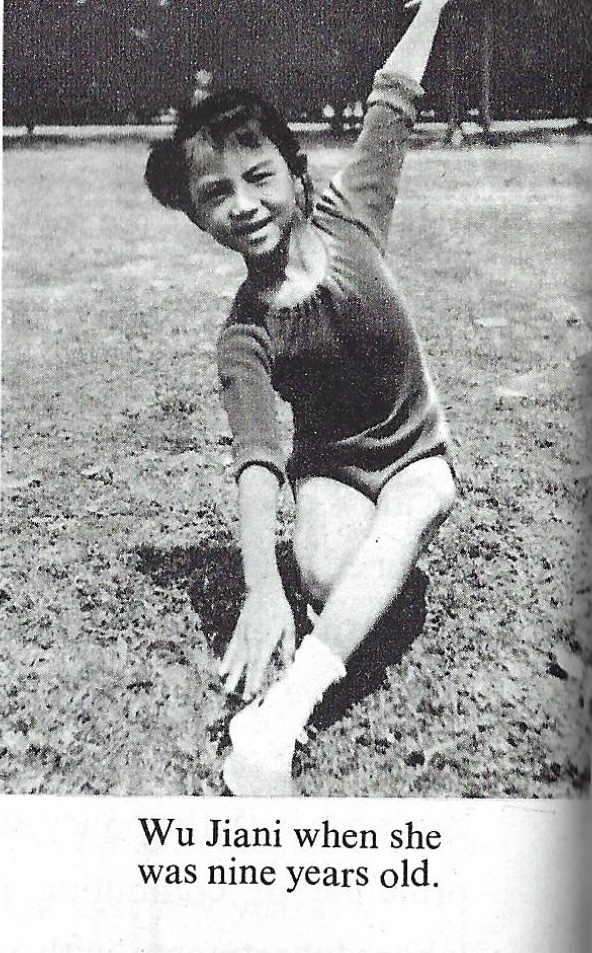
Wu Jiani is from Shanghai. She began learning gymnastics at the age of seven and entered the national gymnastics team at ten. She was sickly from childhood, and for a gymnast her physical condition was far from ideal: her knee joints protruded, her ankle joints were stiff, and in her first national competition she did not even place among the top thirty. In training she often failed to grasp key techniques, so she spent two years “warming the bench” on the team. Coaches decided three times to send her back.
But the stubborn little Jiani did not lose heart. She charged head-on at her difficulties with tenacity. Time and again she fell from the apparatus; without a word, she climbed back up and tried again. Her knees and ankle joints were weak, so she trained overtime at night, pressing and working them until the joints themselves changed their original shape. Practicing the highly dangerous move known as the “front somersault” [i.e., a Radochla roll] was especially risky. Wu Jiani often released too late, striking the bar with both feet; or she let go too early, failed to catch the bar, and crashed onto the mat. The pain brought tears to the corners of her eyes—but she never retreated.
“As the saying goes, beneath a plunging waterfall there must be a deep pool.” It was with just such determination that Wu Jiani took flight from the “cold bench.” It was with this same spirit that she mastered a world-class, high-difficulty skill that no one else could perform—the “Jiani Leap.”
May Jiani keep leaping—leaping ever higher!
PLA Daily, December 12, 1982
佳妮的腾越
Author: 阎乃华
外国记者称赞吴佳妮的表演是完美无缺的。是的,要不然她怎么能在亚运会体操比赛中,得到个罕见的十分呢。岂止如此,小佳妮在高低杠上的一个高难度动作,是世界上别的运动员还从来没有做过的。因此,国际体联以她的名字给这个动作命名为“佳妮腾越”。可是,有谁知道,十六岁的吴佳妮为了这个“腾越”,走过一段多么不平坦的道路。
吴佳妮是上海人,七岁时开始学习体操,十岁时就来到了国家体操队。她从小体弱多病,作为一个体操运动员,她的身体条件十分不理想,膝关节突出,踝关节发硬,第一次参加全国比赛竟连前三十名也没排上。她训练时往往不得要领,所以在队里坐了两年“冷板凳”,教练曾三次决定把她送回去。但是倔强的小佳妮并未气馁,她顽强地向困难冲击。多少次从器械上摔下来,她一声不吭,爬上去再干;膝、脚关节不好,她晚上加班练习,直压得关节改变了原来的形状……练“前空翻”这个高难动作十分危险,吴佳妮常常因为撒手晚了,两脚碰在杠子上;或撒手早了抓不着杠子摔在垫子上,疼得眼泪直在眼圈里转,可她从不退缩。“飞瀑之下,必有深潭”,吴佳妮就是靠着这么一股劲,从“冷板凳”上起飞的,靠着这么一种精神,练出了世界上别人还做不了的高难动作“佳妮腾越”。祝佳妮腾越,再腾越!
The “Jiani Leap” appears at the 0:10 mark, when Wu Jiani beats the low bar, straddles over the high bar, and regrips it in eagle grip.
1983
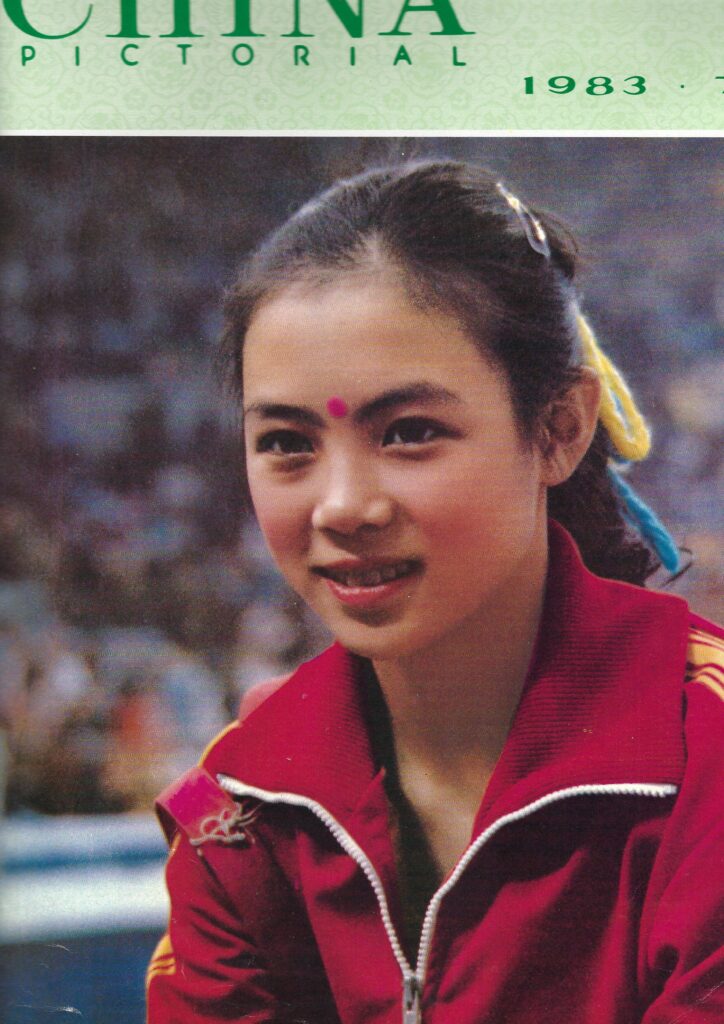
A Rising Star
Wu Jiani, slim, delicate, and gentle, is China’s top athlete. Anyone who doubts it will surely be convinced after seeing 16-year-old Wu fly from the lower bar to the top bar (2.30 meters above ground). This young lass entered five international competitions in 1982 and returned in triumph. In eleven days she was in New Delhi, Nagoya, and Tokyo, and won 10 medals: three golds and two silvers at the Asian Games, and five golds at the China-Japan Cup and Tokyo international contests.Wu Jiani was born in Shanghai, but her parents worked hundreds of miles away in Sichuan province. She was brought up by her grandparents. Little Jiani was weak and sickly. Her grandmother urged her to start working out. Everyday they jogged and exercised together. Jiani became stronger with each passing day. She entered school when she was seven, and was quickly spotted by the coach from a spare-time training center, who accepted her as a gymnastics trainee.
Little Jiani loved the balance beam. She put up a log in her room and jumped and turned on it. Despite long hours of practice, she failed in her first national contest; she was not among the first 30.
She was heartbroken and decided to give up sports for good. But her coach helped her analyze her poor performance. He suggested that her back and legs were a bit too weak to execute difficult stunts. She decided to make a fresh go at it, and overdid her training program. Her coach often had to stop her in the middle of her training and tell her to rest.
Three years later, Wu Jiani was the 1980 national balance beam champion. In 1981, she succeeded for the first time in doing a novel and terribly difficult stunt—an abdomen rebound from the lower bar with legs straddled to the top bar, hang with twisted arms, and rear swing with straddled legs to the lower bar—at the 21st World Gymnastics Championships held in Moscow. At the 9th Asian Games Wu Jiani won the only full mark (10) of the gymnastics events on the balance beam.
Wu Jiani said in her gentle way, “I owe much to my coaches and to all those who’ve given me support. I must share my honor with them. I still have a long way to go.”
China Pictorial, 1983, Issue 7
More Interviews & Profiles