Nellie Kim’s memoir, The Smell of Melon (Zapakh Dyni), was serialized in the Soviet sports newspaper Sovetsky Sport in February 1983, three years after the Moscow Olympics. It traces her journey from childhood in Chimkent (now Shymkent, Kazakhstan) to the pinnacle of international gymnastics.
By then, Kim was already one of the sport’s most decorated athletes: a five-time Olympic gold medalist across the 1976 and 1980 Games, the 1979 world all-around champion, and a key contributor to multiple Soviet team victories at World Championships and other major international competitions.
The Smell of Melon does not focus solely on Kim’s triumphant moments. In fact, it devotes considerable attention to uncertainty, self-doubt, and the long process of becoming an elite athlete. Kim writes candidly about difficult training sessions, conflicts with coaches, homesickness, injuries, and the emotional highs and lows that accompanied her rise through the Soviet gymnastics system. The memoir is also rich in portraits of the people who shaped her career, including her parents, coach Vladimir Baydin, Larisa Latynina, Olga Korbut, Ludmilla Tourischeva, Maria Filatova, and even Nadia Comăneci.
The translation below follows the original 1983 newspaper serialization as it appeared in Sovetsky Sport.
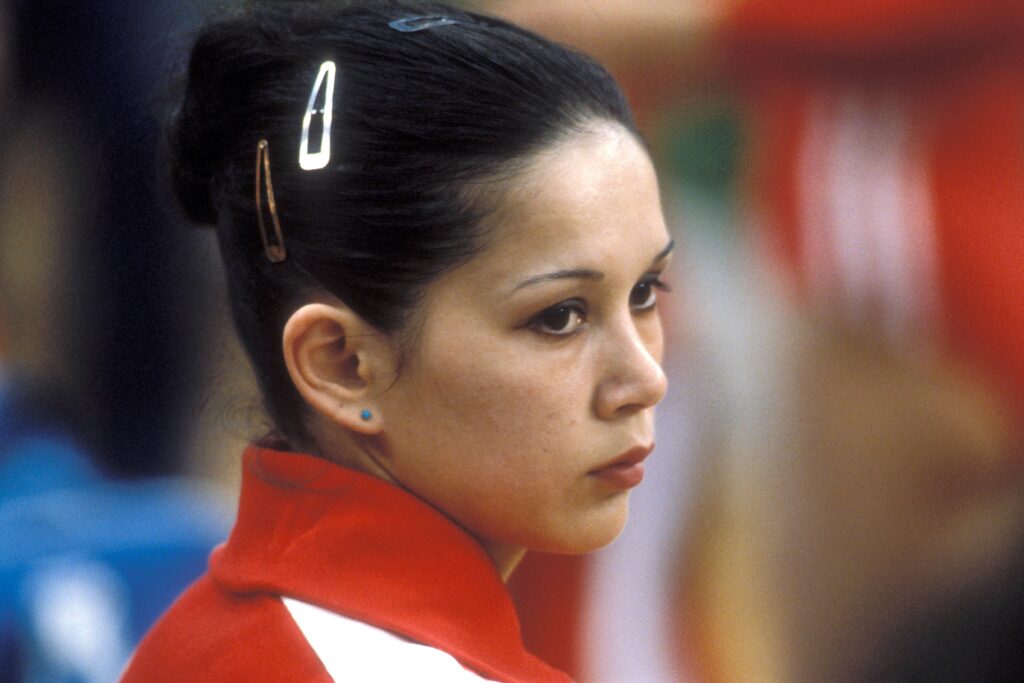
The Smell of Melon
“They called her ‘Iron Kim,’ yet she herself admits that she approached competitions with the same nerves as everyone else. And still, Nellie Kim achieved extraordinary success on the competition floor. A five-time Olympic gold medalist, world and Soviet all-around champion, and winner of the USSR Cup, she lived a sporting life that was dazzling, though far from carefree. It had everything—failures, tears, and moments of despair.
Passionate by nature, restless. In gymnastics, Kim looked for her own “self”; she didn’t lock herself away within the gym walls alone, but sought—and still seeks—ways to apply her strengths in other areas of human endeavor.
Everything in this world interests her—this athlete, our contemporary. A recipient of two Orders of the Red Banner of Labor.
Oh, I’m sitting in the locker room and crying.
Crying like a little girl whose tasty candy was snatched away by a mean boy. I’m crying, and I’m angry—at myself, at my coach, at the whole world.
Masha Filatova walked in. I knew it. I felt she’d be the first to come. I’ve never met anyone kinder than she is. Well, maybe only my mother. But a mother is a mother. And she’s far away.
To be honest, even Masha’s appearance irritates me right now. I love her; I value Masha’s generosity—how she gives others the warmth of her heart. But at the moment, I want to be alone.
“Masha, I’m going to step out. It’s fine… I’ve had enough of all of them! Maybe I’ll run back to the hotel?”
“Nellychka, little dove, there’s no need to run away. This will pass. So the vault isn’t working—so what! And my bars are a disaster. My coach, Innokenty Ivanovich, is devouring me with his eyes, but what can I do? Don’t cry, don’t cry. If you want, I’ll go and say your leg hurts.”
“It doesn’t, Mashutka, it doesn’t. I’m probably talentless—I understand nothing about vaulting. Why did I ever agree to learn this Tsukahara?”
Latynina appears. She holds her head high; she radiates confidence, and I feel I’m about to hear a heap of barbed remarks.
Sensing my mood from my eyes, Larisa Semyonovna changes in an instant (she does this superbly), becoming homey, cooing:
“Nelya, why the long face? What a calamity—forgot how to vault. You’ll learn again! We’re still young…”
Latynina hugs me and wipes away my tears with the corner of the cleanest handkerchief. I start muttering some nasty things about my own coach and about the vault coach, Antonov; I think even Latynina herself gets a little of it. In short, I’m being a brat.
Larisa Semyonovna stands up and leaves without a word. Once again—proud posture, unapproachable.
The door doesn’t quite latch, and I hear our head coach of the USSR team toss to someone, “Now they’ve learned how to put on hysterics.”
That phrase sobers me. It stings my pride. Now I’m angry only at myself—at my weakness, at having let others see my tears of despair.
I stride out of the locker room. It’s horribly unpleasant that everyone is staring at you—the girls, the coaches, and the gymnastics fans who have come at this morning hour to the Minsk Sports Palace, where the women’s and men’s national teams are holding their final training camp before the Montréal Olympics.
Yes, I’m already grown, experienced. A thousand times, I’ve learned how to overcome myself, my weaknesses. And I know full well that sport isn’t a moonlit stroll, not sweet ice cream, not my beloved melons…
I walk straight ahead, eyes forward, and see Lev Konstantinovich Antonov, standing by the vaulting horse, shrink slightly. I feel sorry for him: how much coaches depend on us, the athletes! And Antonov isn’t even really a coach. He’s a senior lecturer at the Institute of Physical Culture, an associate professor, a Candidate of Pedagogical Sciences. A specialist in vaults. He even wrote his dissertation on the subject. And he helps the girls and me with all his heart. It was he, Antonov—a big, heavy man with a full, graying head of hair—who devised specifically for me the Tsukahara with a full twist and proved theoretically that this vault, and only this vault, was the one I needed for the Olympic podium. This vault would surprise the judges. And surprise, as a rule, is simply delight at seeing something new—and delight usually means a high score. For boldness. For innovation. If only I could execute it perfectly…
Antonov waits. Out of the corner of my eye, I see Baydin, leaning on the beam in the far corner of the podium, watching me. My God, am I really so spoiled that they have to fuss over me like a little child?
I know this will pass soon, but what impression does it make on those present? The most frightening thing would be if, at the coaches’ council, someone said, “Comrades, we must seriously consider whether Nellie Kim should go to the Olympics. She’s poorly prepared, she hasn’t updated her program, she hasn’t met her objectives. But most importantly, Kim lacks a strong character; psychologically, she’s not capable of fighting the world’s best gymnasts for the win.”
Yes, that could happen. And not even the fact that I have experience at the World Championships and European Championships, that I have gold medals from national championships, would help.
I go cold at these thoughts, and I feel sorry for myself, for the coaches, for the girls who are worried—they’ve so rarely seen me like this. Tears well up again, but this time they’re not tears of anger, but of pity. Gentle, soothing tears.
And suddenly—what a miracle!—a wave of cheerfulness and tenderness for Antonov rises in my heart. He’ll never raise his voice at me; he’ll coax me, quietly reason with me. I walk up and whisper, “Maybe I should lengthen the run-up a bit?”
Lev Konstantinovich nods happily: “Try it, Nellie, try it. Two more steps. But snap the twist sharper. I’ll put down another mat.”
I walk slowly to the start of the runway. I calm down immediately. I smile at Masha Filatova, who has stood by me the whole time. I nod to Lyuda Tourischeva, who, together with Ela Saadi, is working on the floor; inwardly, I sympathize with Olya Korbut—she’s out of sorts too, sitting hunched on the springboard by the bars. Almost all the girls are taking a short pause, and only Sveta Grozdova seems not to know what fatigue is. Incredible diligence! She doesn’t know how to rest; for her, the best rest is changing apparatus. Sveta is constantly in motion, set after set, and in the breaks, she doesn’t just sit on a chair—she rehearses routines with her arms.
I vault, and vault again. Five times, six. The rise isn’t bad, the push with my arms too; even the twist itself seems to be taking proper shape (I’m no longer flinging my arms and legs), but the landing—no good at all. We keep searching, searching; we try shortening the run-up; I vault without the twist to feel the height of the flight.
Despair washes over me again. I hate myself for being talentless. Now Antonov’s forbearance annoys me; I need a jolt—I absolutely need Baydin’s demanding persistence!
Where is he, Vladimir Borisovich? Right here, in the flesh. As if sensing my weakness, he hurries over at full tilt. Short and stocky, he rolls along like a bun—only not rosy-cheeked, but angry.
“Can’t you understand that during rotation you have to stretch your body like a string! And then you don’t have time to get your legs locked!”
Baydin is almost shouting; he’s irritated, too. What a day this is!
I snap: “Get out of the gym! Your remarks are getting in my way—without you, I’ll nail it for sure!”
My coach—my beloved coach—the one who brought me up, taught me everything, lived through a fantastically hard gymnastics life alongside me, who turned a willful, slightly scatterbrained girl into a member of the national team—falls silent and retreats. I barely have time to scare myself with what I’ve done when I make another run-up and, already in the air, feel that I’m headed for an excellent landing. Antonov almost claps his hands, and I realize I’ve got no strength left.
…That night, I hardly sleep. Guilt gnaws at me. In the morning, I don’t warm up. I come to the Sports Palace in a dress, not in training clothes. Latynina meets me: “What happened? Nelya, why aren’t you on the competition floor?”
“Larisa Semyonovna, I’d like you to book me a ticket to Chimkent.”
I’m going home. Nothing is working out for me…
I DON’T KNOW whether this was the right way to begin notes about a gymnast’s life. But for me, this conversation is a confession. What I want, first and foremost, is to tell about the hard—but extraordinarily captivating—life of an athlete. No embellishment, no rose-colored paint.
On magazine covers, people are used to seeing me smiling, coquettish, with armfuls of medals, with cups. And yes, I’m a cheerful, lively person. I’m interested in discovering the world, getting to know people, traveling, loving, and suffering. I can’t stand loneliness!
But I wasn’t made for magazine covers. There, you only have to smile, whereas in sport you more often scowl and get angry. And when you’ve passed through many trials—when you’ve lived through moments of despair—victory is all the sweeter; with your whole soul, with every cell of your tired body, you rejoice at summiting a peak whose path turned out to be so long and so hard.
Just imagine, even for a second, my rapture and elation when, in Montréal, they handed me the gold medal for vault. For my beloved and hated full-twisting Tsukahara! And the happiness on Baydin’s and Antonov’s faces! And Latynina’s smile? It was her victory, too. She must have remembered those words that chilled the air: “Larisa Semyonovna, please book me a ticket to Chimkent…”
That’s why I want to start my reminiscences with the hard days of my life. There were many, but the days of preparation for the 1976 Olympic Games somehow etched themselves in my memory the most.
…Let’s go back to the Minsk Sports Palace.
So, I asked for a ticket to Chimkent. And there was less than a month left until the Olympics. Larisa Semyonovna turned pale. She looked over my pretty dress and sandals. She paused.
“Nelya, you know that’s impossible. We’ll talk about everything this evening, all right? Go to the hotel, bring your uniform. Do a light training session. We’ll talk in the evening, in the evening. What will the girls think if you leave?”
And really—what would they think? Haven’t I seen Olya Korbut’s tears, or Lida Gorbik’s? Ela Saadi or Nina Dronova in a foul mood? Can everything go smoothly? Maybe only Tourischeva never showed weakness in public, but that’s Tourischeva for you.
I didn’t leave. I trained very focused, detached. More than anything in the world, I wanted to eat a melon. The smell of melon followed me through the two hours of practice. I longed for melon, and for home, for Chimkent; I thought of my father, mother, sister, and brother. How are they?
I worked my floor routine, and where the choreographer demanded a smile, I didn’t smile. I waited for evening. I was tired.
Larisa Latynina is a great teacher. And a wonderful actress. Pedagogy can’t exist without acting. Yes, I agree that true pedagogy is, first and foremost, honesty—toward the pupil and toward oneself. But there are times when you must sacrifice “straightforward” simplicity and show yourself to be a skillful actress who, in that moment, inhabits the image, thoughts, and actions of the “offender.”
That’s exactly what I was then in Minsk—at fault. And Latynina displayed all of her mastery as a coach-teacher (this is how I analyze it now) to set me back on the right path.
That night (we talked almost until morning), I opened up; I laid out all my troubles and doubts, sorrows and joys. Larisa Semyonovna was one with me: she laughed when I smiled; her eyes grew moist when I was sad; she chirped and purred; she reasoned and commanded.
I trusted her, and I felt lighter.
Understand that, at nineteen, you sometimes want to be little again and feel that someone can comfort you. Training, trips, tournaments—these are wonderful, but they wear you out; you long for home, and your mother or sister—those you can share your secrets with—are far away. Coach Baydin is a man, after all; it’s easier to open up to a woman.
Imagine, I suddenly said to Latynina: Sometimes I’m simply in despair. What kind of life is this? It’s as if someone wound a clockwork spring inside me. All I think about is not being late for practice. And so many restrictions—this is forbidden, that is forbidden. I want to go to a disco with my friends. No, I can’t stand this regimen…
Larisa Semyonovna didn’t start philosophizing, but answered warmly, like at home: “When I was competing, do you think I never had such thoughts? Oh, I did! You can see I’m cheerful and daring by nature. And how I loved to dance! My coach, Aleksandr Semyonovich Mishakov—also a cheerful, lively person—often said, ‘Larochka, life is long; sport is only a small part of its pleasures. Think of it this way: you’ve been given enormous good fortune—to become a good athlete. Yes, you have to sacrifice some desires. Give up a little for a big goal.’”
“And it’s true, Nelya—you’ll dance to your heart’s content yet, sit at plenty of parties, and you’ll know family happiness. It’s just your age—you think your best years are slipping away. No, believe me, your best years aren’t behind you. I competed at three Olympics, and now I’m preparing the team for a third Olympics as a coach, and I’m happy with my work. Oh, you, my dear girls, my darlings! Your troubles will pass, your tears will dry, and you’ll be laughing up there on the podium, flowers in hand and medals around your necks. You just have to bear it a little, make yourself work properly. Right, Nelya?”
We were sitting in the Jubileinaya Hotel, a hundred meters from the Sports Palace, on the tenth floor, in Larisa Semyonovna’s room. Dawn was breaking. We didn’t want to part. We drank coffee, boiling water in a little immersion heater. A new day—Sunday—was beginning. And Latynina let me sleep in, even until evening if I wanted. Sleep is the best at relieving tension. But I already felt light; I was myself again. I deliberately waited for breakfast and went up to Baydin to apologize for my rudeness at practice. Vladimir Borisovich winked at me as if to say, it happens—no big deal.
Then I went to sleep. I drifted off with the feeling that the room smelled of melon. I really was terribly homesick.
Strictly speaking, my first home wasn’t in Chimkent, but in the small Tajik town of Shurab, in Leninabad Oblast. I was born there on July 29, 1957. Soon after—two months later—our family moved to Chimkent; my father had gotten a new job.
My father, Vladimir Nikolaevich Kim, works at the Chimkent slate factory. He started as a factory worker and machine technician; then he finished a technology institute by correspondence and became an engineer. Now he’s the head of the repair-and-construction shop.
I respect my father very much. Outwardly stern, restrained, he loves children boundlessly, although he never spoiled us; he gave us independence. From my father, I learned firmness and high standards. I was struck by the surprising softness of his heart, which, for some reason, he hid from others. He’s a real working man, and I can’t imagine him apart from his native slate factory. I saw that he didn’t work for the paycheck; he gave himself completely to the plant. We were very proud when Father said, modestly, that he’d been elected to the factory committee. So people respect Vladimir Kim!
My relationship with my father has always been the warmest. Only once in my life did he punish me severely, and I still remember it; the apparent injustice of that punishment still stings.
Once, my little brother and I asked our parents’ permission to go by ourselves into the foothills to pick snowdrops. It was a wonderful day; we tramped many kilometers, happily ate our sandwiches, and got so carried away picking the delicate flowers that we didn’t notice dusk falling. And we’d wandered far! I pictured my father and mother worrying, calling the police… Sasha and I ran back as fast as we could, losing half the snowdrops. I felt responsible for my brother, but for some reason, I wasn’t afraid to face my father; I was sure he would hear me out.
Parental love is blind. This time, my father couldn’t contain himself and took off his belt; he’d been too frightened for us and couldn’t hold back. I had hurried so much, I understood the situation so well—and then, without even hearing me out, I was punished…
I sulked for two days. I wanted to run away to the mountains again—forever. To hide in some hut or in the cave of a fearsome snow leopard that wouldn’t harm me. They’d search for me—for a week, a month. The whole city would be out looking. I cried quietly and savored my “revenge.” And on the third day, I woke up with no anger in my soul, no bitterness. It had passed, and the hurt was gone as if it had never been. That’s my character—quick to let go. But for some reason, I decided I would never punish my own children—what if I, too, acted that unfairly?
Sovetsky Sport, February 5, 1983
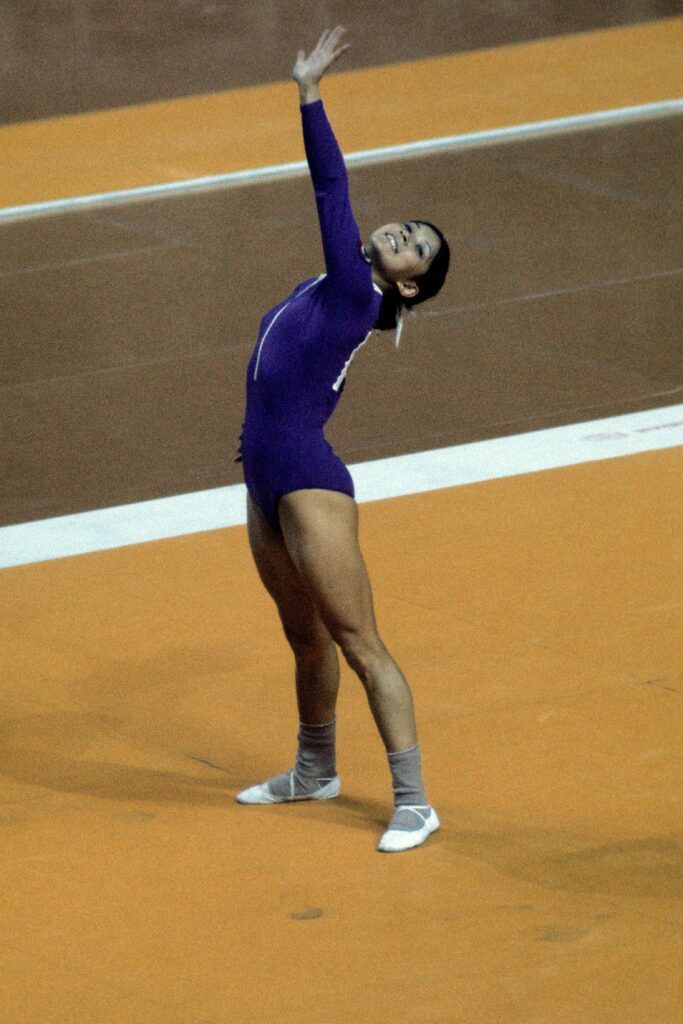
My mother, Alfiya Gazizovna, came from a small Tatar village called Mazyar near Kazan. Lively and energetic, she became for me an example of striving toward a goal and a desire for self-improvement. I remember how we used to laugh when she would show us, her children, her excellent knowledge of Tatar, Tajik, Uzbek, and German. She must have had a talent for languages.
A saleswoman in a small grocery store, at the age of thirty-five, she enrolled in the correspondence department of the Alma-Ata Institute of Trade. She studied persistently and diligently, never missing a session. I marveled at how hard she worked to master subjects that were entirely new to her. I worried about her a great deal. When the gymnastics tournament in Montréal was over, I managed to reach Chimkent by phone and asked her, with extraordinary excitement: “Mama, how are you doing? Did you pass your state exams?” Hearing that she had passed successfully and received her diploma made me just as happy as the day before, when I had won three gold medals.
…We lived amicably, for there were five of us in the family now. When I was three, my little brother Sasha was born, and six years later, my sister Ira.
Chimkent is a green, cozy city. But alas, when the north wind blew, it was literally buried in a curtain of dust. And all across the city were the smokestacks of asbestos, phosphorus, lead, brick, and other factories.
For as long as I can remember, the neighbors in our two-story wooden house of eight apartments often complained about me. I grew up a lively girl who found no greater joy than joining in a game of Cossacks and Robbers (I was a great runner) or beating up some quarrelsome boy. I fought fiercely, viciously, and with great enjoyment—and I bit hard. Probably this “passion” for biting frightened my peers, and they were afraid to argue too much with me. The boys were fair, though: whenever we built bonfires in the yard, they always gave me the most comfortable spot to sit and watch the flames.
At school, I studied willingly, drawn to history, literature, and English, while I couldn’t stand mathematics. No one needed to supervise me or convince me to do my homework every day.
I remember how, in the second grade, I had my first love. I didn’t understand what was happening to me—some kind of longing gripped my little heart. He was a classmate, an honor student, lived in my building, and once gave me a beautiful book of Kazakh fairy tales on March 8th. That made an impression, and I began to look at my neighbor in a new way. And you know, years later, I asked many of my girlfriends if they remembered their first crush. Strangely enough, all of them answered with a smile: “Yes, I think it was in the second grade…”
Remembering childhood and youth is an extraordinary pleasure. Memory picks out, like a spotlight from the darkness, little cheerful images and the faces of neighborhood or school friends. Names and surnames have been forgotten, but the faces remain.
I always laugh when I tell the story of how an energetic American director once came to Chimkent, having arranged with the USSR Sports Committee to make a film about me.
That was in 1975. That summer, I had performed well at the Spartakiad of the Peoples of the USSR, sharing first place in the all-around with Olga Korbut and winning three gold medals in individual events. I had earned many points for the Kazakhstan team; everyone congratulated me, and they promised to resolve the housing question for our family.
By then, we were indeed cramped; my brother and sister had grown, and I was already a student. But, as often happens, the “question” was being resolved slowly.
And then a letter and a phone call: an American director was coming to Chimkent! What a commotion! In three days, they issued a housing order, helped buy and move in furniture, repainted the sports school, renovated the gym, and, if they’d had the chance, they probably would have painted the grass green! For some reason, it amused me to watch all this fuss. I’ll be honest, I’ve never liked showiness. If there are shortcomings, one should boldly prove that they can be overcome.
The director arrived—young, about thirty. Sociable, easy to talk to. I enjoyed speaking English with him. To my amazement, he worked with me for just one day! He worked hard and diligently, and I helped him however I could.
Earlier, a film about me had been made at the Alma-Ata studio. They tormented Baydin and me for an entire month. We even quarreled with them; they completely disrupted our training. Imagine, they seriously discussed how I might “hang in the air” during a pirouette so the shot would come out better. What did they think, I was in zero gravity? Still, I must admit that the little film, which they titled Surprise from Nellie Kim, turned out pretty well overall.
What I truly love is our generous hospitality. That very evening, coaches and parents gathered at our house for dinner—beshbarmak. They dragged home a twenty-four-kilogram watermelon from the bazaar and fretted that someone else had snapped up one nearly twice as big—they had wanted to astonish the guest.
The evening went splendidly—the American ate beshbarmak like a seasoned Kazakh, danced a lot, and sang. And everything felt light and easy.
I came to gymnastics the way thousands of other children did. It happened in the third grade. We were in a math lesson. The teacher was carefully scanning the class roster, and my heart clenched in anticipation of being called on. Oh, how I disliked mathematics—with its incomprehensible numbers and sudden conclusions. Childish math for a third-grader was nothing much, but still, I remember it never came easily to me.
I watched the teacher’s eyes intently: she tilted her head slightly, had probably already found my surname under “K,” and any moment now, she would put down her pen and say, “Nelya, I haven’t called on you for a while. Please come to the board. Do you know the lesson?” And I would answer timidly, “I know…” and walk to the board, writing in chalk with my body half-turned toward the class, while my ears, like radar dishes, picked up the whispering of little Seryozha Riba, who had a crush on me and was trying to help…
But then, the door opened, and into the classroom stepped a stocky man with lively, almost radiant eyes, who strode purposefully toward the teacher.
He whispered with her (no doubt explaining the purpose of his visit and showing the principal’s permission), then turned to us and said in a cheerful voice: “My name is Baydin. I’m a gymnastics coach at the children’s sports school. Which girls would like to do gymnastics?”
Almost all the girls raised their hands, and I raised both hands.
The coach looked at me, smiled, and clapped his hands together with a laugh: “Girls, come out into the hallway! I’ll be testing you!”
No one had the slightest idea what these mysterious “tests” were, but escaping a math lesson—yes, please! So we all rushed out into the corridor.
The coach, evidently in a hurry to check as many classes as possible, didn’t take us to the gym. At his command, we rose on our toes, bent forward and sideways, jumped in place, then Baydin, supporting each girl’s back, tested how well she could do a bridge. My flexibility was poor, and Baydin pursed his lips in disapproval.
I was upset and already wanted to sit back at my desk when the coach called out three surnames, mine among them, and told us to come to the sports school the next day after class for our first training session, bringing sports clothes.
I couldn’t believe my ears, but Baydin repeated the three names once more—mine, too. I clapped my hands in delight, and the teacher, seeing my joy, showed unusual kindness and didn’t call me up to the board.
At Sports School No. 3, under the city education department, we had no facilities of our own. The gymnasts rented space in the Palace of Metallurgists. My goodness, what a gym it was! Miserable—that’s how I’d describe it. The equipment was so old we bound it with bandages. Worst of all were the uneven bars: they didn’t just creak with cracks anymore, they actually howled. The hall was used for volleyball, basketball, and even soccer, and each time the apparatus had to be dragged out of storage and put back again after practice. That tedious, heavy labor soured our moods. Baydin and his wife, Galina Vasilyevna, who worked alongside him, took on most of the burden of rolling equipment in and out on primitive carts, but we girls also had our share.
Still, all that came later. At first, there was the headlong rush to training, the thrill of touching the old beam, the uneven bars, the cracked leather of the pommel horse, the sheer joy of moving, of discovering an entirely different world.
From my very first steps in the gym, I was fascinated. Baydin turned our sessions into noisy games where the most important thing was the fun of competition: who could do more push-ups, who could hold an “L-sit” the longest, who could do the best split or handstand.
If you asked me about the greatest event of my childhood, I know how I’d answer. In 1969, I competed in Chimkent under the Candidate for Master of Sport program, just three years after I had started gymnastics. I think it was the city championship. Galina Yakovlevna Shamray, the 1954 world all-around champion and Olympic champion, came as a guest. She was then the head coach of Spartak, the sports society that sponsored our school. I won, and Shamray presented me with a huge bouquet of flowers. For me, that was such a tremendous event that I wept with happiness, and it seemed to me the whole world was looking at me, at the bouquet, and at the world champion!
I also remember that same year going with Baydin to Rostov-on-Don for the USSR Championships. I stared wide-eyed at the gymnasts, clapping until my hands hurt for Olga Korbut, Ludmilla Tourischeva, Larisa Petrik, and Olga Karaseva. And afterwards, I ran after them, collecting autographs.
A year later, I almost quit gymnastics…
That spring, Baydin and I went to Tbilisi for what was called a review-competition for the best, most unusual routine or new, original element. Baydin secretly prided himself on the fact that I could perform some things from the repertoire of the seniors, and he thought my forward salto dismount from the uneven bars would surely astonish the experts. On beam, I had learned a dismount with a 720-degree twist after a slow back walkover.
But how bitterly disappointed we were when we saw true innovation and some breathtaking gymnastics! Twelve-year-old Sveta Grozdova from Rostov-on-Don, fragile and translucent, showed such an unusual element on bars that I was struck dumb with amazement. And how dazzling was Nina Dronova, around whom everyone tiptoed—there was so much talk about her: “A wonder-child, a prodigy, she will eclipse all the queens of the podium!” And what the tiny Masha Filatova could already “pull off”!
I was terribly upset and, at first, didn’t even want to go out with my pitiful routine and shabby “original” element on bars. I performed with embarrassment, acutely aware of my provincial backwardness.
But Baydin wasn’t embarrassed. He calmly peered through the camera lens, filming hundreds of meters of film. He was learning, absorbing the advances of coaching thought, eager to get home and work!
And then it happened. At the coaches’ meeting, a very respected trainer in the gymnastics world (I won’t name her), herself a famous champion, while reviewing the level of the participants, said this about me: “Nellie Kim from Chimkent. Her program is weak, there’s no sense of school, she doesn’t have a gymnast’s build, her shoulders are tight, and she lacks flexibility. In short, unfortunately, I see no prospects.”
Baydin later passed those words on to me. Was it unpedagogical? Perhaps. But he was that way—straightforward, never hiding the truth, always speaking to your face.
He cursed that coach up and down. Also unpedagogical—but it made me feel better. “Let her talk! So your body isn’t ‘gymnastic’—who cares,” Baydin fumed. “We’ll show her what bad shoulders can do. We’ll show her in a year!”
He blustered, but for a whole week, he was out of sorts, often lost in thought. Clearly, the authority of that champion was great, and her negative judgment had even affected him: “What if there really is no future?”
But Vladimir Borisovich was not one to suffer doubts for long. Soon, in his work, he was back to his old, energetic self.
Two months later, I had a joyful moment: Lidiya Gavrilovna Ivanova, head coach of the junior national team, sent an invitation to a summer training camp in Sukhumi. Without Baydin, true, but he wasn’t upset—he hopped around the gym waving the letter and shouted: “Nellka’s going to the seaside! Girls, Nellka’s going to the seaside! With the national team!”
It is frightening to arrive alone in an unfamiliar city. I traveled on my own, frightened at first, but by the end of the day, my fears and torments were over—I had arrived at the training base in Eshera, just outside Sukhumi. The only person I knew was Lidiya Ivanova. But the first to come up to me was Raya Bichukina, a Muscovite, who said something encouraging. I already liked her; I had seen her once at a competition. I was touched, and, through the whole camp, we never left each other’s side.
The Sukhumi camp gave me so much: in terms of refreshing my program, gaining a new understanding of gymnastics, and finding friends. Lidiya Ivanova placed me in the group of the well-known Moscow coach Nikolai Evdokimovich Mayburov, who, at the time, was training a very promising gymnast, Lyuba Bogdanova. Baydin came to the seaside at his own expense, and though he couldn’t officially participate in the training, he didn’t miss a single session. And again, he was inseparable from his movie camera. Whole evenings we would sit by the sea, discussing what had been done that day, making new plans.
Competitions, whether large or small, allowed me to rehearse my routine, which we felt was finally fit to show the coaches of the USSR national team. At last, we learned that the junior national championship was scheduled for December 1971 in Ivano-Frankivsk.
That little Ukrainian town utterly charmed me with its narrow streets, toy-like houses, and the lilting speech of its people. Baydin was a bit agitated; he felt that the hour of triumph had come, when he could show himself as a true “provincial coach.”
I watched the training of the likely leaders—Lyuba Bogdanova, the Leningrad girls Irina Shchegoleva and Galina Khryapina, Valya Tikhonova from Volzhsky—and, alas, no fighting spirit stirred within me. At that point, I hadn’t yet developed the inspiration or the thirst for battle that would awaken later. I was probably weighed down by the huge amount of rough training work that Baydin and I had gone through in the gym. I didn’t know my own strength or potential and only thought of how to get it all over with quickly. I was more concerned about the textbooks I had brought with me, and in the evenings, I happily paged through history and my English textbook, memorizing words and grammar.
It’s not that I didn’t try to show myself in the best possible light in competition—I did think above all of the honor of my sports school and my city—but inspiration never came. The compulsory program for candidates for the Master of Sport at that time was fairly straightforward, and most of the girls managed it successfully. I felt that I wasn’t doing certain parts of the exercises quite correctly, and mentally made notes for myself of what needed improvement.
Looking through reports of those competitions, I found only one sentence about myself: “In the compulsory program on vault, N. Kim from Chimkent was memorable.” Vault really was my strong suit, but to place only fifth in the tournament and get just a single sentence of notice?! That upset me. But not for long. Because Lidiya Ivanova congratulated Baydin and me and told us that I would be called to all-Union training camps more often now and that soon I would take part in an international competition. That was truly joyous news.
Sovetsky Sport, February 6, 1983
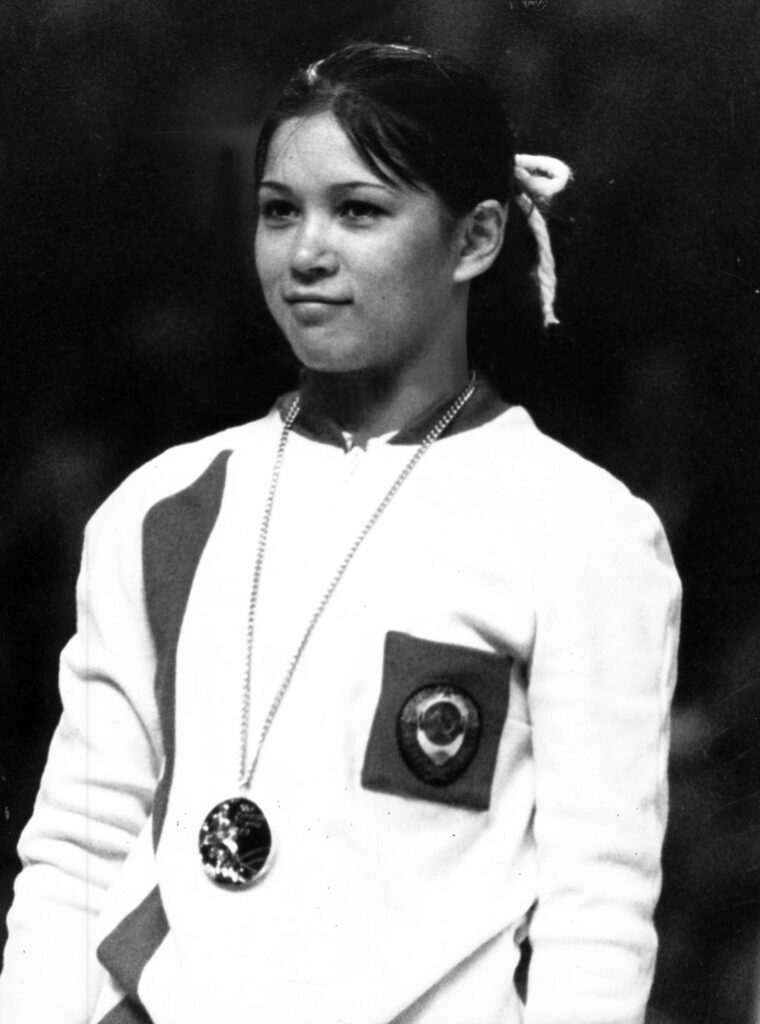
I watched the Olympic Games in Munich on television. I was fifteen years old, and in theory, I could have been on the Olympic team, just as Masha Filatova would be at that age four years later. But back then, I hadn’t yet “grown up” to the level of my idols’ mastery.
How I envied Olga Korbut and Ludmilla Tourischeva! How beautiful, magnificent they were—how the world admired their exquisite art! I would look at our girls’ performances and involuntarily ask myself: “Could you score a 9.8 on bars? Could you land a beam dismount like that? Could you put together floor routines as splendid as Tourischeva’s?”
Baydin was practically beside himself at training.
— “Did you see Korbut’s salto on beam? Our program will be even harder!”
I reveled in the prospect of beating the “queens” of the podium and shouted back with excitement:
— “We will!” — and up I went onto the beam.
It was so interesting to work with Vladimir Borisovich. Even now, I can’t imagine what would have become of me without Baydin. At times, of course, I was upset by his lack of diplomacy, his bluntness in dealing with his students. But he never schemed, never fawned, never sugar-coated anything—he said what he thought. And if he was dissatisfied, we felt it keenly.
He was a very troublesome man for the self-appointed “well-wishers.” He could shout at anyone if he knew he was right and saw injustice, laziness, arrogance, or idleness.
They tried to “re-educate” him, but Vladimir Borisovich took blows from the shadows rather calmly and went on the offensive himself: writing to high sports authorities, to the press, seeking justice. Even when he became a famous coach, when he was respected, some still could not forgive his obstinacy.
But everything he did, he did only for us!
My coach was charged with great ambitions. How many coaches quietly work away in sports schools, putter around in the gym, spend day and night there, give their whole soul to the children—perhaps even dream of big sport, of loud victories for their pupils—but are embarrassed by the loftiness of their dream and never set big goals.
It’s very important for a coach to have courage. I saw how Baydin went through thousands of meters of film, recording any competition, even small local ones, so that later he could sit at the projector’s rattle and pick out movements, connections, elements he liked. He wanted to build me a program that was no worse than those of our very best gymnasts.
Olga Korbut first showed her beam salto in 1969 at the national championships. Vladimir Borisovich immediately seized on that salto, sensing instinctively that here was the doorway to a bigger world.
To invent a completely new element is no simple matter. Of course, you can dream up something extravagant, but how do you actually teach it, bring it to perfection, turn a baffling stunt into a charming little étude—a jewel in the routine? To make the decision to attempt an entirely new combination is psychologically very hard. So many doubts creep in…
If Korbut had captivated the gymnastics world with her beam salto in Munich, then I managed to repeat that trick rather easily in December 1972 at the national junior championships, held in Zaporizhzhia.
I don’t know, but it seems to me that the tournament in Zaporizhzhia forced me to see my potential in a new light. I came second, yielding first place to my best friend Raya Bichukina, but I suddenly imagined myself as a leader. I felt the thrill inside; I liked the fight, I liked appearing beautiful on the podium. My beam salto provoked a storm of applause in the Sports Palace, and that was incredibly gratifying.
The head coach of the junior USSR team, Lidiya Ivanova, praised both Baydin and me, saying that the progress was obvious, the routines matched exactly to my height, and now it was time to refine the technique of key connections and achieve consistency.
I didn’t sleep that night after the competition ended. Again and again, I replayed the moments of the contest in my head. How did I let the title slip away? I had led after the compulsory program, after the optional too, and then in the final, I made a small mistake on floor. I watched my rivals very closely—not only because in a contest you must be prepared for anything. I was studying their routines, trying to understand whose were better. There were such interesting gymnasts at that championship.
Take the Leningrad girl Flora Gilmutdinova. Everyone was crazy about her. Slim, tall, with delicate, mysterious features—she reminded you of the Mona Lisa. Lyrical, lofty, Flora’s gymnastics was poetry. Or Sveta Kudinova. Blonde, sharp-nosed, a little imp—an exact copy of Tamara Lazakovich. And she, too, was a pupil of Vikenty Dmitriev, who had trained Olympic champions Larisa Petrik and Lazakovich. Applause also went to Svetlana Grozdova, who showed unusual, original routines. People liked Lyuda Savina from Minsk—slightly haughty, but elegant, with excellent “schooling.” Tamara Yerilina from Grodno recalled her fellow townswoman Olga Korbut, just as daring and lively. Raya Bichukina—cheerful, full of life, the “queen” of floor. She reminded everyone very much of Olympic champion Olga Karaseva…
The coaches and journalists admired the girls. Of myself, I heard only one compliment: “Kim—she’s a fighter.” That was all. I fretted: had I really left no impression, had I no style of my own? But the judges gave me high marks—so I must have achieved something.
Besides second place in the all-around, I also won vault and uneven bars.
Now, looking back on those years, I’ve wondered: why was it that from all those gymnasts who impressed everyone at the junior championship of ’72, apart from Sveta Grozdova, none became great masters? Why did they all fade away along that hard, thorny road to Olympic heights? And among the boys, too, there were many interesting gymnasts, each with a distinctive style, with combinations very difficult for their age. Yet the only one who later sparkled was Sasha Dityatin, who, in Zaporizhzhia, won the title in the candidate-for-master program.
That’s how hard it is to lead a student to the door of the senior national team, how hard to endure all the twists of sporting life…
I never saw Baydin in such high spirits. He wasn’t really inclined to melancholy anyway—always lively, energetic, active. But this was a success, his own personal success! Vladimir Borisovich strutted proudly, smiled left and right, and put heavy pressure on my psyche: “Nelka, do you realize we’ve caught up with them? We’ll work a bit more, and things will be great. They told me they’re planning to send you to an international tournament. Imagine that! But what’s more important, you know? The Youth Games! Next year—where are they being held? In Alma-Ata! We won’t disgrace ourselves, will we?”
What could I answer to that breathless torrent of happiness? In my mind, I was already there, abroad. I imagined myself winning international competitions, receiving a beautiful prize, and bringing it back to Chimkent. The girls there would be so jealous!
My thirteen-year-old brother Sasha gave up gymnastics and switched to boxing. Even though I was the one who had brought him to our sports school, I wasn’t against his “betrayal” of gymnastics. After all, a boy should choose what he likes best. Sasha needed boxing; he didn’t want to be bullied by the fighters in his class, since he was one of the smallest.
Then I took a new pedagogical step: I brought our younger sister Irina to the sports school. I felt that she would do well. She was just as quick as I had once been; she ran fast, jumped well, and was bold and fearless. I think she was more talented than I, but her character turned out to be gentler.
And so at fifteen, I had already become a “coach.” I helped little Irina learn her first elements, while I myself was preparing for a trip to Leningrad for the USSR–Japan meet.
The choreographer Elena Ivanovna Kapitonova undertook to choreograph my new floor routine. A woman of remarkable charm (incidentally, the wife of Olympic cycling champion Viktor Kapitonov), she worked with gymnasts with extraordinary conscientiousness. Her routines stood out for their good taste, originality, and unexpected twists… For a long time, we debated what music and what character to choose for my routine. We settled on music by Pozhlakov and decided to make the routine eccentric and fast. We called it “Nenets Dancer.”
And so, in April 1973, we traveled to Leningrad for a friendly meet with the Japanese gymnasts.
For the first time, I read something positive about myself in a newspaper report: “The winner was Nellie Kim, a girl from Chimkent. This is a new dot on the country’s gymnastics map. The debutante is fifteen years old. At that age, Kuchinskaya, Petrik, Tourischeva, and Janz were already dazzling. The winner’s routines are elegant: on beam, she performs the ‘Korbut salto’ in the middle of the routine, and on floor, a double twist. Let’s call her a ‘girl without nerves.’”
At the end of August 1973, we went to the GDR for the “Friendship” tournament. There I first saw an eleven-year-old schoolgirl from Romania—Nadia Comăneci. I won’t hide it; our coaches and the girls on the team were literally stunned by Nadia’s unique talent. At eleven, she was already performing a soaring Tsukahara with complete ease, a double twist on floor, a double twist dismount from beam, and on bars, she was performing absolute miracles. And yet, for some reason, I wasn’t afraid of Nadia; I, too, had a double twist on floor.
The judges gave preference to this stern, unsmiling girl with perfect execution technique. No matter how hard I tried, I still fell two-tenths short of Comăneci. Nadia scored 37.85; I had 37.65.
At the time, I didn’t know that our rivalry would last for several years…
In Lost Illusions by Balzac, I found the phrase: “One must study the weaknesses of an opponent one wants to get rid of.” Maybe that’s true in some things, but in sport, thankfully, that advice doesn’t apply.
I admired Nadia’s fluidity and virtuosity, and I had no wish to “get rid of” a new rival. What I wanted was not to study her weaknesses, but, on the contrary, her strengths. After the tournament, Baydin and I had a long talk and came to the conclusion that we, too, needed to make our program more difficult; we had the reserves for it.
Head coach Lidiya Gavrilovna Ivanova raised the issue at a meeting of the All-Union Federation: Nadia Comăneci could only be defeated with some new weapon. Something urgent needed to be done in Soviet women’s gymnastics, or else the Olympic medals would slip through our fingers.
But for many, Comăneci was still an unknown. And when you don’t see danger up close, you don’t think about it. Besides, her tender age made people skeptical: after all, we’d seen more than a few “early bloomers”—stars that flared brightly and quickly faded on the gymnastics horizon.
And indeed, set against Tourischeva, Korbut, Saadi, Aronova, Siharulidze, it was hard to believe that somewhere an as-yet little-known talent was growing.
But Baydin and I did not forget Comăneci; her harmonious, carefully polished routines had impressed us too deeply.
At the 1973 USSR Cup in Tbilisi, I made a pile of mistakes. And I had come there as the champion of the first Youth Games. Baydin clutched his head in despair, and I was furious at myself and the whole world. Furious—but helpless. Tourischeva led. Behind her were the tender, impetuous Rusiko Sikharulidze; the forceful Galina Khryapina; the lyrical Elvira Saadi; the doll-like, spontaneous Nina Dronova; and the quiet girl from Riga, Tanya Shchegolkova. As for me, I ended up in eighth place. Though before the final, I had been in fifth. In the final, I fell from the beam.
Larisa Latynina was dissatisfied with my performance, and with Ludmilla Savina’s, as well. She called us talented girls but very inconsistent.
This is the dialogue (I will never forget it) that took place between Baydin and me after the all-around final, on the eve of the event finals:
— I understand, you’re tired, you haven’t had any rest, there’s been a jumble of tournaments. But you still shouldn’t have fallen in the final. What happened?
— Nothing!
— Listen, no need to sulk—it wasn’t the last competition. Let’s figure out why the fall on beam happened. Didn’t you feel the salto?
— I’m inconsistent, I’m untalented. Latynina said so too. I won’t compete tomorrow, I don’t need your medals!
— What’s this? You’re already grown, and you can’t keep yourself in hand. Let’s talk seriously.
— All right…
— You know perfectly well you’re not competing for your own amusement. The whole republic, Chimkent, Spartak—they’re watching you. Do you think you’ll win every time? Oh no, my dear, sport is a hard game, and there are no victories without falls. The main thing is to learn to bear defeats steadfastly. Take Tourischeva—she had setbacks at the Mexico Olympics, then at two national championships. But she didn’t give up, didn’t panic, she analyzed, looked for mistakes, and became world and Olympic all-around champion! Can you perform tomorrow as you do in training?
— I don’t know…
— I know you can! Yes, you’re tired, yes, your arm hurts. But where’s your will? Your courage, your fire? You’re a cheerful girl—remember what the newspaper wrote about you during the Youth Games, I still carry that clipping: “Kim, black-eyed and mischievous, led the Kazakhstan team forward.” You led them! That means you were a leader. So now you fell. Smile at the judges, don’t show your weaknesses. Character is forged in struggle. Why am I telling you such obvious truths?
— Vladimir Borisovich, it’s just so humiliating to lose so poorly.
— Humiliating, yes. But you’ve got a whole life ahead, and if you take every defeat this hard, you won’t have any nerves left. Do you think I don’t suffer? I feel like I should be taking Validol myself. But I analyze your performance, and I try to find the mistake. Maybe you should have rested two days before the Cup, but we trained. Maybe we need to change something in the routine. We were going to make the program harder anyway.
— Let’s make it harder! Let’s do it!
— But that’s not the point now. Tomorrow, the event finals are at stake. You’ve got a strong score on bars. You can, you must, fight for a medal. Show your character, prove yourself. Show that you can be resilient.
— I’ll try… Do you think you’ve lost faith in me? You’re wrong. I just had a moment of weakness. Maybe I can still snag a bronze?
— Bronze? You’ve got the top score! You must perform as well as in training—then everyone will believe in you…
— “The champion of the country on uneven bars is Nellie Kim of Chimkent. She is awarded the gold medal, and so is her coach, Vladimir Baydin.” How was that? Did it sound like radio commentator Turpishchev? Oh, how I’d love to hear that tomorrow for real…
And the very next day, I did hear those exact words from our wonderful announcer, Roman Turpishchev! And it seemed to me that he pronounced them about me with special solemnity.
And what an event it was—to share the title on uneven bars with Ludmilla Tourischeva, the Olympic all-around champion herself, the one I had tried to emulate, from whom I had learned resilience, with whom I had dreamed of training and competing.
We stepped onto the podium, Lyuda shook my hand, congratulated me, and we were presented with gold medals. I gazed at the gold medal and couldn’t take my eyes off it. Was it possible—I was champion of the Soviet Union?
…In Chimkent, we were met by leaders of the city sports committee and Spartak. At home, I threw my arms around my mother’s neck—I had missed her so much. My father, usually reserved, couldn’t hide his joy and bustled around me. He even bought a huge melon at the bazaar. And little Irina and Sasha took turns hanging my medal around their necks and running outside to show it off to the neighborhood kids.
At school, they organized a sports evening timed to my return, and I talked about the Youth Games, the national Cup, about Tourischeva, Saadi, how training went, and that, apparently, in November, I would fly to Japan for a major international tournament.
Sovetsky Sport, February 16, 1983
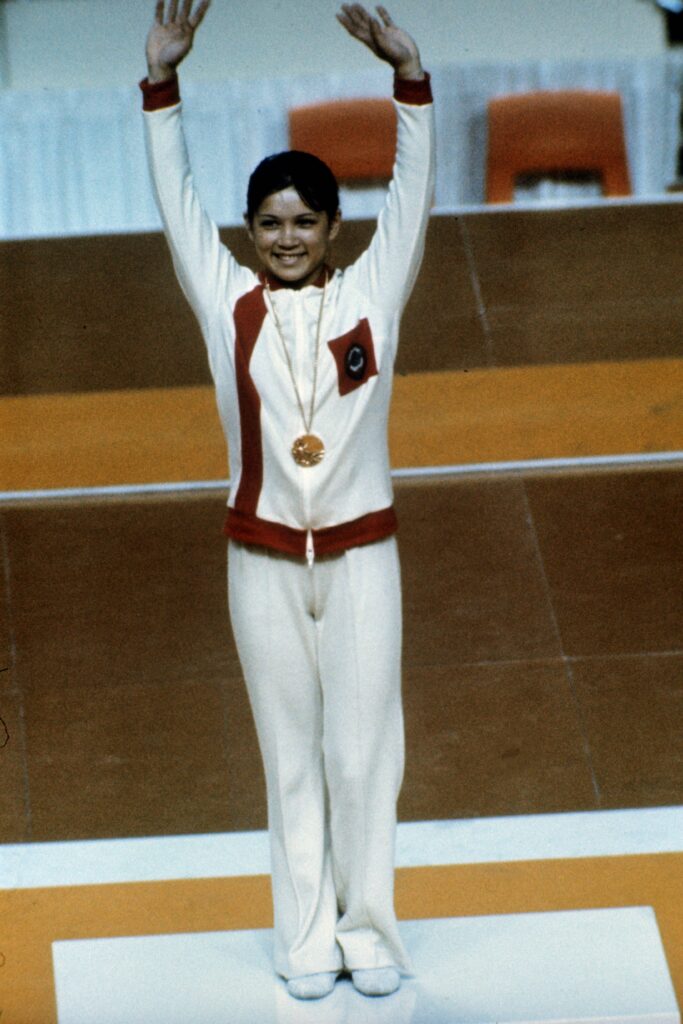
In every athlete’s life, there comes a very important moment when you cross the threshold that separates you from the very highest level of mastery. To make an Olympic team or a world championship team—that, in my view, is what it means to “cross the threshold.”
“Here it is—unattainable, yet desired,” I thought when I learned I’d been named to the team for the 1974 World Championships in Varna. And not as an alternate, but as a full-fledged member!
At the end of October 1974, we set off for Bulgaria, to the Black Sea coast. The plane headed for Varna; the flight was short, and I buried myself in a book—The Adventures of Tom Sawyer. Of course, I’d read Mark Twain as a child, but I very much wanted to feel small and carefree again. I value the humor of that wonderful writer. I read and smiled, trying not to think about the competition. Trying not to think… Yet every couple of pages I’d catch myself “running through” in my head either my balance beam routine or my uneven bars routine—and only the optionals. I wasn’t afraid of the compulsories; they came easily to me.
The world championships are a grand thing! I wasn’t exactly a novice anymore; I’d seen a number of countries and had won and placed at many meets. But the atmosphere in Varna’s Sports Palace impressed me especially—there it was, the biggest stage in world gymnastics; there they were, competitors at the biggest tournament of the International Federation; there they were, the strictest judges! The colors of the flags, the bright costumes, the unusual bustle, the pale faces of the coaches—how could you not lose your head in such an environment?
Our team had three experienced gymnasts—Ludmilla Tourischeva, Olga Korbut, and Elvira Saadi—and three debutantes—Dronova, Sikharulidze, and me. Naturally, it fell to the first-timers to start the rotations in turn. We had discussed that order back in Moscow, but before the start, our spots and assignments were clarified once more. The main directive was this: give everything for the team’s success.
…It was a wonderful evening—an evening of happy memories. We chattered nonstop; even the always-composed Tourischeva laughed more than usual. And the giggler Nina Dronova and the cheerful Korbut dreamed up such stories that everyone died laughing. How light the heart feels after hard trials, after summiting a cherished peak. Your body is heavy with fatigue, but your soul is at peace. You aren’t ashamed to go home—that’s what matters.
Our women’s team won—and now they were saying about me, too: Kim is a world team champion. I also had a bronze medal on beam. Not bad for a debut, I suppose. And I was pleased that I’d shown some grit: because of a leg injury, I didn’t compete in the all-around final, but in the apparatus finals, I did my beam routine cold, without warm-up.
Whatever I did that fall and winter, my thoughts kept slipping to the coming Olympics. We even rang in the New Year—1976—in a way that didn’t feel wintry; we mostly talked about summer, about the Olympic Games, about Comăneci, about what we would bring to the most important competition of my life.
That’s when Baydin suggested I learn something sensational—say, a Tsukahara vault with a full twist, and on floor, a double salto. Those two events suited me best; I had “springy” legs.
It’s one thing to propose it and another to agree. We were tormented by doubts: with such a difficult and polished program, did I really need to learn something entirely new? Wouldn’t it steal precious time from refining the routines that were already solid?
By nature, Baydin is a restless man; he wanted to amaze the world. And to be honest, it wouldn’t have interested me to repeat the same thing for a whole year either. Of course, deep down I was afraid of that full-twisting Tsukahara, but an inner voice whispered, “What are you scared of? You have to move forward! Only then can you win at the Olympics!”
Baydin also pressed for the new vault because Lev Antonov—who, as I’ve written, had long enjoyed the reputation as the national team’s top expert in vaulting—had promised to help. Baydin met Antonov at a gymnastics meet; they shared a hotel room. They must have taken to each other, having found common ground in their views on the development of gymnastics.
We waited for Antonov to arrive in Chimkent, and in the meantime, began working on the vault without him. How much effort it took! It was hard for me also because I wanted to be the first in the world to perform this vault on an international stage.
For a whole month, I flailed like a fish on ice. And when something finally clicked, and I landed on my feet, Vladimir Borisovich and I both believed in future success.
Baydin came up with all sorts of things—he filmed every one of my vaults, drew up complicated graphs for the phases of flight and landing. But when Antonov arrived, the work went faster: the specialist devised several so-called lead-up drills that helped me feel the technique of the twist more keenly.
I also worked on the double salto on floor.
At the 1976 USSR Cup—the final selection for the Olympic team—we decided to unveil our novelties. Were we taking a risk? Absolutely. The consistency wasn’t there yet. Baydin only wanted absolutely precise execution, and as for me, I was landing the double salto cleanly only five times out of ten. Yet I was counting a great deal on floor.
Floor in general took a lot of our time. For the ’76 Olympics, we decided to keep “Samba,” which had already brought me victory at the Spartakiad of the Peoples of the USSR. But inserting a double salto changed the rhythm of the routine. The music needed to be re-edited, the turns and gestures reworked.
The choreographer Valentina Kosolapova worked briskly and with zeal, sparing neither herself nor me. And the national team’s accompanist, Yevsei Vevrik, prepared the musical arrangement.
You could say this man is a living history of Soviet gymnastics. For more than twenty years, he worked with the country’s best gymnasts. A member of the USSR Composers’ Union and the author of several music collections, he not only accompanied but also composed music for floor routines for Larisa Latynina, Polina Astakhova, Sofya Muratova, and later for athletes such as Natalya Kuchinskaya, Larisa Petrik, Olga Karaseva, and Ludmilla Tourischeva.
The accompanist is a full-fledged coauthor of the gymnast’s floor exercise. He often suggests certain gestures, and more often poses puzzles for the choreographer, dreaming up a musical phrase that has to be filled with movement and elements.
…The USSR Cup took place in May 1976 in Moscow, at the Sports Palace.
Tourischeva finished the compulsories first, with the top total. I was a tenth behind, Korbut four more behind me. That layout suited Baydin and me just fine. Now the optional routines would be a contest of nerves.
Tourischeva came off on a transition from the low bar. Korbut botched her signature salto and ended up on the mats; Lida Gorbik also got a low score on beam. I was up next. Floor. And right away, a misfire: on the double salto I lost my balance and touched the carpet with my hands. A deduction. But since the overall composition seemed to please the judges, they weren’t as harsh with me. And they announced me the leader going into the final, since the new vault in the first event had come off—9.95. Odd, isn’t it? In the warm-up, nothing was working, but when it counted, the shape of the vault came out nearly perfect.
The final brought an unforgettable battle! Korbut passed me before the last event. It all came down to floor. Incidentally, Olga had learned a double salto, too; she didn’t want to lag behind others and was dreaming of another Olympic triumph. Her routine was new as well—“In Memory of Édith Piaf,” passionate and stormy. Olga ran, lifted off, rotating in the air, but landed very badly. The music “ran on” ahead; you could see Korbut overcame the urge to step off the carpet and finished the routine. Her score was so low that even the second day’s hard-luck case, Ludmilla Tourischeva, passed her.
My hour had come. Do or die! Everything worked; the arena applauded; I smiled—9.85! The USSR Cup—a crystal vase—was in my hands for the first time!
My good mood was reinforced by the fourth day, when the national titles on individual events were decided. I won gold on vault and on beam.
But my spirits and Baydin’s quickly dipped when we heard the opinions of certain experts who still didn’t consider me the team leader, giving the nod to Tourischeva and Korbut. That’s how hard it is to prove your strength when you’re set against the authority of such gymnasts, such “stars.”
After the USSR Cup, we had a training camp in Minsk, which I mentioned at the very beginning. Larisa Latynina, weighing who would compete behind Olya and Lyuda at the Olympics, treated me as the backup for those two leaders. That, of course, weighed on me and made me nervous.
In Minsk, on top of everything, my ankle injury flared up, and I had to put on a leather “boot” each time to brace the sore muscle.
Montréal… The Olympics…
I’m looking at a photo someone gave me during the Olympic competition. No familiar bangs. I’m smiling. Where did the little fringe I trimmed so carefully go? At the last practice, it suddenly occurred to me that my bangs might fall into my eyes and I’d lose my orientation. I quietly took some hairspray from Ela Saadi and poured half a bottle on my head. It turned into a “mush.” I had to cut my hair. A funny memory for me, it seems, but the fact itself shows there’s nothing “iron” about me; I was as nervous as anyone, with silly thoughts popping into my head…
And yet in Montréal, I had to smile and put on the face of an independent, brave girl. The hosts, shooting a film about the Olympics, decided to build the plot of that big picture around the stories of six athletes. I was one of the six. The cameramen followed me everywhere, hardly ever leaving me alone—except, of course, in the Olympic Village, where men were strictly forbidden to enter the women’s side. The sharp-tongued Olya Korbut immediately dubbed me a “Hollywood movie star” and teased me nonstop.
The cameramen didn’t mind getting up at the crack of dawn to be out by the Olympic Village at first light, on the green lawn where our assistant coach, Polina Grigorievna Astakhova, led us for morning calisthenics.
I love to sleep in as a rule, and I would run out to the lawn last every time, still sleepy. The cameras were already whirring. I was annoyed—why film me like this?
“Kimya Nellie!” the coach would call to me. “Once again, you were up talking with the girls all night. I’m going to put you in separate rooms!”
Yes, almost everyone called me “Kimanelly.” I didn’t mind the nickname. It came long ago when Vladislav Rastorotsky, calling me to the phone in the gym, said very quickly, “Kim, Nellie, telephone!” It came out “Kimanelly.” The girls picked it up at once: Kimanelly this, Kimanelly that.
…The anxious, dragging days before the competition flew by. I did my best to drive away thoughts of gold medals. I didn’t refuse filming, I tore around the Village on a bicycle, I danced at the Interclub, I happily signed autographs—in a word, I distracted myself and shook off my nerves.
Even so, I couldn’t steady the trembling in my knees during beam; I wobbled a bit in the simple compulsories and earned only a 9.4.
We had already seen Nadia Comăneci in training—she looked great! Yes, her style was impeccable. And Nadia took the lead.
There had been so much talk that the Soviet team wouldn’t withstand the challenge from the young Romanian team. But once the competition began, everyone understood that no one would pass us. We supported one another so fervently that nothing could “topple” the team.
After compulsories, my total matched Korbut’s and Svetlana Grozdova’s. We were tied for fourth, just a little behind Tourischeva and Teodora Ungureanu, an excellent gymnast from Romania. And Comăneci drew ahead.
I was stunned. Fourth! And I’d wanted to take on the burden of leadership—I was miffed at Latynina.
I held myself together in the locker room, but when I got to the bus, I fell apart.
Then Baydin came up—angry, hair on end—clearly he hadn’t expected that turn of events either.
“Taking it hard?” he asked. “Stop it. Pull yourself together.”
I didn’t respond.
“Quit hanging your head!” he raised his voice. “Are you Kim or aren’t you? They call you Iron Kim, don’t they?”
As soon as he said those words, my eyes suddenly dried. I even smiled. What was I doing? There was still so much to compete!
The next day, we cheered for the men. Kolya Andrianov was superb. But the Japanese were on his heels, and as a team we still couldn’t get past them.
That evening, the girls told me: “You’ve got a mission—distract Masha somehow; we’ll get her some flowers.”
On July 19, Masha Filatova turned fifteen. We remembered. I easily talked her into going out to the plaza in front of the Village to trade pins. Oh, she was a master trader!
Morning, July 19. Flowers by Masha’s bed. Kisses. “Girls, let’s win today!”
Masha, the little rascal, stole the show on the competition floor. She did such wonders that she even outshone Nadia Comăneci. You only have a birthday once a year, and Masha’s was a success. She’ll remember it for life!
We competed with verve, already savoring a beautiful team victory. The gap kept growing, and our spirits rose. Could our dream really be about to come true?
…And then we were called to the podium.
It was a dazzling instant of happiness! The incredible dream of winning an Olympic gold medal had come true!
That one minute made it worth enduring the training, worth bearing the pain and injuries, the defeats, the strain of hundreds of meets. To wait and wait and prepare for the main event—and then to pour it all out, generously pour out all your strength, all your emotions on the Olympic stage.
I stood on the podium as if in a dream. The smile wouldn’t leave my face; I looked at my girls and couldn’t believe what had happened. How we had longed for this victory, how long we had walked toward it!
I won’t go into detail about the finals—enough has been written about them. In short: I managed to win silver in the all-around and two gold medals—for vault and floor. Right there, I went to the post office and sent a telegram to my choreographer and elder friend, Valentina Kosolapova, in Alma-Ata: “I’m happy. Kisses. Thank you for everything.”
Sovetsky Sport, February 17, 1983
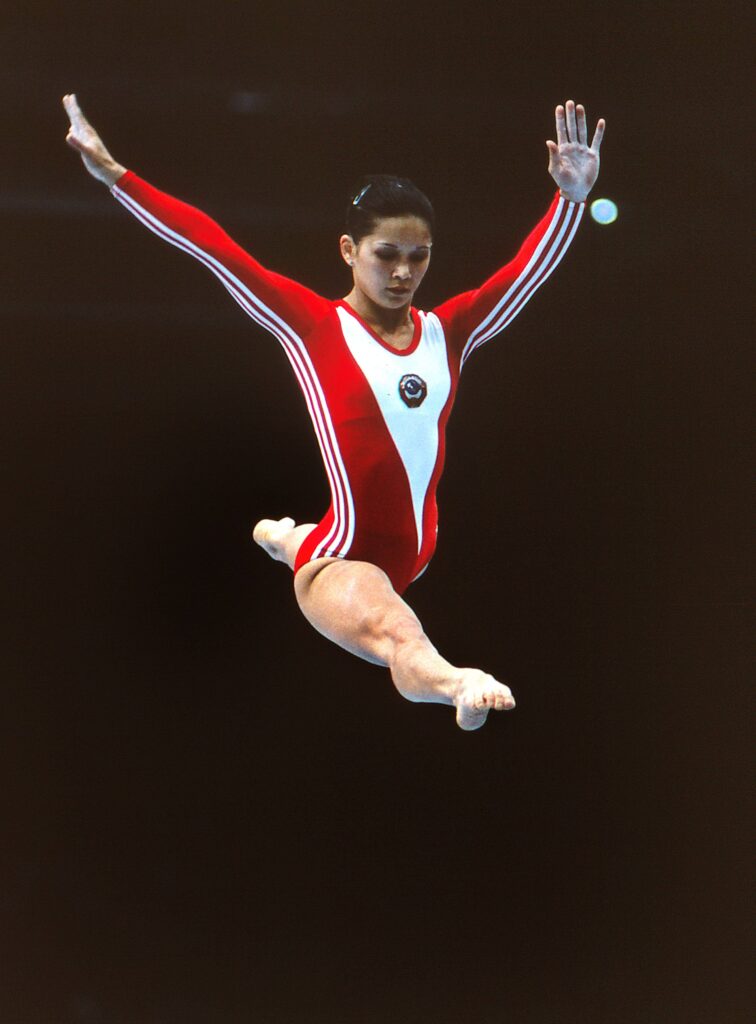
I was happy, but completely drained. The goal was achieved—three Olympic medals now in my collection. The highest kind. The country awarded me, along with other Olympians, the Order of the Red Banner of Labor.
I thought to myself: you did everything you could. You lived up to expectations. Time to think about your personal life. You denied yourself so much—for the sake of sport, for gymnastics.
When I returned to Chimkent, I forgot about the gym completely. Baydin asked: “When should we schedule training?” I looked at him as if I were seeing him for the first time.
I plunged into an atmosphere of admiration. Immodest? But that’s how it was. I was, as they say, in demand everywhere. My parents were proud of me, and Irka—she was simply over the moon, sticking her nose in the air in front of her friends. Every morning, the phone rang—polite, pleading, insistent, sometimes even demanding invitations to schools, technical colleges, factories, clubs, sports sections…
A month later, walking past my old sports school, I looked into the gym. I just wanted to see the girls with whom I had started here. Very few of them were left. Mostly “youngsters.” My old friends were already working as coaches, having children…
Naturally, they all gathered around me. Why aren’t you training? Well, I told them, I’ve decided to quit.
Surprise on their faces. The coaches shook their heads. Quit gymnastics at nineteen?
We talked about everything for a long time. I opened up, couldn’t stop:
— Look, girls. I still have two years before graduating from the Institute of Physical Culture. But for some reason, I don’t want to be a coach. I feel I’m not ready yet for this difficult profession. Maybe I could work as a PE teacher at a school? But would I be able to teach children with real heart? I don’t know… It seems I’m drawn to some kind of work with foreign languages. It’s not for nothing that I study English. I like it… I like speaking with foreigners, telling them about us, about beautiful Kazakhstan, about Chimkent—after all, they don’t know much…
At the time, nothing was clear. Suddenly, I had the urge to hide away from people. And I set off for a little village near Kazan, where my grandmother lived.
What a wonder those two weeks spent on the Volga were! Peace hovered over me in the tall fir trees. I could lie for hours in a meadow, basking in the no-longer-hot autumn sun, watching an ant hurrying about its business, grasshoppers, beetles…
And one day, I realized that idleness, river swimming, soul-searching—all of it was really the deepest longing for the gym, for the old apparatus, for gymnastics, without which, it turned out, life was dull!
That very day, I bought a ticket back to Chimkent, couldn’t sit still on the plane, and, upon arrival, burst into Baydin’s home:
— Training starts tomorrow!
Nearly two months without the gym… I hadn’t even done exercises. You can imagine how much weight I’d gained.
I entered the familiar gym—tears in my throat. What had I done? Where would I be without gymnastics? So much strength left, so many plans unfulfilled!
And I didn’t have a single free minute. Evenings, I spent over textbooks. I didn’t abandon English either. My dictionary was always with me, and each day, I memorized about five or six words or expressions.
And then came England, exhibition performances, and different cities in that country. Enthusiasm flooded my heart again. I dreamed once more of victories on the world stage—the audience received me very warmly as one of the leaders of the USSR team. I won’t deny it; it was pleasant. I don’t want to boast, but I felt that I inspired sympathy.
In 1977, I moved to Minsk. And although my new coach was the Honored Master of Sport Nikolai Pavlovich Miligulo, who threw himself into the work with great zeal, the season didn’t go well for me—the move, a long illness—all this threw me off track.
…The final round of selection for the 1978 World Championships, to be held in Strasbourg, France, was still ahead. The new head coach of the national team, Aman Muradovich Shaniyazov, after reviewing my program at training camp, was quite satisfied. He said he counted on me and expected good results.
And the final round—that was the USSR Cup. It was nerve-racking, with many falls; even the country’s all-around champion, Lena Mukhina, finished only fourth. As for me, I competed steadily, but, as we anticipated, the overly strict rules (remember how some gymnasts then received more than ten points for performing ultra-difficult elements?) pushed me back to seventh place.
We went to Strasbourg with this team: Elena Mukhina, Maria Filatova, Natalia Shaposhnikova, 15-year-old Tatiana Arzhannikova from Vitebsk, Svetlana Agapova from Yaroslavl, and me. That very team won gold! Once again, we defeated the strong Romanian gymnasts!
[Note: Tatiana Arzhannikova was officially born in 1964, so officially, she could not be 15 in 1978.]
The title of all-around world champion went to Elena Mukhina; I was just two-tenths of a point behind her, and third place went to Natasha Shaposhnikova. Of course, I was pleased with such an outcome—after almost two years of quiet, I managed such a successful performance. And I got plenty of applause. Could it be they still remembered me, that the judges liked me? I was very happy for Mukhina—a true champion, without reservation. The most difficult program, virtuosity, softness, femininity. And the consistency that she had long lacked.
My soul sang. Inspired, in the finals, I won the vault title, and together with Lena, we shared the gold medals in floor exercise.
1979—that was my year!
I took part in the second Spartakiad of the Peoples of the USSR in my life. And although I couldn’t repeat my success of 1975 by winning the all-around, in the finals, I won three gold medals: on floor, vault, and bars. By the way, on floor, I had another premiere—Moscow choreographer Galina Vladimirovna Savarina staged for me a new floor routine set to Santa Esmeralda’s “House of the Rising Sun.”
Buoyed, I carefully prepared for the 20th World Championships, which took place in early December in Fort Worth, Texas.
The team seemed strong enough: three experienced gymnasts—Masha Filatova, Natasha Shaposhnikova, and I—and three young girls: Lena Naimushina from Krasnoyarsk, Stella Zakharova from Kyiv, and Natasha Tereshchenko from the settlement of Ust-Omchug in the Magadan region. All of them had performed well in all-Union and international competitions. Zakharova, moreover, had won the 1979 World Cup in Tokyo. I had taken second place there.
But alas, Zakharova, Tereshchenko, and Naimushina made mistakes on bars, and our team lost first place to the Romanians. That had only happened once before at World Championships—in 1966, when the Soviet team was defeated by Czechoslovakia.
Yes, we were very upset, but there was still one more chance to “make it up.” I led going into the finals, with an excellent 15-year-old gymnast from the GDR, Maxi Gnauk, close on my heels.
In the finals, I received four scores of 9.85. Just as if ordered! Gnauk fell behind by 0.275 points. For the first time, I won the title of all-around world champion!
You can imagine what a joyful New Year I had! My father and mother flew to Minsk, as did my brother, while my sister was already living with me, studying at a boarding school, and, by the way, had switched from gymnastics to synchronized swimming. (Now Ira is in the tenth grade, a member of the Belarusian national team, preparing to compete at the Spartakiad of the Peoples of the USSR.) My brother brought his new drawings; he had discovered a talent for art and enrolled in an art school.
Time… there is never enough of it. Already on January 1, 1980, I went to training. I hadn’t slept—went to bed at three in the morning. But I knew the Moscow Olympics lay ahead. And of course, I wanted to win the main prize of the Olympic Games.
At last, I could fully express, fully reveal my “self” through sport, through gymnastics, through movement. And my soul demanded work, demanded fire.
I trained a lot, with joy. Every step, every action was carefully considered. As a graduate of the Institute of Physical Culture, I tried working with young gymnasts. But I hadn’t yet fully tasted coaching; competition and twice-daily training demanded special attention. Still, no matter how hard it was, I never refused public assignments: in the national team, the Komsomol bureau entrusted me with helping newcomers to the squad, and in the republic, when meeting with sports enthusiasts, I promoted my beloved gymnastics. I especially remember a meeting at the House of Culture of the Minsk Tractor Plant. The audience asked such interesting questions.
And again, the struggle for leadership at the Olympic tournament in Moscow was between the well-known Nadia Comăneci and me. But unfortunately, on my beloved floor exercise, I touched the mat with my hands—a serious error. It dropped me immediately to fifth place.
And here into the fray stepped Maxi Gnauk of the GDR and Elena Davydova. Until the very last apparatus, it was unclear who would wear the crown of the all-around champion of the 22nd Olympic Games. The gold medal went to Lena Davydova! Comăneci and Gnauk tied for second. And the Soviet team—once again—took first place. The girls hugged me like an older sister, like their captain.
…I still had one more chance—the apparatus finals. And I was doubly happy that it was on floor exercise that I was able to repeat my Montréal triumph. Both Nadia Comăneci and I had the same total. And we, two old rivals, both received the top prize. Nadia also distinguished herself on beam; there, she won gold as well.
At a party in the Olympic Village, I met my future husband, Valery Movchan. In the first days of the Olympics, he had won gold as part of the USSR team in the team pursuit on the velodrome. And in March 1981, we were married. At last, I had found a true friend.
I celebrated my 25th birthday on July 29, 1982, in Moscow. At the same time, the USSR cycling championships were being held in the capital, with my Valery participating. We gathered with friends in a café and celebrated two birthdays at once—mine and that of world track cycling champion Sergei Kopylov.
A month later, Valery and Sergei competed at the World Championships in England. Both won gold medals in their events.
While Valery was in England, I was invited to visit the International Youth Camp near Minsk. There was the traditional meeting of youth from the USSR and France. It was great fun; they even held their own mini-Olympics.
And then in Soviet Sport, I read several interviews with participants in the meeting. Don’t think I want to boast, but the words of Corinne Cholet, a French schoolgirl, seemed to me objective: “Western newspapers and magazines keep saying that the Soviet system of physical education leads to colorlessness, to stereotyped personalities. That is a complete lie; I saw for myself when I met Nellie Kim. A sporting star of the first magnitude, she has not turned into an unapproachable idol worshipped by fans, but has remained a modest, warm person. Aren’t such people one of the achievements of Soviet sport?”
Once again, I ask the readers’ forgiveness, but this quote refers not so much to me as to the thousands of our sporting stars. Sport helped them find their place in life, to be optimists, true builders of a communist society.
…After the Olympics, I continued to take part in exhibition performances, and I became interested in judging—“performing” at national championships and international tournaments. I worked with gymnasts at the sports club of the Red Banner Belarusian Military District, while also trying to find my calling beyond the podium—I wanted to test myself in journalism, as a translator…
And while I was still in this period of reflection, I was given a serious and responsible assignment—to help prepare the Belarusian team for the Spartakiad of the Peoples of the USSR.
And once again, I was back in the gym. And it was very rewarding that my advice, my experience, helped the gymnasts in their training. And little girls looked at me with wide eyes. And I felt that I liked this new work…
Thank you, sport! You gave me happiness. Could I ever part with you?…
Literary record by V. Golubev.
Sovetsky Sport, February 18, 1983
Notes
Spartakiad of the Peoples of the USSR. Held roughly every four years between Olympic cycles, the Spartakiad was the closest domestic equivalent to the Olympic Games in the Soviet Union — a multi-sport competition in which athletes represented their constituent republics rather than the unified national team. For gymnasts, it served both as a major competitive event in its own right and as a de facto selection trial. Kim won the all-around at the 1975 Spartakiad, sharing the title with Olga Korbut — a result that signaled her arrival in the top tier of Soviet gymnastics even before her Montréal medals confirmed it.
Sports Society Spartak. Soviet athletes were generally attached not to independent clubs but to large voluntary sports societies affiliated with particular sectors of Soviet institutional life. Spartak was one of the largest, drawing its membership primarily from trade unions in light industry, consumer cooperatives, and the civilian workforce — as distinct from the military-affiliated CSKA or the police-affiliated Dynamo. The society maintained sports schools, facilities, and coaching staff across the country, including the Chimkent school where Baydin worked. When Kim notes that Spartak shefstvovalo — patronized or sponsored — her school, she is describing the organizational chain through which state resources reached provincial athletes.
Children’s and Youth Sports School (DYUSSH). The DYUSSH network was the backbone of Soviet elite sports development. State-funded and administered through local education or sports committees, these schools identified promising children, often through recruitment visits to ordinary schools — exactly the scene in which Baydin appears in Kim’s classroom — and provided them with coaching, equipment, and competition opportunities at no cost to their families. By the late Soviet period, the network comprised thousands of schools nationwide. Although entry-level recruitment could be broad, advancement through the system was highly selective.
Beshbarmak. A Central Asian dish of boiled meat — traditionally lamb or horse — served over flat noodles. Traditionally eaten by hand, the dish’s name literally means “five fingers” in Kazakh. It is closely associated with Kazakh and Kyrgyz hospitality and is quintessentially festive food, the sort of meal prepared for honored guests. That Kim’s family served beshbarmak to the visiting American director, and hauled a twenty-four-kilogram watermelon from the bazaar to accompany it, was not incidental hospitality but a full expression of the local tradition of honoring a guest with abundance.
The melon. Chimkent sits in southern Kazakhstan, in an agricultural region where melons — particularly the sweet, dense varieties long cultivated in Central Asia — have been grown for centuries and remain a source of regional pride. The melon is not merely a generic symbol of summer or sweetness but a specific pleasure tied to a particular landscape and climate. When Kim, drilling her Tsukahara vault in Minsk with the Olympics only weeks away, finds herself consumed by a longing for melon, the episode reads less like a simple craving than a moment of homesickness: a yearning for something so rooted in home that it cannot quite be replicated elsewhere.
Komsomol bureau. The Komsomol — the All-Union Leninist Young Communist League — was the mass youth organization through which Soviet citizens between roughly fourteen and twenty-eight participated in organized civic and political life. Membership was effectively expected for anyone with professional or athletic ambitions. Within institutions such as the national gymnastics team, a Komsomol bureau handled many of the organizational responsibilities assigned to young people: mentoring newcomers, encouraging collective discipline, coordinating public appearances, and overseeing political education activities.
Order of the Red Banner of Labor. Established in 1928, the Order of the Red Banner of Labor was one of the Soviet Union’s highest civilian decorations. It was awarded for exceptional achievements in industry, science, culture, education, public service, and sport. Olympic champions and other distinguished athletes frequently received the order as recognition not only of their competitive success but also of their contribution to Soviet prestige abroad. When Kim notes that she was awarded the Order of the Red Banner of Labor following the 1976 Montreal Olympics, she was joining a select group of athletes whose accomplishments were deemed to have national significance. The decoration ranked among the Soviet state’s most prestigious honors and reflected the importance attached to international sporting success during the Cold War.
Tatars. The Tatars are a Turkic-speaking people whose historical homeland lies in the Middle Volga region of Russia, particularly in and around the Republic of Tatarstan, with Kazan as its principal cultural center. The term Turkic refers to a large family of related peoples and languages stretching from Turkey across the Caucasus, Central Asia, and Siberia. Tatars, Kazakhs, Uzbeks, Kyrgyz, and Turks all belong to this broader Turkic linguistic and cultural family, though they possess distinct histories and identities. Descendants of the medieval populations of the Volga Bulgars and the Golden Horde, Tatars constitute one of the largest ethnic minorities in the former Soviet Union. When Kim identifies her mother as a Tatar from a village near Kazan, she is locating part of her family background within a distinct cultural and linguistic tradition that differs from both the Russian majority and the Korean heritage of her father.
March 8 (International Women’s Day). One of the most important public holidays in the Soviet Union. Men and boys customarily gave flowers, cards, and small gifts to women and girls, including classmates, teachers, relatives, and coworkers. A gift given on March 8 did not necessarily imply romantic interest, though particularly thoughtful gifts could carry personal significance.
Fact-check. Personally, I would love to read Nelli Kim’s fact-checked version of this memoir. Soviet sports autobiographies were rarely the product of a single author, and some athletes later rejected stories that appeared under their names. Olga Korbut, for example, disavowed Olga Korbut: A Biographical Portrait, written by Sovetsky Sport journalist Mikhail Suponev. Likewise, in a 2008 interview with International Gymnast, Olga Mostepanova seemed to reject a widely circulated 1998 Sovetsky Sport interview, insisting that she had never given an interview about her age. Whether Kim would endorse every detail of The Smell of Melon is impossible to know. What can be said is that the memoir reflects not only Kim’s recollections, but also the editorial practices and publication culture of Soviet sports journalism in the early 1980s.
More Books