At the 2010 Asian Games in Guangzhou, Chinese gymnast Zhang Chenglong and South Korea’s Kim Soo-Myun finished in a tie for the gold medal in the men’s floor exercise final. But several months later, the result became the center of a judging scandal. The FIG alleged that Chinese judge Shao Bin, who was serving on the difficulty panel, had altered an execution score before it was posted, without consulting the execution-panel chair or the superior jury. According to the FIG, the change raised Zhang from second place into a tie for first.
Initially, the Chinese Gymnastics Association distanced itself from Shao’s actions, describing the score change as his own unilateral decision and promising further action once the FIG completed its investigation. But Shao later offered a very different account. He acknowledged changing the score but argued that he had done so to correct an injustice, insisting that Zhang had performed better and deserved the gold medal. Chinese team officials, including head coach Huang Yubin, publicly defended him, while also questioning why FIG technical delegate and superior-jury president Adrian Stoica had ultimately approved the competition results.
The dispute, therefore, became about more than whether a score had been changed: the parties disagreed over who knew about the alteration, who bore responsibility for allowing the changed score to stand, and whether Shao’s stated desire to correct what he regarded as a judging error could justify bypassing established procedures. In August 2011, the FIG ultimately found Shao guilty of fraud, downgraded his judging status, and ordered him to pay $8,800 in legal costs.
Here’s some of the press coverage of the judging controversy.
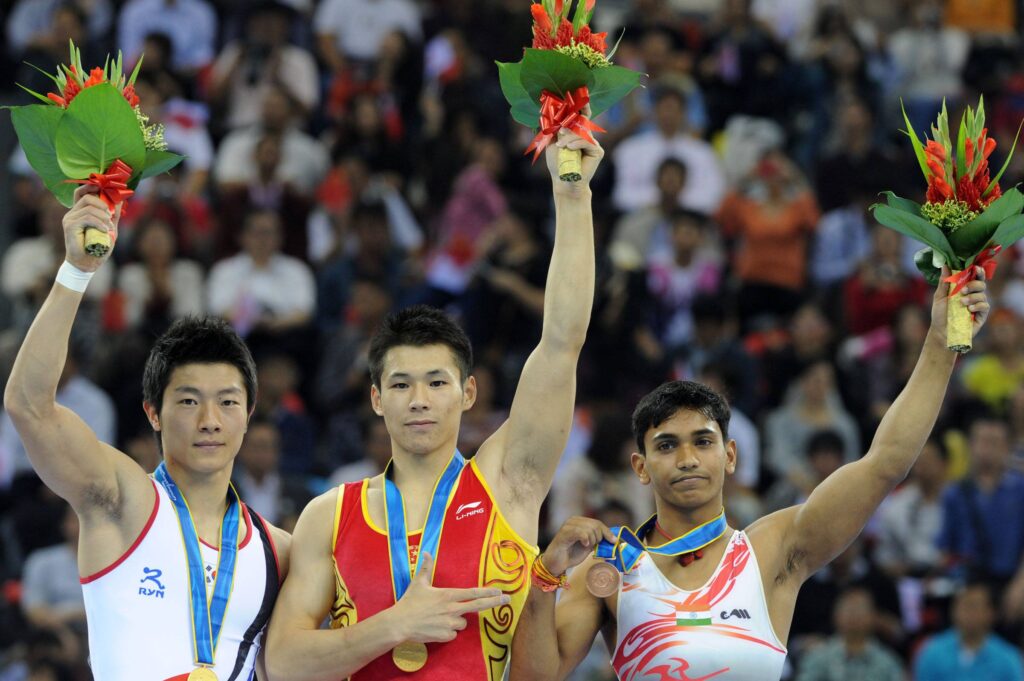
2010: Korean Coverage at the Time
Kim Su-myeon Wins Floor Exercise Gold
November 17, 2010 | By Choi Hee-jin
Shares First Place with Chinese Gymnast
Kim Su-myeon (24, POSCO Engineering & Construction) has won South Korea’s first gold medal in artistic gymnastics at the Guangzhou Asian Games. On November 16, Kim scored 15.400 points in the floor exercise final at the Asian Games Town Gymnasium, tying with gold medal favorite Zhang Chenglong of China to share the gold medal.
Kim qualified for the eight-man final in second place with a score of 15.250, behind Zhang Chenglong (15.350). He was the sixth gymnast to compete in the final. Although Kim had watched Zhang score 15.400 before taking to the floor, he showed no signs of nervousness, performing his entire routine—including difficult aerial skills and landings—with near perfection.
The judges spent more than five minutes evaluating Kim’s performance before awarding him the same score as Zhang. Under gymnastics rules, when two gymnasts receive identical scores, both are awarded medals.
Kim, who had previously shared the pommel horse gold medal at the 2006 Doha Asian Games, once again found himself sharing the top spot, this time after switching his specialty to floor exercise. With his victory, South Korea extended its streak of winning at least one gold medal in men’s artistic gymnastics to seven consecutive Asian Games, dating back to the 1986 Seoul Games.
After the competition, Kim admitted, “To be honest, isn’t it better to win a gold medal all by yourself? It’s a little disappointing.”
Nevertheless, he added, “I would have been happier if I had won the gold medal outright, but I’m grateful just to have received one. I’ve been under a lot of stress because of frequent minor injuries, but I overcame them through extensive training.”
Kim and Yoo Won-chul (26, POSCO Engineering & Construction) are regarded as the two leading figures in South Korean men’s artistic gymnastics.
Kim had already raised expectations for an Asian Games gold medal by finishing third in the individual all-around at the Japan Cup in July, a competition featuring the top eight men’s and women’s artistic gymnastics teams from the Olympics.
On November 15, Kim narrowly missed a medal in the individual all-around final, finishing fourth with a six-event total of 88.750 points. However, he made up for that disappointment the following day with a polished performance on his specialty, floor exercise, establishing himself as one of Asia’s best.
Meanwhile, Yoo Won-chul failed to win a medal, finishing fourth on still rings and sixth on floor exercise. In the pommel horse final, Kim Hee-hoon (Korea National Sport University) and Kim Ji-hoon (Seoul City Hall) finished fifth and sixth, respectively.
In the women’s competition, Cho Hyun-joo (Hakseong Girls’ High School), who had been considered a medal contender, finished fourth in the vault final after making a mistake on her landing. Park Ji-yeon (Cheonan Girls’ High School) and Park Eun-kyung (Dogok Spa Land) finished fifth and seventh, respectively, on uneven bars.
Original
March 2011: Coverage of the Controversy
Chinese gymnastics judge faces discipline over disputed Asiad gold
The global governing body of gymnastics has opened disciplinary proceedings against a Chinese judge for altering scores to help a Chinese athlete share a gold medal with a South Korean gymnast at last year’s Asian Games.
The International Gymnastics Federation (FIG) said Wednesday the judge Bin Shao, who was only supposed to evaluate the difficulty of routines on the “D” panel, modified an execution score for China’s Zhang Chenglong in the men’s floor event at the Asian Games in Guangzhou, southern China. The FIG said Bin altered the score prior to its release but failed to inform either the head execution judge or the superior jury.As a result, Zhang ended up sharing the gold with Kim Soo-myun of South Korea.
“Mr. Bin committed this act upon his own initiative and with complete disregard for the rules in force,” FIG said in a statement, adding the judge’s attitude was “wholly unacceptable.”
In artistic gymnastics, there are two judges who determine the difficulty of the routine and award a D-score, and four judges for execution who give an E-score.
The D-score is open ended and judges can add points based on the difficulty of required elements. The E-score has a base score of 10.0 and judges deduct points for mistakes.In Guangzhou, Kim earned a 6.600 D-score, 0.2 more than Zhang.
Despite a relatively clean routine, Kim earned an 8.800 E-score, while Zhang scored a 9.000.
Kim Dae-won, a senior official at the Korea Gymnastic Association who served as a judge in Guangzhou, recalled that Adrian Stoica, head of the men’s technical committee at FIG, reprimanded Bin for the scoring change, and the event had to be stopped for several minutes.
“The Asian Games ended quietly anyway, but FIG had been quite upset over Bin’s violation,” Kim said. “I think the latest measure is an extension of that.”
Kim said he found the FIG decision rather unusual.
“Most FIG judges are European and the Asian Games are run by the Asian Gymnastics Union,” he said. “So the FIG didn’t take much interest in the Asiads.”
China won all but one of the gold medals in artistic gymnastics in Guangzhou. South Korean Yang Hak-seon prevented the sweep by taking the men’s vault.
Korean Herald, March 17, 2011
“Gymnastics Judge Shao Bin Committed Violation — Apparently on His Own Initiative”
Xinhua Daily Telegraph, March 18, 2011, reporters: Ji Ye, Luo ZhengguangThe International Gymnastics Federation issued a statement on its official website on March 16 stating that Chinese judge Shao Bin is suspected of violating relevant ethics codes and arbitration rules during the men’s floor exercise final at the Guangzhou Asian Games.
“Mr. Shao Bin was serving on the difficulty panel. He made a change before an execution score was announced, but did not consult the execution chair or the superior jury before doing so. Mr. Shao Bin has admitted to this conduct,” the statement said. The FIG further stated that Shao Bin’s action caused Chinese gymnast Zhang Chenglong’s score to rise from second place to first, tying Korean gymnast Kim Su-myeong for the gold medal. The FIG found Shao Bin’s attitude toward the matter “entirely unacceptable” and decided to refer the case to the Disciplinary Committee. Shao Bin and the Chinese Gymnastics Association were notified on the 10th.
Chinese Gymnastics Association: Shao Bin acted on his own
Chinese Gymnastics Association deputy secretary-general Pan Chenfei stated on March 17 that the incident was Shao Bin’s own unilateral act, and that after the FIG had confirmed the facts and issued its ruling, the CGA would take corresponding action.
The CGA’s three-point statement read as follows: First, the association had notified Shao Bin as required by the FIG and had immediately launched an investigation. Based on preliminary findings, this was Shao Bin’s own unilateral act. The association would conduct a deeper investigation and required his cooperation. Second, the association has always been firmly opposed to violations of international gymnastics rules. We have consistently required that judges follow proper conduct in both training and management, and any violation of international sports rules is wrong. Third, the FIG is currently investigating the matter; once findings are confirmed and a ruling is issued, the association will take corresponding action against the individual involved.
Pan Chenfei noted that the management of gymnastics judges at the Guangzhou Asian Games was the responsibility of the Asian Gymnastics Union. The Sports Administration Center for Gymnastics under the General Administration of Sport is responsible only for domestic competition judging.
When asked whether Zhang Chenglong’s gold medal might be rescinded, Pan said the FIG would decide based on its investigation, but that the outcome was not yet known.
China won 13 gold medals in gymnastics at the Guangzhou Asian Games — just one short of a sweep — equaling the country’s historical best at the 1994 Hiroshima Asian Games.
Chinese gymnastics team leader: Awaiting official investigation results
Team leader Ye Zhennan stated on March 17 that he was not fully informed of the situation and was awaiting the official investigation results. “We have received the relevant notification from the FIG. The FIG handles judges it considers problematic every year. As for the national team, we only organize athletes to compete; we are not aware of this incident. We are also waiting for the official investigation results.”
The Sports Administration Center for Gymnastics under the General Administration of Sport was reportedly holding meetings to discuss the matter and would make a public statement later.
Shao Bin chooses silence
Shao Bin declined to speak with reporters by telephone on March 17. Shao Bin currently serves as dean of the College of Physical Education at Shanghai University. Shanghai University Party Committee propaganda department deputy director Liu Shaoxue stated that although Shao Bin holds a position at the university, his participation in the Asian Games judging was arranged and managed by the Chinese Gymnastics Association, so the university was not aware of the specifics of the alleged violation. Liu added that the university was also trying to contact Shao Bin, hoping he would offer “some kind of explanation,” but had not yet received a response. The Shanghai Municipal Sports Bureau and the Shanghai Gymnastics Sports Center both told reporters that because Shao Bin’s status is that of a national gymnastics judge, he does not fall under the management of municipal sports authorities, and they were accordingly unaware of the alleged score-changing violation.
An “intolerable” scandal
On March 16, an unprecedented scandal shook the international sports world: Chinese gymnastics judge Shao Bin was suspected of having unilaterally altered scores during the Asian Games to ensure a Chinese gold medal. The FIG found this conduct, which violated sporting ethics, “intolerable” and stated it must be severely punished.
In recent years, Chinese sports has seen a succession of scandals — age falsification, doping, match-fixing, and corrupt officiating have all been recurrent. But for a Chinese judge at a major international competition to unilaterally alter scores in violation of the rules of the relevant international sports body appears to be a first for Chinese sports — and indeed, such conduct has rarely been seen in the history of major international competitions.
According to the Korea News Agency, “a Korean judge witnessed Shao Bin’s score alteration and it was discovered at the time by the head of the judges’ technical committee, who rebuked him; the competition was even briefly suspended as a result.”
According to the Chinese Gymnastics Association, Shao Bin has internally “confessed” and taken personal responsibility. If that is the case, several questions arise: Why did Shao Bin alter the score? Why did he risk being caught in the act in order to secure an Asian Games gold medal for the Chinese gymnastics team? And was this truly a personal act, or was he instructed to do so — or both?
Before Shao Bin himself speaks, these remain mysteries; even after he speaks, his account may not necessarily reflect the truth.
In reality, Shao Bin’s motive is not difficult to surmise — it likely falls into one of two categories: first, he was driven by material interest, seeking gain for himself or some interest group; second, he was driven by sentiment — pursuing gold medals at any cost in the name of “patriotism.” If the former, this is a familiar type — Shao Bin is simply another person brought down by the chains of sporting interests. But if the latter, that is considerably more alarming, because it represents a distorted, pathological, and narrow-minded form of nationalism that has nothing to do with genuine patriotism and in fact damages the nation’s image.
The Shao Bin incident is yet another warning for Chinese competitive sports. In recent years, the gold-medal-at-all-costs mentality has continued to prevail in Chinese competitive sport, and this fixation on gold medals above all else at competitions large and small has given rise to many distortions and disorders.
体操裁判邵斌违规,疑本人擅自所为
(Reporter: Yang Ming)
新华社日内瓦3月16日体育专电国际体操联合会16日在其官网上发布声明称,在广州亚运会男子自由体操决赛上,中国籍裁判员邵斌(音)在执法时,存在违背相关道德章程和仲裁规定的嫌疑。“邵斌先生当时是在难度组,他在一项执行分数公布前作出了更改,但是更改前他并未与执行裁判长或高级裁判组沟通。(邵)斌先生对此行为供认不讳,”该声明说。同时国际体联称,邵斌此举导致了中国体操选手张成龙的分数从第二位升至了第一位,与韩国选手金洙眠并列第一。国际体联认为“完全无法接受”邵斌对待此事的态度,因此决定从严处置,现已将本案移交纪律委员会处理。邵斌本人及中国体操协会已于10日接到了国际体联的通知。中国体操协会:违规改分是邵斌擅自所为据新华社北京3月17日电(记者姬烨)中国体操协会副秘书长潘辰飞17日就裁判邵斌在广州亚运会上涉嫌违反裁判规程一事表示,该事件是邵斌擅自所为,在国际体操联合会查实并作出处理后,中国体操协会也会做出相应处理。中国体操协会在其三点说明中指出:第一,协会已经按照国际体联的要求通告邵斌本人,并立即展开调查。经初步调查,此事是邵斌本人擅自所为。协会还将对此事进行深入调查,并要求他配合调查。第二,协会对违反国际体操规则的事情历来是坚决反对的。我们一贯在体操裁判的教育和管理上要求遵守规矩,任何违反国际体育规则的行为都是错误的。第三,目前国际体联正在对此事进行调查,一经查实并作出处理,协会也将对当事人作出相应处理。潘辰飞称,广州亚运会体操裁判的管理是由亚洲体操联合会负责。体育总局体操运动管理中心只负责国内体操比赛的裁判管理。当被问及张成龙获得的这枚金牌是否会因此而被取消时,潘辰飞表示国际体联将根据实际调查情况决定,但现在还不知道调查结果。中国体操队在广州亚运会上夺得13枚金牌,只差一金实现包揽,平了1994年广岛亚运会的历史最好成绩。中国体操队领队:裁判违规一事等待官方调查结果据新华社北京3月17日电中国体操队领队叶振南17日表示,对这一事件还不太清楚,目前正在等待官方调查结果。叶振南说:“这个事情我们已经接到了国际体联的相关通知,国际体联每年都会对一些他们认为有问题的裁判进行处理。对于国家队,我们只是组织队员参赛,对这个事件并不清楚。我们现在也在等待官方调查的结果。”据悉,国家体育总局体操运动管理中心目前正开会研究此事,将在晚些时候对此事公开表态。邵斌选择沉默据新华社上海3月17日体育专电(记者罗争光)邵斌17日对记者的电话采访选择了沉默。邵斌现任上海大学体育学院院长。上海大学党委宣传部副部长刘绍学表示,虽然邵斌在该校任职,但由于参与广州亚运会裁判工作由中国体操协会统一管理安排,因而学校方面尚不清楚其涉嫌违规的具体情况。刘绍学还表示,学校方面也在与邵斌本人联系沟通,希望他能对此事“有个说法”,但尚未得到回应。上海市体育局和上海市体操运动中心在接受记者采访时也表示,因为邵斌的身份为国家体操裁判,不接受上海市体育部门管理,因而对其此次涉嫌违纪改分的情况并不了解。“无法容忍”的丑闻16日,一则前所未闻的丑闻震动了国际体坛:中国体操裁判邵斌,涉嫌在广州亚运会比赛中,为保中国选手夺金牌而擅自改分。国际体操联合会认为这种违反体育道德的行为“无法容忍”,必须进行严厉处罚。近年来,中国体坛丑闻不断,更改年龄、兴奋剂、假球黑哨等现象屡见不鲜,但在国际大赛上,中国裁判违反相关国际体育组织的规定而擅自改比分的丑闻却似乎是中国体坛第一例,这种行为甚至在国际体坛大赛史上也鲜有所闻。据韩通社报道,“一位韩国裁判看到,邵斌改比分的行为当时已被裁判技术委员会主任发现并受到斥责,比赛甚至因此而中止一段时间。”按照中国体操协会的说法,邵斌已经内部“招了”,并把责任都揽在自己身上。如果真是如此,就产生如下疑问:第一、邵斌为什么擅自改分?他为什么要冒被当场抓住的危险,拼命替中国体操队保一块亚运会金牌?第二、他这样做到底是个人行为还是有人授意?抑或是两者兼有?在邵斌本人没有开口前,这些依然是谜;甚至,在他开口承认后,也未必是实情。其实,邵斌的动机不难推测,无非出于两种可能:第一是受利益驱动,为自己或某利益团体牟利;第二是情感因素,为金牌,以“爱国”的名义而不择手段地争金牌。如果是前者,那是我们熟悉的类型,邵斌不过是又一个被体育利益链条绊倒的堕落者;但如果是后者,那就相当的可怕,因为这是一种扭曲、病态、狭隘的民族主义心态,不但和爱国无关,反而损害了国家形象。邵斌事件对中国竞技体育是又一次警醒。这些年,中国竞技体育界依然盛行唯金牌论,在大大小小的运动会上,金牌压倒一切的定位催生了许多体坛怪象、乱象。(记者杨明)
“The Gymnastics ‘Score-Changing Scandal’ — Who Was Really at Fault?”
Jiefang Daily, March 20, 2011, reporters: Yao Qinyi, Zhang WeiAfter the Chinese gymnastics judging “score-changing scandal” came to light, it attracted widespread attention. The judge at the center of the affair, Shao Bin, who had initially remained silent, finally broke his silence; members of the Chinese gymnastics team rallied to defend him; and FIG technical officials stepped forward to insist that they had fulfilled their own responsibilities. With each party maintaining a different account, many people were left confused: who was actually at fault here?
Shao Bin: “This is what a judge should do”
Shao Bin spoke publicly for the first time: “I act with a clear conscience, and as a judge I should do what I did.” Shao Bin maintained that he had changed the score in the interest of fairness and to protect the rights of the athlete who had genuinely performed better: “Zhang Chenglong’s performance in the competition was indeed superior to the Korean athlete’s; he rightfully deserved the gold medal.” Shao Bin also disclosed that at the time of the change, he had the tacit acquiescence of another judge — a Korean — and that it was therefore not entirely a unilateral act.
Members of the Chinese gymnastics team also stepped forward in support. Team leader Ye Zhennan argued that FIG men’s technical committee chair, Guangzhou Asian Games technical delegate, and head judge — Romanian Stoica — should bear responsibility. “All final results from the finals had to receive his final approval before taking effect. Stoica was present at the venue and raised no objection to Shao Bin’s action nor rejected it; in fact he signed off on the competition results. This point is quite puzzling.” Head coach Huang Yubin formally spoke up for Shao Bin in media interviews as well, stating that Shao Bin’s action in changing the score was itself an act of upholding the truth. “In both exercises, Zhang Chenglong surpassed the Korean athlete in both difficulty and execution. Our judge acted with integrity — he risked punishment to correct a mistake. If he hadn’t changed it, our Zhang Chenglong would have been wronged by a misjudgment and finished second. Who could he appeal to? Would it have been fair if the Korean athlete had taken the medal?”
Official: “I immediately raised the matter”
In response to team leader Ye Zhennan’s suggestion that any score change at the Asian Games had to pass through Stoica before taking effect, FIG men’s technical committee chair Stoica replied in his report to the FIG that he had absolutely not tacitly permitted any judge to change a score. Stoica stated that after Shao Bin changed the score, he immediately went to Huang Liping, a member of the judging panel, to raise the issue and attempt to have the score restored to the original figure given by the judges. As for why he had unlocked and passed the score through the system, Stoica said this was due to a design flaw in the system itself — but notably, he never explained why he ultimately signed off on the final results sheet.
“But nonetheless — and I acknowledge I do not have clear evidence — I consider that for a FIG international judge, Shao Bin’s conduct is unacceptable. I do not know whether, without clear evidence, this matter can be referred to the Disciplinary Committee, but this judge must certainly face consequences for what he did,” Stoica stated.
Crisis: When everyone claims to be blameless, that itself is the greater fault
In fact, with all parties in the “gymnastics scandal” insisting that they themselves were without fault, they are deepening a trust crisis for the sport. As of yesterday, a Sina.com opinion poll showed that 46.1% of respondents chose “multiple scandals in Chinese gymnastics lately — nothing unusual,” while only 24.7% chose “there may be more to this story than meets the eye.”
Behind Shao Bin’s action there may well have been no material interest; his changing of the score may genuinely have been motivated by a sense of fairness. But regardless, his procedural conduct clearly violated the relevant rules. In the face of this incontrovertible fact, no amount of self-justification — however ethically defensible — can exonerate him professionally, and no amount of argument will win public sympathy.
From the FIG’s perspective, even if Stoica did raise objections to the score change at the time, his final signature remains there in black and white — and that cannot be denied. As head judge, he must take responsibility for that tacit endorsement.
A commenter online with the handle “SWD345” wrote: “There have already been quite a few negative stories about gymnastics. Now this has happened, and everyone is just passing the blame around. It’s disheartening.” The sentiment was widely shared.
As a subjectively scored sport, gymnastics is highly susceptible to controversy. This “score-changing scandal” concerns not only the image of Chinese gymnastics but the reputation of the sport worldwide. At this critical moment, the appropriate response for each party would be to accept its own responsibility — mutual finger-pointing will only cause greater damage.
体操“改分门”,到底谁错了?
中国体操裁判的“改分门”曝光后,引起各界广泛关注。日前,一度沉默的当事裁判邵斌也终于开口,中国体操队上下也纷纷站出来力挺事件主角,与此同时,国际体联的技术官员也站出来强调自己已履行职责。几方各执一词,让不少人有点迷茫:这件事,到底是谁错了?邵斌:“裁判应该这样做”裁判邵斌日前首度开口表达了自己的看法:“反正我做事心里坦然就行,我作为一个裁判应该这样做。”邵斌认为,他改分是为了公正以及保护真正完成动作较好的运动员的权益,“当时张成龙在比赛中的表现确实比韩国选手更佳,理应得到金牌。”此外,邵斌透露,改分时他得到另外一位韩国裁判的默许,不完全是擅自行为。中国体操队人士日前也纷纷站出来力挺邵斌。领队叶振南认为,国际体联男子技术委员会主席、广州亚运会技术代表和裁判长罗马尼亚人斯托伊卡要为此承担责任。“所有决赛的最终成绩,需要得到他的最终认可才能生效。斯托伊卡在现场并没有对邵斌的行为提出异议并驳回,而且还签字认可了比赛成绩。”中国体操队总教头黄玉斌接受媒体采访时也正式为邵斌喊冤,他指出邵斌当时改分的行为,本身就是坚持真理。“两套动作,我们张成龙不论从难度还是完成情况都高于韩国选手。我们裁判是公正的,冒着被处罚的危险把错误扭转过来,如果不变动,我们中国的张成龙在误判当中拿到第二,这个冤又向谁诉?难道让韩国选手拿了的话就公正了吗?”官员:“立刻进行了交涉”针对中国体操队领队叶振南关于 “亚运会上任何裁判的打分改分都必须通过斯托伊卡这一关才能生效”的质疑,国际体联男子技术委员会主席斯托伊卡在交给国际体联的报告中回应:自己当时绝对没有默许任何裁判改分。斯托伊卡表示,在邵斌改分之后,他立刻找到裁判组成员黄力平那里进行了交涉和沟通,“试图把成绩恢复成原来裁判所打的分数”。在解释为什么将当时的分数解锁通过时,斯托伊卡表示是因为系统本身的设计缺陷所致,但重要的是,他自始至终没有说明他为什么会在最终成绩单上签字。“但尽管如此——我确实没有明确的证据——我认为作为一位FIG国际裁判,邵斌的这种态度是不能接受的。我不知道如果没有明确的证据,这件事能不能移交给纪律委员会,但这名裁判必然应该为他的所为受到处罚。”斯托伊卡表示。危机:都没错才是大错事实上,在“体操门”这件事上,都强调自己无错,反而会加深体操这个项目的信任危机。截至昨天,新浪网公布的一份民意调查显示,选择“中国体操最近丑闻多,正常”的网民达到了46.1%,而选择“或许其中另有内情”的网民只有24.7%。裁判邵斌的背后可能确实没有什么利益链,他的改分行为,也确实是出于公平之心。但无论如何,他的操作程序确实违反相关规定。在这样一个铁的事实面前,哪怕伦理道德上问心无愧,但职业道德上却肯定难辞其咎。再多的辩解,并不会博得公众的好感。而从国际体联的角度来说,即便裁判长斯托伊卡当时确实对改分提出了异议,但他的最终签名却白纸黑字留在那里,这是无论如何无法抵赖的。作为裁判长,就必须为自己的这种默许行为负责。网名为“SWD345”的一位网友留言:“体操的负面新闻已经不少了,现在出了这个事,大家还在互相推诿责任,让人心寒。”这个说法得到了不少人的认同。体操运动作为一个主观评分类项目,很容易出现争议。可以说,这次的“改分门”事件并不仅仅关系到中国体操的形象,更关系到体操这项运动在全世界的脸面。在这样的关键时刻,各方面各领其责是最好的危机公关,互相推诿只会带来更大的麻烦。
“Stoica Responds to the Score-Changing Incident”
Wenhui Daily, March 20, 2011, reporters: Zhang Lü, Zhao BoThe Chinese gymnastics “judging scandal” continues to develop. FIG men’s technical committee chair and Guangzhou Asian Games gymnastics head judge Stoica responded yesterday, stating that the reason he failed to correct Shao Bin’s score change in a timely manner was that the computer scoring system experienced a technical problem, making it impossible to restore the original score, and that he was therefore forced to accept the changed result.
The Shao Bin “judging scandal” occurred during the Guangzhou Asian Games. Four months passed before the FIG decided to open an investigation. Both Chinese Gymnastics Association deputy secretary-general Pan Chenfei and team leader Ye Zhennan raised questions about this delay: “The final results of all competition events required Stoica’s signature before they could take effect. If Shao Bin had privately altered scores, Stoica would have been able to see this on the venue’s monitoring system in real time — yet he raised no objection and confirmed the results. That is puzzling.”
In his report to the FIG, Stoica wrote: “After learning of Shao Bin’s score change, I, as the head of the superior jury, attempted to restore the score to the original figure given by the judges. However, the scoring system used at the competition had not saved the original record — only the final score displayed on the big screen. Unable to find the original score, I was forced to accept the published score.”
“As a FIG judge, Shao Bin’s attitude [in altering the score] is unacceptable,” Stoica declared, stating that Shao Bin would “inevitably pay the appropriate price for what he has done.”
Stoica did not explain why the matter had only come to light four months after the fact. FIG press officer Philippe offered the explanation that although irregularities had been detected at the time, an immediate determination could not be made; evidence — witness testimony and physical evidence — needed to be gathered. After reviewing video footage of the competition that day, the FIG confirmed that the incident was suspicious and therefore reopened the matter.
According to one informed source, however, “the FIG is currently in the midst of a leadership transition and election, and internal competition is fierce. There are people who have grievances against Stoica. If he spotted the score-changing problem but signed off on it as technical delegate, he obviously cannot escape responsibility.” In other words, Shao Bin may have become a sacrificial pawn in FIG internal politics.
Notably, Shao Bin’s score change would have been impossible to conceal from the Korean judge who was also serving on the D panel at the time — yet that Korean judge neither reported nor disclosed the matter, either at the time or afterward, and the FIG has to this day taken no action against him.
After the Chinese gymnastics “judging scandal” broke, many knowledgeable insiders fell silent. In particular, after the Chinese Gymnastics Association characterized the score change as “personal conduct,” most insiders clammed up entirely — but head coach Huang Yubin took an unambiguous public position in defense of Shao Bin: “I told Shao Bin to hold his head high — you are the one who acted with integrity.”
Huang Yubin raised two questions: first, at previous Asian Games the FIG had never sent a technical delegate, but this time it did — “If there was an injustice, he had the authority to stop it or rule according to the rules. Why didn’t he?” Second, after the score-changing problem arose, why did Stoica sign off on the results sheet?
Huang Yubin maintained that Shao Bin’s score change was not an act of injustice. “In both exercises, Zhang Chenglong was superior to the Korean athlete in both difficulty and execution. At the time, many judges had made errors — but our judge acted with integrity. He risked punishment to correct the mistake. If he hadn’t changed it, our Zhang Chenglong would have been unjustly relegated to second place — and who would he have had to appeal to?”
According to reports, Shao Bin, now embroiled in the “judging scandal,” has traveled to Beijing. FIG spokesperson Philippe recently disclosed that the FIG has requested Shao Bin travel to Lausanne, Switzerland, to attend a FIG hearing — but this has not yet been confirmed by either Shao Bin himself or the Chinese Gymnastics Association.
中国体操“裁判门”仍在发酵。国际体操联合会(FIG)男子技术委员会主席、广州亚运会体操裁判长斯托伊卡昨日回应称,之所以没有及时纠正邵斌改分的行为,是因为他打分的计算机系统出现问题,无法更正比分,只能接受改分结果。邵斌“裁判门”一事发生于广州亚运会期间。时隔4个月,FIG才决定展开调查。对此,中国体操协会副秘书长潘辰飞和中国体操队领队叶振南都提出了异议,“比赛最终结果都需要斯托伊卡签字才能生效。如果邵斌私自修改比分,那他当时可通过现场监控录像看到,但他并没提出异议,还给予确认,这点很蹊跷。”在递交给国际体联的一份报告中,斯托伊卡称:“(在得知邵斌改分后)作为高级裁判组组长,我试图将成绩恢复成原先给出的分数,但赛会所采用的打分系统没有保存原始记录,只有最终显示在大屏幕上的得分。在找不到原始分的情况下,我被迫接受了公布的得分。”“作为一名FIG裁判,邵斌(擅自改分)的态度是不可接受的。”斯托伊卡声称,邵斌必然会为他的所作所为付出应有的代价。斯托伊卡没有说明,此事为何时隔4个月才曝光。国际体联新闻官菲利普的解释是:尽管当时已经发现了猫腻,但尚不能立即作出判断,需要收集人证、物证。在观看了当日比赛的影像资料后,FIG确认此事存在疑点,因而旧事重提。不过据一位知情人透露,“FIG现正处在换届改选的当口,相互竞争非常激烈,有人对斯托伊卡有意见。如果看出了改分的问题,作为技术代表最后却签字,他当然脱不了干系。”换言之,邵斌可能成为FIG人事斗争的牺牲品。值得玩味的是,“裁判门”事件中,邵斌改分举动很难避开另一位同在D组的韩国裁判,但无论在当时,还是事后,这位韩国裁判都没有检举或揭发改分一事,FIG至今也未对其作出任何处罚。中国体操“裁判门”事发后,体操界多名知情人均保持缄默。尤其是中国体操协会将改分定性为“个人行为”后,大部分知情人噤若寒蝉,但中国体操队总教练黄玉斌却态度鲜明地力挺邵斌,“我就跟邵斌说,你要挺直腰杆,你是正义者。”黄玉斌提出两点质疑,其一,以往的亚运会,FIG从不参与,这次却派技术代表参加,“出现不公的话,他有权制止或者按规则判罚,可他为什么没有做?”其二,出现改分问题后,斯托伊卡为何要在成绩单上签字?黄玉斌认为,邵斌改分并非不公之举。“两套动作,无论是难度,还是完成情况,张成龙都优于韩国选手。当时很多裁判都出现了误判,但我们的裁判是公正的,冒着被处罚危险把错误扭转了过来。”据悉,身陷“裁判门”的中国体操裁判邵斌已前往北京。FIG新闻发言人菲利普日前透露,国际体联要求邵斌前往瑞士洛桑,参加FIG的听证会,但此事尚未得到邵斌本人和中国体操协会的证实
“Chinese Sport Needs a Voice”
Jiefang Daily, March 29, 2011, reporter: Zhang WeiDiscussion of the score-changing scandal involving Chinese gymnastics judge Shao Bin has not yet run its course. This reporter reached Shao Bin yesterday; he said he has prepared all necessary materials and is waiting for the FIG to schedule his hearing. The FIG neither consulted with him beforehand nor provided a processing timeline afterward — leaving Shao Bin to wait indefinitely. This inevitably calls to mind a topic that has been raised before: that Chinese sport, especially in its strongest disciplines, needs a voice within the relevant international federations.
After Zhang Jilong faded from the inner circle at the AFC, the Chinese football world expressed anxiety about being “without allies in the court.” To be fair, Chinese football is not exactly a dominant force in Asia, and competing for a senior position in the AFC is genuinely difficult. But gymnastics and other Chinese sporting strengths not only can but absolutely should secure positions within their respective federations from which they can “make their voices heard.”
After retiring from competition, gymnastics legend Li Ning entered the judging ranks, and during that period there were few instances of deliberate score suppression against Chinese athletes. World champion Huang Liping, after retiring, joined the FIG and served as vice chair of the men’s technical committee. Li Xiaoshuang, after retiring, was also recommended to serve as an official at the FIG. But in recent years, China’s voice within the FIG — despite being the world’s preeminent gymnastics power — has gradually grown quieter. Although Huang Liping still holds a position at the FIG and even served as a senior judge at the Guangzhou Asian Games, in the handling of the Shao Bin affair, the Chinese side appears not to have been given any opportunity for prior communication or self-defense.
And it is not only gymnastics. After assuming the chairmanship of the Chinese Badminton Association, Cai Zhenhua stated that he wanted to strengthen China’s voice within the Badminton World Federation: “We must speak not only through performance on the court, but also through a deliberate effort to cultivate personnel who serve in international organizations — to make a genuine contribution within those organizations, to actively participate in all their work, and to play the role of a responsible major badminton nation.” China’s diving, judo, weightlifting, and other disciplines should all develop greater awareness in this regard. Particularly in subjectively scored sports like diving, which is similar in nature to gymnastics, strengthening China’s voice within FINA is especially important. The Chinese diving community has been working toward this goal in recent years; Guo Jingjing, for example, has expressed a desire to work within FINA after her competitive career.
It must be emphasized: the purpose of strengthening China’s voice within international sports federations is not to exploit an insider advantage to secure unjust benefits, but rather to better fulfill responsibilities, uphold fairness and integrity, and to have a smooth channel for communication when incidents arise. From this perspective, even Chinese table tennis — which dominates world competition — could make appropriate efforts in this direction.
2011: The Aftermath
Gymnastics judge Shao Bin back to work
(Xinhua)
Updated: 2011-05-11
BEIJING – Shao Bin, a gymnastics judge involved in a a dispute over at the 2010 Asian Games, made his appearance at a Chinese national meet before the international gymanstics governing body’s decision is announced, local media reported Wednesday.Shao showed up at the national gymnastics championships, also serving as a trial for the world championships, among a group of senior judges.
Shao declined to comment on his return to the judge panel as the International Gymnastics Federation (FIG) has yet to unveil their decision.
An experienced international judge, who refused to be named, considered that Shao’s return may be a sign of a favorable FIG decision, the newspaper said.
Shao was accused of modifying an execution score prior to the Men’s Artistic Floor Exercise final at the Guangzhou Asian Games late last year.
The new score moved China’s Zhang Chenglong from second to a first place tie with Kim Soo Myun of South Korea.
The FIG announced an appeal to the change of scoring in March and launched an investigation into this matter.
Shao insisted that his decision was not wrong because it ensured the justice of the competition.
Archived here
Chinese gymnastics judge guilty of changing score
LAUSANNE, SWITZERLAND — A Chinese gymnastics official has been found guilty of fraud after he falsified a score to help a Chinese athlete win gold at the 2010 Asian Games.
The International Gymnastics Federation says it downgraded Shao Bin’s status as a judge and ordered him to pay $8,800 in legal costs. He can appeal the sanction by Sept. 9. Shao worked on a panel evaluating the difficulty of routines in the men’s floor exercise final in November at Guangzhou, China.
The international federation says Shao “altered an execution score prior to posting” without telling event officials. The altered mark moved Chinese gymnast Zhang Chenglong from second into a tie for first place with Kim Soo-Myun of South Korea.
The Journal Star, August 31, 2011