By the spring of 1999, Meng Fei had established herself as one of China’s leading all-around gymnasts. Although often overshadowed by higher-profile teammates such as Liu Xuan and Kui Yuanyuan, she had helped China to silver at the 1995 World Championships and bronze in 1997, earned the 1997 World Championship silver medal on uneven bars, and won the all-around title at the 1997 Chinese National Games. This profile, published just months before the World Championships in Tianjin, gave English speakers a rare peek at life inside the Chinese national team.
Funny, outspoken, and occasionally irreverent, Meng discusses everything from exhausting training and unequal treatment of the women’s team to dancing in the dormitory with teammate Bi Wenjing. Enjoy this article from the archives!
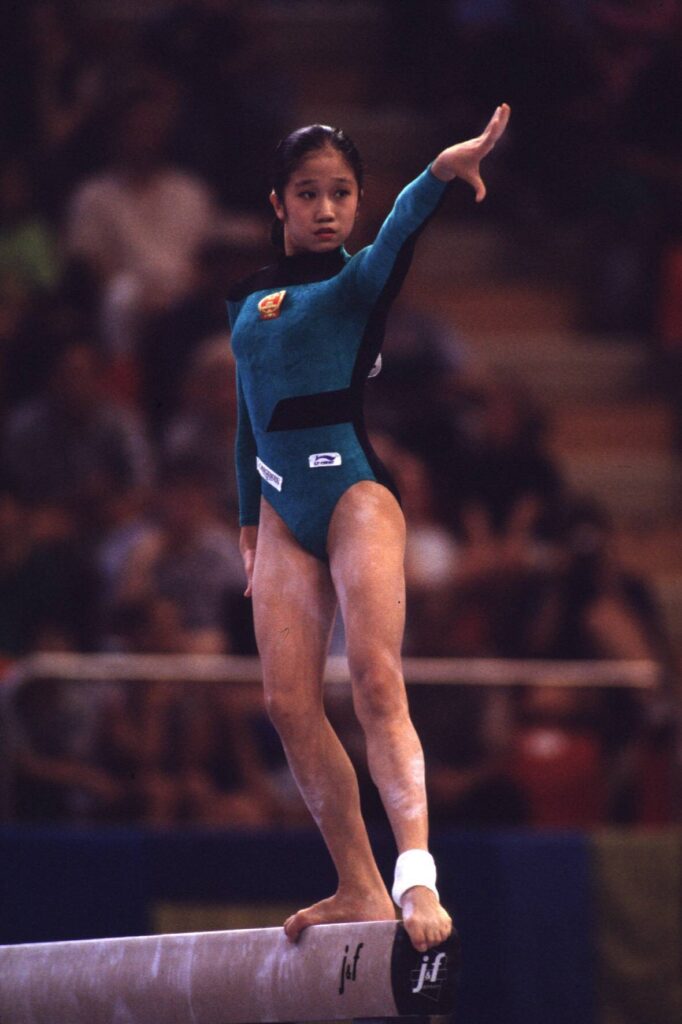
Waltzing to Her Own Tune
Meng Fei tells it like it is and plans to back up her words in Tianjin
BY MARTINE JELLEMA
In Chinese folklore, there is a story of a girl, Meng Jiangnu, whose husband is commissioned to build a part of the Great Wall. The work is tough, and after a period of hardship, he dies. When Meng finds out, she goes to the Wall and cries over her husband’s death so bitterly that a section of the Wall crumbles down.
Meng Fei may not be as weepy as her namesake, but in her own way she has proven to be just as shattering. The way she made her international debut, for instance, is worthy of a place in Chinese mythology. At a 1995 China-U.S.-Belarus tri-meet, Meng skyrocketed to fame by throwing a Gaylord from inverted giants on bars. It was one of the most difficult elements ever seen on the event, and it helped her clinch the silver in her first-ever international competition.
Four years and a growth spurt later, Meng has discarded the skill that made her famous and has matured into one of the world’s top all-arounders. Though she is often overshadowed by teammates Liu Xuan, Bi Wenjing, and Kui Yuanyuan, Meng was in fact China’s most successful participant in the 1997 world championships, quietly claiming fifth all-around, a silver on bars and fourth place on floor exercise.
Clearly, she deserves more attention than she gets, not just because she is China’s most reliable all-arounder (if it weren’t for her low-difficulty vaults, she’d win all-around medals a lot more often), but also because her gymnastics is simply off the wall. Meng’s difficulty-packed bars set includes a sequence of Higgins roll-invert-full-piked Jaeger, as well as a Lu transition from low to high, a Tkatchev and a double layout dismount. On beam she tumbles a flip-flop-layout-layout, an Onodi and a rarely seen front somi-half (called a Grigoras in the Code). Yet it is on floor that she shines brightest. At the ’97 worlds, Meng’s routine was described by a BBC commentator as “a New Year performance from Vienna.” He was referring to Meng’s music (a Strauss-like waltz of the sort performed at the traditional Viennese New Year’s concert, which is shown all over Europe), but he could just as easily have been talking about the exercise itself. Meng’s sumptuously choreographed set was one of the few truly balletic performances on display in Lausanne, and it earned her the praise of all who had complained for years about the lack of artistry in the sport.
Yet there is more to Meng Fei than a handful of gorgeous routines. Even more striking than her gymnastics is her personality. Meng is not a wallflower. She’s loud and lively and can always be counted on to relieve a teammate’s nerves with a joke. A self-confessed prankster, Meng likes “mocking people” and “making noise.” She measures things by their being “a good laugh” or not, and she’s frank enough to admit that gymnastics isn’t always a hoot. “I find gymnastics rather tiresome,” she sighs. “It’s exhausting.”
So exhausting, in fact, that she can’t see herself remaining active in the sport after she retires from competition. “I don’t want to be a coach,” she says derisively. “Coaching is no fun. It’s boring.”
Which is not to say that Meng doesn’t like gymnastics. She may not find much pleasure in the monotonous workouts, but she enjoys performing in front of a crowd and relishes the opportunity it gives her to prove her prowess. She doesn’t worry, though, if things don’t go as expected. “Sometimes my rivals are simply better than I am,” she says. “There are gymnasts out there who are better than I am, and I’m aware of that.”
Another thing Meng likes about being a gymnast is the traveling. Though she doesn’t get to see much of the countries she visits, she doesn’t mind spending time in hotels. “Sometimes hotels are better fun than living at home,” she says. It appears that the Beijing National Training Center doesn’t have much to offer by way of fun. “We have to keep ourselves busy,” Meng claims. “There’s nothing for us to kill time with but TV.” So what do she and best friend Bi Wenjing do after their workouts? “We stay in our room, watch cartoons, make noise, put on some loud music, and dance.”
And they snack. Gymnasts aren’t supposed to eat very much, but Meng is proud to announce that the female gymnasts at the National Training Center have something their male colleagues don’t have: a fridge. Apparently, it is full of snacks. Hmm, what happened to dieting? “We’re not really on a diet,” Meng claims. “They (the men) are. We’re not.”
But that’s the only advantage they have over the men. Meng thinks the women are placed at a disadvantage compared to their male teammates. Her main complaint is that the female gymnasts are babied. “We don’t get the same opportunities that the men get,” she explained at the Brussels Milk Gym Gala. “For instance, last night Zhang Jinjing and the coaches went to a bar to try some Belgian beer. I couldn’t come along; I had to stay in the hotel and watch cartoons. They don’t seem to realize that I’m a grown-up girl. I can drink too!”
The unequal treatment of the men’s and women’s teams is particularly hard to swallow since they don’t train equally hard. According to Meng, the women train harder than the men. “We keep pretty much the same hours, but the intensity of the workouts isn’t the same,” she claims. “Their workouts are more relaxed than ours.” In other words, the women’s team should receive more respect than the men’s team? “I think so. We train harder than they do and we often obtain better results.”
On an individual basis, this appears to be true. From a team point of view, however, the Chinese men have proven more successful than their female colleagues. The men have garnered four world titles; the women have none. Meng expects this situation to change in October at the world championships. “I think the women’s team will take the title in Tianjin,” she predicts. “We’ve never had a better team. If we can’t win this year, we probably never will.”
True, the Chinese have an amazing team. Liu, Kui and Bi are better than ever, and there’s a host of talented juniors waiting in the wings. With all this depth, the question arises as to whether Meng’s place on the Tianjin squad is all that secure. Isn’t it time she made space for a younger teammate?
Meng doesn’t think so. Although she is the first to admit that her younger rivals sometimes out-trick her, she expects her experience to tip the scales in her favor. “To be successful as a team, you need a mixture of experience and big tricks, and I can deliver both.”
And that is not where it ends. Meng doesn’t just expect to be a team member at the 1999 worlds; she expects to be a team leader. “I think Tianjin will see my best individual performance ever,” she predicts. “I hope for good results.”
Obviously, Meng Fei is not ready to go to the wall yet. IG
MENG FEI MIX (sidebar)
BIRTH DATE/PLACE: 3/22/81; Beijing, China
RESIDENCE: Beijing
COACHES: Lu Shanzhen, Liu Qunlin
BEGAN GYMNASTICS: 1985
ROLE MODEL: 1996 Olympic champion Li Xiaoshuang (“he was always reliable, no matter how much pressure he was under”)
FAVORITES: Svetlana Khorkina (gymnast); purple (color); vegetables and chocolate (food – “I hate seafood”); anything fast (music)
BEST FRIEND ON TEAM: Bi Wenjing
RESULTS: ’95 China-USA-Belarus, 2nd AA; ’95 worlds, 2nd team; ’96 China Cup, 1st AA; ’97 worlds, 3rd team, 5th AA, 2nd UB, 4th FX; ’97 nationals, 1st AA (tied with Kui Yuanyuan); ’97 Trophee Massilia, 1st UB; ’98 American Cup, 2nd AA; ’98 Goodwill Games, 4th AA, 4th FX; ’98 Asian Games, 1st team, 2nd BBInternational GYMNAST April 1999
Note #1: While Meng Fei’s birthday is officially registered with the FIG as March 22, 1981, Chinese online encyclopedias often use March 22, 1982 as her birthdate. It is my understanding that she uses 1982 as her birth year in the United States. This would have made her underage at the 1995 World Championships, where the Chinese team took silver, as well as the 1997 World Championships, where she took silver on bars and bronze with her team.

Note #2: Meng Fei was not part of the 1999 team that lost its team bronze medal after the FIG determined that Dong Fangxiao was underage.
Note #3: According to an article in the Southern Weekly, Sang Lan’s injury influenced Meng Fei’s decision to quit the sport.
More on Chinese gymnastics