Categories
1996 Age China WAG World Championships

1996: A Profile of Kui Yuanyuan – “10 Years of Tempering the Blade”

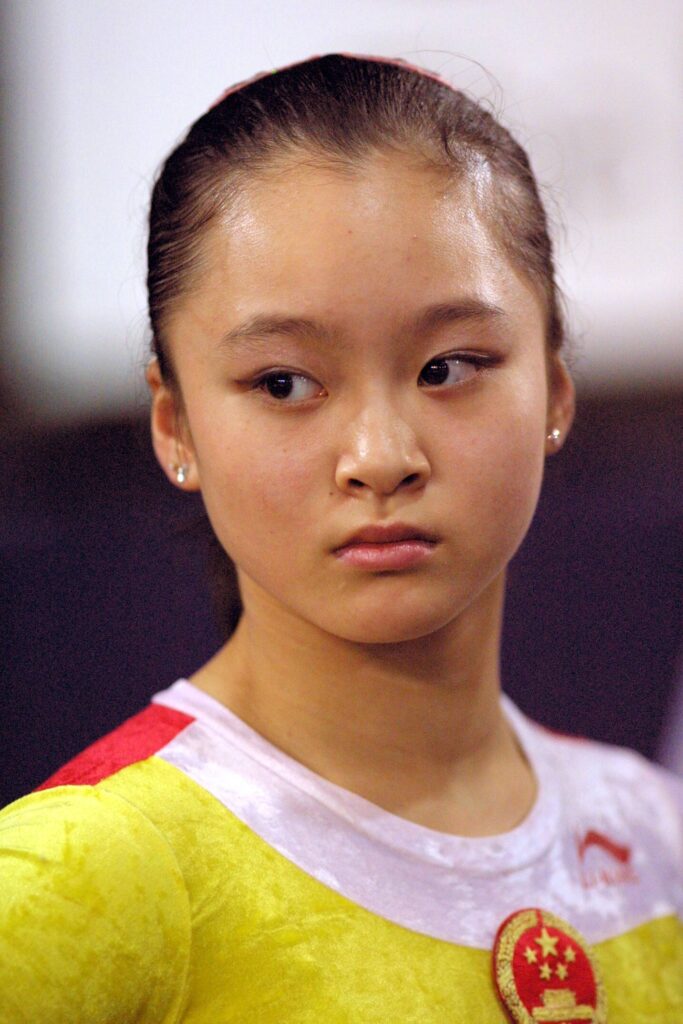
At the 1996 World Gymnastics Championships in San Juan, Puerto Rico, fifteen-year-old Kui Yuanyuan stepped onto the floor exercise as an unlikely candidate for gold. Not considered a core member of China’s women’s team, she had nonetheless turned heads in the semifinals with a second-place finish — and then, in the final, delivered a routine that would define her young career. The following profile, published in People’s Daily on April 22, 1996, captures that remarkable night through the eyes of staff reporter Miao Lu.

Kui Yuanyuan’s San Juan triumph was the beginning of a decorated international career. She would go on to help China claim the team bronze at the 1997 World Championships in Lausanne and earn individual bronze on balance beam at that same competition. She was also a member of the 2000 Olympic team that was stripped of its bronze medal.

But was she really 15 in 1996? The answer—drawn from the People’s Daily itself—is most likely no. Six months after describing her as 15 in San Juan, the same newspaper covered the 1996 National Championships, where Kui won the all-around, and referred to her as “not yet 15.” The contradiction is telling. With her birthday reportedly in June, an athlete who was “not yet 15” in October 1996 could not have been born in 1981. Which means she could not have been 15 at the World Championships in April or the Olympics in July—and could not have been 16 at the 1997 Worlds, either.

But was she still delightful to watch? Yes. So, enjoy these articles and videos of Kui.

Kui Yuanyuan, DTB Pokal, 1997
Categories
1981 Age China WAG

1981: A Profile of Huang Qun – “For the Raising of the Five-Star Red Flag”

In the spring of 1981, People’s Daily ran a glowing profile of Huang Qun, one of China’s most promising young gymnasts. The piece described her as 13 years old — a detail that would later take on significance. If the newspaper was correct, Huang was born in 1968. Yet when she stepped onto the podium at the 1984 Los Angeles Olympics to claim a bronze medal with her team, the official record listed her birth year as 1969. The discrepancy is modest by the standards of Cold War gymnastics, but it is documented in one of China’s own state-run publications, at a moment when there was no reason to misrepresent her age in either direction. The profile below, translated here in full, offers a rare contemporaneous snapshot of Huang Qun at the start of her international career — and another data point in the long history of age falsification in elite gymnastics.

Huang Qun, 1984 Olympics
Categories
2000 Age China WAG

How China Explained the Dong Fangxiao Case

In April 2010, the International Olympic Committee stripped China’s women’s gymnastics team of its bronze medal from the 2000 Sydney Olympics. The decision followed an eight-month investigation by the International Gymnastics Federation (FIG), which concluded that team member Dong Fangxiao had been 14 years old at the Games—two years below the minimum age of 16.

The English-language coverage of the scandal—the discovery of conflicting documents, the investigation, the ruling, and the redistribution of medals—has been extensively documented. Less familiar to English-speaking audiences is how the case unfolded inside China: how state media framed the ruling, how sports officials explained it to the public, and how Chinese journalists and commentators responded.

What emerged was not a single narrative, but a fractured one. Alongside brief, formulaic official statements ran a parallel discussion in China’s press that questioned responsibility, credibility, and the structure of a state-run sports system that governed athletes’ lives long before—and long after—the medal was won.

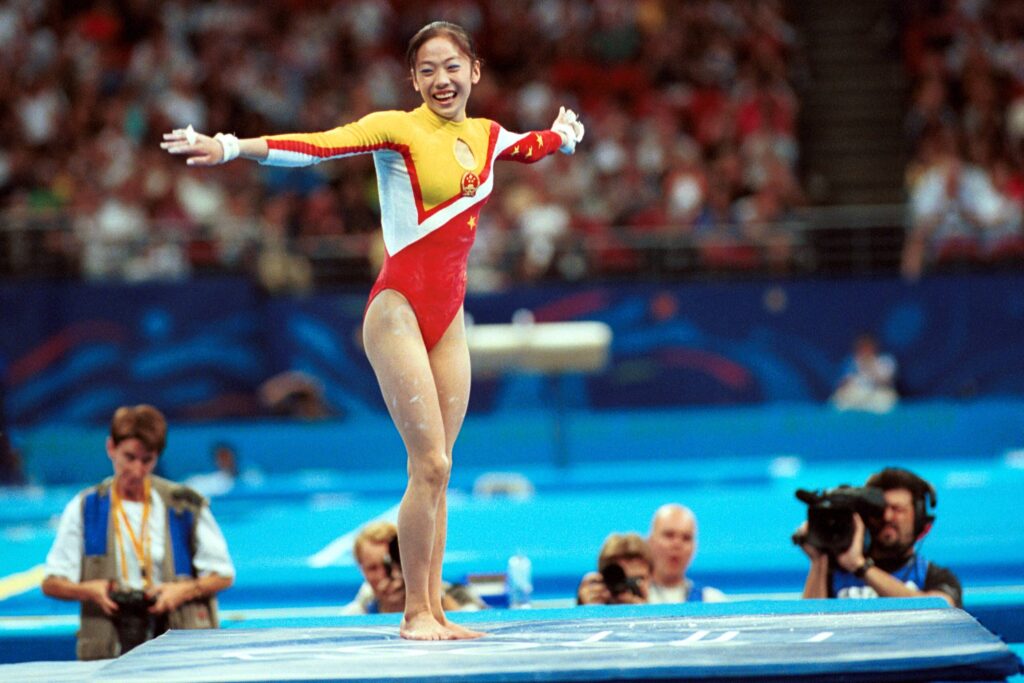
Dong Fangxiao, DTB Pokal, 2000
Categories
Age North Korea WAG

2014: Cha Yeong Hwa and the FIG’s Changing Passport Governance

In September 2014, the International Gymnastics Federation issued a disciplinary notice withdrawing the license of a North Korean gymnast, fining her federation, and annulling her results.

The gymnast was Cha Yeong Hwa (차영화), and once again, the charge was age falsification.

What made the case significant was not the accusation itself—by then, age manipulation was a familiar problem—but how quickly it was detected and how comprehensively it was punished. Compared with earlier North Korean cases, Cha’s discrepancy was smaller. The response was not.

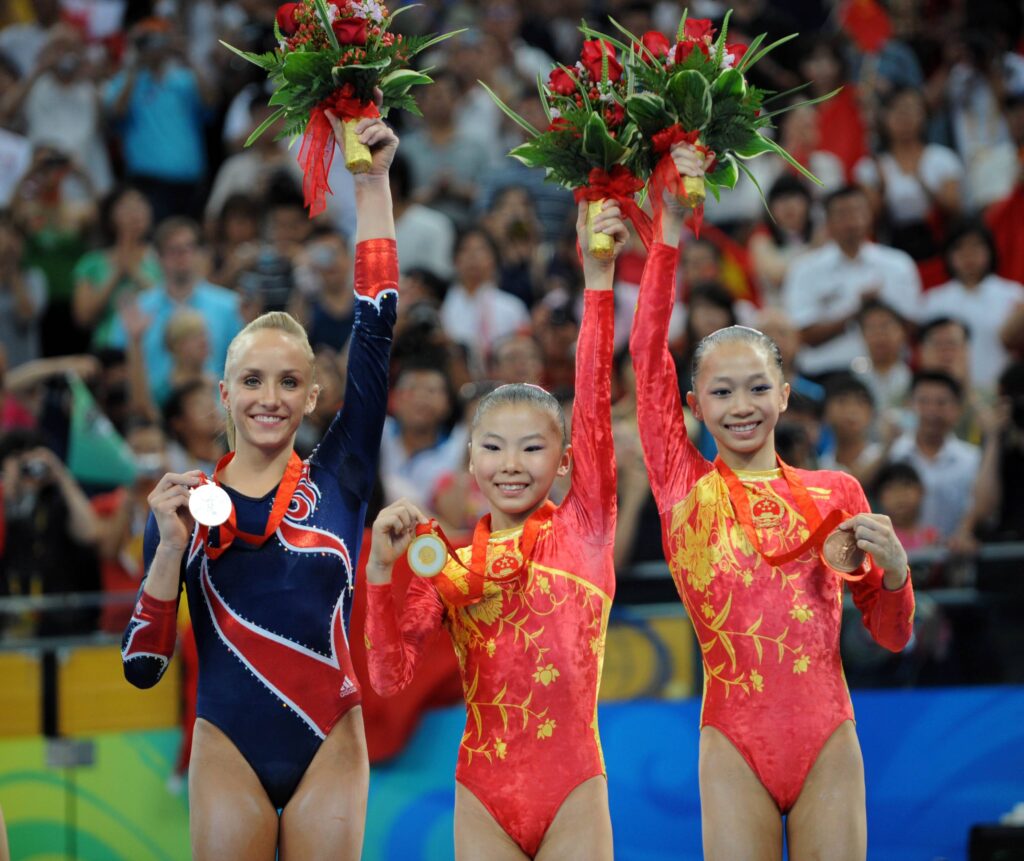
Hong Su Jeong, 1st place; He Ning, 2nd place; Cha Yeong Hwa, 3rd place; Uneven Bars, 2006 Asian Games

Uemura Miki of Japan would eventually take Cha’s third-place spot.
Categories
Age North Korea WAG

The Twin Deception: How North Korea Fooled International Gymnastics for Years

In August 2006, at the Asian Artistic Gymnastics Championships in Surat, India, Hong Su Jeong stood on the vault podium with a silver medal around her neck. The gold went to her younger sister, Hong Eun Jeong—a result that seemed to mark an early challenge to the sibling hierarchy. Four months later, at the Asian Games in Doha, Qatar, the order reversed. Hong Su Jeong again won silver on vault, but that time, she finished ahead of her younger sister, who took bronze.

The results fit neatly into the story that surrounded them. Hong Su Jeong was cast as the elder sister—more experienced, more seasoned—while Hong Eun Jeong, three years younger, was presented as the promising successor rising in her wake. A profile in the Beijing Evening News in 2006 reinforced the contrast, noting that Hong Su Jeong had trained for nine years, while her younger sister had trained for only six.

The story of two sisters competing together was endearing, and over the years, the math was stable, with the sisters always being three years apart.

But it turned out to be false.

Cheng Fei, 1st place; Hong Su Jeong, 2nd place; Hong Eun Jeong, 3rd place; Asian Games, 2006

Note: Throughout this piece, I’ve bolded Hong Su Jeong’s name to help visually differentiate her name from her younger sisters’ name.

Categories
Age North Korea WAG

Kim Gwang Suk: The First Official Case of Age Falsification in Women’s Gymnastics

In early January 1993, the International Gymnastics Federation announced a decision that was unprecedented in the sport’s history: the Democratic People’s Republic of Korea’s women’s gymnastics team would be banned from that year’s World Championships in Birmingham. The reason? The federation had entered Kim Gwang Suk into international competition with three different birthdates—October 5, 1974, at the 1989 World Championships; February 15, 1975, at the 1991 Worlds; and February 15, 1976, at the 1992 Barcelona Olympics.

“This is not a case of doping, and under no circumstances is she guilty,” FIG Secretary General Norbert Bueche told reporters in Geneva. “The dates of birth were deliberately falsified by the association. Such actions cannot be tolerated.”

Kim Gwang Suk’s case marked the first time the FIG had publicly exposed and sanctioned age falsification in elite gymnastics, though the practice was widely suspected to have occurred for years. The case revealed both the lengths to which some federations would go to gain a competitive advantage and the challenges international sports bodies faced in enforcing their own age eligibility rules.

Thirty years after Kim Gwang Suk’s competitive career ended, her life is still a mystery. What survives are fragments: competition reports, newspaper descriptions, brief quotations filtered through translators—almost all produced outside North Korea. This essay follows the traces she left on the international stage between 1989 and 1993, as recorded by foreign journalists and officials, and concludes by examining the narrow but consequential precedent her case set for how the FIG would confront age falsification in the years that followed.

Kim Gwang Suk, 1989
Categories
1981 Age European Championships USSR WAG

Alla Misnik: The 13-Year-Old Doing the Gymnastics of the Future

In April 1981, a gymnast from Kharkov stepped onto the podium at Leningrad’s Yubileiny Sports Palace and won the USSR Cup in artistic gymnastics. Alla Misnik, training under coach Valentin Shumovsky, announced herself as one of Soviet gymnastics’ brightest new talents. Her uneven bars routine featured what Sovetsky Sport called “a magnificent cascade” of elements—a Tkachev, a Jaeger, clear-hip circles with pirouettes, a double-back dismount—forming what one judge described as “a routine of the future.”

A month later, Misnik traveled to Madrid for the 1981 European Championships. There, the Soviet Union’s leading gymnast did not win. She finished third in the all-around behind East Germany’s Maxi Gnauck and Romania’s Cristina Grigoraș, and earned silver medals on uneven bars and floor exercise. For a debut at a major international championship, the results were impressive.

Yet they were results that required explanation in the Soviet press. Why had the Soviet team failed to win a single gold medal? Internationally, the outcome ignited debates about the direction of women’s gymnastics. Was it really a women’s sport anymore?

What went largely unremarked at the time, however, was a more basic fact: Misnik was too young to be competing in Madrid at all.

Misnik on the cover of International Gymnast
Categories
1978 Age Bulgaria World Championships

Thirteen in Strasbourg: Krassimira Toneva at the 1978 World Championships

In October 1978, gymnasts gathered in Strasbourg, France, for the XIX World Artistic Gymnastics Championships. Among the Bulgarian women was Krassimira Toneva, who, like many gymnasts in the sport’s history, was technically too young to be there. She was born in 1965.

Krassmira Toneva, via the Krassmira Toneva Foundation
Categories
1993 Age Netherlands

1993: The Dutch Federation’s Bungled Attempt at Age Falsification

In the summer of 1993, a minor act of deception briefly exposed a much larger truth about international gymnastics. At the European Championships in rhythmic gymnastics, a thirteen-year-old Dutch athlete was entered into competition using a teammate’s passport—an expedient decision made to avoid a poor result, and one that unraveled almost immediately. What followed was not a dramatic scandal, but something quieter and more revealing: admissions of responsibility, careful hedging of language, and a collective effort to keep consequences manageable.

The Dutch press covered the episode in a restrained, procedural tone. Reports in De Telegraaf and NRC Handelsblad detail how officials within the Dutch Gymnastics Federation (KNGB) knowingly circumvented age-eligibility rules, how the European Gymnastics Federation (UEG) investigated the breach, and how blame was diffused among coaches, administrators, and judges. The prose is sober; the facts are clear. Yet beneath this matter-of-fact surface lies a familiar pattern—one that challenges easy assumptions about where and how age manipulation occurs in the sport.

Age falsification in gymnastics is often narrated as an Eastern Bloc pathology: the product of centralized authority, pliable civil registries, and authoritarian sports systems willing to rewrite identity in service of medals. The Dutch case unsettles that narrative. Here was a Western European federation operating within a democratic state, an independent press, and formal oversight mechanisms—yet subject to the same pressures and incentives. Fear of finishing low in the rankings, institutional expectations of success, and the belief that everyone else was bending the rules proved sufficient to justify deliberate deception.

The mechanics of the fraud are themselves instructive. Lacking the ability—or political cover—to alter official documents, Dutch officials resorted to substitution rather than fabrication: entering an underage gymnast under another athlete’s passport and trusting that inspections would be cursory. This was not naïveté but pragmatism shaped by structural constraint. It reveals how rule-bending adapts to local conditions, even as its underlying logic remains constant.

Equally telling is the response from governing bodies. Despite explicit admissions that fraud had occurred, there was little appetite within the European Union of Gymnastics (UEG) for severe punishment. Officials emphasized their own inspection failures, spoke of shared responsibility, and repeatedly downplayed the likelihood of a suspension. The prevailing tone was conciliatory rather than corrective—a preference for containment over confrontation. Read together, these articles illuminate a sport in which age manipulation was widely understood, unevenly enforced, and, so long as it avoided public embarrassment, often met with indulgence rather than meaningful consequence.

Categories
Age China Interviews & Profiles WAG

1986: A Profile of Chen Cuiting – “Like a Spring Swallow Arriving Gracefully”

In 1986 and 1987, Chinese media presented Chen Cuiting as a gymnast perfectly timed for inheritance: the nation’s elegant answer to Romania’s Daniela Silivaș. Reporting from the Seoul Asian Games, a People’s Daily correspondent lingered on her “spring swallow” lightness, praising the ease with which she carried herself to the all-around title. Both that article and a subsequent China Pictorial profile placed her age at fifteen—young, but properly arrived.

The China Pictorial piece, published in February 1987, filled in the arc behind the moment. Born on July 15, 1971, in Changsha, Hunan, Chen had risen from a raw “tumblebug”—a nickname earned for her explosive tumbling—into a national champion who, as the magazine put it, had learned to “smile spontaneously to the music.” It was a familiar story of discipline refined into artistry, told at precisely the point when promise seemed to be turning into permanence.

From today’s vantage point, however, that narrative no longer sits so easily. Across both Chinese- and English-language websites, Chen’s birthdate now appears as November 15, 1972. If accurate, she would have been only thirteen, turning fourteen, during the 1986 season—below the minimum age of fifteen required for senior international competition. The confident certainties of the mid-1980s press thus coexist uneasily with a digital record that rewrites the calendar.

Whatever the truth of her age, Chen Cuiting’s competitive record is unmistakable. She dominated Chinese women’s gymnastics through the late 1980s, breaking out internationally at the 1986 Asian Games with team gold, all-around gold, floor gold, and vault silver. She remained the country’s leading all-arounder at home, winning the title at the 1987 National Games and the 1988 National Championships. Though her Seoul Olympics yielded no individual medals—fourteenth in the all-around, sixth with the team—she rebounded at the 1989 World Championships with team bronze and top-six finishes in the all-around, beam, and floor. Her career closed where it had begun to crest: at the 1990 Asian Games in Beijing, she again swept gold in the team, all-around, and floor, adding another vault silver before retiring. In just five years, she anchored the national team through a transitional era, her dominance unquestioned even as the story told about her grew more complicated.

Chen Cuiting, 1986, Goodwill Games