When Sui Lu finished second on balance beam at the 2012 Olympics, she was widely described as a 20-year-old. For example, Jiefang Daily, one of Shanghai’s leading newspapers, wrote:
At age 20, a female gymnast must overcome even more obstacles. Sui Lu’s performances at these Olympics had already proven her ability.
In 2008, Mike Walker, a cybersecurity specialist, uncovered cached spreadsheets from the Chinese government’s official sports website. At the time, attention centered on He Kexin and the birthdate listed in those documents: January 1, 1994. But she was not the only gymnast whose age shifted over time. Huang Qiushuang’s birthdate did as well. In fact, those same documents show her age changing.
But there is another wrinkle: Huang Qiushuang may have been even younger than the dates listed in those spreadsheets. At least, that was the view of some Chinese journalists.
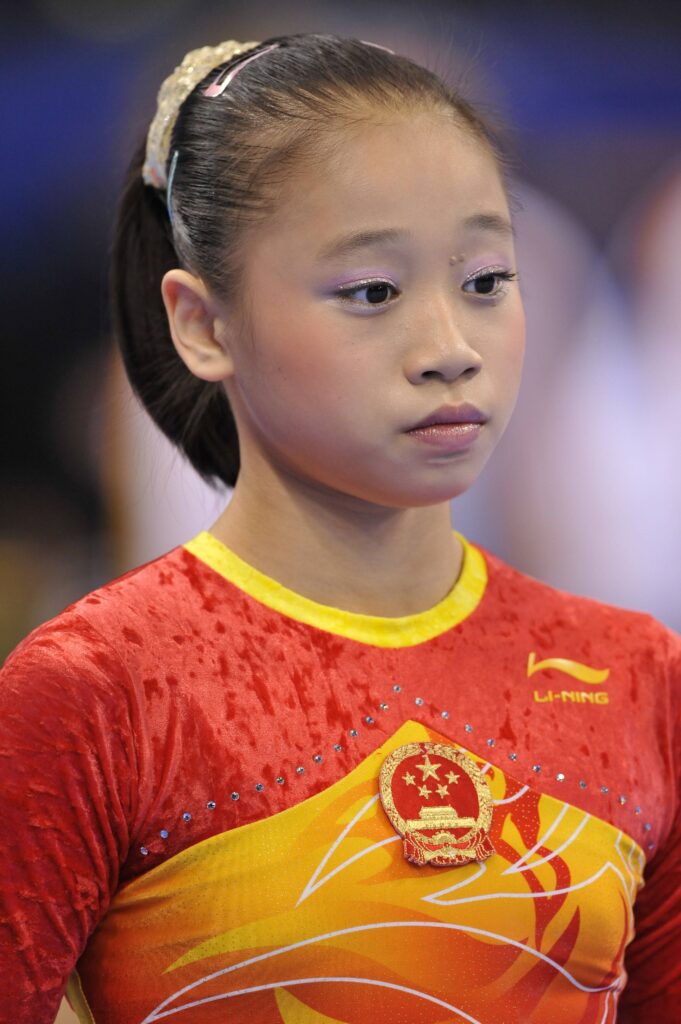
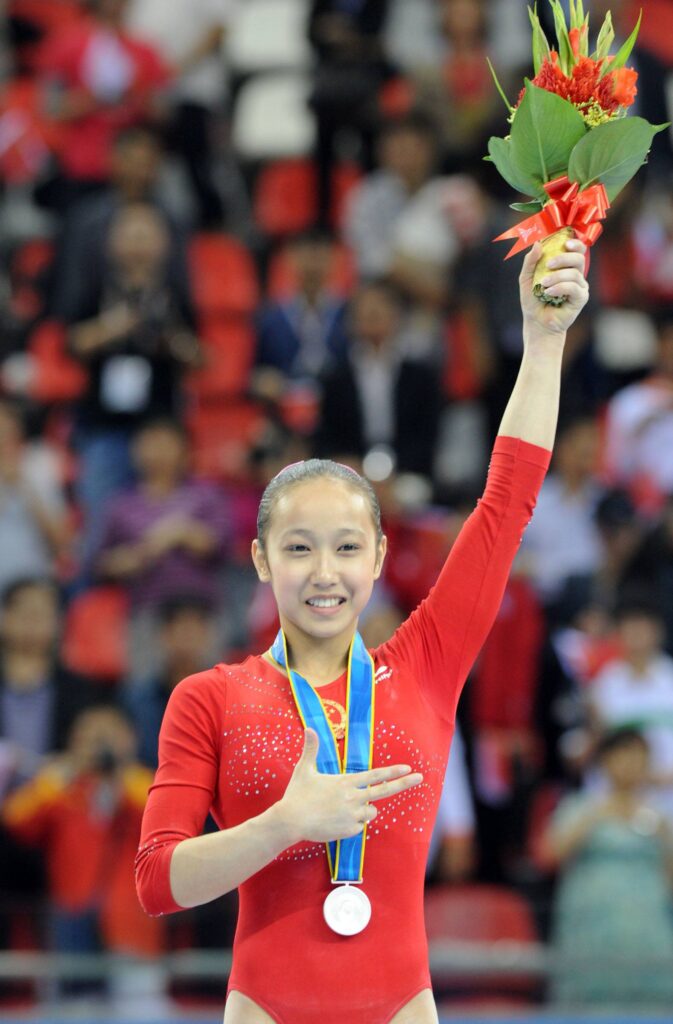
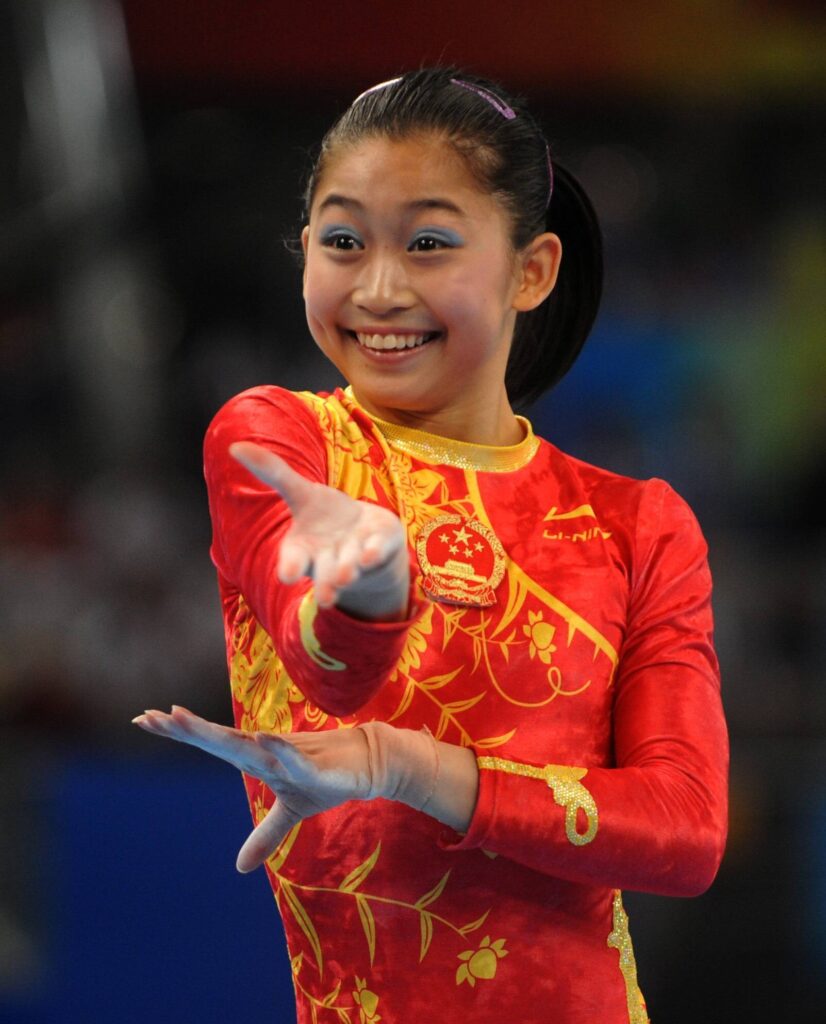
Huang Qiushuang, 2010 Asian Games, November 17, 2010
In 2011, in the wake of Dong Fangxiao’s verdict and amid a skating age scandal, Chinese journalists wrote openly about the problem of age falsification in sport. Even the China Youth Daily addressed the issue, underscoring just how messy age adjustments could be:
In Chinese sport, athletes falsifying their ages has long been an open secret. This reporter has frequently encountered a revealing phenomenon when interviewing athletes: ask them how old they are, and they often have to think for a long time, sometimes even consulting teammates before answering — because some athletes have changed their ages not once but multiple times, and have lost track of their own versions.
The China Youth Daily is the official newspaper of the Central Committee of the Communist Youth League of China.
Though the article did not mention Jiang Yuyuan, her case illustrates the phenomenon clearly. Depending on the document consulted, she appears to have been born in 1993, 1992, or 1991.
The question was simple enough: how old was He Kexin?
It was the question that defined women’s gymnastics at the 2008 Beijing Olympics, shadowed China’s historic team gold, and resurfaced repeatedly in the years that followed. But embedded within it was a second, harder question: why had this become an issue in the first place?
In the West, the conventional answer pointed first to the Chinese state — a system that had been suspected of age falsification, and that controlled the bureaucratic infrastructure of sport: passports, identity cards, and national registration systems. A second answer pointed to the American press, which had built an international controversy out of cached web pages, newspaper articles, and the appearances of a teenage athlete.
But in Chinese-language media coverage of the controversy, a third explanation appeared. It pointed not to Beijing and not to U.S. journalists, but to one of the most famous coaching partnerships in gymnastics history: Béla and Márta Károlyi.
In that telling, the Károlyis were not neutral observers of the controversy. They were among its principal drivers.
Gymnastics coach Bela Karolyi speaks during a 2014 news conference in Arlington, Texas.
The story of He Kexin’s age has been told many times, but nearly always from the same vantage point. Western readers know the New York Times investigation, the deleted spreadsheets, and Béla Károlyi’s comments about baby teeth. What they do not know — because almost none of it has been translated or discussed in English — is how Chinese mainland media told the same story.
This essay traces that mainland narrative across a single year, from the first stray press mentions of He Kexin’s age in late 2007 through the International Gymnastics Federation’s formal resolution of the controversy in October 2008. It is not, primarily, a story about whether she was 14 or 16. It is a story about how the same events, covered by journalists working under different constraints and writing for different audiences, can produce such divergent accounts.
Nastia Liukin, He Kexin, and Yang Yilin, 2008 Olympics, Copyright: imago/Xinhua
Yang Yun was fifteen years old—officially—when she competed at the 2000 Sydney Olympics. Her registered birthdate, December 2, 1984, meant she turned sixteen in the Olympic year, clearing the minimum age requirement set by the International Gymnastics Federation in 1997. She won bronze medals in both the team event and on uneven bars.
In 2001, she competed in the Goodwill Games, but ultimately, the Sydney Olympics were her first and last major competition. After retiring, she enrolled at the Communication University of China to train as a broadcaster. By 2008, she had established herself as a sports commentator and was engaged to Yang Wei, who would go on to win the men’s all-around champion in Beijing.
In the months leading up to the Beijing Olympics, Yang Yun was cast as a supporting figure in a love story, not the subject of scrutiny.
In November 2001, at China’s Ninth National Games, a small gymnast from Beijing captured the country’s attention. Newspapers called her “Kang Douzi”—“Little Bean Kang”—and, almost without exception, they described her the same way: just thirteen years old. She cried after a costly fall on uneven bars that may have cost her team the gold. Days later, she rebounded to win the all-around title, throwing herself into her coach’s arms, still unmistakably a child on one of the biggest stages in Chinese sport.
And yet, within a year, that same gymnast had changed. By 2002, Kang Xin was no longer thirteen. According to her official profile, she was sixteen—old enough to compete internationally, old enough to stand alongside China’s senior team at the Asian Games.
How does a gymnast age three years in the span of one?
Kang Xin, Date: 22.11.2002, Copyright: imago/Schreyer
When Sun Xiaojiao won bronze on balance beam at the 2001 World Championships, she turned 17 that year, according to the FIG’s records. A year later, when she took gold at the 2002 World Cup Final, she turned 18.
But here’s the thing: Sun Xiaojiao was not born in 1984.
Sun Xiaojiao, Date: 25.11.2001 Copyright: imago/Schreyer
Ling Jie, like many Chinese gymnasts, was a standout on uneven bars and balance beam, and like many other Chinese bars and beam queens, her age appears to have been adjusted. In her case, her birth year was moved backward to 1982, making her eligible to compete at the 1998 Asian Games in Bangkok, where the Chinese women won team gold.
Even during her competitive career, there were indications that Ling Jie had both a registered “competition age” and an “actual age” (实际年龄). What, precisely, her “actual age” is remains a matter of debate. Today, Ling Jie lives in the United States, where she coaches at World Champions Centre—the Biles family’s gym—and uses one birth year; yet in the coverage of the Sydney Games, the Chinese press circulated another.
This article does not attempt to resolve the question of her true birth year. What is clear, however, is that she was not born in 1982 and therefore was not 16 at the 1998 Asian Games.
Below, you can find what has been printed about her age, as well as several profiles about the 1999 beam champion.
Gold medal winner Svetlana Khorkina of Russia (C) stands with Ling Jie of China (L) and Yang Yun of China (R), 24 September 2000 following their uneven bars routine in the women’s apparatus finals at the Sydney 2000 Olympic Games. (Photo by WILLIAM WEST/AFP via Getty Images)